


Key Takeaways
Your partner isn't wrong — they're from a different planet
Gray's central thesis is disarmingly simple: most relationship conflict stems not from lack of love but from expecting your partner to be a flawed version of you. Men and women have different stress responses, communication styles, emotional cycles, and love needs — not because one gender is broken, but because they metaphorically developed on different planets.
When she complains about her day, she doesn't want solutions — she wants empathy. When he goes quiet, he isn't punishing her — he's processing. Gray counseled over 25,000 people and found the same pattern: women say "He doesn't listen" while men say "Nothing I do is enough." Both are loving; neither understands the other's language. Remembering the Mars/Venus difference turns blame into curiosity.
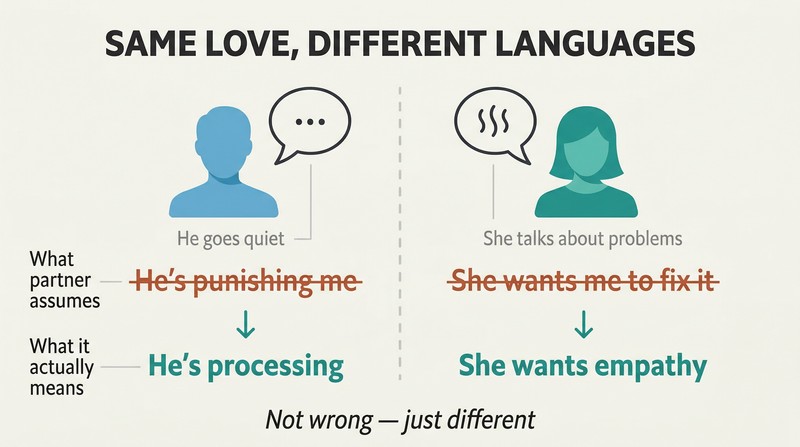
When she talks about problems, shut down Mr. Fix-It and just listen
The most common mistake men make is offering solutions when women want empathy — what Gray calls being "Mr. Fix-It." When Mary said "There's so much to do," Tom fired off fixes: quit your job, don't worry about it. Each solution made her feel more unheard. The corrected version? Tom takes a breath, says "Sounds like you had a hard day," and listens. After a few minutes she feels better — not because anything was solved, but because she was heard.
Women's parallel mistake is the "Home-Improvement Committee" — offering unsolicited advice that makes a man feel incompetent. When a woman told lost-while-driving Tom to call for directions, he heard "I don't trust you." Both mistakes have the same root: giving the love you'd want, not the love they need.
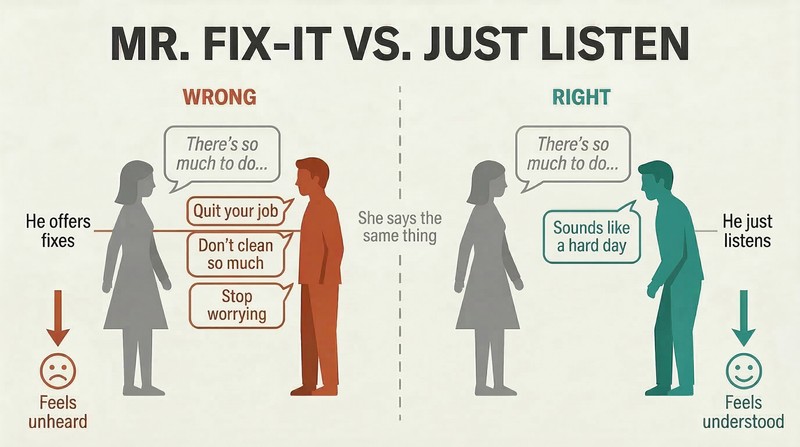
Give a stressed man his cave — he'll emerge when he's ready
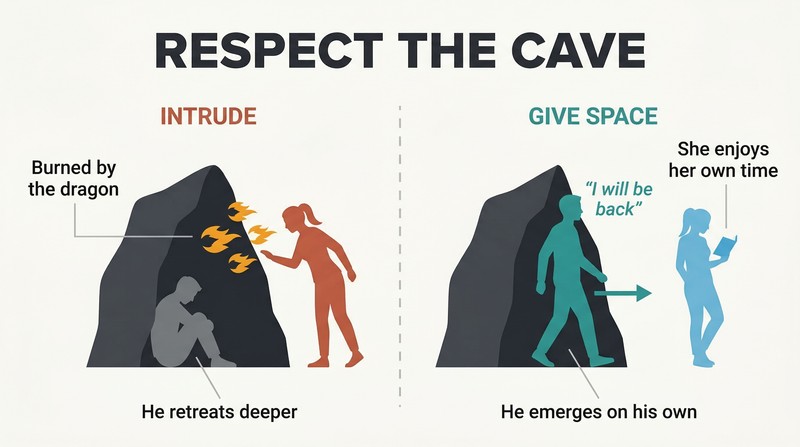
Men process stress through withdrawal. When overwhelmed, a man retreats into his metaphorical "cave" — reading news, watching sports, going silent. He's not ignoring her; only 5% of his awareness is available while the other 95% wrestles with problems. Asking "What's wrong?" only pushes him deeper.
Six ways to support him in his cave:
1. Don't disapprove of his need to withdraw
2. Don't offer solutions or nurturing questions
3. Don't sit outside the door waiting
4. Don't worry or feel sorry for him
5. Do something enjoyable for yourself
6. Trust that he will come back
The magic words he can offer as he retreats: "I need some time to think about this. I will be back." Those four final words — "I will be back" — prevent her from spiraling into fear of abandonment.
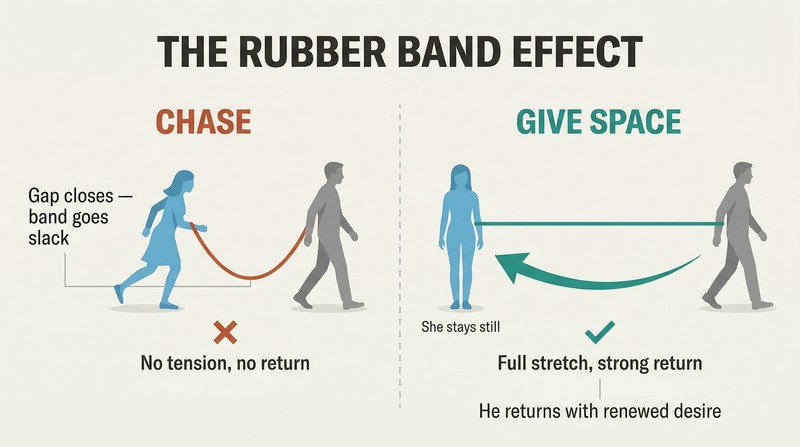
Men pull away like rubber bands — chasing only delays the snap-back
Gray's rubber band metaphor describes the male intimacy cycle: a man gets close, then pulls away to reestablish independence, then springs back with renewed desire. Maggie nearly lost Jeff because every time he pulled away, she panicked and chased — preventing the rubber band from stretching its full distance and snapping back. Once she gave him space, Jeff returned more loving than before.
Two behaviors obstruct this cycle:
1. Chasing (following physically, interrogating emotionally, guilt-tripping)
2. Punishing (coldness, rejection, or withholding affection when he returns)
A woman who understands this cycle stops taking his distance personally. Crucially, when a man springs back, he picks up intimacy right where he left off — but she may need conversation time to reconnect. Both sides must respect this asymmetry.
When her mood crashes like a wave, be present — don't rescue
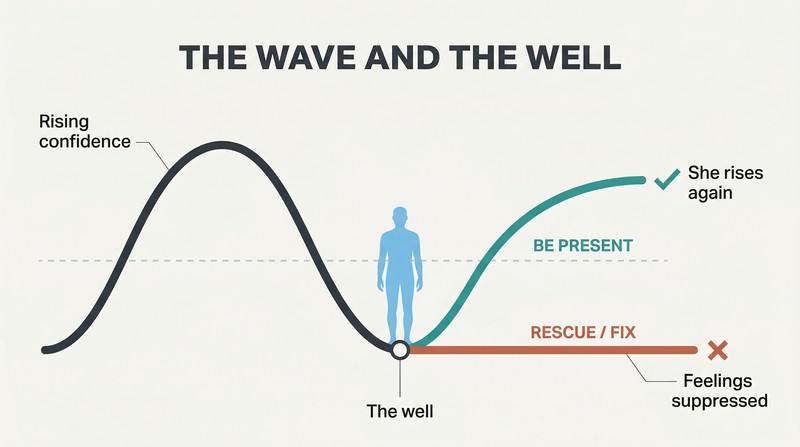
A woman's self-esteem cycles like a wave, rising on love and confidence before crashing into what Gray calls "the well" — a period of emotional housecleaning where suppressed feelings surface. Bill tried to fix Mary's crashes by explaining why she shouldn't be upset. This only made things worse. The counterintuitive truth: when a man listens supportively, she may initially feel worse — sinking deeper before she can rise. That's a sign his support is working, not failing.
Even wealth can't prevent the wave. Chris couldn't understand why rich Pam still got upset. Gray's point: money satisfies financial needs but exposes emotional ones. A woman's self-esteem cycle averages roughly 21 – 35 days. A man's job isn't to prevent the crash — it's to be present when she hits bottom so she feels safe rising again.
'We never go out' is a feeling, not a court deposition
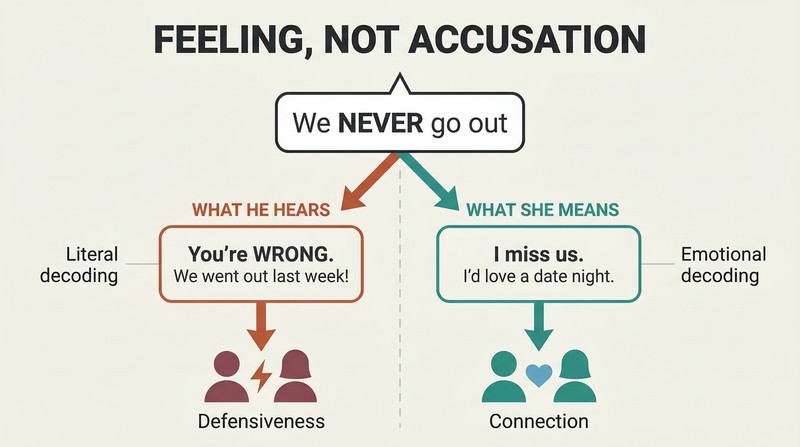
Women speak in emotional truths; men hear literal accusations. When she says "We NEVER go out," she means "I'd love a date night — I miss us." He hears a factual claim and counters: "That's not true — we went out last week." Now she feels invalidated AND still unheard. Gray's Venusian/Martian Phrase Dictionary translates ten such complaints: "Everyone ignores me" really means "I'm feeling invisible today — would you tell me I'm special?" "Nothing is working" means "I'm overwhelmed — would you give me a hug?"
The reverse problem: when a man says "I'm fine" or "It's nothing," women hear rejection. He actually means "I'm handling this alone — please trust me." Both genders need a translator, not a lawyer.
Redirect from one grand gesture to dozens of small daily ones
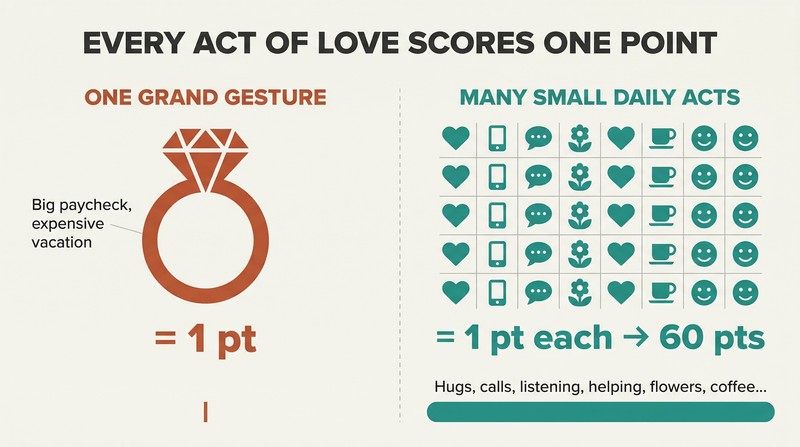
Men's scoring math is catastrophically wrong. Chuck, a successful doctor, thought his hefty paycheck scored 30 – 60 points monthly. To his wife Pam, it scored exactly one — while she racked up 60 points cooking, cleaning, and managing their life. He couldn't understand her unhappiness because his ledger said "even."
A woman's love tank works like a gas tank: it needs frequent refilling with many small deposits. Gray lists 101 small acts — from giving four hugs a day to calling from work just to say "I love you" to turning off the TV when she talks — each scoring a full point. One expensive vacation cannot substitute for months of daily attention. When Gray stopped seeing his eighth therapy client and came home an hour early to his wife instead, his marriage and career both flourished.
Stop trying to improve him — acceptance is what actually changes men
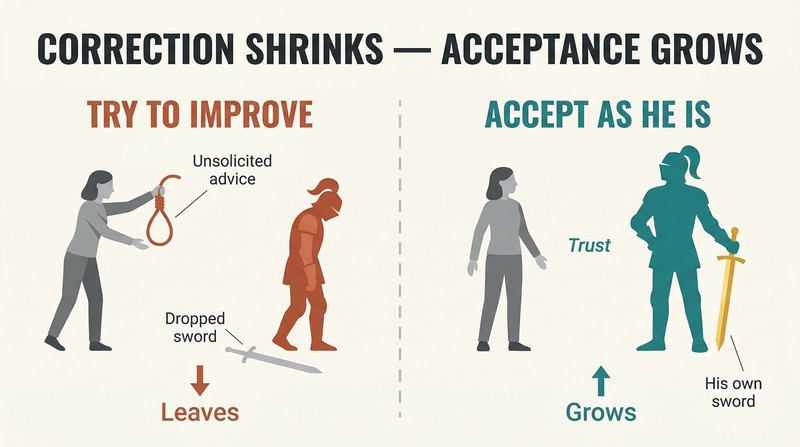
Gray illustrates this with a knight in shining armor who slays dragons with his sword. His princess offers a noose instead, then poison. Each time, the knight hesitates, loses confidence, and eventually leaves for a village where no one second-guesses his weapon. Unsolicited advice tells a man he's broken. His competence is central to his identity — correction registers as "you're not good enough."
The paradox: a man who feels trusted is far more likely to ask for feedback and change on his own. Men have six primary love needs — trust, acceptance, appreciation, admiration, approval, and encouragement. Women primarily need caring, understanding, respect, devotion, validation, and reassurance. Partners instinctively give the love THEY want to receive rather than what the other gender needs — which is why love fails despite good intentions.
Most fights follow one script: he invalidates, she disapproves
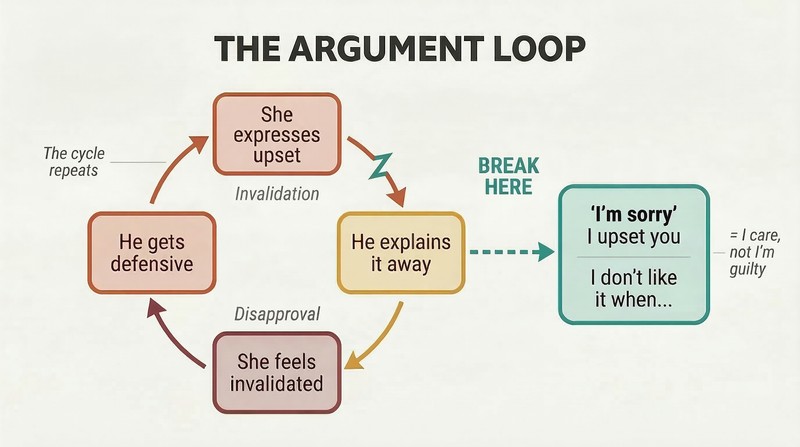
The anatomy of every argument follows a predictable pattern: she expresses upset about "XYZ," he explains why she shouldn't be upset, she feels invalidated and escalates, he feels her disapproval and gets defensive, then he expects an apology. Gray realized this watching his own marriage: his wife Bonnie asked, "Sometimes I would like YOU to tell ME you're sorry for upsetting me." He saw the logic immediately.
The surgical fix: he learns to say "I'm sorry I upset you" before explaining himself — on Venus, "I'm sorry" means "I care," not "I'm guilty." She learns to state feelings directly ("I don't like it when you're late") instead of through rhetorical questions ("How could you be so late?") — which men decode as pure disapproval. Arguments survive when both partners feel unloved, not when they disagree.
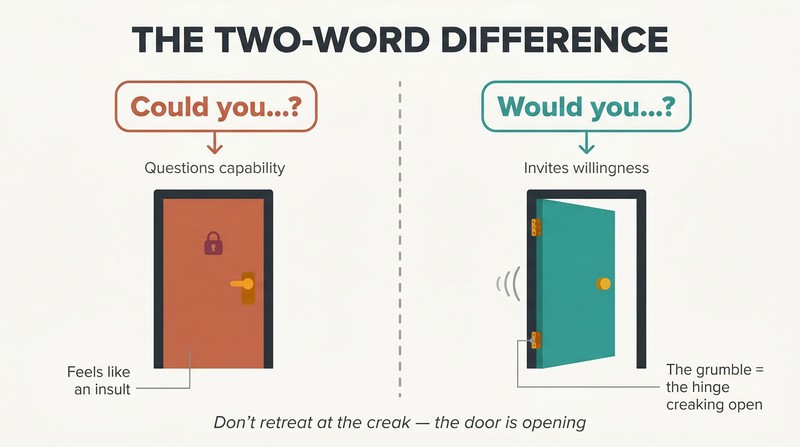
Say 'would you' not 'could you' — then outlast the grumbles
Word choice transforms compliance. "Could you empty the trash?" questions a man's capability — an insult on Mars. "Would you empty the trash?" asks for willingness — an invitation to be heroic. Seventeen men in Gray's seminars confirmed this distinction viscerally. One said: "When I hear 'would you,' I begin making a decision and I am willing to be supportive."
Three steps for getting support:
1. Practice asking for what he already gives — retrain the dynamic with low stakes
2. Ask for more and accept "no" gracefully — build his willingness over time
3. Use assertive asking: make your request and pause silently
The "pregnant pause" is critical. When he grumbles, groans, or scowls, don't argue or retreat. His groaning is the sound of a rusty hinge opening — the sound of him stretching toward yes.
Analysis
Gray's 1992 framework endures not because it is scientifically rigorous — it isn't, and he acknowledges relying on clinical observation over controlled research — but because it names patterns that millions of people instantly recognize. The book's genius is taxonomic: by labeling the cave, the wave, and the rubber band, Gray gave couples a shared vocabulary that depersonalizes conflict. When she can say 'you're in your cave' instead of 'you don't love me,' the emotional temperature drops immediately.
From a modern psychology perspective, many of Gray's observations align with attachment theory (anxious partners chase, avoidant partners withdraw) and Gottman's research on the 'Four Horsemen' of relationship dysfunction — particularly contempt and stonewalling. His insight that arguments escalate through invalidation and disapproval anticipates Gottman's finding that a 5:1 ratio of positive to negative interactions predicts marital stability. The Love Letter Technique mirrors expressive writing research by James Pennebaker showing that structured emotional disclosure reduces psychological distress.
The book's primary limitation is its gender essentialism. Gray treats Mars and Venus as near-universal categories, acknowledging only briefly that about 10% of women may identify more with Martian traits. Contemporary research on within-gender variation suggests the overlap between men's and women's communication styles far exceeds the differences between group averages. The risk is that readers weaponize the framework: 'I don't have to listen because I'm from Mars.' Gray himself warns against this misuse in his introduction but underestimates how easily metaphors calcify into excuses.
Nevertheless, the book's core operating principle — adjust your approach rather than demanding your partner change — remains among the most practical advice in relationship literature. Whether the differences are gendered, temperamental, or attachment-based, the skill of translating your partner's behavior charitably rather than literally is universally applicable.
Review Summary
The book has polarized readers, with some praising its insights and others criticizing its stereotypical approach. Supporters find it helpful in understanding gender differences and improving communication. Critics argue it oversimplifies complex human behavior and promotes outdated gender roles. Some readers appreciate the practical advice, while others feel it lacks scientific backing. Overall, the book's effectiveness seems to depend on individual perspectives and willingness to apply its concepts.
People Also Read






Glossary
Mr. Fix-It
Man's instinct to offer solutionsGray's label for the male tendency to respond to a woman's expression of feelings by immediately offering practical solutions. On Mars, talking about problems is an invitation for advice. Men don't realize that on Venus, a woman shares problems to feel heard and emotionally connected—not to receive a fix.
Home-Improvement Committee
Woman's instinct to improve her partnerGray's label for the female tendency to offer unsolicited advice, suggestions, and constructive criticism to help a man 'grow.' On Venus, pointing out what can be improved is an act of caring. Men, however, interpret it as a message that they are broken and incompetent, which undermines trust.
The Cave
Man's mental retreat under stressGray's metaphor for how men cope with stress by withdrawing into silent, solitary problem-solving. A man in his cave becomes distant, forgetful, and unresponsive—not because he doesn't care, but because 95% of his mind is focused on resolving an issue. The cave is protected by a 'dragon'—meaning anyone who intrudes will provoke an angry reaction.
Rubber Band
Male intimacy cycle metaphorGray's metaphor for the male intimacy cycle in which a man gets emotionally close, then instinctively pulls away to fulfill his need for autonomy, before springing back with renewed desire for connection. Like a rubber band stretched to its limit, once he reaches maximum distance, he naturally returns with energy and passion.
The Wave
Female emotional cycle metaphorGray's metaphor for how a woman's self-esteem and emotional well-being rise and fall in a rhythmic cycle averaging 21–35 days. At the peak she feels abundant and loving; at the crash she descends into 'the well'—a period of emotional housecleaning where suppressed negative feelings surface to be processed and healed.
Emotional Housecleaning
Periodic surfacing of suppressed feelingsThe process that occurs when a woman's wave crashes and she descends into her well. Previously suppressed negative feelings—disappointments, resentments, fears—rise to the surface. This is a natural, healthy process that requires a supportive listener rather than someone attempting to fix or prevent it. Blocking this process suppresses positive feelings alongside negative ones.
Love Letter Technique
Structured emotional writing processA writing exercise where you address a letter to your partner moving through five emotional layers in order: anger, sadness, fear, regret, and love. The structure ensures you process the complete truth of your feelings rather than getting stuck in one emotion. It can be shared or kept private, and is followed by a Response Letter—a note you write to yourself expressing what you wish your partner would say in return.
Venusian/Martian Phrase Dictionary
Translation guide for gendered expressionsGray's framework for translating common expressions that are routinely misunderstood between genders. For example, when a woman says 'We never go out,' the dictionary translates the emotional meaning ('I'd love to spend time together') and reveals the hidden request for support, distinguishing it from the literal accusation a man might hear.
90/10 Principle
Most upset is from the pastGray's principle that when we are upset with our partner, approximately 90% of the emotional charge relates to unresolved feelings from our past (childhood, previous relationships) and only about 10% is appropriate to the present situation. Past pain gets projected onto current circumstances, making small irritations feel like major wounds.
The Grumbles
Man's resistance before agreeing to helpGray's term for the moaning, groaning, scowling, and mumbling a man typically does when asked to shift direction and fulfill a request. Contrary to how women interpret it, grumbling is not refusal—it signals that he is in the process of considering the request and stretching toward yes. Silence from the requester during this process increases the likelihood he will agree.
Pregnant Pause
Strategic silence after making a requestA technique in Gray's assertive asking method where, after making a clear request using 'would you' language, the woman remains completely silent and allows the man to grumble through his resistance. Breaking the silence with justifications, guilt, or withdrawal forfeits the power of the request and reduces the chance of a positive response.
FAQ
What's "Men Are from Mars, Women Are from Venus" about?
- Understanding Gender Differences: John Gray's book explores the psychological differences between men and women, likening them to being from different planets—Mars and Venus.
- Communication and Relationships: It delves into how these differences affect communication and relationships, offering strategies to improve understanding and cooperation.
- Improving Relationships: The book aims to help couples enrich their relationships by recognizing and respecting these differences.
Why should I read "Men Are from Mars, Women Are from Venus"?
- Enhance Relationship Skills: The book provides insights into understanding your partner's needs and behaviors, which can improve relationship skills.
- Resolve Conflicts: It offers practical advice on resolving conflicts and avoiding misunderstandings that arise from gender differences.
- Personal Growth: The insights can lead to personal growth by fostering tolerance, acceptance, and better communication with the opposite sex.
What are the key takeaways of "Men Are from Mars, Women Are from Venus"?
- Different Emotional Needs: Men and women have different primary emotional needs, which must be understood and respected for a relationship to thrive.
- Communication Styles: Recognizing the different communication styles of men and women can prevent conflicts and improve intimacy.
- Natural Cycles: Understanding the natural cycles of intimacy and independence in men and emotional waves in women can help partners support each other better.
What is the "rubber band" concept in "Men Are from Mars, Women Are from Venus"?
- Men's Need for Autonomy: The "rubber band" concept describes a man's natural cycle of getting close, pulling away, and then returning to intimacy.
- Not Personal: This pulling away is not a reflection of a man's feelings for his partner but a need for independence and self-reconnection.
- Supportive Response: Women are encouraged to give men space during this time, trusting that they will return with renewed love and commitment.
What does the "wave" metaphor mean in "Men Are from Mars, Women Are from Venus"?
- Women's Emotional Cycles: The "wave" metaphor illustrates how a woman's self-esteem and emotional state rise and fall like a wave.
- Emotional Housecleaning: When a woman's wave crashes, it is a time for emotional housecleaning, where she needs support and understanding.
- Supportive Listening: Men are advised to listen and offer empathy during these times, helping women to feel loved and supported.
How can understanding these concepts from "Men Are from Mars, Women Are from Venus" improve my relationship?
- Better Communication: By understanding these concepts, partners can communicate more effectively, reducing misunderstandings and conflicts.
- Increased Empathy: Recognizing each other's natural cycles fosters empathy and patience, allowing partners to support each other better.
- Stronger Connection: These insights can lead to a stronger emotional connection and a more fulfilling relationship.
What are the primary emotional needs of men and women according to "Men Are from Mars, Women Are from Venus"?
- Men's Needs: Men primarily need trust, acceptance, appreciation, admiration, approval, and encouragement.
- Women's Needs: Women primarily need caring, understanding, respect, devotion, validation, and reassurance.
- Reciprocal Nature: Fulfilling these needs in each other creates a reciprocal cycle of love and support.
How does the Love Letter Technique work in "Men Are from Mars, Women Are from Venus"?
- Expressing Feelings: The Love Letter Technique involves writing a letter to express feelings of anger, sadness, fear, regret, and love.
- Structured Approach: The technique is structured to ensure all emotions are addressed, allowing for a more balanced and less confrontational conversation.
- Healing and Understanding: By writing and sharing these letters, partners can better understand each other's feelings, leading to healing and improved communication.
What are some common mistakes women make in relationships, according to "Men Are from Mars, Women Are from Venus"?
- Unsolicited Advice: Women often offer unsolicited advice, which can make men feel mistrusted and unloved.
- Indirect Communication: Women may communicate indirectly, expecting men to read between the lines, which can lead to misunderstandings.
- Over-Responsibility: Women might take on too much responsibility, leading to resentment and burnout, instead of asking for support.
What are some common mistakes men make in relationships, according to "Men Are from Mars, Women Are from Venus"?
- Not Listening: Men often fail to listen attentively, which makes women feel unloved and unimportant.
- Offering Solutions: Men tend to offer solutions instead of empathizing with a woman's feelings, which can be perceived as dismissive.
- Minimizing Feelings: Men may minimize the importance of a woman's feelings, leading to a lack of emotional connection and support.
How does "Men Are from Mars, Women Are from Venus" suggest handling conflicts in a relationship?
- Understanding Differences: Recognize that conflicts often arise from misunderstandings of gender differences in communication and emotional needs.
- Empathy and Patience: Approach conflicts with empathy and patience, seeking to understand your partner's perspective before reacting.
- Constructive Communication: Use constructive communication techniques, such as expressing feelings without blame and listening without judgment, to resolve conflicts amicably.
What are the best quotes from "Men Are from Mars, Women Are from Venus" and what do they mean?
- "Men are motivated and empowered when they feel needed." This highlights the importance of men feeling that their efforts and presence are valued in a relationship.
- "Women are motivated and empowered when they feel cherished." It emphasizes that women thrive when they feel loved and appreciated for who they are.
- "When men and women are able to respect and accept their differences then love has a chance to blossom." This underscores the book's central message that understanding and respecting gender differences is key to a successful relationship.
About the Author
Other books by John Gray







Download PDF
Download EPUB
.epub digital book format is ideal for reading ebooks on phones, tablets, and e-readers.








































