

Key Takeaways
Stop trying to renovate your husband; you can only remodel yourself
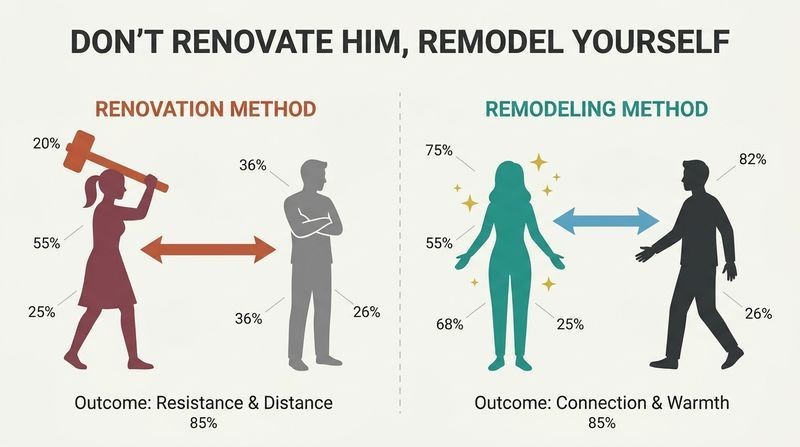
There is no working on your relationship, only on yourself. Doyle spent six years convinced she had married a lazy, unambitious man and set out to improve John through criticism, suggestions, and ultimatums. He dug in his heels and the marriage nearly collapsed. Her breakthrough came when she asked long-married women their secrets and discovered her husband's stubbornness was largely a reaction to her control and complaints.
When she changed her own behavior, John transformed back into the attentive man she fell for. The premise: as long as your husband is not an active addict, a physical abuser, or a serial cheater (her three deal-breakers), he is a good guy, and the wife holds outsized power over whether the home feels warm or hostile.
What's provocative here is the deliberate rejection of the 50/50 partnership model in favor of near-total wifely responsibility. Systems theory supports one kernel: in any interdependent dyad, changing your own behavior reliably shifts the other's, because relational patterns are circular, not linear. Gottman's research similarly finds that softened startups defuse conflict. The obvious tension is the gendered framing, which places the burden almost entirely on women and could excuse genuinely bad male behavior. Doyle guards against this with her deal-breaker list, but readers should hold both truths: focusing on what you control is empowering, and it is not the same as accepting mistreatment.
Complaining about your spouse to a paid stranger corrodes intimacy
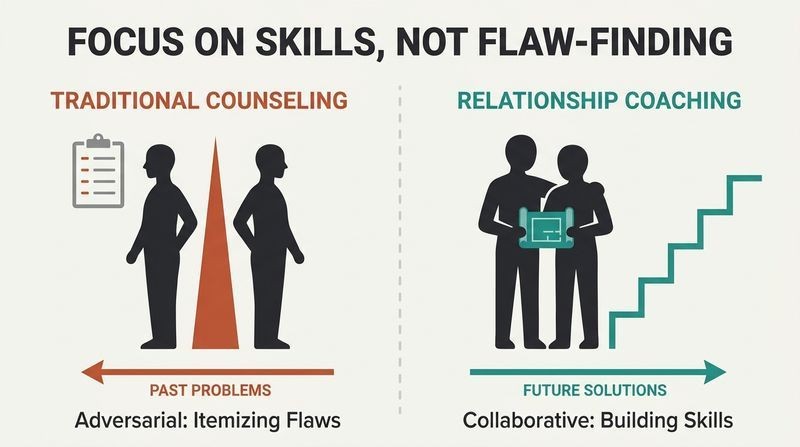
Doyle brands marriage counselors "marriage cancelers." She and John spent over $9,000 on therapy that left them worse off, and she later glimpsed her counselor's own tense marriage. Her core objection: there is no respectful way to itemize your husband's flaws in front of him and a stranger. It creates an adversarial, humiliating dynamic that is the opposite of emotional safety.
She contrasts counseling (problem-focused, past-oriented, assumes something is broken, academically credentialed) with coaching (solution-focused, present and future-oriented, assumes you want new skills, delivered by someone who has lived the transformation). Clients like Christine were told by counselors that their marriages were dead; one destroyed a salvageable family on that advice. Doyle argues most divorces stem from missing skills, not incompatible people.
This is the book's most contested claim, and it overreaches. Meta-analyses of couples therapy, particularly Emotionally Focused Therapy, show durable improvement for roughly 70% of couples, so a blanket indictment ignores real evidence. Yet Doyle isolates something legitimate: airing grievances without repair can entrench resentment, and therapist quality varies wildly. Her counseling-versus-coaching table is partly a marketing frame for her own business, which readers should note. The steelman is that skills-based, action-oriented, present-focused approaches (which good therapy also employs) often outperform open-ended venting. The weakness is treating an entire clinical field as monolithic.
Do three purely pleasurable things daily before expecting your marriage to improve
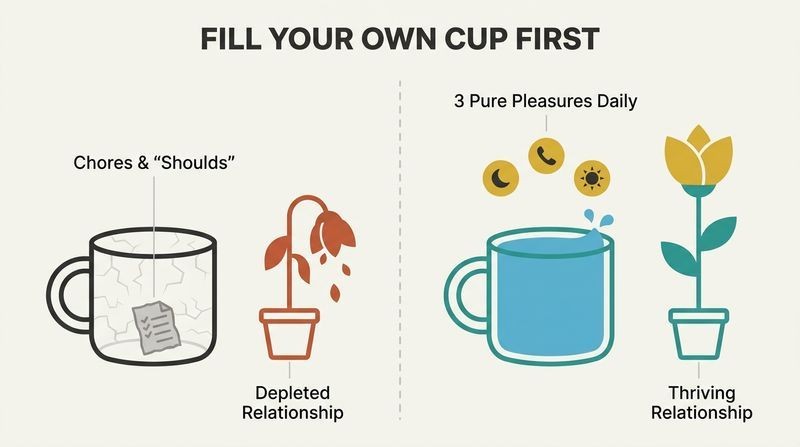
Self-care is the non-negotiable first skill. Doyle instructs women to list twenty things that delight them and do at least three every day. The catch: it must feel good in the moment, not merely afterward. When her client Marni tried to count folding laundry as self-care, Doyle rejected it. Chores, productivity, and "shoulds" do not qualify; naps, beach volleyball, facials, and calling a sister do.
The logic is that happiness is your job, not your husband's. A depleted, resentful wife cannot attract affection, and a woman tending her own delight signals she is pleaseable and teaches others to treat her well. Marni reported her time "expanded" once she prioritized pleasure, because a relaxed, happy person accomplishes more than a frazzled one.
The insight aligns with positive psychology's "broaden-and-build" theory, which holds that positive emotions widen thinking and build resources, making the time-expansion claim psychologically plausible rather than mystical. The distinction between in-the-moment pleasure and after-the-fact accomplishment is sharper than most self-care advice and echoes research on intrinsic versus instrumental motivation. One caveat: prescribing pleasure as a marital strategy risks instrumentalizing joy, doing it to attract your husband rather than for its own sake. Doyle mostly frames it as self-honoring, which is healthier. For overextended caregivers, the permission to prioritize personal delight is genuinely countercultural and useful.
Turn every complaint into a pure desire with no "you" in it
A complaint is an unexpressed desire in disguise. Instead of "You never take me out," say "I would love a night out." Doyle's rule: strip the word "you" (which converts desire into command), forget the how, and name only the end result. When client Patty said "I want my husband to get a better job," Doyle drilled down past money to the real desire: "I would love some new clothes."
Expressing desire always "works" because you honor yourself regardless of the outcome. "I'm sick of this heat" generates zero solutions; "I want to cool off" generates a dozen. Saying "I want you to spend time with me" is a trap, because compliance won't give you what you crave, which is to feel spontaneously desired.
This maps neatly onto Marshall Rosenberg's Nonviolent Communication, which distinguishes observations and needs from evaluations and demands, and onto solution-focused therapy's emphasis on desired outcomes over problem analysis. The neuroscience angle is real: framing a goal positively activates approach-oriented problem-solving, while complaint framing triggers defensive rumination. The banned "you" is a clever behavioral hack against the criticism-defensiveness spiral. The limitation is that some needs genuinely require a partner's specific action, and perpetually indirect requests can leave real problems unaddressed. Doyle allows direct requests ending in a question mark, which is a useful escape valve she does not overemphasize.
To a man, your "helpful" tip lands as "you're incompetent"
Respect is oxygen; criticism suffocates. Doyle names the helpful-hurt-hopeless cycle: a wife offers a well-meant suggestion, the husband hears criticism and gets defensive, she feels hurt and escalates, and both spiral into hopelessness she blames on his temper. She argues wives cause most divorces this way while believing they were only trying to help.
Her antidotes are two phrases. "Whatever you think" conveys trust on matters that are his (bills, car, his work). "I hear you" lets you listen without agreeing or fixing. When client Kathy answered a phone-plan question with "Whatever you think, I trust you," her husband was so moved that intimacy returned that night. Respect means honoring his choices even when you would decide differently, and apologizing when you slip into disrespect.
Gottman's decades of research corroborate the mechanism: contempt and criticism are the strongest predictors of divorce, and men are more likely to flood physiologically during conflict, matching Doyle's "respect as oxygen" metaphor. "Whatever you think" functions as a trust signal that interrupts the demand-withdraw pattern documented across cultures. The critical caveat is scope: reflexively deferring on shared decisions (finances, parenting) can suppress a woman's legitimate agency and voice. Doyle carves out that when he asks for your preference, you should give it. The healthiest reading treats these phrases as tools against nagging, not as a mandate for silence.
Before you correct him, ask whose paper the problem is on
All control is rooted in fear. Doyle's "stay on your own paper" metaphor, borrowed from grade-school honesty, means minding only what you control: your words, tone, attitude, and choices. His clothes, driving, and spending are on his paper. When she catches herself fixating on his behavior, she reads it as a signal she is avoiding something on her own paper (an unwritten blog, an abandoned painting).
Before acting on a control urge, she runs four questions:
1. What am I afraid of?
2. Is my fear realistic?
3. Can I actually control this?
4. Is it worth the intimacy it will cost?
Most fears (a UTI from too little water, a ruined evening from wrong socks) dissolve under scrutiny, freeing her to choose connection over control.
The four-question protocol is essentially cognitive-behavioral disputation applied to relationships: identify the automatic thought, test it against evidence, assess controllability, and weigh costs. It resembles Byron Katie's "The Work" and Stoic dichotomy-of-control practice, which distinguishes what is "up to us" from what is not. The observation that controlling others is a defense against facing one's own unlived life is psychologically astute and echoes Jung's projection. The boundary case Doyle handles well through her client Tiffany: overlapping "papers" (kids, shared home) require negotiating your own limits rather than commandeering others', though drawing that line cleanly in practice is harder than the metaphor implies.
Create a vacuum by doing less, and watch him fill it
Over-functioning crowds out his contribution. Doyle stopped washing dishes, making John's appointments, and finding his lost keys. By doing less, she found he did more, taking initiative she had once nagged for. She reframes helping as a choice: leaving dishes in the sink beats presenting a stressed, martyred self to guests. The phrase "I can't" honors your limits without explanation.
Her boldest application is relinquishing the household finances, even when the wife earns most of the money. Controlling his spending, she argues, casts you as his mother (unsexy) and drains his motivation, since men earn harder when they see the scoreboard. She cites studies that married men out-earn single peers by around 22%. Clients reported husbands who sold prized possessions to fund their wives' happiness once trusted with the money.
The systems concept underneath is over-functioning and under-functioning, a reciprocal pattern Murray Bowen described: when one partner over-does, the other under-does, and stepping back invites the other forward. Elena's headache experiment is a clean demonstration. The married-men-earn-more statistic is real but heavily confounded (selection effects, that higher earners are more marriageable), so the causal story that wifely trust boosts income is shaky. The finances advice is the book's riskiest: relinquishing all financial oversight can expose women to genuine harm if trust is misplaced. Doyle flags it as "graduate work" requiring an already-safe partner, a prudent hedge readers should heed.
Rejecting his gift or compliment quietly rejects him
Receptivity is the essence of femininity. Doyle argues that dismissing a compliment ("this old thing?"), refusing help, or criticizing a gift breaks a cycle: the feminine receives, and the masculine is inspired to cherish the receiver. Reject the gift and you reject the giver, and he stops trying. Her rule is to say only "thank you" and nothing more.
Tara rejected a bottle of perfume early on and received no gift for fifteen years, until she practiced gracious receiving and her husband finally bought her a sweater. Doyle lists why receiving is hard: it can feel out of control, arrogant, undeserved, or threatening to independence. She reframes the goal from independence to interdependence: not needing his help, but wanting it, and letting him feel successful by accepting it.
There is a real behavioral principle here: positive reinforcement shapes behavior, and rejecting attempts to please extinguishes them, a straightforward operant-conditioning insight. Research on gratitude and "capitalization" (how partners respond to each other's good news and gestures) shows that active, appreciative responses strengthen bonds. The gendered packaging (femininity as receptivity, masculinity as provision) is a strong essentialist claim that many readers will resist and that the evidence does not require; the underlying mechanism works regardless of gender. The strongest practical nugget is content-neutral: graciously accepting help and gifts, even imperfect ones, reinforces generosity and builds connection, while reflexive self-sufficiency starves it.
Say "Ouch" instead of attacking, and "I miss you" instead of accusing
Vulnerability, not defense, triggers his protective instinct. Doyle reframes vulnerability as courage, not weakness, and the ingredient that made him fall for you. Her signature moves swap defended anger for exposed hurt:
1. Instead of "You hurt my feelings," just "Ouch."
2. Instead of "You're never home," "I miss you."
3. Instead of doing it all, "I can't" or "I need help."
The timing rule matters: say "Ouch" before you fire back, or you forfeit the sacred trust vulnerability invokes. When client Deanna finally wrote her estranged husband a note saying she missed him, a dead marriage slowly revived. Anger, Doyle notes, always masks an underlying hurt (rejection, embarrassment), and choosing the hurt preserves intimacy while anger invites a war.
This is the book's most research-aligned chapter. Brené Brown's work establishes vulnerability as the birthplace of connection, and Sue Johnson's attachment-based therapy shows that anger is almost always a "secondary emotion" concealing a primary fear of disconnection, exactly Doyle's claim. "Ouch" is an elegant bid: it names hurt without assigning blame, giving the partner room to repair rather than defend. The nuance worth adding is that vulnerability requires a reasonably safe partner to be reciprocated; with a genuinely contemptuous or abusive spouse, repeated undefended openness can be exploited. Doyle's earlier deal-breaker screen is meant to filter for that, though the filter is imperfect.
Affirm the husband you want, and gather evidence he already is him
Gratitude and the spouse-fulfilling prophecy rewire your marriage. Doyle prescribes thanking your husband three times daily, even for taking out the trash, because appreciation motivates repetition while "thanks, but also fluff the pillows" is a complaint in disguise. What you focus on expands, so cataloging his faults manufactures more of them.
The spouse-fulfilling prophecy flips negative affirmations. A woman who told her husband "It's not like you to lose your temper" (over her child's protests that he always did) watched him check himself in a restaurant weeks later. Doyle stopped nagging John about money and started calling him "Mr. Moneybags"; he built a thriving business. Since "you're always late" is itself an exaggeration, she argues, you may as well exaggerate toward the outcome you want and let your husband rise to it.
The mechanism is well documented under different names: the Pygmalion effect showed that teachers' raised expectations measurably improved students' performance, and expectancy effects operate powerfully in close relationships. Gratitude interventions are among positive psychology's most replicated mood and relationship boosters. The honest tension, which Doyle addresses playfully, is the line between reframing and self-deception; a Facebook commenter accused her of encouraging lying. The sturdier defense is that perception is selective anyway, so choosing a generous lens is a legitimate cognitive choice, not a fabrication. The limit: affirmation cannot substitute for addressing genuinely destructive patterns, and expecting the best of a dangerous partner is not a virtue.
Analysis
The Empowered Wife is a framework-driven self-help book built on a single audacious inversion: that a wife, by changing only herself, can single-handedly revive a dying marriage. Doyle's Six Intimacy Skills (self-care, respect, relinquishing control, receiving, vulnerability, and gratitude) are packaged as a proprietary, coachable system, and the book braids memoir, client vignettes, and blunt contrarianism against marriage counseling, communication culture, and gender-sameness feminism.
Its intellectual center of gravity is sound and surprisingly well-supported by adjacent research she never cites: Gottman on contempt as a divorce predictor, Sue Johnson and Brené Brown on vulnerability and attachment, Bowen on over- and under-functioning, and the Pygmalion effect on expectancy. Stripped of gendered packaging, the actionable core is content-neutral relationship wisdom: interrupt the criticism-defensiveness spiral, express needs as desires rather than demands, reinforce the behavior you want, and lead with exposed feeling rather than armored blame. That these tools work regardless of sex is both the book's hidden strength and the evidence against its essentialist framing.
The weaknesses are real and worth naming for readers. The blanket condemnation of couples therapy overreaches against a field with solid outcome data. The near-total allocation of marital responsibility to wives is empirically dubious and ethically fraught; it can shade into self-blame or into rationalizing a partner's poor conduct. The three deal-breakers (active addiction, physical abuse, infidelity) are the load-bearing safety valve, yet the "myth of verbal abuse" chapter risks encouraging women to minimize genuine harm. The finance-relinquishing advice, however transformative for some, could expose vulnerable women to exploitation.
Read critically, the book is most valuable not as gospel about gender but as a disciplined practice in focusing on what one controls, a Stoic and cognitive-behavioral posture dressed in the language of femininity. Its enduring insight: chronic fixation on a partner's flaws is often a defense against one's own unlived life.
Review Summary
The Empowered Wife receives mixed reviews, with some praising its practical advice for improving marriages and others criticizing its perceived sexist and outdated views. Supporters appreciate the emphasis on self-care, respect, and gratitude, while critics argue it places too much responsibility on women and dismisses serious issues like abuse. The book's approach to communication and intimacy skills resonates with some readers, but others find it manipulative and simplistic. Many reviewers note the author's frequent promotion of her coaching services and workshops throughout the book.
People Also Read






Glossary
Six Intimacy Skills
Doyle's six-part marriage methodDoyle's trademarked framework of six practices a wife applies to herself to restore intimacy: replenish your spirit with self-care, restore respect, relinquish control of your man, receive graciously, reveal your heart with vulnerability, and refocus your view with gratitude. The premise is that practicing these skills changes the wife, and the husband responds by becoming attentive and affectionate.
Needless Emotional Turmoil (NET)
Self-generated relationship sufferingDoyle's term for the avoidable stress, conflict, and anguish a wife creates by controlling, complaining, criticizing, or fixating on her husband's flaws. Practicing the Six Intimacy Skills, and processing upsets with girlfriends before confronting a spouse, reclaims the energy otherwise wasted on NET for one's own purpose and pleasure.
Helpful-hurt-hopeless cycle
Escalating spiral from well-meant criticismDoyle's name for the recurring pattern where a wife offers a "helpful" suggestion, the husband hears criticism and becomes defensive, she feels hurt and escalates, and both end up feeling hopeless. Because "helpful" in wife-language translates to "critical" in husband-language, she argues the only way to break the loop is to stop being helpful.
Stay on your own paper
Mind only what you controlA metaphor from grade-school test-taking meaning focus solely on what is yours to control: your words, tone, attitude, and choices. A husband's clothes, driving, spending, and decisions are on his paper. Obsessing over his "paper" signals you are neglecting something unaddressed on your own.
Spouse-fulfilling prophecy
Affirm the partner you wantDoyle's adaptation of the self-fulfilling prophecy: deliberately affirming the positive quality you want your spouse to embody ("It's not like you to lose your temper," "You've always been a good provider") rather than the negative one you fear. Because attention shapes reality and people rise to expectations, focusing on desired traits tends to elicit more of them.
Pure desire
A wish stated without demandAn expressed want framed as an outcome with no expectation, manipulation, or the word "you" attached, phrased as "I would love..." A pure desire never ends in a question mark and honors yourself regardless of whether it is fulfilled, unlike a demand, which punishes the partner for not delivering.
Marriage cancelers
Doyle's label for counselorsDoyle's provocative renaming of marriage counselors, borrowed from a divorce law firm, reflecting her claim that couples therapy frequently precedes separation and divorce. She argues that voicing grievances about a spouse in front of a stranger is inherently adversarial and erodes the emotional safety intimacy requires.
FAQ
What's The Empowered Wife about?
- Focus on Intimacy Skills: The Empowered Wife by Laura Doyle centers on six core skills, known as the Six Intimacy Skills™, designed to improve marriages by attracting a husband's time, attention, and affection.
- Empowerment through Self-Care: The book encourages women to prioritize their own happiness and self-care, which enhances their relationships and creates a more fulfilling partnership.
- Transforming Relationships: Doyle shares personal anecdotes and stories from other women, illustrating how these skills can transform a struggling marriage into a loving and passionate relationship.
Why should I read The Empowered Wife?
- Practical Advice: The book offers actionable advice that can be implemented immediately to improve your marriage, providing a fresh perspective on relationship dynamics.
- Real-Life Success Stories: Numerous testimonials from women who have successfully applied the Six Intimacy Skills™ showcase the effectiveness of the methods presented.
- Shift in Mindset: It encourages a shift from blaming partners to taking personal responsibility for one’s happiness, leading to a more harmonious relationship.
What are the key takeaways of The Empowered Wife?
- Six Intimacy Skills™: The book outlines six essential skills that women can practice to enhance intimacy and connection with their husbands, including self-care and expressing desires.
- Empowerment through Responsibility: Women have the power to influence their relationships positively by focusing on their own actions and desires rather than trying to change their husbands.
- Respect and Trust: Emphasizes the importance of respecting your husband and trusting his decisions, fostering a more loving and supportive environment.
What are the Six Intimacy Skills™ mentioned in The Empowered Wife?
- Self-Care: Prioritizing your own well-being and happiness is crucial for becoming more attractive and available for intimacy.
- Restore Respect: Honoring your husband’s decisions and refraining from criticism helps rebuild intimacy and connection.
- Relinquish Control: Letting go of the need to control your husband, focusing instead on your own happiness, is essential.
- Receive, Receive, Receive!: Being open to receiving love, compliments, and help from your husband reinforces your bond.
- Reveal Your Heart: Expressing your true feelings and desires fosters deeper emotional intimacy.
- Refocus with Gratitude: Emphasizes the power of gratitude in transforming your perspective and enhancing your relationship.
How does The Empowered Wife address common marriage issues?
- Focus on Self-Improvement: Encourages women to look inward and focus on their own actions and desires rather than blaming their husbands for marital issues.
- Communication Techniques: Provides specific phrases and techniques, such as “I hear you” and “Whatever you think,” to foster better communication and emotional safety.
- Building Respect: Teaches women how to honor their husbands and create a more loving environment through respect.
What is the significance of self-care in The Empowered Wife?
- Foundation for Happiness: Self-care is presented as a crucial element for personal happiness, directly impacting the quality of the marriage.
- Empowerment: By taking care of themselves, women can reclaim their power in the relationship, leading to a more balanced and fulfilling partnership.
- Attracting Affection: Engaging in self-care helps women attract their husbands’ time, attention, and affection naturally.
How can I start implementing the advice from The Empowered Wife?
- Begin with Self-Care: Make a list of activities that bring you joy and commit to doing at least three of them each day.
- Practice Expressing Desires: Shift your communication from complaints to expressing what you would love using positive language.
- Focus on Respect: Make a conscious effort to respect your husband’s decisions and refrain from criticism, using phrases like “Whatever you think.”
What if my husband doesn’t respond positively to the advice in The Empowered Wife?
- Be Patient: Change takes time, and your husband may need time to adjust to your new approach.
- Stay Committed: Focus on your own actions and desires rather than trying to control or change your husband.
- Seek Support: Consider joining a community or support group of women practicing the Six Intimacy Skills™ for encouragement and inspiration.
How can I apply the concept of vulnerability from The Empowered Wife?
- Admit Your Feelings: Express your feelings honestly, such as saying “Ouch!” when you’re hurt, to open the door to deeper intimacy.
- Ask for Help: Let your husband know when you need support, as vulnerability can strengthen your bond.
- Share Your Needs: Communicate your desires openly, fostering a safe space for both partners to express themselves.
What does Laura Doyle mean by "refocusing your view with gratitude"?
- Shift Your Perspective: Focus on what you appreciate about your husband to change your overall outlook on your marriage.
- Create a Gratitude List: Write down things you are grateful for about your husband to recognize his contributions.
- Express Gratitude Daily: Make it a habit to thank your husband for small and big things alike, inspiring him to continue doing things that make you happy.
What are some practical ways to express gratitude in my marriage?
- Daily Affirmations: Express gratitude at least three times a day for simple tasks or larger contributions.
- Catch Him Doing Good: Acknowledge and appreciate your husband when he does something you like, reinforcing positive behavior.
- Be Specific: Use specific examples when expressing gratitude, such as “Thank you for making dinner; it was delicious!”
What are the best quotes from The Empowered Wife and what do they mean?
- “Every master was once a disaster.”: Highlights that growth often comes from overcoming challenges, encouraging readers to embrace their journey.
- “You are a living magnet.”: Emphasizes the power of mindset and how positive thinking can attract positive outcomes in relationships.
- “If mama’s not happy, nobody’s happy.”: Stresses the importance of a woman’s happiness in a marriage, impacting the entire family dynamic.
Download PDF
Download EPUB
.epub digital book format is ideal for reading ebooks on phones, tablets, and e-readers.








































