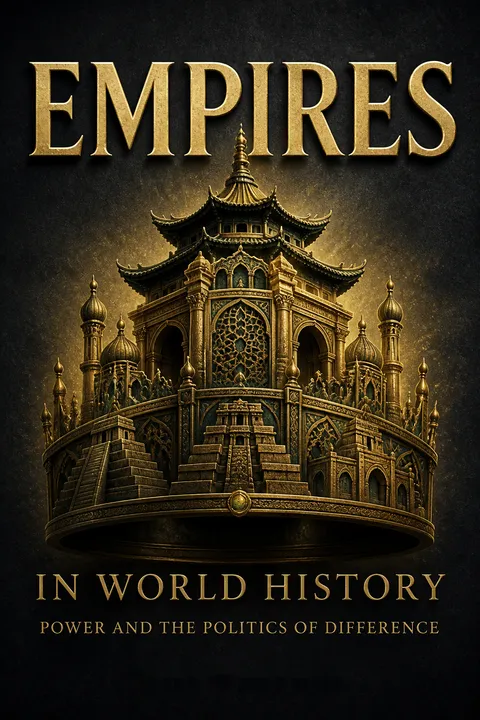

Key Takeaways
1. Empires, not nation-states, are the enduring historical norm.
For much of the last two millennia, empires and their rivalries, in regions or around the world, created contexts in which people formed connections-as ethnic or religious communities, in networks of migrants, settlers, slaves, and commercial agents.
Challenging assumptions. We often take the world of nearly two hundred nation-states for granted, but this political arrangement is barely sixty years old. Historically, most people have lived under empires, vast political units that consciously maintained the diversity of their conquered populations. The nation-state, based on the idea of a single people in a single territory, is a relatively recent phenomenon.
Enduring structures. Empires like the Roman, Chinese, and Ottoman endured for centuries, even millennia, demonstrating remarkable durability. Their longevity challenges the notion that the nation-state is natural or inevitable, highlighting instead the wide range of ways societies have organized power. These long-lasting entities shaped political possibilities and human affiliations across vast regions.
Complex trajectories. The transition from empire to nation-state is not a simple, linear progression. Conflicts over national identity and state boundaries flared globally as empires dissolved, as seen in Yugoslavia or Rwanda. Even today, ambiguities about sovereignty persist, with some new states declaring themselves multinational while others strive for homogeneity, and some ceding authority to larger political units like the European Union.
2. The "Politics of Difference" is fundamental to imperial governance.
The concept of empire presumes that different peoples within the polity will be governed differently.
Managing diversity. Empires, by their very nature, incorporated diverse peoples and cultures, often coercively. Unlike nation-states that tend to homogenize populations within their borders, empires explicitly declared and managed the non-equivalence of multiple groups. This "politics of difference" was a core strategy for exploiting and ruling vast, unlike populations.
Varied approaches. Empires employed a spectrum of strategies to manage difference. Some, like the Roman Empire, leaned towards homogenization, extending citizenship and a shared culture to elites who adopted Roman ways. Others, like the Mongol empires, adopted a pragmatic approach, protecting diverse religions and cultures while demanding loyalty.
- Roman style: Incorporation through shared civilization, law, and citizenship (e.g., extending Roman citizenship to Latins and later all free males).
- Mongol style: Pragmatic acceptance of religious and cultural diversity, focusing on personal loyalty to the Great Khan.
- Ottoman style: Orchestrated tolerance, allowing religious communities to self-govern under the sultan's overarching authority.
Beyond binary splits. Social difference in empires was rarely a simple colonizer/colonized or black/white binary. Empires often recognized local leaders, customs, and religions, finding ways to profit from the skills and connections of distinct communities. Loyalty, rather than likeness, was often the primary goal, making difference a fact and an opportunity, not just an obsession.
3. Intermediaries are indispensable yet precarious for imperial power.
Empires unintentionally created subversive possibilities for intermediaries, who could circumvent imperial purposes by establishing alternative networks or allegiances, attaching themselves to other empires, or rebelling...
Delegating authority. Ruling vast, dispersed realms with limited central staff meant empires relied heavily on intermediaries. These could be co-opted indigenous elites, settlers from the imperial core, or even individuals detached from their communities, like slaves. Their role was to ensure order, collect taxes, and mobilize resources.
Diverse forms of intermediaries:
- Indigenous elites: Local leaders who gained from cooperation with the imperial power (e.g., Indian caciques for the Spanish, Polish nobles for the Russians).
- Settlers: Groups transplanted from the imperial core, expected to act in imperial interest (e.g., Roman colonists, British planters in Ireland).
- Slaves/Clients: Individuals detached from their origins, dependent solely on imperial masters (e.g., Ottoman Janissaries, Abbasid mawali).
Inherent risks. This reliance on intermediaries created inherent vulnerabilities. Local agents could prioritize their own interests, establish rival networks, or even rebel against imperial control. The Ottoman system of using slave-officials (Janissaries) was designed to prevent aristocratic power but still faced the risk of these elite slaves turning against the sultan. Similarly, American colonists, initially intermediaries, eventually rebelled against British rule.
4. Empires are shaped by constant interaction, competition, and adaptation.
Relationships among empires were critical to their politics and to their subjects' possibilities.
Interconnected destinies. Empires rarely acted in isolation; their histories were deeply entwined. Interactions ranged from trade and diplomacy to imitation and outright warfare. The fragmentation of one empire often created opportunities for others, as seen in the rise of Islamic caliphates on the edges of the Byzantine and Sassanian empires.
Catalyst for innovation. Competition among empires spurred innovation in statecraft, military technology, and administrative practices. For instance, the constant interaction between Chinese empires and nomadic confederacies led to advancements in cavalry warfare and border management. European maritime powers developed new naval technologies and trading strategies in response to Ottoman dominance of land routes.
Shifting power dynamics:
- Rome and China: Developed independently but influenced their respective regions profoundly.
- Byzantium and Islamic Caliphates: Shared cultural heritage but engaged in centuries of conflict and mutual influence.
- Mongols: Unified Eurasia, facilitating cross-continental knowledge and goods exchange, influencing later Russian, Ottoman, and Chinese empires.
- European powers: Their rivalries drove overseas expansion and shaped the global economy.
No fixed borders. Imperial edges were not static lines but zones of opportunity and conflict. Peoples on contested territories could resist, deflect, or leverage imperial encroachments, often playing rival empires against each other to their own advantage.
5. Monotheism profoundly transformed imperial legitimacy and conflict.
The alliance between monotheism and empire-in fourth-century Rome and seventh-century Arabia-was a transformation of enormous importance, setting forth a restrictive idea of legitimacy-one empire, one emperor, one god.
A new basis for unity. The adoption of monotheistic religions like Christianity and Islam offered empires a powerful, universalistic moral framework that transcended local cults and kinship ties. This provided a strong ideological foundation for imperial unity and expansion, promising salvation and a shared moral order across vast spaces.
Double-edged sword. While monotheism could unify, it also introduced new sources of conflict:
- Internal schism: Divergent interpretations of doctrine led to bitter disputes and divisions within empires (e.g., Christian heresies in Byzantium, Sunni-Shi'ite split in Islamic caliphates).
- External conflict: The universalistic claims of a single true faith could fuel militant expansion (jihads, crusades) against non-believers or rival monotheistic empires, leading to mutually exclusive civilizational visions.
Impact on governance. Monotheism influenced how empires managed diverse populations. Christianized Rome became less tolerant of polytheism, while Islamic empires developed systems (dhimma) to accommodate "people of the book" (Jews, Christians) under their rule. The close association of church and state in Byzantium contrasted with the more fluid relationship in early Islamic polities, where religious scholars (ulama) gained authority independent of the caliph.
6. Eurasian nomadic empires pioneered unique, influential strategies of power.
Mongol khans had the technological advantages of nomadic societies-above all, a mobile, largely self-sufficient, and hardy military-but it was thanks to their capacious notions of an imperial society that they rapidly made use of the skills and resources of the diverse peoples they conquered.
Masters of mobility. Nomadic peoples of the Eurasian steppe, like the Xiongnu, Huns, and Mongols, developed formidable military and political strategies. Their mobile, self-sufficient armies, skilled in horsemanship and archery, gave them a decisive edge over settled agricultural societies for millennia. This mobility allowed for rapid conquest and the control of vast territories.
Pragmatic governance:
- Flexible alliances: Nomadic societies were built on fluid kinship ties, sworn brotherhoods, and strategic marriages, allowing for the formation of powerful confederacies.
- Religious pluralism: Unlike monotheistic empires, nomadic rulers often showed indifference or pragmatic tolerance towards diverse religions (Buddhism, Christianity, Islam), integrating spiritual advisors from various faiths into their courts.
- Administrative adaptation: While known for violence, Mongols also adopted administrative techniques from conquered peoples, such as writing systems (from Uighurs) and census-taking (from China), to manage their vast realms.
Lasting legacy. The Mongol Empire, the largest land empire in history, unified Eurasia from China to the Black Sea, facilitating unprecedented cross-continental exchange of goods, knowledge, and statecraft. Their methods of rule, emphasizing personal loyalty, pragmatic diversity, and military organization, profoundly influenced later empires like the Ottoman, Russian, and Chinese dynasties (Yuan, Qing).
7. Overseas expansion redefined global economies and imperial forms.
These new connections eventually reconfigured the global economy and world politics.
New frontiers. Blocked by the Ottoman Empire's dominance of eastern Mediterranean and land routes, and constrained by internal European rivalries, Western European monarchs sought alternative routes to the lucrative Asian markets. This led to maritime exploration and the accidental "discovery" of the Americas, fundamentally altering global connections.
Diverse colonial forms:
- Trading enclaves (feitorias): Fortified trading posts established by Portuguese and later Dutch, British, and French powers at strategic points in existing Asian and African commercial networks. These relied on concentrated naval power and local cooperation.
- Plantation colonies: Developed in the Americas (e.g., Portuguese Brazil, Spanish Caribbean) for cash crops like sugar, relying heavily on the forced labor of enslaved Africans.
- Settler colonies: Areas where European migrants established permanent communities, often displacing or incorporating indigenous populations (e.g., British North America, Spanish America).
Economic transformation. The influx of American silver, produced by coerced indigenous labor, lubricated global commerce, enabling Europeans to purchase Asian goods. The transatlantic slave trade, driven by the demand for plantation labor, created a vast, brutal system linking Africa, the Americas, and Europe, profoundly reshaping demographics and economies. These new imperial ventures created unprecedented wealth for European powers, fueling their internal development and further global ambitions.
8. Revolutions reshaped, but did not end, the imperial order.
Empire was the stage, not the victim, of eighteenth- and early nineteenth-century revolutions.
New ideas, old structures. The 18th-century revolutions (American, French, Haitian, Spanish American) introduced radical ideas of popular sovereignty, natural rights, and citizenship. However, these concepts were often debated and applied within existing imperial frameworks, rather than leading to an immediate, universal shift to nation-states.
Contested citizenship:
- French Revolution: Debated whether "rights of man and citizen" applied to slaves and people of color in colonies like Saint Domingue, leading to temporary emancipation and imperial citizenship, only to be reversed by Napoleon.
- American Revolution: While proclaiming liberty, the new "Empire of Liberty" denied citizenship to slaves and systematically marginalized Native Americans, defining a racialized and exclusionary form of republican empire.
- Spanish American Revolutions: Began as struggles for greater autonomy within the Spanish monarchy, eventually leading to independence but often preserving existing social hierarchies and creating new, fragile states.
Imperial resilience. Napoleon's rise demonstrated that revolutionary fervor could be channeled into new, vigorous forms of empire-building, echoing Roman and Carolingian precedents. His conquests across Europe, though ultimately defeated by other empires, showed the enduring appeal of imperial power. The post-Napoleonic settlement in Europe reinforced monarchical consolidation rather than ushering in an era of nation-states.
9. Capitalism and industrialization fueled new, intensified imperial dynamics.
The nexus of plantation slavery overseas and agricultural and industrial development at home was tightened up during the extraordinary expansion of the sugar economy.
The Great Divergence. The 18th and 19th centuries saw a "great divergence" in economic power, with Western Europe, particularly Britain, industrializing rapidly. This was not solely due to internal factors but to a symbiotic relationship with empire. Colonial resources, especially low-cost sugar and raw materials like cotton, freed metropolitan land and labor for industrial production.
New forms of economic imperialism:
- "Imperialism of Free Trade": Britain, with its industrial might and naval supremacy, exerted informal control over nominally independent states, ensuring favorable trade terms and market access through economic leverage and occasional military threats.
- Chartered Companies: Entities like the British East India Company evolved from trading ventures into de facto sovereign powers, collecting taxes and administering vast territories in India, demonstrating a blend of private enterprise and state power.
- Resource Extraction: The demand for raw materials and markets intensified, leading to "creeping colonization" and the scramble for Africa, as European powers sought secure access to resources and preempted rivals.
Social and moral debates. The rise of industrial capitalism and its reliance on colonial exploitation sparked moral debates within empires. The antislavery movement, for instance, challenged the legitimacy of slavery within the British Empire, linking it to broader critiques of "old corruption" and advocating for the moral superiority of wage labor. These debates highlighted the tension between imperial practices and evolving metropolitan values.
10. The 20th century's world wars were inter-empire conflicts.
World War I revealed and did nothing to resolve the instability in the European system of empires.
Globalized conflict. Both World War I and World War II were fundamentally struggles among empires, not just nation-states. Belligerents mobilized vast human and material resources from their overseas colonies and contiguous territories, making these conflicts truly global in scope. The wars were driven by imperial rivalries, geopolitical anxieties, and the desire to reallocate populations and resources from rival empires.
Destabilization and collapse:
- WWI: Exposed the fragility of the European imperial system. It led to the collapse of the Ottoman, Habsburg, German, and Romanov empires, creating a volatile mix of new, often ethnically diverse, states in Central and Eastern Europe.
- WWII: Saw the rise of new, aggressive imperial powers (Nazi Germany, Imperial Japan) with radical racial and expansionist ideologies. Japan's rapid conquests in Southeast Asia exposed the vulnerability of European colonial rule, fundamentally weakening British, French, and Dutch empires.
New superpowers. The wars ultimately led to the rise of two new superpowers, the United States and the Soviet Union, each with distinct imperial-like global ambitions. The US envisioned a world of open, democratic nation-states, while the USSR promoted a federation of socialist republics and international communism, both challenging traditional European colonialism.
Human cost. These inter-empire conflicts resulted in unprecedented death tolls, widespread destruction, and massive population displacements, particularly in Europe and Asia. The systematic atrocities committed by Nazi Germany and Imperial Japan pushed the "politics of difference" to genocidal extremes, leaving a legacy of profound trauma.
11. The "end of empire" is a complex, ongoing, and uneven process.
Many recent bloody and destabilizing conflicts... emerged from failures to find viable alternatives to imperial regimes.
Post-war dilemmas. The end of World War II did not immediately signal the end of empires. European powers initially sought to re-legitimize and re-develop their colonial holdings through programs of "development" and expanded political participation, hoping to retain influence and economic benefits. However, these efforts often backfired, as colonized populations demanded full equality and self-determination.
Decolonization's varied paths:
- Violent struggles: In places like Indochina (Vietnam) and Algeria, nationalist movements engaged in protracted armed conflicts against returning colonial powers.
- Negotiated transitions: In India and Ghana, independence was achieved through political mobilization and negotiation, though often accompanied by significant social upheaval (e.g., the partition of India).
- Unilateral declarations: In Indonesia, nationalist leaders seized the initiative immediately after Japan's surrender, proclaiming independence.
Persistent challenges. Decolonization often left behind fragile states with artificial borders, mixed populations, and deep-seated inequalities. The "unmixing" of peoples, as seen in post-Ottoman Europe and the India-Pakistan partition, led to immense suffering and ongoing conflicts. The promise of national unity and self-determination frequently clashed with the realities of diverse ethnic, religious, and class interests within newly independent states.
12. New forms of power persist, challenging the nation-state ideal.
The great powers proclaim a world of inviolable and equal nations, while deploying economic and military might to undermine other nations' sovereignty.
Illusory equivalence. Despite the proliferation of theoretically sovereign nation-states after decolonization, the world remains characterized by profound inequalities in power and resources. The "fiction of sovereign equivalence" often masks the continued exercise of imperial-like influence by powerful states and transnational corporations.
Reconfigured imperial powers:
- United States: Operates through "imperialism of free trade," military interventions, and client states, projecting power globally while denying it is an "empire."
- Russian Federation: Re-emerged from the Soviet collapse with a multiethnic, patrimonial system, reasserting influence in its "near abroad" and leveraging energy resources.
- China: Reclaimed its historical imperial role, with a strong, centralized party-state overseeing massive economic growth and asserting control over diverse populations and contested borderlands.
- European Union: A unique confederal entity, transcending traditional nation-state rivalries, but still grappling with questions of loyalty, identity, and external influence.
Enduring legacies. The fault lines of past empires continue to shape contemporary conflicts, from the Middle East to the Caucasus. The "politics of difference" persists, with states struggling to manage diverse populations, often resorting to exclusion or forced assimilation. The challenge remains to imagine and create new political forms that can reconcile desires for belonging, equality, and mutual respect, moving beyond the historical patterns of imperial arrogance and its human costs.
People Also Read

Download PDF
Download EPUB
.epub digital book format is ideal for reading ebooks on phones, tablets, and e-readers.








































