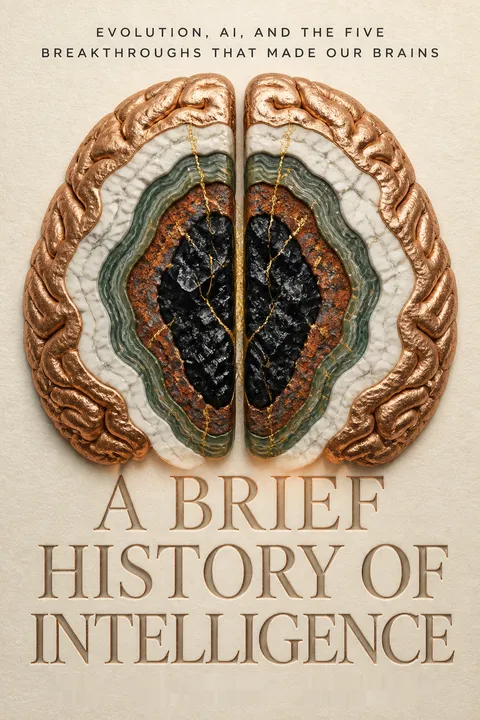

Key Takeaways
1. Intelligence Began with Simple Steering and Valence.
All you need is a brain that steers a bilateral body toward increasing food smells and away from decreasing food smells.
Primitive intelligence. Life's earliest forms, even single-celled organisms, displayed rudimentary intelligence through complex protein networks. However, the first true brains emerged approximately 600 million years ago in bilaterians, worm-like creatures characterized by bilateral symmetry. This body plan simplified navigation, reducing complex movement choices to simple left or right turns, thereby optimizing for forward motion.
Valence-based navigation. The core innovation was the ability to assign "valence" to stimuli, categorizing the world into "good things" to approach and "bad things" to avoid. Sensory neurons directly signaled this inherent goodness or badness, rather than objective features. This basic "steering" mechanism, reminiscent of a Roomba vacuum cleaner, allowed early bilaterians to effectively navigate intricate environments without needing a sophisticated understanding of their surroundings.
Affect and association. This nascent brain also developed fundamental forms of affect and associative learning. Neuromodulators like dopamine and serotonin created persistent behavioral states, such as "escape" or "exploit," enabling animals to "steer in the dark" when sensory cues were fleeting. Associative learning allowed these ancient worms to modify their steering decisions based on past experiences, continuously refining their perception of what was beneficial or detrimental.
2. Reinforcement Learning Emerged with Vertebrates, Driven by Prediction.
Dopamine is not a signal for reward but for reinforcement.
Vertebrate learning. Around 500 million years ago, the Cambrian explosion ushered in vertebrates, fish-like ancestors with a new brain template featuring a cortex and basal ganglia. This era introduced "reinforcement learning"—the capacity to learn arbitrary sequences of actions through trial and error, a cognitive leap beyond simple bilaterians. This addressed the "temporal credit assignment problem," where rewards are often delayed from the actions that produced them.
Dopamine's new role. The key to this breakthrough was the evolutionary repurposing of dopamine. Initially a "good-things-nearby" signal, dopamine transformed into a "temporal difference learning signal." It no longer reacted to the reward itself, but to the change in predicted future reward. This allowed the brain to reinforce actions that improved the expectation of a reward, even if the actual reward had not yet materialized.
Curiosity and timing. This advanced learning mechanism brought forth familiar intellectual and affective features. Curiosity emerged, intrinsically rewarding exploration and novelty, which is vital for effective trial-and-error learning. The ability to learn from the omission of expected rewards or punishments, coupled with a precise perception of time, also developed, enabling vertebrates to anticipate events and experience disappointment or relief.
3. Mammals Unlocked Simulation and Imagination with the Neocortex.
If the reinforcement-learning early vertebrates got the power of learning by doing, then early mammals got the even more impressive power of learning before doing—of learning by imagining.
The neocortical superpower. Approximately 200 million years ago, small, warm-blooded mammals, surviving amidst dinosaurs, evolved the neocortex. This new brain structure bestowed the "superpower" of simulation—the ability to mentally explore actions and their potential consequences before physically executing them. This "learning by imagining" is a form of model-based reinforcement learning.
Generative world model. The neocortex functions as a "generative model," continuously constructing an internal simulation of the external world. This explains peculiar perceptual phenomena such as:
- "Filling in" missing visual information.
- Perceiving only "one interpretation at a time" in ambiguous images.
- The "can't unsee" effect, where once an interpretation is formed, it's hard to revert.
Imagination, dreaming, and even hallucinations are manifestations of the neocortex operating in this generative mode.
Advanced cognitive feats. This simulation capability enabled several sophisticated cognitive abilities. "Vicarious trial and error" allowed mammals to mentally "play out" different options, like a rat pausing at a maze fork to consider paths. "Counterfactual learning" enabled them to learn from "what if" scenarios, grasping causal relationships. "Episodic memory" emerged, allowing the recall of specific past events as simulated realities, which also aided in overcoming catastrophic forgetting.
4. Primates Developed "Mentalizing" to Model Minds and Anticipate Futures.
We understand others by imagining ourselves in their shoes.
The rise of mentalizing. Around 15 to 30 million years ago, early primates, driven by a unique frugivore diet and complex social dynamics, experienced significant brain expansion. This led to "mentalizing"—the ability to model one's own mind and, by extension, the minds of others. This capacity was facilitated by new neocortical regions, particularly the granular prefrontal cortex (gPFC).
Theory of mind. "Theory of mind," the capacity to infer others' intentions and knowledge, became paramount for navigating intricate primate politics. Chimpanzees, for example, exhibit sophisticated deception and alliance-building, demonstrating an understanding of what others know or want. This ability to "think about thinking" (metacognition) allowed primates to predict and manipulate social interactions within their groups.
Imitation and foresight. Mentalizing also enabled "imitation learning," allowing primates to acquire novel skills by observing others, a more sophisticated form of learning than simple observational selection. Furthermore, primates gained the ability to "anticipate future needs," planning for wants they don't currently experience, such as a monkey carrying tools for a future task. These abilities are deeply intertwined, suggesting a common underlying mechanism of modeling mental states.
5. Human Language: The Ultimate Breakthrough for Cumulative Ideas.
The true power of DNA is not the products it constructs (hearts, livers, brains) but the process it enables (evolution). In this same way, the power of language is not its products (better teaching, coordinating, and common myths) but the process of ideas being transferred, accumulated, and modified across generations.
A unique human trait. The final breakthrough, "speaking," emerged in early humans, around 100,000 years ago, marking a unique divergence from other apes. Human language is distinct due to its use of declarative labels (symbols) and grammar, allowing for an infinite number of unique meanings. This wasn't due to entirely new brain structures, but a repurposing of existing mentalizing areas through a hardwired "language curriculum."
Transferring inner worlds. This curriculum includes innate behaviors like "proto-conversations" and "joint attention" in infants, priming them for language acquisition. Language's power lies in its ability to transfer "inner simulations" (concepts, ideas, thoughts) between brains with unprecedented detail and flexibility. This enabled "learning from others' imagined actions," allowing groups to collectively benefit from individual insights and experiences.
Cumulative culture. Language facilitated "cumulative culture," where ideas and inventions accumulate and refine across generations, a phenomenon unique to humans. This led to an explosion of technological and cultural complexity, from basic stone tools to modern civilization. The "perfect storm" of ecological pressures, social dynamics, and biological adaptations (like cooking and premature birth) drove this rapid brain growth and the unique evolution of language, making humans the "hive-brain apes."
6. The Neocortex: A Universal Simulator, Not a Specialized Organ.
The neocortex does not do different things; each neocortical column does exactly the same thing.
Mountcastle's insight. A central, unifying theory in the book is that the neocortex, which expanded dramatically in mammals and primates, is not a collection of specialized organs but a universal learning machine. Vernon Mountcastle's "neocortical column" hypothesis posits that the neocortex is composed of repeating microcircuits, each performing the same fundamental computation, regardless of whether it's processing vision, touch, or language.
Function by input. Evidence strongly supports this "universal algorithm" idea. Rewiring visual input to the auditory cortex in ferrets allows them to see, and congenitally blind humans repurpose their visual cortex for other senses. This implies that the neocortex's function is primarily determined by its inputs and outputs, rather than by inherent specialization. Its core task is to build a "generative model"—an internal simulation of whatever data it receives.
Predicting everything. This generative model allows the neocortex to predict everything, from sensory data to motor commands and even mental states. Whether it's perceiving the world, imagining futures, planning movements, or understanding other minds, the neocortex is always rendering and controlling simulations. This general computational power, applied to different domains, explains the diverse functions attributed to various neocortical regions.
7. Evolution Builds Intelligence Incrementally, Layer by Layer.
Each breakthrough was possible only because of the building blocks that came prior.
Foundational layering. The history of intelligence is a narrative of continuous, incremental innovation, where each major breakthrough built upon the foundations laid by previous evolutionary steps. From the first neurons to human language, complexity emerged not through sudden, inexplicable leaps, but through the repurposing and elaboration of existing structures and mechanisms.
Interconnected breakthroughs. This layered evolution is evident across all five breakthroughs:
- Steering relied on the prior evolution of neurons and reflexes.
- Reinforcement learning bootstrapped on the valence signals of good and bad.
- Simulation became possible because model-free reinforcement learning already existed to affect behavior.
- Mentalizing was essentially simulating the older mammalian neocortex, turning the computation inward.
- Speaking required mentalizing to infer intent and facilitate shared attention.
Efficiency and accumulation. This "building block" approach highlights evolution's remarkable efficiency, constantly finding new applications for existing solutions. It suggests that even the most complex human abilities are deeply rooted in ancient, simpler mechanisms. Understanding this incremental process is crucial for reverse-engineering intelligence, as it reveals the necessary sequence of capabilities that must be acquired.
8. AI's Journey Mirrors Evolution's Path, Revealing Missing Pieces.
What I cannot create, I do not understand.
Evolutionary parallels in AI. The quest to build artificial intelligence often parallels the evolutionary path of biological intelligence. Early AI attempts struggled with problems like "temporal credit assignment," which evolution solved with temporal difference learning and dopamine. Rodney Brooks's Roomba, a commercially successful robot, effectively replicated the simple "steering" intelligence of early bilaterians.
LLMs and their limitations. Modern AI, particularly large language models (LLMs) like GPT-3 and GPT-4, demonstrate impressive language prediction and pattern matching. However, they often lack a true "world model" or "theory of mind," struggling with commonsense reasoning and inferring intent in the nuanced way humans do. This suggests that while LLMs excel at language prediction, they don't necessarily possess the underlying simulation and mentalizing capabilities of the human brain.
The path forward for AI. The book argues that AI's future success in achieving human-level intelligence depends on incorporating these "missing pieces"—the ability to build and explore internal world models, simulate actions, and model other minds. Just as evolution built intelligence layer by layer, AI development may need to follow a similar trajectory, moving beyond mere pattern matching to truly understand and interact with the world and its inhabitants.
People Also Read




Download PDF
Download EPUB
.epub digital book format is ideal for reading ebooks on phones, tablets, and e-readers.








































