
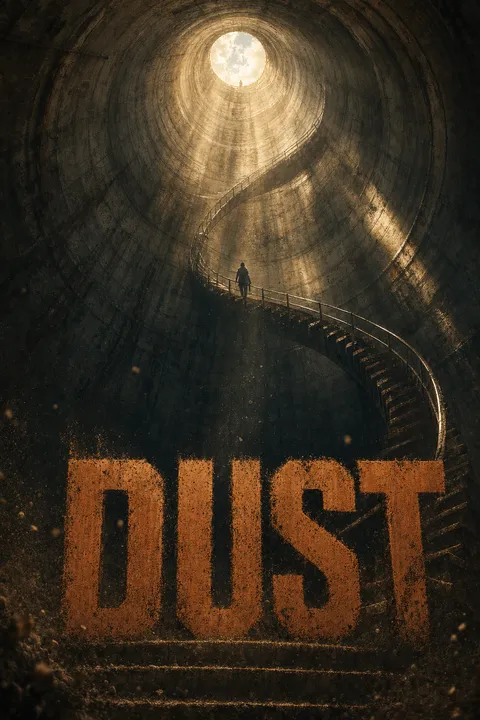


Plot Summary
Prologue
Two men speak across a crackling radio line. Lukas,2 minding a distant silo, reports quiet order and a lottery that pleased people. The older voice presses him to keep mining old server data for meaning. Lukas2 reads aloud about Cordyceps, a fungus that hijacks an ant's brain and marches it to its death. The older man declares this no accident: it means none of them are truly free.
Lukas2 mentions his mayor1 is away on a project she refuses to share, one she believes will bring trouble. She distrusts the voice entirely, doubting he is even the same person each call. The older man wishes them luck, then confesses a foreboding certainty that nothing good will come of whatever she is planning.
The exchange plants the novel's central metaphor: humanity as the ant, reprogrammed by an invisible architecture it cannot perceive. Howey uses the Cordyceps parasite to frame the silos as machines of behavioral control, where free will is an illusion sustained by ritual, lottery, and lore. The dramatic irony is thick: Lukas trusts his benefactor while his mayor refuses to, and both readings will prove partly right. The anonymized, machine-flattened voice foreshadows a world where identity itself is engineered and interchangeable. Most tellingly, the section ends on dread rather than hope, establishing that knowledge here is dangerous and that the coming rebellion will demand terrible costs.
Boring Through Sacred Concrete
Deep in Mechanical, Juliette Nichols,1 the reluctant mayor of Silo 18, drives an excavator against the outer wall her people consider a holy seal. Frightened miners watch her violate taboo, some blaming her for the friends who died when she refused to clean. When the wall finally gives way, she does not find open earth but a wall of ancient machinery.
Crawling through, she and the albino miner Raph10 discover a colossal buried digging machine, circular and grease-packed, deliberately stowed rather than abandoned. Juliette1 realizes it was designed to bore its own path to a neighboring silo, and that the backup generator is meant to power it. Her promise to rescue Solo3 and the children trapped in Silo 17 now has a means.
Juliette's drive to dig literalizes her defining trait: she trusts nothing she has not taken apart herself. The taboo she shatters is theological as much as physical, exposing how the silo's survival depends on fear dressed as reverence. The buried digger reframes the founders as gods and demons both, leaving tools and instructions across time. Howey stages the tension between individual conviction and collective dread that will haunt the book: Juliette sees hope where her people see doom. Her guilt over past deaths shadows even this triumph, establishing a leader whose stubbornness saves and damns in equal measure, and whose curiosity refuses the comfort of settled ignorance.
A Mayor Spreading Fear
Lukas Kyle,2 head of IT and Juliette's1 lover, descends to plead with her. Her return from the outside once inspired wonder, but her plan to tunnel beyond the silo now breeds panic. A priest named Wendel13 preaches that her digging will let poison flood in and kill thousands, and transfer requests are flooding the deputies.
Climbing through levels scarred by the recent uprising, Juliette1 confronts the hostility herself: averted eyes, mothers shielding children, a chaotic town hall where residents scream accusations until a gavel and drawn gun restore order.
Her own father12 begs her not to go outside again. Juliette1 insists on pressing forward, determined to sample the true air and prove the world beyond can be understood, even as her people recoil.
This section dramatizes the paradox of the liberating leader: the truth she carries destabilizes the very people she wants to free. Howey contrasts two economies of belief, the church selling afterlife comfort and Juliette selling terrifying uncertainty, and shows why fear so reliably outsells hope. Her strained intimacy with Lukas, who does the mayoral labor while she welds in secret, reveals a woman who loves through projects rather than presence. The scar Lukas notices, mysteriously vanished, seeds a biological mystery about the silo itself. Beneath the politics runs a study of how authority erodes when a ruler pursues conviction over consensus, alienating allies while chasing a revelation nobody asked to receive.
The Waiting World of Solo
In the drowned, decaying Silo 17, Jimmy Parker, who long called himself Solo,3 tends the last of the receding floodwaters and the wild orphans who share his ruin.
Little Elise,7 gap-toothed and fearless, clutches a homemade book of stitched-together pages while the older teens Rickson14 and Hannah,15 now parents themselves, fear what Juliette's1 rescue will bring. Jimmy3 severs a wire to stop the pump from running dry, following Juliette's1 radioed instructions, and prepares to move down toward Mechanical where the diggers will break through.
He dreads the crowds promised to fill his empty home, having only ever known solitude as safety. His affection for Elise7 anchors him even as thousands of strangers, and the dangers of company, loom just beyond the rock.
Solo embodies the psychology of prolonged isolation: safety and loneliness fused so tightly that rescue itself reads as threat. Howey uses his fractured self, the man who split into Jimmy and Solo to endure decades alone, to explore how identity fragments under solitude and reassembles under love. The orphans represent an unsupervised humanity, feral yet tender, raising children by improvised rules. Elise's memory book, assembled from salvaged knowledge, becomes a quiet emblem of how civilization persists through curation and story. This section widens the novel's scope beyond politics into intimate survival, reminding us that the stakes of Juliette's tunnel are not abstractions but a handful of people learning, warily, to trust.
The Ledger of Doomed Silos
Far away in Silo 1, Donald4 wakes his sister Charlotte5 from cryogenic sleep and hides her among the drones and cryopods. Dying from the poisoned air he once breathed, Donald4 secretly radios Lukas2 and Juliette,1 feeding them knowledge of the old world while cracking open the servers that rank every silo by survival odds.
Charlotte,5 a former drone pilot, rebuilds a radio and lightens a drone to fly beyond the surrounding dust. The siblings grasp the horrifying design: all fifty silos but one are meant to be exterminated, their own included, the survivor chosen by whirring machines. Donald4 has grown attached to Silo 18, saving it daily by not reporting its defiance, torn between letting the system run and finding some way to stop it.
Howey inverts the reader's map here, revealing the puppeteers as themselves imprisoned and doomed. Donald's compassion, dismissed by Charlotte as sentimental attachment, becomes the moral engine against the servers' cold arithmetic. The percentages reduce human worlds to interchangeable spares, dramatizing bureaucratic evil: genocide administered as spreadsheet maintenance. Charlotte's faith in computers versus Donald's insistence on human mercy stages the book's philosophical core, whether chosen fate or free chaos better serves life. The shifts and cryopods emerge as a technology for hoarding power without transfer, a solution to history's oldest problem achieved through erasure of memory. Donald, coughing blood, becomes a conscience racing his own mortality toward an impossible intervention.
The Argon Was the Poison
Juliette1 walks the surface again, this time to gather real samples, sealing gaskets and heat tape meant to rot as evidence. Back in the Suit Lab with the technician Nelson, she compares the seals and finds the control sample, supposedly inert airlock gas, has decayed as badly as the outside.
The truth detonates in her mind: the argon pumped into airlocks during every cleaning is not protection but the very toxin that poisons the world. Each exile, each cleaning, releases the machines that keep the earth uninhabitable. The silos are not sheltering humanity from a ruined world; they are the ones ruining it, tick by ceremonial tick, using citizens' fear of one another to keep the exiles marching out.
This is the novel's Copernican reversal, collapsing the founding lie that has justified generations of exile. Howey ties the mechanism to the Cordyceps prologue: fear is the parasite, and the cleanings are the ant's fatal climb, humanity spreading its own poison through ritualized dread. The revelation reframes every cleaner as an unwitting weapon and every airlock as a delivery system for extinction. Juliette's method, using components engineered to fail as proof, epitomizes her empirical faith triumphing over inherited doctrine. Emotionally, the discovery transmutes her curiosity into fury, converting a scientist into an avenger. The scene argues that manufactured fear is the deadliest technology of all, more lethal than any gas.
Severing the Poisoned Line
Certain now that her mysterious radio contact4 has been lying, Juliette1 confronts Donald4 with cold rage. She accuses him of engineering the cleanings, of pumping toxin into their airlocks, and declares she is cutting every cable, camera, and gas line connecting Silo 1 to her home.
No one will ever clean again. Donald,4 blindsided, realizes she misunderstands the mechanism yet stumbles toward the same terrible conclusion himself: the dust unleashed with each cleaning is what devours mankind.
He shouts a confession into a dead line, calling himself an ancient, taking blame. Juliette,1 meanwhile, severs the connection entirely, mistaking a would-be ally for the architect of her suffering, and begins to imagine turning her digging tools toward retribution instead of rescue.
The tragedy of misdirected blame drives this beat: Juliette aims her wrath at Donald, the one insider trying to help, while the true monster remains offstage. Howey exploits the flattening of the machine-altered voice to make trust impossible, showing how systems of anonymity corrode even genuine solidarity. Donald's anguished self-accusation reveals a man desperate for the punishment that might feel like absolution. Juliette's decision to cut the cord is an assertion of sovereignty, refusing to be watched, powered, or poisoned by unseen hands. Yet her righteous certainty blinds her, foreshadowing catastrophe. The section meditates on how justified anger, deprived of accurate targets, becomes a weapon that recoils on the innocent and hastens disaster.
The Shepherd Rises Again
In Silo 1, security officers investigate a bloodied cryopod and a tampered corpse, unraveling that the man impersonating the silo's head, Thurman, is actually an impostor. The real Shepherd, Paul Thurman,6 is revived: gaunt, white-haired, and furious.
It was Thurman6 who dreamed the whole world order, who threw himself on a grenade decades ago and saved a suicidal Donald4 against his will. Discovering Donald's4 secret radio talks and stolen drones, Thurman6 has him seized and beaten savagely while Charlotte5 watches, hidden beneath a tarp, helpless.
Thurman6 announces he will put Donald4 back to sleep and, more chillingly, shut down Silo 18 for the trouble it has caused. The genocidal machine's chief operator has awakened to reassert absolute control.
Thurman's return personifies the ideology behind the servers: the conviction that a few enlightened men should engineer humanity's fate. His grenade sacrifice recasts him as a savior who cannot stop saving, a paternalism so total it becomes tyranny. Howey stages the beating as the collision of two worldviews, Donald's mercy crushed under Thurman's certainty, witnessed by a sister rendered mute by fear. The revelation that identities are interchangeable, one Thurman swapped for another, literalizes the shifts system's erasure of the self. This is the antagonist's full emergence, and it transforms the abstract threat of the rankings into a specific, boot-wielding will. Power here refuses transfer, refuses death, and refuses conscience.
The Silo Dies
Thurman6 gives the order, and Silo 18 begins to die. In the server room, Lukas2 answers a call from an unfamiliar voice demanding Bernard; the man6 announces he invented the world order and coldly commands a shutdown. White gas hisses from the vents, killing the security chief Sims where he stands. The airlock doors gape open to the outside, and residents, driven mad, stampede upward into the poison instead of down.
Juliette1 races through Mechanical screaming for everyone to flee through the tunnel to Silo 17. Lukas,2 trapped and bleeding, radios his final words of love before dying. As the last survivors crowd through the digger, Shirly8 detonates the tunnel charges behind them, sacrificing herself to seal the poisoned air away.
The apocalypse Juliette feared arrives as direct consequence of the truth she exposed, binding revelation to catastrophe. Howey inverts the reader's expectation of hidden gas coming from below by having death pour from above, from the very outside people were taught to fear. Lukas's death by radio, voice fading into static, delivers the novel's most devastating intimacy, a love conducted through wires now severed at the source. Shirly's self-immolation to save others answers Thurman's cruelty with sacrificial love, the moral antithesis of the shifts. The scene crystallizes the book's argument that fear kills more efficiently than any weapon: the panicked climb upward, the herd instinct toward the poison, is the Cordyceps march made literal and mass.
A Voice From Silo One
Grieving in the wreckage of Silo 17, Juliette1 hears a new voice on the radio: Charlotte Keene,5 Donald's sister,4 calling from Silo 1. Juliette1 rages, blaming them for her dead home, promising to kill whoever is next in line. Charlotte5 counters with harder truths. Her brother4 did not do this; a man named Thurman6 did, the one who murdered the old world.
Billions died when the silos were built, a slaughter so vast that thousands more barely register. Charlotte5 insists the outside beyond the dust cloud is green and livable, that a drone reached blue skies and grass. She mentions a map with lines converging on a place marked SEED before a guard bursts in and captures her mid-sentence.
Charlotte becomes the bridge between two prisons, offering Juliette both an enemy to name and a hope to chase. The revelation of billions dead reframes the entire series' scale, exposing the silos as the endpoint of a deliberate genocide, not a shelter from accident. Howey dramatizes the difficulty of cross-cultural truth-telling: two women speaking the same language yet inhabiting incompatible realities, one measuring worlds in silos, the other in continents. Charlotte's interrupted transmission about SEED plants the redemptive counter-plot against Juliette's vengeance. The exchange shifts the emotional register from despair toward fragile alliance, suggesting that survival depends on believing a stranger's impossible testimony over the evidence of one's own poisoned experience.
The Reluctant Guard's Choice
In Silo 1, a night guard named Darcy11 follows clues from a bloody elevator, a bullet, and a mismatched blood sample straight to Charlotte's5 hideout among the drones. He captures her but, unsettled by the beating he saw Thurman6 inflict and by patterns of secrecy above him, chooses to hear her out.
Reading Donald's4 stolen notes and helping Charlotte5 fly another drone into green fields, Darcy11 becomes convinced the whole silo is a doomsday clock rigged to erase memory. He frees Donald4 from his cell, and the three siblings and guard plot escape. Donald4 explains the collapse codes, the concrete-laden levels built to fail, and Anna's16 sabotage that may have spared Silo 17 by sending healing machines instead of poison.
Darcy dramatizes conscience reawakening within the machine's own enforcer, the moment obedience fractures under witnessed cruelty. Howey uses his fading memories, a former protector trained to take a bullet, to argue that decency is a self that survives erasure and reasserts itself once the drugs and routines lapse. The exposition of collapse codes and Anna's Robin Hood sabotage retroactively explains Silo 17's anomalous survival, tightening the plot's causal weave. This section privileges the theme that individual choice can subvert designed systems: if a handful of men built this, a handful can unmake it. Darcy's turn also reframes heroism as the refusal to keep following orders past the point where they curdle into atrocity.
Lines That Cross at SEED
Amid the ruins, Juliette1 nearly wages her own war, hauling dynamite to blow open Silo 1's door, blessed grimly by the broken Father Wendel.13 But rescuing Elise7 from a fanatical congregation that had forced the child into a marriage, and reuniting with Solo3 and the orphans, cools her rage toward preservation.
Studying the toppled servers, whose layout mirrors the silos, and the fuel load of the second digger, she realizes the diggers were never meant to link silos. Their angled paths and precise fuel converge on the SEED site Charlotte5 described, a bunker leading to open, living land. Rather than dig for weeks or seek revenge, Juliette1 resolves to lead her people overland in cleaning suits toward that promised destination.
Juliette's pivot from vengeance to deliverance marks her moral maturation, echoing Wendel's shift from sermons of hellfire to passages of hope. Howey rhymes the burning of the Legacy books with the danger of dogma weaponized, whether religious or vengeful. The insight that servers, silos, and digger paths all encode the same buried map rewards the reader's accumulated knowledge, transforming infrastructure into revelation. Elise's rescue restores Juliette's sense of what is worth protecting, redirecting a leader who had nearly abandoned everyone for retribution. The SEED discovery reframes the founders' design as containing, alongside its cruelty, an escape hatch, suggesting even architects of genocide left a seam of mercy, a way out for those clever and brave enough to read it.
The Server Room Town Hall
Juliette1 gathers the few hundred survivors into the server room, feeding them from Solo's3 dwindling pantry, and lays out the truth with maps pinned to the wall. Staying means slow starvation and living under the thumb of people who can open their doors and poison their air at will. Leaving means a suited march across the surface toward a place where, she believes, blue skies wait.
She holds up a cleaning suit and asks them to trust a stranger's5 radioed promise and lines that cross on a map. Raph,10 Solo,3 and the children stand with her first. Mechanics begin refitting nearly a hundred and fifty suits with shared oxygen bottles while Juliette1 and her father12 grimly bag the long-dead bodies of Silo 17's fallen.
The town hall recasts leadership as honest persuasion rather than command, the inverse of the servers' hidden manipulation. Juliette asks her people to choose their fate consciously, the very freedom the founders denied. Howey emphasizes faith without proof, the cleaner's leap she once mocked now becoming her own creed, closing the arc of a woman who trusted only what she could dismantle. Her father's forensic observation, that the corpses decay too slowly and the orphans never sicken, deepens the mystery of Silo 17's altered air, hinting at Anna's mercy machines at work. The scene balances collective dread with communal resolve, dramatizing how a traumatized people might choose the terror of the open over the certainty of the tomb.
The Reactor and the Bomb
Refusing to flee, Donald4 tricks Charlotte5 and Darcy11 into the drone lift, forcing them toward the surface while he wheels a stripped bunker-buster bomb toward Silo 1's reactor. His plan is to destroy the servers forever, freeing every remaining silo to live and die by its own choices rather than the machines' judgment.
Darcy11 is shot covering Charlotte's5 escape and dies pushing her lift to safety. At the reactor, Thurman6 and his guards shoot Donald4 down before he can swing his hammer. Bleeding out, Donald4 raises his pistol with the last of his strength, aims not at his killers but at the bomb's cone, and fires. The blast collapses Silo 1 into a vast sinkhole, taking Thurman6 and the servers with it.
Donald's death completes his transformation from unwitting destroyer to deliberate liberator, choosing annihilation of the control system over his own survival. Howey frames the act as the counter-move to Thurman's grenade: one man threw himself on death to save a life against its will, the other embraces death to grant countless lives their freedom. The bomb aimed at the reactor severs the umbilical of surveillance and lottery, ending the arithmetic of chosen extinction. Darcy's sacrifice, dying as the protector he rediscovered himself to be, redeems the enforcer role entirely. The collapse of Silo 1 into the earth literalizes the fall of the architects, gravity turning at last against those who wielded it to bury humanity.
Through the Wall of Dust
Juliette1 leads her tethered groups across the poisoned surface, oxygen bottles shared between them, until the choking gray suddenly relents. They step through the edge of the dust cloud into a world of vivid green grass, blue sky, and roaming white clouds, colors more saturated than any children's book. One by one, weeping and laughing, they crack their helmets and breathe real air.
In a bowl among the hills they find a concrete seed bunker stocked with tools, clothing, labeled seeds, and solar power, a deliberate second chance left by the founders. Juliette,1 once ready to die on a hill, now imagines her people planting crops and building a home above ground, following Elise's7 map toward the distant water.
The passage through the dust is the novel's resurrection, the crossing from tomb to garden, gray to color, death-march to pilgrimage. Howey inverts the cleaning ritual: suits meant for dying carry people into life, and the hill that once meant exile becomes a threshold to Eden. The seed bunker complicates the founders' legacy, revealing that the same hands that engineered genocide also stored redemption, mercy braided into monstrosity. The saturated colors dramatize how thoroughly fear had dimmed their perception of the possible. Emotionally, the section releases the accumulated grief into astonished joy, yet Howey keeps it grounded in labor and logistics, insisting that hope is a thing you build, seed by seed, not a paradise simply inherited.
The Stranger Over the Hill
As the survivors debate whether to settle at the seed bunker or press on toward water, a lone suited figure staggers over the ridge and collapses. Juliette1 runs to free the helmet and finds Charlotte Keene,5 the woman whose radioed truths guided them here, alive after escaping the destruction of Silo 1. No longer an enemy across a poisoned line but a kindred survivor, Charlotte5 takes Juliette's1 offered hand.
Juliette1 welcomes her, explaining they are not staying but traveling toward the sea, a long journey ahead. Charlotte,5 who has already come so far, agrees without hesitation. Two women from opposite ends of a broken system meet at last in open air, choosing to walk forward together into an unwritten world.
The reunion closes the novel's central relationship, converting a fraught radio alliance into face-to-face partnership founded on shared loss and mutual truth-telling. Howey stages forgiveness as recognition: Juliette holds no grudge because Charlotte, too, sacrificed and suffered under the same machine. The meeting fuses the book's two imprisoned worlds into one liberated community, the manipulated and a manipulator's kin standing as equals. That they refuse to nest in the ready-made bunker and choose the harder road to the sea affirms the theme that freedom means self-determined striving, not comfortable inheritance. The handshake in the wind becomes a quiet manifesto: humanity, like weeds along an edge, insists on growing wherever it is not permitted to be.
Epilogue
Around a campfire beneath real trees, the survivors marvel at wood, at an unseen howling animal, at stars scattered across a parting sky. Elise7 nestles against Juliette1 and names constellations, calling one cluster after her puppy and inviting Juliette1 to name a figure shaped like a man.
Juliette,1 tears in her eyes, says that one already has a name, thinking of Lukas.2 Later, Courtnee9 brings her a mug of astonishing tea, and the two women wonder whether they will survive. Gazing at endless land no small group could ever fill, Juliette1 answers that they will make it, that they can make any damn thing they choose.
The closing scene domesticates the two ancient terrors of silo life, fire and clouds, into comfort and shelter, signaling a world remade on new terms. Howey lets grief and hope coexist: Juliette names a constellation for her dead lover even as she embraces a future she once could not imagine. Elise's constellation-naming enacts the human impulse to inscribe meaning onto the vast and unknown, the same impulse that built silos but now builds myth freely. The miraculous tea, a first unengineered pleasure, symbolizes abundance after scarcity. The final declaration reframes freedom as creative agency: no servers, no lottery, no imposed fate, only people choosing what to build. It ends not on arrival but on open, chosen becoming.
Analysis
Dust completes Howey's meditation on fear as humanity's most lethal technology. The prologue's Cordyceps fungus, which drives an ant to climb and die, becomes the book's governing metaphor: the silos' inhabitants are reprogrammed by manufactured dread, sent to spread the very poison that dooms them. Howey structures the novel as a series of inversions, each collapsing a comforting lie. The gas that protects is the gas that kills. The benefactor is a captive. The shelter is the instrument of genocide. The outside that means death becomes the threshold to a garden. This relentless overturning enacts the epistemological courage the book prizes, embodied in Juliette,1 who trusts nothing she has not personally taken apart. Against her empiricism stands Thurman's6 ideology, the conviction that enlightened men should engineer the species' fate and abolish the messy transfer of power through cryogenic erasure of memory. The novel indicts this as the ultimate hubris: control so total it requires forgetting, a clock that ticks toward chosen extinction. Yet Howey refuses easy binaries. The same founders who committed genocide seeded a way out; Anna's16 sabotage braids mercy into monstrosity; even Donald,4 an unwitting destroyer, becomes a deliberate liberator. The book's emotional engine is grief transmuted into agency. Lukas2 dies by radio, Shirly8 and Darcy11 sacrifice themselves, Donald4 trades his life to shatter the servers, and from these losses Juliette1 learns that freedom is not inheritance but creation, a thing built seed by seed. The final images, fire and clouds domesticated into comfort, and Juliette's1 declaration that her people can make anything they choose, reframe survival as self-determination. Howey argues that hope is not naivety but the harder discipline: choosing to plant, to trust a stranger's testimony, to walk into the unwritten open rather than die safely in the tomb.
Review Summary
Dust concludes Hugh Howey's Silo trilogy with mixed reactions from readers. Many found it a satisfying end to the series, praising its world-building, pacing, and exploration of themes like resilience and freedom. However, some felt disappointed by predictable plot elements, underdeveloped characters, and unanswered questions. The book ties together storylines from previous installments, following characters like Juliette and Donald as they uncover truths about their underground world and fight for survival. Despite criticism, most readers agreed it was an engaging finale to a compelling dystopian saga.
People Also Read





Characters
Juliette Nichols
Defiant mayor and mechanicA mechanic turned reluctant mayor who survived being sent outside to clean, Juliette leads by conviction rather than consensus. She trusts only what she can dismantle, a temperament that makes her a brilliant engineer and a divisive ruler. Driven by guilt over friends lost in past conflicts and by promises she refuses to break, she pursues buried truths with a stubbornness she inherited from her estranged father12. Her scarred body maps a life of dangerous rescues; her love for Lukas2 softens her into rare vulnerability. Torn between vengeance and protection, curiosity and caution, she embodies the tension between the individual who demands to know and the collective that fears knowing. Her arc bends from tunneling toward answers to leading her people toward an unwritten future.
Lukas Kyle
IT head and devoted loverThe young head of IT in Silo 18 and Juliette's1 partner, Lukas is a gentle intellectual who studies stars and the forbidden Legacy books. Where Juliette1 acts, he reflects; he handles the tedious mayoral duties she neglects and smooths the conflicts she ignites. He believes revolutions eventually yield progress, a faith Juliette1 mocks by pointing at the ruined world. His long radio conversations with a mysterious benefactor4 feed his hunger to understand the old world. Loyal, patient, and quietly brave, he supports Juliette's1 dangerous projects even when they frighten him, choosing love over the safe path his position offers. His tenderness and his ability to read Juliette's1 hidden hurts make him her emotional anchor.
Jimmy (Solo)
Long-isolated silo survivorJimmy Parker, who called himself Solo through decades of solitude in the drowned Silo 17, survived alone as a boy when his father hid him away during his silo's fall. Half-wild, bearded, and prone to talking to himself, he fused a fractured identity to endure loneliness. He guards a hoarded pantry, a rifle, and hard-won survival skills. Now caretaker to a band of orphans, especially the beloved Elise7, he dreads the crowds that rescue will bring, equating company with the danger that once nearly killed him. Beneath his eccentric fear lies deep loyalty and a surprising capacity for leadership. His journey traces a man relearning trust and rediscovering, in the open world, competence and purpose he never knew he possessed.
Donald
Dying architect turned conscienceOnce a congressman and architect, Donald designed the silos without grasping their purpose, and now, awakened out of order and dying from poisoned air, he becomes their reluctant saboteur. He secretly radios Silo 18, feeding knowledge while wrestling with guilt so profound he once walked outside hoping to die. Haunted by the woman Anna16, who saved him, and by the wife he lost, he is a man drowning in remorse and searching for either absolution or a way to undo the horror he enabled. Compassionate where the system is cold, he risks everything to give distant strangers a chance at freedom. His love for his sister Charlotte5 and his terror of being buried alive define his final, decisive choices.
Charlotte Keene
Drone pilot and truth-tellerDonald's4 younger sister, a former Air Force drone pilot, woken from cryosleep into a nightmare she remembers a green world preceding. Disciplined by military life yet emotionally raw, she rebuilds radios and lightens drones in secret, aching for a body and world she has lost. She trusts machines more than her brother4 does, a faith she gradually questions. Fierce, resourceful, and loyal, she becomes the voice that carries impossible truths across the airwaves to a grieving stranger1. Torn between letting the automated fate play out and fighting it, she ultimately chooses her brother's4 mercy over the servers' logic. Her isolation mirrors Juliette's1, marking her as a kindred spirit forged in a different prison.
Paul Thurman
Architect of the world orderThe Shepherd, a former senator who conceived the entire silo system as humanity's only survival, Thurman is a towering, white-haired man of absolute conviction. He believes a chosen few must engineer the species' fate, and he solved the problem of power transfer by abolishing it through cryogenic shifts. Once Donald's4 mentor and savior, having thrown himself on a grenade to spare him, his paternalism has hardened into tyranny. He administers genocide as maintenance, untroubled by the arithmetic of doomed silos. Ruthless yet convinced of his own righteousness, he represents the danger of intellect divorced from conscience, of men certain they are smarter than chaos itself and entitled to decide who lives.
Elise
Fearless orphan childThe youngest of Silo 17's orphans, gap-toothed and endlessly curious, Elise carries a homemade memory book stitched from salvaged pages of knowledge. Prone to wandering after anything shiny or edible, she also settles arguments with disarming wisdom. Her devotion to a rescued puppy and her trust in the good of people make her the emotional heart of the group and a surrogate daughter to both Jimmy3 and Juliette1.
Shirly
Grieving head of MechanicalChief of Mechanical after the uprising and Juliette's1 old friend, Shirly is a fierce, capable engineer nursing raw grief over her husband Marck's death. She resents the dig that drains her crews and strips the silo of its backup generator, and her strained loyalty to Juliette1 carries the weight of blame and love intertwined. Her courage under crisis proves absolute.
Courtnee
Pragmatic mechanic leaderA sharp, practical mechanic and old friend of Juliette's1, Courtnee manages the dig and later steps into leadership among the survivors. She challenges Juliette's1 schemes with blunt realism about food, air, and fuel, yet ultimately backs her. Her competence and loyalty make her an indispensable steadying presence when order threatens to dissolve into chaos.
Raph
Loyal albino minerA pale, strong miner who worked the excavator alongside Juliette1, Raph is steadfast and brave, insisting on accompanying her into danger. Grieving a lost love from Supply, he leavens hard journeys with wry talk, including a haunting theory that the silo's stores were stocked for a fixed span of years. His devotion to Juliette1 never wavers.
Darcy
Night guard with reawakening conscienceA young Silo 1 security officer working the night shift, Darcy is a former protector whose past self resurfaces once he stops taking his medication. Methodical and observant, he pieces together the murders that lead him to Charlotte5. Unsettled by cruelty he witnesses above him, he chooses conscience over orders, becoming an unlikely ally to the siblings he was meant to hunt.
Dr. Nichols
Juliette's healer fatherJuliette's1 estranged father, a doctor specializing in the youngest children, reconciles with her after decades of hardheaded avoidance. Reluctant to endorse her dangerous outings, he nonetheless tends her and the orphans. His forensic eye detects the eerie anomalies of Silo 17, corpses too preserved and children too healthy, hinting at the altered air's mystery.
Father Wendel
Fearmongering then broken priestA charismatic silo priest who preaches that Juliette's1 digging invites damnation, drawing crowds to services of dread. His clash with Juliette1 pits inherited faith against empirical heresy. Later, confronted by the reality beyond the walls, he collapses into doubt, torn between passages of hellfire and hope, a man whose certainties shatter against the truth.
Rickson
Eldest orphan and young fatherThe oldest of Silo 17's wild children, hardened by raising siblings amid violence, Rickson distrusts strangers and expects the worst of people. Now a father with Hannah15, he balances suspicion with fierce protectiveness of his makeshift family.
Hannah
Young orphan motherA teenage mother among the orphans, gentle and wary, who nurses her infant through the harrowing journey. She dreads the silo's implant customs and clings to Rickson14, embodying the fragile continuity of life carried forward by the very young.
Anna
Absent saboteur of mercyThurman's6 daughter, referenced through Donald's4 memories, who was granted deep system access and used it to defy the design, arranging Donald's4 awakening and possibly sparing Silo 17 with healing machines. A brilliant, tragic figure who loved Donald4 and tried to end the killing.
Erik
Mine foreman and supporterThe old mining foreman who calculates dig routes and rallies the workers. Gruff but grateful, he tells Juliette1 that even a grim refuge is a gift, giving her his blessing and his materials for her cause.
Bobby
Boulder-like minerA massive, braided miner who operates the excavator and doubts the digger can be steered. Loyal and hardworking, with a daughter who shadows him, he lends muscle and blunt honesty to the tunneling effort.
Walker
Reclusive radio geniusAn eccentric, agoraphobic electronics wizard who builds the radios that connect silos. Terrified of open spaces, he nonetheless proves vital, his portable sets and knowledge threading communication through the story's crises.
Shaw
Kind bazaar boyA boy from the bazaar who befriends Elise7, sharing food and helping her escape captors. Brave and generous, he follows the survivors and becomes part of the found family fleeing toward a new world.
Plot Devices
The Buried Digger
Engine of escape and truthA colossal circular excavation machine hidden behind each silo's outer wall, greased and stowed for centuries beside the generator room. Juliette1 uncovers it while attempting to tunnel to Silo 17, and it becomes both the literal means of rescue and a coded message from the founders. Its precise fuel load and angled orientation eventually reveal that it was never designed to link silos but to carry survivors to a hidden SEED site of open, living land. The digger reframes the silo builders as leaving deliberate tools for a way out, mercy embedded in their machinery. It drives the plot from rescue mission to catastrophic exodus to redemptive pilgrimage.
The Argon Cleanings
Hidden mechanism of extinctionThe gas pumped into airlocks whenever a citizen is sent outside to clean, believed to shield the silo from toxic air. Juliette's1 careful sampling with engineered seals and heat tape reveals the horrifying inversion: the argon is not protection but the delivery system for nano-machines that keep the world uninhabitable. Every cleaning, every exile, poisons the earth anew. This device transforms the entire series' premise, exposing the cleanings as ritualized weapons powered by citizens' fear of one another, the Cordyceps parasite made civic policy. Its discovery converts Juliette1 from investigator to avenger and detonates the fragile trust between the silos and their unseen controllers.
The Silo Radio Network
Cross-world communication lifelineHand-built radios, especially Walker's19 portables and the comm servers, allow communication within and between silos. They enable Donald4 to feed knowledge to Lukas2 and Juliette1, and later let Charlotte5 reach Juliette1 across the ruin. The machine-flattened voice that strips emotion and identity fuels dangerous mistrust, letting Juliette1 mistake an ally4 for an enemy. The radio is the thread connecting the novel's separated worlds, carrying revelation, love, grief, and betrayal. Lukas's2 final words travel through it as he dies, and Charlotte's5 impossible truths arrive through it. It embodies both the promise and peril of connection across a fractured, surveilled humanity.
The Silo Rankings
Machine judgment of who livesA shifting list generated by Silo 1's servers, ranking every silo by survival probability down to hundredths of a percentage. The number one silo alone is meant to inherit the world; all others will be exterminated. Donald4 and Charlotte5 pore over these numbers, grasping the genocidal arithmetic that reduces human worlds to interchangeable spares. The rankings dramatize bureaucratic evil, extinction administered as data maintenance, and they reveal the servers as the true controllers of human fate. The device raises the book's central question of whether cold computation or human mercy should decide survival, and it makes the destruction of the servers a moral imperative rather than mere sabotage.
Elise's Memory Book
Fragile vessel of knowledgeA homemade book stitched together by the orphan Elise7 from salvaged pages, holding maps, fishing methods, animals, and fragments of the lost world. Small and endlessly guarded, it represents how civilization survives through curation and story rather than through institutions. When the founders' Legacy books burn, Elise's7 improvised volume endures, and its map of the sun and water guides the survivors' decision to journey toward the coast. The book quietly argues that knowledge freely chosen and lovingly assembled outlasts controlled, censored archives, and that a child's curiosity may preserve what empires of control cannot destroy.
FAQ
Synopsis & Basic Details
What is Dust about?
- A quest for truth: Dust follows Juliette, a former mechanic turned mayor, as she seeks to uncover the secrets of the world beyond her silo. Driven by a desire to save her friends and understand the truth, she embarks on a dangerous journey that challenges the very foundations of her society.
- A world of secrets: The story explores a dystopian world where people live in underground silos, their lives controlled by a mysterious authority. The narrative delves into the hidden truths about the silos, the world outside, and the forces that have kept humanity trapped for generations.
- A fight for freedom: As Juliette's actions spark a rebellion, the story becomes a fight for freedom and autonomy. The characters must confront their fears and make difficult choices as they navigate a world filled with danger and uncertainty.
Why should I read Dust?
- Intriguing Dystopian World: Dust offers a richly detailed and thought-provoking dystopian setting, exploring themes of control, freedom, and the human spirit's resilience. The silo society is both fascinating and terrifying, drawing readers into its mysteries.
- Compelling Characters: The novel features a cast of complex and relatable characters, each with their own motivations and struggles. Juliette's journey is particularly compelling, as she evolves from a reluctant leader to a determined force for change.
- High-Stakes Plot: The plot is filled with suspense, action, and unexpected twists, keeping readers engaged from beginning to end. The stakes are high, and the characters face constant danger, making for a thrilling and emotional reading experience.
What is the background of Dust?
- Dystopian Society: The story is set in a post-apocalyptic world where humanity is confined to underground silos, their lives controlled by a mysterious authority. This setting creates a sense of claustrophobia and oppression, highlighting the characters' desire for freedom.
- Technological Control: The silos are technologically advanced, with systems that monitor and control every aspect of life. This technology is used to maintain order and suppress dissent, creating a world where individual autonomy is limited.
- Historical Amnesia: The characters have limited knowledge of the past, with their history and origins shrouded in mystery. This amnesia contributes to the sense of unease and the characters' desire to uncover the truth about their world.
What are the most memorable quotes in Dust?
- "It means … It means we aren't free. None of us are.": This quote, spoken in the prologue, encapsulates the central theme of the novel, highlighting the characters' lack of autonomy and the oppressive nature of their society. It foreshadows the characters' struggle for freedom.
- "They were gods and demons, both. But they left us space for redemption. They meant us to be free, Father, and they gave us the means.": Juliette's words to Father Wendel reveal her belief in the power of human agency and the potential for change. It underscores the theme of hope and the characters' determination to create a better future.
- "Our decisions... They last forever. Whatever we do, it'll always be what we did. There's no taking them back.": Lukas's reflection on the lasting impact of choices emphasizes the weight of responsibility and the consequences of actions. It highlights the characters' struggle with their past and their desire to make a difference in the present.
What writing style, narrative choices, and literary techniques does Hugh Howey use?
- Multiple Perspectives: Howey employs a multi-perspective narrative, shifting between characters like Juliette, Lukas, and Donald. This allows readers to experience the story from different viewpoints, enhancing the complexity of the plot and the characters' motivations.
- Foreshadowing and Suspense: The novel is filled with subtle foreshadowing and suspenseful moments, creating a sense of unease and anticipation. Howey uses these techniques to keep readers engaged and guessing about what will happen next.
- Detailed World-Building: Howey creates a richly detailed and immersive world, with vivid descriptions of the silos, the technology, and the characters' daily lives. This world-building enhances the reader's understanding of the story's themes and the characters' motivations.
Hidden Details & Subtle Connections
What are some minor details that add significant meaning?
- The color of coveralls: The different colors of coveralls (blue, yellow, red, silver) are not just for identification but also represent different social classes and roles within the silo. This detail highlights the rigid social structure and the characters' place within it.
- The recurring mention of "the Pact": The Pact, a set of rules and beliefs that govern the silo society, is often mentioned but never fully explained. This ambiguity adds to the sense of mystery and control, highlighting the characters' limited knowledge of their world.
- The use of "shadows": The term "shadow" is used to describe assistants or those who follow others, highlighting the power dynamics and the lack of individual autonomy within the silo society. This detail adds a layer of complexity to the characters' relationships.
What are some subtle foreshadowing and callbacks?
- The mention of "Cordyceps" in the prologue: The discussion of the Cordyceps fungus, which reprograms an ant's brain, foreshadows the theme of control and manipulation that runs throughout the novel. It hints at the possibility that the characters are not as free as they believe.
- Juliette's recurring dreams of falling: Juliette's dreams of falling foreshadow her journey into the unknown and the dangers she will face. They also symbolize her fear of losing control and the potential for failure.
- The recurring image of the "red lines": The red lines on the map, initially seen as flight paths, later become a symbol of the silos' interconnectedness and the hidden forces that control them. This callback highlights the characters' growing understanding of their world.
What are some unexpected character connections?
- The connection between Donald and Juliette: Despite being from different silos, Donald and Juliette share a common desire for truth and freedom. Their conversations reveal a deep understanding of each other's struggles, highlighting the shared human experience across different societies.
- The connection between Walker and Jimmy: Walker, the reclusive radio technician, and Jimmy, the isolated survivor from Silo 17, share a common interest in the past and the technology of the old world. This connection highlights the importance of knowledge and the power of shared experiences.
- The connection between Shirly and Juliette: Despite their initial animosity, Shirly and Juliette share a deep bond as women in positions of power. Their relationship evolves throughout the story, highlighting the complexities of female friendship and the challenges of leadership.
Who are the most significant supporting characters?
- Raph: Raph's loyalty and unwavering support of Juliette make him a crucial ally in her journey. His pale appearance and quiet demeanor contrast with his strength and determination, highlighting the importance of inner strength.
- Courtnee: Courtnee's resourcefulness and leadership skills make her an invaluable asset to the dig team. Her character represents the power of female agency and the importance of collaboration in the face of adversity.
- Father Wendel: Father Wendel's journey from a position of power to one of disillusionment highlights the complexities of faith and the search for meaning in a world filled with uncertainty. His character represents the struggle for spiritual guidance and the importance of questioning authority.
Psychological, Emotional, & Relational Analysis
What are some unspoken motivations of the characters?
- Lukas's desire for knowledge: While outwardly loyal to the silo, Lukas is driven by a deep curiosity about the past and the world outside. His secret conversations with Donald reveal his desire to understand the truth, even if it means challenging the established order.
- Charlotte's need for purpose: Charlotte's actions are driven by a need to honor her brother's sacrifice and find meaning in her own life. Her desire to escape the confines of Silo 1 is fueled by a need to make a difference and create a better future.
- Juliette's guilt and responsibility: Juliette's actions are often driven by a deep sense of guilt and responsibility for the lives lost due to her past decisions. This guilt fuels her determination to uncover the truth and save her people, even at great personal cost.
What psychological complexities do the characters exhibit?
- Juliette's internal conflict: Juliette struggles with the weight of leadership and the responsibility for the lives of her people. She is torn between her desire for freedom and her fear of the unknown, highlighting the psychological toll of her journey.
- Donald's self-loathing and guilt: Donald is haunted by the consequences of his actions and the knowledge that he has contributed to the oppression of others. His self-loathing and guilt drive him to seek redemption, even if it means sacrificing himself.
- Lukas's intellectual curiosity vs. emotional needs: Lukas is torn between his intellectual curiosity and his emotional needs. He is drawn to the truth, but also desires connection and love. This internal conflict highlights the complexities of human nature and the challenges of balancing reason and emotion.
What are the major emotional turning points?
- Juliette's decision to go outside: Juliette's decision to venture outside the silo is a major emotional turning point, marking her transition from a reluctant leader to a determined seeker of truth. This decision is driven by a mix of hope, fear, and a deep sense of responsibility.
- Donald's sacrifice: Donald's decision to detonate the bomb is a major emotional turning point, highlighting his desire for redemption and his willingness to sacrifice himself for the greater good. This act of selflessness is both tragic and inspiring.
- The discovery of the open airlock: The discovery of the open airlock and the presence of the gas is a major emotional turning point, as it shatters the characters' sense of security and forces them to confront the harsh realities of their existence. This moment is filled with fear, panic, and a desperate need for survival.
How do relationship dynamics evolve?
- Juliette and Lukas's relationship: Juliette and Lukas's relationship evolves from a romantic connection to a partnership based on mutual respect and shared goals. Their bond is tested by the challenges they face, but ultimately strengthened by their shared desire for truth and freedom.
- Juliette and Shirly's relationship: Juliette and Shirly's relationship evolves from animosity to a grudging respect, highlighting the complexities of female friendship and the challenges of leadership. Their shared experiences and mutual understanding lead to a bond that transcends their differences.
- Donald and Charlotte's relationship: Donald and Charlotte's relationship is one of sibling loyalty and mutual support. Their bond is tested by the challenges they face, but ultimately strengthened by their shared desire for freedom and a better future.
Interpretation & Debate
Which parts of the story remain ambiguous or open-ended?
- The true nature of the outside world: While the characters discover a world beyond the silos, the true nature of this world remains ambiguous. The extent of the damage, the presence of other civilizations, and the long-term implications of their actions are left open to interpretation.
- The origins of the silos: The origins of the silos and the forces that created them remain shrouded in mystery. The characters uncover some clues, but the full truth about their past and the reasons for their confinement are never fully revealed.
- The long-term consequences of the characters' actions: The novel ends with the characters embarking on a new journey, but the long-term consequences of their actions are left open-ended. The future of the silos and the fate of humanity remain uncertain, leaving readers to ponder the possibilities.
What are some debatable, controversial scenes or moments in Dust?
- Juliette's decision to go outside: Juliette's decision to venture outside the silo is a controversial moment, as it puts her life and the lives of others at risk. Some may argue that her actions are reckless and selfish, while others may see them as necessary for the greater good.
- Donald's use of the bomb: Donald's decision to detonate the bomb is a controversial moment, as it results in the destruction of Silo 1 and the loss of many lives. Some may argue that his actions are justified, while others may see them as a tragic and unnecessary act of violence.
- The ending of the novel: The ending of the novel, with the characters embarking on a new journey, is open to interpretation. Some may see it as a hopeful beginning, while others may view it as a continuation of the cycle of violence and oppression.
Dust Ending Explained: How It Ends & What It Means
- A new beginning: The ending of Dust sees Juliette and the survivors of Silo 17 venturing into the outside world, leaving behind the ruins of their old lives. This journey symbolizes a new beginning, a chance to build a better future free from the constraints of the past.
- Uncertainty and hope: While the ending offers a sense of hope, it also acknowledges the uncertainty of the future. The characters face new challenges and dangers, and the long-term implications of their actions remain unknown.
- The power of human agency: The ending emphasizes the power of human agency and the importance of making choices that shape one's destiny. Despite the challenges they face, the characters are determined to create a better world, highlighting the resilience of the human spirit.
Silo Series
About the Author

Download PDF
Download EPUB
.epub digital book format is ideal for reading ebooks on phones, tablets, and e-readers.








































