
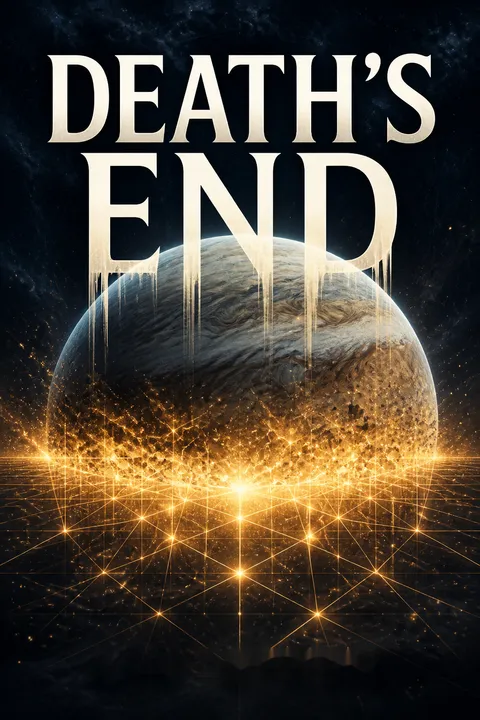


Plot Summary
Prologue
In 1453, as Ottoman cannons hammer Constantinople's walls, a prostitute named Helena demonstrates impossible magic — extracting objects from sealed stone chambers, removing a prisoner's brain through solid walls. Emperor Constantine sends her to assassinate Sultan Mehmed II.
But Helena cannot return from the mysterious place where her power resides. She dies pinned to a minaret wall, never knowing that her abilities came from a high-dimensional fragment briefly intersecting Earth.
The fragment departed hours before the city fell — twenty-five days of magic, then nothing. Her story prefigures the greater missed chances to come: dimensions that open and close, powers that arrive too late, the terrible gap between what physics permits and what human will can seize.
Tianming's Star
Yun Tianming2 is twenty-eight, dying of lung cancer, and utterly alone. His sister wants him euthanized to preserve their father's savings. A former college classmate, Hu Wen,14 arrives with three million yuan — profits from a beverage idea Tianming2 once tossed out casually.
The money cannot save him; his cancer has spread everywhere. But it ignites one final desire. Years ago in college, Tianming2 fell silently in love with Cheng Xin1 — a woman who once sat beside him at a reservoir, folded a paper boat, and set it drifting on rain-dimpled water.
Through a nearly defunct UN program auctioning distant stars, he buys DX3906 and registers it under her name. Then he applies for euthanasia. She will never know who gave her a world 287 light-years away.
Sending Only a Brain
At the newly formed PIA, Chief Thomas Wade3 proposes sending a spy probe to the decelerating Trisolaran Fleet. Cheng Xin,1 a young technical aide, invents en-route propulsion: nuclear bombs distributed along the probe's path, detonating sequentially to push a lightweight sail to one percent of lightspeed.
The concept is brilliant, but the mass limit is devastating — the entire assembly cannot exceed one metric ton, then five hundred grams. Wade's3 solution arrives with surgical coldness: they will send only a brain, flash-frozen, trusting that the Trisolarans can revive it.
The PDC approves the revised Staircase Program. Now they need a terminally ill volunteer willing to become humanity's loneliest ambassador — someone whose brain can serve as a ticking bomb inside the enemy's heart.
The Rescue That Wasn't
Tianming2 lies in the euthanasia room pressing confirmation buttons when Cheng Xin1 bursts through the door. She has not come out of love — she barely remembers him. She has come to recruit a dying man with spaceflight knowledge for the Staircase Program. His hysterical, silent laughter shakes the bed.
At the loyalty oath ceremony, Tianming2 refuses to pledge allegiance to humanity — a refusal that paradoxically makes him the ideal candidate, since the Trisolarans will believe his independence is genuine. His brain is surgically removed.
Only afterward does Wade3 reveal to the devastated Cheng Xin1 who bought her that star. She collapses sobbing over the sealed cryogenic container, too late to say anything. A surgeon whispers that the Trisolarans could, theoretically, clone his body from the brain's DNA. Seeds accompany the probe into deep space.
Bronze Age's Homecoming Trap
Fourteen years after the catastrophic Doomsday Battle, the warship Bronze Age decelerates toward Earth. Its crew survived the internecine dark battles between fleeing human ships by attacking another vessel, killing its crew, and consuming the remains as food.
Now they approach a transformed world where dark forest deterrence has brought peace. The welcoming crowds, the flowers, the tearful embraces are all holographic illusions. When every crew member disembarks, the simulation vanishes — replaced by armed military police and a cold voice announcing arrest for murder and crimes against humanity.
Before the convicted prisoners are transported to an asteroid-belt prison, one officer hijacks the ship's communication system and transmits a final warning to the other surviving warship, Blue Space: do not come back. Blue Space, already suspicious, immediately reverses course.
Wade's Bullet, Sophon's Tea
Cheng Xin1 wakes after 264 years. Her star has planets — one Earthlike — making her fabulously wealthy. Society has feminized: men resemble women, violence is nearly extinct, and the aging Luo Ji5 still grips the deterrence switch after fifty-four years.
Wade,3 also awakened and competing for the Swordholder position, shoots Cheng Xin1 twice with a centuries-old handgun; police destroy his arm and arrest him. Then Sophon,6 the Trisolaran robot ambassador, invites Cheng Xin1 for an elaborate tea ceremony. Beneath the ritual's beauty lies a clear message: this gentle world must be protected.
The public adores Cheng Xin1 — a maternal figure the feminized society trusts far more than the cold-eyed Common Era men vying for the position. Holding a stranger's baby before cheering crowds at the UN plaza, she accepts her candidacy.
Fifteen Minutes as Swordholder
Forty-five kilometers beneath the Gobi Desert, Luo Ji5 sits cross-legged in a white semicircular hall, facing the wall he has stared at for fifty-four years. He passes the red switch to Cheng Xin.1 Neither speaks. Prosecutors waiting in the lobby arrest him for suspected mundicide the moment he passes.
Within five minutes, warnings flood the screens: six strong-interaction probes, hidden just outside detection range, are accelerating toward Earth. Cheng Xin1 stares at the countdown. She imagines four billion years of evolution pressing down on her — dinosaurs, trilobites, a hundred billion pairs of human eyes.
The baby she once held seems warm in her arms again. She screams and throws the switch across the floor. The droplets obliterate all three gravitational wave transmitters. Dark forest deterrence dies without a single signal sent.
Four Billion on One Continent
Sophon6 reappears in camouflage and katana. A second Trisolaran fleet, traveling at lightspeed, will arrive in four years. Humanity must resettle to Australia within one year or face extermination. Droplets attack cities to enforce compliance. The Great Resettlement packs 4.16 billion people onto a single continent.
Cheng Xin,1 now blind from psychological trauma, lives with AA4 and an Aboriginal elder named Fraisse9 in the desert near Warburton. Society collapses into totalitarianism, nations fight over food, and the Australian army becomes the world's sole military power.
Then Sophon6 announces the final step: electricity will be cut, agricultural factories will die, and the starving population will cannibalize itself down to fifty million survivors. On that darkest morning, Cheng Xin1 sits sightless in the chaos, unable to see the dawning horrors around her.
Gravity's Universal Broadcast
One year earlier, in deep space beyond the Oort Cloud, Blue Space stumbles into a four-dimensional fragment — a bubble of higher-dimensional space. From this vantage, three-dimensional objects lie open like unrolled paintings. Using this advantage, the crew disables escort droplets and captures Gravity, humanity's gravitational wave transmitter ship.
Captain Chu Yan15 reveals the Second Trisolaran Fleet is traveling at lightspeed. He proposes broadcasting Trisolaris's coordinates. Among the combined crews of 1,415, a referendum is held. When the tally reaches 944 — the required two-thirds — dozens of hands press the red button together.
Twelve seconds of gravitational waves ripple through space-time, sentencing Trisolaris. On Earth, the broadcast is received a year later. The Trisolarans flee. The Great Resettlement reverses. But Earth's location is now exposed to the universe.
Trisolaris Annihilated
Three years and ten months after the broadcast, a star flares brighter than anything in the night sky. A near-lightspeed projectile has pierced Trisolaris's sun, blowing a fifty-thousand-kilometer hole through its photosphere. Solar material erupts in a fiery plume that intersects the planet's orbit.
Trisolaris passes through this column of plasma and emerges glowing — its ocean boiled away, an ocean of lava replacing the surface. Later, the wounded star collapses and explodes. The attack came not from another planetary system but from an unknown spaceship nearby.
Dark forest theory is confirmed with terrible finality. Sophon6 invites Cheng Xin1 and Luo Ji5 for a final tea ceremony. Luo Ji5 asks one precise question: does a cosmic safety notice exist? Sophon6 pauses, confers with distant controllers, and answers unequivocally — yes.
Tianming Tells Fairy Tales
Sophon6 reveals that Yun Tianming2 wants to see Cheng Xin.1 She travels alone to a Lagrangian point in a small dinghy rigged with a bomb — if the Trisolarans judge she's receiving forbidden intelligence, it detonates in three seconds.
A sophon unfolds, and Tianming2 appears: healthy, tanned, farming wheat aboard a Trisolaran vessel. They cannot discuss anything substantive; a yellow warning light flashes at the slightest approach.
So Tianming2 tells three fairy tales he claims she invented as a child — stories of a painter who captures people in portraits, a kingdom sealed by ferocious fish, and a princess who escapes on a soap-propelled boat. The green light stays on throughout. When the sophon vanishes and the bomb remains silent, Cheng Xin1 exhales. She has memorized every word.
Soap Boats and Maelstroms
AA4 buys antique bath soap from a museum. She places a paper boat with a soap fragment in a bathtub. The dissolving soap lowers surface tension behind the boat, pulling it forward — a model for curvature propulsion, where flattened space behind a ship lets curved space ahead pull it to lightspeed.
Cheng Xin1 sees the connection instantly but dares not speak openly; sophons might be listening. The IDC deciphers Tianming's2 layered metaphorical system: each critical message is hidden behind two levels of metaphor, confirmed by a supporting clue. A linguist traces the fairy tale name He'ershingenmosiken to two Norwegian locations beside the Moskstraumen — a massive maelstrom.
If lightspeed were reduced below the Solar System's escape velocity, the system would become a black hole: a cosmic safety notice declaring itself harmless. Three survival paths emerge: the Bunker Project, the black domain, and lightspeed ships.
Cheng Xin Gives Wade Everything
Curvature propulsion trails are discovered in space near Trisolaris — they permanently lower the speed of light in their wake, potentially exposing civilizations. Lightspeed ship research is banned worldwide. But Wade3 approaches Cheng Xin1 after a Bunker Project test.
He wants her company, her wealth, her authority — everything needed to build lightspeed ships in secret. She agrees on one condition: if the project ever threatens humanity, he must wake her and defer to her judgment. Wade3 hesitates visibly, then accepts, warning that keeping his promise may not be a blessing.
Cheng Xin1 and AA4 enter hibernation. Over the next sixty years, Wade3 transforms the Halo Group into a space construction empire, funneling profits into a hidden curvature propulsion program on Mercury, building the circumsolar particle accelerator that rings the Sun.
Cheng Xin Stops Wade Again
Sixty-two years later, Cheng Xin1 wakes in the Bunker World — space cities behind Jupiter. Ordinary life has returned: crowded buses, gossip about fish prices, couples whispering. Wade3 has achieved curvature propulsion, declared Halo City's independence, and armed soldiers with antimatter bullets — each capable of annihilating a space city.
She enters his laboratory. Soldiers in black stand with golden bandoliers across their chests, each cartridge a hydrogen bomb. One tells her they fight for the freedom to reach the stars. But Cheng Xin1 envisions fragile space cities shattering like eggs.
She orders Wade3 to disarm. He looks at her with exhaustion and quotes a line about losing human nature versus losing everything. She chooses human nature. Wade3 keeps his promise. The golden cartridges pile up on the laboratory platform. He is later convicted and executed.
Singer Flicks a Foil
In a distant arm of the Milky Way, a low-ranking alien called Singer12 sifts through broadcast coordinates, judging which civilizations warrant elimination. He spots the Solar System — already targeted once, its dead neighbor still glowing.
But he notices a nearby curvature propulsion trail, a sign of advancing technology. A simple mass dot won't suffice; the gas giants create blind corners. He requests a dual-vector foil from his Elder, who grants it without hesitation.
Singer12 peels the foil from its crystal packaging, admires its elegant lethality — a tenderness that turns death into a song — and flicks it toward the Sun with a force field feeler. Then he resumes singing a classical love ballad from his home world. The weapon drifts at lightspeed: a sliver of two-dimensional space that will flatten everything it touches.
The Painting of the Solar System
The foil arrives as a transparent slip of paper emitting faint light. Two ships investigate; the slip's protective packaging evaporates, exposing raw two-dimensional space. A cascade begins. Neptune flattens into concentric rings. Saturn follows.
Then Earth — its oceans freeze into hexagonal snowflakes five thousand kilometers across, forming a crystalline wreath around the planet's portrait. Space cities melt into the expanding plane, every atom preserved in position, every cell of every person laid open in a drawing of infinite complexity.
Cheng Xin1 and AA4 watch from Pluto as the Sun sinks into a dark red two-dimensional sea. Jupiter, humanity's chosen shield, follows. The Bunker Project — those fragile cities hiding behind gas giants — proves as useless as an umbrella in a flood of rewritten geometry.
Halo Escapes at Lightspeed
On Pluto, Luo Ji5 — nearly two hundred years old — reveals the final secret from humanity's underground tombstone. After Wade's3 execution, his followers continued curvature propulsion research on a hidden Mercury base. They built three engines. One is installed in Halo, Cheng Xin's1 yacht.
The Federation Government had collaborated in secret once they discovered that lightspeed trails could create black domains — the very safety notice they needed. But there wasn't time to build a thousand ships. Luo Ji5 orders Halo to leave.
As the Sun collapses into the two-dimensional plane, stars shift blue ahead and red behind. Halo crosses 287 light-years to DX3906 — Tianming's2 star — in fifty-two subjective hours, though centuries pass outside. Cheng Xin1 and AA4 are the only survivors of Solar System civilization.
Eighteen Million Years Too Late
At DX3906, cosmologist Guan Yifan7 waits on the habitable planet. He shares the universe's darkest truths: civilizations weaponize physical laws, collapsing dimensions and lowering lightspeed across galactic arms. When Tianming's2 ship arrives — AA4 confirms his presence on the surface — its curvature drive ruptures nearby zero-lightspeed death lines left by alien visitors.
The speed of light in the system crashes. Cheng Xin1 and Yifan,7 orbiting in a shuttle, are trapped at reduced lightspeed — each orbit takes fractions of a second for them, but millennia pass below.
After they manage to decelerate using an emergency antimatter engine, radiometric dating reveals 18.9 million years have elapsed. The planet is covered in purple vegetation. No trace of Tianming2 or AA4 remains — except giant letters carved into bedrock twenty-three meters down: WE LIVED A HAPPY LIFE TOGETHER.
Universe 647
A luminous rectangle rises from the ground — a door that admits only recognized humans. Cheng Xin1 and Guan Yifan7 step through into a one-cubic-kilometer pocket universe containing a wheat field, a white house, and a familiar face: Sophon,6 managing this miniature cosmos.
Tianming2 built it as a refuge for Cheng Xin1 to survive the great universe's collapse and witness a new big bang. But a supermembrane broadcast arrives from the Returners: too many civilizations have stolen mass for pocket universes, and the great universe may lack sufficient matter to collapse and be reborn.
Without the big crunch, there will be no new beginning — only eternal, cold expansion. Cheng Xin1 and Yifan7 decide to return their universe's mass. Robots cart soil, machinery, and structure through the door until almost nothing remains.
Epilogue
A spaceship carries Cheng Xin1 and Guan Yifan7 back into the great universe, leaving Universe 647 nearly empty. In the one-cubic-kilometer void, only two things remain: a sealed message bottle containing the memories of two civilizations, and a small transparent sphere — Cheng Xin's1 ecological world. Inside it, water globes drift in weightlessness.
A tiny fish leaps from one sphere into another, swimming between green algae. On a miniature continent, a dewdrop lifts from the tip of a grass blade, rises spiraling into the air, and refracts a single ray of light from its tiny sun into the surrounding darkness. Life, in its smallest possible form, endures in an otherwise empty cosmos.
Analysis
Death's End constructs the most elaborate moral trap in science fiction. Cheng Xin's1 compassion is not a character flaw but the precise quality her civilization values — the feminized Deterrence Era explicitly selects her BECAUSE she will not destroy. They receive exactly what they chose, and it annihilates them. Liu refuses to resolve this into a simple lesson. Wade3 is correct about physics but monstrous in method. Cheng Xin1 is noble in reasoning but catastrophic in result. The universe does not grade on intention.
The book's most radical proposition is that physical constants are archaeological artifacts. The speed of light, the number of macroscopic dimensions — these may be scar tissue from wars ten billion years old. The ten-dimensional Edenic universe was dismantled by civilizations willing to amputate their own dimensionality for military advantage. This transforms the trilogy's cosmological backdrop from natural order into war ruin, from physics into forensics.
Liu's treatment of scale is the novel's distinctive literary achievement. The narrative moves from the intimate — a man buying a star for a woman who doesn't know his name — to the literally universal: whether pocket universes are draining enough mass to prevent cosmic rebirth. These scales are causally connected. Tianming's2 love produces the fairy tales that encode the physics that could have built the black domain. A private emotion becomes a cosmological force, then is thwarted by another private emotion: Cheng Xin's1 inability to permit Wade's3 cruelty.
The Returners' broadcast poses the final question: when personal survival threatens the fabric of reality, what is ethical? Cheng Xin's1 decision to return mass to the dying universe is consistent with her lifelong pattern — she has always chosen the larger good over self-preservation. But this time, her characteristic impulse aligns with what the cosmos actually requires. The woman who was arguably wrong at every civilizational juncture finally acts correctly, precisely because the stakes have scaled beyond civilization into cosmology itself. Her weakness and her strength were always the same thing.
Review Summary
Death's End concludes the Remembrance of Earth's Past trilogy with epic scope and mind-blowing ideas. Many reviewers praise its ambitious narrative spanning millions of years and exploring complex scientific concepts. The female protagonist Cheng Xin receives mixed reactions, with some appreciating the representation and others finding her decisions frustrating. While some critique the pacing and character development, most agree the novel's grand scale and imaginative ideas make it a remarkable conclusion. Some readers found the ending disappointing, but overall, the trilogy is widely regarded as a masterpiece of hard science fiction.
Characters
Cheng Xin
Humanity's reluctant guardianAn aerospace engineer from the Common Era who becomes the most consequential decision-maker in human history. Her defining trait is instinctive maternal protectiveness extending to all of humanity—she cannot destroy to save. This quality makes her beloved by the feminized future society and unsuited for deterrence. Shaped by her adoption story—her mother chose her out of pure love and sacrificed relationships to protect her—Cheng Xin inherited love as her governing principle. She is perpetually caught between responsibility and compassion, between what survival demands and what her conscience permits. Placed repeatedly in positions of godlike authority, she possesses a fundamentally human heart. Her psychology represents the collision between individual morality and civilizational necessity—the question of whether kindness can survive cosmic stakes.
Yun Tianming
The silent lover in exileA terminally ill aerospace engineer whose unrequited love for Cheng Xin1 defines his existence. Raised in emotional isolation by parents who demanded elite refinement while living ordinary lives, Tianming developed a sealed-off interior world and a deep capacity for silent devotion. His love for Cheng Xin1 is the only warmth in his life—he would give her a star without expecting her to know his name. Paradoxically, his profound aloneness makes him uniquely suited for unimaginable challenges: someone comfortable in absolute solitude, resistant to psychological breakdown, willing to sacrifice everything for a connection that may never be reciprocated. His creativity—once dismissed as idle talk that made a classmate14 a billionaire—proves to be his greatest asset. He represents the power of private devotion to alter the trajectory of civilizations.
Thomas Wade
Ruthless visionary without limitsFormer CIA operative turned PIA chief, Wade embodies the pure will to advance without moral constraint. His psychology is that of the consummate predator: cold, calculating, capable of genuine cruelty, and willing to sacrifice any individual for the species. He takes pleasure in watching others despair—not from sadism, but from a conviction that despair sharpens resolve. His relationship with Cheng Xin1 is the book's central tension: he represents everything she opposes, yet his reasoning proves prescient. His catchphrase—advance without regard for consequences—distills a philosophy that treats morality as a luxury survival cannot afford. Wade is not evil in the conventional sense; he is evolution stripped of sentiment, a human being who has fully internalized the dark forest's logic while retaining enough humanity to keep a promise that costs him everything.
AA
Cheng Xin's irrepressible anchorCheng Xin's1 closest friend and business partner, a vivacious astronomer-turned-CEO who bridges Common Era and future sensibilities. AA's defining quality is resilience—she bounces back from every catastrophe with irrepressible energy, whether fighting hostile roommates in Australian refugee camps or managing a space construction empire behind Jupiter. She provides Cheng Xin1 with the emotional grounding that keeps her functional. Shrewd and practical where Cheng Xin1 is idealistic, she possesses a scientist's sharp eye—her doctoral discovery of planets around DX3906 creates the chain of events that transforms Cheng Xin's1 life—combined with a fearless willingness to act. Her decoding of the soap-boat metaphor demonstrates that brilliance lives in playfulness as much as in solemnity.
Luo Ji
The original SwordholderThe first Swordholder who maintained dark forest deterrence for fifty-four years through sheer force of will. Once a carefree, irresponsible professor, he was hardened by the Wallfacer Project into a figure of terrifying stillness. He sacrificed his family and his ability to speak to keep two civilizations in check, staring at a wall like a duelist poised to strike. His gaze became his weapon—projecting across four light-years the absolute certainty that he would press the button. Respected by his enemies but resented by the civilization he protected, he embodies the paradox that guardians must become what their wards fear.
Sophon
Trisolaran ambassador and shapeshifterThe Trisolaran robot ambassador, controlled by sophon particles. She manifests as an impossibly beautiful Japanese woman who shifts between identities: gracious tea ceremony hostess, terrifying katana-wielding ninja, coldly analytical spokeswoman, and ultimately, caretaker. She represents Trisolaris's complex relationship with humanity—simultaneously captor, diplomat, and executioner. Her various incarnations mirror the shifting power dynamics between the two civilizations, and her abiding concern for Cheng Xin's1 welfare hints at something approaching respect between species.
Guan Yifan
Cosmologist haunted by cosmic truthA civilian cosmologist originally aboard Gravity who has traversed four centuries through hibernation. Perpetually thoughtful, he is consumed by the universe's apparent degradation—its too-few dimensions, its too-slow light. His knowledge of the cosmos's darkest truths makes him both invaluable and melancholic. He suspects that physical constants are war ruins, that the ten-dimensional Edenic universe was dismantled by civilizations willing to amputate their own dimensionality for military advantage. His warmth and steadiness provide a counterpoint to the universe's indifference.
Vadimov
Cheng Xin's protective mentorCheng Xin's1 boss at the PIA, a Russian aerospace veteran who becomes her surrogate big brother. Generous and self-aware, he recognizes he would be the ideal Staircase candidate but struggles with the weight of that knowledge against his love for his young wife and baby daughter. He hides their photographs under his pillow, superstitiously protecting them from danger. His generosity toward Cheng Xin1—encouraging her brilliance without jealousy—represents the human warmth the PIA's mission constantly threatens to extinguish.
Fraisse
Aboriginal elder, spiritual anchorAn Aboriginal Australian elder who shelters Cheng Xin1 during the Great Resettlement. A hibernation survivor from the Common Era, he maintains transcendent calm by reconnecting with his ancestors' way of life. His nightly phone calls—simple descriptions of sunrises, kangaroos, desert rain—sustain Cheng Xin1 through her blindness and despair. He performs a Māori war haka to demonstrate what holding the enemy's gaze really means, then gently tells Cheng Xin1 that her failure is not her fault.
Cao Bin
Physicist bridging erasA Common Era physicist and colleague of the famous Ding Yi who hibernates across centuries. He participates in the Swordholder competition and later assists with curvature propulsion research, serving as Cheng Xin's1 guide to each new era she awakens into.
Bi Yunfeng
Accelerator builder, idealistA particle accelerator engineer from the Common Era who designs the circumsolar particle accelerator and passionately supports Halo City's lightspeed ship research, devoting decades to the dream of interstellar flight.
Singer
Alien cleansing agentA low-ranking alien who sifts through broadcast coordinates and casually launches the dual-vector foil at the Solar System while singing ancient songs from his home world.
Bai Aisi
Physicist aboard RevelationA Crisis-Era physicist aboard the exploration ship Revelation who identifies the dual-vector foil as two-dimensional space and calculates that the escape velocity from the collapse equals lightspeed.
Hu Wen
Inadvertent benefactorTianming's2 college classmate who built a beverage empire from Tianming's2 offhand idea and returns with three million yuan, inadvertently enabling the star purchase that changes history.
Chu Yan
Captain of Blue SpaceThe scholarly captain of Blue Space who orchestrated survival during the dark battles and later leads the referendum to broadcast Trisolaris's coordinates via gravitational waves.
Plot Devices
Dark Forest Deterrence
Mutual destruction keeps peaceThe gravitational wave broadcast system serves as humanity's shield against Trisolaran invasion. Massive antennas can transmit both civilizations' coordinates to the universe, guaranteeing mutual annihilation. The system's effectiveness depends entirely on the Swordholder—the single individual controlling the switch. When wielded by Luo Ji5, whose psychological profile promises a ninety-percent-plus probability of activation, Trisolaris dares not act. But the system contains a fatal design flaw: it requires one person willing to destroy two worlds, and humanity's democratic process ultimately selects someone who cannot. The architecture—too few space-based transmitters, too dependent on a single fallible human—reflects civilization's deeper inability to maintain the predatory vigilance the dark forest demands.
The Staircase Program
Sends Tianming's brain to TrisolaransA desperate early-Crisis initiative using nuclear pulse propulsion to accelerate a tiny probe to one percent of lightspeed. Cheng Xin1 invents en-route propulsion—distributing nuclear bombs along the flight path rather than carrying fuel aboard. When the payload limit shrinks to five hundred grams, Wade3 proposes sending only a brain. The program launches successfully but a cable breaks near Jupiter, sending the probe off-course. Despite its apparent failure, the Trisolarans intercept the probe, creating humanity's only embedded agent in an alien civilization. The Staircase Program embodies a recurring pattern: humanity's most consequential achievements arise from projects that appear to have failed, their true significance visible only across centuries.
Yun Tianming's Fairy Tales
Strategic intelligence in metaphorThree stories embedded within over a hundred fairy tales, encoding critical strategic intelligence through a sophisticated system of dual-layer metaphors and bearing coordinates. A soap-propelled boat points to curvature propulsion. A spinning umbrella maps to a centrifugal governor—encoding the constancy of the speed of light. The Moskstraumen maelstrom encodes the black domain concept. Each real message requires two metaphorical layers plus a confirming coordinate to resolve literary ambiguity into concrete intelligence. One metaphor—a painter who captures people in portraits, dissolving them from three-dimensional reality—goes undeciphered by the committee. It describes the dimensional strike that would ultimately prove the Bunker Project worthless.
Dual-Vector Foil
Collapses 3D space into 2DA sliver of two-dimensional space sealed in a protective field, launched at the Solar System by an alien named Singer12. When the packaging evaporates, the raw two-dimensional space contacts three-dimensional reality and triggers an irreversible cascade: everything touching the expanding plane is flattened into a depthless image preserving all structural detail at the atomic level. The foil renders the Bunker Project worthless—hiding behind gas giants is meaningless when space itself is being rewritten. It represents the dark forest's ultimate indifference: a weapon tossed casually by a low-ranking alien, transforming an entire stellar system into artwork. The foil's characteristic is what Singer12 calls an unyielding tenderness that turns death into a song.
Curvature Propulsion / Black Domain
Lightspeed drive that doubles as shieldThe curvature engine flattens space behind a ship, allowing curved space ahead to pull it asymptotically to lightspeed. Its critical secondary effect: the trail permanently reduces the speed of light in that region. If enough ships departed from a star in every direction, their overlapping trails could lower lightspeed below escape velocity, creating a reduced-lightspeed black hole—a black domain—that serves as a cosmic safety notice. This dual function means lightspeed ships are simultaneously the path to stellar escape AND the mechanism for the safety notice. The connection between the two is not discovered until late in the research process, and by then, decades of potential development time have been lost to political prohibition and internal conflict over the technology.
FAQ
Synopsis & Basic Details
What is Death's End about?
- Uneasy peace shatters: Half a century after the Doomsday Battle, the fragile balance maintained by Dark Forest Deterrence is threatened, despite advancements and cultural exchange between Earth and Trisolaris.
- Ancient knowledge resurfaces: Cheng Xin, awakened from hibernation, holds knowledge of a forgotten program that could disrupt the delicate balance between the two worlds.
- Dark and dangerous universe: The story explores the unforgiving nature of the universe, questioning whether humanity can reach for the stars or will perish in its infancy.
Why should I read Death's End?
- Cosmic scale and philosophical depth: The novel grapples with profound questions about humanity's place in the universe, the nature of good and evil, and the long-term consequences of our choices.
- Intricate plot and compelling characters: Liu Cixin weaves a complex narrative filled with memorable characters, unexpected twists, and thought-provoking scenarios.
- Exploration of advanced scientific concepts: The book delves into mind-bending concepts such as dimensionality, curvature propulsion, and the implications of manipulating the fundamental laws of physics.
What is the background of Death's End?
- Historical and Cultural Revolution context: The series is rooted in the trauma of the Cultural Revolution, influencing Ye Wenjie's initial contact with Trisolaris.
- Technological advancements: The story explores advanced concepts like particle accelerators, hibernation technology, and gravitational wave transmitters, extrapolating from existing scientific principles.
- Political and social commentary: The novel reflects on the nature of power, the challenges of global governance, and the potential for both cooperation and conflict in the face of existential threats.
What are the most memorable quotes in Death's End?
- "No banquet is eternal. Everything has an end. Everything.": This quote encapsulates the overarching theme of impermanence and the inevitable decline of civilizations, highlighting the futility of clinging to power or glory.
- "The city is fallen and I am still alive.": Constantine XI's defiant words before his death underscore the human spirit's resilience in the face of overwhelming odds, even when all hope seems lost.
- "I want to be remembered.": Helena's motivation for attempting to assassinate Mehmed II reveals a deep-seated human desire for legacy and recognition, even through morally questionable actions.
What writing style, narrative choices, and literary techniques does Liu Cixin use?
- Blend of hard science fiction and philosophical speculation: Liu Cixin seamlessly integrates complex scientific concepts with profound philosophical questions, creating a unique and thought-provoking reading experience.
- Use of excerpts from "A Past Outside of Time": These excerpts provide historical context and philosophical reflections, adding depth and complexity to the narrative.
- Shifting perspectives and time manipulation: The novel spans vast stretches of time and shifts between different characters' perspectives, offering a panoramic view of humanity's struggle for survival.
Hidden Details & Subtle Connections
What are some minor details that add significant meaning?
- The significance of the number of stars auctioned: The fact that only seventeen stars were auctioned off in the Stars Our Destination Project highlights the limited appeal of escapism and the project's ultimate failure as a resource-generating initiative.
- The description of the particle accelerator as a "full stop mark": This seemingly simple description foreshadows the end of physics as Yang Dong knows it, and the limitations humanity faces in understanding the universe.
- The lunar eclipse as a terrible portent: This detail in the opening section foreshadows the fall of Constantinople, linking the fate of the city to cosmic events and highlighting the role of superstition in human affairs.
What are some subtle foreshadowing and callbacks?
- The origami boat at Miyun Reservoir: This seemingly insignificant event foreshadows Yun Tianming's later gift to Cheng Xin and the themes of love, loss, and the passage of time.
- The discussion of euthanasia: The early introduction of the euthanasia law foreshadows Yun Tianming's decision and the ethical dilemmas surrounding end-of-life choices in a crisis-ridden world.
- The mention of Orban, the Hungarian engineer: This historical reference foreshadows Helena's potential betrayal and highlights the theme of individuals switching allegiances for personal gain.
What are some unexpected character connections?
- Dr. Zhang's connection to Cheng Xin: The revelation that Dr. Zhang knew Cheng Xin's sister adds a layer of complexity to his motivations and raises questions about his role in Yun Tianming's euthanasia.
- Hu Wen's transformation into a beverage entrepreneur: This unexpected career change highlights the adaptability and resilience of individuals in the face of crisis, as well as the unpredictable nature of life.
- The spy in the guise of a friar: This minor character connection reveals the extent of Constantine's desperation and the lengths to which he was willing to go to protect Constantinople.
Who are the most significant supporting characters?
- Sophon: As the Trisolaran ambassador, Sophon plays a crucial role in shaping events and influencing human decisions, embodying the complex relationship between the two civilizations.
- AA: As Cheng Xin's friend and confidante, AA provides emotional support and practical guidance, representing the enduring power of human connection in the face of adversity.
- Guan Yifan: As a cosmologist and fellow traveler, Guan Yifan offers intellectual insights and philosophical perspectives, helping Cheng Xin navigate the mysteries of the universe.
Psychological, Emotional, & Relational Analysis
What are some unspoken motivations of the characters?
- Ye Wenjie's desire for redemption: While her actions led to the Trisolar Crisis, Ye Wenjie may have been motivated by a desire to find meaning and purpose after experiencing immense personal trauma.
- Thomas Wade's obsession with control: Wade's ruthless pursuit of power may stem from a deep-seated fear of vulnerability and a need to impose order on a chaotic universe.
- Cheng Xin's yearning for connection: Despite her aloofness, Cheng Xin may be driven by a desire for genuine human connection, as evidenced by her relationships with Yun Tianming and AA.
What psychological complexities do the characters exhibit?
- Luo Ji's transformation from cynical intellectual to world savior: Luo Ji's journey reveals the potential for individuals to rise to extraordinary challenges, but also the psychological toll of wielding immense power.
- Yang Dong's struggle with existential dread: Yang Dong's exploration of physics leads her to question the nature of reality and experience a profound sense of alienation and despair.
- Helena's desire for recognition: Helena's motivation for assassinating Mehmed II reveals a complex mix of ambition, insecurity, and a yearning for historical significance.
What are the major emotional turning points?
- Yang Dong's suicide: This event marks a turning point in the story, highlighting the devastating impact of the Trisolar Crisis on individuals and the fragility of human existence.
- Yun Tianming's acceptance of euthanasia: This decision reflects his resignation to fate and his desire to alleviate the burden on his family, showcasing the emotional complexities of end-of-life choices.
- Cheng Xin's realization of her role in the failure of deterrence: This moment of self-awareness marks a profound shift in Cheng Xin's character, as she grapples with the consequences of her actions and seeks redemption.
How do relationship dynamics evolve?
- Cheng Xin and Yun Tianming's unrequited love: Their relationship evolves from a distant admiration to a profound connection forged through sacrifice and shared experiences, highlighting the enduring power of love across time and space.
- Cheng Xin and AA's enduring friendship: Their friendship provides emotional support and stability in a world of constant change, demonstrating the importance of human connection in the face of adversity.
- Humanity's relationship with Trisolaris: The relationship evolves from fear and hostility to uneasy peace and cultural exchange, ultimately culminating in betrayal and the collapse of deterrence.
Interpretation & Debate
Which parts of the story remain ambiguous or open-ended?
- The true nature of the universe: The novel leaves open the question of whether the universe is truly a dark forest or if there are other possibilities for interstellar relations.
- The motivations of the higher-dimensional beings: The novel offers glimpses of beings with unimaginable power, but their ultimate goals and intentions remain shrouded in mystery.
- The fate of the new universe: The novel ends with the creation of a new universe, but its future remains uncertain, leaving the reader to ponder the possibilities and challenges that lie ahead.
What are some debatable, controversial scenes or moments in Death's End?
- Cheng Xin's decision not to activate the deterrence system: This decision is highly controversial, with some arguing that it was a betrayal of humanity and others claiming that it was a morally justifiable choice.
- The portrayal of the feminized future society: The novel's depiction of a society dominated by feminine values has been interpreted as both a utopian vision and a dystopian warning.
- The use of euthanasia as a plot device: The novel's exploration of euthanasia raises complex ethical questions about individual autonomy, societal responsibility, and the value of life.
Death's End Ending Explained: How It Ends & What It Means
- The collapse of the Solar System into two dimensions: This event signifies the ultimate failure of humanity to navigate the dark forest and the tragic consequences of their choices.
- The creation of a new universe: This act of cosmic creation offers a glimmer of hope for the future, suggesting that even in the face of annihilation, new beginnings are possible.
- The journey to Universe 647: Cheng Xin and Guan Yifan's decision to enter the mini-universe represents a final act of responsibility and a testament to the enduring human spirit, even as they face an uncertain future.
Remembrance of Earth's Past Series Series


About the Author

Download PDF
Download EPUB
.epub digital book format is ideal for reading ebooks on phones, tablets, and e-readers.








































