

Key Takeaways
Most hot tech products die in the gap between early buyers and the mainstream
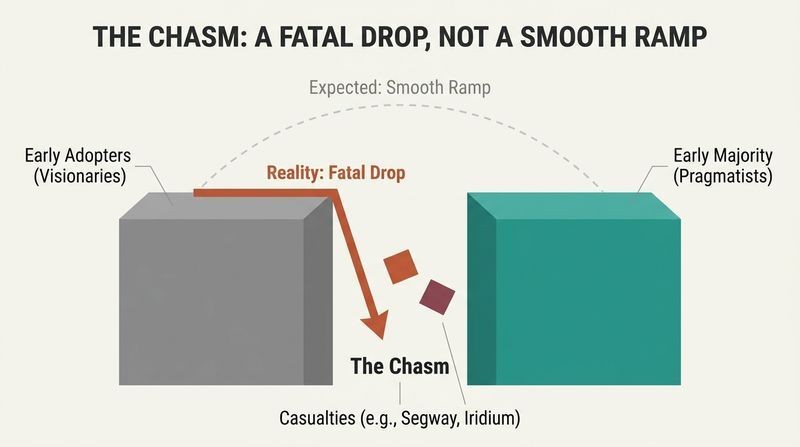
The chasm is a fatal transition, not a smooth ramp. Moore's central claim upends the comfortable assumption that a promising product simply rolls from enthusiasts to the masses. In reality, a deep gap separates early adopters (visionaries) from the pragmatist early majority. Sales spike early, then mysteriously stall. Founders, mistaking the initial blip for a takeoff, spend heavily on expansion right when cash is drying up. The result is the high-tech parable: dismal quarters, fired VPs of marketing, brutal down-rounds, and a zombie company.
Real casualties fill the chasm: the Segway (killed by stairs), Motorola's Iridium satellite phones (killed by buildings, a reputed $6 billion loss, network sold for $25 million), QR codes, and pen tablets. Good technology is not enough.
What's striking is how well this 1991 diagnosis predicts modern startup death. The chasm reframes the venture 'valley of death' as a demand problem, not just a funding one. It resonates with Clayton Christensen's work on disruption and with the base-rate reality that most funded startups fail despite working products. One nuance worth flagging: consumer internet businesses (Facebook, Skype) often scale virally without any classic chasm, which Moore concedes belongs to a separate model. The chasm framework is sharpest for business-to-business products requiring behavioral and infrastructure change, less so for frictionless app downloads.
Buyers split into five psychological types, not one smooth demand curve
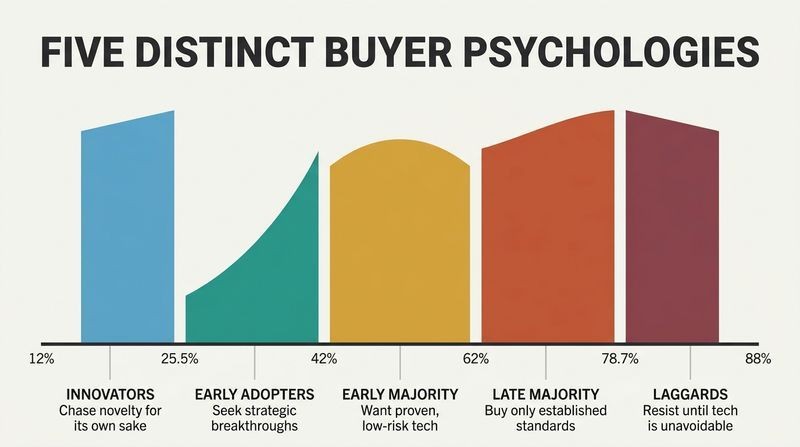
Adoption follows a bell curve of five psychographic profiles. Moore borrows the Technology Adoption Life Cycle (originally from studies of farmers adopting new seed potatoes) and sorts buyers by their gut response to disruptive innovation:
1. Innovators (techies): chase technology for its own sake
2. Early adopters (visionaries): buy a strategic breakthrough
3. Early majority (pragmatists): want proven, low-risk improvement
4. Late majority (conservatives): buy only established standards
5. Laggards (skeptics): resist until tech is hidden inside something else
Each group needs its own pitch. The classic model says use each captured group as a reference to swing to the next, like Tarzan on vines. Ask someone when they would buy an electric car and their answer reveals their type: first on the block versus not until gas becomes inconvenient.
The genius here is treating markets as populations of distinct minds rather than a monolithic 'demand.' This anticipates modern behavioral segmentation and jobs-to-be-done thinking. The categories map loosely onto personality research: innovators skew high on openness, conservatives high on risk-aversion. A caveat: real individuals shift type by category. Someone can be a visionary about phones and a laggard about kitchen gadgets. The profiles describe behavior toward a specific innovation, not fixed identity, which is why the model works best when applied narrowly rather than as a horoscope for whole customer bases.
Visionaries want revolution; pragmatists want evolution, so one can't sell the other
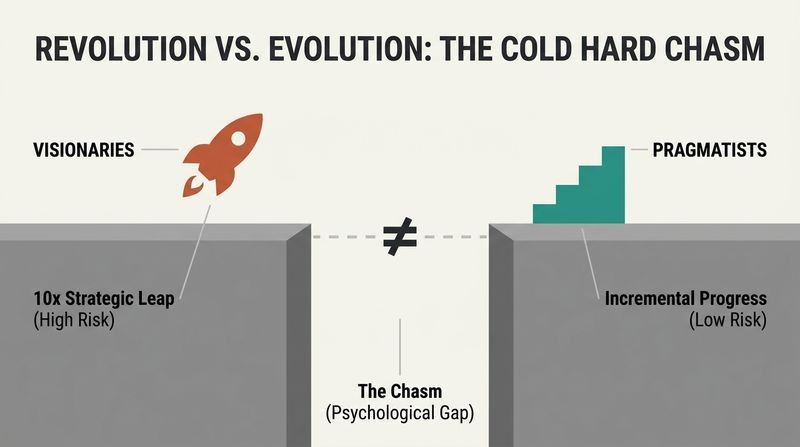
The chasm exists because the two adjacent groups are psychologically incompatible. Visionaries buy a dream: a tenfold strategic leap that leapfrogs competitors, and they tolerate bugs, custom projects, and missing infrastructure as the price of being first. Pragmatists want a percentage improvement with minimal disruption, extensive references, and a working whole product. Four visionary traits actively repel pragmatists:
1. They disregard colleagues' experience (references bore them)
2. They care more about technology than their own industry
3. They ignore existing infrastructure and standards
4. They leave chaos and disruption in their wake
This creates a catch-22: pragmatists demand references from other pragmatists, but no pragmatist will buy first. Same customer name on the check, radically different sale.
This is the deep structure beneath the chasm, and it echoes the sociology of diffusion. Everett Rogers found later adopters trust peer networks, not media or mavericks. Pragmatists communicate 'vertically' within their industry, while visionaries roam 'horizontally' across fields, so word of mouth simply does not cross the gap. The insight generalizes beyond tech: any organization trying to move a bold idea from champions to the cautious majority faces this reference vacuum. The practical corollary is brutal: the very customers who fund your birth become useless as social proof for your survival.
Cross the chasm like D-Day: overwhelm one tiny beachhead, then expand
Concentrate all forces on a single niche you can dominate. Moore's controlling metaphor is the Normandy invasion: you cannot liberate Europe by attacking everywhere, so you seize one beach with overwhelming force. Pick one narrowly bounded market segment with an unbearable problem, win over half its new orders, and use that dominance to topple adjacent segments like bowling pins. Documentum did exactly this: it targeted regulatory affairs departments in pharma (only about 40 companies worldwide), where slow drug-application filing cost roughly $1 million per day. From that beachhead it rolled into research, manufacturing, oil refineries, and finance, reaching over $100 million.
The enemy is the sales-driven instinct to chase every deal. Scattered wins in five segments generate zero word of mouth. Four wins in one segment ignite it.
The counterintuitive move is choosing a smaller pond on purpose. What matters is not the segment's size but the intensity of its pain, because acute pain pulls you out of the chasm fast. This mirrors military doctrine (concentration of force) and Peter Thiel's later 'monopoly' argument to start with a small market you can own. The bowling-pin logic also reframes the financial case: entrepreneurs should pitch the sum of the head pin plus all downstream niches, not just the tiny first target. Moore notes Microsoft ignored this by inheriting a de facto standard, a warning that famous exceptions make terrible strategy templates.
Pragmatists buy the whole product, not the thing in your box
Ship the complete solution, or the promise breaks. Borrowing from Theodore Levitt, Moore distinguishes the generic product (what you ship) from the whole product (everything the customer needs to actually achieve their goal: support, integrations, standards, partners, training). Techies happily cobble together their own whole product. Visionaries build it themselves. Pragmatists refuse: they want it ready on day one. This is why they prefer arguably inferior products like Microsoft Office or Cisco routers, because the surrounding ecosystem is complete.
High tech chronically delivers 80-90% of the whole product and almost never 100%, leaving customers feeling cheated and unwilling to serve as references. During the chasm crossing there is no external help coming, so you must recruit partners and tactical alliances to fill every gap yourself.
The whole product concept is arguably the book's most durable export, now standard vocabulary in product management. It explains the paradox of the winning-but-worse product: markets standardize on ecosystems, not features. Network effects and complementary-goods economics reinforce this. Aruba beat Cisco in campus Wi-Fi not with better radios but by absorbing network management, security, and video partners into one solution too fiddly for a giant to bother matching. The subtle warning is against feature-obsessed engineering cultures: past a point, more R&D on the core product yields diminishing returns while whole-product investment compounds loyalty.
Choose your target with vivid customer stories, not market-size spreadsheets
Crossing the chasm is a high-risk, low-data decision, so trust informed intuition. You are entering a market you have never penetrated with a product no one has experienced, so analyst forecasts (a billion-dollar market, we only need 5%) are a house of cards. Moore prescribes target customer characterization: write dozens of one-page scenarios of specific imagined people getting stuck, each capturing the situation, desired outcome, interfering factor, and economic consequence, then a rewritten 'after' version with the new product.
Rank each scenario against showstopper factors: Is there a single identifiable economic buyer? A compelling reason to buy? A whole product deliverable within months? No entrenched competitor already there? Then score the nice-to-haves (partners, distribution, pricing, positioning, bowling-pin potential). Commit to one and only one beachhead.
The move from statistics to narrative is quietly radical for a business book. Moore argues intuition works by isolating a few memorable, high-quality images rather than crunching samples, which aligns with Gary Klein's research on naturalistic expert decision-making and Kahneman's recognition-primed judgment. Personas, now ubiquitous in design, trace much of their lineage here. The risk is confirmation bias: made-up scenarios can encode the founder's wishes rather than reality. Moore hedges by advising early validating market research, but the deeper wisdom is his white-water rafting rule: in the chasm, a decisive imperfect choice beats data-paralysis, because standing still favors incumbents.
Invent your own competitors so pragmatists know where to file you
Where there is no competition, there is no market. Coming from an early market with no rivals, you must create a competitive set, because pragmatists refuse to buy until they can compare. Moore's tool uses two reference beacons. The market alternative is the vendor customers already spend money with (this identifies the budget you will capture). The product alternative is another company riding the same new technology (this legitimizes the disruption and lets you differentiate by niche focus).
Box positioned itself precisely at the intersection: Dropbox's ease of use meets SharePoint's enterprise standards. WorkDay named its own PeopleSoft heritage as the market alternative and Salesforce as the product alternative. Segway and Better Place failed partly because neither could name a credible market alternative, so there was no budget to raid.
This is a sophisticated reframe of positioning as budget archaeology. The market alternative answers the buyer's real first question, which is not 'is this good?' but 'what pocket does this come out of?' Behavioral economists would note it exploits the anchoring and categorization instincts of the mind: humans evaluate the unfamiliar only against the familiar. The Segway autopsy is especially instructive, suggesting that if you cannot locate an existing budget or a peer riding your technology, you are not ready to cross. It is a rare positioning framework that doubles as a go, no-go readiness test.
Make your product easy to buy, not easy to sell, and pass the elevator test
Positioning lives in the customer's head, and less is more. Companies pile on selling arguments to make products easy to sell, which repels buyers. The goal instead is to occupy one uncontested space labeled 'best buy for this situation.' People are fiercely conservative about what you put in their heads and grant you only a telegram's worth of space, like BMW's 'upscale performance sedan.' Try to claim more and the market (and your competitors) fill the space for you.
Moore's discipline is the elevator test: if you cannot explain your position in a two-sentence formula (for target customers dissatisfied with the market alternative, our product is a category that provides a reason to buy; unlike the product alternative, we offer a specific whole product), then word of mouth dies, R&D scatters, and investors walk.
The 'easy to buy' inversion is a deceptively deep piece of sales psychology, consonant with Daniel Pink's finding that people resist being sold but enjoy buying. The demand to sacrifice claims, saying Verinata is not the cheapest test even when it is, cuts against every founder's instinct to advertise all their strengths. Cognitive load research supports the austerity: minds encode one attribute per brand, so a diffuse message encodes as nothing. The elevator test also functions as an organizational alignment device: a position too fuzzy to say in a sentence guarantees that marketing, engineering, and partners each build a different product.
Your top priority isn't revenue or profit, it's owning a distribution channel
Secure a channel pragmatists trust, and price to motivate it. During the chasm, the number-one corporate goal outranks revenue, profit, press, even customer satisfaction: establish a customer-oriented distribution channel, because everything else can be fixed later and this cannot. Moore maps five channels to five buyers:
1. Direct sales for enterprise executives (big-ticket, consultative)
2. Web self-service for individual end users (transactional, freemium)
3. Sales 2.0 for department managers (digital direct-touch)
4. Two-tier distribution for design engineers
5. Value-added resellers for small-business owners
Pricing's job in this window is not to please customers or investors but to motivate the channel. Price at the market-leader point (pragmatists expect to pay up to a 30% premium for the leader) and build in an unusually fat channel margin as a reward for the extra effort of pushing something new.
Elevating distribution above profit sounds heretical but reflects a hard truth about path dependence: the channel is the one decision you usually get to make only once. The insight that margin is the channel's reward, not the vendor's profit, reframes pricing as a behavioral incentive system rather than a value calculation. This connects to principal-agent theory: resellers optimize their own effort, so you must overpay them to overcome the inertia of their existing relationships. The subtlety pragmatists rarely articulate is that a premium price itself signals leadership, so underpricing to win deals can paradoxically make a product harder to buy.
After the chasm, fire your pioneers and bury the hockey-stick forecast
The company that crossed must become a different company. Moore's closing warning: post-chasm success is strangled by pre-chasm commitments. Two personality types who were essential fuel become liabilities. Pioneer technologists love inventing and loathe maintaining standards. Pioneer salespeople keep closing custom visionary deals that rob the mainstream R&D effort. Both must be redeployed or moved out, and replaced by 'settlers' who value predictable, orchestrated group performance.
Equally dangerous is the financing fiction. Startups raise money on hockey-stick curves (flat, then miraculous continuous growth) because that is what venture capital rewards. But real high-tech revenue climbs like a staircase: early-market spurt, chasm plateau, mainstream surge, repeat. Founders who mortgage their equity to a hockey stick get diluted into oblivion when the chasm plateau arrives right on schedule.
The pioneers-to-settlers transition is an underappreciated theory of organizational lifecycle, prefiguring the founder-versus-professional-manager tension studied by Noam Wasserman. It also raises an uncomfortable ethical question Moore faces directly: is it fair to recruit people whose success guarantees their own obsolescence? His answer, transparency and tailored compensation up front, is more humane than most scaling playbooks. The staircase-versus-hockey-stick critique remains a sharp indictment of spreadsheet-driven venture finance, where the revenue line is enslaved to the founder's cost curve and the investor's return expectations rather than to how markets actually mature. The prescription, sometimes seek profitability from day one, still cuts against growth-at-all-costs orthodoxy.
Analysis
Crossing the Chasm is a thesis-driven business strategy book aimed at high-tech marketers, founders, and their investors, built almost entirely on argument-by-analogy (the chasm, D-Day, bowling pins, pioneers and settlers). Its durability, over 600,000 copies and three decades of citation, comes from naming an intuition practitioners already half-knew: that early traction lies. By giving the phenomenon a vocabulary, Moore created a shared language that spread virally through engineering teams and venture firms, ironically demonstrating the word-of-mouth dynamics the book preaches.
The book's intellectual core is a correction to Everett Rogers's diffusion-of-innovations curve. Where Rogers implied smooth sequential adoption, Moore inserts discontinuities, most consequentially the chasm between visionaries and pragmatists. This single amendment reorganizes an entire discipline around one imperative: earn pragmatist trust through references, whole products, and market leadership. Everything downstream (niche targeting, whole-product planning, creating competition, channel-first pricing) serves that imperative.
The framework's greatest strength is also its boundary. It is fundamentally a business-to-business model for disruptive innovations that demand behavioral and infrastructure change. Moore is admirably candid that consumer internet phenomena often bypass the chasm entirely, requiring his separate Four Gears model (acquire, engage, monetize, enlist). Readers should resist applying chasm logic universally; a frictionless app and an enterprise database face different physics.
Modern readers will notice the examples date quickly, a problem Moore acknowledges by re-editing three times. But the underlying mechanics remain sound and increasingly relevant as software-as-a-service and product-led growth blur his channel categories. The deepest, least-quoted insight may be organizational: that crossing the chasm requires a company to stop being itself, shedding the pioneer culture that made early success possible. That is a psychological and human-capital argument disguised as a marketing one, and it is where the book transcends its genre.
Review Summary
Crossing the Chasm is a highly regarded marketing book focusing on the challenges of transitioning from early adopters to mainstream customers in high-tech industries. Readers praise its insights on market segmentation, positioning, and strategy for crossing the "chasm" between early and mainstream markets. While some find it dated, many consider it essential reading for entrepreneurs and product managers. The book's concepts are particularly relevant to B2B scenarios. Critics note its age and lack of data-driven approaches, but most agree it offers valuable frameworks for understanding technology adoption lifecycles.
People Also Read





Glossary
The Chasm
Deadly gap before mainstream adoptionThe dangerous, often unrecognized gap in the Technology Adoption Life Cycle between early adopters (visionaries) and the early majority (pragmatists). Sales stall here because visionaries make poor references for pragmatists, who refuse to buy without peer references. Many startups fall in and die, having mistaken early-market traction for the start of mainstream growth.
Technology Adoption Life Cycle
Five buyer types on bell curveA model, adapted from agricultural diffusion research, that segments buyers of a new technology by their psychological response to disruptive innovation: innovators (techies), early adopters (visionaries), early majority (pragmatists), late majority (conservatives), and laggards (skeptics). Each group forms a predictable portion of the market and requires a distinct marketing approach.
Whole Product
Complete solution beyond the boxThe full set of products and services a customer needs to achieve their buying objective, beyond the generic product a vendor ships. Includes integrations, support, standards, partners, and training. Pragmatists insist the whole product be complete before buying, which is why crossing the chasm requires recruiting partners and allies to fill every gap.
Visionaries
Early adopters buying strategic breakthroughsMoore's term for early adopters. Executives who match emerging technology to a strategic opportunity and fund high-risk, high-visibility projects seeking a tenfold competitive leap. They are price-insensitive, tolerate bugs, and act as venture-like funding, but their revolutionary demands make them poor references for the cautious mainstream.
Pragmatists
Early majority wanting proven improvementMoore's term for the early majority, the bulk of any mainstream market. They want incremental, low-risk, measurable improvement, extensive references from industry peers, a complete whole product, and market-leading vendors. Winning their trust is the entire point of crossing the chasm, and they reward loyalty with durable, high-volume business.
Bowling Pin Strategy
Niche wins topple adjacent nichesA market-expansion tactic where you dominate one beachhead niche, then use its customers, partners, and references to knock over adjacent segments, like bowling pins. Each subsequent niche requires less effort. Documentum used it to expand from pharma regulatory affairs into research, manufacturing, oil, and finance.
Market Alternative and Product Alternative
Two reference competitors you nameThe two beacons used to create competition when crossing the chasm. The market alternative is the established vendor whose budget you intend to capture, defining your category. The product alternative is another company using the same new technology, legitimizing the disruption and giving you a point of differentiation through niche focus.
Elevator Test
Two-sentence positioning claimA discipline requiring you to state your positioning in the time of an elevator ride, using a set formula naming target customer, market alternative, product category, compelling reason to buy, product alternative, and whole product. Failing it means your message cannot travel by word of mouth and your strategy is not investable.
Pioneers and Settlers
Post-chasm personnel transitionMoore's metaphor for the organizational shift after crossing the chasm. Pioneers (visionary technologists and salespeople) excel at creating early markets but resist standardization and must be redeployed. Settlers build the infrastructure, procedures, and predictable relationships that pragmatist mainstream markets demand.
Four Gears Model
Digital consumer adoption alternativeMoore's separate model for digital consumer businesses that scale without crossing a chasm. Its four interacting activities are acquire traffic, engage users, enlist the faithful, and monetize. It follows a 'ubiquity now, revenue later' logic, introducing monetization last to avoid stalling growth.
FAQ
What's Crossing the Chasm about?
- High-Tech Marketing Focus: Crossing the Chasm by Geoffrey A. Moore explores the challenges of marketing disruptive high-tech products to mainstream customers.
- Chasm Concept: Introduces the "chasm," a gap between early adopters and the mainstream market, which is crucial for a product's success.
- Frameworks for Success: Provides strategies for companies to transition from early adopters to the early majority effectively.
Why should I read Crossing the Chasm?
- Practical Insights: Offers actionable marketing strategies for high-tech industries, valuable for entrepreneurs and marketers.
- Understanding Customer Segments: Helps readers comprehend the Technology Adoption Life Cycle, crucial for effective marketing.
- Proven Success: Widely used by companies to refine marketing strategies, demonstrating its relevance and effectiveness.
What are the key takeaways of Crossing the Chasm?
- Targeting Importance: Emphasizes targeting a specific niche market to successfully cross the chasm and build a strong reference base.
- Whole Product Concept: Stresses the need for a complete solution, including services and support, to meet customer expectations.
- Marketing as Warfare: Suggests assembling a strong "invasion force" of resources and strategies to penetrate the mainstream market.
What is the "chasm" in Crossing the Chasm?
- Gap Between Markets: The "chasm" is the gap between early adopters and the mainstream market, where many products fail.
- Transition Challenges: Involves overcoming the challenges of moving from early adopters to a larger, skeptical mainstream audience.
- Focus on Pragmatists: Highlights the need to understand pragmatists, who require proven solutions and are more risk-averse.
What is the Technology Adoption Life Cycle in Crossing the Chasm?
- Stages of Adoption: Categorizes consumers into innovators, early adopters, early majority, late majority, and laggards.
- Bell Curve Representation: Illustrates how different segments adopt technology at varying rates, with early adopters being quicker.
- Marketing Implications: Understanding this cycle helps tailor strategies to reach each segment, especially the early majority.
What is the "whole product" concept in Crossing the Chasm?
- Complete Solution: Refers to the complete solution needed by customers, including the core product and necessary services.
- Four Levels: Includes the generic, expected, augmented, and potential product levels to meet customer needs.
- Importance for Pragmatists: Essential for pragmatists who expect a complete solution without additional effort.
How can I effectively target a niche market according to Crossing the Chasm?
- Identify Pain Points: Start by identifying a specific pain point your product can address to gain traction.
- Focus Resources: Concentrate resources on achieving dominance in the niche market for efficient marketing.
- Leverage Word of Mouth: Use satisfied customers to spread the word within a tightly-knit community.
What strategies does Moore suggest for crossing the chasm?
- Target a Specific Niche: Focus on a niche market to establish dominance and build credibility among pragmatists.
- Develop a Whole Product Offering: Ensure your product is supported by necessary services and features for mainstream appeal.
- Leverage Partnerships: Collaborate with partners to enhance your product offering and credibility.
How does Crossing the Chasm apply to modern technology?
- Relevance to Current Trends: Principles remain relevant with rapid technological innovation and new market emergence.
- Application in Startups: Startups can use chasm-crossing strategies to navigate growth challenges and establish a foothold.
- Adapting to New Technologies: Understanding customer adoption dynamics and the whole product concept is vital for success.
How does Crossing the Chasm define different customer segments?
- Technology Enthusiasts: Early adopters excited about new technology, crucial for initial feedback and validation.
- Visionaries: Seek competitive advantages through innovative solutions, willing to invest in promising technologies.
- Pragmatists: Cautious and require evidence of reliability, influenced by peer recommendations, crucial for mainstream adoption.
What are the best quotes from Crossing the Chasm and what do they mean?
- "If you don’t know where you are going, you will wind up somewhere else.": Emphasizes the importance of having a clear target market and strategy.
- "Marketing is warfare—not wordfare.": Highlights the aggressive nature of marketing in competitive environments.
- "Whole products grow up around the market-leading products.": Underscores the significance of establishing a strong market presence.
What is the significance of pricing in Crossing the Chasm?
- Motivating Distribution Channels: Pricing should motivate channels to promote and sell the product, crucial during the chasm period.
- Market Leadership Pricing: Set prices at a market leader level to attract pragmatist buyers willing to pay a premium.
- Balancing Value and Cost: Balance perceived value with pricing to attract customers while ensuring adequate margins.
About the Author
Other books by Geoffrey A. Moore


Download PDF
Download EPUB
.epub digital book format is ideal for reading ebooks on phones, tablets, and e-readers.








































