


Key Takeaways
Positioning is context, and context alone can make or break a product
Positioning sets the mental scene. April Dunford, who repositioned sixteen products as a startup marketing VP, defines positioning as deliberately setting the context that helps customers instantly grasp what you are, who you are for, and why you matter. The Washington Post's Joshua Bell experiment proves the stakes: one of America's finest violinists played incognito in a subway station and earned $32.17 in 45 minutes. Same virtuoso, same Stradivarius, radically different context.
Weak positioning sabotages everything else. When a product is misframed, prospects can't figure it out, sales cycles drag, churn spikes, and you face price pressure. Dunford compares it to speaking Japanese slowly and loudly to an English speaker: pouring more marketing budget behind confusing positioning just amplifies the confusion.
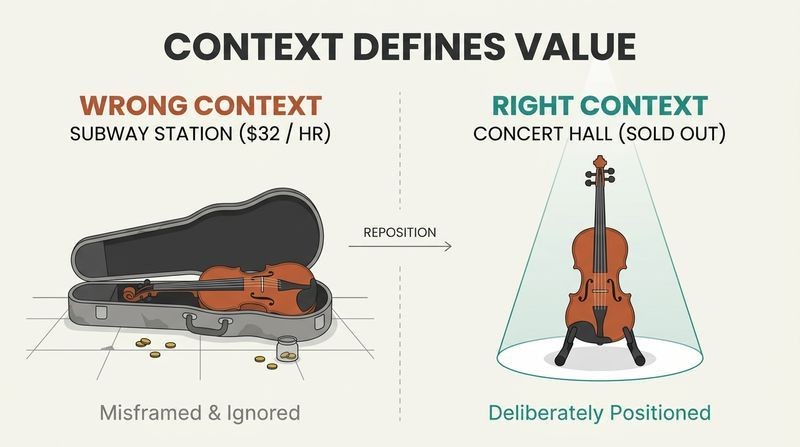
What's compelling is how Dunford reframes a soft-sounding marketing word into a hard business lever. The Joshua Bell story echoes behavioral economics: Kahneman's work on framing shows the same information yields different decisions depending on presentation. There is a nuance worth flagging, though. The subway experiment also measured attention under time pressure, not just context, so it slightly overstates positioning's power. Still, the core insight holds across disciplines. Marina Abramovic's line that baking bread in a gallery makes you an artist captures it: value is not intrinsic to the object but assigned by the frame surrounding it.
Any product can live in many markets, and the default is rarely best
Escape the two traps. Dunford argues most creators never choose their positioning deliberately. Trap 1: you stay fixated on what you set out to build even after the product morphed into something else. Trap 2: you nailed a market once, but the market shifted underneath you. Her baker parable makes it concrete: a tiny chocolate cake could be sold as cake, but reframed as a muffin it competes with donuts, sells at coffee shops, and follows an entirely different business model. Same batter, different business.
Frankencake versus cake pop. A cake on a stick pitched as innovative cake sounds wrong. Reframed as a lollipop for grownups, the stick and ball suddenly belong. The features didn't change; the frame that makes them make sense did.
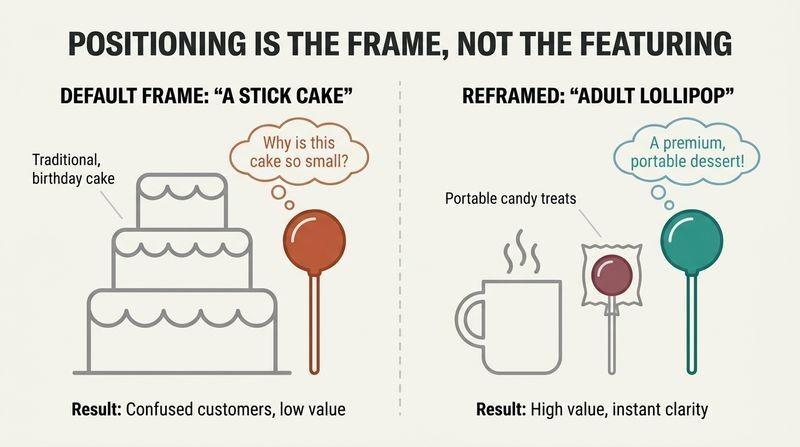
This is the book's central and most liberating claim. It connects to Clayton Christensen's Jobs to Be Done theory: customers hire products for a job, and the job defines the competitive set, not the product's ingredients. Arm and Hammer baking soda is the canonical proof, going from a baking ingredient to a fridge deodorizer and lifting sales from $16 million to over $318 million. The caution is that repositioning is not infinitely elastic. A frame must be credible, or customers reject it. The art lies in finding the frame where your genuine strengths become obvious rather than manufactured.
Never write a traditional positioning statement; it just cements your assumptions
The fill-in-the-blank template fails. Dunford recounts her first day at IBM, thrilled to finally learn positioning, only to be handed a mad-libs template: FOR target buyers, IS A category, UNLIKE competitor, WHICH PROVIDES benefits. Positioning a database, she produced circular nonsense and filed it away forever, coining her term malicious compliance. The template's fatal flaw is that it assumes you already know the right answers. It reinforces the status quo, hands the advantage to incumbent leaders, gives no clue whether your positioning is good or bad, and is impossible to memorize.
Do the work, don't document assumptions. Great positioning is a discovery process, not a template. If you are a baker debating cake versus muffin, filling in blanks never reveals the muffin option exists.
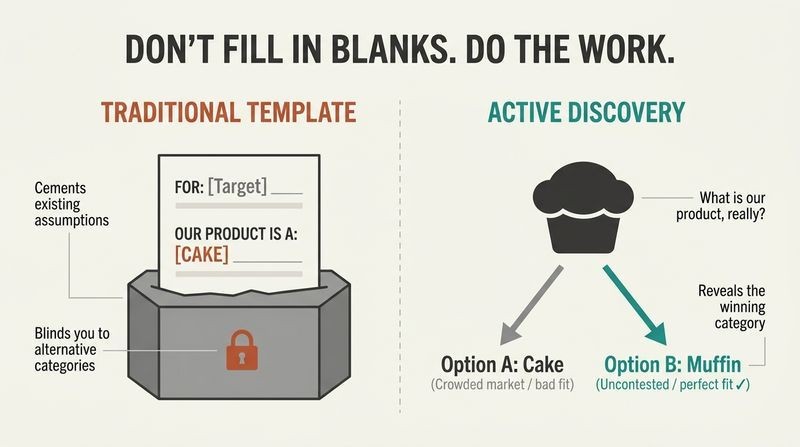
Dunford's takedown of a decades-old business-school staple is bracing and largely earned. The positioning statement, popularized alongside Geoffrey Moore's Crossing the Chasm, conflates capturing a decision with making one. Her critique parallels a broader complaint in strategy: templates optimize for looking rigorous rather than thinking rigorously. There is a steelman for the statement, though. As a final alignment artifact, once the hard thinking is done, a concise statement can keep teams consistent. Dunford essentially agrees, replacing it with her positioning canvas. The real target is using the template as a substitute for analysis rather than a summary of it.
Positioning breaks into five moving parts, plus one optional trend
Five components, defined in order. Dunford decomposes positioning so each piece can be perfected:
1. Competitive alternatives: what customers would do if you didn't exist
2. Unique attributes: features or capabilities the alternatives lack
3. Value and proof: the provable benefit those attributes deliver
4. Target market characteristics: who cares intensely about that value
5. Market category: the frame that triggers helpful assumptions
6. (Bonus) Relevant trends: something new that makes you urgent right now
Order matters because everything cascades. Attributes are only unique relative to alternatives; value flows from attributes; value determines who cares; that segment reveals the best market frame. Start anywhere else and the logic breaks. Dunford insists you begin with what customers see as alternatives, not with your own feature list.
The sequencing insight is the underrated gem here. Most teams instinctively start with their features because that is what they know and love, but Dunford shows this quietly smuggles in an assumed competitor set that customers may not share. Anchoring on competitive alternatives first is a discipline borrowed from customer research and design thinking: define the problem space before the solution. One tension worth naming is proof. Requiring objective, third-party validation for value claims is rigorous but hard for early-stage products with few reviews or references, which is precisely when positioning matters most.
Start with the customers who already adore you, not your product
Your best-fit customers hold the key. Dunford's breakthrough came from a coffee chat: the fastest path to good positioning is hunting for what already works, then decoding why. When she surveyed all customers about why they chose a product, the results were muddy noise. When she isolated only the ecstatic fans, a crisp pattern emerged. Best-fit customers understand you fast, buy fast, rarely haggle, refer friends, and defend you fiercely.
Fish with a wide net first. If you lack enough happy customers to spot a pattern, keep positioning loose and test broadly. Her fishing net metaphor: you think your net catches grouper, but if you keep hauling in tuna, move to the tuna spot. Positioning too tightly too early blinds you to your real market.
This is a quietly radical reordering of intuition. The natural instinct is to broaden the funnel to catch more fish, but Dunford argues narrowing to your delighted minority accelerates growth. It aligns with Everett Rogers's diffusion research and Paul Graham's startup advice to do things that don't scale and find customers who love you. There is a survivorship caveat worth flagging: your happiest current customers reflect who you already reached, not necessarily your largest addressable opportunity. Overfitting to ecstatic early adopters can trap a company in a niche. Dunford's segment-must-be-big-enough test partly guards against this, but the tension is real.
Your real competitors are whatever customers would use instead, often a spreadsheet
Customers define the yardstick. Dunford insists you catalog competitive alternatives from the customer's view, not yours. You may lose sleep over a rival startup, but your prospects have never heard of it. In business software, the most common alternative is a duct-taped combination of spreadsheets, documents, and manual effort. Sometimes the alternative is hiring an intern, or doing nothing at all because customers don't yet realize they have a problem.
Why this matters for claims. If you boast your product is easier to use than a competing app, but the customer's actual alternative is Excel, your claim only lands if you beat Excel. Dunford advises ranking alternatives from most to least common and clustering them into two to five groups, staying focused on best-fit customers.
This deceptively simple reframe dissolves a common startup delusion: obsessing over named competitors customers ignore. It connects to the concept of the status quo bias in behavioral economics, where inertia and the incumbent solution (even a clunky spreadsheet) are the true opponent. Andy Grove's observation that most products lose to non-consumption rather than rivals resonates here. A practical extension: interviewing lost deals and asking not why they rejected you but what they chose instead surfaces the real alternative. The main limitation is that customers are unreliable narrators of their own behavior, so observed switching beats stated preference.
Declaring a market category detonates a bomb of assumptions, for you or against you
Categories are cognitive shortcuts. Say you sell a CRM tool and customers instantly assume your competitor is Salesforce, your features include contact tracking, and your pricing is monthly per user. A well-chosen category does your explaining for free. A poor one forces you to spend every sales meeting battling wrong assumptions. Dunford's database startup lived this: calling themselves a database meant every prospect asked how they beat Oracle, a fight a startup could never win. Repositioned as a data warehouse, prospects stopped comparing them to Oracle and started buying.
When features don't match the frame. An email-for-lawyers product had no calendar and its prized feature was secure file sharing. Reframed as team collaboration software, its value became obvious and customers stopped hunting for missing email features.
Category is the highest-leverage and highest-risk lever in the book. Cognitive science backs it: categorization is how brains manage overwhelming choice, and the reference category anchors all subsequent judgments, an effect related to Kahneman's anchoring. The strategic subtlety Dunford surfaces is that the same product can be a weak entrant in one category and a category-defining leader in an adjacent one. The database-to-warehouse pivot even let them raise prices, since warehouses commanded a premium while databases were commoditized. The risk: choosing an aspirational category where you can't credibly meet baseline expectations invites the Frankencake reaction of instant rejection.
Pick one of three positioning styles based on your competitive reality
Match style to landscape. Once you choose a market frame, decide how you intend to win:
1. Head to Head: become leader of an existing category by beating the incumbent at its own game. Rarely wise for startups (don't try to out-cola Coke) unless no clear leader exists yet.
2. Big Fish, Small Pond: dominate a subsegment with distinct unmet needs the leader ignores. Selling Coke for dogs rather than fighting Coke.
3. Create a New Game: invent a category when no existing frame fits. Highest risk, biggest reward, requires teaching the market a problem exists.
Janna Systems proves the second style. Branded a cheaper, crappier Siebel in the giant enterprise CRM market, they repositioned as CRM for investment banks, grew from $2 million to over $70 million in eighteen months, and sold for $1.7 billion.
This taxonomy is Dunford's most practical strategic contribution, mapping neatly onto Michael Porter's logic that strategy means deliberate choice and trade-off. The counterintuitive move is Big Fish, Small Pond: teams fear that narrowing the market shrinks opportunity, when in practice it concentrates limited sales resources where you actually win and unlocks word-of-mouth within tight communities. Salesforce itself once ceded enterprise to Siebel and won small business first. Category creation, glamorized in Silicon Valley, is correctly flagged as brutally hard, requiring deep pockets and patience. Eloqua spent fourteen profitable quarters before investors even understood marketing automation. The honest warning: fast followers often steal the category the pioneer built.
Layer a trend on top, but never let it replace your category
Trends answer why now. A category tells customers what you are; a trend tells them why you matter right now. Dunford treats trends as an optional bonus, aiming for the center of three circles: your strengths, your market, and a trend your buyers care about. Redgate Software, a database tools leader, wove the DevOps movement into its story as database DevOps and saw a 100% jump in inbound leads.
But trends without a category baffle. A startup pitched itself as the sharing economy for pets, then Uber for cats, leaving Dunford picturing feline drivers. It was actually a marketplace for pet services. Long Island Iced Tea renamed itself Long Blockchain, briefly spiked, then got delisted when no real strategy materialized. Being boring beats being bewildering.
Dunford's discipline here counters a chronic startup temptation to chase buzzwords. The Long Blockchain fiasco is a perfect cautionary tale of narrative untethered from substance, and it rhymes with countless AI-washing pitches today where the trend is invoked without a credible mechanism. The three-circle framing is a useful Venn-style heuristic, though it risks implying trends are merely decorative. In fast-moving categories, a genuine technological shift can be the difference between relevance and obsolescence, not just gloss. The sharper reading is that a trend amplifies a clear position but cannot manufacture one, and amplifying confusion only accelerates failure.
Make positioning a team sport led by the business owner, then revisit it every six months
Positioning is business strategy, not a marketing chore. Dunford insists the person who owns the product's business (the CEO in a startup, the division head in a large firm) must drive the effort, because positioning cascades into messaging, sales targeting, onboarding, and the product roadmap. It cannot be owned by marketing alone any more than overall strategy can. Assemble three to twelve people across functions, align on a shared vocabulary first, and consciously shed positioning baggage, the inherited assumptions from how the product was originally conceived.
Positioning is never finished. Products evolve and markets shift, so Dunford recommends a checkup every six months or after any major event: a new competitor, a regulatory change, an economic swing, or new enabling technology. Then translate the result into a sales story and a living messaging document.
The insistence on cross-functional buy-in reflects hard-won organizational wisdom: positioning that lives in a slide deck nobody uses is worthless, a fate Dunford saw befall every positioning statement she encountered. Her point that positioning cascades into pricing and roadmap elevates it from tactic to strategy, consistent with how Wave repositioning from accounting to financial software reshaped its entire business model. One practical friction: the recommended outside facilitator, while genuinely useful for surfacing unspoken assumptions and giving quiet voices air, is a luxury many startups skip. The deeper lesson is that positioning decays, so treating it as a one-time launch task rather than a maintained asset is the real mistake.
Analysis
Obviously Awesome fills a peculiar gap: positioning has been revered as essential since Ries and Trout's 1981 classic, yet nobody codified how to actually do it. April Dunford's contribution is methodological, not conceptual. She takes a fuzzy, intimidating idea and renders it into a repeatable ten-step process anchored by five components, three styles, and a canvas. The book's genius is treating positioning as deliberate business strategy rather than clever wordsmithing.
The intellectual core is a single liberating claim: your product is not trapped in the market you imagined for it. This is essentially a marketing-side application of Jobs to Be Done thinking, though Dunford arrives at it independently through practitioner experience across sixteen product launches. Her strongest move is inverting the natural starting point. Founders want to lead with features; she forces them to start with what happy customers would use as an alternative, because that comparison set silently determines everything downstream.
The evidence is anecdotal rather than empirical, which is both a strength and a limitation. Stories like the database-to-warehouse pivot and Janna Systems becoming CRM for investment banks (a $1.7 billion exit) are vivid and instructive, but they are curated successes. There is survivorship bias baked into any book built on wins, and no counterfactual tells us how many repositioning efforts failed. The framework also skews B2B tech, and consumer or commodity applications get lighter treatment.
What elevates the book is its honesty about difficulty gradients. Dunford ranks category creation as brutally hard and warns startups away from head-to-head fights with entrenched leaders, steering most toward dominating a defensible niche first. That advice, echoing Porter's trade-off logic and Thiel's start-small doctrine, is contrarian precisely because it feels like shrinking ambition when it actually concentrates force. For anyone who has watched a genuinely good product die of misunderstanding, this is the rare business book that is both prescriptive and true.
Review Summary
Obviously Awesome receives overwhelmingly positive reviews, with readers praising its practical approach to product positioning. Many consider it one of the best marketing books they've read, appreciating its concise, actionable advice and clear framework. Readers find value in the 10-step positioning process and real-world examples. Some criticize the book for being too short or lacking in-depth details, but most applaud its straightforward style and immediate applicability. The book is highly recommended for marketers, product managers, and startup founders seeking to improve their positioning strategies.
People Also Read








Glossary
Positioning
Context that makes value obviousDunford's definition: deliberately defining how your product is the best at something a specific market cares deeply about. She frames it as context-setting, the clues (messaging, pricing, features, category) that help customers instantly understand what a product is, who it serves, and why it matters, much like the opening scene of a film establishes the story.
The Five (Plus One) Components
Building blocks of positioningDunford's decomposition of positioning into interlocking parts, defined in order: competitive alternatives, unique attributes, value and proof, target market characteristics, and market category, plus an optional bonus component, relevant trends. Each builds on the previous, so the sequence matters and analysis must begin with competitive alternatives.
Competitive Alternatives
What customers use insteadWhat target customers would actually do or use if your product did not exist, seen from their perspective rather than yours. Often not a direct competitor but a spreadsheet, a manual process, hiring an intern, or doing nothing. It sets the yardstick customers use to judge whether you are better.
Market Category
Frame triggering customer assumptionsThe market you declare yourself part of, which acts as mental shorthand triggering powerful assumptions about your competitors, expected features, and pricing. A well-chosen category makes your strengths obvious and does your explaining for free; a poor one forces you to waste sales energy fighting mismatched assumptions.
Positioning Baggage
Inherited assumptions from originsThe outdated ideas and framing baked into a product from how it was originally conceived and built. Founders and long-time employees carry the most, seeing the product through its full history, while customers arrive with none. Teams must consciously let go of this baggage to consider better positioning options.
Big Fish, Small Pond
Dominate an underserved subsegmentA positioning style where you carve off a defined subsegment of an existing market with distinct unmet needs the overall leader ignores, and dominate it rather than fighting the leader head-on. You must still meet baseline category expectations while proving superior fit for the subsegment. Exemplified by Janna Systems becoming CRM for investment banks.
Create a New Game
Invent your own categoryThe hardest positioning style: establishing an entirely new market category when no existing frame fits your product. It requires teaching customers that a problem exists, defining evaluation criteria, and proving you are the best vendor, all demanding heavy resources and patience. Eloqua creating marketing automation illustrates both its difficulty and its outsized rewards.
Sales Story
Positioning turned into pitchDunford's recommended way to operationalize positioning before writing messaging. A narrative arc a salesperson follows: define the problem, show how current solutions fall short, describe the perfect-world solution, introduce your product in its category, then walk through value themes. It aligns the whole team on how positioning translates into a first sales conversation.
Positioning Canvas
One-page positioning summary toolDunford's single-page template for capturing and sharing finished positioning across a company. It records the product name and one-line description, market category and subcategory, and lines up competitive alternatives, unique attributes, value, and the who-cares-a-lot segment to show how they relate. Her replacement for the traditional positioning statement she rejects.
FAQ
What's "Obviously Awesome" about?
- Author and Focus: "Obviously Awesome" by April Dunford focuses on product positioning, particularly for B2B tech companies.
- Purpose: The book provides a step-by-step guide to help businesses position their products so that customers understand, buy, and love them.
- Experience-Based: It draws on Dunford's two decades of experience in marketing and positioning, offering practical advice rather than just theory.
- Target Audience: It's aimed at founders, marketers, and salespeople who struggle to make their products stand out in crowded markets.
Why should I read "Obviously Awesome"?
- Practical Framework: The book offers a 10-step positioning process that is actionable and easy to follow.
- Real-World Examples: It includes case studies and examples that illustrate how effective positioning can transform a product's market success.
- Comprehensive Guide: It covers everything from understanding your customers to capturing your positioning in a way that can be shared across your organization.
- Expert Insights: April Dunford is a recognized expert in the field, and her insights can help you avoid common pitfalls in product positioning.
What are the key takeaways of "Obviously Awesome"?
- Positioning as Context: Positioning is about setting the right context for your product so that its value is obvious to customers.
- 10-Step Process: The book outlines a clear, step-by-step process for effective positioning, from understanding your customers to capturing your positioning.
- Importance of Differentiation: It emphasizes the need to highlight what makes your product unique compared to alternatives.
- Market Category Selection: Choosing the right market category is crucial for making your product's strengths obvious to potential buyers.
What is the 10-Step Positioning Process in "Obviously Awesome"?
- Step 1: Understand the customers who love your product to identify what makes them happy.
- Step 2: Form a positioning team that includes cross-functional representation for diverse perspectives.
- Step 3: Align your positioning vocabulary and let go of any positioning baggage to open up new possibilities.
- Steps 4-10: These include listing competitive alternatives, isolating unique attributes, mapping attributes to value themes, determining who cares a lot, finding a market frame of reference, layering on a trend, and capturing your positioning.
How does April Dunford define positioning in "Obviously Awesome"?
- Context Setting: Positioning is described as the act of deliberately defining how you are the best at something that a defined market cares a lot about.
- Foundation for Marketing: It serves as the foundation for all marketing and sales tactics, ensuring they are effective.
- Customer-Centric: Effective positioning is centered on the customer's perspective and how they perceive your product compared to alternatives.
- Dynamic Process: Positioning is not static; it should evolve as your product and market change.
What are the Five (Plus One) Components of Effective Positioning in "Obviously Awesome"?
- Competitive Alternatives: What customers would use if your product didn’t exist.
- Unique Attributes: Features and capabilities that set your product apart from alternatives.
- Value (and Proof): The benefits those features enable for customers, backed by evidence.
- Target Market Characteristics: Traits of a group of buyers who care a lot about the value you deliver.
- Market Category: The market you describe yourself as being part of, to help customers understand your value.
- (Bonus) Relevant Trends: Trends that can make your product more relevant right now.
What are some of the best quotes from "Obviously Awesome" and what do they mean?
- "Positioning is the act of deliberately defining how you are the best at something that a defined market cares a lot about." This quote underscores the importance of intentionality in positioning.
- "If we fail at positioning, we fail at marketing and sales. If we fail at marketing and sales, the entire business fails." It highlights the critical role of positioning in business success.
- "Great positioning supercharges all of your marketing and sales efforts." This emphasizes how effective positioning can amplify the impact of your marketing and sales strategies.
- "Positioning is a secret superpower that, when harnessed correctly, can change the way the world thinks about a problem, a technology or even an entire market." It suggests that positioning can fundamentally alter market perceptions.
How does "Obviously Awesome" suggest handling positioning for startups?
- Focus on Best-Fit Customers: Start by understanding the customers who love your product and why.
- Iterative Process: Positioning should be a deliberate, iterative process that evolves as you learn more about your market.
- Cross-Functional Team: Involve a team from different functions to get diverse perspectives and buy-in.
- Align with Business Strategy: Positioning should be led by the business leader and align with the overall business strategy.
What are the different positioning styles discussed in "Obviously Awesome"?
- Head to Head: Competing directly in an existing market to become the leader.
- Big Fish, Small Pond: Dominating a subsegment of an existing market where you have a distinct advantage.
- Create a New Game: Creating a new market category when existing ones don't fit your product's strengths.
How does "Obviously Awesome" address the use of trends in positioning?
- Optional but Powerful: Trends can make your product more relevant and interesting to customers right now.
- Reinforce Positioning: Trends should reinforce your positioning, not confuse it.
- Cautionary Approach: Be careful not to focus too much on trends at the expense of clear market positioning.
- Example: The book provides examples of companies that successfully used trends to enhance their positioning.
What are some real-world examples of successful positioning from "Obviously Awesome"?
- Redgate Software: Used the trend of DevOps to make their database tools more strategic and urgent for customers.
- Clearpath Robotics: Repositioned their product as self-driving vehicles for industrial uses, highlighting their unique strengths.
- Wave: Shifted from "accounting software" to "financial services" to better align with their expanded offerings.
What happens after positioning according to "Obviously Awesome"?
- Sales Story: Translate your positioning into a compelling sales story that salespeople can use.
- Messaging: Develop messaging that reflects your positioning for marketing and sales materials.
- Product Roadmap and Pricing: Adjust your product roadmap and pricing to align with your new positioning.
- Regular Check-Ins: Regularly review and adjust your positioning as your product and market evolve.
About the Author
Other books by April Dunford

Download PDF
Download EPUB
.epub digital book format is ideal for reading ebooks on phones, tablets, and e-readers.








































