
Key Takeaways
1. Our Future Imagination is a Repetitive, Externally-Driven Collage
There’s a high chance that your thoughts about the future are a composite of all of those things (or at least some of them), and I’m almost certain that what you imagined wasn’t yours and yours alone.
A borrowed vision. Our perception of the future is rarely self-generated; instead, it's a mosaic of ideas absorbed from countless external sources. Corporations, governments, media, and even religious narratives invest immense effort—collectively spending billions—to shape our collective consciousness, creating a "dense, swirling, impenetrable fog of opinion" that stifles independent thought. This constant external input means our "imagination" is often just a recollection of what we've already been shown.
The futurist's dilemma. The author, despite a career in future-oriented work, resists the "futurist" label due to its clichéd associations: sci-fi adoration, tech obsession, or idealistic prediction. These stereotypes, often perpetuated by media, reflect a narrow, repetitive scope of imagination. For instance, a Google Images search for "futuristic" yields disappointingly homogenous results—glossy robots, flying cars, and glass cities—ideas that have been recycled for decades, from Fritz Lang's Metropolis to contemporary AI renderings.
Beyond the tropes. This reliance on established tropes represents a "crisis of imagination." Instead of genuinely exploring new possibilities, we often default to convenient placeholders from popular culture. The author's motivation, however, stems from a simple curiosity: to crack open the future, understand its complexities, and help others bring their unique ideas to life, pushing beyond the predictable and the pre-packaged.
2. Four Distinct Mindsets Shape Our Future Thinking
Are there any thematic consistencies or patterns we can identify that could at least help us break this expanse into more manageable chunks, so we can know roughly what we’re dealing with before we get sucked into the details?
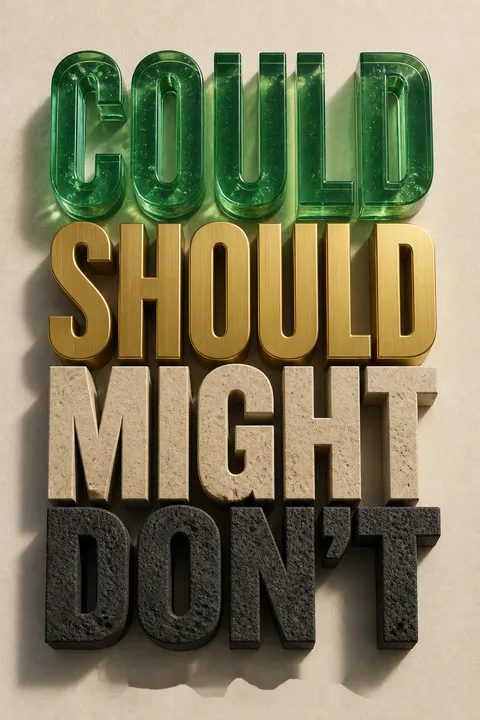
A structured approach. To navigate the overwhelming complexity of the future, the author proposes four distinct, yet overlapping, mindsets: Could, Should, Might, and Don't Futurism. These categories act as a map, offering a framework to understand the diverse ways individuals, organizations, and governments approach what lies ahead, each with its own inherent strengths and weaknesses.
The feudal landscape. Unfortunately, these four approaches often operate in isolation, creating a "feudal futures landscape" where factions struggle to collaborate. This discord leads to haphazard collages of content presented as insight, rather than coherent, rigorous thinking. Recognizing these distinct mindsets is the first step toward a more integrated and effective approach to future exploration.
Beyond snippets. Most people grab "snippets of futurism" from various sources—inspirational quotes, eye-widening statistics, or unsettling tidbits—using them as conversational punctuation marks. However, true rigor demands moving beyond these superficial fragments to understand the underlying motivations and methodologies of each approach, fostering a more critical and comprehensive engagement with future ideas.
3. "Could Futurism" Sells Aspirational Fantasies, Not Pragmatic Realities
Could Futurism is, above all things, overwhelmingly technocratic.
Optimistic allure. Could Futurism is the most visible and alluring form of future thinking, dominating popular culture with its optimistic, technocratic visions. It's characterized by "gleeful imagination," "punchy sound bites," and "engaging narratives" that promise transformative change through technology—robots, self-driving cars, space colonies, and holograms. This approach is transactional, designed to elicit excitement and engagement, often at the expense of nuance.
Ignoring the journey. This mindset typically presents the future at its "maturity," fully developed and mass-adopted, without detailing the intermediate steps or pragmatic challenges. It rejects incrementalism in favor of "large, transformational gestures," often making strident predictions tied to specific, yet arbitrary, deadlines. This lack of a clear path from present to future makes its visions feel unattainable, a "faraway land" of impossible ambitions.
Heroic myths. Could Futurism often populates its visions with idealized, heroic characters—beautiful architects, neurosurgeons, or immaculate families in expansive penthouses. These "trickledown futures" are aspirational, akin to advertising, but they erase the "background talent" of ordinary people and their mundane lives. By focusing on selling ideas rather than truly exploring possibilities, Could Futurism becomes "intellectual cowardice," offering escapist fantasies that crumble under scrutiny.
4. "Should Futurism" Imposes Subjective "Better" Futures, Often Through Numeric Fiction
“Better” is a political word that expresses desires rather than truths.
The guiding light. Should Futurism defines a desired future state and then dictates the actions we "should" take today to achieve it. This mindset offers reassuring clarity, preventing the "unknowable vacuum of the future" from becoming paralyzing. However, its core premise rests on a subjective definition of "better," which varies wildly across individuals, organizations, and cultures, making universal agreement elusive.
Ideology as blueprint. At its heart, Should Futurism is driven by ideology—an interpretation of the world coupled with a prescription for action. Manifestos, from Marinetti's Futurism to Ayn Rand's objectivism, serve as rallying cries, aiming to rewire society toward a "preferable transformation." While ideologies can drive impressive feats, they are often separatist, leading to conflicts and the suppression of counter-perspectives, as seen in the fractal nature of political and religious beliefs.
The illusion of certainty. This mindset heavily relies on "numeric fiction"—projections, estimates, and predictions that use data to create an illusion of certainty. While data feels reliable, once it crosses into the future, it becomes interpretive storytelling, often wildly inaccurate (e.g., US Energy Information Administration's energy use predictions, Irving Fisher's stock market claims). Even "trends" can be self-fulfilling prophecies or oversimplified summaries, leading to misplaced trust in these "guesses."
5. "Might Futurism" Explores Pluralistic Scenarios, But is Limited by Human Imagination and Data Quality
It is impossible to forecast the future, and it is foolish to try to do so.
Embracing uncertainty. Might Futurism acknowledges the impossibility of precise prediction, instead focusing on exploring multiple possible outcomes and their likelihoods. This pragmatic, pluralistic approach, rooted in military strategy and game theory (pioneered by John von Neumann and RAND Corporation), involves creating branching "decision trees" and "what-if" scenarios to prepare for various eventualities, rather than predicting a singular future.
The cone of possibilities. Tools like the "futures cone" (or Voros cone) illustrate this pluralistic thinking, mapping "probable," "plausible," and "possible" outcomes. This framework encourages broad discussion and helps identify overlooked details, but its effectiveness is constrained by the quality of information. Unreliable, incomplete, or actively hidden data (like the CIA's "missile gap" during the Cold War) can lead to "garbage in, garbage out" scenarios, undermining the rigor of the analysis.
Limits of the mind. Our ability to generate diverse scenarios is inherently limited by our own experiences, biases, and imagination. Neurobiological research suggests our future-thinking relies on memory, making it hard to envision truly novel outcomes. Furthermore, our understanding of probability is often flawed, and cultural differences in perceiving time (linear vs. polychronic vs. circular) further narrow our scope. This "crisis of imagination" often leads to regurgitating familiar tropes, hindering genuine foresight.
6. "Don't Futurism" Reveals Overlooked Consequences, Yet Risks Paralysis and Dogmatism
Don’t Futurism typically sits outside the major seats of power and offers counterpoints.
The uncomfortable truth. Don't Futurism actively seeks to uncover and highlight the negative outcomes, unintended consequences, and ethical dilemmas of future proposals. It acts as a critical counterpoint to optimism, dispensing warnings and pointing out pitfalls that are often minimized or ignored by those in power. This perspective is crucial for responsible decision-making, even if it makes for an "unwelcome guest" in positive-leaning discussions.
Fear as a motivator. Historically, fear has been a potent tool in shaping future behavior, from religious depictions of Hell to childhood cautionary tales like "Little Red Riding Hood." In literature and cinema, dystopian narratives (e.g., Frankenstein, Metropolis, Black Mirror) allow us to safely explore tragic outcomes and societal collapses, serving as immersive "role-playing" exercises for potential future challenges.
Beyond doomsaying. While Don't Futurism can be dismissed as "doomsaying" or lead to "ambient despair," its most effective forms transcend mere criticism. Influential works like The Limits to Growth used data and projections to advocate for restraint and prudence, leading to meaningful shifts in direction. Practices like "red teaming" (playing the adversary) and Critical Design (Dunne and Raby's Faraday chair) actively provoke reflection on implications, pushing for a more self-aware and responsible approach to innovation.
7. The Future is Accretive and Mundane, Not a Series of Isolated, Heroic Transformations
The future isn’t a noun, it’s a verb.
Layers of reality. The future is not a distant, abstract destination, but an ongoing, "accretive" evolution of the present. New technologies and ideas don't arrive in a vacuum; they pile upon existing layers of nature, culture, governance, infrastructure, commerce, and fashion, each moving at different speeds. Ignoring this intricate web of interdependencies, as seen in singular visions like Saudi Arabia's "The Line," creates blind spots and unforeseen consequences.
The everyday future. While "Could Futurism" focuses on heroic, transformative moments, the true impact of change is felt in the "mundane"—the ordinary, everyday lives of "background talent." Our cutlery, pavements, and socks have remained largely unchanged for decades, even as cell phones and electric scooters have become commonplace. The author's personal shift to "The Future Mundane" emphasizes imagining new technologies integrated into these commonplace realities, like a VR headset in a forklift driver's backpack.
Beyond the thunderclap. Even significant disruptions, like the advent of GPS or the COVID-19 pandemic, are rapidly absorbed and normalized into daily life. What initially feels like a "thunderclap" of change quickly becomes an "embedded, everyday reality." Understanding this adaptability and the mundane integration of new ideas is crucial for crafting believable and relevant future narratives, moving beyond abstract fantasies to grounded realities.
8. Toxic Positivity and Solutionism Obscure the True Nature of Innovation
Any crack of doubt needs to be minimized, filled in, or painted over in favor of a good story or an enticing proposition, which results in an environment defined by what psychologists refer to as “toxic positivity.”
The advertising imperative. Design, at its core, is a positive act focused on problem reduction, making things simpler or more joyful. This inherent positivity, however, often leads to "toxic positivity" in innovation, where only the beneficial aspects are highlighted. Pitches for new products or ideas become advertisements, suppressing complexity and doubt to create an illusion of "oodles of forward momentum" and secure funding or customer interest.
The "solution" fallacy. The pervasive use of "solutions" as a metaphor for progress is problematic. "Solutions" imply closure and finality, masking the messy, nonlinear, and often broken reality of innovation. Methodologies like Design Thinking, while aiming to systematize innovation, often oversimplify the process into neat, sequential steps, failing to account for dead ends, mistakes, and the inherent uncertainty of creative work.
The broken future. Vision videos and product pitches consistently portray perfectly functioning technologies used by wholesome characters in idealized scenarios. This whitewashes the truth: people use technology for illicit activities, things break, and errors occur. The author highlights a brief, powerful scene in Minority Report where a cereal box's animation malfunctions, making the futuristic world feel "incredibly real" precisely because it's "a little bit broken." Embracing this "ugly grittiness" is essential for honest future storytelling.
9. Rigor and Detail are Paramount for Meaningful Future Engagement
The more detail you can add (or the more detail you demand), the better these stories will be.
Beyond the surface. To improve our collective thinking about the future, we must move beyond superficial headlines, flashy images, and "jaw-dropping statistics." True rigor demands deep engagement with the "meat of the issue," contemplating the full network of impact, tangential changes, and long-term implications of any new idea, rather than just its initial benefits.
Forensic future-casting. The author advocates for "Design Fiction," an approach that forensically examines mundane objects—like a cereal box—to provoke deeper questions about future change. By analyzing its branding, language, ingredients, technology, and regulatory traces, one can project how societal shifts (e.g., VR, homeschooling, UBI) might subtly manifest in everyday items, making abstract concepts feel embedded and normalized.
Embracing reality. This obsession with detail, akin to an archaeologist studying pottery shards, makes future stories believable and relatable. It acknowledges that even "thunderclap" changes quickly become mundane, absorbed into the fabric of daily life. By rendering the future in "excruciating, exacting, precise, and exhausting detail," we close the gap between our world and the one to come, fostering genuine understanding and encouraging responsible action.
People Also Read


Download PDF
Download EPUB
.epub digital book format is ideal for reading ebooks on phones, tablets, and e-readers.








































