
Key Takeaways
1. Algorithms Reduce Us to Numbers, But Math Can Restore Our Agency.
What can we do to regain our humanity and autonomy? I believe we must reclaim the mathematical tools currently being used to manipulate and exploit us by the public and private sectors alike.
Numerification is pervasive. From the moment your alarm rings, algorithms reduce complex human experiences into quantifiable data points. Your social media activity, car movements, grocery purchases, job applications, and even health records are tracked, packaged, and sold. This "numerification" is often dehumanizing, turning individuals into "insignificant numbers" for prediction, optimization, and profit.
Lack of transparency. The formulas governing these algorithms are typically secret, leaving individuals unaware of how their lives are being quantified and influenced. For example:
- TikTok's personalized video playlist.
- Social media follower counts dictating importance.
- Job application algorithms ranking candidates.
- Health insurance formulas determining premiums.
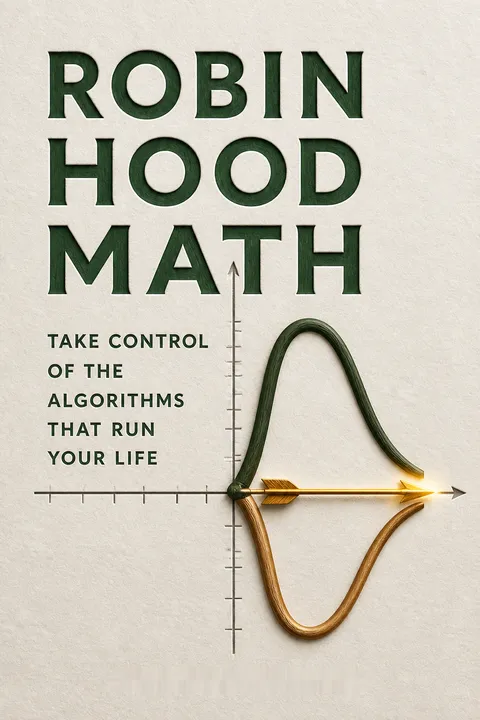
Reclaiming control. The book argues that understanding the underlying math, dubbed "Robin Hood math," is crucial for regaining agency. This isn't about becoming a math prodigy, but about learning how these formulas work to make informed choices and resist manipulation. By demystifying these mathematical tools, ordinary people can bridge the knowledge gap and navigate the data-driven world more effectively.
2. Personalize Rankings to Reflect Your Values, Not Others'.
We can create personalized rankings that include whatever factors we want and weight them however we wish.
One-size-fits-all rankings are flawed. Major rankings, like U.S. News & World Report's Best Colleges, are often rigid, impersonal, and easily gamed. They rely on arbitrary factors and weights, leading to "dramatic shifts" that don't reflect individual priorities. Institutions, in turn, feel immense pressure to manipulate data to climb these influential lists, as seen in the Columbia University and World Bank scandals.
The math of rankings. Rankings are built on weighted sums of standardized data (Z-scores). Each factor (e.g., peer assessment, faculty salaries, class size) is assigned a weight, and these are combined to produce an overall score. However, these choices are subjective and can be influenced by external pressures or financial incentives.
- Factors: What aspects are measured (e.g., student-faculty ratio, weather, basketball program).
- Weights: How much importance is given to each factor (e.g., 25% for city, 35% for weather).
- Standardization: Converting diverse metrics to a common scale (e.g., Z-scores).
Empower yourself with personalized rankings. Instead of blindly trusting external rankings, you can create your own. This involves:
- Choosing factors that genuinely matter to you (even subjective ones like "liking the nearest city").
- Assigning weights that reflect your personal values.
- Using a simple weighted sum to combine these into a unique, holistic score.
This approach fosters skepticism towards official rankings and helps make thoughtful decisions, from choosing a college to adopting a pet, or even understanding inflation (Consumer Price Index) and credit scores.
3. Harness Weighted Averages for Sharper Predictions.
The result is, I think, more creditable to the trustworthiness of a democratic judgment than might have been expected.
The wisdom of crowds. Combining multiple predictions, even from less reliable sources, often yields a more accurate forecast than any single prediction. This phenomenon, first observed by Francis Galton in an ox-weight guessing game, works because individual errors tend to balance out when averaged. Nate Silver famously used this technique with weighted averages to predict election outcomes with remarkable accuracy.
Key statistical concepts:
- Error: The difference between a guess and the true value.
- Balanced guesser: Someone whose errors average close to zero over time.
- Variance: Measures how spread out a collection of numbers is, indicating how wild or consistent guesses are.
- Covariance: Measures how similarly two sequences of numbers move. Low covariance between errors means averaging is more effective.
Applying weighted averages in daily life. When facing uncertainty, don't rely on a single source. Instead:
- Combine expert opinions: Average predictions from various sources (e.g., financial analysts, weather apps, professors) for better estimates of stock prices, job market trends, or future interest rates.
- Assign weights: Give more emphasis to sources you trust more or those with better historical track records. This flexibility allows for nuanced integration of diverse perspectives.
This method reduces the variance of errors, making predictions more accurate and reliable, even if individual sources are imperfect.
4. Beyond Expected Value: Understand Risk Through Distributions and Logarithms.
Expected value provides a reliable gambling strategy only when you can keep playing.
Averages hide risk. Relying solely on averages or expected values can be misleading. While an expected value tells you what to anticipate "on average," it doesn't reveal the full spectrum of possibilities or the likelihood of extreme outcomes. For instance, average NBA salaries don't reflect the vast majority of players earning far less, and average life expectancy obscures high infant mortality rates in the past.
Distributions and variance reveal risk. To truly understand risk, one must consider the entire distribution of possible outcomes, often visualized through histograms.
- Histograms: Show the percentage of data points within different ranges, providing a clearer picture of likelihoods.
- Variance: Quantifies how spread out a distribution is, indicating the degree of "unexpectedness" you should prepare for. High variance means a greater chance of outcomes far from the average, signaling higher risk (e.g., mortgage rate predictions, earthquake timing).
Logarithms for money's true impact. The psychological and socioeconomic impact of money is logarithmic, not linear. Doubling your wealth from $1 million to $2 million feels more significant than from $100 million to $200 million. This "diminishing returns" principle means:
- Focus on digits and doubling: A $10 million jackpot isn't ten times more thrilling than a $1 million one; the impact is closer to the difference between $1 million and $100,000.
- Romer's Rule-of-Thumb for Risk: To price risk, estimate the dollar harm, multiply by its probability (expected loss), then double it. This incorporates the logarithmic impact of money and helps avoid cognitive biases towards inaction.
Diversification and the Kelly Criterion. To manage risk:
- Diversify: Spread investments across different assets, especially those with low covariance (i.e., they don't move in the same direction simultaneously). ETFs and mutual funds offer broad diversification.
- Kelly Criterion: A formula (2p-1, where p is the probability of a favorable outcome) suggests the optimal fraction of your wealth to wager in a favorable bet. It balances risk and reward by maximizing the logarithm of winnings, preventing "gambler's ruin" by ensuring you don't bet too aggressively.
5. Update Your Beliefs Rationally with Bayesian Thinking.
The most powerful antidote to my irrationality came from a surprising source: an 18th-century English priest named Reverend Thomas Bayes.
Two types of probability. To think clearly about uncertainty, we must distinguish between:
- Frequentist (objective) probability: Measures how often an event occurs over many trials (e.g., a coin flip landing heads 50% of the time).
- Subjective probability: Quantifies the strength of one's belief in an event, even if it's not repeatable (e.g., Brazil's chance of winning the World Cup). This is expressed through betting odds.
Bayes's formula for updating beliefs. This 250-year-old formula provides a mathematical framework for revising subjective probabilities in light of new evidence. It states: P(X|Y) = P(X) × P(Y|X) / P(Y).
- P(X): Your initial belief (prior probability) in event X.
- P(Y|X): The probability of new evidence Y, given that X is true.
- P(Y): The overall probability of new evidence Y.
- P(X|Y): Your updated belief (posterior probability) in X, after considering Y.
Practical applications and common pitfalls. Our brains often struggle to combine probabilistic information, either ignoring new evidence or overcompensating. Bayes's formula helps achieve the right balance.
- Medical testing: A positive test for a rare condition doesn't mean a high chance of having it if the condition's prevalence (P(X)) is very low and false positives (P(Y|not X)) are significant.
- Legal reasoning: The low frequency of domestic abusers becoming murderers (P(Y|not X)) is less relevant than the probability of a husband being the murderer given prior abuse and the wife's murder (P(X|Y)).
- "Bayes Made Easy" (A-B+C): A simplified method using ballpark estimates (e.g., 0 for almost certain, 1 for 50%, 3 for 10%) to quickly update confidence in a belief.
Qualitative lessons. Even without precise numbers, Bayesian thinking teaches us:
- Prior beliefs matter: New information updates, rather than replaces, existing convictions.
- Context is key: Don't view rare events in isolation; assess their impact on your beliefs by considering how much more or less rare the event would be if your belief were valid.
- Guides to the right questions: It helps frame complex situations by directing us to the most relevant probabilistic inquiries.
6. Master Social Media Algorithms by Controlling Your Engagement.
The more you know about this formula, the more you’ll be able to take charge of your social media experience and fill your feed with the posts you enjoy the most instead of crap that’s a clickbait trap.
The secret formula is a weighted sum. Facebook, TikTok, and X (formerly Twitter) all use essentially the same mathematical core: a weighted sum of estimated engagement probabilities. This formula ranks posts/videos based on how likely the algorithm thinks you are to interact with them.
- Score = Σ (V_engagement × P_engagement)
- V (Value): Point values assigned to different types of engagement (e.g., a Like, a comment, a share).
- P (Probability): The algorithm's prediction of your likelihood to perform that engagement.
Facebook's algorithm and strategic engagement. Whistleblower documents revealed Facebook's engagement point values.
- Likes: 1 point.
- Heart emoji: 5 points.
- Comments: 30 points.
- Angry emoji: 0 points (after being reduced from 5 points).
- Reporting a post: Negative points (-738 on X).
To "train" your algorithm, engage thoughtfully. For example, an angry emoji signals disapproval without boosting the post's visibility, unlike a comment, which scores high regardless of its sentiment.
TikTok and X's similar mechanics. TikTok prioritizes "playtime" (expected seconds watched), leading to clickbait like "Wait for it" videos. X's open-sourced code shows replies are highly valued (54 points), much more than retweets (2 points).
- TikTok: Manipulates users into rewatching or commenting on nonsensical videos (e.g., "nursing assistant" riddle) to boost "expected playtime" and comments, thus increasing visibility.
- X: Rewards replies and engagement within conversations, making these crucial for virality.
By understanding these weights, you can consciously choose how to interact, avoiding engagement with content you dislike and promoting what you want to see more of.
7. Fight Back Against Tech Giants' Manipulation with Math and Informed Choices.
Amazon may use math to rig the numbers game behind its influential algorithm at our expense, but we can use math to fight back and empower ourselves.
Tech giants prioritize profit over users. Companies like Amazon and Google, driven by ad revenue and market dominance, often degrade their services. Amazon's algorithm, for example, prioritizes its own brands and sponsored listings over better-rated products, misleading customers and harming competitors. Google search is increasingly cluttered with ads and self-promotional content, making it harder to find quality information.
User strategies to reclaim control:
- Amazon: Don't use the default "Featured" sort. Instead, sort by "Average Customer Review" or "Lowest to Highest Price." Be vigilant for "Sponsored" labels.
- Google Search:
- Use the "Web" tab to filter out AI summaries and sponsored links.
- Employ advanced search syntax:
-(minus sign) to exclude words (e.g.,square pants -SpongeBob)...(two dots) for number ranges (e.g.,Europe war 1800..1820).*(asterisk) as a wildcard (e.g.,famous quote "the best * is *").site:to search specific websites (e.g.,COVID vaccine site:cdc.gov).filetype:for specific file formats (e.g.,expected value formula filetype:pptx).-AI -promptorbefore:YYYY-MM-DDfor image searches.
Addressing the "internet's original sin": Ad-based funding. The reliance on ads creates harmful externalities:
- Growth-at-all-costs: Leads to platforms hosting more content than they can safely monitor, as seen in Facebook's role in spreading misinformation in the Philippines.
- Enshittification: Services degrade as companies prioritize ad revenue over user experience once market dominance is achieved.
- Invasive surveillance: Microtargeting ads necessitates extensive data collection, leading to privacy invasions and the risk of personalized pricing.
- Addiction: Platforms are designed to maximize time spent, not quality of engagement.
Paul Romer's progressive ad tax. A Nobel Prize-winning economist proposes a progressive tax on online targeted ad revenue.
- Superlinearity: Tech giants benefit from the "superlinear" value of shareable inputs like user data (output more than doubles when inputs double). A progressive tax (tax burden more than doubles when revenue doubles) would offset this, restoring economic balance.
- Benefits: Discourages monopolies, incentivizes ad-free subscription models, and generates revenue for public goods like journalism, public social media platforms, or universal basic income (UBI).
This "Robin Hood math" approach uses mathematical principles to advocate for collective action, pushing back against the unchecked power of tech titans and fostering a healthier digital ecosystem.
People Also Read








Download PDF
Download EPUB
.epub digital book format is ideal for reading ebooks on phones, tablets, and e-readers.








































