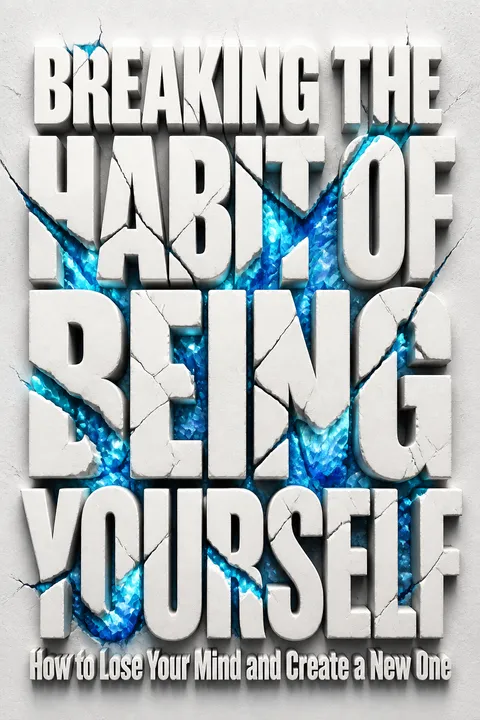


Key Takeaways
Your personality creates your reality, so a new life demands a new self
The book's central thesis is simple and severe. Dispenza argues that your "personality" (how you habitually think, act, and feel) generates your "personal reality" (your circumstances, health, and relationships). If your outer life keeps repeating the same disappointments, it is because you keep reconstituting the same inner self each day. Wanting change while remaining the same person is a contradiction.
The greatest habit to break is being yourself. By your mid-thirties, roughly 95% of who you are has hardened into subconscious programs (memorized behaviors, emotional reactions, and beliefs). To create something genuinely new, you cannot tweak circumstances. You must dismantle the old identity and reinvent a new one, which the author frames as "losing your mind to create a new one."
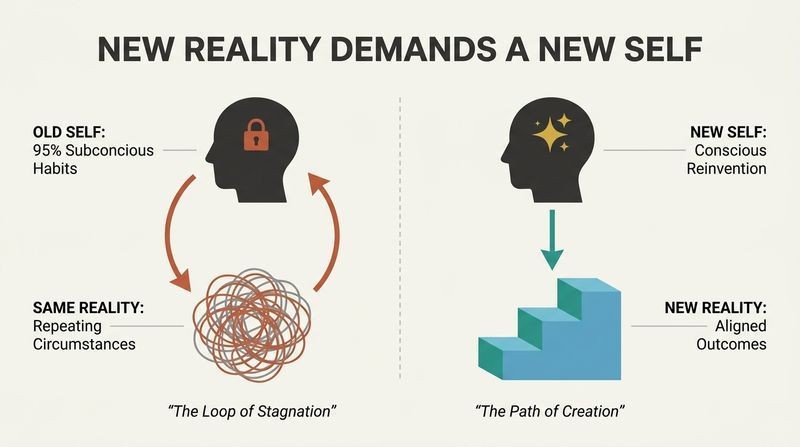
What's striking is how this reframes self-help away from goal-setting toward identity work, echoing James Clear's later point that lasting change is identity-based. The claim resonates with narrative psychology: we become the stories we rehearse. Yet the sweeping "you create your reality" framing invites scrutiny. Structural forces (poverty, illness, discrimination) shape lives independent of mindset, and overstating personal causation risks victim-blaming. The steel-man version is modest and powerful: your interpretive and behavioral patterns, largely automatic, filter every experience, so reworking them changes what you notice, attempt, and tolerate. That alone can shift a life without requiring quantum metaphysics.
Your brain fires the past on repeat, hardwiring you to your problems
Environment programs the mind through repetition. Each morning your senses plug you into the same people, places, and objects, which trigger the same neural circuits, which produce the same thoughts and feelings. Neuroscientist Donald Hebb's principle, "neurons that fire together wire together," means repeated patterns become physically entrenched. Your habitat becomes your habit.
You obsess over problems because you built them. Dispenza compares this to a hamster wheel: thinking equal to your circumstances only reproduces those circumstances. The historical counterexample is people like Gandhi, who held a vision of freedom so vivid it overrode the demoralizing colonial reality around him. Greatness, in this framing, is holding fast to an inner future independent of outer feedback, refusing to let the environment dictate your state.
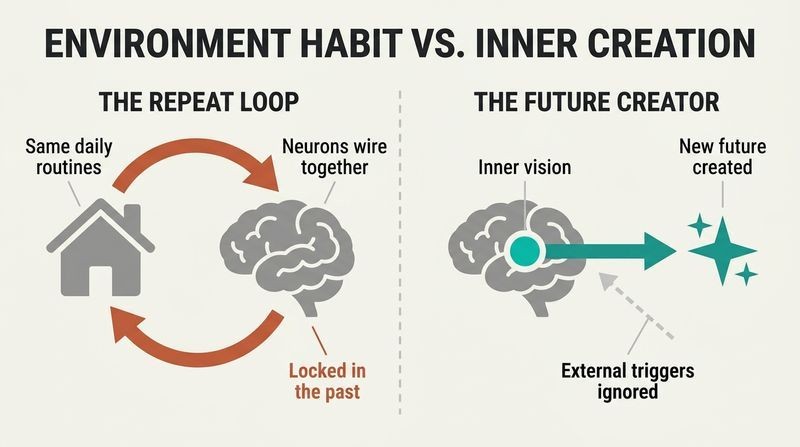
The Hebbian foundation is legitimate neuroscience, and the observation that daily routine reinforces cognitive ruts aligns with research on habit loops and predictive processing (the brain as a prediction machine that expects the familiar). The Gandhi example is inspiring but selectively told: history remembers visionaries who succeeded and forgets equally committed dreamers crushed by circumstance. Survivorship bias lurks here. Still, the practical kernel is sound and testable: environmental cues drive automatic behavior, so changing your inputs or consciously interrupting the loop genuinely alters outputs. Behavioral therapists exploit exactly this when they alter contexts to break entrenched responses.
Emotions are chemical residue of the past that keep your body time-traveling
Thinking and feeling form a self-reinforcing loop. A thought triggers brain chemicals (neurotransmitters, neuropeptides, hormones) that make the body feel a certain way. The body then signals the brain to generate more thoughts matching that feeling. Over years, this loop hardens: an emotional reaction becomes a mood, then a temperament, then a permanent personality trait.
The body becomes addicted to familiar emotions. Cells adjust their receptor sites to a chronic emotion like guilt or resentment, requiring ever-stronger doses, exactly like drug tolerance. When you try to change, the body stages a rebellion, flooding you with cravings and self-sabotaging thoughts ("start tomorrow," "this doesn't feel right"). Because feelings are records of past experience, living by them means literally thinking in the past and re-creating it.
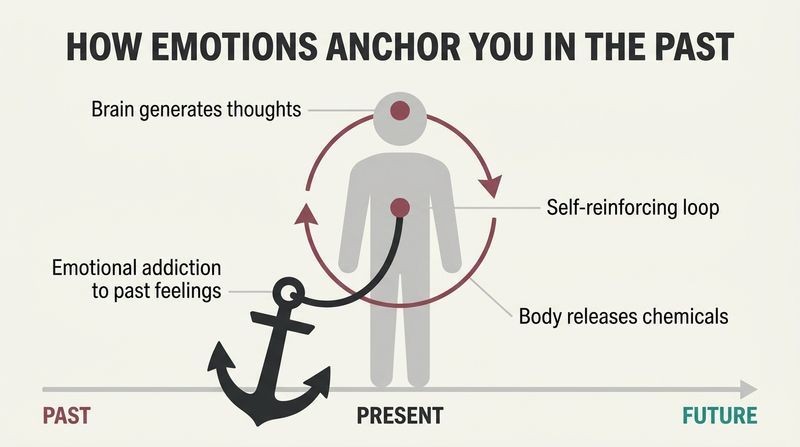
The addiction analogy is the book's most useful contribution, and it has real backing: Candace Pert's work on neuropeptides showed emotions are molecular events distributed through the body, not just brain states. Framing emotional habits as withdrawal explains why insight alone rarely changes behavior, which resonates with why cognitive therapy adds behavioral practice. The mood-to-temperament-to-trait progression is a clean, memorable model. The weaker claim is that the body is "living in the past," which is metaphor dressed as mechanism. Emotions also encode useful information about the present. The goal should be discernment, not blanket suppression of survival feelings as merely toxic residue.
Mentally rehearse the change and your brain rewires as if you lived it
Thought alone can reshape the brain and body. Dispenza cites a study where subjects who only imagined playing piano scales grew nearly the same neural circuitry as those who physically practiced. In a finger-strength experiment, mental rehearsers gained 22% more strength while physical exercisers gained 30%, both without the imaginers moving a muscle. The brain does not sharply distinguish a vividly imagined event from a real one.
This is the engine of self-creation. By repeatedly rehearsing your ideal self (how it thinks, acts, and feels), you install the neural "hardware" before the experience arrives, so your brain becomes a map to the future rather than a record of the past. When rehearsal becomes vivid enough, the thought becomes the experience and generates a real emotion.
Mental rehearsal is well-supported: motor imagery activates overlapping neural regions with actual movement, and elite athletes use visualization routinely. The strength studies point to neural drive improvements rather than muscle growth, an important nuance the book glosses. Where caution is warranted is the leap from "imagination changes the brain" to "imagination manifests external outcomes." The former is neuroscience; the latter drifts toward magical thinking. Interestingly, research on mental contrasting (Gabriele Oettingen) shows that pure positive fantasizing can reduce motivation unless paired with confronting obstacles. Rehearsal works best as preparation and priming, not as a substitute for action in the world.
Meditate to slip past your analytical mind into the subconscious operating system
Meditation is not mysticism, it is access. Dispenza defines it via its Tibetan root, "to become familiar with," and its purpose as bypassing the analytical mind to reach the subconscious, where 95% of your automatic programs live. The analytical mind, active in Beta brainwaves, acts as a barrier. You cannot reprogram code while the gatekeeper is awake.
Change brainwaves to open the door. Brain states range from fast Beta (alert, stressed) through Alpha (relaxed, imaginative) to Theta (the drowsy hypnotic threshold) and Delta (deep sleep). By closing your eyes and using an "induction" (sensing your body parts and the space around them), you slow into coherent Alpha and Theta, where the subconscious becomes editable. The best windows are just after waking and just before sleep, when the door naturally opens.
The brainwave taxonomy is real, though the book's neat mapping of specific states to specific capacities is more schematic than the messy EEG evidence supports. The core insight is genuinely valuable and echoes clinical hypnosis and modern research on the default mode network, which quiets during deep meditation and correlates with reduced self-referential rumination. The "open focus" technique of attending to space draws on legitimate work by Les Fehmi. What deserves emphasis is that the mechanism need not be exotic: reducing sensory load and analytical chatter demonstrably increases suggestibility and neuroplastic openness. That is a defensible, testable claim independent of the quantum overlay.
Feel gratitude before the outcome arrives, not after
Invert cause and effect. Normally we wait for good things to happen, then feel grateful. Dispenza urges the reverse: generate the elevated emotion of a wish already fulfilled before any physical evidence appears. Gratitude signals the body that the desired event has already occurred, aligning your inner state with the future you want rather than the past you're escaping.
Thoughts and feelings must be coherent. He cites a HeartMath experiment where people held vials of DNA. Positive emotion alone did nothing; clear intention alone did nothing. Only when heightened emotion and clear intention combined did the DNA measurably change shape. The lesson: the mind broadcasts one signal, the body another, and only when thought (intention) and feeling (emotion) align do you send a coherent, powerful signal.
The gratitude-first principle has surprising empirical company: positive psychology finds gratitude practices reliably lift wellbeing and broaden cognition (Barbara Fredrickson's broaden-and-build theory), which can indirectly improve outcomes through better decisions and relationships. Anticipatory savoring is a documented mood booster. The coherence point, that divided intention and emotion sabotage effort, matches why ambivalence predicts failure in behavior change. The DNA study, however, is a small, contested result that has not robustly replicated, and leaning on it weakens an otherwise strong psychological argument. The takeaway survives without it: cultivating the emotional state of your goal now changes how you show up today.
Close the gap between the mask you show and who you really feel inside
Everyone lives a duality. There is how you appear (the polished identity you project) and who you really are (how you feel in quiet, unstimulated moments). The distance between them is "the gap," filled with memorized emotions like shame, unworthiness, and fear that you conceal. The bigger the gap, the greater your emotional addiction and the more exhausting your performance.
We stay busy to avoid the buried feeling. Dispenza confesses that at his career peak, lecturing worldwide, he felt empty at home because his happiness depended entirely on external stimulation. People chase novelty, purchases, and eventually addictions to make the feeling disappear, but each fix requires more. Real freedom, called "transparency," arrives when how you appear equals who you are, releasing the energy once spent maintaining the facade.
This is the book's most humane and psychologically grounded section, converging with Carl Rogers on congruence (the alignment of self-concept and experience as the basis of mental health) and with Jungian shadow work. The observation that escalating consumption and addiction are attempts to numb an unexamined feeling anticipates modern accounts of the hedonic treadmill and dopamine tolerance (Anna Lembke's work on the pleasure-pain balance). Dispenza's personal confession lends credibility that abstract theory lacks. The one tension: authenticity is not the same as unfiltered disclosure, and some social masking is functional and healthy. The valuable core is reducing the costly split between inner truth and outer performance.
Chronic stress is you being addicted to survival mode, and it breeds disease
Humans uniquely turn stress on by thought alone. A deer flees a predator, then calmly grazes twenty minutes later. Humans replay past threats and pre-live future ones, keeping the fight-or-flight system running indefinitely. This chronic arousal, dominated by high-range Beta brainwaves, diverts energy from immune, digestive, and repair systems, setting the stage for illness.
Genes are not destiny. Dispenza invokes epigenetics: fewer than 5% of diseases stem from single-gene disorders, while roughly 95% relate to lifestyle, stress, and environment. Stress chemicals can dysregulate genes and trigger disease. In a Japanese study, diabetics who watched a comedy show altered 23 gene expressions and blunted their blood-sugar spike compared to those who sat through a dull lecture. Emotions switch genes on and off.
The stress physiology is solid and well-popularized by Robert Sapolsky, whose work Dispenza cites: chronic glucocorticoid exposure genuinely impairs immunity and health. The epigenetics framing is broadly accurate and empowering, correcting the outdated fatalism of genetic determinism. The comedy-and-diabetes study is real (Murakami) though small. The claim to watch is the precise "95% of illness is lifestyle" figure, which conflates "influenced by" with "caused by" and understates genetic predisposition in many conditions. Nuance matters: epigenetics shows environment modulates gene expression, not that thoughts alone cure disease. Overpromising here can lead patients to forgo effective medical treatment, a genuine ethical hazard.
Run the seven-step meditation: recognize, admit, declare, surrender, observe, redirect, create
A concrete four-week protocol turns theory into practice. After an induction to reach Alpha, the process unfolds:
1. Recognize: name the specific emotion (say, resentment) you want to unmemorize and feel where it lives in the body.
2. Admit and Declare: acknowledge inwardly to a greater intelligence who you've been, then say the emotion aloud to break its bond.
3. Surrender: hand the limitation over to a larger mind rather than forcing a solution.
4. Observe and Remind: catch the old thoughts and behaviors before they run.
5. Redirect: the moment an old pattern stirs, say "Change!" out loud.
6. Create and Rehearse: mentally build and repeatedly practice your new self until it feels natural.
The aim is to prune old circuits, then sprout new ones daily until the new state becomes automatic.
The protocol's strength is its structure: it operationalizes vague advice into a repeatable ritual, which is exactly what behavior change research says works (implementation intentions and cue-based interruption). Saying "Change!" aloud is a form of pattern interruption used in habit reversal training for tics and compulsions. Naming and locating emotions in the body parallels evidence-based practices like affect labeling, which measurably dampens amygdala activity. The "surrender to a greater intelligence" step will alienate secular readers, but it functions psychologically like acceptance and letting go of control, a mechanism validated in AA's serenity principle and in acceptance-based therapies. The framework's real test is consistency, which the four-week scaffolding wisely supports.
Demand an unexpected sign as proof your inner change moved the outer world
Feedback closes the loop and sustains the practice. Dispenza treats change as an experiment: alter your inner state, then watch your outer life for a response. He advises asking the universe for a synchronicity so surprising and unpredictable that it "leaves no doubt" it came from your effort. If the result is something you could have predicted or engineered, it doesn't count, because prediction means you're still operating from the known past.
Stories illustrate the payoff. His daughter, rehearsing an Italian summer, landed an all-expenses teaching job hitting every detail she envisioned. A woman named Pamela, releasing her victimhood in meditation, unexpectedly earned about $22,000 within days. The insistence on unpredictability is meant to distinguish genuine "causing an effect" from ordinary goal-chasing.
This is where rigor and belief part ways. The demand for surprise is clever design and terrible epistemology: it converts confirmation bias into a feature. A brain primed to notice "signs" will find them everywhere (the Baader-Meinhof frequency illusion), and one memorable coincidence outweighs countless non-events in memory. The anecdotes are unfalsifiable and cherry-picked. That said, there's a defensible psychological core: shifting your state genuinely changes behavior (his daughter and Pamela both acted differently), and priming yourself to notice opportunity is real (Richard Wiseman's research on "lucky" people shows they spot more chances). Treat the practice as expectancy and attention training, not cosmic transaction.
Analysis
Dispenza occupies a peculiar niche: a chiropractor-neuroscientist writing a self-help manual that borrows the vocabulary of quantum physics, epigenetics, and neuroplasticity to justify what is, at bottom, a disciplined meditation and identity-reconstruction practice. The book's structure is deliberate and pedagogical, front-loading two parts of theory (the science of you, the brain and meditation) so that Part III's seven-step protocol feels earned rather than arbitrary. This scaffolding is genuinely effective as instructional design, whatever one thinks of the metaphysics.
The work is strongest when it stays close to established science. The Hebbian account of habit, the neuropeptide-driven thinking-feeling loop, the addiction model of chronic emotion, mental rehearsal's neural effects, and stress physiology are all well-grounded and skillfully synthesized for lay readers. Dispenza's core practical claim, that lasting change requires reworking automatic subconscious patterns rather than exerting conscious willpower against them, is both correct and underappreciated. His emotional honesty about his own emptiness at his career peak grounds the abstraction in lived experience.
The work is weakest when it overreaches. The "observer effect" of quantum mechanics does not mean human consciousness sculpts macroscopic reality; that is a persistent popular misreading. The retroactive prayer study and the DNA-conformation experiment are fragile, contested results doing heavy rhetorical lifting. The insistence that manifestations arrive "in ways you least expect" builds unfalsifiability directly into the method, insulating it from disconfirmation.
The honest reader can extract enormous value by treating the quantum and cosmic-intelligence framing as motivational scaffolding rather than literal mechanism. Stripped to its testable core, the book delivers a coherent program: interrupt automatic emotional habits, rehearse a desired identity, reduce the gap between authentic self and performed self, and cultivate elevated emotional states proactively. Those are defensible, life-improving practices. The metaphysics is optional; the discipline is the point.
Review Summary
Breaking the Habit of Being Yourself receives mixed reviews. Many praise its insights on neuroplasticity, meditation, and personal transformation, finding it life-changing. Critics argue it misuses quantum physics concepts and promotes pseudoscience. Supporters appreciate the practical meditation techniques and scientific explanations, while skeptics question the validity of claims about manifesting reality through thought. Some find it repetitive or overly long. Overall, readers tend to either strongly embrace or reject the book's ideas about consciousness and personal change.
People Also Read


FAQ
What's Breaking the Habit of Being Yourself about?
- Transformative Journey: The book explores how individuals can break free from their habitual thoughts and emotions to create a new self. It combines insights from neuroscience, quantum physics, and meditation to illustrate how our thoughts shape our reality.
- Mind-Body Connection: Dr. Joe Dispenza emphasizes the connection between the mind and body, explaining how our emotional states influence our physical health and overall well-being.
- Practical Techniques: The book provides practical meditation techniques and exercises designed to help readers rewire their brains and change their lives by adopting new thought patterns and emotional responses.
Why should I read Breaking the Habit of Being Yourself?
- Empowerment: This book empowers readers to take control of their lives by understanding the science behind their thoughts and emotions. It offers a roadmap for personal transformation.
- Accessible Science: Dr. Dispenza presents complex scientific concepts in an easy-to-understand manner, making it accessible for anyone interested in self-improvement.
- Real-Life Applications: The book includes real-life examples and testimonials from individuals who have successfully applied the principles discussed, demonstrating the effectiveness of the methods.
What are the key takeaways of Breaking the Habit of Being Yourself?
- Thoughts Create Reality: One of the central messages is that "what you think today determines how you live tomorrow." This highlights the power of our thoughts in shaping our experiences.
- Meditation as a Tool: The book emphasizes the importance of meditation in creating lasting change, allowing individuals to access their subconscious and reprogram their emotional responses.
- Overcoming Limitations: Readers learn how to overcome their environment, body, and time to break free from limiting beliefs and create a new identity.
What are the best quotes from Breaking the Habit of Being Yourself and what do they mean?
- “The greatest habit you can ever break is the habit of being yourself.”: This quote encapsulates the book's premise that to change your life, you must first change your identity and the habitual patterns that define you.
- “Your thoughts create your reality.”: This statement reinforces the idea that our mental processes directly influence our experiences and outcomes in life.
- “When you change your mind, you change your life.”: This quote emphasizes the transformative power of shifting one’s mindset and adopting new ways of thinking.
How does Dr. Dispenza define the concept of "the quantum you" in Breaking the Habit of Being Yourself?
- Energy and Potential: Dr. Dispenza explains that "the quantum you" refers to the understanding that we are part of a vast field of energy filled with infinite possibilities. Our thoughts and feelings can influence this field.
- Observer Effect: He discusses the "observer effect" in quantum physics, which states that our attention and intention can collapse potential realities into actual experiences.
- Creating Reality: By harnessing the principles of quantum physics, individuals can learn to create their desired reality by focusing their thoughts and emotions on what they wish to manifest.
What role does meditation play in Breaking the Habit of Being Yourself?
- Rewiring the Brain: Meditation is presented as a crucial practice for rewiring the brain and changing habitual thought patterns. It allows individuals to access their subconscious mind and create new neural connections.
- Emotional Regulation: Through meditation, readers can learn to regulate their emotions and break free from the chemical addiction to negative feelings, fostering a more positive state of being.
- Practical Techniques: The book provides specific meditation techniques that readers can practice to facilitate their personal transformation and achieve their desired outcomes.
How can I apply the principles from Breaking the Habit of Being Yourself in my daily life?
- Daily Meditation Practice: Establish a regular meditation routine to help you connect with your inner self and reprogram your thoughts and emotions. This practice is essential for creating lasting change.
- Mindfulness and Awareness: Cultivate mindfulness by becoming aware of your thoughts and feelings throughout the day. This awareness will help you identify and interrupt negative patterns.
- Set Intentions: Use the principles of intention and visualization to create a clear picture of the person you want to become. Focus on embodying the emotions associated with that ideal self.
What is the significance of the "Big Three" in Breaking the Habit of Being Yourself?
- Environment, Body, and Time: The "Big Three" refers to the three main factors that influence our state of being: our environment, our physical body, and our perception of time. These elements often dictate how we think and feel.
- Breaking Free: To create lasting change, individuals must learn to think and feel greater than these three limitations. This involves transcending the habitual responses tied to their environment, body, and time.
- Empowerment: By overcoming the Big Three, readers can reclaim their power and begin to create a new reality that aligns with their true desires and aspirations.
How does Breaking the Habit of Being Yourself address the concept of neuroplasticity?
- Brain Rewiring: Dr. Dispenza explains that neuroplasticity is the brain's ability to reorganize itself by forming new neural connections throughout life. This means that individuals can change their thought patterns and behaviors at any age.
- Pruning and Sprouting: The book discusses the processes of "pruning" (removing old, unhelpful neural connections) and "sprouting" (creating new, beneficial connections) as essential for personal transformation.
- Practical Application: Readers are encouraged to actively engage in practices that promote neuroplasticity, such as meditation and mindfulness, to facilitate their journey toward becoming their ideal selves.
What is the relationship between thoughts, feelings, and health in Breaking the Habit of Being Yourself?
- Mind-Body Connection: The book emphasizes that our thoughts and feelings have a direct impact on our physical health. Negative emotions can lead to stress, which in turn can trigger health issues.
- Chemical Responses: Dr. Dispenza explains how thoughts produce chemical signals in the body, which can either promote health or contribute to disease. This highlights the importance of cultivating positive emotional states.
- Empowerment through Change: By changing one’s thoughts and feelings, individuals can influence their health outcomes and create a more vibrant, healthy life. The book provides tools to help readers achieve this transformation.
How does Dr. Joe Dispenza define meditation in Breaking the Habit of Being Yourself?
- Meditation as Self-Observation: Dispenza defines meditation as a process of becoming familiar with oneself, which involves observing thoughts and emotions without judgment. This practice helps individuals detach from their habitual responses.
- Accessing the Subconscious: He explains that meditation allows access to the subconscious mind, where deep-seated beliefs and emotional patterns reside. This access is crucial for facilitating change and reprogramming the mind.
- Creating New Neural Pathways: Through meditation, individuals can create new neural connections in the brain, reinforcing positive thoughts and behaviors. This process is essential for breaking the habit of being oneself.
How does Breaking the Habit of Being Yourself address emotional addiction?
- Defining Emotional Addiction: Dispenza explains that emotional addiction occurs when individuals become attached to certain feelings, often negative ones. This attachment can hinder personal growth and perpetuate unhealthy patterns.
- Breaking the Cycle: The book provides strategies for recognizing and unmemorizing these emotional states, allowing individuals to break free from their addictive patterns. This process is essential for creating a new identity.
- Reconditioning the Body: By practicing meditation and self-awareness, individuals can recondition their bodies to respond differently to emotional triggers. This reconditioning is key to overcoming emotional addiction and fostering a healthier mindset.
About the Author
Other books by Joe Dispenza

Download PDF
Download EPUB
.epub digital book format is ideal for reading ebooks on phones, tablets, and e-readers.








































