

Key Takeaways
Your body can't tell a vividly imagined future from a real experience
Rehearsal rewires biology. Dispenza's core claim is that thought plus emotion changes the body as powerfully as lived experience. He cites a Harvard study where volunteers who only mentally practiced a piano exercise grew nearly the same finger-control brain circuits as those who physically played. In a Cleveland Clinic study, subjects who merely imagined flexing a bicep as hard as possible increased strength by 13.5 percent without lifting anything.
The takeaway for you. If you wake up rehearsing the same worries, you biologically install yesterday all over again. But the mechanism runs both directions: repeatedly rehearsing an elevated future primes the brain and signals the body as if that future already arrived. This is the hinge on which the entire book turns.
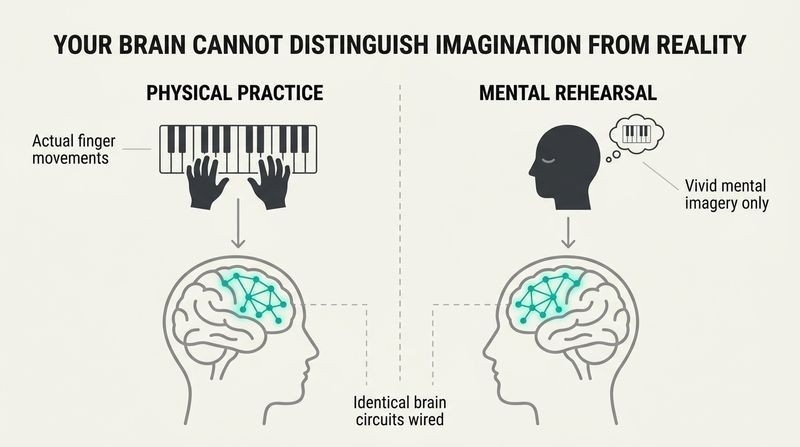
The mental-rehearsal research is genuinely robust and echoes findings in sports psychology, where motor imagery improves performance measurably. What's striking is how Dispenza extends a well-supported neuroscience finding (imagery activates overlapping neural substrates) toward far bolder territory. The honest boundary worth flagging: imagining bicep contractions strengthening muscle is documented, but that is a nervous-system adaptation, not tissue growth, and healing terminal disease by imagery alone rests on anecdote rather than controlled trials. The reader gets maximum value by taking the defensible core, that attention and emotion shape neural and physiological states, seriously, while treating the grander healing claims as hypotheses rather than settled science.
Rehearsing your trauma daily makes you chemically addicted to your own suffering
Anna's downward spiral. A Dutch psychotherapist named Anna lost her husband to suicide, then relived that afternoon a hundred times a day. Dispenza's point: the body cannot distinguish the original event from its memory, so each replay fired the same stress chemistry. Over years she developed paralysis, autoimmune ulcerations, depression, and esophageal cancer.
Emotions become an addiction. Stress hormones like adrenaline and cortisol produce a rush the body starts to crave, so people unconsciously use their problems, enemies, and grievances to re-trigger the familiar chemical hit. Anna reversed everything only when she stopped rebuilding the past through repeated recall and began, through daily meditation, refusing to rise until she felt in love with life again.
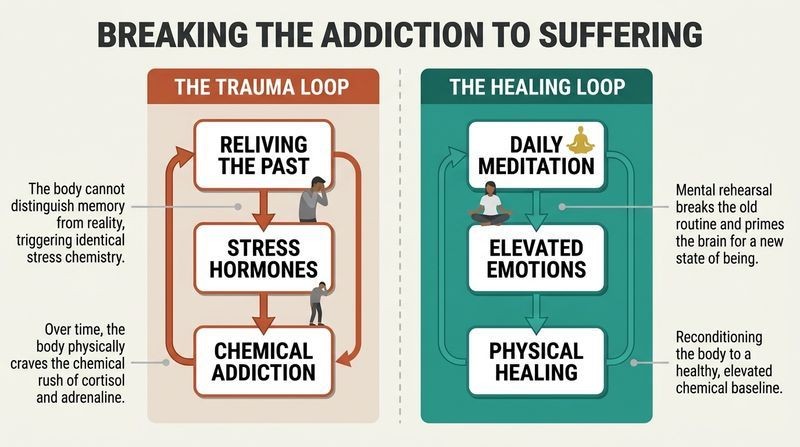
The addiction framing has real physiological grounding. Robert Sapolsky's work on chronic stress shows sustained cortisol suppresses immunity, impairs repair, and damages the hippocampus, and trauma researchers like Bessel van der Kolk document how the body keeps replaying threat. Where caution is warranted is the implied causal chain from grief straight to cancer, which oversimplifies multifactorial disease and risks blaming patients for illness. The more defensible reading: chronic rumination is a measurable health liability, and interrupting the rumination loop through meditation has documented benefits for inflammation and mood. Anna's full reversal is a single uncontrolled case, powerful as narrative, weak as proof.
To change your life, become no body, no one, no thing, nowhere, in no time
Dissolve the self to reach possibility. Dispenza argues most people wake up and immediately reassemble their identity by checking their phone, replaying problems, and anticipating the same routine, spending their energy on the known. His signature meditative move is subtraction: temporarily releasing your body, name, possessions, location, and even your sense of time until you exist as pure awareness.
Why bother. In this state, brain scans of his workshop participants showed a shift from fragmented, high-beta stress patterns toward coherent, synchronized alpha and theta waves. He frames the present moment as the only doorway to a new future, because as long as your attention is bonded to familiar people and grievances, your energy keeps recreating the same reality.
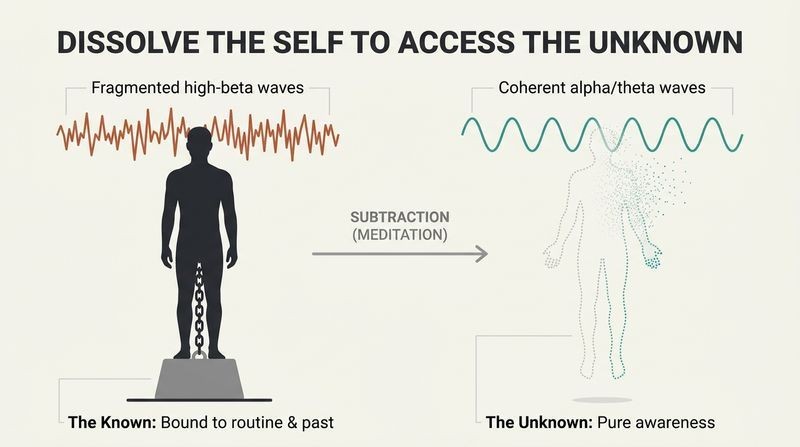
Stripped of its quantum vocabulary, this is a precise description of what contemplative traditions call ego dissolution or self-transcendence, and it maps onto real neuroscience. Judson Brewer and others have shown that quieting the brain's default mode network, the self-referential chatter system, correlates with meditative depth and reduced rumination. The instruction to disidentify from role, possession, and time closely parallels Buddhist anatta and Stoic detachment. The genuinely useful reframe for a modern reader is practical: your morning attention allocation is not neutral. Where you place awareness on waking literally rehearses either your past or a possible future.
Pair a crystal-clear intention with an elevated emotion, or nothing changes
Thought plus feeling equals reality. Dispenza's manifestation formula requires two ingredients working together: a specific intention (which he calls the electrical charge) and an elevated emotion like gratitude, joy, or awe (the magnetic charge). Positive thinking alone fails, he insists, because if you think abundance while feeling lack, the body's emotional signal overrides the affirmation and it never gets past the brain stem.
Feel it before it happens. His son Jace, jobless and traveling, wrote the letter J on paper, listed exact conditions for his ideal work, then attached the emotions he would feel once it arrived, and rehearsed both daily. Gratitude is the master emotion here because it is the felt sense of already having received.
The insistence that emotion must match intention is more psychologically sound than typical law-of-attraction fare. Affirmations research by Joanne Wood found that positive self-statements can backfire for people who do not already believe them, precisely because the felt state contradicts the words, which supports Dispenza's point. Practicing gratitude has strong evidence from Emmons and McCullough for improving wellbeing and even sleep. The weaker link is the leap from internal state to external events finding you through a field. A grounded reader can still extract enormous value: embodying the emotion of a goal changes behavior, attention, and openness to opportunity, which plausibly explains many of the reported outcomes.
Elevated emotions can flip genetic switches in days, not generations
Genes are dimmers, not destiny. Dispenza leans on epigenetics, the science that environment controls whether genes switch on or off, to argue you are not doomed by your DNA. Since emotions are the chemical residue of experience, choosing elevated emotional states sends new signals to your cells ahead of any change in circumstance.
The measurements. At a Tacoma workshop, 117 participants who cultivated love, joy, and gratitude for roughly ten minutes three times daily raised immunoglobulin A, a frontline immune protein, by an average of 49.5 percent over four days. At a Tampa event, researchers found significant changes in eight genes involved in neurogenesis, cellular repair, and cancer suppression. His claim: you can up-regulate healthy genes without a pharmacy.
Epigenetics is legitimate and revolutionary, and stress-related gene expression is well documented. Studies from Richard Davidson and others have shown that a single day of intensive meditation alters expression of inflammatory genes, lending real plausibility to the direction of Dispenza's claims. The IgA and gene-expression results, however, come largely from his own workshops, often without control groups, published outside top-tier peer review, and IgA is notoriously variable with hydration, sleep, and time of day. The signal may be real; the effect sizes deserve independent replication. The empowering core, that lifestyle and emotional regulation influence gene expression, is mainstream. The specific numbers should be held loosely.
Your heart broadcasts a measurable field five thousand times stronger than your brain's
Heart coherence is a trainable skill. Working with the HeartMath Institute, Dispenza measures heart rate variability, the tiny beat-to-beat timing changes that reveal emotional state. Resentment and frustration produce a jagged, incoherent rhythm; gratitude and compassion produce a smooth, ordered one. When the heart beats coherently, it entrains the brain into coherence too.
Why it matters. The heart contains roughly 40,000 neurons, its own little brain, and sends more signals up to the brain than it receives. Its electromagnetic field, HeartMath reports, is far stronger than the brain's and detectable several feet from the body. Sustaining elevated emotion for even 8 to 15 minutes shifts people with poor variability into measurable balance, quieting the amygdala's fear circuits.
Heart rate variability is one of the most validated biomarkers in physiology, tracking autonomic balance, resilience, and even mortality risk, so this chapter sits on firmer empirical ground than most. The vagal connection between calm, coherent breathing and reduced amygdala reactivity is well established in polyvagal and biofeedback research. The strong claim to watch is that the heart's field transmits intention that influences other people's hearts at a distance. That the field is measurable is uncontested; that it carries meaningful information between strangers is not accepted by mainstream cardiology. Still, the practical technique, slow heart-focused breathing while generating appreciation, is a legitimate, low-cost intervention for stress regulation.
Breathe survival energy up your spine to free it for healing and creation
Energy trapped in the lower body. Dispenza teaches a breath that contracts the pelvic, lower, and upper abdominal muscles while inhaling slowly and following the breath to the crown of the head. Physiologically, he says this accelerates cerebrospinal fluid up the spine, creating an inductance field that pulls energy from the first three survival centers (governing sex, digestion, and stress) toward the brain.
Turning lead into gold. He frames it as alchemy: the same energy locked in anger, guilt, or lust becomes fuel for repair and mystical experience. Workshop EEGs recorded participants producing gamma brain waves at extraordinary amplitudes, sometimes 160 to 260 standard deviations above normal, when practicing this breath, indicating intense internally generated arousal rather than external threat.
The breathing mechanics blend documented physiology with speculative bridges. Breath-driven movement of cerebrospinal fluid is real and now imaged with MRI, and breath-hold plus muscular bracing genuinely raises intrathoracic and intracranial pressure. The pelvic-floor engagement resembles the bandhas of kundalini yoga, a centuries-old technique Dispenza essentially reframes in neuroanatomical language. The eye-popping gamma readings are provocative but hard to interpret: extreme standard-deviation figures can reflect movement artifact, muscle tension, or nonstandard baselines rather than transcendence. What a skeptical practitioner can still accept is that intense, structured breathwork reliably shifts arousal and consciousness, a fact underlying Wim Hof, holotropic, and pranayama traditions alike.
Advertisers program your subconscious nightly; do it deliberately for your own future
How programming works. Dispenza dissects a late-night shingles drug commercial that first shocks you with a grotesque rash, changing your emotional state, then feeds facts while your analytical mind is disarmed. Repetition plus emotion plus lowered brain waves equals subconscious programming. Melatonin rising in the evening makes you especially suggestible, which is why such ads run late.
Flip the tool. His countermeasure pairs a kaleidoscope video (its non-representational fractals induce trance and bypass memory-based associative networks) with Mind Movies, a slideshow of images and affirmations of your desired future set to a song you love. Watched in trance, morning and night, it programs empowerment instead of lack. Music becomes the soundtrack of your future rather than your past.
The advertising analysis is sharp media literacy dressed as neuroscience, and it holds up. Suggestibility does rise in hypnagogic, low-frequency brain states, and repetition with emotional arousal is exactly how effective persuasion and conditioning operate, from Pavlov to modern neuromarketing. Reframing the same mechanism as a self-directed tool is clever and echoes vision-boarding and implementation-intention research by Peter Gollwitzer, which shows that mentally pre-living specific future scenes improves follow-through. The honest caveat: a Mind Movie's real power is likely priming attention, motivation, and pattern recognition (you notice opportunities aligned with your rehearsed goal), not magnetically attracting events. Framed that way, the practice is both defensible and genuinely useful.
The pineal gland may act as an antenna tuning frequencies beyond the senses
A crystalline transducer. Dispenza builds an elaborate case that the tiny pineal gland, which normally converts serotonin to melatonin on a light-driven daily rhythm, contains calcite crystals with piezoelectric properties. Squeeze it with the breath's pressure wave, he argues, and it becomes an antenna that receives frequencies beyond visible light and transduces them into vivid inner imagery.
Melatonin's upgrades. Under these conditions he claims melatonin metabolizes into powerful compounds: benzodiazepine-like molecules that quiet the fearful analytical mind, potent antioxidants, and even DMT, the hallucinogen found in ayahuasca. The result is a transcendental experience more real than waking life, complete with geometric fractal patterns, luminous colors, and a sense of dimensions beyond ordinary space and time.
This is the book's most scientifically adventurous chapter and where a careful reader should apply the most salt. The verified facts are narrow: the pineal does produce melatonin, calcite microcrystals were documented in one 2002 study, and endogenous DMT has been detected in rodent pineal tissue at trace levels. The extrapolation to an antenna receiving extrasensory frequencies is not established by any mainstream research. Rick Strassman, who studied DMT clinically, has been openly cautious about pineal DMT claims. The chapter is best read as a poetic neurobiological mythology for profound meditative and psychedelic-like states that many practitioners genuinely report, rather than as confirmed physiology.
Groups meditating on peace have coincided with 70 percent drops in violence
Coherence scales up. Dispenza's most ambitious claim is collective: when large groups generate heart-brain coherence and intend peace, they measurably affect others nonlocally. He cites more than 50 demonstration projects and 23 peer-reviewed studies reporting average reductions in crime, warfare, and terrorism above 70 percent, including a 1993 Washington, D.C., meditation associated with dropping violent crime, and RAND-era gatherings tied to a 72 percent fall in terrorism.
His own data. At workshops, when a room of hundreds broadcast elevated emotion toward volunteers wired to heart monitors, those volunteers slipped into heart coherence at the same moment. This became Project Coherence, global synchronized meditations drawing tens of thousands online, aiming to raise the planet's collective field.
This is where confirmation bias and methodology deserve scrutiny. The Maharishi Effect studies Dispenza cites are almost all produced by researchers affiliated with the Transcendental Meditation movement, using models critics argue can be tuned to find effects, and independent replication is thin. Correlations between meditation gatherings and crime dips are vulnerable to seasonality, selective time windows, and countless confounds. That said, the humbler within-room finding, that shared emotional states synchronize physiology among people in proximity, has partial support from emotional-contagion and interpersonal-physiology research by scholars like Barsade. The inspiring vision of collective coherence is worth holding as aspiration while demanding far stronger evidence before accepting global nonlocal causation.
Analysis
Becoming Supernatural is a thesis-driven self-help manual that fuses genuine neuroscience and epigenetics with speculative quantum metaphysics, aimed at readers hungry for both empowerment and scientific legitimacy. Its structure alternates teaching chapters, guided meditations, and testimonial case studies, a deliberate pedagogy: Dispenza believes witnessing others do the uncommon frees you to attempt it yourself. The difficulty in summarizing lies in separating the defensible from the extraordinary, because the two are woven together as if equally proven.
The strongest material sits on solid ground. Mental rehearsal, stress physiology, heart rate variability, epigenetic gene regulation, and the suggestibility of low-frequency brain states are all real and useful. Dispenza's practical genius is translating contemplative traditions, kundalini breathwork, ego dissolution, gratitude cultivation, into accessible neurobiological language with feedback tools like EEG and HRV that let ordinary people verify internal change. This measurement culture is a real contribution; few spiritual teachers instrument their students.
The weakest material is the interpretive scaffolding: the quantum field as a wish-granting intelligence, the pineal gland as an interdimensional antenna, and nonlocal group effects reducing global violence. Here Dispenza commits a common category error, borrowing the authority of physics vocabulary for claims physics does not support, and relying heavily on his own uncontrolled workshop data and movement-affiliated peace studies. The dramatic healing anecdotes, while moving, cannot bear the causal weight placed on them and risk implying that illness is a failure of consciousness.
The wisest way to read this book is as two texts. One is a practical program of meditation, breathwork, emotional regulation, and mental rehearsal that plausibly delivers many reported benefits through well-understood mechanisms of attention, autonomic regulation, and behavior change. The other is a metaphysical mythology that inspires devotion but demands independent proof. Take the first seriously; hold the second with curious skepticism.
Review Summary
Becoming Supernatural by Dr. Joe Dispenza receives mixed reviews. Many readers find it life-changing, praising its blend of science and spirituality, and reporting positive effects from practicing the meditation techniques. However, critics argue it's pseudoscientific, repetitive, and overly promotional of Dispenza's products and seminars. Some appreciate the scientific explanations and potential for personal transformation, while others find the concepts far-fetched or difficult to implement. The book's approach to mind-body connection and consciousness expansion resonates with some readers but skeptics question its validity.
People Also Read




FAQ
What's Becoming Supernatural about?
- Exploring Human Potential: Becoming Supernatural by Joe Dispenza explores the extraordinary capabilities of the human mind and body, combining scientific research with personal stories to show how individuals can transcend limitations.
- Mind-Body Connection: The book emphasizes the link between thoughts, emotions, and physical health, suggesting that altering thoughts and feelings can change biology and improve well-being.
- Practical Techniques: Dispenza offers meditative techniques like "Blessing of the Energy Centers" to help readers tap into their potential for healing and transformation.
Why should I read Becoming Supernatural?
- Transformative Insights: The book provides groundbreaking insights into the mind-body connection, encouraging readers to explore their potential for healing and personal growth.
- Real-Life Examples: Dispenza shares compelling case studies of individuals who have experienced significant transformations, making the concepts relatable and inspiring.
- Scientific Backing: The author integrates scientific research from fields like quantum physics and neuroscience, appealing to a wide audience interested in both science and spirituality.
What are the key takeaways of Becoming Supernatural?
- Power of the Present Moment: Living in the present moment is crucial for accessing new potentials and breaking free from past patterns.
- Elevated Emotions Matter: Combining clear intentions with elevated emotions like love and gratitude can significantly influence biology and gene expression.
- Meditation Techniques: Dispenza provides specific meditation practices to help individuals recondition their bodies and minds, creating a new future.
What are the best quotes from Becoming Supernatural and what do they mean?
- “The moment you change your energy, you change your life.”: This quote emphasizes that altering one's emotional and energetic state can lead to profound changes in reality.
- “You are not a victim of your genes; you are the master of your destiny.”: Dispenza highlights the power of epigenetics, suggesting individuals can influence genetic expression through thoughts and emotions.
- “When you are truly present, you are in the realm of possibility.”: This underscores the importance of being in the present moment to access infinite possibilities in the quantum field.
How does Becoming Supernatural explain the mind-body connection?
- Thoughts Influence Biology: Dispenza argues that thoughts and emotions directly affect biology, shaping health and well-being.
- Neuroplasticity: The book discusses how the brain can change and adapt based on thoughts and experiences, allowing for new patterns and behaviors.
- Energy and Information: Dispenza emphasizes that by changing our energy, we can change our lives, encouraging readers to view themselves as more than just physical beings.
What is the "Blessing of the Energy Centers" meditation in Becoming Supernatural?
- Focus on Energy Centers: This meditation involves focusing on the body's energy centers (chakras) and blessing each one for healing and balance.
- Combining Intention and Emotion: Participants combine intentions with elevated emotions like love and gratitude to create a coherent energy field.
- Practical Application: Regular practice of this meditation can lead to profound changes in physical and emotional states over time.
How does Joe Dispenza define the "quantum field" in Becoming Supernatural?
- Invisible Field of Energy: The quantum field is an invisible field of energy and information where all possibilities exist, fundamental to creating change.
- Mind and Matter Connection: Dispenza suggests that consciousness can influence the material world, key to manifesting desired outcomes.
- Potential and Possibility: By tuning into the quantum field, individuals can access new experiences and realities, exploring their creative power.
What role does meditation play in Becoming Supernatural?
- Accessing the Subconscious: Meditation is a tool for accessing the subconscious mind and breaking free from habitual patterns.
- Creating New Experiences: Various meditation techniques help individuals connect with the quantum field and manifest intentions.
- Healing and Transformation: Case studies demonstrate how meditation has led to significant healing and transformation, highlighting its power for personal growth.
What is the significance of the pineal gland in Becoming Supernatural?
- Gateway to Higher Consciousness: The pineal gland is a sacred gland connecting individuals to higher dimensions and consciousness.
- Secretion of Powerful Hormones: It secretes hormones like melatonin and serotonin, influencing perception and reality.
- Enhancing Intuition: Activating the pineal gland through meditation enhances intuition and creativity, tapping into deeper awareness.
How does Becoming Supernatural address the concept of stress?
- Impact on Health: Chronic stress creates incoherence in the body's systems, leading to physical and emotional issues.
- Emotional Addictions: Many become addicted to stress hormones, trapping them in cycles of negative emotions and experiences.
- Techniques for Overcoming Stress: Meditation and heart coherence practices help individuals break free from stress and cultivate balance.
What is the significance of the Schumann resonance in Becoming Supernatural?
- Earth’s Electromagnetic Field: The Schumann resonance is Earth's natural electromagnetic frequency, influencing human health and well-being.
- Connection to Collective Consciousness: It can be affected by collective human emotions, indicating interconnectedness between individuals and the planet.
- Impact on Meditation: Aligning meditative practices with the Schumann resonance enhances coherence and unity, amplifying group meditation effects.
How can I apply the concepts from Becoming Supernatural in my daily life?
- Daily Meditation Practice: Incorporate meditation techniques to cultivate elevated emotions and connect with the quantum field.
- Focus on Heart Coherence: Practice heart coherence through breathing exercises and emotional regulation to enhance well-being and relationships.
- Set Intentions: Regularly set clear intentions for desired outcomes to manifest goals and create a fulfilling life.
About the Author
Other books by Joe Dispenza

Download PDF
Download EPUB
.epub digital book format is ideal for reading ebooks on phones, tablets, and e-readers.








































