


Plot Summary
The Survivors' Silence
Control1 arrives at the Southern Reach to take over as acting director and is met by the hostile assistant director, Grace.3 Behind one-way glass, he observes three women returned from the twelfth expedition into Area X, their heads shaved, their memories apparently erased.
He has already counted the words in their pre-expedition transcripts: the biologist2 gave only 753 words before leaving, and roughly 700 after. The other two were voluble. Control1 tears up the anthropologist's and surveyor's files and tells Grace3 he will interview only the biologist.2
In the interrogation room, the biologist calls herself Ghost Bird,2 evades his questions, and finally admits her last memory in Area X was drowning. Control1 knows she is lying about the extent of her amnesia, and that she is his only lever into the mystery.
Control’s fixation on the biologist as a meaningful signal amid bureaucratic noise mirrors the agency’s broader desperation to extract a coherent narrative from Area X. His word-count method exemplifies the rationalist’s gambit: reducing human complexity to measurable data, only to confront the irreducible strangeness of a mind touched by the unknowable. The power struggle with Grace immediately contaminates his authority, establishing the book’s theme of institutional decay as a parallel to the ontological decay spreading from Area X. Ghost Bird’s “drowning” becomes a shared psychic wound.
The Director's Compost Heap
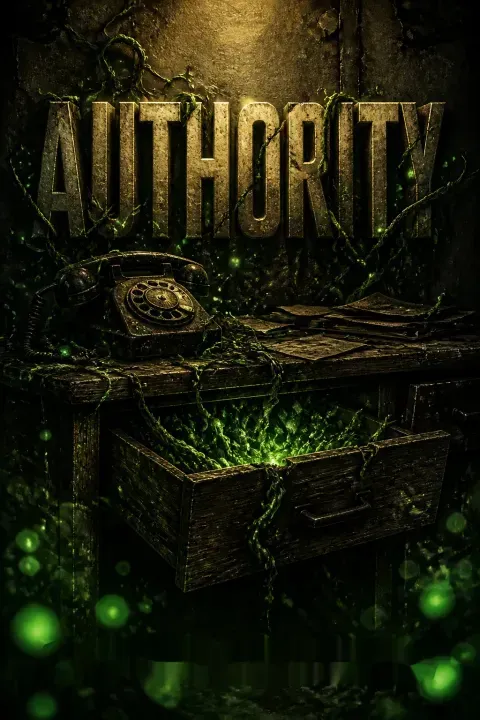
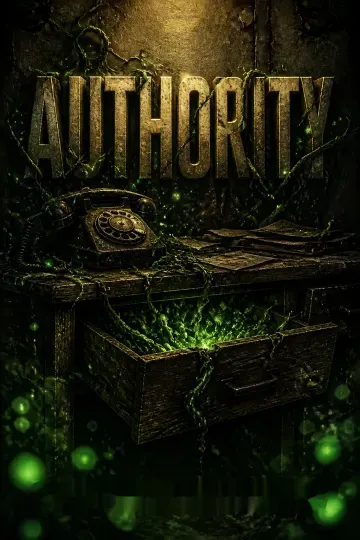
Control1 settles into the former director8's office, a chaos of papers, bulletin boards, and defunct technology. He finds twenty-two surveillance bugs from across decades. When he unlocks a desk drawer, he discovers a plant growing in the dark, its roots clutching a desiccated mouse, next to an old cell phone.
Worse waits behind a blocked door: an entire wall covered in the director8's handwriting, a looping sermon about strangling fruit and seeds of the dead. Grace3 later identifies the text as words from the topographical anomaly inside Area X, originally written by the lighthouse keeper Saul Evans.10
The staff kept the wall as a memorial because Grace3 refuses to believe the director8 is dead. Control,1 unsettled, eventually paints over the words and places his father's carved chess pieces on his desk for protection.
The office as archaeological site reveals the director’s psyche: a mind composting official data with personal obsession, the undying plant a literal intrusion of Area X’s refusal to be contained. The wall sermon functions as a contaminating text, a linguistic virus that blurs the boundary between information and infection. Control’s whitewashing is a futile act of bureaucratic erasure, yet his substitution of family totems signals his need for a talismanic defense against the irrational – a turning inward toward memory as armor against the dissolving real.
The Swirling Door
Cheney,5 the head of the science division, drives Control1 and the strange Whitby4 to the border. They pass abandoned towns and descendants of white rabbits from an old experiment. At the threshold, Control1 sees the entrance for the first time: a rectangular arch of swirling white light, twenty feet high, through which expeditions crawl with packs.
Cheney5 reveals that the door was not created by the Southern Reach but simply found one day. He then mentions a rumor: the former director8 once crossed the border alone, without authorization, before the final eleventh expedition.
Control1 absorbs this as evidence of a hidden agenda. On the drive back, Cheney5 also floats the theory that the border and Area X may originate from two separate entities, one perhaps a reaction meant to contain the other.
The border visit concretizes the Southern Reach’s fundamental impotence: they guard a door they did not build, into a zone they cannot understand, using rituals they no longer believe. The revelation that the director crossed alone recasts her from eccentric administrator to secret agent of her own inscrutable mission. Cheney’s dual-entity theory introduces a cosmological uncertainty that undermines all strategic assumptions. The white rabbits, escaped and breeding, embody the porosity of containment and the banality of the weird forever seeping into the mundane world.
Conversations with a Ghost
In multiple sessions, Control1 probes Ghost Bird2 about the topographical anomaly, the lighthouse, and her missing memories. She oscillates between hostility and a strange recklessness. She mocks him with a scholarly comparison to a clumsy phorus snail, then admits she remembers a tower, not a tunnel or pit.
When he presses her on her drowning statement, she retracts it entirely, claiming it was a childhood memory of a fountain accident. Control1 recognizes the maneuver as a deliberate feint to protect something real.
During a later visit to the holding pond, she shows him a dying beetle poisoned by insecticide and crushes it with her shoe, a cold mercy. She tells him she has a brightness inside her that she does not understand. He grants her this outdoor time despite the security risk, feeling the interrogation becoming something else.
Ghost Bird’s behavior enacts a predator-prey dynamic with the interrogator; her comparisons to animals and her displays of ecological intimacy establish her as someone who processes the world through biomes, not bureaucracies. The fountain lie is a sophisticated act of counter-surveillance—giving a true, verifiable detail to mask a deeper secret. Control’s willingness to take her outside signals his own professional boundary dissolving. Her confession of an interior “brightness” reframes her as something post-human, perhaps a successfully integrated hybrid rather than a merely contaminated victim.
The Box of Accusations
Grace3 summons Control1 to her office and empties a jewelry box full of the bugs he planted back across her desk. Then, in the cafeteria, she forces him to recount his worst professional failure: as a young domestic terrorism operative, he disobeyed orders and spoke with Rachel McCarthy, the girlfriend of a militia member.
The boyfriend discovered the connection via surveillance cameras, concluded McCarthy was an informant, and shot her dead. Control1's career was salvaged only by his mother7's intervention.
Humiliated but also oddly liberated by the public confession, Control1 and Grace3 reach an uneasy truce. She tells him they are alike — people who made terrible mistakes and are trying to be better. She admits the director8 crossed the border and that she, Grace,3 aided her return.
Grace’s public vivisection of Control’s guilt serves a dual purpose: it punishes his intrusion while simultaneously forging a bond through shared moral injury. The Rachel McCarthy story is the original breach in Control’s life, the moment his swaggering competence shattered, and its recitation here parallels the confessional culture of intelligence work where secrets become currency. Grace’s concession that she colluded with the director transforms their relationship from antagonism to complicity, two guardians of a failing institution now yoked by mutual burden.
The First Expedition's Ghosts
In a locked room, Grace3 cues up the surviving video fragments from the first expedition into Area X. Control1 watches the initial normalcy disintegrate: radio transmissions become garbled nonsense, a woman duplicates into two identical, screaming versions of herself, and a man chews his lip until blood runs while reciting the same sermon on the wall.
In the final clip, shot after everyone is dead except the survivor Lowry,6 the camera soars across the marsh with horrifying joy, unmanned. Control1 staggers out haunted, understanding at last that Area X does not simply kill — it unmakes identity, replicates, and absorbs.
He later interviews the biologist2 again, sees her distress, and she grabs his hand, insisting she is not the biologist. He realizes the video has infected him with a knowledge that cannot be shared.
The first expedition footage functions as the book’s traumatic kernel, a message from the real that shatters the bureaucratic frame. The doppelganger effect literalizes Area X’s core operation: identity as interruptible signal, consciousness as material to be copied and overwritten. The flying camera’s ecstatic trajectory suggests that whatever has assimilated the expedition experiences not malice but a terrifying form of play. Control’s silence afterward is the institutional reflex to contain the uncontainable, yet the images lodge in him like a hypnosis deeper than Lowry’s.
The Voice in the Static
Control1 reviews surveillance footage of his own phone calls and discovers the Voice6 has been embedding hypnotic triggers during their conversations. He watches himself go slack, eyelids fluttering, while the Voice6 extracts verbatim reports and plants suggestions — including minimizing his concern about Whitby.4
Enraged, he devises a countermeasure using a timer-activated bullhorn and the director8's list of hypnotic commands. During the next call, he delivers a screaming barrage of obscenities and trigger phrases until the Voice6 reels in agony.
He hangs up with a joke. Later, his mother7 calls and reveals that the Voice was James Lowry,6 the sole survivor of the first expedition, now a damaged and manipulative figure at Central. She admits Lowry6 conditioned Control1 with her knowledge, calling it necessary protection.
The revelation that Control is himself an operated subject—a human recorder planted in hostile territory—collapses the distinction between the expeditions into Area X and his own mission into the Southern Reach. Lowry’s remote manipulation recapitulates the first expedition’s horror: a survivor passing on the contagion of control. Control’s counter-hypnosis, using the director’s own lexicon, is an act of reappropriation, seizing the master’s tools. His mother’s confession recontextualizes familial love as operational necessity, deepening the book’s interrogation of whether any intimacy exists outside of strategic deployment.
The Director's Childhood Photograph
Control1 breaks into the director8's house in Bleakersville and finds her bedroom walls covered with the same strangled sermon and a map connecting the lighthouses, the topographical anomaly, and the Southern Reach. Central had supposedly cleaned the house months ago; someone has been there since.
Searching the office photograph of the lighthouse keeper Saul Evans,10 he suddenly recognizes the girl playing on the rocks in the background: she has the same stooped posture as the director.8 The director8 grew up on the forgotten coast, knew Evans10 personally, and was likely one of the last people to see him before the border came down.
Her entire career — becoming a psychologist, infiltrating the Southern Reach, crossing the border — was never about institutional duty. It was a private, decades-long investigation rooted in childhood trauma and proximity to the Event.
The photograph transforms the director from bureaucratic enigma into tragic figure, her obsession now legible as a survivor’s compulsion to return to the scene of an originating wound. Her entire professional life becomes a long undercover operation, the Southern Reach merely her cover identity. The reappearance of the wall of words in her home suggests that the border’s contamination operates through linguistic and spatial replication, not physical proximity alone. Control’s belated recognition mirrors his own blindness to how his mother has similarly weaponized his life.
Whitby's Lair Above the Cafeteria
Investigating a storage room, Control1 discovers a hidden trapdoor and climbs into a crawlspace filled with a phantasmagoric mural. Whitby4 has painted the Southern Reach staff as monstrous hybrids: the director8 as a boar stuffed with vegetation, Cheney5 as a jellyfish, Control1 as a cyclopean sea creature.
Pasted faces from security badges stare out with expressions of anguish. In the shadows, Control1 finds Whitby4 himself crammed onto a shelf like something incubating, breathing shallowly. Whitby4's hand reaches out and gently strokes Control1's hair.
Terrified, Control1 retreats without speaking. He later understands that Whitby4 did not simply go mad; he became a breach, a permeable membrane through which Area X was already leaking, and that his hidden artwork was a map of the invasion already underway.
Whitby’s mural literalizes the Southern Reach’s inescapable condition: everyone inside the institution is already being remade by Area X, their identities hybridized and rendered monstrous. The caress is a moment of profound uncanniness, tenderness emerging from horror, suggesting that Whitby has passed into a state where human categories no longer apply. Control’s silent flight marks his limit as an investigator; he can document the breach but cannot confront its embodied reality. The scene echoes the first expedition video’s lesson: to witness transformation is to risk becoming part of it.
The Director Comes Home
Late in the day, Control1 walks toward the science division and reaches for the double doors — only to find a soft, breathing wall where the corridor should be. He screams and runs, pulling fire alarms. In the cafeteria, he sees Grace3 standing at the courtyard door, staring out into the rain.
The director8 is approaching across the courtyard, still in expedition clothes, trailing plumes of emerald dust. The rain thins and loses its depth behind her. Whitby4 sits at a table, his jaw elongating, his speech dissolving into the same corrupted language from the first expedition video.
Grace3 refuses to flee; she has been waiting for this reunion. Control1 runs for the parking lot and drives away as jets roar overhead, the border now expanding to swallow the entire Southern Reach.
The breathing wall enacts the book’s central premise: the border was never a fixed line but a slow metastasis, and the Southern Reach was always inside Area X’s body. The director’s return is not rescue but infection; the emerald dust is the substance of transformation, and her lost self is now merely a vehicle for the zone’s propagation. Grace’s faithful vigil becomes a suicide pact with loyalty, while Whitby’s final dissolution confirms that the human staff were not scouts but incubators. Control’s flight is both cowardice and survival instinct, leaving behind everyone he has come to understand.
A Mother's Confession
Control1 reaches his house where his mother7 awaits. She gives him a calming pill and tells him the contamination at the sites where the surveyor and anthropologist were found has broken quarantine. The Southern Reach is lost, the border may continue expanding.
She admits she placed him there as a sensor: if he changed, she would know Area X was affecting him. She also reveals that Ghost Bird2 escaped Central's custody over the weekend and is believed to be heading north. Control1's mother7 calls him her weapon, the one she chose to know everything.
She urges him to find the biologist,2 who she believes was the director8's intended weapon against Area X. Control1 packs a briefcase with money and passports, abandons his cat, and leaves his mother behind, severing the last institutional tether.
Jackie Severance’s confession reframes the entire narrative as a mother’s gambit: love expressed as instrumentalization, a son deployed as a measuring device. The revelation that Control’s integrity was the test collapses the boundary between family and operation, exposing the Southern Reach’s dysfunction as a fractal of Central’s own madness. Ghost Bird’s escape introduces agency into the replicant’s arc: she is no longer a subject to be studied but a fugitive with her own trajectory. Control’s decision to pursue her completes his transformation from institutional functionary to autonomous seeker.
The Voyage to Rock Bay
Control1 flies west under false bookings, then drives and sails north along the coast toward the remote tidal pools where the biologist2 once worked. He dumps his phone, buys a boat named The Living with Salt, and navigates past abandoned lighthouses while strange lights flicker on the horizon behind him.
At Rock Bay, he spots Central operatives staking out her old cottage. He evades them by hiking through the rain forest and continues farther up the coast in his leaking skiff.
He passes black rocks where someone has been harvesting limpets. After three days, weakened and alone, he finally glimpses a figure on the rocks at dusk. He leaves the boat, now flooding, and begins a tense stalk across the jagged black ridge, unsure if she will greet him or kill him.
The northward journey is a ritual of stripping away: Control sheds technology, institutional identity, and finally the boat itself, regressing toward a state of pure physical pursuit. The coastal wilderness mirrors Area X’s pristine strangeness but remains legibly human, offering a liminal space where he can reconstitute himself outside the Southern Reach’s gravitational pull. His tracking of the biologist through her ecological niche—the limpets, the rocks, the tide—demonstrates that he has internalized her method of reading landscapes, becoming more feral in the process.
The Lagoon's Hidden Door
On the outermost rocks, Ghost Bird2 emerges and trains a gun on Control,1 forcing him to throw his own weapon into the sea. He tells her the Southern Reach is gone, that more are coming. She admits she is not the biologist but a replica, fabricated by Area X, carrying the original's memories yet distinct.
When she arrived here, a brightness inside her made her sick until she discovered a portal in the lagoon below: a glimmering light, another door into Area X. Helicopters and boats are closing in. Ghost Bird2 says she cannot go back, and that she needs to know who she is. She dives into the churning water without hesitation. Control,1 after one last look at the world, hears a voice in his head say "Jump." He jumps after her.
The final scene resolves the book’s central tension between containment and surrender. Ghost Bird’s self-naming as replica is an act of radical self-authorship, claiming personhood precisely through her difference from the original. The portal beneath the lagoon literalizes the book’s leitmotif of hidden doors: Area X is not elsewhere but under the surface of the real, accessible through any liminal body of water. Control’s jump is a rejection of the entire apparatus that produced him—mother, agency, mission—in favor of an unknown becoming. The voice in his head may be his own desire or something else calling him home.
Analysis
VanderMeer's "Authority" is a study in institutional decay as ontological horror. The Southern Reach is not merely a failed bureaucracy; it is a body already colonized by the phenomenon it was built to contain, its corridors and filing cabinets serving as an extended nervous system through which Area X probes and remakes the human. Control1's arrival installs the reader in a position of epistemological desperation: every document is a possible lie, every colleague a potential breach, every memory a site of manipulation. The novel systematically dismantles the distinctions between investigator and subject, handler and agent, mother and mission planner, until the central question becomes not "What is Area X?" but "Who is doing the observing, and what has already been done to them?" The book's true horror lies in its recognition that contamination is not a future event but an ongoing process, and that the language we use to describe the alien — borders, doors, expeditions — is itself an artifact of the human need for control that Area X effortlessly metabolizes. Control1's final jump is an act of radical acceptance, an acknowledgment that understanding cannot precede surrender, only follow it.
Review Summary
Authority receives mixed reviews, with some praising its atmospheric tension and character development, while others find it slow-paced and frustrating. Many readers appreciate VanderMeer's writing style and the book's exploration of bureaucracy and mystery. However, some criticize the lack of resolution and answers. The novel's shift in focus from Area X to the Southern Reach agency divides opinions. Despite its flaws, many readers express interest in continuing the trilogy to uncover more about the enigmatic Area X.
People Also Read







Characters
Control (John Rodriguez)
Acting director turned fugitiveA thirty-eight-year-old intelligence operative with a history of failure, sent to run the Southern Reach as his last chance. Son of a spy mother7 and an artist father, he was raised in a family dynasty of secrets. His career was derailed years ago when a lapse in field protocol led to the murder of a civilian, Rachel McCarthy. He carries that guilt as a permanent scar beneath a composed exterior. At the Southern Reach, he tries to apply his fixer's skills—observation, deduction, controlled empathy—but finds himself increasingly drawn to the biologist Ghost Bird2 and eroded by the agency's institutional rot. His discovery that he has himself been conditioned and manipulated forces him to choose between his programmed mission and an autonomous, dangerous freedom.
Ghost Bird (the biologist)
Amnesiac returnee and replicaA woman returned from the twelfth expedition into Area X with fragments of memory and a defiant will. She calls herself Ghost Bird, rejecting the identity imposed by the Southern Reach. In interrogation, she is evasive, mercurial, and sharply intelligent, weaponizing ecological knowledge and a sarcastic humor to unsettle Control1. She is drawn to wild places and speaks of a brightness inside her that she does not understand. Over the course of the book, it becomes clear that she is not the original biologist but a replica created by Area X, possessing the original's memories yet a distinct consciousness. Her journey is one of self-discovery in flight from the institution that would dissect her.
Grace Stevenson
Assistant director and gatekeeperA tall, imposing black woman in her forties who has run the Southern Reach since the director8 disappeared. She is fiercely loyal to the missing director8 and initially treats Control1 as an interloper, deploying bureaucratic sabotage and personal humiliation to undermine him. A former field operative who injured her leg on assignment, she carries her own history of sacrifice and loss. Her hostility masks a profound grief and a belief that the director8 will one day return. When she finally discloses her complicity in the director8's secret border crossing, she and Control1 reach a wary alliance built on shared damage and institutional despair.
Whitby Allen
Unraveling scientist and conduitA pale, bow-tied holistic scientist who has been at the Southern Reach longer than anyone. He is the agency's utility player, running errands for Grace3 and Cheney5 while developing an elaborate theory of terroir as a framework for understanding Area X. His behavior grows increasingly erratic: he is found crouching in a storage room in apparent agony, and he secretly constructs a nightmarish mural in a hidden crawlspace depicting staff members as monsters. By the climax, he has physically transformed, his jaw elongating as his speech dissolves into the same corrupted language from the first expedition videos, revealing that he has become a living breach through which Area X seeps.
Mike Cheney
Head of the science divisionA burly, motorcycle-jacket-wearing physicist whose jovial demeanor masks professional despair. His division has been stripped of resources over decades, reduced to showing new directors the same rabbit video. He provides Control1 with crucial information, including the theory that the border and Area X were created by separate entities, and the rumor that the director8 made an unauthorized solo crossing. He speaks in a stream of self-deprecating aphorisms that reveal a mind still sharp but fatigued by futility.
The Voice (James Lowry)
Hypnotic handler and first survivorControl1's unseen supervisor at Central, disguised by an electronic filter, later revealed to be James Lowry, the sole survivor of the first expedition into Area X. Lowry has leveraged his traumatic survival into influence, championing the use of hypnosis and conditioning on expedition members and later on Control1 himself. He is broken, manipulative, and governed by a terror of Area X that he transmutes into the urge to control everyone beneath him. His remote hypnotic suggestions make Control1 an unwitting recording device, a violation that shatters Control1's trust and leads to a violent severing of the handler-agent bond.
Jackie Severance
Control’s operative motherA high-ranking clandestine agent who has shaped her son's career from the shadows. She is a distant, calculating figure who once worked at the Southern Reach to be near Control1 as a teenager. She placed him in his current position as part of a faction aware that the Southern Reach was compromised, using him as a human sensor to detect contamination. Her love is expressed through operational necessity; she authorized Lowry6's conditioning of Control1 but also provides him with a final mission when everything collapses: find the biologist2 and continue the investigation from outside the failing institution.
The former director (Cynthia)
Missing architect of a secret planThe psychologist who ran the Southern Reach for years before embedding herself as a member of the twelfth expedition. Control1 discovers that she grew up on the forgotten coast and appears as a young girl in a photograph with the lighthouse keeper Saul Evans10, taken just before the border came down. Her entire career was an undercover investigation driven by that childhood proximity to the Event. She crossed the border alone once, planted hypnotic triggers in expedition members, and may have intended the biologist2 as a weapon. She returns during the climax, transformed, trailing emerald dust and leading the border's expansion.
Jessica Hsyu
Staff linguist and analystA slender, optimistic linguist who explains that the wall of words found in the director8's office originates from the topographical anomaly inside Area X, written in living tissue by the lighthouse keeper Saul Evans10. She argues that the words' physical substance matters more than their semantic content, functioning as a conduit for a message beyond language. Her rationalism contrasts with the superstitions of her colleagues.
Saul Evans
The lighthouse keeper whose words spreadA former preacher who became the last keeper of the lighthouse on the forgotten coast. Years before the Event that created Area X, he wrote a strange, looping sermon about fruit, seeds, and transformation. That text now appears on the walls of the topographical anomaly in living tissue and was obsessively copied by the director8. He vanished when the border came down, and his photograph hangs in the director8's office, linking her childhood to the mystery's origin.
Plot Devices
The wall of words (Saul Evans’s sermon)
Linguistic contamination vectorA spiraling text found written on the walls of the topographical anomaly inside Area X, rendered in living tissue. It begins, "Where lies the strangling fruit that came from the hand of the sinner I shall bring forth the seeds of the dead," and continues in a hypnotic, repetitive cadence. The former director8 transcribed it onto her office wall and later her bedroom wall. The linguist Hsyu9 theorizes that the words' meaning resides not in their semantics but in their material substance, which acts as a conduit for a nonhuman message. The text is linked to Saul Evans10, the last lighthouse keeper, who preached it before the border came down. Control1 paints over it, but it reappears elsewhere, suggesting it is self-propagating.
Hypnotic conditioning
Control and manipulation mechanismA system of psychological programming used by the Southern Reach and Central to manage expedition members and, secretly, its own personnel. Director Cynthia8 developed trigger words and phrases—such as "consolidation of authority" and "the possibility of significant variation"—that could induce compliant or suggestible states. Lowry6, the Voice, used hypnosis on Control1 during their phone calls, embedding commands and extracting information without Control1's knowledge. Control1 later turned these same phrases back on Lowry6 to break the conditioning, an overload attack modeled on the failed rabbit-border experiment.
The undying plant from Area X
Unkillable organic remnantA plant removed from Area X that the director8 kept in her locked desk drawer. It has eight slender, luminous green leaves and crimson roots gripping a nodule of soil containing a desiccated mouse corpse. The director8 subjected it to stabbing, burning, and deprivation, but it could not be killed. Someone continued watering it after she disappeared. Control1 later returned it to the storage cathedral of Area X samples. It symbolizes Area X's persistence and its resistance to human destruction, a small-scale demonstration of the forces that eventually overwhelm the Southern Reach.
The border door
Entrance into Area XA permanent opening in the otherwise impenetrable invisible border that surrounds Area X. It appears as a twenty-foot-high, twelve-foot-wide arch of swirling white light that must be crawled through. The Southern Reach did not create this door; it simply appeared one day. Cheney5 speculates that the border and the door may have been created by a different entity than whatever is transforming Area X, possibly as a containment measure. The door's interior is psychically disorienting, inducing visions of vast plains or crushing enclosures, and the time required to traverse it varies unpredictably.
Whitby’s hidden mural
Visual map of psychic contaminationIn a crawlspace above a storage room, Whitby4 painted a vast mural depicting Southern Reach staff members as grotesque hybrid creatures—the director8 as a boar, Cheney5 as a jellyfish, Control1 as a cyclopean sea monster—using security photographs for faces. The mural is annotated with frantic, crossed-out text and ringed by a border of red fire. Whitby4 himself was found living in the space, curled on a shelf, having apparently become a conduit for Area X's influence. The artwork functions as both a warning and a symptom, visualizing the slow transformation of everyone inside the agency.
FAQ
Synopsis & Basic Details
What is Authority about?
- Bureaucracy meets the uncanny: Authority follows John Rodriguez, codenamed "Control," as he takes over the dysfunctional Southern Reach agency tasked with investigating Area X, a mysterious, transforming ecological zone. The story centers on his attempts to impose order and uncover secrets within the crumbling organization and its enigmatic mission.
- Interrogating the unknown: A key focus is Control's interrogation of the Biologist, one of the few returnees from the latest expedition into Area X, who is disoriented and claims to remember little. Her evasiveness and strange behavior become central to Control's investigation into what truly happened beyond the border.
- Unraveling a hidden history: The narrative delves into the Southern Reach's past failures, the eccentric methods of the former director (now missing), and the complex relationships among the remaining staff, revealing layers of bureaucracy, paranoia, and hidden agendas surrounding Area X.
Why should I read Authority?
- Deep psychological immersion: The novel offers a compelling, first-person dive into the mind of Control, exploring themes of control, identity, and the struggle for meaning in the face of the incomprehensible, providing a rich psychological thriller experience.
- Expansion of a unique world: As the second book in the Southern Reach trilogy, Authority significantly expands the lore and mystery of Area X and the organization studying it, shifting perspective from the field to the bureaucratic and human elements behind the expeditions.
- Atmospheric and unsettling prose: Jeff VanderMeer's distinct writing style creates a palpable atmosphere of decay, paranoia, and the uncanny, blending bureaucratic realism with moments of profound strangeness and beauty that linger long after reading.
What is the background of Authority?
- Post-Event government agency: The Southern Reach agency was established after an unexplained "Event" created Area X, a quarantined zone along a remote southern coast that transforms the landscape and those who enter it. The agency's history is marked by failed expeditions and a struggle to understand or contain Area X.
- Decades of mystery: For over thirty years, the Southern Reach has sent expeditions into Area X with little success, facing returnees who are often disoriented, suffer from cancer, or are otherwise fundamentally changed, while equipment brought back is rendered useless or transformed.
- Bureaucratic decay and secrecy: The agency itself is depicted as underfunded, isolated, and riddled with internal conflicts and secrets, operating under a public cover story of environmental catastrophe while grappling with a reality far stranger and more terrifying.
What are the most memorable quotes in Authority?
- "Is your house in order?": Repeated by the mysterious "Voice" from Central, this seemingly simple question becomes a chilling motif, symbolizing Control's struggle to maintain internal and external order amidst chaos and manipulation.
- "I am not the biologist.": Ghost Bird's defiant declaration encapsulates her fragmented identity and the profound, unsettling changes wrought by Area X, highlighting the theme of transformation and the loss of self.
- "Terroir.": Whitby's unexpected introduction of this wine term to describe Area X's unique environmental influence becomes a metaphor for the novel's attempt to understand the uncanny through specific, localized details, even as it underscores the limits of human categorization.
What writing style, narrative choices, and literary techniques does Jeff VanderMeer use?
- First-person limited (Control): The novel is told almost entirely from Control's perspective, immersing the reader in his internal monologue, anxieties, and attempts to rationalize the irrational, creating a sense of claustrophobia and psychological tension.
- Juxtaposition of the mundane and the uncanny: VanderMeer masterfully contrasts the drab, decaying bureaucracy of the Southern Reach with moments of profound strangeness and biological horror, highlighting how the extraordinary infiltrates and warps ordinary reality.
- Repetition and motif: Recurring images (the dream of falling, the cleaning smell, specific animals, lights), phrases ("pristine wilderness," "last chance," "breach"), and structural echoes (interrogations, journeys, discoveries of hidden spaces) build a sense of haunting, cyclical mystery and thematic resonance.
Hidden Details & Subtle Connections
What are some minor details that add significant meaning?
- The pervasive cleaning smell: The "sour metallic tang of a low-quality cleaning agent, almost like rotting honey" is noted by Control early on and reappears in unexpected places (jeep, Grace's office), subtly hinting at a deeper, perhaps biological, contamination or decay within the building itself, beyond mere dirt.
- The height marks on the wall: The "two rather daunting slash marks... with dates about three years apart" and the director's initials in her office, initially dismissed as height checks, become deeply unsettling when the same wall writing appears in her house without these marks, suggesting the writing is somehow tied to the director's presence or actions, not just a static copy.
- The mosquito on the windshield: Control's discovery of a squashed mosquito on his car windshield after talking to the Voice, which he's certain wasn't there before, serves as a subtle, paranoid signal that he is under surveillance and potentially being manipulated or tested, even outside the Southern Reach building.
What are some subtle foreshadowing and callbacks?
- Control's dream of falling: His recurring dream of falling into an abyss filled with "ocean behemoths" directly foreshadows his final act of jumping into the lagoon with the biologist, a descent into the unknown depths of Area X, mirroring the terrifying beauty of his subconscious vision.
- The rabbit experiment's unintended consequences: The detail that descendants of the white rabbits sent into the border have spread, some even ending up as pets, subtly foreshadows the idea that Area X's influence or creations might escape containment in unexpected, seemingly innocuous forms, like the biologist herself.
- Whitby's "terroir" theory: Whitby's seemingly eccentric idea that Area X's nature is tied to the specific "geography, geology, and climate" of the forgotten coast, while dismissed for Area X itself, subtly applies to the Southern Reach and its staff, suggesting their decay and strangeness are a product of their isolated, dysfunctional environment.
What are some unexpected character connections?
- The Director and Saul Evans: The revelation that the girl in the photograph with the lighthouse keeper, Saul Evans, is the director as a child creates a profound, hidden link between the agency's missing director and the origins of Area X, suggesting her lifelong connection and potential complicity.
- Lowry as the Voice: The shocking reveal that James Lowry, the sole survivor of the first expedition and a figure of agency legend, is the mysterious "Voice" manipulating Control from Central connects the trauma of the first expedition directly to the present-day psychological operations within the agency hierarchy.
- The Director and Control's Mother: Grace's assertion that Control's mother had a hand in both the director's unauthorized border trip and her subsequent lack of severe punishment reveals a deep, hidden connection between Control's family dynasty and the Southern Reach's leadership, explaining his placement and protection.
Who are the most significant supporting characters?
- Grace Stevenson: More than just an antagonist, Grace embodies the Southern Reach's institutional memory, loyalty (to the director), and deep-seated resentment. Her complex relationship with Control evolves from open hostility to a grudging, fragile alliance, revealing the human cost of the agency's mission.
- Whitby Allen: Initially appearing as an eccentric, Whitby becomes a tragic figure and a physical manifestation of the Southern Reach's decay and Area X's psychological influence. His hidden art and eventual transformation highlight the novel's themes of madness, artistic expression, and the porous boundary between human and uncanny.
- Lowry (The Voice): As the traumatized survivor turned manipulative handler, Lowry represents the long-term psychological impact of Area X and the agency's willingness to use damaged individuals for its own ends. His role as the Voice underscores the themes of control, manipulation, and the haunting legacy of past failures.
Psychological, Emotional, & Relational Analysis
What are some unspoken motivations of the characters?
- Control's need for validation: Beneath his professional facade, Control is driven by a deep-seated need to prove himself, stemming from past failures (Rachel McCarthy incident) and the pressure of his family legacy, particularly his mother's expectations, making him vulnerable to manipulation.
- Grace's protective loyalty: Grace's animosity towards Control is rooted in fierce loyalty to the former director, whom she sees as having been wronged and misunderstood. Her actions are often motivated by a desire to protect the director's legacy and methods, even after her disappearance.
- The Director's personal quest: The director's eccentric methods and secret border crossing are driven by a personal, perhaps obsessive, connection to Area X's origins (her childhood link to Saul Evans and the lighthouse), suggesting her mission was not purely scientific but deeply personal and desperate.
What psychological complexities do the characters exhibit?
- Control's fragmented identity: Control struggles with his codename vs. real name, his past failures, and the psychological toll of his job, leading to moments of disorientation, paranoia, and a blurring of personal and professional boundaries ("Is your house in order?").
- Ghost Bird's mimicry and adaptation: Ghost Bird exhibits profound identity confusion and mimicry, adopting mannerisms and memories that may not be her own, reflecting Area X's ability to replicate and transform, while also demonstrating a fierce will to survive and forge a new self.
- Whitby's descent into expressive madness: Whitby's artistic expression of his psychological state through grotesque murals reveals a mind grappling with the horrors of Area X and the decay of the Southern Reach, using art as both a coping mechanism and a symptom of his unraveling.
What are the major emotional turning points?
- Control's first encounter with Ghost Bird's "drowning" memory: This moment establishes a strange, almost telepathic connection between them, linking her experience to his recurring dream and pulling him deeper into her mystery, moving their dynamic beyond simple interrogation.
- Watching the first expedition video: Witnessing the horrifying transformation and dissolution of the first expedition members profoundly impacts Control, breaking through his detached professionalism and exposing him directly to the terror and incomprehensibility of Area X's effects.
- Grace's confession in the cafeteria: Grace's unexpected recounting of Control's past failure (Rachel McCarthy) and her subsequent admission of her own struggles and grudging respect marks a significant shift in their relationship, moving towards a fragile, shared understanding of their damaged state.
How do relationship dynamics evolve?
- Control and Grace: Their relationship transforms from overt professional antagonism and power struggles (Control tearing files, Grace banishing returnees, bugging offices) to a complex mix of grudging respect, shared vulnerability (Control's past, Grace's loyalty), and eventually a negotiated, albeit unequal, alliance in the face of collapse.
- Control and Ghost Bird: What begins as a standard interrogator-subject dynamic shifts through moments of unexpected connection (shared dream imagery, personal questions), defiance, and vulnerability, culminating in Control's desperate search for her and his acceptance of her transformed identity.
- Control and The Voice (Lowry): The relationship moves from Control's initial deference and attempts to please a mysterious handler to suspicion, discovery of manipulation (hypnosis), and outright rebellion, revealing the toxic nature of control exerted through secrecy and psychological means.
Interpretation & Debate
Which parts of the story remain ambiguous or open-ended?
- The true nature and purpose of Area X: Despite theories of invasion, environmental reaction, or unknown entities, the fundamental 'why' and 'what' of Area X remain elusive, its motives and ultimate goals undefined, leaving its existence open to multiple interpretations.
- The fate and true form of the Director: Her return trailing emerald dust is deeply unsettling, but her exact state of being – whether a transformed human, a mimic, or something else entirely – is left ambiguous, raising questions about the nature of transformation and survival within Area X.
- The ultimate outcome of Control and Ghost Bird's jump: Their leap into the lagoon, a potential entry point into Area X, leaves their future uncertain. Will they survive? Will they be transformed? Will they find answers or simply become another part of the mystery? The ending offers no definitive resolution to their journey.
What are some debatable, controversial scenes or moments in Authority?
- The white rabbit experiment: The decision by Southern Reach scientists to herd thousands of white rabbits into the border, resulting in mass panic and disappearance, is ethically questionable and highlights the agency's desperation and dehumanizing approach to understanding Area X.
- The use of hypnosis and conditioning on expedition members (and Control): The agency's systematic psychological manipulation of its own personnel, including Control by Lowry, raises significant ethical concerns about informed consent, autonomy, and the morality of using individuals as disposable assets in the pursuit of knowledge.
- Grace's decision to send the anthropologist and surveyor away: Grace's unilateral action, seemingly based on Control's offhand comment, is a stark demonstration of the agency's arbitrary power, lack of clear protocol, and the precarious fate of returnees, sparking debate about her motives and authority.
Authority Ending Explained: How It Ends & What It Means
- Collapse and Expansion: The Southern Reach facility is overrun as the border of Area X rapidly expands, signaled by the Director's return in a transformed state, trailing emerald dust. This signifies the failure of containment and the onrushing, unstoppable nature of Area X's influence.
- Acceptance of the Unknown: Control, having fled the collapsing Southern Reach and reconnected with his mother (who reveals Central's manipulation and the spread of contamination), ultimately chooses to abandon his mission of control and understanding. He seeks out the biologist (Ghost Bird), who has escaped Central's custody.
- A Leap of Faith into Transformation: Finding Ghost Bird at a remote coastal lagoon, which she believes is another entry point into Area X and that she may have brought with her, Control joins her in jumping into the water. This final act is not a return to the agency's methods but a personal leap into the heart of the unknown, embracing transformation and connection over the futile attempt to impose order or escape. It mirrors his recurring dream and suggests a surrender to the uncanny forces he can no longer fight.
Southern Reach Series



Download PDF
Download EPUB
.epub digital book format is ideal for reading ebooks on phones, tablets, and e-readers.








































