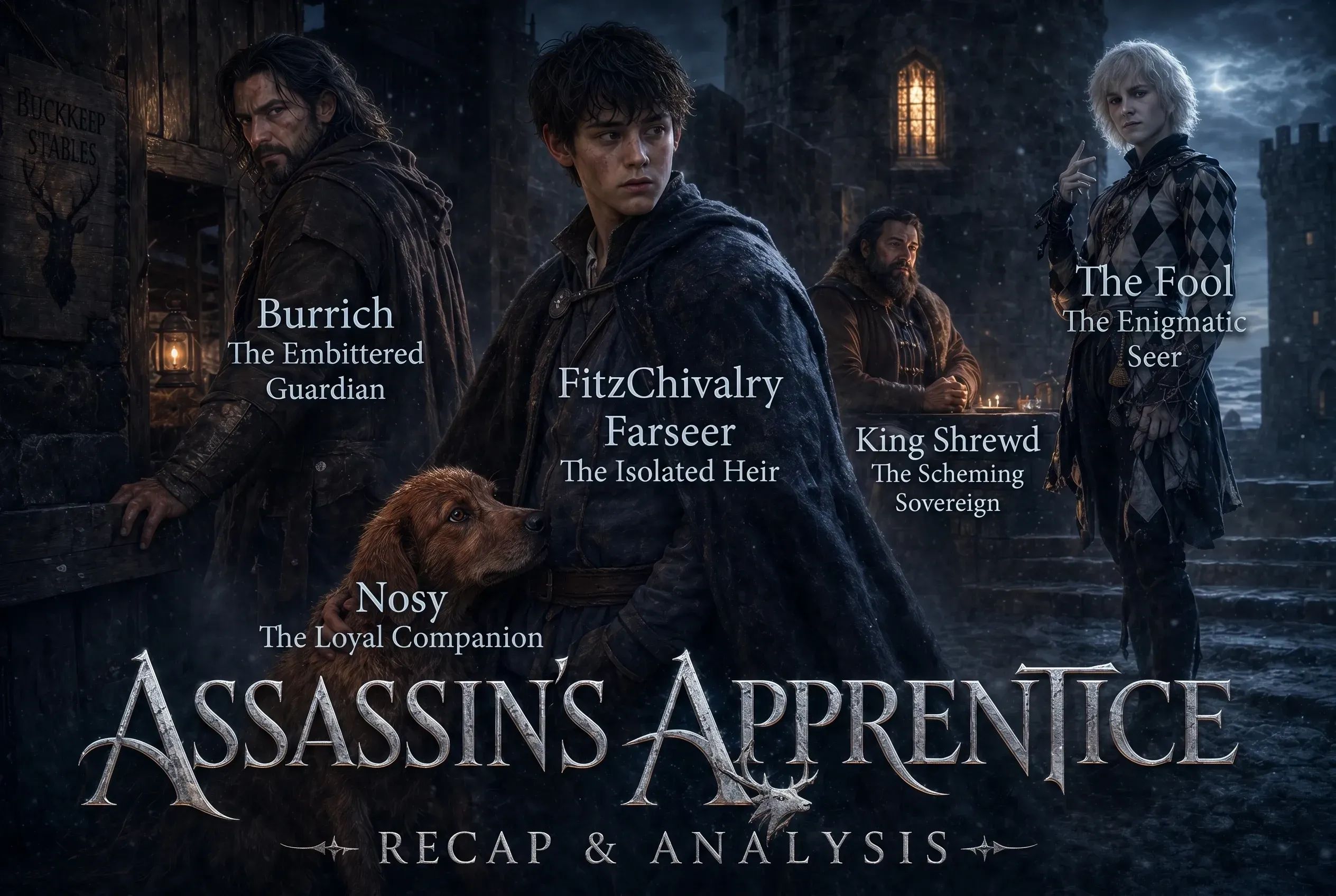


Plot Summary
Bastard at the Door
A grizzled farmer hauls a six-year-old boy1 to a fortified keep and abandons him, announcing the child is Prince Chivalry's by-blow and no longer his to feed. The boy has no name beyond Boy. Prince Verity,5 amused, notes the child wears his brother's face, while Prince Regal6 and his mother, Queen Desire, want the inconvenient bastard1 quietly put aside.
King Shrewd4 forbids it. Gruff stableman Burrich,2 Chivalry's own man and lamed by a boar that nearly killed his prince, is handed the child to raise among horses and hounds. Shamed by the scandal, Chivalry abdicates his claim to the throne and retires with his barren wife8 to a quiet valley. The boy1 is brought to Buckkeep, a catalyst whose existence rearranges the succession.
The novel opens by treating a child as political contaminant rather than person, a theme that will define Fitz's life. Hobb frames identity through negation: the boy has no name, only a function, and the adults debate his utility before his humanity. The single chunk of frozen ice the grandfather hurls captures generational cruelty passed downward. Shrewd's refusal to dispose of him is not mercy but foresight, the first hint that affection and exploitation will be inseparable here. Chivalry's abdication, triggered by a son he never meets, establishes the book's central irony: Fitz changes everything precisely by being unwanted, a living wound that reshapes who rules.
The Wit and the Whip
Roaming the seaport with beggar children, Fitz1 bonds mind to mind with a stable pup named Nosy,14 sharing senses so completely they hunt and steal as one creature. He even fells a grown man with a wordless surge of fury when the puppy is threatened. Burrich,2 catching the pair prowling the streets, recognizes the forbidden beast-magic called the Wit between boy and dog.
Repulsed, naming it a perversion that drowns a man's humanity, he tears Nosy14 away and sends the pup off, snapping the bond like a flash of red pain. Fitz1 lies feverish and heartbroken for days. Afterward Burrich2 becomes a fanatical warden, forbidding any closeness with animals, and a deep, defining loneliness sinks its roots into the boy.1
Here the Wit functions as both gift and stigma, an intimacy so total it terrifies the man entrusted with the child. Burrich's revulsion is partly fear, partly love misdirected: he severs the bond to save Fitz from a fate he believes ends in bestiality and death. The cruelty of the rescue is the point. Hobb dramatizes how protective adults can wound by withholding the very connection a lonely child needs. Nosy's loss becomes Fitz's foundational grief, teaching him that affection invites amputation. The episode also seeds the novel's deepest moral question: whether a despised magic is corruption or simply a truer way of belonging to the world.
Shrewd's Claiming Pin
Cornered at dawn in the Great Hall, the boy1 becomes the subject of a chilling lesson King Shrewd4 poses to Regal:6 what will you make of this bastard,1 a tool, a weapon, an ally, or an enemy left for others to wield? The old king kneels, pins a red gem to the child's shirt, and purchases his devotion outright.
He will feed, clothe, and educate the boy; in return he demands absolute loyalty. Fitz1 is moved into a chamber in the keep, given a placid mare named Sooty, and crushed under a punishing schedule: weapons under the woman Hod, animal craft under Burrich,2 and letters with the scribe Fedwren. The orphan who belonged to no one now belongs, explicitly and forever, to the crown.
Shrewd's genius is transactional honesty. Rather than hiding his intentions, he tells the child he is being acquired, betting that transparent ownership breeds firmer loyalty than deception. This reframes belonging as contract, the only family Fitz will get. The pin is a brand disguised as a gift, and the warmth of being claimed coexists with the cold logic of being inventoried. Hobb explores how power coopts the powerless by meeting genuine needs, food, shelter, attention, so that gratitude and servitude fuse. For a boy starved of place, even conditional belonging feels like rescue, which is precisely how systems of control reproduce themselves through the people they shape.
The Midnight Teacher
A pox-scarred stranger named Chade3 summons Fitz1 up a hidden stair and reveals his purpose: to school the boy in the quiet trade of the royal assassin. Fitz1 learns poisons, stealth, sleight of hand, and observation games that teach him to befriend and read the keep's servants.
To test his loyalty, Chade3 orders him to steal something personal from King Shrewd's4 own chamber. Fitz1 refuses, insisting his sworn word to the King forbids it, and endures Chade's3 furious, devastating rejection.
Days of misery later, Shrewd4 himself confesses the test was his own command, never Chade's3 doing. Vindicated, Fitz1 pockets a small silver knife from the King's tray, then drives it into Chade's3 mantel, a wordless promise that his loyalty must never again be toyed with.
The apprenticeship formalizes Fitz as instrument, yet Chade insists on something rare among handlers: that the boy understand what he learns rather than be blindly used. The loyalty test exposes the contradiction at the heart of assassin-craft, obedience versus conscience. Fitz's refusal proves he cannot be programmed, and his knife in the mantel is a striking act of moral self-assertion, claiming agency within servitude. Hobb suggests that the most dangerous tool is one that thinks. The scene also deepens the surrogate-father motif: Chade offers attention and purpose, but the relationship is built atop manipulation, and Fitz's hurt reveals how much he needs these flawed mentors to actually mean it.
A Father's Distant Death
Riding back from town, Fitz1 meets Verity5 and Regal6 returning with grim news: Chivalry, the father he never met, is dead, supposedly thrown from a horse. Burrich,2 certain the prince could never be unseated, shaves his own head in extreme mourning and crops Fitz's1 hair short.
Chade3 quietly tells the boy the accident reeks of murder, that a royal bastard is forever a vulnerability, and that someone inside the keep may want Chivalry's line erased entirely. He drives home the assassin's coldest truth: the day Fitz1 ceases to be useful is the day they kill him. Around this time the pale, mocking court Fool9 corners him with a nonsense riddle about fitz and feists and fat sufficing, words Fitz1 dismisses yet never quite forgets.
Grief here is complicated by absence. Fitz mourns a father who was only ever a portrait and a shadow, while Burrich's extravagant mourning reveals a love and loss Fitz cannot share. Chade weaponizes the death into a lesson on disposability, teaching the boy to read his own life as a liability ledger. The chapter darkens the coming-of-age frame: maturity here means recognizing you are surrounded by people who might kill you. The Fool's riddle introduces prophecy as ambient noise, meaning hidden in apparent foolishness, and plants the seed that Fitz himself is a hinge on which larger fates turn, a possibility he is far too young to grasp.
The Watchtower Errand
Shrewd4 dispatches Fitz1 on his first true mission, traveling to Neatbay alongside Verity5 to investigate Duke Kelvar's neglect of the vital Watch Island tower. He poses as servant to the foul, fictitious noblewoman Lady Thyme, a disguise Chade3 himself secretly inhabits.
Fitz1 carries hidden poison in case the duke proves a traitor, but solves the crisis without it. After rescuing the choking lapdog of Kelvar's vain young wife, Lady Grace, he plants a flattering vision in her of a queen who trades her jewels for her people's safety.
Inspired, she persuades her husband to staff the tower properly, ending the feud between two quarreling dukes. Fitz1 learns that a well-placed word can accomplish what a blade cannot, and returns having dealt life rather than death.
This mission inverts the assassin premise: Fitz wields persuasion, not poison, discovering influence as a subtler craft than killing. The Lady Thyme disguise reveals how thoroughly the court runs on hidden identities and theater. Most telling is Fitz's instinct toward Grace, a common girl elevated and frightened, whom he reads with empathy rather than contempt. He recognizes a kindred outsider performing a role she was not raised for, and helps her grow into it. Hobb uses the episode to argue that good governance is built on dignity offered to people, the very thing Fitz himself has been denied, and to show the boy his power need not always be lethal.
The Emptied Town of Forge
Roused near midnight, Chade3 rushes Fitz1 on a punishing ride to the coastal town of Forge, where Red-Ship Raiders have taken hostages and issued a grotesque demand: pay gold, or the captives will be returned alive.
They find the returned townsfolk hollowed of all human feeling, squabbling over scraps like soulless puppets, indifferent to their own kin and children. Fitz1 makes a private, horrifying discovery: his Wit cannot sense these Forged ones at all, as if the very threads binding living things have been cut from them.
Spotted by terrified refugees who name the scarred Chade3 the legendary Pocked Man, the pair flee. The Forging plague spreads along the coast, fracturing loyalty between the Inland and Coastal Duchies and exposing the throne's helplessness against a wholly new horror.
Forging is Hobb's invention of a uniquely modern dread: not death but the erasure of empathy, community, and kinship. The Raiders weaponize cruelty by returning people emptied of love, forcing families to grieve the living. That Fitz's Wit, his sense of connection, registers nothing confirms the horror at a metaphysical level: Forged ones are dead to the web of feeling that makes us human. The crisis also functions politically, splitting the kingdom along self-interested lines and revealing that monarchy's true enemy is despair. The Pocked Man rumor shows how trauma generates myth, and how the truth of suffering becomes folklore faster than the state can respond.
Patience, Puppy, and Skill
Lady Patience,8 Chivalry's quirky, grief-shadowed widow, arrives at Buckkeep and astonishes everyone by demanding the King educate the bastard1 as a prince. Shrewd4 denies the title but concedes two things: Patience8 will tutor Fitz1 in music, poetry, and manners, and at last he will be trained in the Skill, the royal mind-magic.
Patience8 also presents him with a terrier pup named Smithy,15 and Fitz1 secretly bonds with the dog through the forbidden Wit, filling the hollow Nosy14 left.
His Skill teacher will be Galen,7 a fanatical Skillmaster who worshipped Chivalry, loathes the bastard who shamed that name, and is rumored to have once beaten a Wit-gifted girl to death. Burrich,2 frightened, warns Fitz1 to bury all trace of his beast-magic before this dangerous man.
Patience embodies love arriving sideways and too late, channeling her tangled feelings for her dead husband into a fierce, clumsy advocacy for the child who symbolized her own barrenness. Her demand cracks open opportunity, but it also delivers Fitz to a predator. The pairing of gifts is poignant: Smithy answers his deepest need for connection while the Skill training threatens to destroy it. Galen's introduction loads the chapter with dread, his idolatry of Chivalry curdling into hatred of Chivalry's living mistake. Hobb structures fortune and danger as inseparable: every door opened for Fitz admits a new threat, and his secret comfort, the Wit, becomes the very thing that could get him killed.
Galen's Cruel Tower
On the wind-scoured Queen's Garden rooftop, Galen7 breaks his pupils with starvation, cold, humiliation, and his riding crop, saving his worst abuse for Fitz.1 Though the Skill genuinely awakens in the boy, Galen7 secretly mists his mind, convincing him he has no talent at all.
During a forced joining, Galen7 savagely beats Fitz1 senseless and abandons him to die, and the shamed boy nearly crawls off the tower's edge to end himself. Only Smithy's15 stubborn love, blazing through the Wit, holds him back from the brink.
Burrich2 and the Fool9 carry his broken body to safety. When Burrich2 learns the truth, he drags Galen7 to the sacred Witness Stones and beats him bloody, forcing the King's4 own justice to acknowledge that the bastard1 had been gravely wronged.
This is the novel's study of psychological abuse: Galen's genius is not the beating but the gaslighting, the implanted certainty of worthlessness that nearly kills Fitz from within. The Skill, meant to connect minds, becomes a tool of violation. Salvation arrives through the despised Wit, Smithy's animal love proving more humanizing than the prized royal magic, a deliberate inversion of the keep's hierarchy of worth. Burrich's brutal vengeance at the Witness Stones reveals the depth of a love he can never speak, redeeming his earlier cruelty. Hobb argues that survival sometimes depends on a single thread of unconditional regard, and that institutional cruelty thrives until someone refuses to look away.
The Test That Broke Him
Galen7 scatters his students across the kingdom for a final trial: Skill your way back to Buckkeep. Fitz1 is dumped near Forge, alone and frightened, waiting for a summons that never comes. Then a nightmare seizes him: through Smithy's15 senses he feels an assassin ambush Burrich2 on the stable stairs and stab the dog.
Fitz1 abandons the test and walks toward Buckkeep, fighting off Forged ones and Red-Ship Raiders, killing with staff and bare hands along the ruined coast. Smithy15 dies before he reaches home. Burrich,2 gravely wounded but alive, learns Fitz1 used the Wit during the trial and casts him out, unable to forgive a boy who chose a dog over the Skill. Losing Molly10 to another suitor as well, Fitz1 collapses into bitter, drunken isolation.
The chapter measures Fitz's values against the kingdom's: offered a chance to prove himself worthy of the prized Skill, he throws it away for love of a dog and a wounded mentor. The Wit, condemned as bestial, here drives the most human choice in the book. Yet the cost is total: Smithy dies, Burrich exiles him, Molly moves on. Hobb refuses to reward the noble choice, dramatizing how integrity and loss often travel together. Burrich's rejection is especially cruel because it is rooted in fear for Fitz's soul, love expressed as banishment. The boy who survived Galen now faces the harder ordeal of meaning, and finds only ash.
Verity's Wasting Window
Chade3 jolts Fitz1 from his self-pity, assigning him to attend Prince Verity,5 who is consuming his own body, the flesh melting from his bones, by Skilling daily to drive Red-Ship navigators onto the rocks. Fitz1 also begins killing in earnest for the crown, leaving poisoned bread for Forged ones and a tainted glass for a brutal lordling.
One day Verity,5 desperate for strength, instinctively draws it through Fitz1 and discovers the buried truth: the boy can Skill powerfully, but Galen7 scarred and walled his mind to cripple him. Gentle where Galen7 was vicious, Verity5 offers to teach him if only there were time. Then he gives Fitz1 what no one else has: his true name, FitzChivalry Farseer,1 and a place as a king's man bound by blood.
Verity reframes the Skill not as elite privilege but as self-sacrifice, a king literally spending his life force for subjects who never thank him. His casual discovery of Fitz's sabotaged talent retroactively reinterprets the entire Galen ordeal as deliberate crippling, transforming Fitz's shame into righteous grievance. The naming is the emotional pivot of the novel: where everyone called him Boy, Bastard, or a borrowed nickname, Verity grants him FitzChivalry Farseer, an identity and lineage. Hobb contrasts two models of authority, Galen's domination versus Verity's reciprocity, and locates Fitz's loyalty where it is freely earned. The boy finally has someone worth serving rather than merely a master to obey.
A Bride and a Hidden Knife
To knit a fracturing realm together, Shrewd4 arranges Verity's5 marriage to Princess Kettricken11 of the Mountain Kingdom, sending Regal6 ahead to Jhaampe to court her on his brother's behalf. Verity,5 devoured by his Skill labors and unable to leave the coast, bitterly resents being represented by his preening younger brother.6
Fitz1 is folded into the wedding procession with a second, secret commission from King Shrewd:4 assassinate Kettricken's11 brother, Prince Rurisk,12 whom Regal6 reports is dying and hostile to the alliance and a threat to muddle the succession.
Uneasy, Chade3 reminds Fitz1 they are political killers, not merciful angels, and warns that a king will sacrifice anyone, even Fitz1 himself, for the survival of the kingdom. The caravan sets out across Farrow's baking plains toward the mountains.
The marriage plot exposes the machinery beneath royal romance: bodies bartered for timber, soldiers, and trade routes. Verity's humiliation, wooed-for in absentia by a brother he distrusts, dramatizes duty's erosion of selfhood. The Rurisk assignment escalates Fitz's craft from poetic justice to cold realpolitik, killing not a child-abuser but a mere obstacle to power. Chade's warning is the chapter's moral keel, insisting Fitz never sentimentalize what he does, while ominously implying Fitz is himself disposable. Hobb sets a trap of conscience: the reader, like Fitz, senses something rotten in an assignment justified by a brother who profits from the death. The journey outward becomes a journey toward moral reckoning.
Poisoned in the Garden
At the bright, tulip-shaped palace of Jhaampe, Fitz1 finds Regal's6 reports to be lies. Princess Kettricken,11 plainspoken and tending her own gardens, casually names him as Shrewd's4 poisoner, having been warned by Regal6 himself.
Then she feeds him a herb that nearly kills him; only the seapurge the Fool9 quietly pressed on him before the journey saves his life. Prince Rurisk12 proves robust, generous, and eager for the alliance, even offering white oak timbers for Verity's5 warships. Stunned, Fitz1 realizes Regal6 wants Rurisk12 dead for reasons that serve only Regal's6 ambition.
He also encounters old Nosy,14 alive and now Rurisk's12 beloved hunting hound, a bittersweet reunion. A fragile reconciliation with Burrich2 collapses again when Burrich2 insists they remain parted while Fitz1 still uses the forbidden Wit.
The mountain kingdom operates by an alien moral logic, rulers who call themselves Sacrifice and serve their people, which exposes Regal's predatory politics by contrast. Kettricken's frank accusation strips Fitz's mission of its cover and forces him to see his target as a good man. The seapurge pays off the Fool's earlier strangeness, confirming his protective prescience. Nosy's reappearance is a gift and a grief, restoring a lost love only to remind Fitz how much the Wit has cost him. Burrich's renewed rejection wounds because it springs from principle, not malice. Hobb tightens the vise: Fitz now knows obeying his king means murdering an ally and serving his betrayer.
Regal's Apple Wine
Drunk and imperious, Regal6 commands Fitz1 to kill Rurisk12 before the wedding and hands him a slow poison through his valet. Spying from beneath the floor of Regal's6 chamber, Fitz1 overhears the prince scheming with his groom Cob.13 Suspecting a trap, Fitz1 visits Rurisk12 and Kettricken11 in the dead of night and, half-poisoned and reckless, openly jokes about the poison, even tipping it into the prince's wine to prove his own honesty.
But Regal6 has already laced a gift of Farrow apple wine. Rurisk12 drinks from it and dies in convulsions. Cob13 bursts in to catch Fitz1 in the act; Fitz1 kills him with his poisoned dagger, recognizing in the man's scent the assassin who knifed Burrich2 and Smithy.15 Kettricken11 fells Fitz1 with a brass ewer.
Regal's true design becomes clear: not merely Rurisk's death but Fitz's, framing the bastard so his execution looks like justice while removing a rival heir. The scene's grim comedy, Fitz joking about poison among people he half-trusts, masks the tragedy unfolding beneath, as the real poison was planted hours before. The revelation that Cob attacked Burrich and Smithy collapses two mysteries into one villainous thread, giving Fitz's killing the weight of vengeance as well as defense. Kettricken's blow is honest grief, not betrayal. Hobb constructs a perfect double-bind: whether Fitz acts or refuses, he is meant to die, and innocence offers no protection against a designed narrative.
Drowning in the Steams
Regal6 lures the poison-weakened Fitz1 to the palace steam baths, has Burrich2 clubbed senseless by an accomplice, and tumbles Fitz1 into a scalding pool too deep to escape, gloating that a dead stableman2 and a dead bastard1 are nothing to him. As Fitz1 drowns, his mind, finally freed of Galen's7 walls, flies across the leagues to Buckkeep, where Verity5 stands at the wedding ceremony with the traitor Galen7 poised beside him to drain the prince dry.
Fitz1 pours his own dying strength into Verity,5 who turns the assault back and pulls the very life out of Galen,7 exposed at last as Queen Desire's bastard and Regal's6 secret half-brother. Verity5 warns Regal6 through the Skill and publicly masks the treachery as Galen's7 fatal overreach of ambition.
The climax fuses Fitz's two storylines: the Skill he was told he lacked saves the king he chose to serve, while drowning by Regal's hand. That his power unlocks only in extremity, when self-preservation falls away, confirms Hobb's theme that connection requires the surrender of one's defended self. Galen's exposure as a Farseer bastard mirrors Fitz darkly: two illegitimate sons, one twisted by resentment into a weapon, the other into a servant of love. Verity's lethal counterstroke and his strategic mercy toward Regal reveal kingship as a blend of ruthlessness and restraint. The hidden becomes the decisive: secret blood, secret magic, secret loyalty all converge to determine the realm's fate.
The Faithful Hound's Last Gift
Old Nosy,14 grieving his dead master Rurisk,12 creeps into the shed where Fitz1 lies bound, chews through the cords, and drags him from the drowning pool by his teeth before his own heart fails. Burrich2 survives his clubbing.
Kettricken,11 refusing to believe Fitz1 would drink poison he had brewed, invokes mountain kin-law to forgive him and spare his life. Cowed by Verity's5 warning, Regal6 escorts Kettricken11 home as a gracious prince, the poisonings blamed on dead servants and Rurisk's12 death never named murder.
Fitz1 recovers slowly from the deadroot that will leave his hands forever prone to trembling. Kettricken11 weds Verity5 through the Skill and becomes a beloved queen-in-waiting, and for one bright winter the Six Duchies dare to believe the Red-Ships can be beaten.
The resolution returns the Wit to center stage as redemptive: the bond Burrich condemned literally saves Fitz's life through a dog's dying loyalty, vindicating the love Fitz never renounced. Nosy's sacrifice rhymes with the novel's meditation that animals grieve cleanly while humans grieve for years. Kettricken's forgiveness, rooted in her people's law of mercy, contrasts the Six Duchies' machinery of vengeance and models the queen she will become. Yet triumph is shadowed: Regal escapes justice, Fitz is permanently damaged, and the kingdom's hope rests on illusion. Hobb closes not with clean victory but with survival, scarred and provisional, and a fragile collective belief that may not withstand the next horror.
Epilogue
An aged Fitz,1 hands faltering and body wracked with pain, struggles to write the very history we have read, his ink trailing into memories of blood on a Red-Ship deck, smoke over burning villages, and poison swirling in a glass. His young assistant lifts the pen from his slack grip and urges him to rest, gathering the scattered pages of herbary, history, and confession.
Fitz1 sends the boy for the Chyurdan herb that quiets his suffering, dreading the day he asks for the lethal third leaf rather than two. As the temptation of oblivion presses close, a familiar voice somewhere near him softly says no, and the manuscript falls silent.
The framing device closes the circle, revealing the entire narrative as the labor of a damaged old man trying to order a life of secrets into meaning. Fitz's tremor, the lingering wound of deadroot and Skill-hunger, makes the act of writing itself a struggle against dissolution. The temptation of the third herb leaf casts addiction and despair as the assassin's final adversary, the cost of a life spent dealing death. The disembodied voice that forbids his surrender, almost certainly the Fool, reasserts the prophecy that Fitz must live to keep possibilities open. Memory here is involuntary and merciless, arriving like the raiders he once fought, and survival means bearing witness rather than forgetting.
Analysis
Assassin's Apprentice is a coming-of-age story that refuses the genre's usual consolations. Hobb takes the orphaned-heir fantasy and strips it of glamour: Fitz1 is not a chosen prince but a tool, claimed by a king who buys his loyalty and trained to kill quietly for the crown. The novel's engine is belonging. Denied family, name, and place, Fitz1 attaches to whoever offers conditional warmth, Burrich,2 Chade,3 Verity,5 the dogs Nosy14 and Smithy,15 and the book interrogates how power exploits exactly this hunger, converting need into servitude. Its two magics encode a moral argument. The Skill, prized and royal, is associated with hierarchy and, in Galen's7 hands, with domination and psychological abuse. The Wit, despised as bestial, repeatedly produces the most human acts in the story and twice saves Fitz's1 life. Hobb inverts the court's hierarchy of worth, suggesting that connection to other living things, not status, is what preserves a soul. Forging completes this thematic triangle as the deliberate erasure of all bonds, a horror more terrible than death precisely because it severs love. The first-person retrospective frame deepens everything: an old, addicted, trembling Fitz1 writes his own history, lending events a fatalism and grief that undercut any triumph. Justice is uneven, Regal6 escapes, Fitz1 is permanently damaged, mentors wound as often as they protect, and survival comes at the cost of innocence. The book is finally about the price of being useful to power: the assassin who thinks, who chooses where his loyalty truly lies, becomes both more dangerous and more vulnerable. Hobb's lasting insight is that integrity and loss travel together, and that love, whether for a prince, a dog, or a king worth serving, is the only thing that makes a hollowed life bearable, even as it guarantees the heart will be scarred.
Review Summary
Assassin's Apprentice is widely praised for its character development, particularly the protagonist Fitz. Many readers find the slow pacing and detailed world-building engaging, though some feel it drags at times. The book is noted for its emotional depth, beautiful prose, and unique magic systems. While some criticize the lack of action, most appreciate the focus on character relationships and political intrigue. Overall, it's considered a strong start to a beloved fantasy series, with many readers eager to continue the journey.
People Also Read


Characters
Fitz (FitzChivalry)
Royal bastard, secret assassinThe illegitimate son of the abdicated Prince Chivalry, raised among stable animals and claimed by King Shrewd4 to be trained as a royal assassin. Fitz narrates his own history as an old man, lending the tale a melancholy hindsight. Driven by a desperate hunger to belong, he attaches fiercely to the few who show him warmth and obeys masters who treat him as a tool. He carries two magics: the despised Wit that bonds him to animals, and the royal Skill that links minds. Psychologically he is a study in conditional love and survival, perpetually negotiating between loyalty and conscience, usefulness and personhood. Resilient, observant, and lonely, he matures from a watchful, mute child into a young man who chooses where his devotion truly lies.
Burrich
Gruff stablemaster, guardianChivalry's devoted stableman, lamed defending his prince from a boar, who is handed the bastard child1 to raise. Stern, hot-tempered, and rigidly principled, Burrich masters animals and men alike with a look. He abhors the Wit as a degradation of the human soul and polices Fitz's1 use of it with a fervor born of genuine fear and a love he can scarcely voice. Abandoned by the prince he worshipped, he pours his thwarted loyalty into the boy1, demanding excellence while withholding tenderness. Beneath his harshness lies grief and a fierce protectiveness that surfaces in extremity. His relationship with Fitz1 is the book's most fraught bond, alternating between exile and rescue, disapproval and sacrifice.
Chade
Hidden assassin mentorA pox-scarred recluse who emerges from secret passages to train Fitz1 in the assassin's craft: poisons, stealth, observation, and political reading. Witty, patient, and ancient in his trade, Chade serves the crown from the shadows and insists Fitz1 understand the morality of what he learns. He is both teacher and surrogate grandfather, offering attention the boy craves while never fully shielding him from the cruelty of court. Beneath his dry humor runs weariness and a buried tenderness, complicated by his own status as an expendable instrument of kings. He embodies the cost of a life spent serving power covertly, and quietly questions the very deeds he prepares Fitz1 to commit.
King Shrewd
Calculating king of DuchiesThe aging ruler of the Six Duchies, named for his cunning and true to it. Shrewd claims the bastard child1 outright, buying loyalty with provision and a gem-set pin, and deploys Fitz1 as a discreet weapon. He governs through manipulation, treating people as game pieces while insisting on a king's first duty to the kingdom. Capable of unexpected honesty and occasional warmth, he is nonetheless willing to sacrifice anyone, including Fitz1, for the realm's survival. His Skill has dulled with age, a vulnerability he hides with pride, and his court becomes a web of intrigue he struggles to hold taut as the Red-Ships threaten.
Verity
Skill-burdened king-in-waitingShrewd's4 middle son and heir after Chivalry's abdication, a bluff, soldierly man who would rather hunt and draw maps than scheme. Burdened with defending the coast, he consumes his own body daily using the Skill to confound Red-Ship navigators, wasting toward exhaustion. Honest to his name, plainspoken and self-sacrificing, he lacks Chivalry's charm and Regal's6 polish but earns deep loyalty through fairness. He treats Fitz1 with absentminded kindness that ripens into genuine regard, and proves a gentle teacher where others were cruel. Verity represents duty's grinding cost and a model of authority rooted in reciprocity rather than domination.
Regal
Vain, scheming princeThe youngest prince, son of Shrewd's4 second queen, raised to believe himself the most royal of the brothers. Vain, foppish, and venomous, Regal nurses ambitions far beyond his birth order and despises the bastard1 who clutters the succession. He cloaks ruthlessness in courtly charm, manipulating ceremonies, alliances, and weaker men to advance himself. Petty in his cruelties yet capable of elaborate, lethal plotting, he treats lives as expendable obstacles. His resentment and entitlement, nurtured by his late mother's grievances against the crown, make him the novel's most personal antagonist, a man who acts as if consequences cannot touch him.
Galen
Cruel SkillmasterThe keep's Skillmaster, an Inlander who rose through royal favor rather than merit. Gaunt, severe, and fanatically devoted to the memory of Chivalry, Galen channels that idolatry into venomous hatred for Chivalry's bastard1. His teaching method is privation, humiliation, and the lash, and he is rumored to have killed a Wit-gifted girl. Cruel, ambitious, and secretly resentful of his own marginal status, he wields the Skill as an instrument of domination and sabotage rather than connection.
Lady Patience
Chivalry's eccentric widowChivalry's scattered, whimsical widow, barren and grief-shadowed, who unexpectedly champions the bastard1 she once could not bear to see. Flitting between subjects, obsessed with plants, papermaking, and poetry, she is both maddening and oddly wise. Her demand that Fitz1 be educated as a prince reshapes his life. Beneath her eccentricity lies guilt over Chivalry's abdication and a thwarted maternal longing she pours, clumsily and movingly, into the boy who wears her dead husband's face1.
The Fool
Cryptic prophetic jesterKing Shrewd's4 pale, colorless jester, of mysterious origin and uncertain age, who speaks in riddles and prophecies. Mocking yet strangely tender toward Fitz1, the Fool seems to know events before they happen and steers the boy with cryptic warnings and timely gifts. Fiercely private, guarding a hidden self of beauty and color, the Fool regards Fitz1 as a pivot of possibility, preserving his life not from affection alone but for the sake of futures only he can glimpse.
Molly
Fitz's chandler sweetheartA spirited chandler's daughter Fitz1 befriends as a tough, sharp-tongued street child called Nosebleed, scarred by an abusive, drunken father. Resourceful and proud, she teaches herself her craft and dreams beyond her station. As she grows into a young woman, the gap of years and circumstance between her and Fitz1 widens. She is his tether to an ordinary life he can never quite claim, and the object of a longing he struggles to voice.
Kettricken
Mountain princess bridePrincess of the Mountain Kingdom, betrothed to Verity5 to seal an alliance. Tall, fair, and plainspoken, she tends her own gardens, works metal, and embraces her people's creed that a ruler is the ultimate servant, the Sacrifice, of the realm. Dignified yet without pretension, capable of fierce loyalty and impulsive action when her family is threatened, she approaches her bartered marriage as solemn duty rather than romance, and embodies an ethic of mercy alien to the scheming Six Duchies court.
Rurisk
Mountain prince and heirKettricken's11 elder brother and the Mountain Kingdom's heir, weakened by an old arrow wound to the chest yet vigorous and clear-eyed. Generous, pragmatic, and a true believer in the alliance with the Six Duchies, he sees his coastline neighbors as a road to the wider world. His warmth and candor upend the lies Fitz1 was told about him, making him both ally and moral test.
Cob
Jealous stable groomA stable boy who once kindly guided the newly arrived Fitz1, but who curdles into jealousy as Burrich's2 attention shifts to the bastard1. Ambitious and resentful, he rises to serve Regal6 and becomes a willing instrument of darker purposes.
Nosy
Fitz's first bonded houndA red-coated stable pup who becomes Fitz's1 first true companion, bonded to him so deeply through the Wit that boy and dog share senses, dreams, and joys. Their connection, and its severing, defines Fitz's1 earliest experience of love and loss, and the loyalty of dogs threads through the whole story.
Smithy
Fitz's beloved pupA brindle terrier pup gifted to Fitz1 by Lady Patience8, with whom he secretly forms a fierce Wit-bond. Smithy's unconditional love becomes a lifeline during Fitz's1 darkest trials, anchoring the boy to himself when everything else fails.
Lacey
Patience's shrewd companionLady Patience's8 patient, ever-tatting serving woman, sharp-eyed and warm-hearted. She smooths her mistress's eccentricities, quietly nudges Fitz1 toward winning Patience's8 affection, and offers practical kindness in a court short on it.
August
Skilled cousin, coterie headA Farseer cousin and one of Galen's7 successful Skill students, who comes to lead the coterie. Distant, self-important, and dismissive of Fitz1, he serves as a Skill-link for Verity5 during the distant wedding ceremony.
King Eyod
Mountain king, servant-rulerThe ruler of the Mountain Kingdom and father of Kettricken11 and Rurisk12, who governs by the creed of selfless service to his people. Plain, grave, and respected, he upholds his land's laws of mercy and justice above personal grief.
Plot Devices
The Skill
Royal mind-magic and bondAn inherited mental magic of the Farseer line that lets practitioners bridge thoughts, influence minds, and project across great distances. The Skill defends the realm when Verity5 uses it to confound Red-Ship navigators, and it can drain a user dangerously, consuming the body to power it. Trained users may draw strength from loyal others, and bonded kin can lend their vitality. Fitz's1 apparent failure to Skill drives much of his shame, until it emerges that his talent was deliberately blocked and walled. The Skill structures the novel's hierarchy of worth, prized above the Wit, and its proper use, connection through openness rather than domination, becomes a moral measure separating mentors from abusers.
The Wit
Forbidden beast-bond magicAn old, despised magic that lets a person sense and share minds with animals, forming deep bonds of shared perception and feeling. Condemned at court as a bestial corruption that strips away humanity, the Wit is the source of Burrich's2 fear and Fitz's1 secret comfort. Through it Fitz1 bonds with the dogs Nosy14 and Smithy15, gaining both joy and grief. Crucially, the Wit cannot sense the Forged, marking them as severed from the web of living connection. Repeatedly the Wit drives Fitz's1 most human choices and even saves his life, inverting the court's contempt and posing the book's central question of whether connection to other creatures debases or ennobles a person.
Forging
Stripping away humanityThe signature atrocity of the Red-Ship Raiders, who capture coastal folk and return them emptied of empathy, loyalty, and kinship, leaving hollow, predatory shells indifferent to their own families. The Raiders weaponize this by demanding ransom to kill hostages rather than return them Forged, breaking the kingdom's morale and turning communities against their own loved ones. Forging fractures the Six Duchies politically and spiritually, exposing the throne's helplessness and seeding the Pocked Man rumors. It also functions thematically as the dark mirror of the Wit and the Skill, both of which are about connection, while Forging is the deliberate annihilation of all human bonds, the ultimate horror in a book obsessed with belonging.
The Assassin's Craft
Poisons, disguise, quiet deathThe toolkit of Chade's3 trade that Fitz1 inherits: tasteless powders, slow poisons, sleeping draughts, sleight of hand, and the art of reading people. It includes the recurring disguise of Lady Thyme, a fictitious noblewoman Chade3 inhabits and Fitz1 attends, allowing covert travel and observation. The craft drives Fitz's1 missions, the poisoned bread for Forged ones, a tainted glass for a cruel lordling, and the fatal commission against Rurisk12. The poisons cut both ways: Fitz1 is himself poisoned more than once, and the deadroot leaves him permanently damaged. The craft embodies the moral weight of serving power through hidden death, and Chade's3 insistence that Fitz1 understand each killing keeps conscience entangled with obedience.
The Framing Manuscript
Aged narrator's confessionThe whole story is presented as a history the elderly, ailing Fitz1 attempts to write, each chapter prefaced by his scholarly epigraphs on the Six Duchies, the Skill, Forging, and folklore. This device layers hindsight and melancholy over events, hinting that the boy survives while withholding how. It also reveals the cost of his life: a body wracked with pain and Skill-hunger, hands that tremble, memories that ambush him. The manuscript foregrounds memory as unreliable yet compulsive, blurring whether recollection is his own or absorbed from others. Its presence transforms the coming-of-age tale into a confession, an old man ordering a life of secrets and killings into meaning he is not sure it possesses.
FAQ
Synopsis & Basic Details
What is Assassin's Apprentice about?
- Illegitimate son's journey: The story follows Fitz, the bastard son of Prince Chivalry, as he navigates the treacherous world of the Six Duchies' court.
- Training in dark arts: Fitz is secretly trained as an assassin by King Shrewd's operative, Chade, learning the skills of stealth, poison, and silent killing.
- Threats to the kingdom: As Fitz grows, he becomes entangled in court intrigue and must confront external threats, including the Red-Ship Raiders, while grappling with his own identity and loyalties.
- Survival and sacrifice: Fitz's journey is a coming-of-age story marked by hardship, loss, and the constant need to make difficult choices for the sake of the kingdom's survival.
Why should I read Assassin's Apprentice?
- Intricate character development: Robin Hobb crafts complex and believable characters with compelling motivations and emotional depth, drawing readers into their struggles.
- Rich world-building: The Six Duchies is a vividly realized world with its own history, culture, and political dynamics, creating an immersive reading experience.
- Moral ambiguity: The story explores complex moral themes, challenging readers to consider the consequences of choices made in the name of duty and survival.
- Unique magic system: The Skill and the Wit offer a fresh take on magic, with their own rules, limitations, and profound effects on those who wield them.
What is the background of Assassin's Apprentice?
- Feudal society: The Six Duchies is a feudal society ruled by the Farseer family, with a clear hierarchy of power and influence among the nobility.
- Coastal kingdoms: The setting is comprised of coastal kingdoms constantly threatened by raiders from the Out Islands, creating a sense of vulnerability and the need for strong defenses.
- Political tensions: Tensions exist between the Coastal and Inland Duchies, reflecting differing priorities and economic interests, adding complexity to the political landscape.
- Historical inspiration: The historical context draws inspiration from medieval Europe, with elements of courtly intrigue, warfare, and social customs shaping the world.
What are the most memorable quotes in Assassin's Apprentice?
- "Probably whatever hurts the most.": Burrich's observation about Chivalry's likely course of action highlights the theme of sacrifice and the painful choices characters must make.
- "Don't do what you can't undo, until you've considered what you can't do once you've done it.": King Shrewd's advice to Regal encapsulates his cautious and strategic approach to ruling, emphasizing the importance of foresight and careful planning.
- "Let go of longing after him. It hurts less, that way.": Burrich's attempt to comfort Fitz after losing Nosy reveals the harsh realities of their world and the need to suppress emotions for survival.
What writing style, narrative choices, and literary techniques does Robin Hobb use?
- First-person narration: The story is told from Fitz's perspective, providing an intimate and subjective view of events, allowing readers to connect deeply with his thoughts and emotions.
- Character-driven plot: The plot unfolds through the actions and decisions of the characters, emphasizing their relationships, motivations, and internal conflicts.
- Subtle foreshadowing: Hobb uses subtle foreshadowing to hint at future events, creating suspense and encouraging readers to pay close attention to details.
- Symbolism and motifs: Recurring symbols and motifs, such as the Skill, the Wit, and the color red, add layers of meaning to the story and reinforce its themes.
Hidden Details & Subtle Connections
What are some minor details that add significant meaning?
- Buck's head buckle: Verity's buckle foreshadows his role as King-in-Waiting, as the buck is the symbol of the Farseer line, and the intricate design hints at the complexities he will face.
- Bandages on Burrich's leg: The bandaging symbolizes Burrich's own wounded state, both physically and emotionally, reflecting his inability to fully heal from Chivalry's abdication.
- The Fool's black and white motley: The Fool's attire foreshadows his ambiguous nature and his ability to see both sides of any situation, highlighting his role as a truth-teller.
What are some subtle foreshadowing and callbacks?
- Regal's comment on Chivalry's seed: Regal's remark about Chivalry being glad to have "seeded one child, somewhere" foreshadows his later attempts to undermine Fitz and the Farseer line.
- Burrich's discomfort with the Wit: Burrich's strong aversion to the Wit foreshadows the dangers and societal prejudices associated with this type of magic, creating a sense of unease.
- Regal's mother's desire to return to Farrow: Queen Desire's repeated threats to return to Farrow foreshadow her eventual discontent and the growing rift between the Inland and Coastal Duchies.
What are some unexpected character connections?
- Chade and Chivalry: The revelation that Chade and Chivalry worked closely together highlights the hidden network of influence and the sacrifices made by those serving the crown.
- Chade and Shrewd: The reveal that Chade is Shrewd's half-brother adds a layer of complexity to their relationship, suggesting a shared history and a deeper understanding between them.
- Burrich and Patience: The past connection between Burrich and Patience, with Patience blaming Burrich for Chivalry's lapse in morals, adds depth to their present interactions and reveals the far-reaching consequences of Chivalry's actions.
Who are the most significant supporting characters?
- Burrich: As Fitz's caretaker and mentor, Burrich provides a moral compass and a sense of stability, shaping Fitz's values and influencing his decisions.
- Chade: As Fitz's teacher and confidant, Chade imparts crucial skills and knowledge, guiding Fitz through the treacherous world of court intrigue and shaping his destiny.
- The Fool: As a mysterious and enigmatic figure, The Fool offers cryptic insights and challenges Fitz's perceptions, prompting him to question his beliefs and motivations.
Psychological, Emotional, & Relational Analysis
What are some unspoken motivations of the characters?
- Chivalry's abdication: Chivalry's abdication stems from a desire to protect Patience and avoid further scandal, but also from a sense of guilt and a recognition of his own limitations.
- Shrewd's manipulation of Fitz: Shrewd's interest in Fitz is driven by a desire to control a potential threat and to use him as a tool to strengthen the Farseer line, even at the expense of Fitz's well-being.
- Regal's resentment towards Chivalry: Regal's resentment towards Chivalry stems from a deep-seated insecurity and a belief that he is more deserving of the throne, fueling his ambition and driving his actions.
What psychological complexities do the characters exhibit?
- Fitz's identity crisis: Fitz struggles with his identity as a bastard, torn between his loyalty to the Farseer line and his sense of being an outsider, leading to internal conflict and self-doubt.
- Burrich's repressed emotions: Burrich's stoicism and emotional repression mask a deep well of grief and loneliness, stemming from Chivalry's abdication and his own physical limitations.
- Shrewd's manipulative tendencies: Shrewd's strategic mind and political acumen are often accompanied by manipulative tendencies, as he prioritizes the needs of the kingdom above the well-being of individuals.
What are the major emotional turning points?
- Fitz's abandonment at Buckkeep: Fitz's abandonment at Buckkeep marks a profound emotional turning point, shaping his sense of self-worth and setting him on a path of loneliness and isolation.
- The loss of Nosy: The loss of Nosy represents a devastating emotional blow for Fitz, severing his connection to the animal world and deepening his sense of isolation.
- Chade's rejection of Fitz: Chade's rejection of Fitz after his refusal to betray Shrewd shatters Fitz's sense of belonging and forces him to confront the moral implications of his training.
How do relationship dynamics evolve?
- Fitz and Burrich: The relationship between Fitz and Burrich evolves from one of mentorship and care to one of distance and resentment, as their differing values and beliefs create a rift between them.
- Fitz and Shrewd: The relationship between Fitz and Shrewd is characterized by manipulation and control, as Shrewd seeks to use Fitz as a tool for the throne, creating a power dynamic that shapes Fitz's actions.
- Fitz and Molly: The relationship between Fitz and Molly is marked by a growing attraction and a shared sense of understanding, but is ultimately complicated by their differing social positions and Fitz's secret life.
Interpretation & Debate
Which parts of the story remain ambiguous or open-ended?
- The nature of the Skill and the Wit: The origins and true potential of the Skill and the Wit remain ambiguous, leaving room for speculation about their connection to the Elderlings and their ultimate purpose.
- The Fool's true identity and motives: The Fool's true identity, origins, and motivations are never fully revealed, adding to his enigmatic nature and leaving readers to question his role in Fitz's destiny.
- The extent of Regal's influence: The full extent of Regal's influence and the depth of his treachery remain open to interpretation, leaving readers to wonder about the true scope of his ambition.
What are some debatable, controversial scenes or moments in Assassin's Apprentice?
- Burrich's treatment of Fitz: Burrich's harsh treatment of Fitz, particularly his suppression of the Wit, is a source of debate, with some arguing that it was necessary for Fitz's safety and others condemning it as cruel and damaging.
- Shrewd's manipulation of Fitz: Shrewd's willingness to use Fitz as a tool for the throne, even at the expense of his well-being, raises questions about the ethics of leadership and the justification of sacrificing individuals for the greater good.
- Fitz's decision to become an assassin: Fitz's decision to embrace the path of an assassin is a controversial one, with some arguing that it was a necessary choice for survival and others condemning it as a betrayal of his own values.
Assassin's Apprentice Ending Explained: How It Ends & What It Means
- Galen's death and Regal's exposure: The ending sees Galen's death and Regal's exposure as a traitor, but it comes at a great cost to Fitz, who is left emotionally and physically scarred.
- Loss of innocence and trust: The ending marks a loss of innocence for Fitz, as he is forced to confront the dark realities of court intrigue and the betrayal of those he trusted.
- Ambiguous future and uncertain path: The ending leaves Fitz's future uncertain, as he grapples with the consequences of his actions and the challenges that lie ahead, setting the stage for the next chapter in his journey.
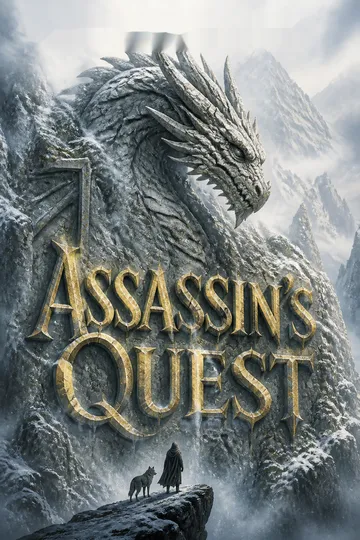
The Farseer Trilogy Series
About the Author

Download PDF
Download EPUB
.epub digital book format is ideal for reading ebooks on phones, tablets, and e-readers.








































