
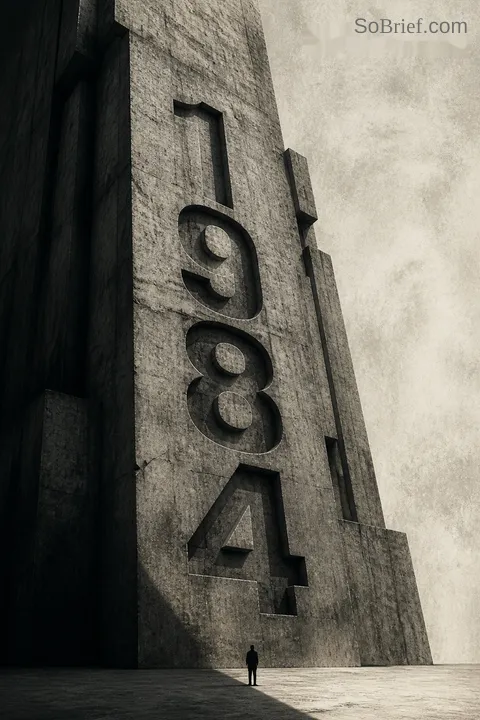


Plot Summary
The Forbidden Diary
In a London where every wall watches, Winston Smith1 — a thin, ailing clerk of thirty-nine — retreats into the single blind spot of his flat, away from the telescreen's gaze. He opens a beautiful cream-papered book bought illicitly from a junk shop and presses a pen to the page. The date he writes, April 1984, is itself a guess; nothing can be known for certain in Oceania.
His hand runs away from him, scrawling defiance against the mustached face on every poster. He knows the act is suicidal, that the Thought Police will eventually take him in the night. Yet the words pour out. Already, he reflects, he is a dead man — and so resolves to stay alive as long as the truth lets him.
The Glance Across the Hate
During the daily ritual where workers scream their fury at the renegade Goldstein's8 face, Winston1 notices two people. A bold, dark-haired girl wearing the scarlet sash of the Anti-Sex League fills him with hatred and lust at once; he suspects her of being an amateur spy.
And O'Brien,3 a burly, urbane Inner Party official, catches Winston's1 eye for a single charged second. In that instant Winston1 feels certain that O'Brien3 shares his secret loathing, that beneath the orthodoxy hides a fellow conspirator.
He clings to a half-remembered dream in which a voice promised they would meet where there is no darkness. The encounter plants two seeds — terror of the girl,2 longing toward O'Brien3 — that will grow into the engine of everything that follows.
Rewriting Yesterday
At the Ministry of Truth, Winston's1 job is to feed inconvenient facts into the memory hole and replace them with lies — rewriting newspapers so the Party's predictions always come true, inventing dead heroes like the fictitious Comrade Ogilvy.
He recalls once holding genuine proof: a photograph showing three executed traitors were innocent, evidence he destroyed within minutes. The realization haunts him that the past has no existence except in records the Party controls and minds it can break. He understands the mechanics of the deception perfectly.
What torments him is the why behind it. Over lunch his colleague Syme,6 a Newspeak fanatic, cheerfully explains how the language is shrinking to make rebellious thought impossible — and Winston1 privately concludes that Syme,6 too clever, is doomed.
The Junk Shop Sanctuary
Drawn back to the slum shop run by the gentle, white-haired Mr Charrington,5 Winston1 buys a glass paperweight enclosing a fragment of coral — a useless, beautiful relic of a time before the Party. Charrington5 shows him a cozy upstairs room with no telescreen and recites scraps of an old church-bell rhyme.
Winston1 nurses a wild theory that hope lies only in the proles, the eighty-five percent left to breed and labor unwatched, who might one day shake off the Party like a horse shaking off flies. Leaving the shop, he spots the dark-haired girl2 on the street and is sure she is trailing him. Terror floods him; he imagines smashing her skull, certain she means to denounce him.
The Note That Said I Love You
In a Ministry corridor the dark-haired girl2 stumbles and falls on her injured arm. Helping her up, Winston1 feels a scrap of paper pressed into his palm. Alone, heart hammering, he unfolds three words that overturn everything: she loves him. The spy he had wanted to murder is instead an ally in desire. For days the maddening problem is logistics — how to speak in a world where every glance is monitored.
Through whispered fragments in the crowded canteen and a squeezed hand amid a crowd watching Eurasian prisoners paraded by, they arrange a meeting in the countryside. The longing to stay alive surges back in him; suddenly minor risks seem foolish, and the prospect of love makes the gray world briefly luminous.
Tryst in the Golden Country
In a hidden clearing beyond the city, the girl — Julia2 — tears off her sash and clothes with a gesture that seems to annihilate a whole civilization. Their lovemaking is, to Winston,1 less private pleasure than political act: pure corruption that the Party cannot tolerate. Julia,2 twenty-six, proves shrewd and earthy, a creature of appetite who breaks rules for joy rather than ideology.
She has had many lovers; this, to Winston,1 is cause for hope — proof the Party's enforced chastity is rotting underneath. She mocks the slogans she publicly chants and treats the regime as a thing to outwit, not topple. Where Winston1 broods on history and truth, Julia2 rebels only from the waist down. Yet together, briefly, they feel human.
The Room Above the Shop
Knowing the folly of it, Winston1 rents Charrington's5 telescreen-free room as a private refuge. Julia2 smuggles in real coffee, sugar, bread, and tea — luxuries stolen from the Inner Party — and even paints her face and dreams of wearing a dress, becoming a woman rather than a comrade. They make love, sleep, and listen to a stout prole washerwoman singing in the yard below.
Winston1 tells Julia2 of his lost mother, of the chocolate he once snatched from his dying sister, of the wife Katharine9 he could never divorce. They both know, with the certainty of a clock striking, that they are already corpses — that the cellars of the Ministry of Love wait. Yet the room feels like a pocket of eternity, inviolate while it lasts.
O'Brien's Invitation
O'Brien3 approaches Winston1 at the Ministry on a Newspeak pretext, slipping him his home address. Winston1 is certain the long-awaited summons has come. He and Julia2 visit the Inner Party member's spacious flat, where O'Brien3 switches off his telescreen — a privilege of his rank — and confirms that the Brotherhood and Goldstein8 both exist.
He swears them to terrible service, then asks if they would ever separate; only this they refuse. He toasts the past, promises to send Goldstein's forbidden book, and recites the missing last line of the bell rhyme.
Winston1 leaves flooded with worship for this powerful, ironic man. Days later, during Hate Week, the book reaches him. Its theory — that perpetual war exists to consume surplus and keep hierarchy frozen — confirms everything he already felt.
The Enemy Changes Mid-Sentence
At the climax of Hate Week, while an orator rages against Eurasia before a roaring crowd, a note reaches the platform. Without pausing, without breaking his sentence, the speaker switches the enemy's name: Oceania is now at war with Eastasia, and has always been. The crowd erupts not in confusion but fury, tearing down banners suddenly declared sabotage.
Winston1 is hurled into a sleepless marathon at the Ministry, rectifying five years of records at lightning speed so no trace of the Eurasian war survives. The episode proves the book's thesis in the flesh — the past is whatever the Party says today. Exhausted afterward, Winston1 finally settles into the safe room to read Goldstein's analysis aloud to Julia,2 who drifts asleep against him.
The Voice Behind the Picture
As Winston1 admires the prole washerwoman and declares the proles humanity's only hope, an iron voice answers from the wall. A telescreen has been hidden behind the old engraving all along.
The room is surrounded; black-uniformed men smash through the window, break the coral paperweight, and drive a fist into Julia's2 stomach before carrying her out. Then Mr Charrington5 enters — but transformed. His cockney whine is gone, his hair darkened, his stoop straightened: he is a sharp-faced officer of the Thought Police, perhaps thirty-five.
The sanctuary was a trap from the first day, every whispered word recorded, every domestic gesture observed. The pocket of eternity collapses in seconds. Winston1 stands exposed, hands behind his head, finally face to face with the machine that owned him.
The Place Without Darkness
In the windowless, ever-lit Ministry of Love, Winston1 endures beatings and relentless interrogation, confessing to crimes real and invented. Then O'Brien3 appears — not as a fellow prisoner, but as the master of his agony, working a dial that floods his body with pain. The promise that they would meet where there is no darkness is fulfilled as cruel irony.
O'Brien3 explains his purpose: not merely to extract confession or to punish, but to cure Winston,1 to capture his inner mind and make him genuinely love the Party before killing him. Holding up four fingers, he demands Winston1 see five, insisting reality exists only in the collective mind of the Party. Winston1 clings to logic — two plus two makes four — as the needle climbs.
The Naked Truth of Power
Through learning, understanding, and acceptance, O'Brien3 reshapes him. He forces Winston1 before a mirror to confront a grey, toothless, rotting wreck of a body — what resistance has made of him. He reveals the Party's true motive: power purely for its own sake, an endless boot stamping on a human face forever.
Earlier despotisms lied about serving the good; the Party knows it seeks only power, power over the mind, proven by inflicting suffering. Winston1 argues that life, the spirit of man, will somehow defeat them; O'Brien3 dismantles each protest.
Winston1 intellectually surrenders, accepting that the Party controls past, present, and reality itself. Yet one private fortress holds: he has confessed everything about Julia,2 but he has not stopped loving her. That, he insists, is the betrayal that matters.
Room 101
O'Brien3 notes that Winston1 obeys but still hates Big Brother,4 and sends him to the room everyone dreads. There, strapped immovable, Winston1 faces a wire cage of starving rats fitted to clamp over his face — the precise horror that has haunted his nightmares his whole life. As the mask closes and the rats' foul reek fills him, terror obliterates thought.
He understands there is only one escape: to thrust another body between himself and the teeth. He screams for them to do it to Julia2 instead, to tear her face off, anyone but him. The cage clicks shut. The inner heart he swore to keep inviolate is surrendered. He has betrayed the one thing he believed they could never reach, and there is nothing left to protect.
He Loved Big Brother
Released, fattened, and emptied, Winston1 haunts the Chestnut Tree Café, drinking Victory Gin and tracing equations in spilled dust. He meets Julia2 once in a cold park; both confess flatly that they betrayed each other, and that after wishing the horror onto the other person you no longer feel the same.
Her body has thickened, her glance turned to dislike; they part without longing. He half-works at a meaningless committee, numb to everything but a war bulletin. When the telescreen trumpets a great African victory, ecstasy seizes him.
He imagines the bullet entering his brain at last, his soul white as snow. Gazing up at the enormous face, he understands the smile beneath the moustache. The struggle is over. He has won the victory over himself. He loves Big Brother.4
Analysis
Orwell's novel endures less as prophecy than as a phenomenology of how power colonizes the interior life. Its central insight is epistemological: tyranny perfected does not merely punish dissent but abolishes the ground on which dissent could stand. By controlling all records and all memories, the Party makes objective reality negotiable, so that Winston1's desperate clinging to arithmetic — two plus two make four — becomes the last redoubt of freedom. The terror is not the boot but the boot's claim to define what a face is. Doublethink anticipates modern anxieties about disinformation, motivated reasoning, and the erosion of shared truth; the memory hole prefigures the frictionless deletion of digital history. Crucially, Orwell locates resistance in the body. Winston1 and Julia2 rebel through appetite, sex, coffee, and sleep — the irreducible animal facts the Party cannot fully ideologize. Their love is political precisely because pleasure generates a contentment that war-fever and leader-worship require be starved. The novel's devastating final movement argues that even this fortress falls: under engineered, personalized terror, the self will sacrifice its dearest loyalty, and the Party's victory is complete only when love is replaced, not merely suppressed. O'Brien3's confession that power is its own end — pursued not for utopia but for the eternal sensation of crushing — strips away the comforting fiction that oppressors are hypocrites who secretly want good. The proles haunt the book as both Orwell's flicker of hope and his bleakest joke: vitality survives among the unwatched masses, yet they remain unconscious of their own strength. The story warns that the machinery of total control targets language, memory, intimacy, and the very category of the real — and that the most chilling outcome is not death but conversion, the moment a broken mind genuinely loves what destroyed it.
Review Summary
1984 is a powerful and disturbing dystopian novel that continues to resonate with readers decades after its publication. Orwell's bleak vision of a totalitarian future where individuality is crushed and truth is malleable remains relevant today. While some find the writing style and characters lacking, most praise the book's chilling portrayal of authoritarianism and thought control. The novel's exploration of surveillance, propaganda, and the manipulation of language and history provokes deep reflection on power and freedom in society.
People Also Read





Characters
Winston Smith
Doubting record-falsifierA frail, ulcer-ridden clerk of thirty-nine in the Ministry of Truth, Winston is cursed with memory in a world built on forgetting. He senses the lie of his reality intimately because his own hands manufacture it, rewriting history daily into the furnace of the memory hole. Driven by an almost suicidal hunger for truth, connection, and the dignity of private feeling, he is nostalgic, intellectually stubborn, and physically timid. He clings to fragments of a vanished past—a coral paperweight, an old rhyme, a dream of his mother's sacrificial love—as proof that another way of being once existed. His tragedy is the gap between his fierce inner conviction that two plus two make four and his utterly vulnerable, breakable body.
Julia
Rebel from the waist downA bold, dark-haired mechanic of twenty-six who services the novel-writing machines and wears the scarlet sash of the Anti-Sex League as flawless camouflage. Julia is sensual, practical, and cunning—a survivor who breaks the Party's intimate rules for pleasure while loudly keeping its public ones. Unlike Winston1, she has no interest in doctrine, history, or organized revolt; corruption beneath the surface is her only creed. She grasps instinctively what Winston1 theorizes: that enforced chastity feeds the Party's hysteria and war-fever. Cheerful, profane, and quick to nap when politics bore her, she embodies the body's stubborn appetite for life. Her rebellion is personal and immediate, making her both Winston's1 liberator and his mirror opposite.
O'Brien
Seductive Inner Party mindA large, burly Inner Party official with a prizefighter's build and an aristocrat's charm, forever resettling his spectacles in a disarming gesture. O'Brien radiates the intelligence and irony Winston1 craves, seeming to promise fellowship across the abyss of orthodoxy. He is the novel's great enigma—patient, articulate, almost tender even at his most ruthless. He understands Winston's1 mind more deeply than Winston1 does himself, anticipating every argument and having long since examined and rejected each. Whatever his true allegiances, O'Brien presents himself as a man of conviction rather than mere hypocrisy, a priest of power who believes his own gospel. His relationship with Winston1 blends intimacy, mentorship, and menace into something stranger than friendship or enmity.
Big Brother
Omnipresent watching faceThe mustached, black-haired visage on every poster, coin, and telescreen, gazing down with eyes that follow the viewer. Big Brother is the Party's focal point for love, fear, and reverence—an embodiment rather than a man, possibly never born and certain never to die. No one has met him; he exists as image and voice, the guise through which an organization wears a human face.
Mr Charrington
Kindly antique dealerThe soft-spoken, white-haired proprietor of the slum junk shop where Winston1 buys his diary and paperweight. Apparently a harmless widower of sixty-three with a collector's faded enthusiasm and a memory full of old church rhymes, he offers the telescreen-free upstairs room. His gentle obsolescence makes him feel like a relic of the vanished pre-revolutionary world Winston1 yearns to recover.
Syme
Zealous Newspeak philologistA small, sharp-eyed specialist compiling the definitive Newspeak dictionary, gleefully devoted to destroying words until rebellious thought becomes impossible. Brilliant and venomously orthodox, he delights in executions and linguistic annihilation alike. Winston1 privately judges him doomed precisely because he is too intelligent and sees too clearly—the Party prefers unconscious loyalty to articulate faith.
Parsons
Sweaty devoted neighborWinston's1 fellow tenant and Ministry colleague, a fat, enthusiastic, paralyzingly stupid man perpetually reeking of sweat and brimming with committee zeal. A model Party drudge on whom the regime's stability depends, he adores Hate Week and community hikes. His own savage children, drilled by the Spies, embody the next generation's terrifying fanaticism.
Emmanuel Goldstein
The eternal designated enemyThe Party's official traitor, a lean, white-haired, sheep-faced figure denounced daily during the Two Minutes Hate. Supposed leader of the shadowy Brotherhood and author of a forbidden book exposing the system, he is the primal heretic onto whom all hatred is channeled—his very existence and the truth of his conspiracy left deliberately uncertain.
Katharine
Winston's estranged wifeWinston's1 vanished wife, a tall, fair, rigidly orthodox woman who submitted to sex only as a frigid duty to the Party. Empty-minded and slogan-stuffed, she became the human embodiment of the regime's war on intimacy, and her memory chills Winston1 whenever desire arises.
Ampleforth
Dreamy doomed poetA mild, hairy-eared versifier at the Ministry who produces sanitized editions of old poems. Imprisoned for letting the word God remain at a line's end, he embodies the gentle intellectual crushed for trivial, unavoidable lapses of orthodoxy.
Martin
O'Brien's silent servantO'Brien's3 small, Mongolian-featured manservant, whose expressionless face seems incapable of changing. Briefly invited to sit among conspirators, he plays the part of valet so completely that his real loyalties remain unreadable.
Plot Devices
The Telescreen
Two-way surveillance instrumentA wall-mounted screen that simultaneously transmits propaganda and receives every sound and movement, never able to be fully switched off for ordinary citizens. It enforces the assumption that one is watched at all times, breeding the instinct to control one's face, breath, and sleep-talk. The few spaces it cannot reach—Winston's1 alcove, the countryside, the room above the junk shop—become the only arenas for rebellion. Its absence defines freedom in the novel; its hidden presence defines betrayal. The device structures the entire plot: every risk Winston1 takes is measured against its gaze, and the discovery of one concealed behind a picture marks the lovers' downfall, proving privacy itself was always an illusion engineered by the state.
Newspeak and Doublethink
Thought-controlling mental toolsNewspeak is the shrinking official language engineered to make heretical thought literally unthinkable by deleting the words for it; doublethink is the mental discipline of holding two contradictory beliefs at once and accepting both. Together they let the Party rewrite the past while forgetting it ever did so, and believe its own lies sincerely. Syme's6 dictionary work and Winston's1 record-falsification both dramatize the mechanism. Doublethink explains how intelligent people sustain the regime: knowing war news is false yet believing in the war, knowing the past is altered yet accepting the alteration as eternal truth. These devices make the oppression total, reaching past behavior into the structure of consciousness itself—the deepest weapon in the Party's arsenal.
The Glass Paperweight
Symbol of private inner worldA heavy lump of glass enclosing a fragment of pink coral, bought from Charrington's5 shop because it belongs to a vanished age and serves no useful purpose. Winston1 treasures it precisely for its uselessness and beauty—qualities the Party cannot tolerate. He comes to see it as a tiny enclosed world: the room, his love for Julia2, and his own fragile interior, fixed in a sort of eternity within the crystal. The object embodies the human longing for a sheltered space outside the state's reach. Its fate during the arrest delivers the device's payoff with brutal economy, externalizing the shattering of the private refuge the lovers believed inviolate.
Goldstein's Book
Forbidden explanatory textA heavy, untitled black volume titled The Theory and Practice of Oligarchical Collectivism, attributed to the arch-traitor Goldstein8 and circulated by the supposed Brotherhood. O'Brien3 delivers it to Winston1, who reads its chapters explaining how perpetual war consumes surplus production, why the High-Middle-Low cycle is frozen, and how doublethink sustains hierarchy. The book gives the reader and Winston1 the system's anatomy, articulating what Winston1 already intuited. Its great withheld secret—the ultimate why behind the Party's effort—is precisely what O'Brien3 later supplies in the torture chambers. The device functions as both ideological exposition and a baited hook, its very existence and authorship deliberately ambiguous to deepen the novel's epistemological dread.
Room 101
Personalized ultimate terrorThe deepest chamber of the Ministry of Love, containing whatever a given prisoner fears most—a threat first overheard as a whisper among other captives, building dread long before its function is revealed. The Party tailors the horror to the individual, understanding that pain alone cannot finally break a person, but a private, unendurable terror can. For Winston1, it is rats. The device is the mechanism of the regime's ultimate triumph: not merely obedience but the betrayal of one's deepest loyalty, achieved by forcing the victim to wish his agony onto the person he loves. It embodies the book's thesis that the state seeks to capture and reshape the inmost self.
FAQ
Synopsis & Basic Details
What is 1984 about?
- Dystopian society under control: 1984 depicts a future totalitarian society, Oceania, where the Party, led by Big Brother, controls every aspect of life, from history to thought.
- Individual rebellion and suppression: The story follows Winston Smith, a Party member who secretly rebels against the Party's oppressive rule, seeking truth and freedom.
- Psychological and physical control: The novel explores the Party's methods of maintaining power through constant surveillance, manipulation of language, and brutal suppression of dissent.
Why should I read 1984?
- Timeless warning about power: 1984 serves as a chilling warning about the dangers of totalitarianism, the abuse of power, and the importance of individual freedom.
- Exploration of human nature: The novel delves into the psychological effects of oppression, exploring themes of rebellion, love, betrayal, and the struggle for identity.
- Thought-provoking and relevant: 1984 remains highly relevant today, prompting readers to question the nature of truth, the role of government, and the importance of critical thinking.
What is the background of 1984?
- Post-war anxieties and totalitarianism: Orwell wrote 1984 in the aftermath of World War II, drawing inspiration from the rise of totalitarian regimes like Nazi Germany and the Soviet Union.
- Political and social commentary: The novel is a critique of totalitarian ideologies, exploring the dangers of unchecked power, propaganda, and the suppression of individual thought.
- Technological advancements and surveillance: 1984 reflects anxieties about the potential for technology to be used for surveillance and control, a theme that resonates even more strongly today.
What are the most memorable quotes in 1984?
- "Big Brother is watching you": This iconic slogan encapsulates the constant surveillance and oppressive atmosphere of Oceania, highlighting the Party's omnipresent control.
- "War is peace. Freedom is slavery. Ignorance is strength": These paradoxical slogans of the Party illustrate the manipulation of language and thought to maintain power and control.
- "Who controls the past controls the future: who controls the present controls the past": This quote reveals the Party's strategy of rewriting history to maintain its authority and shape the narrative of the present.
What writing style, narrative choices, and literary techniques does George Orwell use?
- Third-person limited perspective: The story is told from Winston's point of view, allowing readers to experience his internal struggles and limited understanding of the world.
- Bleak and realistic tone: Orwell employs a stark, unadorned style, creating a sense of realism and highlighting the grimness of the dystopian setting.
- Symbolism and allegory: The novel is rich in symbolism, with objects, places, and characters representing broader themes of oppression, rebellion, and the nature of power.
Hidden Details & Subtle Connections
What are some minor details that add significant meaning?
- The paperweight: The glass paperweight with coral inside symbolizes a connection to the past, a world of beauty and individuality that the Party seeks to destroy.
- The old rhyme: The "Oranges and lemons" rhyme represents a lost culture and a sense of continuity with the past, which the Party tries to erase.
- The red sash: Julia's scarlet sash of the Junior Anti-Sex League, while seemingly a symbol of chastity, becomes a symbol of rebellion when she removes it.
What are some subtle foreshadowing and callbacks?
- O'Brien's dream: Winston's dream of O'Brien saying, "We shall meet in the place where there is no darkness," foreshadows their eventual encounter in the Ministry of Love.
- The Chestnut Tree Cafe: The cafe is a recurring location associated with past Party leaders who were later purged, foreshadowing the fate of those who question the Party.
- The woman in the yard: The prole woman singing in the yard represents the vitality and resilience of the human spirit, a stark contrast to the Party's sterile world.
What are some unexpected character connections?
- Mr. Charrington and the Thought Police: The seemingly harmless shopkeeper is revealed to be a member of the Thought Police, highlighting the Party's pervasive surveillance.
- O'Brien and the Brotherhood: O'Brien's knowledge of the Brotherhood and his ability to turn off the telescreen suggest a deeper connection to the Party's inner workings.
- Syme and Newspeak: Syme's expertise in Newspeak and his enthusiasm for destroying words foreshadow his eventual disappearance, as the Party eliminates those who think too deeply.
Who are the most significant supporting characters?
- Syme: A philologist and Newspeak expert, he represents the Party's intellectual control and the dangers of independent thought.
- Parsons: Winston's neighbor, a devoted Party member, embodies the unquestioning loyalty and blind obedience that the Party seeks to instill.
- Mr. Charrington: The seemingly harmless shopkeeper, who is revealed to be a member of the Thought Police, represents the Party's pervasive surveillance and betrayal.
Psychological, Emotional, & Relational Analysis
What are some unspoken motivations of the characters?
- Winston's desire for truth: Beyond rebellion, Winston is driven by a deep-seated need to understand the truth about the past and the present, even if it means facing pain and death.
- Julia's pursuit of pleasure: Julia's rebellion is motivated by a desire for personal freedom and pleasure, a rejection of the Party's puritanical control over sexuality and emotions.
- O'Brien's need for control: O'Brien's actions are driven by a desire for absolute power and control, a need to reshape reality and human consciousness to fit the Party's ideology.
What psychological complexities do the characters exhibit?
- Winston's internal conflict: Winston struggles with conflicting desires for rebellion and conformity, love and betrayal, truth and falsehood, highlighting the psychological toll of living under oppression.
- Julia's pragmatism vs. idealism: Julia's focus on immediate pleasures and her skepticism towards grand ideologies contrast with Winston's more idealistic and intellectual approach to rebellion.
- O'Brien's intellectual sadism: O'Brien's intellectual brilliance is coupled with a sadistic desire to break down and reshape Winston's mind, revealing the Party's twisted psychology.
What are the major emotional turning points?
- Receiving Julia's note: This moment sparks a mix of fear and hope in Winston, initiating his journey into rebellion and forbidden love.
- The betrayal in Room 101: Winston's betrayal of Julia under torture marks the complete destruction of his personal loyalties and his surrender to the Party.
- Winston's final acceptance: The moment when Winston truly loves Big Brother signifies the Party's ultimate victory, highlighting the power of psychological manipulation.
How do relationship dynamics evolve?
- Winston and Julia's love: Their relationship begins as a rebellion against the Party but evolves into a genuine connection, offering moments of intimacy and shared defiance.
- Winston and O'Brien's complex bond: Their relationship shifts from a perceived alliance to a torturer-victim dynamic, revealing the Party's insidious control over thought and loyalty.
- Winston's relationship with his mother: His memories of his mother highlight the loss of genuine human connection and the Party's destruction of familial bonds.
Interpretation & Debate
Which parts of the story remain ambiguous or open-ended?
- The nature of the Brotherhood: The existence and purpose of the Brotherhood remain ambiguous, leaving the reader to question whether it is a genuine resistance movement or a Party fabrication.
- O'Brien's true motives: O'Brien's motivations are never fully explained, leaving the reader to wonder whether he is a true believer in the Party or a cynical manipulator.
- The ultimate fate of Oceania: The novel's ending does not reveal the long-term fate of Oceania, leaving the reader to ponder whether the Party's control is truly permanent.
What are some debatable, controversial scenes or moments in 1984?
- The graphic torture scenes: The graphic descriptions of torture in the Ministry of Love raise questions about the limits of depicting violence and the psychological impact on the reader.
- Julia's characterization: Julia's focus on personal pleasure and her lack of interest in ideological rebellion have led to debates about her role as a feminist character.
- The ending's bleakness: The novel's pessimistic ending, with Winston's complete submission to the Party, has sparked debate about whether it offers any hope for resistance or change.
1984 Ending Explained: How It Ends & What It Means
- Winston's complete submission: The ending shows Winston's complete surrender to the Party, as he learns to love Big Brother, signifying the total destruction of his individuality and rebellious spirit.
- The Party's ultimate victory: The ending highlights the Party's absolute power to control not only actions but also thoughts and emotions, demonstrating the terrifying effectiveness of totalitarian control.
- A warning about the future: The ending serves as a chilling warning about the potential for totalitarian regimes to erase individual freedom and manipulate reality, urging readers to remain vigilant against such threats.
About the Author

Download PDF
Download EPUB
.epub digital book format is ideal for reading ebooks on phones, tablets, and e-readers.








































