
Key Takeaways
1. Ancient Worlds: A Global Tapestry, Not Isolated Silos
So much of what we study about the past is defined by strict disciplinary, temporal, geographical or thematic boundaries, which means that knowledge about our past is uncovered, written about and taught in clearly demarcated silos, seemingly detached from one another, and into which the interconnected worlds witnessed and explored by the likes of Megasthenes, Deimachus, Patrocles and Demodamas simply do not fit.
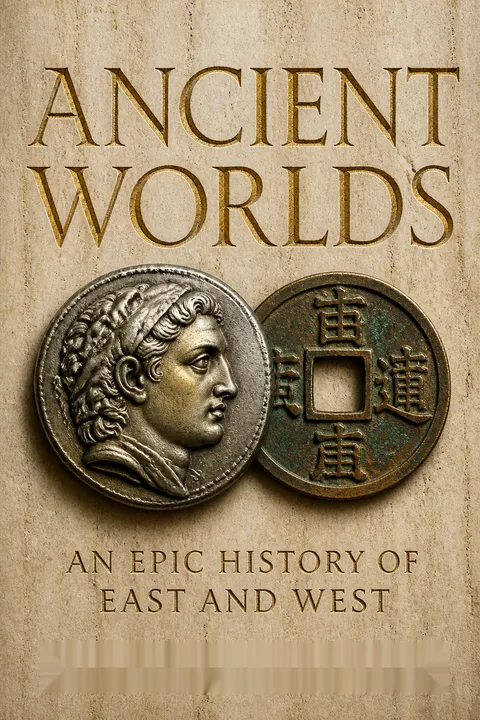
Challenging traditional views. Historian Michael Scott argues against a Western-centric perception of ancient history, advocating for a global vision that connects Greco-Roman civilization with empires across Central Asia, India, and China. This approach reveals shared ambitions, crises, and forms of governance across antiquity, highlighting connections that strengthened over centuries. The book emphasizes that the "ancient world" was not a single, narrow zone but a complex web of interactions.
Early global connections. The narrative begins with Megasthenes, a Greek ambassador to India around 300 BCE, whose eyewitness accounts reveal a world of remarkable creatures and exotic humans, but also a sophisticated Indian society with diplomatic ties to the Seleucid Empire. This demonstrates that even in ancient times, distant cultures were aware of and engaged with each other, sharing gods, traditions, and practices. The existence of a special department in Chandragupta's court for foreigners underscores this interconnectedness.
Beyond Greco-Roman focus. The book aims to broaden our understanding beyond the Mediterranean basin, showing how ancient powers shared ambitions and crises. It highlights that by the 1st century CE, Chinese silk was worn in Rome, Roman merchants sailed to India, and a cornucopia of ideas, knowledge, and beliefs traveled along these routes, foreshadowing our modern globalized world. This perspective challenges the notion of isolated civilizations and reveals a deeply intertwined past.
2. Axial Age Politics: Diverse Paths to Governance Emerge
In these crucial centres across the ancient world, as part of this Axial Age of thinking, the way in which man related to man was being rethought, and in some cases reborn in the furnace of revolution.
Simultaneous political shifts. The late 6th century BCE marked a pivotal "Axial Age" where Athens, Rome, and the state of Lu in China simultaneously re-evaluated political ideas and societal governance. This period saw a rejection of old wisdom and a search for new understandings in philosophy, science, religion, and politics across diverse cultures, even if they weren't directly connected. These revolutions in how man related to man profoundly shaped human history.
Responses to injustice. In all three regions, the desire for political change stemmed from a shared sense of injustice against autocratic rule and a quest for a better, ideal society amidst conflict and civil unrest.
- Athens: An angry mob revolted against tyranny, leading to the invention of democracy.
- Rome: Citizens, disgusted by royal behavior, ousted their king and developed a republican government.
- China: Confucius, an early 50s bureaucrat, sought to reform governance in the state of Lu based on humaneness and justice.
Divergent outcomes. Despite similar motivations, each society developed fundamentally different systems of government, shaped by their unique cultural landscapes and contemporary problems.
- Athens: Direct "people-power" (democracy).
- Rome: A "middling solution" balancing different societal powers (republic).
- China: A focus on a wise and righteous single ruler guided by Confucian philosophy.
These distinct paths underscore the diverse ways ancient societies responded to universal challenges of governance.
3. Fragile Beginnings: The Unintended Birth of Political Systems
We remember and celebrate a new system of governance that introduced freedom and democracy, so prevalent in our world today. But were these outcomes anything the principal actors actively sought or envisaged, or were they an unexpected by-product of actions motivated by other concerns?
Accidental revolutions. The birth of democracy in Athens and the Roman Republic was often an unintended consequence of aristocratic rivalries and popular uprisings, rather than a pre-planned ideological shift. For instance, Cleisthenes' reforms in Athens, which laid the groundwork for democracy, were initially a tactical move against a rival, Isagoras, and a response to Spartan interference. The term "democracy" itself wasn't even coined until after the Persian invasions.
Evolution, not instant perfection. These new political systems were not born in their final, perfect forms but evolved over decades, even centuries, through trial, error, and adaptation to internal and external pressures.
- Athens: Cleisthenes' reforms, initially focused on civic units and new tribes, were solidified by military victories against Persia, which highlighted the importance of the masses (e.g., rowers at Salamis).
- Rome: The Republic, born from the expulsion of Tarquinius Superbus, faced constant internal struggles between Patricians and Plebeians, leading to the creation of Tribunes of the Plebs and the codification of the Twelve Tables.
- China: Confucius's ideas, though precise, struggled for acceptance during his lifetime, gaining influence only posthumously and through adaptation by disciples like Mencius.
Historiographical challenges. Our understanding of these origins is often filtered through later historical accounts, which were influenced by the political outlook of their own times. For example, the Roman Republic's early history was often viewed through Greek-tinted glasses, and the motivations of figures like Cleisthenes or the "tyrant-killers" Harmodius and Aristogeiton are debated. This highlights the malleable nature of history and the need to scrutinize how societies choose to remember their past.
4. War as a Catalyst for Global Interconnectedness
This is a moment in human history (from the end of the third century BCE to the middle of the second) when a handful of rulers and military commanders, from the Mediterranean, across Asia and all the way to China – many of them notably young – marched, sailed, fought, schemed, ruled and died in their quest to redraw the maps of their dominions, carve out new territories and secure themselves against extinction.
Conflict as a connector. The 3rd and 2nd centuries BCE saw intense warfare across the ancient world, which, far from isolating regions, increasingly intertwined their fates. Young, ambitious leaders like Hannibal, Philip V, Antiochus III, and Qin Shi Huangdi made decisions that had ripple effects across continents, transforming local conflicts into global geopolitical chess matches.
Mediterranean power struggles. In the West, Hannibal's audacious march across the Alps in 218 BCE initiated a monumental struggle between Carthage and Rome for Mediterranean supremacy. This conflict drew in other powers:
- Philip V of Macedon allied with Hannibal against Rome, leading to Roman intervention in Greece.
- Rome countered by forming alliances with Philip's Greek enemies, demonstrating a new level of interconnected military strategy.
These wars solidified Rome's dominance, but also forced it to engage directly with the Eastern Mediterranean.
Eastern imperial ambitions. Simultaneously, in the East, Qin Shi Huangdi unified China under the Qin dynasty, building the Great Wall and expanding against nomadic tribes like the Xiongnu. This expansion, and the subsequent collapse of the Qin and rise of the Han, triggered mass migrations of tribes like the Yuezhi westward. Meanwhile, Antiochus III of the Seleucid Empire fought to unify his vast domain from the Mediterranean to Central Asia, clashing with Egypt and reasserting control over breakaway kingdoms like Bactria. These conflicts and migrations created a dynamic, interconnected zone in Central Asia, where diverse cultures met and influenced each other.
5. Young Leaders Reshaping Empires Through Conflict
By 229 BCE, then, the ancient world from the Mediterranean to China was in serious flux: because of fraught and resisted Roman expansion in the west; instability, intense rivalry and dynastic struggle in the centre; and seemingly unstoppable Qin expansion in the east.
A generation of ambitious rulers. The mid-3rd century BCE marked the ascent of a new generation of young, often ruthless, leaders who inherited or seized control of vast territories. These individuals, many in their teens or early twenties, faced immense challenges in unifying, defending, and expanding their realms.
- Hannibal (Carthage): Barely 30 when he crossed the Alps, driven by a lifelong oath against Rome.
- Philip V (Macedon): Assumed the throne at 16, navigating complex Greek alliances and Roman expansion.
- Antiochus III (Seleucid Empire): Became king in his early 20s, battling internal rebellions and external threats from Egypt and breakaway states.
- Qin Shi Huangdi (China): Took control at 14, unifying China and becoming its First Emperor.
Ruthless consolidation of power. These leaders often employed brutal tactics to secure their authority and expand their empires.
- Hannibal: Executed thousands of allied soldiers who refused to join his African campaign.
- Antiochus III: Crucified a rebellious governor and dismembered his cousin to assert dominance.
- Qin Shi Huangdi: Ordered the burning of books and execution of scholars to enforce Legalist ideology and unify thought.
- Maodun (Xiongnu): Killed his father, stepmother, and brother to secure leadership, then used extreme discipline to forge a formidable nomadic empire.
Impact on governance. The actions of these leaders profoundly shaped the political systems they commanded. While some, like Qin Shi Huangdi, sought absolute centralized control, others, like Rome's Scipio, navigated the complexities of a republican system that, despite its strengths, could be hampered by short-term political ambitions. Their struggles and successes laid the groundwork for the mega-empires that would dominate the ancient world.
6. The Silk Roads: Forging East-West Connections Through Trade and Migration
So it was that by the end of the second century BCE, a meshing set of factors – a martial clash of cultures in central Asia and a subsequent expansion of Chinese power, a harsh physical environment that encouraged mobility and connectivity for the sake of survival, and the endeavours of human communities that appeared to have business and trade in their blood – had led to the emergence of a concrete and official commercial chain of interaction across Asia.
Origins in conflict and displacement. The Silk Roads, the vast network of trade routes connecting East and West, emerged not just from a desire for commerce but also from the geopolitical upheavals of the 3rd and 2nd centuries BCE. Qin and Han expansion in China pushed nomadic tribes like the Xiongnu and Yuezhi westward, creating a migratory ripple effect that eventually destabilized Central Asian kingdoms like Bactria. This clash of cultures and forced movements laid the groundwork for new connections.
Central Asia as a crossroads. Bactria, located at the "roundabout" of Central Asia, became a melting pot of traditions, influenced by Greek, Indian, and nomadic cultures. The Yuezhi, after being displaced, eventually conquered Bactria, establishing the Kushan Empire. This region, rich in gold and strategically positioned, facilitated the exchange of goods and ideas. Archaeological finds like the Tillya Tepe burials and Begram storerooms attest to this cosmopolitanism, containing artifacts from Rome, Egypt, India, and China.
Trade and cultural exchange. The Silk Roads became a vital artery for the movement of goods, people, and knowledge.
- Goods: Chinese silk, jade, and bamboo; Indian cotton, ivory, and spices; Roman gold and silver coins.
- Knowledge: Astronomy, calendrical science, medicine, crop rotation.
- People: Traders, exiles, mercenaries, and crucially, Buddhist monks.
The Chinese ambassador Zhang Qian's reports in the late 2nd century BCE provided the Han emperor with the first detailed accounts of these Western regions, highlighting the existing trade networks and the wealth of Bactria. This official recognition spurred further diplomatic and commercial engagement, solidifying the Silk Roads as a permanent link between distant civilizations.
7. Religion and Rule: A New Nexus in a Connected World
Man’s relationship to man, the relationships between communities, as well as that between humans and the divine were inextricably bound together on a journey of dramatic change.
Intertwined destinies. The 4th century CE witnessed a profound transformation in the relationship between religion and political power across the connected ancient world. Rulers increasingly sought to harness religious beliefs to unify, stabilize, and expand their realms, while religious leaders adapted their doctrines and practices to gain imperial patronage and societal acceptance. This created a complex interplay where spiritual and secular authorities often became deeply, and sometimes violently, linked.
Internal and external pressures. Religious innovation arose from both within and outside existing societies, often in response to political and military instability.
- India (Guptas): Leveraged evolving Hindu traditions, like the rise of Vishnu and Shiva, and the weakening of the caste system to legitimize their rule and foster a cohesive, diverse empire.
- China (Buddhism): Amidst political fragmentation and nomadic invasions, Buddhism, a foreign religion, adapted to Chinese thought (Daoism, Confucianism) to gain acceptance and imperial support.
- Armenia (Christianity): King Tiridates the Great forcibly imposed Christianity to centralize power and align with Rome against the Sassanid Empire, leading to violent suppression of paganism.
- Roman Empire (Christianity): Constantine, a pagan emperor, pursued religious toleration and later embraced Christianity, seeking to integrate it into the imperial structure to unify his vast, diverse empire.
Diverse outcomes. The integration of religion and rule led to varied results across these civilizations. In some cases, it fostered stability and diversity (Gupta India), while in others, it led to internal strife and external conflict (Armenia, Roman Empire). This era fundamentally reshaped the religious landscape of the world, with lasting impacts on political identity and inter-community relations.
8. Christianity's Rise: Imperial Patronage and Doctrinal Strife
Constantine was advised in a dream to mark the heavenly sign of God on the shields of his soldiers and then engage in battle.
Constantine's pivotal role. The Battle of Milvian Bridge in 312 CE marked a turning point for Christianity in the Roman Empire. Constantine's victory, attributed by later Christian historians like Lactantius and Eusebius to a divine vision of the Christian cross, positioned him as a divinely favored ruler. Though initially a pagan, Constantine pursued a policy of religious toleration, aiming to integrate Christianity into the imperial structure without alienating the pagan majority.
Balancing pagan and Christian. Constantine's rule was characterized by a delicate balancing act:
- Pagan elements: Retained the title of Pontifex Maximus, used pagan imagery (Sol Invictus) on coinage, and incorporated pagan rituals into the founding of Constantinople.
- Christian elements: Built new churches (e.g., St. Peter's), granted judicial authority to bishops, and convened the first ecumenical councils (Nicaea, Arles) to resolve doctrinal disputes.
His new capital, Constantinople, was designed as a blend of both traditions, symbolizing his vision of a unified empire under a single ruler, reflecting both pagan and Christian elements.
Internal Christian conflicts. Despite imperial patronage, Christianity was plagued by internal divisions, notably the Donatist schism in North Africa and the Arian controversy over the nature of Christ. Constantine's attempts to resolve these disputes, often by asserting his authority as the ultimate arbiter, met with mixed success. While he sought unity, his interventions sometimes exacerbated tensions, highlighting the inherent conflict between secular and spiritual authority.
Armenia's forced conversion. In Armenia, King Tiridates the Great, with the aid of Gregory the Illuminator, forcibly imposed Christianity to centralize power and align with Rome against the Sassanid Empire. This involved:
- Destruction of pagan sites: Temples were razed, and their wealth transferred to the new Christian Church.
- Reconfiguration of social hierarchy: Christianity challenged traditional hereditary noble and priestly positions, leading to violent resistance and assassinations of Christian leaders.
This top-down conversion, while establishing Armenia as the first Christian nation, created deep divisions within society and a fraught relationship between the king and the Catholicos, ultimately contributing to Armenia's partition between Rome and the Sassanids.
9. Eastern Faiths: Adaptation, Diversity, and Imperial Legitimacy
The people are numerous and happy: they have not to register their households, or attend any magistrates . . . the kings govern without decapitation or other corporal punishment.
Gupta India: A golden age of religious diversity. In India, the Gupta dynasty, under rulers like Chandragupta I and Samudragupta, successfully molded old and new Hindu traditions to legitimize their rule and foster a stable, unified empire.
- Divine kingship: Guptas associated themselves with supreme deities like Vishnu, even performing ancient rituals like the horse-sacrifice (ashvamedha) to assert universal sovereignty.
- Patronage and integration: They restructured the relationship with Brahmans through land grants, integrating religious and secular hierarchies while also promoting economic development.
Crucially, the Guptas fostered a remarkable environment of religious toleration, supporting not only diverse Hindu sects but also Buddhism and Jainism. This led to a flourishing of intellectual and cultural life, exemplified by the Nalanda University, which welcomed students from various faiths and regions.
Buddhism in China: Adaptation and acceptance. In fragmented 4th-century CE China, Buddhism, a foreign religion, navigated political instability and cultural differences to gain acceptance.
- Syncretism: Buddhist missionaries strategically integrated their teachings with Daoist and Confucian concepts, using familiar Chinese terminology and even linking the Buddha with Laozi and Confucius to make the faith less alien.
- Addressing social concerns: Buddhists adapted practices like celibacy and begging to align with Chinese social norms, and the sangha (monastery) became a refuge and a vehicle for social mobility, attracting both elites and commoners.
- Imperial patronage: Despite initial skepticism, Buddhist monks like Fotudeng gained influence with northern nomadic rulers through miraculous feats, while in the south, emperors like Xiaowu formally embraced Buddhism, establishing it at court and supporting monasteries.
This process of adaptation and patronage allowed Buddhism to become an accepted mainstream religion in China, coexisting with Daoism and Confucianism, and contributing to a diverse religious landscape.
10. History's Malleability: Shaping the Past for Present Needs
The past then, we should understand, is always a work in progress, a malleable tool that contributes to self-understanding and identity.
Reinterpreting the past. The book consistently demonstrates how ancient societies, much like modern ones, actively shaped and re-presented their histories to suit contemporary political, social, and religious needs. This process was not merely about recording facts but about constructing narratives that legitimized rulers, justified actions, or reinforced cultural identities.
- Roman Republic's origins: Myths and conflicting accounts were used to frame the overthrow of kings as a heroic act, often drawing parallels with Athenian events.
- Constantine's conversion: Christian historians crafted narratives of divine intervention at Milvian Bridge to elevate Constantine and legitimize Christianity's rise.
- Armenia's Christianization: Miraculous tales of Tiridates and Gregory served to conflate political and religious identity, solidifying Armenia's place as the first Christian nation.
History as a guide and a weapon. Different civilizations viewed history with distinct purposes.
- China: Confucian thought emphasized history as cyclical, offering patterns of good and bad governance for rulers to learn from, making historians crucial advisors.
- Western (Greco-Roman, Christian): Initially linear, focusing on creation and divine plans, later used to justify imperial rule and condemn opposing ideologies (e.g., Eusebius linking monarchy with God, democracy with chaos).
This highlights how historical narratives could be both a source of instruction and a tool for propaganda, influencing societal values and political structures.
Modern echoes. The book concludes by drawing parallels between ancient historiography and modern cultural productions, such as the film Dragon Blade. This film, like ancient accounts, reimagines historical interactions to promote contemporary ideals of peace and interconnectedness along the Silk Roads. This ongoing reinterpretation of the past underscores its enduring relevance as a dynamic resource for self-understanding and identity in a globalized world.
Review Summary
Ancient Worlds receives mixed reviews averaging 3.78/5 stars. Readers appreciate Scott's ambitious attempt to create a global history of antiquity, connecting Greek, Roman, Chinese, and Indian civilizations across three periods focusing on politics, warfare, and religion. Many praise the book's structure and engaging writing. However, critics note uneven coverage, with Mediterranean history dominating over Asian content, awkward transitions between regions, and superficial treatment despite claiming groundbreaking methodology. Some find it too detailed while others think it lacks depth. The book works well as an introduction for newcomers but disappoints those seeking truly interconnected global analysis.
People Also Read


About the Author
Download PDF
Download EPUB
.epub digital book format is ideal for reading ebooks on phones, tablets, and e-readers.








































