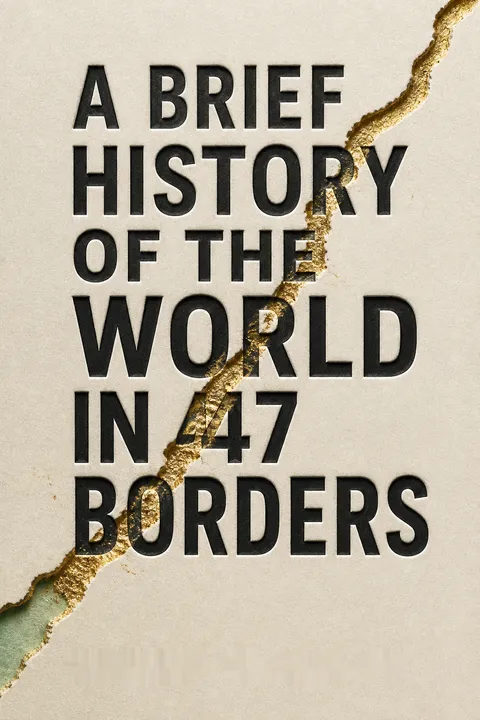

Key Takeaways
1. Borders: Arbitrary Lines, Not Natural Features
No border is inevitable or eternal. They are arbitrary and contingent and, in many cases, could have looked very different if a war or a treaty or the decisions of a handful of tired Europeans had gone a different way.
Human constructs. Borders are fundamentally human inventions, not inherent geographical features. While physical geography like rivers or mountains can influence where lines are drawn, the decision to create a boundary, and its precise location, is always a political act. This is evident from the earliest known border between Upper and Lower Egypt, which was abolished by Menes, demonstrating that even ancient divisions were subject to change.
Shifting meanings. The purpose and meaning of borders have constantly evolved throughout history. The Great Wall of China, for instance, began as a network of defensive barriers between warring states, then became a symbol of a unified empire, and later served as a communication artery or was simply neglected. Its function changed with the political landscape, highlighting that a border's significance is fluid and context-dependent.
Identity and division. Borders define "us" versus "them," shaping national and cultural identities. The arbitrary division of Europe from Asia, rooted in ancient Greek perceptions and later reinforced by religious and political conflicts, illustrates how such lines can create profound, if artificial, distinctions between peoples. This constructed separation has had lasting impacts on how regions and their inhabitants perceive themselves and others.
2. Ancient Empires and the Genesis of Division
The earliest political entities recognisable to us as states – or at least, the earliest we have records of, which of course is not the same thing – emerged sometime in the fourth millennium BCE, in what is sometimes known as the ‘Fertile Crescent’.
Early state formation. The emergence of early civilizations in river valleys like the Nile and Mesopotamia led to the first recognizable states. Initially, the peripheries of these states were often fuzzy "no man's lands" rather than hard borders, as there weren't enough humans to claim all territory. The Nile valley, fertile and prosperous, was one of the few areas to support rival states that "banged into each other," necessitating early divisions.
Roman frontiers. The Roman Empire, while vast, also relied on both natural features and man-made structures to define its limits. Hadrian's Wall and the Limes Germanicus were less about marking state boundaries and more about controlling movement, asserting power, and providing early warning systems against "barbarian" tribes. These frontiers, however, also became centers of military power, contributing to internal instability and the eventual fragmentation of the empire into East and West.
Charlemagne's legacy. The Carolingian Empire, a brief revival of Western Roman power, fragmented due to Frankish inheritance customs, leading to the Treaty of Verdun in 843. This division created "Middle Francia," a bizarre, stretched territory that became a contested fault line for centuries, influencing the eventual formation of France and Germany. The arbitrary nature of these divisions, driven by dynastic concerns, had profound and long-lasting consequences for European political geography.
3. Colonialism's Cartographic Legacy: Redrawing Continents
We have been engaged in drawing lines upon maps where no white man’s feet have ever trod; we have been giving away mountains and rivers and lakes to each other, only hindered by the small impediment that we never knew exactly where the mountains and rivers and lakes were.
Global partitioning. The Treaty of Tordesillas in 1494 exemplifies early European imperialism, where Spain and Portugal, occupying less than 1% of Earth's land, arbitrarily divided the entire planet between them based on a meridian. This act, sanctioned by a Spanish pope, set a precedent for European powers claiming vast, unknown territories with little regard for indigenous populations or existing realities.
Cartographic colonialism. The British Down Survey of Ireland in the 17th century marked a shift towards "cartographic colonialism," where detailed maps became tools for asserting land ownership and dispossession without physical presence. This method was later replicated in the American West with the Jefferson grid, systematically dispossessing Native American populations. The ability to define and control territory from afar, using only a map, became a hallmark of imperial expansion.
The Scramble for Africa. The Berlin Conference of 1884-85 formalized the division of Africa among European powers, often using suspiciously straight lines that ignored existing ethnic or geographical realities. This "effective occupation" principle allowed colonial powers to exploit resources without responsibility, leading to immense suffering, as seen in the Congo Free State. The carelessly drawn borders bundled disparate groups together or split cohesive ones, sowing seeds for future conflicts and instability across the continent.
4. The Enduring Scars of Partition and Conflict
These histories show us how decisions taken for reasons of short-term power politics or ego can have long-term, real-world effects for decades or centuries to come.
Middle East's arbitrary lines. The Sykes-Picot Agreement of 1916, a secret Anglo-French plan to carve up the Ottoman Empire, created arbitrary "lines in the sand" that divided Arab lands and peoples. This betrayal of promises for a pan-Arab state fueled lasting resentment and is still invoked by militant groups and politicians to explain regional instability, even if the actual borders implemented after WWI differed from the original plan.
India's violent division. The Partition of India in 1947, driven by British haste and disagreements between Hindu and Muslim leaders, resulted in the largest and deadliest mass migration in history. The Radcliffe Line, drawn by a barrister with no prior knowledge of India, abruptly divided provinces like Punjab and Bengal, forcing millions to flee their homes amidst horrific violence. This hasty division created two nuclear-armed rivals and left unresolved disputes like Kashmir.
Korea's frozen conflict. The division of Korea at the 38th parallel after WWII, initially a temporary administrative convenience, solidified into a permanent border due to Cold War tensions. The Korean War (1950-53) resulted in millions of deaths and an armistice, not a peace treaty, leaving a heavily militarized Demilitarized Zone (DMZ). This border remains one of the world's most dangerous, a stark reminder of unresolved geopolitical conflicts.
5. Absurdities and Anomalies: When Borders Defy Logic
So messy is this arrangement that the border, marked on the ground by lines of neat white crosses and by plaques showing Dutch or Belgian flags on the fronts of houses, frequently divides buildings in half.
Enclaves and exclaves. The world is dotted with bizarre border anomalies, often legacies of ancient feudal arrangements. Baarle-Hertog and Baarle-Nassau, a Belgian village intertwined with a Dutch one, where the border literally runs through buildings, showcases the extreme practical challenges of such divisions. Similarly, Campione d'Italia, an Italian exclave surrounded by Switzerland, highlights how historical quirks can create complex administrative and economic situations.
Straight lines, crooked realities. Colonial powers often drew straight lines on maps across vast, unknown territories, leading to geographical absurdities. The US-Canada border, famously the longest undefended border, features straight lines that create pene-enclaves like the Northwest Angle and Point Roberts, accessible only by crossing foreign territory. These lines, drawn without on-the-ground knowledge, often ignored natural features and created lasting logistical headaches.
Accidental invasions. The inherent ambiguity and occasional absurdity of borders can lead to comical, yet potentially serious, "accidental invasions." The Swiss army, for instance, has repeatedly, and inadvertently, crossed into Liechtenstein during training exercises. While often resolved with apologies, these incidents underscore how easily even friendly borders can be breached due to human error or poorly defined lines, sometimes with diplomatic repercussions.
6. The Unseen Lines: Borders in Time, Sea, and Air
Whether travelling for business or pleasure, most of us have at some point crossed the invisible line between time zones.
Temporal divisions. Time zones, a modern invention driven by railway timetabling and global communication, are also arbitrary borders. China's single time zone, despite its vast east-west expanse, is a political statement, leading to unofficial local times and even accusations of "terrorism" for non-compliance. The International Date Line, though largely following the 180th meridian, zigs and zags due to national decisions, creating temporal anomalies like Kiribati skipping a day to align with trading partners.
Maritime sovereignty. The Law of the Sea (UNCLOS), a relatively recent international framework, defines maritime boundaries, creating concentric zones of control from a nation's baseline: territorial seas, contiguous zones, and exclusive economic zones (EEZs). These rules, however, are often contested, especially when islands or "rocks" like Japan's Okinotorishima are used to claim vast EEZs, leading to disputes over resources and strategic control.
Airspace and control. Even the air above us is divided into sovereign national airspace and Flight Information Regions (FIRs) for air traffic control. These aerial borders, while designed for safety and efficiency, don't always align with ground boundaries. Disputes, like Russia's seizure of Crimean ATC frequencies, highlight how political conflicts on land can extend into the skies, forcing international bodies to navigate complex questions of jurisdiction and safety.
7. The Digital Age and the Mapmaker's Dilemma
Naively perhaps, Google had hoped we could have one global map of the world that everyone used, but in some countries we are legally obliged to represent borders in particular ways.
Conflicting realities. Online mapping services like Google Maps face a unique challenge: how to represent disputed borders when different nations have conflicting legal and political claims. Displaying a "wrong" border can lead to legal penalties, operational threats, or even staff endangerment. This forces tech giants to present different versions of the world map depending on the user's location, reflecting local political realities rather than a single, objective truth.
Real-time pressures. Unlike traditional atlases, which were updated periodically, online maps are expected to reflect the world in real-time. This constant update cycle intensifies the pressure on digital cartographers to accurately depict rapidly changing geopolitical situations, such as the annexation of Crimea or ongoing conflicts. The minimalist design of online maps often lacks the space for explanatory notes, further complicating the representation of complex disputes.
Power and responsibility. The dominance of a few tech companies in online mapping gives them immense power to shape global perceptions of borders. This power comes with the responsibility to navigate a world where consensus on territorial claims is rare. Some companies, like Russia's Yandex, have even resorted to removing national borders altogether from their maps in certain regions to avoid political entanglement, highlighting the profound dilemma faced by modern mapmakers.
8. The Final Frontier: Defining Space and Sovereignty
Who had truly won this new phase of the space race would, in other words, come down to a question about a boundary: where does Earth’s atmosphere end and outer space begin?
The Kármán line debate. The question of where Earth's atmosphere ends and outer space begins is not just academic; it has significant implications for sovereignty. The Kármán line, often cited at 100km altitude, is a "folk theorem" rather than a universally recognized legal boundary. Different nations and organizations use varying altitudes (e.g., 80km for the US military), leading to disputes over who has truly reached space, as seen in the rivalry between Richard Branson and Jeff Bezos.
Airspace vs. outer space. The distinction between national airspace and free outer space is crucial for national security. A satellite orbiting at 90km might be considered harmless if space begins at 80km, but an invasion of national airspace if the boundary is 100km. This ambiguity allows nations to avoid tying their hands, but also creates potential flashpoints for conflict, especially as low Earth orbit becomes more crowded and strategically important.
Celestial claims. While the 1967 Outer Space Treaty declares space "not subject to national appropriation," it lacks clear definitions for "peaceful purposes" or resource exploitation. The US-led Artemis Accords, creating "safety zones" on the Moon, have been criticized by Russia and China as a new "Enclosure Movement" or colonization attempt. This signals a looming "turf war" for celestial bodies, suggesting that humanity's territorial instincts will extend far beyond Earth.
9. Borders: An Eternal Human Endeavor
Humanity has been drawing lines between ‘us’ and ‘them’ since long before anyone invented maps to draw them on. We’re surely not going to stop now.
Constant flux. Borders are not static; they are constantly shifting, being redrawn, and reinterpreted by political will, conflict, and negotiation. From ancient empires to modern nation-states, the lines on the map reflect ongoing power struggles, economic interests, and evolving identities. Even seemingly stable borders, like those of the UK, can be subject to renewed debate and challenge, as seen with Brexit and Scottish independence.
Deep-seated motivations. The impulse to create borders stems from fundamental human needs and desires: to define power, mark territory, facilitate administration, defend against threats, and distinguish "us" from "them." These motivations are deeply ingrained in human history and continue to drive geopolitical actions, from large-scale invasions to local disputes.
An enduring concept. While specific borders may change, the underlying concept of division seems eternal. The idea of a world without borders, though appealing, remains largely theoretical. As long as human communities exist, there will likely be lines, visible or invisible, that define their limits and shape their interactions, making the study of borders a perpetual lens through which to understand human vanity, folly, and enduring conflicts.
People Also Read
Download PDF
Download EPUB
.epub digital book format is ideal for reading ebooks on phones, tablets, and e-readers.








































