
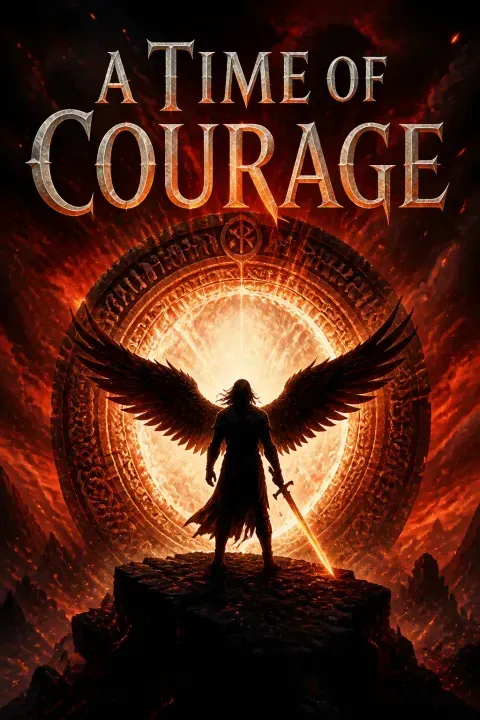


Plot Summary
Asroth Walks Again
Jin5 and her Cheren horse-archers approach Drassil's gates under a banner of false alliance. The gate guards, recognizing her as a Ben-Elim ward, open them without suspicion. Jin's5 warriors sweep through in a tide of blood, holding the entrance for Gulla's8 acolytes and the mist-shrouded Revenants.
Inside the Great Hall, Fritha4 works dark magic upon the starstone prison encasing Asroth7 and Meical.9 The metal shatters. Asroth7 emerges, pale and ravenous, while Meical9 is nearly executed before Riv2 intervenes. Kadoshim and half-breeds flood the hall, slaughtering White-Wings and Ben-Elim. Drassil, the great fortress that stood for over a century, becomes a charnel house within hours.
The fall of Drassil functions as both inciting incident and symbolic rupture: the physical seat of Ben-Elim power becomes the birthplace of a new dark age. Jin's betrayal is not merely tactical but deeply personal. She was raised here as a hostage, and her vengeance transforms the fortress's gates from symbols of protection into instruments of treachery. Fritha's role as midwife to Asroth's rebirth positions her as an anti-creator figure, using blood magic to undo what Elyon's creation sealed. The chapter establishes the central tension: the old order has collapsed, and survival now depends on unlikely alliances among those the Ben-Elim once oppressed.
Riv's Wings Carry Hope
Riv2 grabs the dazed Meical9 from the Great Hall floor and flies him through chaos. She leads him and a band of survivors, including her mother Aphra15 and young Tam, to the lesser-known East Gate. On the weapons-field where she trained all her life, she sees Jin's5 Cheren circling a White-Wing shield wall and dives into the fray.
After fierce combat, she and Meical9 break the Cheren encirclement just long enough for Aphra's15 force to escape. They reach the cabin in Forn Forest, a place where half-breed infants were once secretly buried by the Ben-Elim. There, Bleda3 waits with Sirak survivors. The reunion is tender but the news is grim: Drassil is lost, Asroth7 is free.
Riv's rescue of Meical inverts the power dynamic between Ben-Elim and half-breed. She, the 'abomination' by their laws, becomes savior to their ancient high captain. The weapons-field, site of her greatest humiliation when she failed her warrior trial, becomes the arena where she proves her true worth. The cabin in Forn, with its cairns of murdered half-breed infants, serves as a silent indictment of Ben-Elim hypocrisy. Riv's journey from outcast to leader mirrors the broader narrative arc: those the old order rejected will be the ones who shape what comes next.
The Bride of Darkness
In Drassil's great hall, Fritha4 kneels before Asroth7 and declares herself his betrothed, part of Gulla's8 pact to bind humankind to the Kadoshim cause. Asroth7 nearly kills her before Wrath intervenes, but her cunning and usefulness stay his hand. She leads him to a hidden forge within the great tree's heartwood, where the Seven Treasures were once crafted.
There she saws off the stump of his severed wrist and binds Vald's living hand to his flesh with blood magic and whispered words of power. She forges a black iron gauntlet inscribed with runes of unbreakable strength. The procedure is agonizing, but Asroth's7 screams shift to laughter. He is whole again, and more than he was.
Fritha's betrothal to Asroth represents a dark inversion of sacred union: she binds herself not to a partner but to power itself. Her surgical grafting of Vald's hand onto Asroth literalizes her function in the narrative: she takes from the 'righteous' to empower the demonic. The forge beneath the world-tree is a womb-like space where creation and destruction blur. Fritha's blood magic operates through sacrifice and transformation, making her the thematic opposite of the Order's earth magic, which works through truth and courage. She is not merely evil; she is a creator twisted by grief into a maker of monsters.
Bleda's Broken Crown
At the cabin in Forn, Bleda3 sits fletching arrows, haunted by the image of Jin5 stabbing his mother Erdene. Yul, once Erdene's first-sword, approaches with scores of Sirak warriors. He draws his curved sword and stabs it into the soil, then kneels and places his bow at Bleda's3 feet. Every warrior behind him does the same.
They slice their palms and let blood drip onto their blades, swearing their lives to Bleda.3 He is their king now, not because of bloodline alone, but because he killed Uldin in the heart of the Cheren camp, before his honor guard, before Jin.5 The oath transforms Bleda3 from grieving son into a leader with a purpose: vengeance and the salvation of his people.
This oath-swearing ceremony is a masterclass in earned loyalty. Bleda does not demand fealty; his actions at the Cheren camp, risking certain death to avenge his mother, have already proven his worth. The Sirak Iron Code emphasizes emotional control, yet Yul's cracked voice betrays the depth of feeling beneath the stoic surface. Bleda's reluctance to accept the crown, his awareness of his own failures and losses, humanizes him and makes his eventual growth into a cunning war leader all the more compelling. The blood oath binds them not just to a king but to a shared mission of vengeance.
Fire on the Plain
Three leagues from Dun Seren, Drem1 sees thousands of Revenants surging toward Queen Nara's fleeing people. Byrne6 leads a charge of rune-marked weapons into the horde. Horses and bears carve a wedge through pale flesh and talon.
Drem1 spots Arvid, one of Gulla's Seven, taller and more controlled than the others, directing the assault with a hand-axe. When his horse Rosie is killed and he is pinned beneath her corpse, the white bear appears, smashing through Revenants to stand over him.
Riv,2 Meical,9 and Cullen10 fight desperately to extract him. Byrne's6 Elementals summon wind to strip the Revenants' concealing mist, then ignite a wall of flame across the ridge to slow the horde's advance. They save Nara's people but know the enemy will regroup.
This battle introduces the strategic calculus that will define the war: Revenants are nearly unstoppable without rune-marked blades, and their captains must be identified and killed. Drem's recognition of Arvid establishes his role as the person who can identify the Seven, making him tactically invaluable. The white bear's intervention, saving the man who once fed him honey, signals the deepening bond between human and beast that the Order embodies. Byrne's use of coordinated Elemental magic demonstrates that power wielded collectively, not just individual heroism, is what will turn the tide against overwhelming numbers.
The Siege of Dun Seren
Revenants swarm Dun Seren's walls, building living ladders of interlocked limbs. Drem,1 Keld,11 and Cullen10 heave burning braziers onto these towers of flesh, collapsing them in cascades of flame. But the creatures breach the bear enclosure, infecting the great bears with their bites. Desperate, Drem1 realizes that killing Arvid will save them all.
The fight moves into secret tunnels beneath the keep, where Faelan18 and sixty winged half-breeds have lived hidden for decades, protected by the Order. In a brutal underground battle, Riv2 drives her sword through Arvid's heart. Every Revenant in the horde collapses. The white bear and Hammer survive, the infection halted by Arvid's death. Utul falls protecting Shar, his death a deep wound.
The siege reveals the cost of victory. The bears, noble and loyal, are endangered by their own courage. Drem's tactical insight, using fire against the ladders, shows his growth from solitary trapper to warrior of the Order. Faelan's emergence from decades of hiding in the tunnels is a reckoning: the Ben-Elim's genocide of half-breeds created these refugees, and the Order's protection of them demonstrates an alternative moral framework. Riv killing Arvid with her own hands earns her a place among the Order's heroes. The secret of the tunnels, passed down through generations of captains, illustrates how truth can be preserved in darkness until the world is ready to receive it.
Jin's Burning Path
Jin5 rides onto the plateau of Arcona wearing her dead father's king's band. At the Cheren Heartland, she stands before thousands of warriors and screams for the death of every Sirak. Her warband splits into ten columns that sweep across Sirak territory like a net of blades and fire. Camp after camp falls: gers burning, children and elders slaughtered, warriors overwhelmed by sheer numbers.
Jin5 orders prisoners taken, not for mercy but for later entertainment. She dreams of making them fight each other as Asroth7 did with White-Wing captives. The campaign is methodical, driven by her hatred of Bleda3 and her need to prove herself worthy of her father's legacy. Nearly a thousand prisoners are loaded into cage-wains.
Jin's genocide is not mindless slaughter but calculated atrocity designed to erase a people. Her need to prove herself, to escape the shadow of being raised as a hostage in Drassil rather than riding free on the grasslands, fuels her extremism. The king's band on her arm is both symbol and burden: she must be more ruthless than Uldin ever was. The prisoners in cage-wains represent a delayed gratification of cruelty, a promise to herself that the Sirak's suffering will be prolonged and savored. This reveals the psychology of revenge: it is never satisfied, only deferred, always demanding more blood to fill the void left by the original wound.
The Hunter Becomes Hunted
Bleda3 leads his growing warband of rescued Sirak in a daring daylight raid. His warriors wear captured Cheren deels and fly a hawk banner, riding straight toward the prison wains on the plain before the burning Sirak Heartland. At the last moment, he draws his bow and begins killing the Cheren guards.
More Sirak burst from concealment along the riverbank, and in minutes the wains are opened, prisoners freed and given captured horses. Bleda3 finds the Cheren scout who shot him earlier, speaks his name into the man's ear, and tells him to describe his face to Jin.5 He wants her to know exactly who humiliated her. Then he rides away as Jin's5 furious scream echoes across the plain.
This sequence is Bleda's coming-of-age as a strategist. He weaponizes Jin's rage against her, understanding that a personal vendetta makes a commander predictable. By using Cheren clothing and banners, he turns their symbols of identity into instruments of deception. The deliberate revelation of his name to the wounded scout is not bravado but psychological warfare: he knows Jin will follow him anywhere now, which he intends to use to lead her away from the main Sirak force. Bleda transforms from reactive survivor to proactive hunter, his grief channeled into cold cunning rather than hot fury.
Gulla's Blow at Brikan
Drem,1 Keld,11 and Cullen10 ride to Brikan to evacuate its garrison ahead of Byrne's6 warband. Before they can leave, black mist rolls across the bridge. Revenants pour through the gates, led by Gulla8 and his daughter Morn.17
Keld11 fights with desperate brilliance, his wolven-hounds Fen and Ralla tearing at the creatures. He drives his rune-marked sword through the chest of Rald, one of Gulla's Seven, killing that Revenant captain and collapsing a portion of the horde. But Morn17 appears behind him and stabs her black-bladed knife through his mail, deep into his back.
Gulla8 bites out Keld's11 throat. Drem1 watches his friend die in his arms. In the aftermath, Cullen10 chases a limping Revenant into the forest, and Drem1 follows, discovering a cabin containing Corban's sword and the skeleton of Coralen.
Keld's death is the emotional fulcrum of the novel's middle act. He was mentor, protector, and moral compass for both Drem and Cullen. His loss fractures their innocence and solidifies their hatred of Gulla and Morn into something personal and irrevocable. The discovery of Corban's sword and Coralen's remains in the same moment of grief creates a symbolic continuity: the heroes of one age pass their weapons to the heroes of the next. Keld's last words, asking Drem to look after Cullen and the wolven-hounds, transform Drem from apprentice to guardian, completing an arc that began with his own father's death.
The Kurgan Awaken
Bleda's3 diversionary force of 180 warriors leads Jin's5 entire host into a dead-end ravine. Arrows fly, horses fall, and Bleda's3 mount is killed beneath him. Yul stands over him, deflecting arrows with his sword in a suicidal last stand. Just as death seems certain, the granite wall behind them swings open.
A giantess named Raina19 drags them inside as her kin charge out to smash into the Cheren flank. Ukran, Lord of the Kurgan, leads his warriors with hammer and axe, devastating Jin's5 riders. Bleda3 learns that Raina19 is Alcyon's wife, separated from him for thirty years while she searched for their scattered Clan. She has news: the Shekam giants are riding to war with draigs, allied to Asroth.7
The Kurgan intervention operates on multiple levels. It is a classic epic fantasy rescue but grounded in emotional realism: Raina's decades-long separation from Alcyon gives weight to her decision to finally march west. Bleda's earnestness, his willingness to speak truthfully about love and loyalty, resonates with Ukran in ways that political argument could not. The Shekam revelation raises the stakes: Asroth's alliance with draig-riding giants means the coming battle will involve forces beyond anything the defenders have faced. The hidden tunnels and secret doors of the Kurgan also literalize the theme of concealed truths emerging into the light.
Truth at Ripa
Riv,2 Meical,9 and Hadran fly to Ripa to coordinate with the White-Wing garrison. In the high tower, Kol13 stands surrounded by Ben-Elim captains, attempting to assert sole command. Riv2 walks through the assembled warriors, shoves aside those who block her, and stands before Kol.13 She announces loudly that he is her father, the secret he has hidden for seventeen years.
Aphra15 steps forward and confirms it. The Assembly is stunned. Dumah strips Kol13 of his authority pending a formal trial after the war. Meical9 negotiates a fragile unity: the Ben-Elim will fight alongside the Order of the Bright Star, the Sirak, and the giants. Hadran, once Kol's13 loyal follower, publicly apologizes for his complicity in Ben-Elim deceptions.
Riv's public revelation is an act of liberation disguised as accusation. By naming Kol, she frees herself from the shame of being an 'abomination' and exposes the hypocrisy at the heart of Ben-Elim rule. The Assembly's decision to defer judgment reflects political pragmatism over justice, but the power shift is real: Kol is diminished, and Meical's moral authority grows. Hadran's apology models a path toward redemption through acknowledgment of wrongdoing rather than denial. This scene crystallizes the novel's argument that truth, however painful, is preferable to the rot of secrets.
The Wall Breaks
Dawn breaks over Ripa's plain. Revenants charge the timber wall in black mist, building their living towers. White-Wings pour boiling pitch and loose fire arrows, but the horde is endless. In the center, Aenor's acolytes raise ladders.
On the flanks, the Cheren hammer the shield wall with volley after volley of arrows at full gallop. Then Fritha4 descends on Wrath, the winged draig smashing through the central gate like a battering ram of flesh and scale. Morn17 and her half-breeds drop acolytes directly onto the walkways.
The wall burns, crumbles, and the defenders retreat across pits and trenches. Bleda3 uses runed arrows to kill Tyna, one of Gulla's8 captains, collapsing thousands of Revenants on the eastern flank. But the center cannot hold.
The first battle of Ripa is a masterclass in siege warfare translated to fantasy. Each element of the defense (fire pits, flooded trenches, portable bridges, marked traps) is used and overcome in sequence. The Cheren's wheeling cavalry tactics demonstrate why horse-archers dominated steppe warfare, their ability to deliver continuous fire while staying beyond reach of infantry making the shield wall nearly impotent. Bleda's assassination of Tyna shows strategic thinking: he targets not the endless horde but its keystone. Yet even this victory is swallowed by the sheer scale of Asroth's assault. The battle asks whether courage and preparation can overcome overwhelming force, and answers, for now, that they cannot.
Asroth's Rampage
Asroth7 crosses the blue-flamed trench by commanding the earth to rise beneath him. He wades into the White-Wing shield wall with his long black axe, shattering shields and bodies with each swing. Meical9 challenges him and is beaten, his wing slashed.
Hadran dies at Asroth's7 feet, impaled. Dumah falls, his head severed. Aphra,15 Riv's2 mother, stabs her short-sword into Asroth's7 belly with perfect form, but his starstone mail shatters her blade. His whip wraps around her, iron hooks biting through mail into flesh.
He drags her close and kills her. Riv2 screams and hurls herself at him, stabbing his arm with Morn's17 black knife before his gauntleted fist crushes her into unconsciousness. Bleda's3 horse rears and kicks Asroth7 away, and he carries Riv2 to safety as the defenders flee.
Aphra's death is the novel's cruelest blow because it is both heroic and futile. Her perfect sword-thrust, the maneuver she trained for a lifetime, fails not through lack of skill but because Asroth's armor is literally unbreakable by normal means. This encapsulates the asymmetry of the conflict: courage and training are not enough against starstone and dark magic. Hadran's death, protecting Meical and Riv, completes his redemption arc: the warrior who once served Kol dies defending those he wronged. Asroth's whip, with its iron hooks and black wire, is a weapon of torture as much as war, embodying his cruelty. Riv's survival is a mercy Bleda buys with his own courage.
Byrne's Last Ride
The survivors flee across the river into the shadows of Sarva. Byrne6 and the Order of the Bright Star have finally arrived, too late for the first battle but in time for the war. In the moonlit forest, Byrne6 calls a council. Riv,2 Bleda,3 the Kurgan giants, the White-Wing survivors, and the Ben-Elim remnants gather.
Byrne6 reveals the book found on Coralen's skeleton: it contains words of power that could seal the Kadoshim away forever, but they need starstone metal. Drem1 tells them of the black knife Morn17 wielded, and of the weapons Fritha4 forged. The warband is battered but not broken. Cullen10 carries Corban's sword. Drem1 rides Friend. They will fight one more day.
Byrne's arrival shifts the narrative from desperate defense to purposeful counterattack. The Order represents a different model of leadership: earned through competence and care, not divine right or ancient lineage. The revelation of Coralen's book introduces the possibility of permanent victory, not just survival, transforming the final battle from a last stand into a fight for the world's future. Corban's sword passing to Cullen, his descendant, creates continuity across generations. The forest setting, with its ancient trees and talking crows, evokes a sense that the natural world itself is allied against the Kadoshim's corruption.
The Reckoning Field
Dawn breaks over Balara's plain. The Order's shieldburg formation, a turtle of interlocked shields, withstands the Revenant tide while riders attack the flanks. Drem1 rides Friend into the Shekam draig-riders, the white bear trading blows with scaled beasts twice his weight. Cullen10 kills Gulla8 with a hurled starstone spear, collapsing every remaining Revenant.
Drem1 sees Fritha4 upon Wrath and charges. Friend and the draig maul each other as Drem1 and Fritha4 duel on the ground. She throws burning blood into his face, scarring him, but Drem1 drives his seax into her belly, the same blade his father made. She falls. Before she dies, she whispers to Arn to cut her unborn child from her womb. Drem1 takes the Starstone Sword from her body.
The final battle is structured as a series of personal reckonings. Cullen's killing of Gulla avenges Keld and eliminates the Revenant threat in one stroke, turning the tide of the larger battle. Drem's confrontation with Fritha brings his emotional arc full circle: he began this journey searching for his father's killers, and he ends it by killing the woman who ordered Olin's death. The symmetry of using his father's seax emphasizes that Drem is his father's son, carrying forward Olin's legacy of quiet craftsmanship and stubborn courage. Fritha's final request, to save her child, complicates her villainy: she is a mother as well as a monster, and her love for her unborn daughter is achingly genuine.
Death of a God
Asroth7 stands alone, his Kadoshim guard dead or scattered. Byrne,6 her legs crushed, drags herself across the ground and uses earth magic to bind his ankles with roots. Riv2 flies at him, stabbing through his mail with her black knife, tearing rents in his armor.
Cullen10 drives a spear into his ribs. Balur One-Eye12 hurls Sig's shattered sword at Asroth's7 chest, then picks up the demon's own black axe. Drem1 steps in, parries Asroth's7 short-sword, and drives the Starstone Sword two-handed into Asroth's7 belly, fulfilling his father's oath.
Asroth7 stares at Drem1 in disbelief. Then Balur One-Eye's12 axe shears through Asroth's7 neck, cleaving collarbone deep into his chest. The Lord of the Kadoshim crashes to the ground, silver hair spread in the dirt, and does not rise.
Asroth's death is a collective act, not a single hero's triumph. Each warrior contributes a wound, a blow, a binding, until the accumulation of damage overwhelms even starstone armor. This mirrors the novel's thesis: evil is not defeated by one champion but by a community of those willing to sacrifice. Drem's use of the Starstone Sword, the weapon his father forged and Fritha stole, closes a circle of grief and vengeance that began in the Desolation. Balur wielding Asroth's own axe, and Byrne binding him with roots from the earth he sought to dominate, invert his power against him. The death is both visceral and symbolic: the black axe that once freed Asroth's victims now frees the world from him.
Bleda's Final Arrow
While the main battle rages, Bleda3 and Jin5 hunt each other through the forest's edge. They duel on horseback, then on foot, their swords clashing in a glade littered with dead. Bleda's3 knife finds Jin's5 throat, and she chokes on her own blood.
He stands over her, says it is for his mother, and drives the blade up through her jaw. But as Bleda3 kneels to tend wounded Yul, Kol13 appears. The Ben-Elim thanks Bleda3 for saving him from a Kadoshim, then stabs his spear through Bleda's3 throat. Bleda3 collapses.
Ellac16 returns to find his king dead. Craf the crow, hidden in the branches, witnessed everything and names Kol13 as murderer. Before Kol13 can flee, Ellac16 drives his spear through Kol's13 throat, and three hundred Sirak bows loose their arrows into the Ben-Elim's body.
Bleda's death is the novel's most tragic moment because it comes after victory, not during battle. He has avenged his mother, saved his people, and killed his nemesis, only to be murdered by an ally whose life he saved moments earlier. Kol's killing of Bleda is not strategic but petty, an act of pure spite from a being who cannot tolerate being indebted to a 'lesser' creature. Ellac's execution of Kol, and the Sirak's collective volley, represents rough justice: the law of the Assembly is circumvented, but a deeper moral law is satisfied. Craf the crow, often comic relief, becomes the voice of truth, his testimony carrying more weight than Kol's denials. The scene asks whether some crimes are beyond the reach of institutional justice and must be answered by those who loved the victim.
The Door Closes
Months after the battle, at Dun Seren, Byrne6 gathers the survivors on the weapons-field. Balur One-Eye12 and the giants have built a stone dais, and upon it they pile the starstone weapons taken from Asroth7 and his captains. Byrne6 reads from Coralen's book, and together the warriors of the Order chant words of power.
The black metal melts, flows, and rises into an arched doorway taller than two giants. Through it, purple skies and white mountains shimmer. Meical9 and over three hundred Ben-Elim voluntarily pass through, acknowledging the harm their kind has caused.
Then Byrne6 speaks a greater binding, and ropes of air and flame streak across the sky, dragging every remaining Ben-Elim and Kadoshim, shrieking, through the portal. The door seals. Drem,1 Riv,2 Cullen,10 and their friends sit together afterward, drinking usque and speaking of the future. They will guard the gate and hunt the darkness that remains.
The banishment of all supernatural beings, both 'faithful' and 'fallen,' is a radical resolution that rejects the premise of the Long War entirely. The solution is not to choose the Ben-Elim over the Kadoshim, but to recognize that both are forces beyond human control whose presence has caused centuries of suffering. Meical's voluntary departure distinguishes him from the others: he has learned from Corban that love and friendship matter more than divine mandate, and he leaves not as punishment but as final act of responsibility. The new Age of Courage is not a utopia. Fritha's child survives, carried away by Arn, a seed of future conflict. But the humans, giants, and half-breeds who remain have earned the right to shape their own destiny. The final image of friends drinking together, speaking of truth and courage, affirms that the bonds forged in battle are the truest legacy of any war.
Analysis
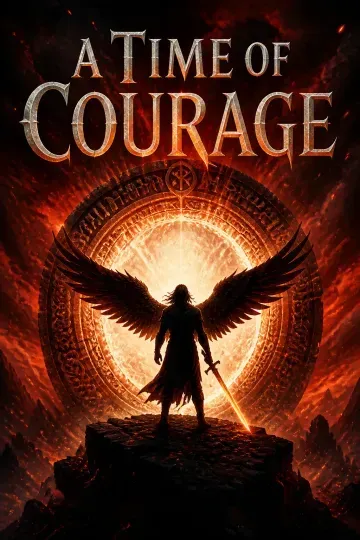
A Time of Courage concludes the Of Blood and Bone trilogy with a vision of victory that is both cathartic and costly. The novel argues that evil cannot be defeated by any single hero, no matter how skilled or brave; Asroth7 falls only because a community of warriors, each with their own wounds and motivations, combine their strength. Drem1 stabs him, Balur One-Eye12 decapitates him, Byrne6 binds him, Riv2 tears his armor, Cullen10 spears him; the accumulation of small victories becomes decisive. This is a deeply democratic vision of heroism, rejecting the solitary chosen one in favor of collective action.
The book's treatment of grief is its emotional backbone. Every major character has lost someone they love, and their responses to that loss define them. Fritha's4 grief for her murdered infant becomes the engine of atrocity. Drem's1 grief for his father becomes a vow that sustains him through terror. Riv's2 grief for Aphra15 and Bleda3 nearly destroys her but ultimately hardens into resolve. The novel suggests that grief is morally neutral; what matters is what we build from it.
The banishment of both Ben-Elim and Kadoshim is a radical political statement: the war between 'angels' and 'demons' was never humanity's fight, and both sides used mortals as pawns. True peace requires the removal of all supernatural powers, not the victory of one over the other. Meical's9 voluntary departure, and his acknowledgment of Ben-Elim crimes, gives this resolution moral weight. The new Age of Courage is not paradise; Fritha's4 child survives, a reminder that evil is not eradicated but must be guarded against by each generation.
The friendships at the novel's center, Drem1 and Cullen,10 Riv2 and Bleda,3 Keld11 and his crew, demonstrate that the bonds forged in shared danger are the truest meaning of the oath they swear: Truth and Courage. These are not abstract virtues but practical necessities, the only things that make survival worthwhile. The final image of friends drinking together, speaking of those they have lost and the tasks ahead, affirms that the purpose of victory is not glory but the chance to live in peace with those you love.
Review Summary
A Time of Courage is highly praised as an epic conclusion to the Of Blood and Bone trilogy and the Banished Lands saga. Readers commend Gwynne's masterful character development, intense battle scenes, and emotional storytelling. The book is lauded for its themes of friendship, loyalty, and hope amidst darkness. Many consider it one of the best fantasy series finales, with a gripping 200-page final battle. While some found it slightly less impactful than The Faithful and the Fallen, most agree it's a satisfying and bittersweet end to a beloved series.
People Also Read
Characters
Drem
Trapper turned warrior of the OrderSon of Olin, a solitary trapper from the Desolation whose father was murdered by Fritha4 for the Starstone Sword. He is large, strong, and profoundly uncomfortable with crowds and enclosed spaces, a legacy of his isolated upbringing. He is literal, honest to a fault, and slow to anger but implacable once roused. His tracking skills and ability to read terrain make him invaluable. His grief for his father drives him, but it is tempered by the friendships he forms with Cullen10, Keld11, Riv2, and the white bear Friend. He joins the Order of the Bright Star and ultimately fulfills his father's oath by killing Asroth7 with the very sword Olin forged. His arc moves from solitary survival to belonging, from grief to purpose.
Riv
Half-breed Ben-Elim warriorDaughter of Aphra15 and Kol13, raised as a White-Wing trainee while her true nature was hidden. She has dapple-grey feathered wings and a fierce temper that once caused her to fail her warrior trial. She struggles with rage, a constant current of fury at the Ben-Elim who would have killed her as an infant and at the injustice of the world. Her rescue of Meical9 from Drassil's fall marks her as extraordinary. She joins the Order of the Bright Star, finding a family that accepts her completely. Her love for Bleda3 is the emotional core of her story. She loses both her mother Aphra15 and Bleda3 in the final battles, grief that nearly consumes her, but she endures, channeling her pain into the protection of the new age.
Bleda
King of the Sirak, master archerSon of Queen Erdene, taken as a child hostage by the Ben-Elim to control his Clan. He grew up in Drassil, betrothed to Jin5 of the Cheren as part of a political arrangement, but he fell in love with Riv2. After Jin5 kills his mother and he kills her father Uldin, he becomes king of the shattered Sirak. He is a brilliant archer and a cunning strategist, transforming from a grieving son into a leader who uses deception and terrain to overcome superior numbers. His love for Riv2 is tender and steadfast, symbolized by the feather and flower he keeps over his heart. He avenges his mother by killing Jin5, but is murdered by Kol13 immediately after, a victim of Ben-Elim arrogance even in victory.
Fritha
High priestess of the KadoshimOnce a White-Wing warrior who was betrayed by Kol13, who ordered her infant daughter Anja killed. Her grief and rage drove her to the Kadoshim. She is a brilliant blood-mage, creator of the Revenants (by transforming Gulla8), the Ferals (twisted human-animal hybrids), and the winged draig Wrath. She becomes Asroth's7 betrothed and forges his starstone weapons and armor. She is pregnant with his child throughout the war. She is not purely evil; her love for her creations, especially Elise and Wrath, and for her unborn daughter, is genuine. She represents what grief can become when untempered by forgiveness. Drem1 kills her in the final battle, but she dies ensuring her child's survival.
Jin
Queen of the Cheren, Bleda's nemesisDaughter of Uldin, raised as a ward in Drassil alongside Bleda3, to whom she was betrothed. Her love for Bleda3 curdled into murderous hatred when she discovered his love for Riv2. After Bleda3 kills her father, she becomes Queen of the Cheren and launches a genocidal campaign against the Sirak. She is a superb archer and horse-warrior, but her rage makes her predictable. She allies with Asroth7 to gain the power to destroy Bleda3 and all he loves. Her pride and need to prove herself drive her to increasingly reckless decisions. Bleda3 kills her in single combat, avenging his mother Erdene. Her tragedy is that her intelligence and skill are consumed by a hatred she cannot master.
Byrne
High Captain of the OrderLeader of the Order of the Bright Star and Drem's1 aunt, descended from Cywen, sister of Corban the Bright Star. She is stern, strategic, and deeply compassionate beneath her hard exterior. She is one of the few who can use earth magic (Elemental power), wielding wind, fire, and earth against her enemies. She lost her legs in the final battle against Asroth7 but continued to fight, dragging herself across the ground to bind Asroth7 with roots. Her leadership is defined by earned loyalty, not inherited authority. She teaches the earth power to a new generation, ensuring that knowledge survives. Her final act is to read the words of power that banish all supernatural beings from the Banished Lands.
Asroth
Lord of the Kadoshim, fallen godThe ancient enemy of the Ben-Elim, imprisoned in starstone metal for 138 years after his defeat at the Day of Wrath. When freed, he is pale, silver-haired, and terrifyingly beautiful, with black eyes and blue-black veins mapping his alabaster skin. He is capricious, sensual, and casually cruel, savoring the pleasures of flesh after millennia as a spirit. He wields a long black axe and wears starstone mail forged by Fritha4. His power over earth magic allows him to command the ground itself. Despite his godlike strength, he is not invincible; his new hand, grafted by Fritha4, remains a vulnerability. Drem1 and Balur One-Eye12 kill him in the final battle.
Gulla
High Captain of the Kadoshim, first RevenantOnce a Kadoshim lord, transformed by Fritha's4 blood magic into something new: part Kadoshim, part Revenant. He has one red eye, elongated limbs, taloned hands, and a shadowy halo that leaks mist. He created seven captains (Gulla's Seven) by biting them, and through them spawned legions of Revenants. He is ambitious and increasingly resentful of Asroth's7 authority, having tasted power during his master's imprisonment. His Revenants can only be killed by decapitation or rune-marked blades. Cullen10 kills him with a starstone spear during the final battle, collapsing every remaining Revenant. His death avenges Keld11 and countless others.
Meical
Former High Captain of the Ben-ElimOnce the leader of the Ben-Elim, imprisoned in starstone alongside Asroth7 for 138 years because he had grown too close to humans, particularly Corban. Freed by the same explosion that released Asroth7, he is disoriented and grieving when Riv2 rescues him. He is stern, honorable, and carries the weight of his people's failures. Unlike Kol13, he has learned that love and friendship matter more than schemes and strategies. He fights with a rune-marked sword and spear. In the end, he voluntarily leads the surviving Ben-Elim through the portal to the Otherworld, acknowledging that their presence in the Banished Lands has caused too much harm.
Cullen
Fierce young warrior, Drem's friendA red-haired warrior of the Order, descended from Corban and Coralen. He is hot-headed, reckless, and laughs in the face of death. Beneath his bravado is deep fear and grief, masked by aggression. He was raised by Sig and Keld11 after his parents were killed by Kadoshim. Keld's11 death shatters him, but he channels his pain into vengeance, killing Gulla8 with a starstone spear. He wields Corban's sword, a gift from Byrne6, and proves himself worthy of his ancestry. His friendship with Drem1 is one of the novel's core relationships, two broken young men who become brothers.
Keld
Huntsman of the Order, Drem's mentorCaptain of Dun Seren's huntsmen, an older warrior of quiet competence and dry humor. He takes Drem1 as his apprentice and treats him with gruff kindness. His wolven-hounds, Fen and Ralla, are his constant companions and fight at his side in mail coats. He saves Drem's1 life multiple times and teaches him not just tracking but the values of the Order. At Brikan, he kills Rald, one of Gulla's Seven, but is stabbed in the back by Morn17 and killed by Gulla8. His last words ask Drem1 to look after Cullen10 and the wolven-hounds.
Balur One-Eye
Greatest giant warrior, Ethlinn's fatherA towering giant with one eye and a lattice of scar tissue. Father of Ethlinn14 and legendary warrior of the Banished Lands. He fights with a massive war-hammer and later wields Sig's rune-marked longsword. His oath is to protect his daughter with his life. He is blunt, grumpy, but fiercely loyal. In the final battle, he hurls Sig's sword at Asroth7, then picks up the demon's own black axe and decapitates him. After Ethlinn14 is killed by Asroth7, his grief is a raw wound, but he channels it into vengeance.
Kol
High Captain of the Ben-Elim, Riv's fatherGolden-haired, scarred Ben-Elim lord who seduced Aphra15 and fathered Riv2, then ordered the murder of half-breed infants to hide his crime, including Fritha's4 daughter Anja. He is arrogant, manipulative, and views humans as tools. He was responsible for Bleda's3 siblings' deaths and kept Bleda3 as a hostage. After Drassil's fall, he attempts to command the allied forces but is stripped of authority when Riv2 reveals his paternity. He murders Bleda3 after the battle, stabbing him with a spear, and is executed by Ellac16 and the Sirak archers.
Ethlinn
Queen of the Giants, ElementalDaughter of Balur One-Eye12, a giantess with dark hair and pale skin who rides a great bear. She is wise, perceptive, and skilled with both spear and earth magic. She united the giant clans for the war against the Kadoshim. She is a natural leader who commands respect through competence and compassion. In the final battle, she duels Asroth7 and nearly defeats him, her spear striking him four times before his Kadoshim swarm her. Asroth7 kills her with his black axe, a devastating loss that drives Balur One-Eye12 to vengeance. Her death represents the cost of the victory.
Aphra
White-Wing captain, Riv's motherCaptain of five hundred White-Wings at Drassil, dark-haired and stern. She concealed Riv's2 existence from the Ben-Elim for seventeen years, hiding her wings and raising her as a normal trainee. She was seduced by Kol13 and later regretted it deeply. Her relationship with Riv2 is complicated by years of necessary deception, but her love is fierce and protective. She leads the survivors from Drassil and fights in both battles at Ripa. She dies at Asroth's7 hands, her sword shattering on his starstone mail, but not before wounding him with a perfect strike. Her death is the wound that nearly breaks Riv2.
Ellac
One-handed Sirak warrior, Bleda's guardianAn aging Sirak warrior missing one hand. He has served Bleda's3 family for decades. He fights with a buckler strapped to his stump and a spear, and he is far deadlier than he looks. Gruff and stoic, he loves Bleda3 as a son. His counsel is blunt but wise. When Kol13 murders Bleda3, he executes Kol13 with his spear and orders the Sirak archers to loose every arrow into Kol's13 body. His grief for Bleda3 is absolute, his vengeance swift and merciless.
Morn
Gulla's half-breed daughterBroad, squat, and muscled, with leathery wings and a permanent scowl. She is Gulla's8 daughter, a half-breed Kadoshim who craves her father's approval but rarely receives it. She bonds with Fritha4 over their shared status as outcasts, swearing a blood oath of sisterhood. She wields a black-bladed knife forged from starstone. She kills Keld11 at Brikan, stabbing him in the back, and is eventually killed by Fen the wolven-hound and Riv2 in the final battle. Her arc is one of misplaced loyalty and the hunger for belonging.
Faelan
Leader of the hidden half-breedsA half-breed Ben-Elim over seventy years old, dark-haired with brown-feathered wings. His mother brought him to Dun Seren as an infant to hide him from the Ben-Elim who would have killed him. He and his descendants have lived in the tunnels beneath the fortress for decades, secretly protected by the Order. He and his kin are skilled archers and aerial fighters. He emerges during the siege of Dun Seren to help defend the fortress. His existence is a living indictment of Ben-Elim policy and a testament to the Order's commitment to protecting the innocent regardless of their nature.
Raina
Alcyon's wife, Kurgan giantessA giantess of the Kurgan Clan, shaven-headed with a ridge of black hair. She is Alcyon's wife, separated from him for thirty years while she searched for her scattered people. She wields a round shield and a single-handed hammer. When she saves Bleda3 and his Sirak from Jin's5 trap, she brings the Kurgan giants into the war. Her reunion with Alcyon is one of the novel's most emotional moments. She carries giant's fire powder, which burns even on water, and uses it to devastating effect against the Shekam ships at Ripa's harbor.
Plot Devices
Starstone Metal
Otherworldly substance of immense powerA black metal forged from the Seven Treasures in a place between the world of flesh and the Otherworld. It is nearly indestructible and can only be worked with blood magic. Asroth's7 prison was made from it, and when shattered, Fritha4 reforged the fragments into weapons and armor: his mail coat, helm, gauntlet, long axe, whip, and short-sword. She also made weapons for her allies. Starstone blades can cut through normal mail like butter and leave trails of black smoke. The metal can be melted and reshaped through collective earth magic combined with blood sacrifice. At the novel's end, all starstone artifacts are melted down and transformed into a portal to the Otherworld.
Rune-Marked Blades
Weapons that can kill RevenantsSwords, spears, axes, and arrows inscribed with runes of earth power that glow blue when they strike a Revenant. Normal weapons barely harm Revenants, but rune-marked blades kill them as easily as they would kill a living human. The Order of the Bright Star, led by Byrne6, teaches the earth power to a select few, who then mark their own weapons. Rune-marked arrows allow Sirak archers to kill Revenant captains from a distance. The weapons are rare and precious, and Byrne's6 smiths work constantly to produce more. Without them, the war against the Revenants would be unwinnable.
Gulla's Seven
Revenant captains whose death destroys their hordeWhen Gulla8 was transformed by Fritha4, he created seven captains by biting them on the shore of Starstone Lake. Each captain spread the Revenant infection by biting others, creating a pyramid of control. If a captain is killed with a rune-marked blade, every Revenant they created dies instantly. The Seven are: Ulf (killed by Drem1 in the Desolation), Arvid (killed by Riv2 at Dun Seren), Rald (killed by Keld11 at Brikan), Tyna (killed by Bleda3 at Ripa), Burg, Thel, and Ormun (killed in the final battles). Gulla's8 own death kills his remaining Revenants. This hierarchy of infection makes the Revenant hordes strategically vulnerable.
Friend the White Bear
Drem's companion and battle mountA massive white bear that Drem1 first encountered in the Bonefells, where it nearly killed him. Later, it saved his life during the battle against Fritha's4 forces. Drem1 feeds it honey, earning its trust. The bear follows the Order's warband, eventually accepting Drem1 as its rider. It wears a coat of mail and fights with devastating power, its claws and jaws capable of tearing through Revenants and draigs alike. The bear's loyalty mirrors Drem's1 own steadfastness. In naming it Friend, Drem1 acknowledges that the bond between them is not ownership but partnership.
The Starstone Sword
Blade forged by Drem's father to slay AsrothA sword forged by Olin, Drem's1 father, from starstone metal with the express purpose of killing Asroth7. Fritha4 murdered Olin and stole the sword, using it to free Asroth7 from his prison. The sword became her primary weapon. Drem1 swears an oath to reclaim it and fulfill his father's purpose. In the final battle, Drem1 takes the sword from Fritha's4 dying body and uses it to stab Asroth7 through the belly, piercing his starstone mail. The sword represents both a son's duty to his father and the idea that purpose, once forged, will find its fulfillment no matter how long it takes.
Of Blood and Bone Series
About the Author
Other books by John Gwynne



Download PDF
Download EPUB
.epub digital book format is ideal for reading ebooks on phones, tablets, and e-readers.








































