
Key Takeaways
1. Wyckoff's Core Logic: Focus on Market Action, Not Just Labels
As I say, the important thing is not that we know how to identify those 4 stop events, but that the market has objectively produced the stop of the trend movement.
Beyond rigid patterns. The Wyckoff methodology, in its modern interpretation, emphasizes understanding the underlying market logic rather than robotically labeling every price movement. While classic "textbook" schemes exist, the continuous interplay of supply and demand means structures often develop in less conventional ways. The true value lies in discerning the overall action—the shift from trend to sideways, or the building of cause—even if initial stopping events aren't perfectly identifiable.
Underlying principles. The core of Wyckoff's teachings remains the universal law of supply and demand, and the principle of cause and effect. For price to rise, accumulation must precede it; for price to fall, distribution must occur. The specific form these processes take is less critical than recognizing their substance and the shift in market control they represent. This open-mindedness allows traders to adapt to the market's infinite variations.
Identifying control. Rather than forcing labels, the objective is to identify who is gaining market control based on observed traces. This involves assessing the market's condition, whether buyers or sellers dominate, and how this imbalance manifests in price action. The methodology provides a framework to interpret these dynamics, enabling judicious scenario planning even when patterns deviate from ideal schematics.
2. Price is Paramount, Volume Provides Context
If there is one piece of data that already incorporates all the information, it is the price.
Price as the ultimate truth. In market analysis, price data holds greater relevance than volume data, according to the author. Price is the direct graphical representation of all executed orders, offering a faithful reflection of market action regardless of session time or other biases. This makes price a more consistent and less misleading data point for analysis, especially when dealing with intraday fluctuations or varying market participation.
Volume's inherent challenges. While volume is crucial, its interpretation can be complex due to factors like session timing (e.g., S&P500 volume spikes at US open vs. regular hours) and the existence of opaque markets. Over-The-Counter (OTC) markets and Dark Pools, where significant transactions occur with delayed or hidden volume reporting, mean that publicly available volume data may not always represent the full picture. This opacity can mislead analysis if not accounted for.
Complementary roles. Despite its challenges, volume remains an indispensable component of market analysis. It provides context to price movements, indicating the level of interest or disinterest at certain price levels. The ideal approach is to integrate both price and volume, understanding their individual strengths and limitations, to form a comprehensive view of market dynamics and identify where professional money is likely positioned.
3. Auction Market Theory: The Market's Quest for Value
The general idea is that the market will move from one equilibrium area to another through trend movements and that these will be initiated when the market sentiment of both buyers and sellers about the current value differs causing the imbalance.
Market's natural cycle. Auction Market Theory posits that markets constantly seek efficiency, or "fair value," where buyers and sellers are comfortable trading. This state of equilibrium is visually represented by price lateralization (ranges). When new information shifts participants' perception of value, an imbalance occurs, leading to trend movements as the market searches for a new consensus.
The three pillars of value. To decipher where value lies, three variables are assessed:
- Price: Acts as a discovery tool, exploring levels to gauge participant reaction.
- Time: Regulates opportunity duration; more time spent in a zone indicates acceptance and value.
- Volume: Represents activity and interest; higher volume signifies greater value assigned to a level.
These elements combine to define "value," guiding the market's continuous rotation between equilibrium and imbalance.
Wyckoff's implicit foundation. Although Richard Wyckoff didn't explicitly use "Auction Market Theory," his concepts of accumulation and distribution ranges, and subsequent trend movements, align perfectly with its principles. Wyckoff's "cause" (accumulation/distribution) is the market's equilibrium phase, and his "effect" (trend) is the market's search for new value. This inherent alignment makes Auction Market Theory the logical bedrock for the Wyckoff methodology.
4. Volume Profile: Objective Zones for Strategic Trading
The Volume Profile is a tool that objectively identifies the most important trading zones and volume-based trading levels.
Visualizing market interest. The Volume Profile is a powerful, objective tool that graphically represents the volume traded at different price levels, appearing as a horizontal histogram. Unlike traditional vertical volume, it answers "where" significant activity occurred, not just "when." This allows traders to clearly identify areas of high interest (High Volume Nodes - HVN) and low interest (Low Volume Nodes - LVN), which are crucial for understanding market structure and potential future reactions.
Key components for analysis:
- Value Area (VA): The price range encompassing 68.2% of total volume, indicating the most accepted trading zone (between VAH and VAL).
- Volume Point of Control (VPOC): The single price level with the highest traded volume, representing the fairest price and a key reference for market control.
- VWAP (Volume Weighted Average Price): An institutional benchmark, indicating the average price of all contracts traded, often used to judge execution quality.
- Extremes: Highs and lows of the profile, indicating finished or unfinished auctions.
Strategic applications. Volume Profile enhances Wyckoff analysis by providing objective levels for:
- Identifying structures: Pinpointing VAH/VAL as range boundaries.
- Determining market bias: Price above HVN/VPOC suggests bullish control, below suggests bearish.
- Analyzing trend health: Observing the migration of value areas (VAH/VAL/VPOC) to confirm trend continuation or signal consolidation.
- Calibrating position management: Using HVNs for take-profit targets and LVNs for stop-loss placement.
5. Order Flow: A Subjective Tool for Precision Triggers
The main source of error when dealing with order flow analysis comes because there is the belief that everything executed in the ASK has a buy initiative origin and everything executed in the BID has a sell initiative origin, but as we have just seen, nothing could be further from the truth.
Unveiling internal dynamics. Order Flow analysis, particularly using Footprint charts, provides a magnified view inside candlesticks, showing executed orders at each price level. It quantifies the interaction between buyers and sellers, revealing imbalances, absorptions, and initiatives. This granular detail can be invaluable for confirming entry triggers, but its interpretation is inherently subjective due to the complexities of order matching.
The "Order Flow Problem." A critical misconception is equating trades on the ASK with aggressive buying and trades on the BID with aggressive selling. In reality, an aggressive order (Market order) always crosses with a passive order (Limit order). Crucially, closing positions (e.g., a stop-loss on a long position is a Sell Market order, appearing in the BID; a take-profit on a short position is a Buy Limit order, appearing in the BID) can appear in either column. This means the intention behind an executed order is often opaque.
Limited, strategic utility. Given its subjectivity, Order Flow is best used as a secondary confirmation tool, applied only when price reaches key trading zones identified by Wyckoff and Volume Profile. The goal is to identify specific patterns like:
- Turning patterns: Absorption (passive blockade of price movement) followed by Initiative (aggressive directional entry).
- Continuation patterns: Control (strong directional imbalances) followed by a Test (pullback to the control zone).
These patterns, when observed in a high-probability context, can offer precise entry triggers, but relying on Order Flow in isolation is akin to a "coin flip."
6. Wyckoff 2.0: An Integrated Framework for Robust Scenarios
It is about bringing together the main ideas of the Wyckoff methodology; the principles of the auction theory and helping us with the Volume Profile and Order Flow tools with the aim of proposing the most robust scenarios possible.
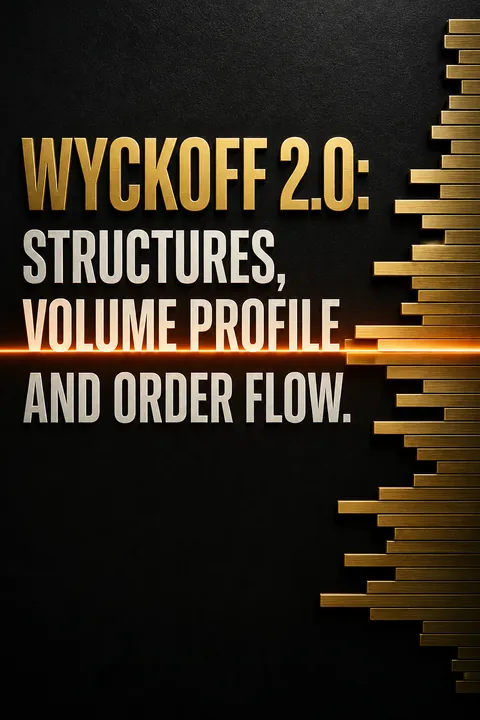
Synergy for clarity. Wyckoff 2.0 is a comprehensive trading approach that integrates the foundational principles of the Wyckoff methodology with the objectivity of Auction Market Theory, the structural insights of Volume Profile, and the precision of Order Flow. This multi-faceted framework aims to provide traders with a deeper understanding of market dynamics, enabling the construction of highly robust and adaptable trading scenarios.
The pillars of Wyckoff 2.0:
- Wyckoff Methodology: Provides the core logic, context (accumulation/distribution, cause/effect), and analytical tools (e.g., shakeouts, SOS/SOW bars) to evaluate market control.
- Auction Theory: Explains the market's fundamental drive for efficiency and value, clarifying why prices move between equilibrium and imbalance.
- Volume Profile: Offers objective identification of key trading zones (HVN, LVN) and levels (VPOC, VAH, VAL, VWAP), refining where to expect price reactions.
- Order Flow: Used selectively for precise entry confirmation, identifying absorption and initiative patterns at critical junctures.
A holistic roadmap. This integrated approach moves beyond isolated indicators or rigid patterns. It provides a clear roadmap for:
- Analyzing market context (range or trend).
- Identifying high-probability trading zones and levels.
- Developing dynamic scenarios with continuous validation.
- Calibrating precise entry, stop-loss, and take-profit points.
By combining these elements, Wyckoff 2.0 seeks to minimize subjectivity and maximize the probability of successful trades.
7. Context is King: Start High, Plan Dynamically
Operationally what we are interested in is to see that the market is building the cause of the subsequent move; that is, that it is in Phase B.
Macro to micro analysis. The first and most crucial step in analyzing any chart is to establish the overarching market context, starting from higher timeframes (e.g., weekly or daily). This macro view helps determine whether the market is in a range (building cause) or a trend (developing effect), and critically, who is in control (buyers or sellers). Without a clear high-timeframe context, descending to lower timeframes can lead to misinterpretations and "noise."
Identifying the "cause" phase. The operational interest lies in identifying when the market is in Phase B of a Wyckoff structure, actively building a cause (accumulation or distribution). This is the phase where the market is preparing for its next significant move. Once this higher-timeframe context is clear—for instance, identifying a potential accumulation—the trader can then confidently bias their directional outlook (e.g., favoring long entries).
Strategic timeframe descent. Only after establishing a solid high-timeframe context and directional bias should a trader move to lower timeframes. This descent is not for random exploration but to:
- Locate minor accumulation/distribution structures that align with the major structure's context.
- Identify precise entry triggers within these minor structures that support the larger directional bias.
This structured approach ensures that smaller-scale trades are always aligned with the path of least resistance dictated by the broader market picture.
8. Scenario Planning: Validate Continuously, Prepare Alternatives
The best way to approach this scenario-building process is through a continuous validation protocol. This is about actively reacting to what the market does (If X, then maybe Y).
Dynamic market, dynamic plans. Market control can shift rapidly, necessitating continuous assessment of price action and volume. Scenario planning is not about rigid predictions but about proposing the most probable next move based on current information. A "continuous validation protocol" means constantly asking, "If the price does X, then what is the most likely Y?" This adaptive mindset prevents clinging to outdated biases.
Focus on the immediate next move. It's crucial to only pose solid scenarios for the next market movement, not beyond. Predicting multiple moves ahead is fraught with uncertainty because:
- Trader intentions (short-term vs. long-term) are unknown.
- Larger, more influential traders can intervene at any moment, altering the market's direction.
This disciplined focus ensures that decisions are based on the most immediate and relevant market feedback, rather than speculative long-term forecasts.
Always have an alternative. Even with a strong directional bias, always prepare an alternative scenario in the opposite direction. For example, if expecting a bullish breakout, also consider the possibility of a failed breakout turning into an Upthrust. This readiness allows for swift adaptation if the market deviates from the primary expectation, preventing hesitation and potential losses. This dual-scenario approach is vital for navigating the inherent uncertainty of financial markets.
9. Position Management: Calibrate Entry, Stop Loss, and Take Profit
Thanks to the principles of the Wyckoff methodology, we will be in a position to set up scenarios; thanks to the identification of the zones and trading levels by Volume Profile we will be able to refine with greater accuracy where the price is most likely to go; and thanks to the precision of Order Flow it will allow us to further confirm and calibrate the entry trigger.
Integrated management. Effective position management in Wyckoff 2.0 leverages all integrated tools for precise entry, stop-loss placement, and take-profit targets.
- Entry: Triggered by intentional price action (SOS/SOW bars) or confirmed by Order Flow patterns (absorption/initiative, control/test) at key trading zones. Stop orders are preferred for entry, confirming momentum, rather than limit orders which pre-suppose future movement.
- Stop Loss: Placed strategically beyond significant Wyckoff structures (e.g., below a Spring, above an Upthrust) and protected by multiple Volume Profile levels. Low Volume Nodes (LVN) are ideal, as they represent rejection zones where price is expected to turn or move quickly through. Confluence of VWAP, VPOC, and VAH/VAL also provides robust protection.
Targeting high-probability zones. Take-profit levels are identified using areas of high previous trading activity. High Volume Nodes (HVN) act as magnets, attracting price due to past consensus. Specific levels like the VPOC of a value zone, Developing Volume Point of Controls (DVPOCs), and Naked VPOCs (untested VPOCs from previous sessions) are highly effective targets. These levels represent areas where the market is likely to find new equilibrium or encounter opposing interest, making them logical points to secure profits.
10. Fractality: Market Patterns Repeat Across All Timeframes
The same is true of continuation patterns. In essence a control will be part of an impulsive move while a test to that control will be part of a corrective move. This is the natural dynamic of trend movements: impulses and reversals.
Universal behavior. The market exhibits fractality, meaning that similar patterns and dynamics repeat across all timeframes, from tick charts to monthly charts. A turning pattern observed in Order Flow (absorption + initiative) on a minute chart is essentially a micro-scale accumulation or distribution. This same behavior scales up to P and b-shaped Volume Profiles over a session, and further to multi-day or multi-week Wyckoff structures.
Scaling patterns. This principle applies to both reversal and continuation patterns:
- Reversal: A small-scale absorption and initiative on a Footprint chart can represent a minor accumulation. This minor accumulation might, in turn, be the Spring of a larger Wyckoff structure, or the "bell" of a bP-shaped Volume Profile.
- Continuation: A "control" identified in Order Flow is part of an impulsive move. A test to that control is a corrective move. On a larger scale, the VPOC of an entire impulsive leg (from a fixed Volume Profile) acts as a control zone, where pullbacks are expected to find support before the trend resumes.
Consistency in logic. The underlying logic of market behavior—the interplay of supply and demand, the formation of cause and effect—remains constant, regardless of the timeframe. Understanding fractality allows traders to apply the same analytical principles across different scales, providing a coherent framework for interpreting market action and identifying opportunities, whether for short-term or long-term trading.
11. The Order Flow Problem: Understand Its Limitations
What would happen if there is a crossing of orders of a Stop Loss of a Buy Market and a Take Profit of a Sell Limit? This type of crossover will be reflected in the ASK, but is there really an intention to add buying pressure to the market? Obviously not, as we see in this example both traders would be out of the market and yet their transaction would be reflected in the ASK.
Opaque intentions. The "Order Flow Problem" highlights the inherent subjectivity and limitations of interpreting order flow data in isolation. While order flow tools show executed orders, they cannot definitively reveal the intention behind those orders. A transaction appearing in the ASK column, for instance, could be an aggressive buy, a stop-loss being triggered on a short position, or a take-profit from a long position. All these actions are fundamentally different in their market impact.
Beyond speculative intent. Furthermore, not all market participants are speculative traders aiming to move price directionally. Hedgers, arbitragers, and institutions covering positions also execute orders, and their transactions contribute to the visible order flow without necessarily implying a directional bias. This adds another layer of complexity, making it difficult to isolate the "smart money" or true directional pressure solely from order flow data.
Contextual dependency. Due to these ambiguities, relying solely on order flow for trading decisions is highly unreliable. Order flow analysis becomes meaningful only when subordinated to a broader, objective context provided by methodologies like Wyckoff and tools like Volume Profile. It serves as a confirmatory lens, used sparingly at critical junctures (e.g., identified support/resistance zones) to validate a pre-existing scenario, rather than as a standalone predictive tool.
People Also Read









Download PDF
Download EPUB
.epub digital book format is ideal for reading ebooks on phones, tablets, and e-readers.








































