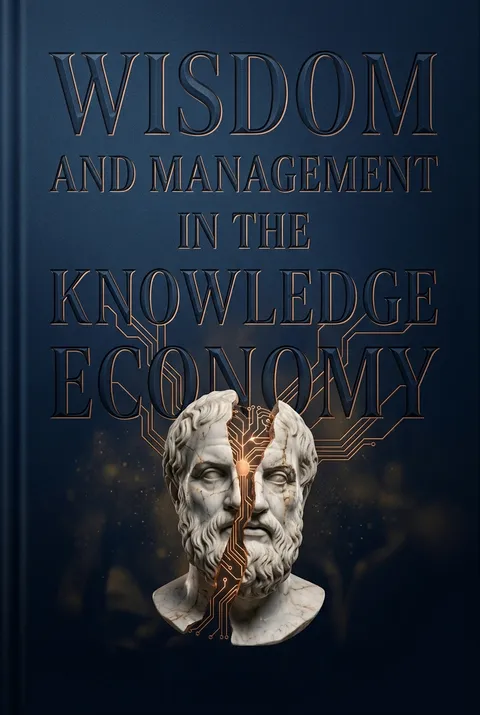

Key Takeaways
1. Wisdom transcends knowledge in the modern economy
"In the knowledge economy, wisdom is the ultimate competitive advantage."
Wisdom vs. knowledge. While knowledge is abundant in the information age, wisdom remains scarce and invaluable. Wisdom involves:
- Discernment in applying knowledge
- Understanding complex systems and their interactions
- Foreseeing long-term consequences of decisions
Wise managers can navigate uncertainty, make ethical choices, and create sustainable value. They synthesize information from various sources, consider multiple perspectives, and balance short-term gains with long-term impact.
2. Balancing rationality and intuition is crucial for effective management
"The art of management lies in harmonizing analytical thinking with intuitive insight."
Integrated decision-making. Successful managers in the knowledge economy:
- Utilize data-driven analysis for informed decisions
- Trust their intuition and experience in ambiguous situations
- Combine both approaches for holistic problem-solving
This balance allows for swift action in fast-paced environments while maintaining a strategic outlook. Managers must cultivate both their analytical skills and their intuitive capabilities to excel in complex, dynamic business landscapes.
3. Cultivating practical wisdom enhances organizational decision-making
"Practical wisdom is the cornerstone of effective leadership in the face of uncertainty."
Developing phronesis. Practical wisdom, or phronesis, is essential for:
- Navigating ethical dilemmas
- Adapting to changing circumstances
- Making decisions that benefit all stakeholders
Organizations can foster practical wisdom by:
- Encouraging reflection and learning from experience
- Promoting mentorship programs
- Creating opportunities for diverse problem-solving scenarios
Managers with practical wisdom can make nuanced decisions that consider context, ethics, and long-term consequences.
4. Ethical leadership is fundamental in the knowledge-based economy
"In a transparent world, ethical leadership is not just morally right; it's a business imperative."
Ethics as a cornerstone. Ethical leadership in the knowledge economy:
- Builds trust with stakeholders
- Attracts and retains top talent
- Enhances brand reputation and customer loyalty
Leaders must:
- Consistently demonstrate integrity in decision-making
- Foster a culture of transparency and accountability
- Address ethical challenges proactively
Ethical leadership creates a sustainable competitive advantage by aligning organizational actions with societal values and expectations.
5. Embracing diversity and multiple perspectives fosters innovation
"Diversity of thought is the wellspring of creativity and innovation in the knowledge economy."
Cognitive diversity. Organizations thrive when they:
- Cultivate teams with diverse backgrounds and expertise
- Encourage open dialogue and constructive dissent
- Leverage different perspectives for problem-solving
Benefits of embracing diversity include:
- Enhanced creativity and innovation
- Improved decision-making through varied insights
- Increased adaptability to market changes
Managers must create inclusive environments where diverse voices are heard and valued, leading to more robust and innovative solutions.
6. Continuous learning and adaptation are essential for success
"In a rapidly evolving economy, the capacity to learn and unlearn is more valuable than static knowledge."
Agile learning culture. Successful organizations in the knowledge economy:
- Prioritize continuous learning at all levels
- Adapt quickly to changing market conditions
- Encourage experimentation and calculated risk-taking
Strategies for fostering a learning culture:
- Implementing regular skill development programs
- Rewarding innovation and knowledge-sharing
- Creating cross-functional teams for diverse learning experiences
Managers must lead by example, demonstrating a commitment to lifelong learning and adapting their leadership style to new challenges.
7. Emotional intelligence amplifies managerial effectiveness
"In the knowledge economy, EQ often trumps IQ in determining managerial success."
EQ in leadership. Emotional intelligence enhances:
- Communication and relationship-building
- Conflict resolution and team cohesion
- Employee engagement and motivation
Managers with high EQ can:
- Read and respond to others' emotions effectively
- Manage their own emotions in high-stress situations
- Create positive work environments that boost productivity
Developing emotional intelligence should be a priority for managers seeking to excel in the complex interpersonal dynamics of the knowledge economy.
8. Sustainable practices are vital for long-term organizational health
"Sustainability is not just about the environment; it's about creating enduring value in all aspects of business."
Holistic sustainability. In the knowledge economy, sustainability encompasses:
- Environmental stewardship
- Social responsibility
- Economic viability
Organizations must:
- Integrate sustainable practices into core business strategies
- Balance short-term profits with long-term value creation
- Consider the impact of decisions on all stakeholders
Managers who prioritize sustainability can build resilient organizations that thrive in an increasingly conscious and interconnected world.
9. Technology should augment, not replace, human wisdom in management
"The most effective use of technology in management is to enhance human judgment, not to supplant it."
Human-tech synergy. In the knowledge economy:
- Technology serves as a tool to support decision-making
- Human wisdom remains crucial for interpreting data and making ethical choices
- The integration of AI and human insight creates powerful outcomes
Managers should:
- Leverage technology to streamline processes and gather insights
- Maintain a critical perspective on technological outputs
- Focus on developing uniquely human skills like creativity and empathy
The future of management lies in effectively combining technological capabilities with human wisdom to drive innovation and sustainable growth.
Review Summary
Download PDF
Download EPUB
.epub digital book format is ideal for reading ebooks on phones, tablets, and e-readers.








































