
Key Takeaways
1. Mill's Harm Principle is Challenged by Pervasive Human Error
My goal in this book is to challenge the Harm Principle on the ground that in certain contexts, people are prone to error, and paternalistic interventions would make their lives go better.
Revisiting Mill. John Stuart Mill's influential Harm Principle asserts that government may only legitimately coerce individuals to prevent harm to others, not for their own good. This principle, deeply ingrained in modern thought, assumes individuals are the best judges of their own well-being. However, recent behavioral science reveals that people frequently make systematic errors that undermine their own welfare, even in self-regarding decisions.
Empirical evidence. Decades of research from psychology and behavioral economics demonstrate that human beings are often myopic, impulsive, and prone to various cognitive biases. These errors can lead to choices that are detrimental to their long-term health, wealth, and happiness. For example:
- Procrastination on retirement savings
- Ignoring long-term costs of energy-inefficient products
- Unrealistic optimism about personal risks (e.g., smoking, texting while driving)
- Misjudging probabilities of adverse events
Foundational shift. These findings fundamentally challenge the "Epistemic Argument" for the Harm Principle, which posits that individuals possess superior information about their own good compared to external actors, including government officials. If people consistently err in ways that harm themselves, the moral argument for paternalism, carefully applied, gains significant ground.
2. Our Minds Operate with Two Systems: Automatic and Deliberative
Within recent social science, authoritatively discussed by Daniel Kahneman in his masterful Thinking, Fast and Slow, it has become standard to suggest that the human mind contains not one but two “cognitive systems.”
System 1 vs. System 2. Our minds employ two distinct cognitive systems. System 1 is fast, automatic, intuitive, and often emotional, driving many of our daily decisions and habits. System 2 is slow, deliberative, reflective, and rational, engaging in careful calculation and planning. While System 2 embodies the "Econ" (rational actor) model, System 1 often reflects the "Human" tendency towards biases and impulses.
Impact on decision-making. Many of the errors people make stem from System 1's dominance, especially in complex or unfamiliar situations. For instance, the "affect heuristic" shows how immediate emotions can override rational assessment of risks and benefits. Interestingly, research indicates that when people make decisions in a foreign language, System 2 is more engaged, leading to fewer biases like framing effects or loss aversion.
Understanding errors. Recognizing the interplay between these systems is crucial for understanding why people deviate from purely rational choices. System 1's quick judgments, while often efficient, can lead to significant mistakes when faced with novel challenges or when long-term consequences are involved. This dual-system model provides a powerful framework for identifying "occasions for paternalism" where interventions might help align choices with individuals' deeper, more reflective goals.
3. Behavioral Market Failures Justify Thoughtful Intervention
My central claim is simple: Behavioral market failures are an important supplement to the standard account of market failures, and in principle, they do justify (ideal) responses, even if those responses are paternalistic.
Beyond traditional market failures. Standard economics identifies market failures like monopolies, information asymmetry, and externalities (harm to third parties) as justifications for government intervention. Behavioral economics adds "behavioral market failures" to this list, arising from systematic human errors that prevent individuals from acting in their own best interest. These failures provide a new rationale for government action, even without harm to others.
Key behavioral failures:
- Present Bias: Overvaluing immediate gratification, leading to procrastination on long-term benefits (e.g., saving, exercising).
- Shrouded Attributes: Ignoring important but non-salient features of products (e.g., hidden fees, long-term energy costs).
- Unrealistic Optimism: Believing one is less likely to suffer misfortunes than others, leading to insufficient precautions.
- Probability Neglect: Focusing on the outcome rather than its likelihood, often driven by vivid, available examples.
Corrective action. When these behavioral market failures are significant, they create a strong, presumptive case for regulatory responses. Such interventions aim to help individuals make choices that better align with their own welfare, as they would define it upon careful reflection. This approach suggests that paternalism, when informed by behavioral insights, can be a tool for enhancing individual well-being.
4. Choice Architecture is Inevitable, Shaping All Our Decisions
Choice architecture exists whenever we enter a cafeteria, a restaurant, a hospital, or a grocery store; when we select a mortgage, a car, a health care plan, or a credit card; when we turn on a tablet or a computer and visit our favorite websites (including government websites), which highlight some topics and downplay others; and when we apply for drivers’ licenses or building permits or social security benefits.
The unseen influence. Just as fish are unaware of water, we often overlook the "choice architecture" that constantly surrounds and influences our decisions. This architecture refers to the background context in which choices are made, encompassing everything from how options are presented on a menu to the default settings on a printer or a website. It is pervasive and unavoidable, whether consciously designed or not.
Ubiquitous impact. Every environment, public or private, inherently possesses a choice architecture that steers individuals in certain directions. For example:
- A restaurant's menu layout (e.g., "Simply 600" section)
- The default settings on a new smartphone
- The order of options on an application form
- The placement of products in a grocery store
No neutrality. Crucially, no choice architecture is truly neutral. Any design choice, even an unintentional one, will have an impact on outcomes. Since we cannot eliminate choice architecture, the pertinent question shifts from whether to influence choices to how to design environments to be helpful, simple, and welfare-promoting, rather than harmful, complex, or exploitative. This inevitability of influence raises serious questions for the Harm Principle, as some form of "paternalism" (or at least guidance) becomes unavoidable.
5. Nudges (Soft Paternalism) Offer a Choice-Preserving Path to Better Outcomes
In the face of behavioral market failures, nudges are usually the best response, at least when there is no harm to others.
The First Law of Behaviorally Informed Regulation. Given the inevitability of choice architecture and the reality of human error, the most effective and least intrusive response is often a "nudge." Nudges are interventions that steer people's decisions in a beneficial direction without removing their freedom of choice. They are a form of "soft paternalism" because they maintain the ability to opt out or choose differently.
Examples of effective nudges:
- Disclosure: Providing clear, salient information (e.g., calorie counts on menus, fuel economy labels).
- Warnings: Graphic health warnings on cigarette packs to highlight risks.
- Default Rules: Automatically enrolling people in retirement plans or organ donation, requiring an active opt-out.
- Salience: Placing healthy food options more prominently in cafeterias.
Respecting choice. Nudges are generally preferable to mandates or bans because they respect individual autonomy and diversity of preferences. They work by making beneficial choices easier or more attractive, or by making detrimental choices less so, without imposing material costs or coercion. This approach aligns with the idea that people often want to make better choices but struggle due to cognitive biases or lack of attention.
6. Paternalism Exists on a Continuum, Not a Simple Dichotomy
Under this approach, a statement that paternalism is “hard” would mean that choice architects are imposing large costs on choosers, whereas a statement that paternalism is “soft” would mean that the costs are small.
Degrees of intervention. Paternalism is not a binary concept but rather a spectrum of interventions, ranging from the "hardest" (e.g., criminal bans, severe fines) to the "softest" (e.g., subtle nudges, informational campaigns). The distinction hinges on the magnitude of costs (material or non-material) imposed on individuals for making certain choices. This continuum helps in evaluating the appropriateness and impact of different paternalistic measures.
Hard vs. Soft. Hard paternalism involves significant material costs or outright prohibitions, like mandatory seatbelt laws or bans on certain substances. Soft paternalism, or libertarian paternalism, influences choices without imposing material costs, preserving freedom of choice. Examples include:
- Hard: High taxes on cigarettes, bans on large soda containers.
- Soft: Educational campaigns, default enrollment in savings plans, graphic warnings.
Beyond material costs. It's important to consider psychic or affective costs as well. A graphic warning, designed to frighten, might impose a significant psychic cost, making it less "soft" than a nominal monetary fine. Social meanings, too, act as powerful nudges, imposing implicit subsidies or taxes on behaviors by altering their perceived value or acceptability. Understanding this continuum allows for a more nuanced discussion of paternalism's ethical and practical implications.
7. Means Paternalism Helps Us Achieve Our Own Stated Goals
Behavioral economists generally focus on means, not ends. Most of their key findings involve human errors with respect to means. Their goal is to create choice architecture that will make it more likely that people will promote their own ends, as they themselves understand them.
Respecting individual ends. A crucial distinction in paternalism is between influencing means and influencing ends. Means paternalism accepts individuals' ultimate goals (e.g., to be healthy, save money, live long) but intervenes to help them choose the most effective ways to achieve those goals, especially when cognitive biases lead them astray. Ends paternalism, by contrast, attempts to alter what people value or desire.
Focus on correcting errors. Behavioral economics primarily supports means paternalism. It highlights how errors like present bias, unrealistic optimism, or inattention to shrouded attributes prevent people from effectively pursuing their own objectives. For example, if someone wants to save money but procrastinates on enrolling in a retirement plan, a default enrollment (a nudge) helps them achieve their own financial goal.
The "Bridge Exception." Mill himself acknowledged a "Bridge Exception": if someone is about to cross an unsafe bridge, and there's no time to warn them, one might legitimately stop them because "he does not desire to fall into the river." This illustrates means paternalism – intervening to prevent an outcome the person would not rationally desire, given their underlying ends. While the line between means and ends can be blurry (e.g., does a fuel economy label influence the end of caring about the environment?), the core intent of means paternalism is to facilitate, not dictate, individual aspirations.
8. Welfarist Objections to Paternalism Are Empirical, Not Absolute
The problem with these objections is that they depend on empirical claims that are often false.
The Antipaternalist's Quintet. Critics raise several welfarist objections against paternalism, arguing that it ultimately makes people worse off. These include:
- Epistemic Argument: Individuals know their own situations and values best; officials lack this specific information.
- Competition: Free markets, through competition, will correct errors and offer diverse choices.
- Learning: Mistakes are valuable learning opportunities; paternalism infantilizes and stifles personal growth.
- Heterogeneity: "One size fits all" interventions fail to account for diverse tastes and circumstances.
- Public Choice: Officials have their own biases and motivations, potentially leading to harmful interventions.
Context-dependent validity. While these objections have force, they are largely empirical and not universally true. For instance, markets don't always correct behavioral failures; sometimes they exploit them. Learning from mistakes is valuable, but some errors (e.g., fatal health choices) offer no second chances. Heterogeneity is real, but some interventions (e.g., seatbelt laws) benefit nearly everyone.
Comparative assessment. The real question is comparative: are individuals' errors more frequent and damaging than potential government errors? In many cases, especially with well-designed nudges, the benefits of intervention can outweigh the costs, including any perceived loss of choice or learning. The "Bridge Exception" highlights that when people clearly choose against their own welfare, intervention can be justified.
9. Autonomy Concerns Often Reflect Deeper Welfare Considerations
On one view, what really does and should matter is welfare, for which claims about autonomy are best understood as a heuristic (at least in the areas under discussion here).
Autonomy as an ingredient of welfare. One perspective views freedom of choice as a component of overall welfare. People often dislike having their choices overridden or heavily influenced, experiencing frustration or anger that diminishes their well-being. From this "thin" autonomy perspective, nudges are generally less objectionable than mandates because they preserve the ultimate right to choose, thus minimizing welfare loss.
Autonomy enabled by architecture. Paradoxically, choice architecture often enhances autonomy. If we had to make every decision ourselves—from how to purify tap water to the safety features of an airplane—we would be overwhelmed and have far less time and mental energy to pursue our true passions. Delegating countless decisions to others, through implicit or explicit choice architecture, frees us to focus on what truly matters.
Autonomy as a heuristic. A more "reckless" argument suggests that strong, "thick" autonomy claims (that freedom is an end in itself, regardless of welfare) might function as a moral heuristic for what ultimately promotes welfare. When we respect autonomy, we generally promote well-being. However, in cases where choices demonstrably lead to self-harm, and individuals would regret those choices upon reflection, prioritizing autonomy might inadvertently lead to worse outcomes. Nudges, by preserving choice while guiding it, often navigate this tension effectively.
10. Ethical Nudging Demands Transparency and Practical Reversibility
For Glaeser’s reasons, nothing should be hidden, and everything should be transparent.
Visibility and accountability. While mandates and bans are highly visible and trigger political accountability, some critics worry that soft paternalism, being subtle, might be invisible or manipulative. The concern is that nudges could operate "behind the back" of choosers, escaping public scrutiny and potentially leading to abuse. This argument emphasizes the importance of transparency for any government intervention.
Transparency is achievable. However, there is nothing inherent in nudging that requires secrecy. Many behaviorally informed initiatives, such as redesigned food labels, automatic enrollment in savings plans, or graphic health warnings, are public and subject to scrutiny. The key is to ensure that choice architecture is openly discussed, debated, and justified on its merits, rather than being covert.
Reversibility, in practice. A core feature of soft paternalism is "easy reversibility"—the ability to opt out. Yet, the very biases nudges address (like inertia or procrastination) can make opting out difficult in practice. While this means reversibility isn't a panacea, it remains a crucial safeguard. People do opt out if a default is truly undesirable, demonstrating that freedom of choice, even if not always exercised, is a real protection against truly harmful nudges.
11. Paternalism Should Respect System 1's Legitimate Role in Life
Isn’t it System 1 that makes life worth living? Why should public officials, or anyone else, make people focus on something other than what they want to focus on, and promote choice architecture that devalues, denigrates, and undermines some of their most fundamental motivations and concerns?
The joy of impulse. A significant critique of paternalism is that it might overly prioritize System 2's rationality, neglecting the legitimate and often joyful impulses of System 1. Many of life's greatest pleasures—falling in love, enjoying delicious (and sometimes unhealthy) food, acting spontaneously—stem from System 1. A life solely governed by cold, hard logic would be dry and unfulfilling.
Correcting errors, not eliminating joy. The goal of behaviorally informed paternalism is not to eliminate joy or impulsive action, but to correct systematic errors that people themselves would regret upon reflection. For example, nudges against excessive smoking or texting while driving aim to prevent self-inflicted harm that most people, in their deliberative moments, would wish to avoid. They are designed to strengthen System 2's hand when System 1's impulses lead to self-defeating outcomes.
Finding the balance. The challenge lies in distinguishing between choices that are genuinely self-defeating (and would be regretted) and those that reflect a legitimate, if risky, pursuit of happiness or meaning. Paternalistic interventions should avoid making life "chocolate-free and long" if individuals genuinely prefer a different balance. The focus remains on helping people achieve their own ends, acknowledging that those ends include a rich tapestry of experiences, some of which are driven by System 1.
Review Summary
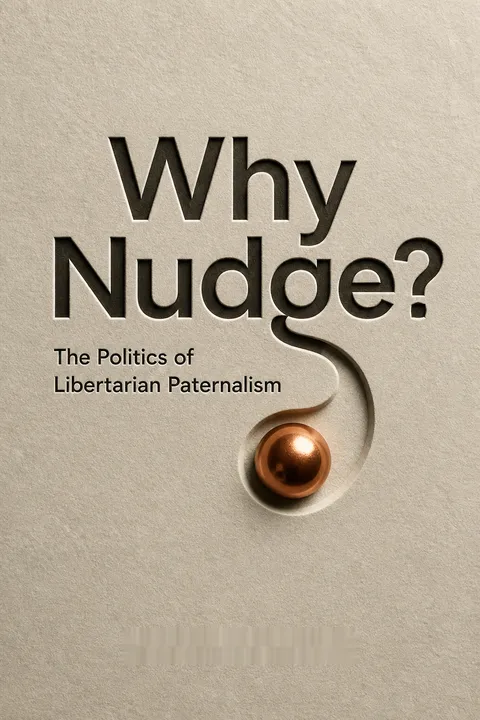
Why Nudge? receives mixed reviews with an average rating of 3.47/5. Critics frequently cite poor writing style, excessive repetition, and dense academic language that obscures Sunstein's arguments. Many readers appreciate the philosophical discussion of "libertarian paternalism" and the challenge to John Stuart Mill's Harm Principle, but find the book less accessible than Nudge. Some view it as repetitive of Sunstein's earlier work. Supporters value the framework for understanding behavioral market failures and when government intervention through "nudges" is justified, while skeptics question the paternalistic approach and potential government overreach.
People Also Read










About the Author
Other books by Cass R. Sunstein







Download PDF
Download EPUB
.epub digital book format is ideal for reading ebooks on phones, tablets, and e-readers.








































