


Key Takeaways
The American Dream isn't gone; the old routes to it collapsed
The dream survives, the roads to it don't. Hedges opens with the raw feeling of a home burglary to argue that something far more precious has been stolen from ordinary people: not the dream of freedom, security, and wealth itself, but their ability to reach it. The old script (get a degree, climb the corporate ladder, or open a small business) has quietly become a trap that trades too much time for too little money.
The numbers he cites are grim. By age 65, he claims, roughly 95 percent of people are dead, broke, still working, or dependent on family, church, or state, and fewer than 1 percent of Americans earn over $100,000. His pitch: quit doing what the 95 percent do and become a 'five-percenter' who owns their own life.
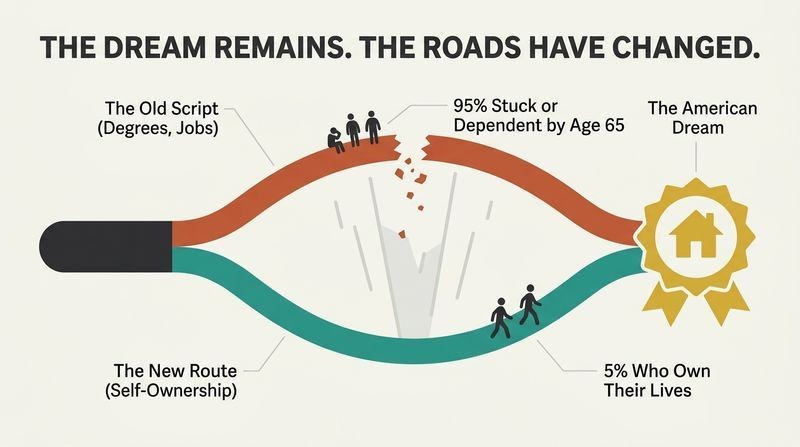
What's striking is how Hedges reframes personal failure as systemic betrayal, a move that is both empowering and convenient for a salesman. It relieves the reader of shame ('you're not a coward, you're a victim') while positioning his product as rescue. Behavioral economists call this an external locus of control, which can motivate action but can also excuse it. The emotional architecture here mirrors classic recruitment rhetoric: name the pain, assign a villain, offer the cure. The insight that credentials no longer guarantee security has aged remarkably well, echoing later work on the hollowing of the middle class, even if the proposed remedy deserves scrutiny.
A pyramid isn't a scam; a scam is when value stops flowing down
Every distribution system is shaped like a pyramid. Borrowing from educator Dr. Karl Dean Black, Hedges argues that governments, churches, schools, and corporations are all multi-level pyramids: power flows up (as votes or dollars) only so long as value flows down (as services or products). When value stops flowing down, power stops flowing up, and the structure collapses.
So the shape is neutral; the ethics live in the exchange. A chain letter or the 'airplane game,' where newcomers pay in but receive no product, is an illegal pyramid because nothing of value comes back down. A legitimate business, by contrast, delivers real goods at a fair price. Hedges uses a deliberately provocative analogy: like sex, the pyramid isn't inherently good or bad, only its use is.
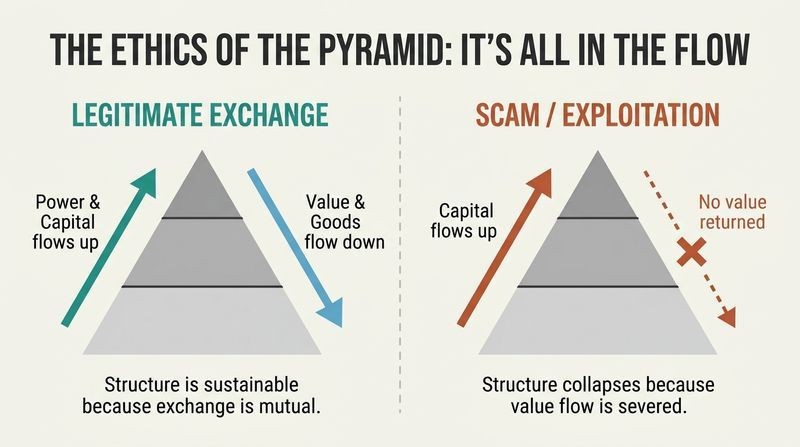
The value-flows-down test is genuinely useful and echoes how regulators actually distinguish legal MLMs from illegal schemes. The FTC's real-world line hinges on whether income comes from selling products to genuine outside customers or merely from recruiting new participants who buy inventory. That nuance is where Hedges's argument gets slippery: many MLMs technically move product but derive most rewards from recruitment, making them functionally recruitment-driven. The 2004 FTC observation that most MLM revenue often comes from distributors buying their own stock complicates his clean binary. The framework is sound; the application requires the very skepticism he encourages elsewhere, applied to his own industry.
Social Security is the biggest legal Ponzi scheme in America
Ponzi robbed Peter to pay Paul. Carlo Ponzi's 1920 scheme promised 50 percent returns in 45 days using postal reply coupons he never actually bought, paying early investors with later investors' money until the merry-go-round stopped. Hedges argues Social Security runs on identical mechanics: today's workers fund today's retirees, with the surplus replaced by government IOUs.
The demographics doom it, he warns. The 76 million Baby Boomers propped up the fund, but once they retire around 2010, far fewer workers (the 'Baby Bust') remain to pay in. He notes 7 of 10 families pay more in Social Security taxes than income tax, and a man turning 30 in 1990 would pay $200,000 more than he collects. He extends the charge to bloated CEO pay and self-voted congressional raises.
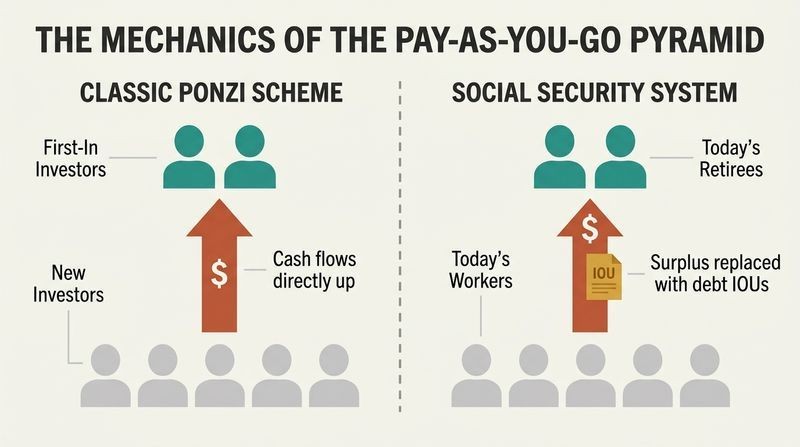
The Ponzi comparison is rhetorically potent but economically imprecise. Social Security is a pay-as-you-go transfer program backed by taxing authority and adjustable parameters (retirement age, tax rates, benefit formulas), whereas a Ponzi scheme is fraudulent and collapses the instant inflows dip. One can be reformed by legislation; the other only by prosecution. Still, Hedges anticipated a real fiscal strain that demographers and the program's own trustees continue to flag. The CEO pay critique also proved prescient: the executive-to-worker pay ratio he pegged near 100-to-1 has since ballooned past 300-to-1, lending his populist anger enduring relevance.
Chasing security in a traditional job is telling yourself a comforting lie
Job security is a 1950s memory. Hedges piles on the layoff statistics of the early 1990s: GM shedding 70,000, IBM planning 100,000 cuts, Sears slashing 53,000, over 700,000 jobs lost in 1992 alone. He cites economist Paul Zane Pilzer's forecast of 20 percent unemployment by 2000 and quotes Labor Secretary Robert Reich that no one's job is safe.
Small business and franchising fare no better. He claims 90 percent of small businesses fail in year one, and of survivors, 80 percent fold within five years. His own venture made a million dollars but cost $1.2 million to run. Franchises average $85,000 just to start, and per business writer Jane Bryant Quinn, one-third of franchisees lose money, one-third break even, one-third profit.
Hedges captures a real structural shift: the postwar social contract of lifetime employment was genuinely eroding under automation, globalization, and shareholder-driven restructuring. His instinct that individuals must build assets they own, rather than rent their labor, aligns with later financial-independence thinking. But his failure statistics are inflated folklore; Bureau of Labor Statistics data shows roughly half of new businesses survive five years, not 10 percent. The rhetorical sleight is subtle: by exaggerating how badly every alternative fails, he narrows the reader's perceived options down to his own. The underlying anxiety is legitimate; the doom framing is engineered.
80 to 90% of a product's price is distribution, not manufacturing
Making things got cheap; moving them got expensive. Echoing economist Paul Zane Pilzer's one-word secret for the 1990s, 'Distribution,' Hedges explains that technology slashed manufacturing to just 10 to 20 percent of retail price (food is about 15 percent, clothing 17 percent). The wheat in a $2.50 box of cereal costs pennies. The remaining 80 to 90 percent is the cost of getting the product from factory to living room: advertising, wholesalers, brokers, warehouses, and retail staff.
Whoever conquers distribution wins. Sam Walton built a $22 billion family fortune not by making products but by distributing them cheaper. Hedges argues Network Marketing attacks the same fat target, redirecting the distribution markup away from middlemen and TV ad budgets into the pockets of ordinary distributors.
This is the book's most intellectually durable insight. The observation that value migrated from production to distribution and logistics anticipated the defining business story of the following decades, from Walmart's supply-chain dominance to Amazon's logistics empire. Where Hedges falters is the implied equivalence between Walmart-style efficiency and MLM. Walmart lowers consumer prices by ruthlessly compressing distribution costs; many MLMs actually charge premium prices while paying multi-level commissions upward, which can make products more expensive, not less. The cost structure he correctly identifies is real, but relational word-of-mouth selling does not automatically undercut it. Sometimes it simply relocates the markup to the recruiter's upline.
A lot of people doing a little each beats a few superstars
Duplication is the engine. Network Marketing companies partner with independent distributors who each sell modestly but recruit and coach others, earning a percentage of their whole group's volume. Unlike direct sales, which depends on rare super-salespeople, this model depends on many ordinary people doing a little, which Hedges argues is far easier to teach and replicate.
The penny-doubled parable. A penny doubled every day for 30 days becomes over $5.3 million, though it looks like nothing early on ($1.63 after day 15). Applied to recruiting, sponsoring one person per month while teaching each recruit to do the same yields 4,096 people in a year. Even assuming a brutal 90 percent quit rate, 400 remain, and if each moves $100 to $1,000 monthly, a 5 percent commission pays roughly $2,000 to $20,000 a month.
The doubling math is mathematically true and psychologically seductive, which is precisely the problem. Exponential recruitment cannot continue indefinitely; the same geometry that produces 4,096 in a year would exhaust the planet's population in under 40 doubling cycles. This is the structural ceiling every recruitment-heavy model eventually hits, and it explains why late entrants systematically lose. Hedges gestures at attrition with his '90 percent quit' scenario but treats the survivors as steady earners rather than acknowledging that the churn is the business model. The genuine kernel, that leverage and delegation beat solo effort, is sound. J. Paul Getty's line about preferring 1 percent of a hundred people's efforts captures it well.
Design your income to keep paying you after you stop working
Escape the time-for-money trap. Hedges divides income into four options: a job (trading hours for pay, no freedom), self-employment (long odds), investments (great, but require large capital), and residual income. Residual or passive income, the royalties earned by authors, songwriters, and performers, keeps arriving long after the work is done.
Network Marketing as the everyman's royalty. Most people will never write a hit song or invent a light bulb, but Hedges pitches network commissions as passive income anyone can build. He claims to know distributors who left for extended vacations and returned to larger checks than when they left, and notes that an extra $250 a month would prevent 80 percent of bankruptcies. The appeal: build an organization once, get paid on its ongoing volume.
The distinction between earned and passive income is one of the most valuable mental models in personal finance, popularized by everyone from Robert Kiyosaki to the FIRE movement. Hedges deserves credit for surfacing it plainly in 1992. The honest caveat is that MLM residual income is rarely passive; it typically requires continuous recruiting, motivating, and retention work to offset the very attrition he describes, making it closer to managing a fragile sales team than collecting book royalties. True passive income usually comes from owning appreciating or dividend-producing assets. The aspiration is right; the labeling of network commissions as 'passive' oversells how hands-off the reality tends to be.
When everyone floats downstream, find your fortune swimming up
Paradigms die when a better one arrives. A paradigm is simply 'the way it is' until it stops working. Hedges tells the Swiss watch story: Swiss makers invented quartz technology but dismissed it to protect their jeweled-mainspring empire, so they sold it to the Japanese, who used it to seize the watch market. The lesson: incumbents resist the very innovation that would save them.
History rewards the early upstream swimmer. Citing Sam Walton's advice to swim upstream, Hedges traces how department stores, shopping malls, and franchising were each mocked, resisted, even nearly legislated illegal, before dominating. Franchising came within 11 votes of being outlawed by Congress, then grew to 34 percent of retail and $800 billion in sales. By the time a trend is obvious, the big money is gone.
The paradigm-shift framing borrows from Thomas Kuhn and the innovator's-dilemma logic Clayton Christensen would formalize a few years later: established players are structurally blind to disruptions that threaten their existing revenue. The Swiss watch case is a textbook example of incumbents optimizing themselves into obsolescence. Hedges wields this history skillfully to preempt skepticism, equating doubt about Network Marketing with the shortsightedness that killed the Swiss watch industry. It is a clever rhetorical inoculation, but it also commits a logical error: that some ridiculed innovations succeeded does not mean every ridiculed thing is a suppressed innovation. Plenty of mocked ideas were mocked because they didn't work.
The media stays silent because network marketers buy no ad space
Follow the advertising money. Hedges argues newspapers, magazines, and TV profit from advertisers, not readers, so they protect big-budget advertisers and attack upstarts who threaten them without spending on ads. He recounts a Network Marketing air-purification firm that won a warehouse contract with a $100,000 bid against a giant's $1 million bid, only to face a local TV 'expose' and an attorney general lawsuit.
Speech rules stacked against distributors. He claims network marketers in some states are barred from stating their own real incomes publicly and must instead cite regional averages including inactive distributors, comparing it to forbidding Michael Jordan from naming his salary. He frames the 'book your boss doesn't want you to read' subtitle as evidence that the powerful shoot the messenger.
The media-follows-advertising critique is legitimate media-economics and predates Hedges by decades; Chomsky and Herman's propaganda model made a similar structural argument. But applied here it functions as an unfalsifiable shield: any negative coverage becomes proof of a conspiracy rather than possible evidence of real problems. That is a hallmark of persuasion systems that must insulate members from outside information. Ironically, the income-disclosure rules he resents exist precisely because inflated earnings claims are the most common and documented form of MLM harm, which is why the FTC mandates realistic average-income disclosures. The rule protects recruits from exactly the cherry-picked success stories the book itself deploys.
Get in before Critical Mass, when growth explodes overnight
Timing is the whole game. Hedges maps four phases of any industry: Foundation (risky pioneering years), Concentration (gaining acceptance), Momentum (explosive growth), and Stability. Network Marketing's foundation ran from the 1940s until Amway's 1979 court victory against the FTC established its legality. He places the industry at the edge of Momentum, approaching 'Critical Mass,' the tipping point where an offering suddenly becomes universally wanted.
The window is now. Like personal computers, microwaves, and VCRs that sat dormant then exploded once they crossed the threshold, he predicts Network Marketing will jump from 2 percent to 10 percent of the population within four to six years, meaning most of the money will be made this decade. His closing challenge: pull the door marked 'success' instead of endlessly pushing, and 'I dare you to be rich.'
The four-phase adoption curve is a folk version of Everett Rogers's diffusion of innovations and the S-curve familiar to technologists. The urgency framing, 'the window is closing, act now,' is also the oldest lever in sales psychology, exploiting scarcity and fear of missing out. It is worth noting the tension inside the book's own logic: if duplication guarantees exponential growth for anyone who joins, timing shouldn't matter much; but if timing is everything, then late entrants are structurally disadvantaged, quietly conceding the early-in-advantage that critics call the defining feature of recruitment-driven models. The genuinely useful takeaway survives the sales pitch: adopting a proven trend before mass saturation is a real edge.
Analysis
This is a 1992 persuasion document dressed as a business book, and it should be read as both a fascinating primary source and a masterclass in motivated reasoning. Its structure is a five-phase funnel: agitate the reader's economic anxiety, discredit every conventional alternative, redefine the loaded word 'pyramid,' then present Network Marketing as the only rational escape. Understanding this arc matters more than any single claim.
Hedges is strongest as a diagnostician of the 1990s economy. His core observations, that lifetime employment was dying, that credentials no longer guaranteed security, that value in the economy was migrating from manufacturing to distribution and logistics, and that executive pay was decoupling from performance, have all aged remarkably well. The Pilzer 'distribution' thesis in particular anticipated the Walmart and Amazon era with uncanny accuracy.
He is weakest, unsurprisingly, when the diagnosis pivots to the cure. The book leans on inflated failure statistics (the 90-percent-of-small-businesses-fail figure is folklore), presents exponential recruitment math without confronting its mathematical ceiling, labels recruitment-intensive commission income as 'passive,' and constructs an unfalsifiable media-conspiracy shield that reframes all criticism as suppression. The income-disclosure rules he resents exist precisely to prevent the cherry-picked success stories the book itself parades.
The most valuable way to read it today is dialectically. Take the mental models that transcend the sales pitch: value flows down or the structure collapses, distribution is where cost and opportunity concentrate, leverage beats solo effort, passive income beats trading hours, and early adoption of proven trends confers advantage. Then apply the very skepticism Hedges preaches ('do your homework, check the product, the people, the company') to his own industry, where independent FTC and academic data consistently show that the large majority of participants earn little or lose money. The book teaches critical thinking best when turned back on itself.
Review Summary
"Who Stole the American Dream" receives mixed reviews, with an average rating of 3.89 out of 5. Some readers praise it as eye-opening and informative about network marketing, while others criticize it as a marketing ploy. Positive reviews highlight the book's insights into economic trends and the potential of network marketing. Critics argue that it's outdated and overly focused on promoting network marketing. The book's writing style and structure are noted as simplistic by some, while others find it engaging and thought-provoking.
People Also Read








Glossary
Network Marketing
Distributor-network product selling modelA distribution method in which a company sells products through independent distributors who both sell directly and recruit others, earning commissions on their own sales plus a percentage of the sales made by everyone they recruit. Hedges frames it as the 'people's franchise,' an unconventional alternative to jobs, corporate careers, and traditional small business ownership. Also called multi-level marketing.
Pyramid principle (value flows down, power flows up)
Test separating legit from scamEducator Dr. Karl Dean Black's model that all distribution organizations are multi-level pyramids where value (products or services) flows down and power (dollars or votes) flows up in response. A structure is legitimate when value keeps flowing down; it becomes a fraudulent scheme and collapses when money flows up but no real value comes back down.
Duplication (doubling concept)
Exponential growth through recruiting copiesThe idea that a network grows by each member recruiting and training others to do exactly what they do, producing exponential expansion. Illustrated by a penny doubled daily reaching over $5 million in a month, and by sponsoring one person monthly while teaching each recruit to do the same, theoretically yielding thousands in a year.
Critical Mass
Tipping point of explosive adoptionThe moment an industry gains popular acceptance and becomes market-driven, triggering sudden, explosive growth, as happened with personal computers, microwaves, and VCRs. Hedges places Network Marketing at the threshold of Critical Mass, arguing early entrants who position themselves beforehand capture the surge of new participants and profits.
Four Phases of Growth
Industry life-cycle adoption stagesHedges's model of how successful industries mature: Foundation (risky pioneering years), Concentration (gaining mainstream acceptance), Momentum (explosive market-driven growth), and Stability (maturity). He argues the greatest wealth is created by those who enter just before the Momentum phase.
Residual (passive) income
Income continuing after work stopsEarnings that keep arriving after the initial work is done, like royalties paid to authors, songwriters, and performers. Hedges contrasts it with trading time for money in a job and pitches Network Marketing commissions on an organization's ongoing sales volume as a form of residual income accessible to ordinary people.
Ponzi scheme
Paying old investors with new moneyNamed after Carlo Ponzi's 1920 fraud, a scheme that pays earlier investors with money from later ones rather than from real profit, collapsing once new money slows. Ponzi promised 50 percent returns using postal coupons he never bought. Hedges uses it as the template for illegal pyramids and, controversially, for Social Security.
FAQ
1. What’s "Who Stole the American Dream" by Burke Hedges about?
- Exposes the Loss of the Dream: The book argues that the traditional American Dream—financial freedom, security, and happiness through education, a good job, or small business ownership—has been stolen from average Americans.
- Critique of Conventional Paths: Hedges details how college degrees, corporate careers, and small businesses no longer guarantee success or security due to economic shifts, automation, and corporate greed.
- Introduction to Network Marketing: The author presents Network Marketing as a revolutionary, accessible alternative for ordinary people to reclaim the American Dream.
- Personal and Societal Wake-Up Call: Through personal stories and economic analysis, Hedges urges readers to question the status quo and consider unconventional paths to prosperity.
2. Why should I read "Who Stole the American Dream" by Burke Hedges?
- Challenges Conventional Wisdom: The book debunks widely held beliefs about education, employment, and entrepreneurship, encouraging readers to rethink their approach to financial security.
- Offers a New Perspective: Hedges introduces Network Marketing as a legitimate, empowering business model for those disillusioned with traditional career paths.
- Practical and Motivational: The book combines real-life success stories, economic trends, and motivational advice to inspire readers to take control of their financial future.
- Timely and Relevant: With ongoing economic uncertainty and job insecurity, the book’s message is increasingly relevant for anyone seeking alternatives to the “rat race.”
3. What are the key takeaways from "Who Stole the American Dream" by Burke Hedges?
- The Old Dream Is Broken: Traditional routes to success—college, corporate jobs, and small business—are no longer reliable due to systemic changes.
- Pyramids Are Everywhere: Hedges explains that all organizations, including government and corporations, are structured as pyramids, but only some are exploitative.
- Network Marketing as a Solution: The book positions Network Marketing as a fair, accessible, and potentially lucrative way for average people to achieve financial freedom.
- Mindset and Action Matter: Hedges emphasizes the importance of open-mindedness, personal responsibility, and willingness to embrace change for success.
4. How does Burke Hedges define the "American Dream" in "Who Stole the American Dream"?
- Freedom and Security: The American Dream is described as the ability to live freely, securely, and with enough financial resources to enjoy life.
- More Than Money: Hedges stresses that the Dream includes health, happiness, and the freedom to pursue one’s passions—not just wealth.
- Out of Reach for Most: The book argues that, for the majority, the Dream has become a myth due to economic and societal shifts.
- Reclaimable Through New Means: Hedges believes the Dream can be reclaimed, but only by adopting new paradigms like Network Marketing.
5. What does "Who Stole the American Dream" by Burke Hedges say about traditional career paths like college, corporate jobs, and small business?
- College No Longer Guarantees Success: Hedges points out that many graduates struggle to find relevant jobs and often end up underemployed or in unrelated fields.
- Corporate Jobs Are Insecure: The book highlights mass layoffs, lack of loyalty, and the disappearance of job security in corporate America.
- Small Business Is Risky: Hedges notes that most small businesses fail within a few years, often leaving owners worse off financially.
- Need for Unconventional Solutions: The author argues that these traditional paths are outdated and urges readers to seek new opportunities.
6. How does Burke Hedges explain the concept of "pyramid schemes" in "Who Stole the American Dream"?
- Pyramids Are Natural Structures: Hedges explains that all organizations, including businesses and governments, are structured as pyramids with multiple levels.
- Difference Between Legal and Illegal: The book distinguishes between legal multi-level structures (where value flows down) and illegal pyramid schemes (where only money flows up).
- Examples of Illegal Schemes: Hedges describes chain letters, Ponzi schemes, and the "airplane game" as classic illegal pyramids that collapse when new recruits dry up.
- Critique of Legal Pyramids: The author controversially labels Social Security and some corporate structures as legal pyramid schemes that benefit those at the top.
7. What is Network Marketing according to "Who Stole the American Dream" by Burke Hedges?
- Alternative Distribution System: Network Marketing is presented as a business model where products are distributed directly to consumers through networks of independent distributors.
- Everyone Can Participate: Hedges emphasizes that anyone, regardless of background or education, can succeed in Network Marketing.
- Value Flows Down: Unlike illegal pyramids, Network Marketing rewards participants based on actual product sales and value delivered to consumers.
- Focus on Duplication: The model relies on teaching others to do the same, creating exponential growth through the “doubling concept.”
8. Why does Burke Hedges believe Network Marketing is the best way for average people to achieve the American Dream?
- Low Barrier to Entry: Network Marketing requires minimal startup costs compared to franchises or traditional businesses.
- Residual Income Potential: The model allows for passive income through building a network, not just trading time for money.
- Flexibility and Freedom: Participants can work part-time, from home, and set their own schedules, making it accessible for families and diverse lifestyles.
- Empowerment and Cooperation: Success is based on helping others succeed, fostering a culture of cooperation rather than cutthroat competition.
9. What are the main criticisms and misconceptions about Network Marketing addressed in "Who Stole the American Dream"?
- Confusion with Pyramid Schemes: Many people mistakenly believe Network Marketing is inherently a scam, not understanding the legal and ethical differences.
- Media and Corporate Resistance: Hedges argues that traditional businesses and media outlets attack Network Marketing because it threatens their interests and advertising revenue.
- Regulatory Challenges: The book discusses how Network Marketers face unique legal restrictions, such as limitations on sharing income claims.
- Stigma and Skepticism: Hedges acknowledges the skepticism but encourages readers to investigate the industry for themselves with an open mind.
10. What advice does Burke Hedges give for evaluating Network Marketing opportunities in "Who Stole the American Dream"?
- Do Your Homework: Hedges urges readers to research the company, products, compensation plan, and leadership before joining.
- Look for Real Value: Ensure the company offers genuine products or services that people want and use, not just recruitment incentives.
- Assess Support and Training: A good Network Marketing company provides training, marketing materials, and ongoing support for distributors.
- Beware of Red Flags: Avoid companies that require large upfront investments, make unrealistic income promises, or lack transparency.
11. How does technology contribute to the growth of Network Marketing, according to "Who Stole the American Dream"?
- Enables Large-Scale Operations: Computers, the internet, and telecommunications make it possible to manage and pay thousands of distributors efficiently.
- Facilitates Communication: Tools like fax, conference calls, and video presentations allow for rapid training and recruitment across distances.
- Expands Market Reach: Technology allows Network Marketers to operate globally, reaching customers and partners worldwide.
- Supports Home-Based Business: Advances in technology make it easier than ever to run a business from home, increasing accessibility.
12. What are the most powerful quotes from "Who Stole the American Dream" by Burke Hedges, and what do they mean?
- “For things to change, you have to change. For things to get better, you have to get better.” — Emphasizes personal responsibility and the need for self-improvement to achieve success.
- “The mind is like a parachute—it doesn’t work unless it’s open.” — Encourages readers to keep an open mind, especially when considering unconventional opportunities.
- “If you don’t change your direction—you’re bound to end up where you’re headed.” — Warns against complacency and urges proactive change to avoid undesirable outcomes.
- “Network Marketing is the wave of the future.” — Summarizes Hedges’ belief that Network Marketing is the next major evolution in business and personal opportunity.
- “I dare you to be rich!” — A motivational challenge to readers to take action and pursue their dreams through new avenues like Network Marketing.
About the Author
Other books by Burke Hedges

Download PDF
Download EPUB
.epub digital book format is ideal for reading ebooks on phones, tablets, and e-readers.








































