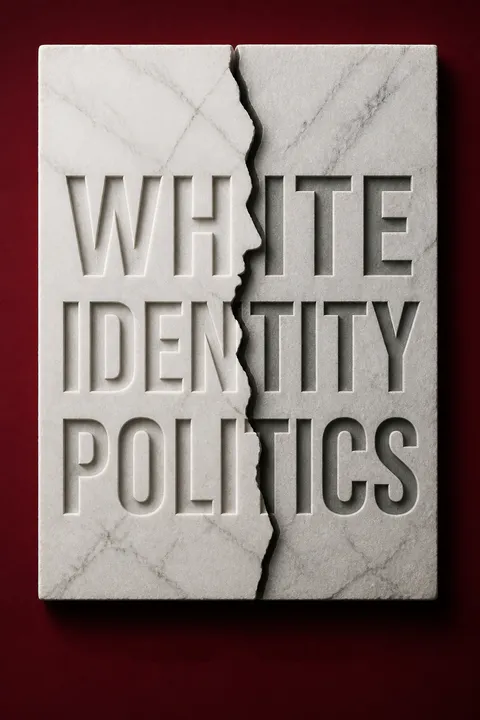

Key Takeaways
1. White Identity is No Longer Invisible, but a Salient Political Force.
Whiteness was once thought to be invisible because of whites’ dominant position and ability to claim the mainstream, but today a large portion of whites actively identify with their racial group and support policies and candidates that they view as protecting whites’ power and status.
Emerging visibility. For decades, white identity in America was largely invisible, taken for granted due to whites' dominant social, economic, and political position. However, a significant shift is underway, with many white Americans now actively identifying with their racial group. This newfound visibility is not merely a cultural phenomenon but has profound implications for political behavior and the future of racial dynamics in the United States.
Political implications. This emerging white identity translates directly into political action. A substantial portion of white voters now support policies and candidates explicitly or implicitly aimed at safeguarding what they perceive as their group's power and status. This marks a departure from past research, which primarily focused on out-group hostility, bringing into focus the significance of in-group identity and favoritism.
Understanding Trump's rise. The book argues that understanding this shift is crucial for comprehending recent political phenomena, particularly the rise of figures like Donald Trump. Trump's campaign effectively mobilized whites around their racial identity, demonstrating that this identity is a potent, measurable force in contemporary American politics, influencing everything from policy preferences to electoral outcomes.
2. White Identity is Reactive, Activated by Perceived Threats to Dominance.
My main claim is that such identities are reactionary – they are activated in response to group threat.
Threat as a catalyst. White identity, traditionally latent, becomes salient and politically meaningful when conditions that facilitate its invisibility are disturbed. This means that when white Americans perceive genuine challenges to their group's dominant status, their racial identity is activated, becoming a lens through which they interpret the political and social world. This reactive nature is a cornerstone of dominant group identity.
Specific triggers. The book identifies several "big events" that have served as powerful threats to whites' dominant status, making their racial identity more salient. These include:
- Massive waves of immigration, primarily from Central America and Asia.
- The erosion of whites' numerical majority status, with projections of becoming a minority.
- The increasing racial and ethnic diversity within America's political, social, and economic institutions.
- The symbolic displacement of white political power by the election of the nation's first Black president, Barack Obama.
Maintaining advantage. For high-status groups like whites, this activated group consciousness is often aimed at justifying and maintaining their existing advantages within a stratified system. It's not just about reacting to perceived threats, but about actively defending their position and resisting changes to the racial status quo.
3. White Identity and Consciousness are Prevalent and Distinct from Racial Prejudice.
In other words, white identity is not defined by racial animus, and whites who identify with their racial group are not simply reducible to bigots.
Measurable presence. Contrary to past assumptions that white identity is negligible, the book demonstrates its significant prevalence. Between 30% and 40% of white Americans consider their racial identity "very" or "extremely important." A smaller, but still substantial, 20% exhibit "white racial consciousness," which is a more politicized form of identity.
Beyond prejudice. A critical distinction the book makes is that white identity and consciousness are not merely proxies for racial prejudice or animus. While some overlap exists, these in-group attitudes are conceptually and empirically distinct from out-group hostility. Many white identifiers do not harbor strong negative feelings towards minorities, and conversely, some prejudiced whites do not strongly identify with their race.
Reliable and valid. The research employs robust survey measures, including a multi-item scale for white identity (importance, pride, commonality) and white consciousness (identity plus perceived deprivation and collective action). These measures are shown to be:
- Reliable: Consistent across different surveys and over time.
- Valid: Accurately capturing the intended concepts, as confirmed by open-ended responses and statistical analysis.
This methodological rigor allows for confident exploration of their political consequences.
4. White Identifiers are a Diverse Group, Not Just the "White Working Class."
The politics of white identity is not wholly or even primarily rooted in economic disenfranchisement; it is far broader and more pervasive.
Beyond economic grievance. While the narrative of the "aggrieved white working class" gained prominence, particularly after the 2016 election, the book challenges this narrow framing. White identity politics is not solely a phenomenon of economically disenfranchised, blue-collar workers. While some white identifiers may fit this profile, the movement's base is much broader.
Demographic profile. White identifiers are a demographically diverse group, though certain characteristics are more correlated with higher levels of racial solidarity:
- Age: Slightly older individuals tend to have stronger white identities.
- Education: Less educated whites are more inclined to adopt a racial identity.
- Gender: Women are slightly more likely to possess a racial identity than men.
- Geography: A modest tendency for higher identity in the South and rural areas.
- Economic Status: Not necessarily objectively poorer or unemployed, though those high on consciousness may feel more financially troubled.
Personality traits. Beyond demographics, personality traits play a significant role. White identifiers tend to score higher on:
- Authoritarianism: A preference for order and intolerance of challenges to the social status quo.
- Social Dominance Orientation (SDO): A desire for hierarchical group arrangements and in-group dominance.
These traits suggest a worldview that values tradition and stability, making individuals more receptive to identity-based appeals when the status quo is perceived as threatened.
5. White Identity is Defined by an Exclusive Americanism, Pride, Privilege, and Grievance.
When you’re accustomed to privilege, equality feels like oppression.
Content is clear. White identity is not an empty vessel; it is imbued with specific meanings and attitudes. White identifiers share a common understanding of their group's place in society, often intertwining it with a particular vision of American identity. This vision is often exclusionary, prioritizing characteristics traditionally associated with white, Anglo-Protestant heritage.
Pride and entitlement. White identifiers express a strong sense of pride in their racial group and its perceived accomplishments. They recognize and embrace the privileges associated with being white, viewing them as inherent advantages they are entitled to maintain. This sentiment is often accompanied by a desire to celebrate their "white heritage," similar to how other racial groups celebrate theirs, and a resentment towards any suggestion that such expressions are problematic.
Grievance and alienation. Despite recognizing their privileged status, white identifiers also articulate a profound sense of grievance and alienation. They believe:
- Their group is experiencing discrimination or "reverse racism."
- They are in zero-sum competition with racial and ethnic minorities for economic and political resources.
- Their group is not getting its "fair share" and is owed a better chance in life.
This paradox highlights that for many, the perceived erosion of privilege feels like oppression, fueling a defensive posture aimed at preserving the existing racial hierarchy.
6. Immigration is a Primary Catalyst for White Identity Politics.
Immigration is an issue that cuts to the heart of whites’ concerns about their group’s status atop the nation’s hierarchy.
Historical echoes. The history of U.S. immigration policy is deeply intertwined with the concept of whiteness, from the 1790 Naturalization Act limiting citizenship to "free white persons" to the 1924 Immigration Act's "Nordic victory." Each major wave of non-European immigration has triggered debates about preserving America's identity as a white nation. Today's influx of immigrants from Latin America and Asia is no exception.
Perceived threat. For white identifiers, immigration is not merely an economic or cultural issue; it is a fundamental threat to their group's dominance. They perceive:
- Numerical displacement: The prospect of whites becoming a numerical minority.
- Cultural erosion: New languages, foods, and traditions displacing the country's dominant Anglo-centric culture.
- Racial purity: Concerns about the changing "ethnic makeup" of the country.
These perceptions are amplified by media coverage and political rhetoric, making immigration a potent issue for mobilizing white identity.
Strong opposition. The book consistently demonstrates that white identity and consciousness are among the strongest predictors of anti-immigration sentiment. White identifiers are significantly more likely to:
- Prefer decreasing immigration levels.
- Support policies like building a border wall and tightening border security.
- Believe immigrants take jobs, harm the economy, and increase crime rates.
- Feel anger and fear when presented with information about increasing immigration or their impending minority status.
This robust link underscores immigration's role as a central issue for white identity politics.
7. White Identity Drives Support for "Pro-White" Policies and Opposition to Globalization.
White racial solidarity, it turns out, powerfully predicts opinion on many policies, including attitudes toward social welfare and entitlement programs like Social Security and Medicare.
In-group favoritism in policy. White identity is not primarily about opposing policies that benefit minorities, but rather about supporting policies perceived to benefit whites. This in-group favoritism is evident in attitudes towards:
- Social Security and Medicare: These programs, historically framed as rewards for hard work (a stereotype associated with whites), receive strong support from white identifiers. They are seen as "for us," contrasting with means-tested welfare programs.
- Legacy Admissions: White identifiers are significantly more likely to favor college legacy admissions, a policy that disproportionately benefits white students and is sometimes called "affirmative action for whites."
Distinct from racial animus. Crucially, white identity's influence on these policies is distinct from racial resentment. While racial resentment strongly predicts opposition to programs like welfare or government aid to blacks, white identity is largely unrelated to these issues. In fact, white identifiers often support increased federal spending for all racial groups, including minorities, as long as their own group's interests are also served.
Globalization as a threat. Beyond domestic policies, white identity extends to international issues. White identifiers express:
- Opposition to outsourcing: They want the government to discourage companies from moving jobs overseas.
- Resistance to free trade: They are less supportive of increasing trade with other countries and favor limiting imports.
- Isolationist foreign policy: They prefer the U.S. to "stay home" and not concern itself with global problems.
This suggests that white identifiers perceive globalization as another threat to their group's status, both economically and in terms of national sovereignty.
8. White Identity is Central to Understanding Support for Trump and Opposition to Obama.
We cannot understand the rise and success of Donald Trump, one of the most unconventional and unexpected modern presidential candidates, without turning our attention to white racial identity and consciousness.
Obama as a symbolic threat. Barack Obama's election represented a profound symbolic challenge to whites' political dominance. White identity was a strong predictor of opposition to Obama in 2012, even after accounting for racial animus. White identifiers were significantly less likely to vote for him, partly due to a belief that he would favor Black Americans at the expense of whites. This suggests that any non-white candidate may face similar resistance from white identifiers.
Trump's strategic appeal. Donald Trump's 2016 campaign uniquely capitalized on white identity and consciousness. His platform resonated deeply with white identifiers through:
- Immigration stance: His draconian anti-immigration rhetoric and promise of a border wall directly addressed a core concern of white identifiers.
- Policy positions: His commitment to protecting Social Security and Medicare aligned with policies favored by white identifiers, departing from traditional Republican calls for cuts.
- "Make America Great Again": This slogan was interpreted by many as a call to restore white power and status.
White identity and consciousness were among the strongest predictors of support for Trump, surpassing even racial resentment in some analyses.
Beyond prejudice. While Trump certainly appealed to racial prejudice, the book emphasizes that white identity's influence on Trump's support was independent. It was not just about disliking minorities, but about a desire to protect and restore the perceived power and privileges of the white in-group. This highlights a crucial, distinct dimension of Trump's electoral success.
9. Historical Precedent: Politicians Have Long Capitalized on White In-Group Sentiments.
Trump is not alone in having successfully tapped into whites’ in- group sentiments. George Wallace, Richard Nixon, and Pat Buchanan clearly took advantage of both in- group and out- group racial attitudes.
Wallace's overt appeals. Decades before Trump, figures like Alabama Governor George Wallace explicitly appealed to white in-group sentiments. His infamous "segregation forever" speech, while overtly racist, also praised the "Great Anglo-Saxon Southland" and warned of whites being "submerged" by a "colored majority." White in-group affect was significantly linked to warmer evaluations of Wallace.
Nixon's "Southern Strategy." Richard Nixon's "Southern Strategy" in 1968 and 1972, often seen as exploiting racial resentment through "law and order" rhetoric, also tapped into white in-group concerns. White in-group affect was significantly related to support for Nixon, suggesting his appeals resonated with whites seeking to maintain their group's power in the wake of the Civil Rights Movement.
Buchanan's early warnings. Patrick Buchanan, running for president in the 1990s, foreshadowed Trump's platform. He advocated for strict immigration limits, a border fence, and opposed NAFTA, all while explicitly linking these issues to preserving "Judeo-Christian values" and "Western heritage" against "multiculturalism." White in-group sentiments predicted support for Buchanan, demonstrating that these appeals have a long history of resonating with a segment of white voters.
10. White Identity Politics Poses a Persistent Challenge to Racial Equality.
The power and import of white identity politics makes clear that as a nation, we have a long way to go toward achieving racial equality, and race remains one of the most fundamental organizing features of American politics.
Enduring force. The demographic shifts driving white identity politics are irreversible, ensuring that this phenomenon will remain a significant force in American politics for decades. As the U.S. continues to diversify, white identity's salience is likely to persist, influencing electoral outcomes and policy debates. This means that the challenge to racial equality will continue to be fought on multiple fronts.
Insidious illusion. White identity politics is problematic because it often co-opts the language of oppression, with whites claiming discrimination to justify maintaining a system of racial inequality. This "insidious illusion" makes it difficult to challenge, as many white identifiers genuinely believe they are simply protecting their group's legitimate interests, rather than perpetuating systemic disadvantage.
Elite responsibility. Political elites play a crucial role in either exacerbating or ameliorating these tensions. Leaders like Trump demonstrate the power of exploiting white grievances and anxieties, pushing a narrative that frames demographic change as a threat. Conversely, elites could reframe equality in less zero-sum terms, emphasizing shared superordinate identities, but this is a daunting task given the deep-seated nature of the racial hierarchy.
A complex path forward. Achieving racial equality requires addressing not only individual racial animosities but also dismantling the structural racial hierarchy that white identity politics seeks to preserve. This involves:
- Recognizing privilege: Helping whites understand their unearned advantages without triggering defensiveness.
- Reframing narratives: Presenting diversity and minority success as non-threatening to white status.
- Countervailing forces: Supporting organized efforts by diverse groups to hold elected officials accountable and resist inequitable policies.
The future of American democracy hinges on navigating these complex racial dynamics.
People Also Read










Download PDF
Download EPUB
.epub digital book format is ideal for reading ebooks on phones, tablets, and e-readers.








































