
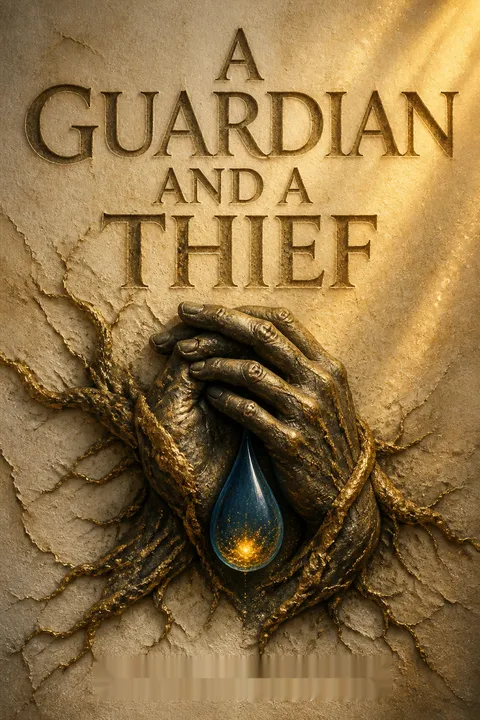


Plot Summary
Seven Days to Escape Kolkata
In a Kolkata ravaged by crop failure, drought, and lethal heat, Ma1 cooks rice and smuggled eggs in her family home, counting seven days until a flight to Michigan. Her husband5 has already emigrated for a research position; she remains with her two-year-old daughter Mishti3 and her widowed father Dadu2 — a retired manager turned poet who fears becoming a ghost of himself abroad.
The house is stripped to three suitcases and a pile of items too precious to leave. They navigate a city without buses or taxis, hiring a rickshaw to reach the American consulate, where they collect passports stamped with climate visas. On the way home, they search the market for Mishti's3 beloved cauliflower and find only seaweed. The old world of food is gone.
The Thief Through the Bars
At three in the morning, Boomba4 — a twenty-year-old shelter resident who days earlier watched Ma1 steal eggs from the shelter kitchen — scales a pipe and slides his starved body between the iron bars of the kitchen window. He stumbles through the dark house, stepping over a toy truck, and finds Ma's1 purse in the bedroom doorway.
Behind a hidden switch beneath a child's drawing on the stairwell, he discovers the storeroom: bins of rice, lentils, raisins, cashews, milk powder — all taken by Ma1 from shelter donations. He empties everything, sells the food at a predawn community kitchen, pockets the phone, and throws three navy-blue booklets he doesn't recognize onto a garbage heap. He keeps the purse for his mother.10
No Report, No Reissue
Morning reveals devastation: the storeroom gutted, Ma's1 purse gone, and with it the passports — their only passage out. At the police station, the officer chews sandwiches and accuses them of insurance fraud, refusing to file a report.
At the consulate, the American officer12 explains that without documentation, she must cancel the visas, with the next appointment months away. Dadu,2 summoning his most dignified bearing, bluffs that he is a renowned writer with journalist friends who will publicize the consulate's cruelty toward an elderly man and his preschool granddaughter.
The officer12 hesitates, imagining the headline, and relents — she won't update the system. If they find the passports, the visas stand. If they don't, they cannot fly regardless. It is the thinnest lifeline imaginable.
Mishti Spots Scooby-Doo
Their neighbor Mrs. Sen6 — a professor who shares her home with two parrots — reveals that her door-mounted security camera captured the thief departing at three a.m., a pixelated figure clutching Ma's1 purse and a bin. The image is too blurry to show a face.
But Mishti,3 grasping the table on tiptoe, shouts her recognition: the thief wears a Scooby-Doo T-shirt. Ma1 and Dadu2 canvass the city with the printed image for a full day until a stationery shopkeeper identifies the shirt as stolen from his own clothesline — along with a hexagon-branded handkerchief.
Ma1 recognizes the fabric: boxes of those handkerchiefs were donated to the shelter. The thief is a resident. That night, the new shelter manager identifies the figure instantly: Boomba,4 bed 223.
The Thief Knows Her Secret
Ma1 finds Boomba4 on his tidy bed, staring at the ceiling. She confronts him, shaking with fury, loud enough for the room to hear. He rises calmly and leads her to the empty stairwell. There, he delivers his counterstrike: he saw her stealing eggs and suspects money too.
If she involves the police, he will tell them everything. Ma's1 mind races through the consequences — the billionaire's15 lawyers, a police case barring her departure, years awaiting trial. She had skimmed not just food but cash from the shelter's maintenance budget.
She swallows her rage and asks only for the passports. Boomba4 says he threw them away but remembers where. His condition: when Ma1 flies to America, the house becomes his — keys, papers, everything. For his mother,10 his father,9 his little brother.8 The stalemate is total.
The Boy Who Burned His Home
As a child in a flood-ravaged village, Boomba4 dreamed of exploring the world like Ibn Battuta — but only if he could take his family with him. His father9 was mauled by a tiger while collecting forest honey. His mother10 planted a million mangrove saplings until the project was shut down.
At sixteen, Boomba4 became primary caretaker for his baby brother Robi.8 At seventeen, drying the infant's laundry over a boiling pot, a tiny shirt slipped into the flames and burned the family's house to the ground.
The guilt drove him to Kolkata at eighteen, where fake policemen stole his savings, an employer fired him for theft, and a falling tree destroyed his rented room. Twelve days before robbing Ma,1 he arrived at the shelter — admitted by Ma1 herself, who made a tender exception for a boy who looked too young to be alone.
Dadu Bleeds for Cauliflower
Boomba4 leads Ma1 to the garbage heap by night, but after an hour of climbing through filth, the passports are nowhere. He vanishes. At home, Mishti3 refuses fried onions and whispers for cauliflower in her sleep. Dadu2 slips out before dawn.
At the ration shop, the owner refuses everyone; a crowd shoves the man and scatters. Wandering the dead streets, Dadu2 finds a whole orange guarded by a small boy in an abandoned bank and takes it, hearing the child cry behind him. He buys a rhinoceros painting from a street artist for Mishti's3 future room.
Then he spots cauliflowers inside a stranger's house and forces his way in. The wife hurls a steel glass; Dadu2 stumbles backward and his skull strikes the pavement. Bleeding, he pulls the man down, seizes cauliflowers and cans, and runs.
Gold Bangles for Forged Visas
Ma1 plasters reward posters near the garbage dump, but a taste-seller she pays to distribute them tears them up instead. The seller's mockery sparks a desperate idea. At the back of a photocopy shop, behind a door papered with forgotten forms, a forger11 shows Ma1 fake American passports and visa stamps.
The fastest option takes forty-eight hours. Payment: gold only. Ma1 delivers her dead mother's bangles — inseparable from her memories of holding that hand, the gold sliding from elbow to wrist — and forces herself to believe this man is not a scammer.
That same night, Boomba4 returns to the house demanding the storeroom for himself and his incoming family. Ma1 cannot refuse without risking exposure. She opens the door, locks herself and Dadu2 and Mishti3 in the bedroom above, and waits.
Mishti Vanishes at Dawn
Ma1 planned to stay awake all night but surrendered to exhaustion. She wakes to an unlocked bedroom door, crayons on the empty mattress, silence where there should be a two-year-old's chaos. Boomba4 had drawn Mishti3 downstairs by producing her stolen truck and racing it along the floor.
He promised cauliflower, ice cream, boat rides — and stickers she could press onto his arms, a privilege her mother forbade. He needed a child to gain entry to the billionaire's15 daughter's wedding feast on the floating hexagon. Ma1 races through the neighborhood.
Mrs. Sen's camera shows the pair boarding a rickshaw. At the rickshaw stand, the same driver13 who took the family to the consulate commandeers a microphone and rallies his colleagues. Another driver remembers: the man and the little girl went to the jetty. Ma1 tries to swim the river but nearly drowns.
The Ferry Goes Under
On the hexagon, copper vessels carry real carrots, potatoes, fried fish, steamed rice, chocolate ice cream. Boomba4 removes bones from Mishti's3 rui fish and peels lychees for her with careful fingers.
But after the meal, his boatman friend Shanto7 — whose young son died of cerebral malaria because he could not afford the medicine — leads a raid on the hexagon's pantries and clinics. Thousands join, seizing food and supplies. Boomba4 grabs a jeweled globe from the library. The billionaire's15 guards fire warning shots. The overloaded return ferry sinks meters from shore.
In the churning water, Boomba4 grips Mishti3 and a ten-kilogram sack of rice. Both will drown him. He watches the rice vanish into the muddy current. A familiar boat pulls them out. Shanto7 helps children into rescue boats, then lets the river carry him to his son.
Dadu's Last Morning
Dadu2 beats Boomba4 with his walking stick and drives him from the house, but the exertion — compounding the untreated head wound, the hunger, the grief — collapses him at the dining table that night. Ma1 revives him with sprinkled water. He insists he only needs rest.
In the morning, she touches his shoulder. He does not move. His skin is cool, his white hair shivering in the air conditioning's breeze. Ma1 sits beside him and holds his hand for what feels like hours while Mishti3 smashes crayons into the floor, bewildered by a morning with no scolding.
Behind Dadu's2 closing eyes, memories cascade — his mother's coconut oil, his father's hand across his lap in a rickshaw, his wife's first touch two weeks after their wedding. At the crematorium, Ma1 kneels before the oven while Mishti3 gathers twigs and plays woodpecker against a tree trunk.
Passports Return, America Doesn't
The forged passports are a scam — the ink on Mishti's3 visa bleeds within hours, and the forger's11 phone rings forever unanswered. Then the neighborhood ironing man14 rattles the garden gate, clutching three water-damaged navy booklets. A ragpicker found them at the garbage dump and traced the address from Dadu's2 reward poster.
Ma1 inspects the visa stamps: intact, authentic, miraculous. She packs Dadu's2 ashes in a tiffin box, fills her purse with protein paste and cash, and takes a taxi to the airport. A guard shines a flashlight at the passports and waves them through.
Inside the terminal, hundreds stand before the departures board with expressions emptied of hope. All flights to America are suspended — the hexagon looting ignited worldwide outrage, and America has shut its doors to climate immigrants. On the phone, Ma1 tells her husband5 they are boarding.
The Guardian Falls
Ma1 and Mishti3 return from the airport to find shadows moving behind the kitchen window. While they were gone, Boomba4 used a parrot and Mrs. Sen's6 spare key to infiltrate the house, and his family has arrived from the village.
Ma1 leaves Mishti3 next door with the parrots, opens Dadu's2 suitcase, and finds his secateur — pruning shears from his years in the trade. She unlocks the front door and shouts for Boomba.4 His father9 appears instead, wearing one of Dadu's2 shirts, claiming the house is theirs. Ma1 raises the secateur.
A child's voice calls from the storeroom — Boomba's brother Robi.8 Ma1 hesitates. Boomba's father9 swings the pressure cooker Boomba4 had claimed days earlier — once against her arm, then against the base of her skull. Ma1 crumples. Her fingers burrow into the soil, seeking a way to remain.
Mishti Takes His Hand
Boomba4 descends the stairs and finds his father9 standing over Ma's1 motionless body. His parents drag her behind the house and wash the earth with a bucket of water. Boomba4 walks to the neighbor's garden, where Mishti3 sits feeding a leaf to Abba the parrot, oblivious.
He calls her Jhimli — the name Shanto7 misheard on the ferry, the name Boomba4 has known her by since the hexagon. He tells her that her mama said to come home. Mishti3 looks perplexed. She asks for her mother.1 But she takes his hand.
In the house behind them, Robi8 spins the jeweled globe on the dining table. Boomba's mother10 surveys the garden and imagines gourds and tomatoes where hibiscus grows. The house has changed hands. The guardian is gone. The thief stands where the guardian stood.
Analysis
Ma1 is both guardian — of Mishti,3 of her family's future — and thief, stealing from the shelter's most vulnerable residents. Boomba4 is both thief — of food, documents, a child — and guardian, feeding Mishti3 deboned fish, choosing her life over a sack of rice in churning water. The novel argues that moral identity is not fixed but situational, determined less by character than by what the hunger of the moment demands.
The seven-day countdown compresses a civilization's collapse into domestic scale. Each day strips another institutional layer — police, consulates, markets, hospitals — until the family confronts what remains: the body's needs and the body's strength. Dadu,2 the gentlest character, steals an orange from a child and fights strangers for cauliflower. The novel tracks how swiftly decency erodes when a two-year-old says she is hungry, creating no villains — only people whose love has narrowed to the diameter of their own family.
Kolkata functions as both character and casualty. Its street philosophers, carrom players, parrots, and crows remain animated by stubborn vitality even as the ground softens beneath them. Dadu's2 attachment to the city's laughter is not nostalgia but resistance against the premise that survival demands abandoning everything you know. His death severs the family's last living link to the city's memory of itself.
The hexagon looting crystallizes the book's structural irony: the billionaire's15 feast, meant to placate the poor, catalyzes the political backlash that traps them. America closes its border precisely when it is most needed — a pattern Majumdar connects to historical famines engineered by colonial extraction. The final image — Mishti3 taking Boomba's4 hand — refuses consolation. The child does not know her mother1 is gone. She does not know the stranger calling her Jhimli will rename her life. What persists is the novel's most unsettling insight: in crisis, the distinction between guardian and thief depends entirely on whose hand the child holds.
Review Summary
A Guardian and a Thief receives high praise for its powerful storytelling, complex characters, and thought-provoking themes. Set in a near-future Kolkata ravaged by climate change, the novel explores moral ambiguity and desperation through two families' interconnected struggles. Readers appreciate Majumdar's lyrical prose, tense pacing, and unflinching portrayal of humanity's best and worst. While some find the ending divisive, many commend the book's emotional impact and timely message. Critics highlight its potential for sparking important discussions and predict it will be a major literary achievement of 2025.
People Also Read







Characters
Ma
Mother fighting to emigrateA former shelter manager in Kolkata, Ma is the novel's moral fulcrum—a devoted mother capable of extraordinary tenderness and calculated theft. She has spent a decade serving displaced families at a billionaire-funded shelter, rising from assistant to manager with genuine conviction. Yet she has stolen food and skimmed cash from the shelter's budget to secure her family's survival and emigration. This contradiction defines her: she loves the shelter's children broadly but loves Mishti3 with an exclusionary ferocity that overrides every other allegiance. Psychologically, Ma buries guilt beneath action—she is always doing, fixing, managing—and her relationship with her father Dadu2 oscillates between protective impatience and unspoken devotion. Her pragmatism masks a deep romanticism about escape, about the kitchen she'll have in Michigan, about reunion with her husband5.
Dadu
Poet grandfather, city loverMa's1 widowed father, a retired distribution manager who spent his career knowing that his true self lay elsewhere—in poems, in rhymes for his granddaughter3, in eavesdropping on street corner philosophers. Dadu embodies Kolkata's soul: its humor, its warmth, its stubborn insistence that laughter is the most truthful response to life. He fears America will strip him of everything he knows about himself—his language, his social bonds, the city where his boyhood self still wanders. Yet his love for Ma1 and Mishti3 is absolute, expressed in small acts—thumping a saltshaker, watering cilantro, reading animal stories. Beneath the gentle poet lives a man capable of sudden ferocity when his family is threatened. The crisis reveals both: the man who writes rhymes and the man who fights for cauliflower.
Mishti
Two-year-old center of gravityMa1 and Baba's5 daughter, barely two, is the fulcrum around which every adult decision rotates. She craves cauliflower, adores Scooby-Doo stickers, and invents words with gleeful imprecision—goosebutts for goosebumps, flowerflower for cauliflower, twuck for truck. She is the reason for emigration, the justification for theft, and the vulnerability that gives Boomba4 his leverage. Her innocence is simultaneously shield and instrument: she identifies the Scooby-Doo T-shirt that cracks the investigation, and her presence at the hexagon feast grants Boomba4 entry. She represents the future that all parties—her mother1, her grandfather2, her abductor4—are fighting to claim. Her trust is absolute, her love physical and immediate, her comprehension of danger limited to the radius of her mother's1 arms.
Boomba
Desperate thief, reluctant guardianTwenty years old, from a village devastated by floods, Boomba carries the weight of a family he accidentally harmed. As a child, he dreamed of being an explorer; as a teenager, he burned down his family's home in a laundry accident. This guilt propels him to Kolkata, where the city systematically strips him of his savings, his jobs, and his shelter. He is neither villain nor hero but a young man whose moral compass points exclusively toward the north of his own family—particularly his four-year-old brother Robi8. Psychologically, Boomba oscillates between the gentle boy who removes fish bones for a child and the reckless survivor who breaks into houses and blackmails strangers. He is capable of tenderness that he himself does not fully understand, and of cruelty that he rationalizes as necessity.
Baba
Distant husband in MichiganMa's1 husband, a mosquito-disease researcher at a lab in Ann Arbor who arranged the family's visas and plane tickets. He exists only through phone calls—gentle, optimistic, eager for reunion, planning apartment layouts and Scooby-Doo sneakers for Mishti3. He represents the promise of America and the agony of separation. Ma1 lies to him systematically throughout the crisis, concealing the robbery, Dadu's2 condition, and ultimately their failure to board the plane. His trust in her reports measures the widening distance between his hopeful reality and hers.
Mrs. Sen
Parrot-keeping neighbor professorAn unmarried professor who shares her home with two parrots named Abba and Bee Gees, Mrs. Sen is the family's most loyal ally—providing security camera footage, tea, apples for Mishti3, and a safe harbor for conversation. She hunts underground markets for bird food with the same determination Ma1 applies to finding cauliflower. Her door camera and spare key to Ma's1 house both play crucial roles in the story's unfolding. Warm, eccentric, and fiercely independent, she represents the neighborhood bonds that sustain life when institutions collapse.
Shanto
Grieving boatman turned rebelA quiet ferryman who befriended Boomba4 on the river, Shanto lost his young son to cerebral malaria because he could not afford the medicine. His grief converts to public courage at the hexagon feast, where he leads thousands in raiding the billionaire's15 stores of food and medicine. His act of defiance—and its catastrophic consequences for the overloaded ferry—reverberates far beyond the river, ultimately triggering the political backlash that cancels all flights to America.
Robi
Boomba's beloved little brotherBoomba's4 four-year-old brother, fragile and adoring, who dreams of reuniting with his older brother in the city. He represents everything Boomba4 is fighting to protect—the reason Boomba4 needs a house, a dry room, a future.
Boomba's father
Tiger-scarred, diminished fatherMauled by a tiger while collecting forest honey, he retreated into passivity and self-blame. His trauma manifests as helplessness that forces his teenage son4 to carry the family's burden alone.
Boomba's mother
Tough-loving mangrove planterA practical woman who planted a million mangrove saplings before losing her job. She sends Boomba4 to the city with reluctant hope, and her gardener's eye surveys every new space for its potential to grow food.
The forger
Passport scammer with a penOperating from the back of a photocopy shop with his elderly mother, this man with a tricolor pen preys on the desperate, accepting gold for fake documents that disintegrate within hours.
The consular officer
American gatekeeper in KolkataA young blond woman posted to Kolkata for hardship pay, she holds the family's fate in bureaucratic hands. She relents only when Dadu's2 bluff about press connections threatens her professional reputation.
The rickshaw driver
Recurring ally on wheelsA young man who first takes the family to the consulate and later commandeers a microphone at the rickshaw stand to help locate Mishti3, embodying the city's grassroots solidarity.
The ironing man
Grumbling deliverer of miraclesA neighborhood fixture pressing clothes under a small awning, he receives the recovered passports from a ragpicker and delivers them to the house, complaining about the interruption to his work the entire way.
The billionaire
Floating patron of the poorThe city's sole remaining billionaire, she lives on an artificial hexagonal island and funds the shelter. Her daughter's wedding feast for the poor becomes the catalyst for looting, international outrage, and the cancellation of climate flights.
Plot Devices
The Passports and Climate Visas
MacGuffin driving all actionThree navy-blue Indian passports containing American climate visas represent the family's sole passage to safety. Ma's husband5 spent months navigating bureaucracy to secure them. Their theft by Boomba4—who doesn't recognize their value and discards them on a garbage heap—drives every subsequent decision: the frantic search, the mutual blackmail, Ma's1 turn to forgery, Dadu's2 bluff at the consulate, the reward posters. The passports' miraculous return via a ragpicker and the ironing man14 creates the novel's cruelest structural irony: America cancels all climate flights the same day the documents are recovered. The objects that once promised escape become relics of a withdrawn promise, potent as currency one day and worthless the next.
The Hidden Storeroom
Repository of stolen shelter foodConcealed beneath the staircase and accessed by a switch hidden behind a framed child's drawing, the storeroom holds bins of rice, lentils, cashews, raisins, and milk powder—all taken by Ma1 from shelter donations. The room embodies Ma's1 central moral contradiction: she genuinely cares for the shelter's residents yet steals from them to feed her own child. When Boomba4 discovers it, the storeroom's contents fund his survival while its emptying leaves Mishti3 hungry. The room later becomes Boomba's4 foothold in the house—he sleeps on its floor, stores his belongings there—and finally, with quiet devastation, it is where Robi8 asks to sleep, because the small dark space reminds him of the only home he has ever known.
Mrs. Sen's Security Camera
Only functioning justice systemMounted above the neighbor's6 front door, this modest camera captures what the police refuse to investigate. It records the thief's departure—a pixelated figure in a Scooby-Doo T-shirt—and later records Boomba4 boarding a rickshaw with Mishti3 at dawn, directing the family's search to the jetty and the hexagon. In a city where institutions have collapsed, the camera serves as the family's sole instrument of accountability. Its limitations are equally telling: the footage is too blurry to identify a face, making a two-year-old's recognition of a cartoon dog the actual investigative breakthrough. The camera represents the gap between surveillance and safety—seeing everything, preventing nothing.
The Floating Hexagon
Catalyst for global catastropheThe billionaire's15 artificial island, anchored where the river widens to the sea, symbolizes wealth's capacity to literally float above crisis. It contains solar-powered residences, clinics, libraries, and gardens where privileged children play in manufactured breezes. The billionaire15 hosts a wedding feast for the poor as public relations for her daughter's celebration—an act of patronage that becomes the story's pivotal catastrophe. Thousands loot the island's stores. The overloaded return ferry sinks. The international footage of the raid provides American politicians with justification to cancel all climate immigrant flights. The hexagon's feast, meant to feed twenty thousand, destroys the escape route for thousands more—generosity weaponized by the politics of fear.
The Pressure Cooker
Domestic object turned lethal weaponInitially packed in a cardboard box among items the family cannot take to America, the pressure cooker is claimed by Boomba4 during his nighttime exploration of the house. He picks up lid and body, feeling their heft like cannons in his hands, and keeps them as potential weapons. The object's trajectory—from kitchen appliance to instrument of self-defense to the weapon that strikes Ma1 down—mirrors the novel's thesis about how crisis transforms the mundane into the lethal. When Boomba's father9 swings it against Ma's1 skull, a tool designed to soften food under pressure becomes the instrument that resolves the novel's central contest over the house, over Mishti3, over survival itself.
Download PDF
Download EPUB
.epub digital book format is ideal for reading ebooks on phones, tablets, and e-readers.








































