
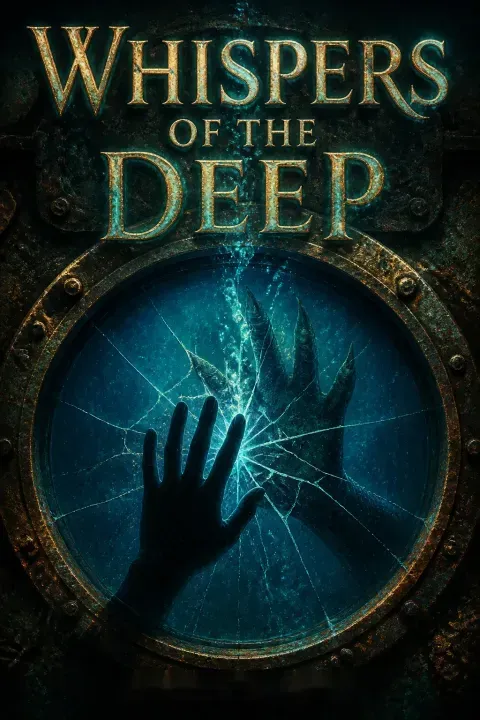


Plot Summary
The Monster at the Glass
Mira1 is welding a slow leak in a long-sealed entertainment dome when a shadow blocks the light. She looks up to find an undine hovering inches from the glass: a black tail with electric blue fins, a muscled gray torso, and eyes like polished obsidian. He has been watching her work.
When her gaze unconsciously flicks toward a hairline crack in the glass, his expression shifts from cold curiosity to searing hatred. They both lunge at the same moment. Mira1 scrambles under the blast door as he slams his massive body against the weakened panel.
Water explodes into the room, chasing her heels until the rubberized door seals shut. Through the viewing port, she sees him baring rows of needle-sharp teeth, his claws raking the metal inches from her face, before he vanishes back through the shattered dome.
This first encounter operates as a double awakening. For Mira, the undine transforms from whispered legend into terrifying flesh, yet her engineer's mind immediately catalogs details: the crack, his intelligence, the blood trailing from his tail. For Arges, she represents the achromos who have polluted his sea and killed his father. The crack in the glass becomes the story's governing metaphor: the fragile, failing boundary between two species who have never truly seen each other. Mira's defiant snarl back at him foreshadows her entire approach to the undines: she will not be prey without a fight.
Breathing for Two
Days later, red alert lights flash through Beta's engineering wing. The air supply has been sabotaged. Mira,1 sent to do grunt work after no one believed her undine story, misses the last evacuation elevator. She turns a corner and the same undine's black tail slams her across the floor.
They are trapped together in an airless hallway. His body convulses and water gushes from slits along his ribs: he has expelled the sea from a second set of lungs. Now they both need the dwindling oxygen. Mira1 bolts for a glass wall panel, melting its rivets with her welder as he watches.
When the flame dies from lack of air, he uses his coiled tail to batter the panel until it peels open. Water floods in. She is drowning when he seals his cold lips over hers and exhales borrowed air into her lungs, then carries her through the open sea to a glass elevator.
This sequence inverts the first encounter's violence into necessity-driven cooperation. Arges could kill her, but he doesn't. Mira could leave him to suffocate, but she doesn't. The breath-sharing moment is the story's primal scene: two enemies merging their survival into a single act. His gills flutter at her touch, a mating response he has never experienced before. The water between them transforms from a death sentence into the medium of their connection. Both characters act against their conditioning here, planting the seed for everything that follows.
The Matriarch's Scheme
Arges2 returns to his undine city of Okeanos to find his pod in chaos. His brother Daios,3 blood-red and scarred, attacks him immediately because Mira1's scent clings to his scales. Their podmate Ekhetes is dead from the sabotage mission.
On the great spiral of coral, the ancient Matriarch Mitéra5 interrogates him. Her hair is a bell of transparent jellyfish tendrils, her skin pearlescent. When Arges2 recounts how a human female saved his life to repay a debt, Mitéra5 draws her claws across his neck and scents his blood in the water.
She declares that this achromo who shows no fear is a gift from the sea. Arges2 must return to her, earn her trust, and extract every secret of her species. Only then will the undines have the knowledge to destroy the human cities once and for all.
Mitéra represents institutional memory and ancient hatred transformed into strategy. She doesn't just want Mira dead; she wants Arges to weaponize intimacy itself. The scene establishes the central conflict Arges will face: his duty to his people versus his growing fascination with Mira. His brother Daios's immediate violence foreshadows the threat that will pursue them. Mitéra's manipulation also introduces the tragic irony at the story's core: the very mission meant to destroy the humans will instead create the bridge between species.
The Abduction
Mira1 volunteers for an external repair mission wearing a prototype wetsuit and her own invention: a rebreather that filters oxygen from seawater. She and a lumbering drone set out across the ocean floor to fix the panel Arges2 shattered. From above, hidden among kelp, Arges2 and his podmate Maketes4 watch her move through the water with unexpected grace.
When she reaches the engineering tunnel, Arges2 strikes. He wraps an arm around her waist and swims hard for the cliff's edge. Mira1 slashes at him with a serrated knife. The shock loosens his grip, and a rogue current sweeps her over the drop into absolute darkness.
She tumbles through volcanic ruins, her headlamp shattering, until she wedges herself into a narrow stone crevice. In the pitch black, a soft blue glow appears. Arges2 is searching for her, his bioluminescence lighting the crevices as his gills flutter with concentration.
The abduction is framed from both perspectives, creating dramatic irony: Mira experiences terror and violation while Arges performs a duty, already confused by his own reactions. The knife wound is significant; she draws his blood, proving she is not helpless. His bioluminescence, previously a threat display, becomes a searchlight of concern. The volcanic ruins where she hides are literally ancient, a reminder that this war predates both of them. When he finds her, his expression is not predatory but something closer to relief, though neither of them has words for that yet.
The Gilded Cage
Arges2 carries Mira1 to a hidden cavern lit by golden sea flowers and pale coral. She surfaces to find an abandoned human research station: rusted computers, empty crates, a moldy cot, and a generator that still sputters to life. The computer displays 'Systems Offline'.
She cannot call for help. Arges2 brings her a gutted fish, then a waterlogged antique welder. When she cannot stomach raw meat, he cleans the fish with his claws, his massive body half out of the water. She taps her chest three times and says her name.
He repeats it: Mira,1 which in his language means hope. She learns his name: Arges.2 He begins returning daily with food, fresh water in plant pods, and salvaged scrap from the sea floor. One day he dumps an ancient android,6 still operational, onto the cave floor. It blinks awake and photographs him.
The cave is a liminal space between captivity and sanctuary. Arges's gift-giving behavior, though he doesn't recognize it, mirrors undine courtship rituals: hunting for a mate, bringing treasures. Mira's practicality transforms the prison into a workshop, and naming becomes the first bridge between their languages. The android Byte is a narrative masterstroke: a neutral third party who can observe, record, and eventually translate. The cave's previous human occupants left their bones outside, curled with an undine skeleton, hinting at the story's deeper history of interspecies love.
The Language of Touch
Using Byte6's language-learning capabilities, Mira1 devises a plan to create a translation chip. But first she must get Arges2 to speak enough. She begins teaching him English words by pointing to body parts, drawing him closer each time.
When she points to her lips and says the word, something shifts in his dark eyes. He takes her hand and guides it down his torso to his rib gills, where cold breath feathers over her fingers. At his neck, warm air exhales through frilled membranes that lift toward her touch like petals seeking light.
She cannot resist stroking the delicate velvet of his gills. He arches into her palm, a guttural groan vibrating through the water. His tail lashes, his colors flare electric blue. In that moment of mutual vulnerability, she slaps the translation chip behind his ear, and he convulses in agony.
The gill-touching scene is the story's most charged moment of cross-species discovery. Arges's gills are erogenous zones his people only share with mates, yet Mira touches them with pure curiosity. The text builds a taxonomy of intimacy: breath on her fingers, the velvet texture, the involuntary arching response. When she uses this moment to implant the chip, she commits a betrayal within an act of connection. The pain she causes him echoes the first encounter's violence, but now it carries the weight of violated trust. Their relationship's pattern is set: intimacy always comes with a cost.
Brother's Blood in the Water
Arges2 returns to the cave to find his brother Daios3's scent everywhere. Panicked, he moves Mira1 to a kelp forest where bell-shaped plants create breathable air pockets. Leaving her there with Byte,6 he races home to discover Daios3 has seized control of the pod and launched a full assault on Beta.
Arges2 arrives at the battle too late. Bodies of his people drift past him into the abyss. He finds Daios3 wrestling with a mounted weapon that blasts his arm off at the shoulder. Arges2 drags his screaming brother to safety, then turns to see Daios,3 even in shock, vow to finish what Arges2 started.
Daios3 plunges toward the kelp forest, toward Mira.1 Arges2 pursues, hearts hammering, and arrives just as Daios3 strikes her against the rocks. Arges2 places himself between his brother and his captive, spines raised.
Daios embodies undine trauma made flesh: scarred, single-minded, incapable of seeing humans as anything but enemies. His failed attack demonstrates the suicidal nature of blind hatred; he loses an arm and dozens of lives for nothing. Arges's intervention creates a schism in his identity: he is now positioned against his own blood in defense of an achromo. Maketes's presence, watching and wavering, introduces a third path: curiosity over violence. The battle's carnage also serves as the book's cost accounting, making clear that continued war will destroy both species.
Healing the Wounded Warrior
In the kelp forest's aftermath, Mira1 discovers Arges2 is bleeding from a deep shoulder wound. She retrieves a trauma pod from Byte6's storage and coaxes the wary undine closer. He submits reluctantly, laying his head in her lap with his neck gills pressed against her thighs.
She can feel his breath flutter through the delicate membranes. As she applies the healing salve that seals his wound, she asks him to talk. Her translation chip, now at seventy-two percent after processing the multi-undine argument, lets her understand nearly everything.
He tells her of his father's death at human hands, of growing up taught that achromos are monsters. She tells him she is an orphan, a nobody who knows nothing useful about Beta's defenses. The admission that she is worthless as a hostage hangs between them. He has no reason to keep her alive, yet his hand tightens possessively on her hip.
The healing scene reverses their power dynamic. Arges is physically vulnerable, his head in the lap of a creature he was sent to exploit. Mira's admission that she knows nothing of strategic value should render her disposable, yet it instead frees them. She is no longer a mission objective but simply a person. His tightening grip is involuntary, the body speaking before the mind can censor it. The seventy-two percent comprehension rate is symbolic: they understand enough to hurt each other with truth, but not enough to fully navigate what they're becoming.
Alys Fairweather's Ghost
Byte6 scans Mira1 and delivers a grim prognosis: severe vitamin deficiencies, low blood pressure, the beginning of organ stress. She has been dying slowly in the caves. Arges,2 desperate, asks the sea itself to guide him. The currents carry him to a glass dome suspended in sunlit shallows, overgrown with algae but intact.
Inside he finds a bed with a yellow comforter, a kitchen, and a greenhouse bursting with vegetables. Outside lie two skeletons intertwined: a human woman and a massive male undine, curled together in death. He moves their bones before bringing Mira1 here.
When she surfaces through the moon pool and sees the hand-painted daisies on the walls, the jars of preserved food, the dresses in the wardrobe, she weeps. Byte6 projects memories of the dome's original owner: Alys Fairweather,8 who loved an undine a century ago.
Alys Fairweather's dome transforms the story from a singular romance into a recurring pattern. Mira and Arges are not the first; they are inheritors of a hidden history of interspecies love that both civilizations have suppressed. The two skeletons outside, coiled together even in death, provide a template for what Arges and Mira might become. The dome is also a gift the sea itself provided, answering Arges's prayer with tangible proof that their union is not an aberration but a return. Mira's tears are for Alys, for herself, and for all the lovers history has refused to acknowledge.
The Breathing Bond
Mira1 finally tells Arges2 she can understand him. In the dome's moon pool, he apologizes for everything: the kidnapping, the lies, the mission. She forgives him and kisses him. What begins as soft exploration escalates into their first sexual encounter in open water.
He learns human lovemaking requires gentleness, not the violent coiling of undine mating. The second time, something unprecedented occurs. As Arges2 climaxes, one of the neural tendrils woven through his hair punctures Mira1's neck and seals itself there with a gelatinous substance.
Byte6's scan reveals the astonishing truth: the tendril connects to her trachea, allowing Arges2 to breathe for her. His gills filter oxygen from the water and pump it directly into her lungs. She can now survive underwater without her rebreather, as long as they remain connected. His body has rewritten itself for her.
The breathing tendril is the story's most literal metaphor: love as a physical bridge between incompatible biologies. It represents spontaneous adaptation, the body evolving faster than the mind can rationalize. For Arges, this is proof that the sea itself sanctions their union; his body would not transform for something forbidden. For Mira, it is both liberation and tether: she can finally enter his world fully, but only through constant physical connection to him. The tendril also foreshadows the Ancients' vision of her pregnancy, suggesting their bodies are laying groundwork for reproduction across species lines.
Stranded on the Shore
Daios,3 Maketes,4 and another undine track Mira1 to the dome. They interrupt Arges2 and Mira1 mid-embrace. Arges2 hurls himself into the water and leads his brothers on a chase through a sunken human village, trying to draw them away from her.
Maketes4 hesitates, and Arges2 uses the moment to appeal to his friend's natural curiosity: Mira1 can give him a translation chip, let him understand the achromos as Arges2 now does. But Daios3 crashes through a wall and locks his tail around Arges2 's. They grapple through the ruins until Daios3 uses his greater bulk to launch them both out of the water.
Arges2 skids across sharp stones, his hip fin nearly torn off, his gills lacerated. As a storm rumbles overhead, Daios3 warns that their people will never accept this abomination, then vanishes into the sea. Maketes4 lingers just long enough to promise he will care for Daios.3
The shore functions as a third space between their worlds, one neither fully controls. Arges's injuries are comprehensive and symbolic: torn from the water, he is as vulnerable as Mira would be in the depths. Daios's warning carries the weight of prophecy, echoing the Ancients' vision. Maketes's hesitation and eventual mercy open the possibility that the undine pod is not monolithic in its hatred. Arges, bleeding on the rocks beneath a storm, has now lost everything: his pod's respect, his brother's loyalty, and potentially his life. Only Mira remains.
Bound by His People
Arges2 returns to Okeanos to formally renounce his pod, choosing Mira1 over his people. Before he can speak, Mitéra5's warriors ensnare him with weighted nets. The council has voted: Mira1 must die. When Arges2 is permitted to choose her executioner, he names Maketes,4 hoping for mercy.
Maketes4 goes to the dome but, after Mira1 gives him a translation chip, cannot bring himself to kill her. Instead he drags her through the sea and deposits her at Beta's glass walls. Her rebreather fails just as she pounds on the window. Humans pull her inside, and she is immediately imprisoned.
A man in a pressed uniform from a secret city called Tau interrogates her, burning to know about the undine who stole her. When she refuses to betray Arges,2 he carves her arms and stabs her in the belly, then throws her bleeding body into the ocean as bait.
The parallel captures expose the brutal symmetry of both civilizations. Mitéra's nets and the Tau agent's knife serve the same function: enforcing species purity through violence. Maketes's mercy is the first crack in the undine consensus, driven by the translation chip's gift of understanding. Mira's torture is particularly devastating because her own people inflict it, punishing her for surviving, for loving across the boundary. The Tau agent represents a deeper layer of human cruelty, a hidden city operating outside even Alpha's control, suggesting the rot is more extensive than anyone knew.
The City Falls
Still bound in coral nets, Arges2 receives word from Maketes:4 Mira1 is alive but being tortured. He performs his greatest deception, telling Mitéra5 the achromo's poison has lifted from his mind and he now craves human blood. He proposes a plan to infiltrate Beta through the moon pools, using welders stolen from Alys's dome to melt the seals.
Mitéra5 releases him. Arges2 leads his pod into Beta's depths, instructing them to steal weapons and droids but to spare lives where possible. He himself has only one target. He follows the Tau agent through the city, down into a private escape sub, and out into the deep.
Arges2 rips the submarine's glass shield away, watches the man drown for a few seconds, then tears his arms from his body. As sharks converge on the remains, Arges2 turns back. Melete,7 a scarred female warrior, is already breathing for Mira1 through a borrowed tendril connection, racing toward the dome.
Arges's deception of Mitéra completes his transformation from loyal son to divided soul. He weaponizes the very hatred that once defined him, using it to save the woman his people want dead. The attack on Beta is a moral tightrope: Arges must appear ruthless enough to satisfy his warriors while minimizing casualties. His murder of the Tau agent is brutal and swift, a personal vengeance that echoes his father's death. Melete breathing for Mira through a borrowed tendril is crucial: it proves the biological adaptation is a species capability, not just Arges's unique gift.
Choosing the Future
Mira1 wakes in Alys's dome after weeks of recovery. Melete7 and other undines have tended her, bringing food and cautiously asking for translation chips. But Arges2 has not come. She fears he regrets everything, that she was just a mission after all.
When he finally surfaces through the moon pool, she punches his chest and rips out the breathing tendril. He reconnects it and tells her he has spent weeks securing their safety: convincing his pod to accept her, restructuring their leadership, ensuring no more assassination attempts.
They make love again, this time with Mira1 fully aware of her own power in their dynamic. Afterward, floating in sunlit shallows with his tail coiled beneath her, she outlines a plan. Beta is crippled but Alpha, the political heart of human civilization, remains. If they can win over someone powerful there, they might broker peace.
The reunion scene addresses the emotional toll of uncertainty. Mira's anger is grief wearing a different face: she assumed the worst because her entire life has taught her she is disposable. Arges's absence was an act of love, but one that replicated her deepest wound. The sex that follows is different from their previous encounters: she is an active architect of her pleasure, not a passive recipient of his discoveries. Floating in the shallows between sea and sky, between his world and hers, they sketch a future that neither the Ancients nor Mitéra predicted: not isolated lovers in hiding, but bridge-builders between civilizations.
Epilogue
Mira1 stands beside Arges2 in the sunken human village, surrounded by undine warriors. Maketes4 grins at her. Daios3 glowers, his missing arm a permanent reminder of his failed assault on Beta. In Mira1's palm rests one more translation chip, this one intended for Daios.3
She tells him if he bites her, Arges2 will kill him. He inclines his head, and she attaches the chip. When he can understand her words, she lays out her proposal. Alpha is the key. Its General controls everything, and his daughter is obsessed with sea creatures.
Mira1 draws the plan in the sand: kidnap the daughter, not to harm her but to open her eyes, just as Mira1's own were opened. The undines murmur. It is audacious and dangerous. Daios3 stares at the tiny shell Mira1 placed in his hand, representing the girl he must capture. His dark fingers close around it as he vows the daughter will be his.
The epilogue transforms the romance's resolution into the launchpad for a larger conflict. Mira has fully transitioned from captive to strategist, using her insider knowledge of human society to give the undines a nonviolent path forward. Daios's acceptance of the translation chip and the mission is the book's final argument: even the most entrenched hatred can yield to curiosity. The shell in his hand echoes Arges's courtship gifts to Mira, suggesting that the daughter may become for Daios what Mira became for Arges: a bridge across an impossible divide. The epilogue closes a circle while opening a door, promising that the love story was never just about two individuals but about what their union makes possible.
Analysis
Whispers of the Deep is fundamentally about the violence of categories. Both human and undine societies have organized themselves around a single defining opposition: us and them, achromo and Person of Water, civilized and monstrous. Every institution in the book serves to maintain this boundary. Mitéra5's council, the Tau agent's secret city, the weapons mounted on Beta's walls, the nets that bind Arges:2 all are technologies of separation masquerading as defense. The love story is not just romance but epistemology: Mira1 and Arges2 must learn to see each other as individuals before they can see each other's species as anything other than enemy. The translation chips literalize this process, turning incomprehensible whale-song into language, song into argument, alien into intimate. But the book is careful not to present love as a simple solution to structural violence. Arges2's pod does not suddenly embrace humans because their leader fell for one. Beta does not open its doors. The epilogue's plan to kidnap the General's daughter is a recognition that peace, like war, must be strategized. The breathing tendril, the story's most fantastical element, makes a profound argument: love across difference is not about tolerating the other's strangeness but about being physically remade by it. Arges2's body changes to sustain Mira1's life. He cannot hold her without also sharing his breath. This is the book's vision of what genuine coexistence requires: not tolerance but transformation, a willingness to be altered by the encounter.
Review Summary
People Also Read






Characters
Mira
Engineer and inventor, human captiveAn orphaned engineer from Beta, the industrial hub of the underwater human cities. Mira was raised in the engineering dorms after her parents died in a workplace accident, leaving her their tools and a fierce self-reliance. She invented a rebreather that extracts oxygen from seawater, a device born of curiosity rather than ambition. Sharp-tongued, fearless in the face of danger, and constitutionally incapable of backing down from a fight, she has spent her life being undervalued by superiors who dismiss her as reckless. Her loneliness is the quiet engine of her character; she has never had a friend who would notice if she disappeared. This makes her unexpectedly receptive to connection across species lines. Her arc moves from defensive hostility to radical trust, from seeing the undines as monsters to recognizing them as people with a legitimate grievance against humanity.
Arges
Undine warrior and pod leaderA black-tailed undine with electric blue bioluminescence and a body built for predation. Arges leads his pod through tactical brilliance rather than brute force, a trait that sets him apart from his larger, more violent brother Daios3. His father was murdered by humans when Arges was a child, an event that shaped his worldview into one of uncomplicated hatred. He has two hearts, gills along his ribs and neck, neural tendrils woven through his hair, and a body capable of spontaneous biological adaptation. When Mira1 touches his gills, they flutter, a mating response he has never experienced. His internal conflict is the story's engine: he was sent to exploit Mira1 but finds himself protecting her, then desiring her, then biologically remaking himself for her. His arc traces the painful dissolution of tribal loyalty in favor of individual love.
Daios
Arges's vengeful brotherArges2's blood brother, marked by dark red scales and a body covered in battle scars. Larger and more aggressive than Arges2, Daios speaks a language of pure violence. He resents Arges2's leadership and believes the pod should attack the humans without restraint. During a catastrophic assault on Beta, he loses his arm to a human weapon. This loss hardens his hatred into something almost religious; he becomes a zealot of species purity. His tracking of Mira1 and attacks on her represent the undine orthodoxy that Arges2 must overcome. Yet in the epilogue, when Mira1 places a translation chip behind his ear, something shifts. He accepts the mission to capture the General's daughter, suggesting that even his entrenched hatred may be vulnerable to the same transformation his brother2 underwent.
Maketes
Yellow-finned undine, curious friendA warrior with bright yellow fins and a temperament ill-suited to killing. Maketes is the podmate who finds joy in the ocean's beauty rather than in battle. When sent to execute Mira1, he cannot do it. She gives him a translation chip, and the ability to understand human speech fractures his certainties. He begins secretly observing human cities, learning their languages and customs. His curiosity makes him the first undine to truly see the achromos as people. He becomes Arges2's ally in deception, lying to Mitéra5 about Mira1's death and helping to orchestrate Arges2's release from the nets. In the epilogue, he grins at Mira1 like an old friend, representing the possibility of genuine interspecies friendship.
Mitéra
Undine Matriarch and oracleThe ancient leader of Arges2's people, transformed by giving herself to the coral. Her hair has become a bell of transparent jellyfish tendrils, her skin pearlescent and iridescent, her eyes colorless and all-seeing. She communes with the Ancients, massive deep-sea creatures who grant visions of possible futures. Mitéra is a pragmatist wrapped in mysticism: she sends undines to their deaths to teach painful lessons, orders Arges2 to seduce Mira1 for information, and ultimately binds him in nets when he chooses love over duty. She is not evil but institutional, the living embodiment of undine tradition. Her manipulation of Arges2 comes from genuine belief that humans must be destroyed for her people to survive.
Byte
Ancient android, language decoderDesignation Beta Iota Epsilon 427, a mapping droid trapped under a rock on the ocean floor for over a century. Byte was built to chart the seabed but its secondary function is knowledge gathering and database preservation. It speaks thirty-seven human dialects and can learn new languages through observation. Mira1 names it and becomes its first friend in a hundred years. Byte can manufacture translation chips and carries a trauma pod for medical emergencies. Its memories of Alys Fairweather8, the human woman who loved an undine a century before Mira1, provide the story's crucial revelation that interspecies love has happened before. Byte is crotchety, protective, and carries the emotional weight of having watched its original human companion grow old and die.
Melete
Scarred female undine warriorA female undine with short-cropped hair and dark purple markings, covered in battle scars. When Mira1 is dying from the Tau agent's knife wound, Melete allows Arges2 to connect one of her neural tendrils to Mira1's neck so she can breathe for the human during the swim to the dome. She stays connected for days, sustaining Mira1's life through her own respiration. Her willingness to save an achromo represents the undine capacity for compassion that Mitéra5's doctrine suppresses.
Alys Fairweather
Historical human who loved an undineThe daughter of Professor Norbert Fairweather, the architect who designed Alpha. Alys opposed her father's destruction of ocean ecosystems to build the underwater cities. She disappeared a century ago in her submarine, which returned empty with claw marks on the hull. In truth, she lived in the glass dome with a green-finned undine who loved her until she died of old age. Her skeleton was found curled with his outside the dome. Her diaries, dresses, and preserved garden provide Mira1 with everything she needs to survive.
Plot Devices
Translation Chips
Enable interspecies communicationSmall neural implants manufactured by Byte6 that attach behind the ear. When activated, they cause a flash of intense pain before syncing with the brain's language centers. Byte6 creates them after observing and learning a new language; the first chip for Arges2 required weeks of recorded undine speech to reach viability. Mira1's chip, built at seventy-two percent language comprehension, leaves gaps in her understanding but enables conversation. The chips transform the story from a mute captivity narrative into a genuine dialogue between species. They also represent a dangerous technology: in the wrong hands, they could enable undines to spy on human cities or humans to interrogate undines. Mira1 guards their distribution carefully, refusing to give Arges2 chips for his people until she trusts individual undines.
Mira's Rebreather
Allows Mira to breathe underwaterA prototype device of Mira1's own invention, attached to the back of her neck with twin tubes that filter oxygen from seawater. It is experimental, clunky, and prone to slow degradation over weeks of continuous use. The rebreather enables Mira1's external repair missions and her survival after being kidnapped. Its eventual malfunction near Beta's walls nearly drowns her, forcing the crisis that returns her to human custody. The device represents Mira1's engineering genius and the human reliance on technology to survive in an environment that was never meant for them, contrasting with the undines' biological adaptation to the sea.
Neural Breathing Tendril
Biological connection for underwater breathingA tendril from Arges2's hair that spontaneously pierces Mira1's neck during their second sexual encounter. It secretes a gelatinous sealant and connects directly to her trachea, allowing Arges2's gills to filter oxygen from the water and pump it into her lungs. The connection requires Arges2 to breathe faster to supply both of them, and it limits how far apart they can be while underwater. The tendril can be detached and reattached, though doing so leaves a small dark mark on Mira1's neck. Other undines can also form this connection, as Melete7 proves when she breathes for Mira1 during the rescue. The tendril is the story's central metaphor for love as biological transformation.
Alys Fairweather's Dome
Sanctuary and proof of interspecies loveA glass dome suspended in sunlit shallows, originally built by Professor Fairweather for his daughter Alys Fairweather8 after she 'disappeared.' It contains a moon pool entrance, a small kitchen, a bed with preserved linens, a greenhouse of vegetables and fruits, and a wardrobe of handmade dresses. Solar panels provide power. Outside the dome, two skeletons were found intertwined: Alys Fairweather8 and her undine mate, who died together. The dome provides Mira1 with nutrition, sunlight, and safety, reversing her physical decline. It also serves as proof that she and Arges2 are not anomalous; interspecies love has occurred before and can be sustained across a human lifetime. Arges2 found the dome by asking the sea for guidance, adding a spiritual dimension to its discovery.
Deep Waters Series
About the Author




Download PDF
Download EPUB
.epub digital book format is ideal for reading ebooks on phones, tablets, and e-readers.








































