
Key Takeaways
1. The "Affirmative Action for Whites" Era Systematically Favored White Americans
Public policy, including affirmative action, has insufficiently taken this troubling legacy into account.
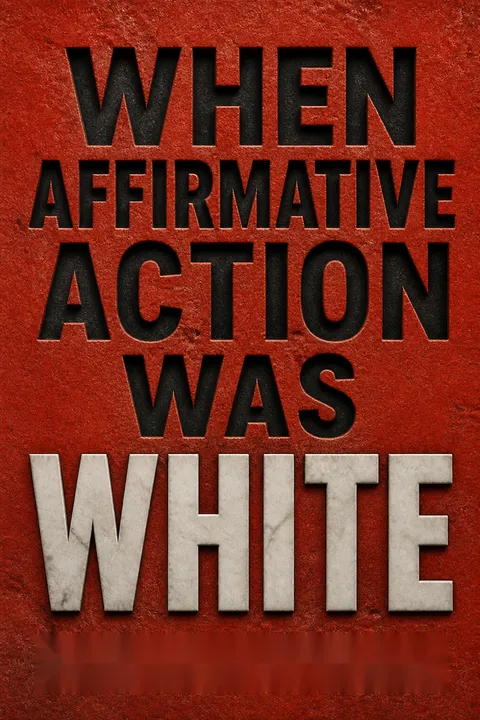
A hidden history. The period of the New Deal and Fair Deal (1930s-1940s) saw the federal government implement groundbreaking social and economic policies that, while often appearing race-neutral, were designed and administered in ways that overwhelmingly benefited white Americans. This era effectively constituted a massive, unacknowledged program of "affirmative action for whites," laying the foundation for the modern white middle class. The author argues that this untold history is crucial for understanding the roots of contemporary racial inequality.
Transformative impact. These policies were not marginal; they were central to reshaping American society. Programs like Social Security, labor legislation, and the GI Bill dramatically improved the lives of millions, providing unprecedented access to:
- Old age pensions and unemployment insurance
- Minimum wages and regulated work hours
- Union membership and collective bargaining rights
- Higher education and vocational training
- Subsidized homeownership and business loans
Unequal distribution. However, the benefits of these transformative programs were not distributed equally. The vast majority of African Americans were either explicitly excluded or faced severe discriminatory barriers in accessing these opportunities, leading to a profound and lasting racial disparity in wealth, education, and social mobility. This systemic bias, embedded in federal policy, created a critical lag in black assimilation into the rapidly expanding post-war middle class.
2. Southern Congressional Power Embedded Racial Bias in New Deal Legislation
Because no bills could be legislated into law without the assent of the members of Congress from that region... public policy had to be tailored to meet their preferences, most notably their desire to protect Jim Crow.
A pivotal alliance. The Democratic Party during the New Deal and Fair Deal was a coalition of "strange bedfellows," uniting Northern liberals with powerful Southern segregationists. Southern Democrats, representing a one-party authoritarian system that disenfranchised blacks, held disproportionate power in Congress due to seniority and the filibuster. This allowed them to dictate the terms of federal legislation.
Legislative veto. Southern members used their strategic positions, particularly on key committees, to ensure that federal policies would not challenge the racial hierarchy of the South. They maintained a "legislative veto," forcing compromises that protected "the southern way of life" and its low-wage economy. This meant that even progressive national programs were shaped to reinforce, rather than dismantle, Jim Crow.
Mechanisms of exclusion. Southern representatives employed three main strategies to embed racial bias:
- Occupational exclusions: Deliberately excluding categories of work where blacks were heavily overrepresented (e.g., farmworkers, domestics).
- Decentralized administration: Insisting that federal programs be administered by local, often racist, officials.
- Absence of anti-discrimination clauses: Preventing the inclusion of anti-discrimination provisions in social welfare programs that distributed funds to the South.
3. Social Security and Welfare Programs Deliberately Excluded Black-Dominated Occupations
Social Security, as passed and signed by President Roosevelt in August 1935, produced a stark outcome.
Exclusion by design. The Social Security Act of 1935, a landmark piece of legislation, was fundamentally shaped by Southern demands. Despite recommendations for universal coverage, farmworkers and domestic servants—occupations that constituted over 60% of the black labor force in the 1930s—were explicitly excluded from old-age and unemployment insurance provisions. This "discrimination by design" ensured that the program would not undermine the South's racialized, low-wage economy.
Local control of assistance. For the social assistance components of the Act, such as Aid to Dependent Children (ADC) and old-age assistance for the indigent poor, Southern members successfully insisted on decentralized administration. This granted state and local officials, almost exclusively white, wide discretion in setting eligibility and benefit levels. The result was:
- Lower relief rates for blacks compared to whites, despite greater need.
- Reduced participation of black children in ADC programs in Southern states.
- Lower monthly benefits for black elderly compared to whites.
A policy apartheid. For the first quarter-century of its existence, Social Security operated as a form of "policy apartheid," leaving the majority of African Americans without its crucial protections. While some blacks did receive limited benefits, the systemic exclusions and discriminatory administration meant that this foundational welfare program disproportionately boosted white economic security, further widening the racial gap.
4. Labor Laws Were Crafted to Undermine Black Workers and Unionization in the South
With the passage of the Fair Labor Standards Act, all the New Deal legislation concerned with work included occupational provisions that converged with, and sustained, intense southern preferences, thus making possible their acquiescence to statutes and rules that advanced the cause of labor; that is, primarily white labor.
Exclusions in foundational laws. The National Labor Relations Act (NLRA) of 1935, which empowered unions, and the Fair Labor Standards Act (FLSA) of 1938, which established minimum wages and maximum hours, both contained explicit exclusions for agricultural and domestic workers. These exclusions, driven by Southern congressional power, ensured that the majority of black workers, concentrated in these sectors, would not benefit from these transformative labor protections.
Southern shift against labor. During and after World War II, as unions began to make inroads in the South and organize black workers, Southern Democrats dramatically shifted their stance. Fearing that unionization would disrupt the region's racial order and lead to wage leveling across racial lines, they allied with Republicans to weaken labor laws. This marked a "tidal shift" where labor issues became inextricably linked to race for Southern legislators.
Devastating impact on unions and black workers. This new political alignment led to the passage of the Taft-Hartley Act in 1947, which severely curtailed union power, and the Portal to Portal Act, which weakened FLSA enforcement. These changes:
- Made union organizing much more difficult, especially in the South.
- Diminished the ability of organized labor to protect workers' rights.
- Ensured that the national government would not intervene to level wages or challenge discriminatory labor practices in the South.
5. World War II Military Policies Enforced Segregation, Limiting Black Advancement
The Roosevelt administration and its military leaders navigated between black aspirations... and white resistance... Seeking to forge an effective fighting force, maintain order, and build support in the public and in Congress for its policies, the administration combined mass black participation in the armed services and access to formerly restricted officer positions and leadership roles with an unyielding commitment to racial segregation.
A "Double V" campaign. African Americans entered World War II with a "Double V" campaign, seeking victory against fascism abroad and racial equality at home. Despite their aspirations, the U.S. military remained rigidly segregated, reflecting and reinforcing Jim Crow policies. This "separate but unequal" system was a profound contradiction for a nation fighting for democracy.
Systemic discrimination. Official military policy, approved by President Roosevelt, mandated that black troops would be inducted in proportion to their population but assigned exclusively to black units, commanded primarily by white officers. This segregation imposed high costs:
- Limited opportunities for blacks to serve in skilled positions.
- Impeded efficient military organization.
- Lowered black morale and exposed soldiers to local violence and humiliation.
- Used illiteracy as a tactic to keep down the number of black troops.
Limited gains amidst profound barriers. While some black soldiers gained literacy, skills, and exposure to a "modern" world, these opportunities were far less abundant than for whites. Black officers were often excluded from white facilities, and training opportunities were severely restricted. The military's accommodation to Southern racism meant that, despite individual advancements, the overall effect of wartime service was a widening racial disparity in training and occupational advancement compared to whites.
6. The GI Bill, Though Universal in Language, Created a White Middle Class
It was, the document concluded, “as though the GI Bill had been earmarked ‘For White Veterans Only.’”
A revolutionary program. The Servicemen's Readjustment Act of 1944, or the GI Bill, was the most comprehensive set of social benefits ever offered by the federal government. It provided unprecedented opportunities for 16 million returning veterans, including:
- Subsidized mortgages for nearly 5 million new homes.
- Educational grants for 2.25 million in higher education and 5.6 million in vocational training.
- Business loans and job placement assistance.
Designed for local control. Despite its color-blind language, the GI Bill was deliberately crafted under the leadership of Southern Congressman John Rankin to accommodate Jim Crow. Responsibility for implementation was largely devolved to states, localities, and private institutions (banks, colleges), ensuring that white officials and businesses could administer benefits in line with local racial customs.
Systematic denial for black veterans. This decentralized administration led to widespread discrimination against black veterans:
- Education: Most black veterans were funneled into underfunded, overcrowded historically black colleges, or fraudulent private vocational schools, while white veterans accessed expanding, well-resourced institutions.
- Housing: Banks routinely denied federally-guaranteed mortgages to black applicants, often through "redlining" and overt racism, effectively excluding them from the primary means of wealth accumulation.
- Employment: The U.S. Employment Service channeled black veterans into "black jobs," often below their skill level, reinforcing existing racial divisions of labor.
7. Post-War Public Policies Significantly Widened the Racial Economic Gap
If African Americans had been included on fair and equal terms in social welfare provisions, labor unions, work protection, the Army, and benefits for veterans, Lyndon Johnson might have offered a rather different speech in June 1965.
A cumulative disadvantage. The combined impact of discriminatory New Deal and Fair Deal policies created a profound and lasting economic chasm between white and black Americans. While white families gained unprecedented access to wealth-building opportunities, black families were systematically denied, leading to a widening racial gap across various indicators.
The compounding effect of exclusion:
- Wealth: By 1984, the median white household's net worth was $39,135, compared to $3,397 for black households, largely due to disparities in homeownership. This gap continued to grow into the 21st century.
- Income: While black-white wage convergence occurred during WWII, it reversed post-war as discriminatory policies shifted the balance of federal assistance to favor whites.
- Education and Skills: Limited access to quality education and vocational training for blacks, especially through the GI Bill, meant they were ill-equipped for the burgeoning middle-class job market.
A missed opportunity. The post-WWII era, a period of unprecedented national prosperity, could have been a moment to reduce racial inequality. Instead, the "affirmative action for whites" embedded in federal policies acted as a brake, preventing African Americans from participating fully in the country's economic expansion and solidifying their marginalized status.
8. President Johnson's Vision for Comprehensive Affirmative Action Remained Unfulfilled
Johnson’s revolutionary brand of affirmative action, in fact, never happened. His desire to dramatically improve the lot of the least well off African Americans was never achieved.
"To Fulfill These Rights." In his landmark 1965 Howard University speech, President Lyndon Johnson articulated a vision for affirmative action that went beyond legal equality. He called for "equality as a fact and equality as a result," aiming to close the massive economic and social gaps between blacks and whites, and between more and less prosperous blacks. He recognized that "Negro poverty is not white poverty," stemming from "ancient brutality, past injustice, and present prejudice."
A dashed ambition. Johnson's ambitious project for comprehensive, race-conscious social uplift was ultimately derailed. Factors such as the escalation of the Vietnam War, intensifying racial violence in urban centers, and a backlash in white public opinion made such a broad, racially oriented attack on poverty politically impossible. His vision became a "mirage from a bygone time."
A narrower path. Instead, a more limited form of affirmative action emerged, focusing on opening access for blacks to top-tier jobs and higher education. While successful in expanding the black middle class and promoting diversity, this approach did not address the systemic, mass-based disadvantages that Johnson had highlighted. The original, broader goal of rectifying the deep, cumulative harms of past discrimination remained largely unrealized.
9. Affirmative Action's Legitimacy Requires Grounding in Specific Historical Harms
The best case for affirmative action is neither some very general reparation for massive harms nor the lighter and more limited, if desirable, objective of diversity.
Beyond general claims. The author argues that the current debate around affirmative action is often unproductive, with opponents calling for color-blindness and proponents relying on broad claims of reparations for historical racism or the pragmatic benefits of diversity. To gain wider legitimacy and effectiveness, affirmative action needs a more precise and principled foundation.
Corrective justice. Affirmative action should be understood as an act of "corrective justice," intervening to remedy specific, identifiable injustices caused by prior governmental action. This differs from a general allocation of goods or compensation for abstract historical crimes. The harms inflicted by slavery and Jim Crow are too vast to be fully requited, making calls for large cash transfers politically unrealistic and symbolically inadequate.
The burden of proof. Legitimate affirmative action must demonstrate a clear and tight link between its remedies and specific historical harms based on race. Generalized claims about racism are insufficient. This approach places the onus on historical evidence to justify interventions, ensuring that race-conscious policies are narrowly tailored and serve a compelling public purpose.
10. Justice Powell's Principles Offer a Framework for Legitimate Race-Conscious Remedies
Powell’s guidelines can do more than certify the type of affirmative action that was created in the 1960s. As we will see, they also can guide a more extensive program closer to President Johnson’s original intentions.
A principled standard. Justice Lewis Powell's swing opinion in Regents of the University of California v. Bakke (1978) provides a crucial framework. While rejecting quotas, Powell affirmed that race could legitimately be a "plus" factor in admissions, but only under strict conditions. He balanced the desire for a color-blind society with the recognition of persistent racial disadvantage.
Two demanding stipulations. Powell's framework for legitimate affirmative action requires:
- Specific historical harms: A clear and tight link connecting affirmative action's remedies to specific, identifiable historical harms based on race, not just general racism.
- Compelling public purpose: The goal pursued by affirmative action must be a sufficiently valuable social good to justify suspending color-blind rules, and non-racial alternatives should always be preferred if available.
Strict scrutiny. This "strict scrutiny" standard, while high, is not insurmountable. It allows for race-conscious policies when the discrimination being remedied is specific, identifiable, and broadly institutional, rather than merely individual prejudice. This approach provides a constitutional and moral basis for affirmative action that can appeal to a broader political spectrum.
11. Renewing Affirmative Action Means Targeting Systemic Disadvantage Beyond Race
This history has been missing from public debate. Discussions about affirmative action usually begin with the 1960s, when its beneficiaries shifted from white to black. Such historical amnesia has weakened the case for affirmative action.
Beyond the 1960s. The author argues that public debate and policy on affirmative action suffer from historical amnesia, largely ignoring the "affirmative action for whites" era. By tracing the "baneful influence" of discriminatory New Deal and Fair Deal policies, a more compelling case can be made for a renewed, broader affirmative action.
Targeting the legacies of white affirmative action. A renewed affirmative action program should focus on rectifying the specific, cumulative harms inflicted by federal policies that systematically disadvantaged blacks. This could involve:
- Compensatory grants: One-time grants into retirement funds for those excluded from early Social Security, or their heirs.
- Tax credits: Equivalence of average losses for lack of minimum wage access.
- Subsidized opportunities: Programs for mortgages, small business loans, and educational grants for those denied GI Bill benefits.
A broader, yet targeted approach. Alternatively, a less administratively burdensome approach could target poor Americans facing conditions produced by these historical patterns, using instruments like expanded Earned Income Tax Credits, guaranteed childcare, and basic health insurance. The goal is to move beyond race-exclusive remedies where the original harm was not race-exclusive, while still primarily addressing racial injustice. This approach aims to transcend racism and its legacies, ultimately moving towards a truly color-blind society.
People Also Read






Download PDF
Download EPUB
.epub digital book format is ideal for reading ebooks on phones, tablets, and e-readers.








































