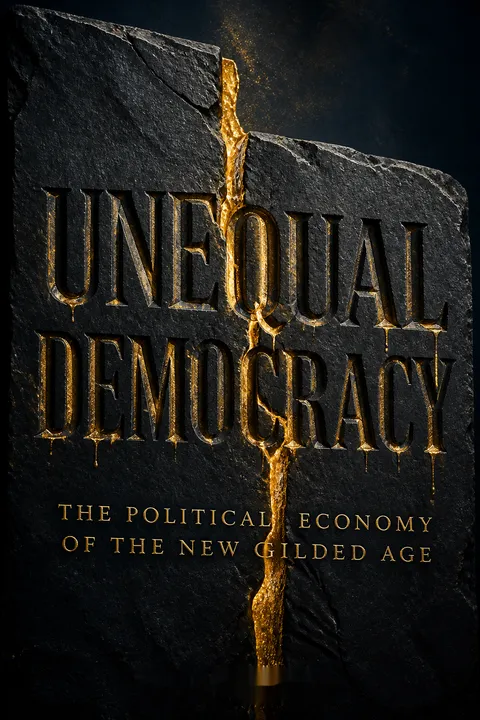

Key Takeaways
1. America's New Gilded Age: A Stark Rise in Inequality
The share of total income going to people at the level of Dahl’s “economic notables”—the top 0.1% of income-earners—has more than tripled, from 3.2% in the late 1950s to 10.9% in 2005.
Dramatic divergence. The United States has experienced a profound escalation in economic inequality since the mid-1970s, reaching levels comparable to the "Roaring Twenties" before the Great Depression. This "New Gilded Age" is characterized by vastly richer affluent families and stagnating incomes for the middle and working poor. For instance:
- The top 1% of income-earners saw their share of total income more than double from 10.2% to 21.8% over the same period.
- From 1980 to 2005, over four-fifths of the total increase in Americans' real pre-tax income went to the top 1% of taxpayers.
Stagnant growth for many. While the post-World War II era initially saw rapid and egalitarian income growth across all segments, the last three decades tell a different story. Income growth for less affluent families has slowed to a crawl, with much of it attributable to increased working hours, particularly from women entering the workforce. This contrasts sharply with the robust, broad-based growth of earlier decades.
Beyond economic inevitability. Many attribute this escalating inequality to impersonal "market forces" like technological change and globalization, suggesting it's an inevitable economic reality. However, the author argues that politics and public policy play a significant role in either reinforcing or mitigating these pressures. The stark differences in inequality levels compared to other rich democracies, and historical shifts within the U.S., underscore that political choices are crucial.
2. Partisan Politics Drives Economic Outcomes
My projections based on the historical performance of Democratic and Republican presidents suggest that income inequality would actually have declined slightly over the past 50 years—completely erasing the substantial increase in inequality documented in chapter 1—had the patterns of income growth characteristic of Democratic administrations been in effect throughout that period.
Profound partisan impact. The economic fortunes of American families have been dramatically shaped by which party occupies the White House. Over the past half-century, Democratic and Republican presidents have presided over strikingly different patterns of income growth, particularly for the middle and lower classes. This is not a mere coincidence but a reflection of fundamental differences in policy priorities.
Democrats vs. Republicans. Under Democratic administrations, middle-class families' real incomes grew twice as fast, and working poor families' incomes grew six times faster, compared to Republican administrations. Democrats tend to prioritize:
- Lower unemployment rates
- Higher overall economic growth
- Policies like the Earned Income Tax Credit (EITC) and minimum wage increases (when not blocked).
Republicans, conversely, often prioritize: - Containing inflation
- Tax cuts favoring corporations and high-income individuals.
Cumulative effects are enormous. The cumulative effect of these partisan differences is staggering. If Democratic patterns of income growth had been consistently applied, income inequality would have slightly declined over the past 50 years, reversing the observed trend. Conversely, continuous Republican control would have led to an even greater divergence between rich and poor, creating a "Platinum-Gilded Age." This highlights that economic inequality is, in substantial part, a political phenomenon.
3. Voters' Myopia and Biases Fuel Republican Success
As Ostrogorski surmised more than a century ago, the American voter “sees only present advantages.”
The puzzle of Republican success. Despite Democratic presidents historically overseeing greater income growth for most Americans, Republican candidates have won a majority of presidential elections in the post-war era. This anomaly is explained by three significant biases in how voters hold incumbents accountable, each favoring Republicans. These biases collectively account for a 9.5 percentage point average Republican vote margin.
Three key biases:
- Myopic Voters: Voters disproportionately reward or punish incumbents based on economic performance only in the election year, largely ignoring the rest of the administration's term. Republicans have been remarkably successful at concentrating income growth in election years, while Democratic growth often peaks earlier. This bias alone adds 3.5 percentage points to the average Republican vote.
- Class Bias in Economic Voting: Voters, regardless of their own income level, are more sensitive to income growth among affluent families (top 95th percentile) than among middle- or low-income families. Since Republicans tend to generate more high-income growth in election years, this bias adds another 3.5 percentage points to their average vote.
- Campaign Spending Advantage: Republicans consistently outspend Democrats in presidential campaigns. Campaign spending significantly sways voters, especially affluent ones, adding another 3.5 percentage points to the average Republican vote margin.
Consequences for democracy. These biases mean that electoral accountability is warped. Voters are not the "rational god of vengeance and reward" that democratic theory often assumes. This "false consciousness," rooted in psychological quirks rather than cultural issues, has profoundly shaped American electoral politics and, consequently, the trajectory of economic inequality.
4. "Moral Values" Don't Explain Working-Class Voting Shifts
Contrary to this familiar story, I find that low-income whites have actually become more Democratic in their presidential voting behavior over the past half-century, partially counterbalancing Republican gains among more affluent white voters.
Challenging a popular narrative. The notion that working-class whites have abandoned the Democratic Party due to "moral values" or cultural issues is a pervasive but largely mythical story. Analysis of voting patterns over the past half-century reveals a different trend:
- Low-income white voters have become more loyal to Democratic presidential candidates.
- Republican gains among white voters have been concentrated among the affluent, particularly in the South following the Civil Rights era.
Economic issues remain paramount. For working-class voters, economic concerns continue to outweigh cultural issues like abortion or gay marriage. The idea that "culture outweighs economics as a matter of public concern" is not supported by the evidence. Even among highly religious white voters, economic issues like government spending and jobs are more influential in their voting decisions than cultural issues.
Class politics is alive and well. Far from eroding, the class basis of American politics has strengthened. Income has become a more potent predictor of partisan affiliation and voting behavior, with a growing divergence between low-income (more Democratic) and high-income (more Republican) white voters. This pattern of class polarization is substantial, even when compared to other democracies.
5. Public Opinion on Inequality is Complex and Contradictory
Most of the people who recognized and regretted the fact that economic inequality has been increasing nevertheless supported President Bush’s tax cuts.
Egalitarian sentiments vs. policy preferences. Americans express strong abstract support for egalitarian values, such as equal opportunity, and generally feel more warmly towards "working class people" and "poor people" than "rich people" or "big business." A majority also believes the rich pay too little in taxes. However, these sentiments often fail to translate into consistent policy preferences that would address rising inequality.
Perceptions are often disconnected from reality. While three-fourths of Americans believe income differences between rich and poor are larger than 20 years ago, this perception is often a "cynical folk wisdom" rather than an accurate reflection of actual economic trends. The belief that "the rich get richer and the poor get poorer" became widespread in the 1960s and 70s, a period of decreasing inequality, and remained stable even as inequality dramatically increased later.
Ignorance and ideological bias. Public opinion on inequality is characterized by:
- Ignorance and Inattention: Many citizens are unaware of basic economic facts or haven't thought about the implications of rising inequality.
- Ideological Polarization: Well-informed conservatives are less likely to acknowledge increasing inequality or view it as a problem, while well-informed liberals are more likely to. Political awareness, in this context, often reinforces ideological consistency rather than promoting objective understanding of facts.
Policy latitude for elites. This complexity, confusion, and ideological distortion in public opinion provide significant leeway for political elites to pursue their own policy agendas, even when those agendas seem to contradict broad public sentiments. The disconnect between values and policy preferences is a major obstacle to translating egalitarian ideals into political action.
6. Tax Cuts for the Rich: Public Support Rooted in Misperception
More than three years after the 2001 tax cut took effect, 40% of the public said they had not thought about whether they favored or opposed it, and those who did take a position did so largely on the basis of how they felt about their own tax burden.
A massive upward transfer. The Bush tax cuts of 2001 and 2003, costing trillions, disproportionately benefited the wealthiest Americans through cuts in top rates, dividends, capital gains, and the estate tax. Despite public skepticism that the rich would benefit most, these cuts garnered widespread public support.
Superficial support. Public opinion on these complex tax policies was remarkably tenuous:
- 40% of the public admitted they "haven't thought about" whether they favored or opposed the 2001 tax cut.
- Support was often based on a simple, often misguided, sense of "I pay too much tax," rather than a nuanced understanding of the cuts' distributional impact.
- Views on whether the rich pay too much tax had no apparent impact on support for the cuts, even though the cuts primarily benefited the wealthy.
Ignorance bolsters support. Better-informed citizens, particularly Democrats, were more likely to oppose the tax cuts. However, the sheer number of uninformed citizens, many of whom defaulted to supporting the cuts (especially if associated with President Bush), significantly bolstered overall public approval. This suggests that popular support for these policies was largely grounded in political ignorance.
Elite-driven policy. The success of the Bush administration in implementing such ambitious, regressive tax policies with minimal political backlash demonstrates the considerable latitude political elites have when public opinion is confused or disengaged. This outcome was more a reflection of elite ideological goals and strategic legislative maneuvering than a direct response to clear, informed public demand.
7. The Estate Tax Paradox: Elite Will vs. Public Sentiment
The real political mystery is not why the estate tax was phased out in 2001, but why it survived for more than 80 years—and will likely return when the phaseout expires in 2011.
Widespread public antipathy. The federal estate tax, which only affects the wealthiest 1-2% of taxpayers, is remarkably unpopular among ordinary Americans. Surveys consistently show overwhelming public support for its repeal, regardless of income level or political affiliation. This antipathy is deep-seated, predating modern conservative lobbying efforts.
Misconceptions and values. Public opposition is fueled by:
- Misinformation: Many mistakenly believe the tax affects "most families" or "might affect me someday."
- Core Values: It clashes with deeply held American values about family, work, and the right to pass on earned wealth, often perceived as "tax on top of tax."
- Information's limited impact: Even if citizens were perfectly informed about who pays the tax, a majority would likely still favor repeal.
Elite intransigence. The true "political mystery" is why such an unpopular tax persisted for over 80 years. The answer lies not in public support, but in the ideological commitment of liberal Democratic elites who valued the tax's progressive nature. It was only with unified Republican control in 2001 that the estate tax phaseout was enacted, demonstrating the power of elite ideology over public sentiment.
8. Minimum Wage Erosion: A Failure of Democratic Responsiveness
The real value of the minimum wage has declined by more than 40% since the late 1960s, despite remarkably strong and consistent public support for minimum wage increases.
A stark decline. The real value of the federal minimum wage has plummeted by almost 45% since its peak in 1968, even as average hourly wages for all American workers have significantly increased. This erosion has occurred despite overwhelming and consistent public support for raising the minimum wage, often by margins of four to one, even among Republicans and the wealthy.
Economic consensus ignored. While orthodox economic theory once argued that minimum wage increases cause unemployment, recent research suggests that modest hikes have negligible negative employment effects and significantly reduce wage dispersion and inequality. This evolving economic understanding has largely been ignored by policymakers.
Politics of inaction. The decline is primarily due to:
- Nominal wage setting: The minimum wage is not indexed to inflation, requiring periodic legislative action to maintain its real value.
- Partisan obstruction: Republican presidents and congressional members have consistently opposed increases, using legislative complexities like filibusters and packaging unpopular measures to block or moderate changes.
- Declining union power: The massive decline in labor union membership has significantly weakened a key political ally for minimum wage advocates, contributing to a roughly 40% drop in its real value.
Democratic efforts and limitations. While Democratic administrations have historically overseen increases in the minimum wage, their efforts have often been stymied by Republican opposition. The 2007 increase, a rare success, was a modest step that still left the real value far below its historical peak, highlighting the persistent challenges in translating broad public will into policy for the working poor.
9. Unequal Representation: The Poor Are Politically Invisible
The opinions of millions of ordinary citizens in the bottom third of the income distribution have no discernible impact on the behavior of their elected representatives.
An oligarchical reality. In the American political system, elected officials, particularly U.S. senators, are not equally responsive to all citizens. There is a profound disparity in political representation based on income:
- Affluent constituents (top third of income distribution) receive considerable weight in their senators' policy choices.
- Middle-income constituents receive less weight than the affluent, but still have some influence.
- Low-income constituents (bottom third of income distribution) are effectively ignored, with their preferences having "no discernible impact" on their senators' voting behavior.
Pervasive unresponsiveness. This unequal responsiveness is consistent across a wide range of issues, including:
- General ideological positions (W-NOMINATE scores)
- Specific salient roll call votes on government spending, the minimum wage, and civil rights
- Social issues like abortion.
This pattern suggests that the U.S. political system functions more as an "oligarchy" than a democracy of "political equals."
Beyond participation gaps. This representational inequality cannot be fully explained by differences in political participation (turnout, knowledge, or contacting officials). While affluent citizens are more likely to vote, be informed, and contact officials, these factors only modestly reduce the observed disparities. The disproportionate influence of the wealthy, particularly through campaign contributions, remains a strong, albeit indirect, explanatory factor.
10. The Corrosive Feedback Loop of Unequal Democracy
Economic inequality clearly has pervasive, corrosive effects on political representation and policy making in contemporary America.
A vicious cycle. The pervasive influence of wealth on politics creates a dangerous feedback loop: increasing economic inequality leads to greater political inequality, which in turn produces public policies that further disadvantage the poor, exacerbating economic disparities. This cycle risks making inequality entrenched and immutable, undermining the very foundations of democracy.
Elite ideology vs. public will. Policy choices are often driven more by the ideological convictions of elected officials than by public opinion. Whether it's tax cuts for the rich, the persistence of the estate tax, or the erosion of the minimum wage, elite partisanship frequently overrides broad public sentiment, especially when that sentiment is confused or disengaged. This highlights Schumpeter's view that democracy is about choosing rulers, not direct rule by the people.
Obstacles to change. Several factors impede the translation of egalitarian ideals into policy:
- Public confusion and myopia: Voters' limited attention spans and susceptibility to misinformation.
- Ideological biases: Political awareness can reinforce partisan distortions of economic reality.
- Social isolation: Increasing economic and residential segregation reduces empathy and understanding across class lines.
- Racial divisions: Racial resentments continue to hinder support for redistributive policies.
Politics matters, but the system is biased. While the processes of American democracy offer choices, the system is heavily biased. The hope for a "Progressive Era" or "New Deal" style backlash against concentrated wealth is tempered by the deep-seated structural and psychological barriers to collective action. Confronting inequality requires not just mobilizing the disadvantaged, but also overcoming the pervasive influence of wealth and the inherent biases in political accountability.
Review Summary
Unequal Democracy examines how economic inequality affects American democracy through statistical analysis. Reviewers praise Bartels' data-driven approach showing that income inequality grows under Republican presidents while Democratic administrations benefit all income levels more equally. A key finding is that elected officials ignore the bottom third of income earners' preferences while catering to the wealthy. While some find the conclusions obvious, most appreciate the rigorous methodology. Critics note the book is dense with statistics and graphs, making it challenging for general readers, though the empirical evidence is considered compelling and eye-opening.
People Also Read

Download PDF
Download EPUB
.epub digital book format is ideal for reading ebooks on phones, tablets, and e-readers.








































