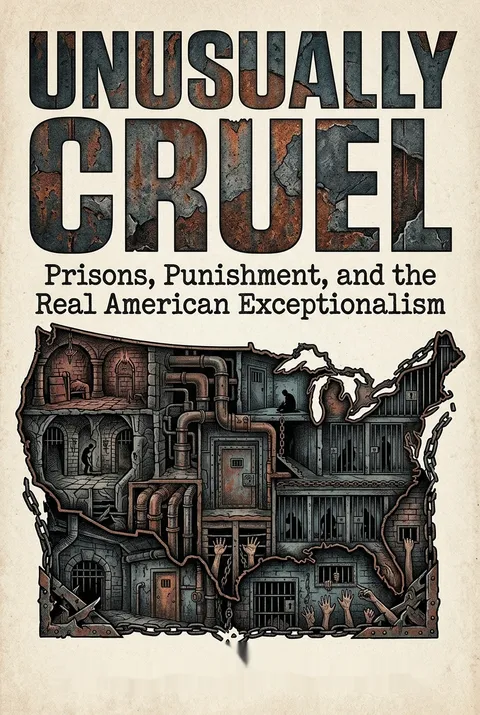

Key Takeaways
1. American punishment is uniquely cruel and exceptional.
On the contrary, the American criminal justice and prison systems have become—borrowing from the language of the Eighth Amendment—'unusually cruel.'
Stark disparity. The United States, home to only 5 percent of the world's population, incarcerates nearly 25 percent of the world's prisoners, a rate 7–10 times higher than other Western democracies. This profound disparity, termed "real American exceptionalism," extends beyond mere incarceration rates to encompass every stage of the criminal justice system. Historically, US incarceration levels were comparable to Europe's until a dramatic divergence began in the mid-1970s.
Historical shift. Alexis de Tocqueville once marveled at the "unusual mildness" of American criminal justice in the 1830s. However, by 1971, while European countries averaged 63.2 prisoners per 100,000 people, the US rate, though slightly higher, was still within a comparable range. By 2015, the US rate had skyrocketed by 468% to nearly 700, whereas the European average saw a modest 44% increase before a slight decline. This rapid and recent shift underscores a fundamental change in America's punitive philosophy.
Comprehensive cruelty. This book systematically analyzes how the US applies harsher, more unforgiving, and often dehumanizing practices across the entire "life cycle" of criminal justice. From plea bargaining and sentencing to prison conditions, rehabilitation, parole, and societal reentry, the US consistently stands apart. This pervasive cruelty, rather than isolated issues, defines its exceptionalism and prompts a critical re-evaluation of its justice system.
2. Plea bargaining in the US is widespread and coercive, unlike in Europe.
It is no exaggeration to say that plea bargaining is the overwhelming norm in American criminal justice, and trials—even if much-heralded in American popular culture—are the exception.
Ubiquitous practice. Approximately 95 percent of criminal cases in the United States are settled through plea bargaining, where defendants plead guilty, often to lesser charges, in exchange for a lighter sentence. This practice, endorsed by the Supreme Court in cases like Santobello v. New York, is theoretically designed to be a mutually agreeable arrangement that saves time and resources for all parties involved.
Coercive reality. In practice, American plea bargaining often deviates significantly from its theoretical ideal, characterized by a vast power imbalance. Prosecutors frequently employ tactics like "overcharging" or threatening severe mandatory minimum sentences, coercing defendants—especially those held in pretrial detention or represented by inadequate counsel—into accepting deals, even if they are innocent. This coercive environment has led to over 300 exonerated individuals having initially pled guilty.
European contrast. European countries, rooted in inquisitorial rather than adversarial legal systems, approach plea bargaining with far greater caution and restriction. In France and Germany, it is a recent and limited innovation, applied rarely and with strict procedural safeguards. German plea bargaining, for instance, does not eliminate the need for a trial and involves active judicial oversight, preventing the high-pressure tactics common in the US. Even the UK, a common law system, features less powerful prosecutors and greater transparency, making US practices uniquely prosecutor-dominated and potentially unjust.
3. US sentencing is drastically harsher, with widespread life and LWOP sentences.
The most dramatic difference is between the United States, which continues to use the death penalty and life sentences without possibility of parole and where prison sentences exceeding ten years are common, and the rest of the Western world, which has renounced the death penalty and where prison sentences longer than a few years are uncommon.
Extreme sentence lengths. American sentencing practices are exceptionally severe, marked by frequent and disproportionately long prison terms. While most European countries typically limit prison sentences to 10–15 years, the US routinely imposes terms far exceeding a decade. For example, burglars in the US serve 3–6 times longer than their counterparts in Canada or England, and drug offenders face mandatory five-year federal sentences for quantities that would result in zero to six months in Britain.
Life and LWOP. The US stands alone in its extensive use of life sentences, with nearly 160,000 Americans serving such terms by 2012, representing a 469% increase since 1984. Crucially, almost 50,000 of these are "life without parole" (LWOP), a sentence virtually non-existent in Europe, where a "life" sentence almost invariably implies the possibility of eventual release. The "felony murder" rule, largely abolished in its country of origin (the UK), further expands murder liability in the US, contributing to these extreme sentences.
Juveniles and capital punishment. The severity extends to juveniles, with over 2,500 American children sentenced to LWOP, a practice categorically prohibited in other countries. Furthermore, the US remains the only Western democracy to retain the death penalty, a policy abolished across Europe by the 1980s. This ultimate punishment, and the high-level "anchor" it provides, contributes to the overall draconian nature of US sentencing, which has shifted from indeterminate, rehabilitative models to rigid, punitive determinate and mandatory schemes since the 1970s.
4. US prison conditions are inhumane, overcrowded, and violent, contrasting with Europe.
Indeed, from this vantage point, American prisons appear to be some of the harshest and scariest places in the democratic world.
Crisis conditions. American prisons are characterized by systemic overcrowding, pervasive violence, and dehumanizing conditions. Many facilities operate at nearly double their design capacity, leading to unsanitary environments, inadequate medical and mental healthcare, and a constant atmosphere of fear among inmates. The Supreme Court, in rulings like Rhodes v. Chapman, has largely deferred to prison officials, setting a low bar for "minimal civilized measure of life's necessities" and making it exceedingly difficult for prisoners to challenge their treatment.
Solitary and abuse. The US leads the world in the use of solitary confinement, holding 80,000–100,000 individuals in isolation, sensory deprivation, and idleness, often for years or decades. This practice, considered torture by the UN, exacerbates mental health problems and antisocial behavior. The omnipresent risk of sexual violence and rape, acknowledged by the Prison Rape Elimination Act (PREA), further highlights the extreme dangers within US facilities, fostering a culture of "hypermasculinity" and constant vigilance.
European humanity. In stark contrast, European prisons, particularly in Scandinavia, prioritize humane treatment and rehabilitation. They offer greater personal space, privacy, and security, with fewer restrictions on movement and no demeaning uniforms. Countries like Germany and France emphasize "dynamic security" through staff-prisoner interaction, provide comprehensive healthcare comparable to outside society, and allow extensive contact with the outside world, including family visits and work release programs. This approach views imprisonment as the punishment itself, without needing added discomfort or degradation.
5. Rehabilitation, abandoned in the US, remains central to European prison systems.
Instead, just as plea bargaining practices and sentencing policies were sending massive numbers of people to increasingly overcrowded prisons, the very purpose of prison shifted overwhelmingly in the direction of punishment, and the principles of rehabilitation and correction became empty slogans of another era.
US abandonment. Until the mid-1970s, rehabilitation was a core mission of American prisons, reflected in terms like "corrections." However, sociologist Robert Martinson's 1974 "What Works?" report, despite his later retraction and critics' refutations, was widely misinterpreted as "nothing works." This provided "scientific" justification for the "tough on crime" movement, leading to the dismantling of educational, vocational, and drug treatment programs, and a shift towards punishment and warehousing.
Punitive model's failure. The abandonment of rehabilitation has not improved public safety in the US. Recidivism rates have actually increased, with over two-thirds of prisoners re-arrested within three years of release. This punitive model, which prioritizes incapacitation and deterrence over human transformation, has proven costly and ineffective, perpetuating a cycle of crime and incarceration. The dehumanizing conditions in US prisons further hinder any potential for self-improvement.
European commitment. European countries, notably France and Germany, maintain a strong commitment to rehabilitation and "resocialization." This is enshrined in law, with Germany's Prison Act stating the sole aim of incarceration is to enable prisoners to lead crime-free lives upon release. Inmates receive individualized "reintegration plans," access to education (including university degrees), job training, and opportunities for work-day releases. This approach, supported by judges and prison officials, aims to prepare inmates for productive societal reentry, emphasizing moral obligation and long-term societal benefit over short-term punitive costs.
6. Discretionary parole has virtually disappeared in the US, but thrives in Europe.
In just a short period, the 'Willie Horton' phenomenon crystallized the changing political climate from one of accepting the reality of early parole to fervent and hostile opposition to it.
US decline. Discretionary parole, once a routine mechanism for early release in the US, has dramatically declined since the 1970s due to several factors:
- Determinate Sentencing: A shift from indeterminate sentences to fixed terms, limiting judicial and parole board discretion.
- Mandatory Minimums & Truth-in-Sentencing: Laws requiring prisoners to serve a large portion (often 85%) of their sentence.
- Abolition of Parole Boards: 16 states eliminated discretionary parole entirely, and federal parole was abolished for post-1987 offenses.
- Increased Set-Offs: Longer periods between parole applications (e.g., California's Marsy's Law extended this from 1–5 years to 3–15 years).
Politicization of parole. The "Willie Horton" ad of 1988 profoundly politicized parole, making elected officials terrified of being blamed for a paroled inmate committing another crime. This fear led governors to routinely reverse parole board recommendations, effectively ensuring that "life" sentences often mean "until death." This political toxicity has paralyzed the system, prioritizing career safety over the freedom and rehabilitation of individuals.
European routine. In contrast, France, Germany, and the UK maintain robust, depoliticized parole and early release systems. Inmates can earn conditional release after serving a portion of their sentence (e.g., two-thirds in Germany, half in the UK), with judges, not politicians, making decisions based on reintegration potential. Compassionate release for illness or old age is also common. This approach provides strong incentives for good behavior and rehabilitation, fostering hope and preparing inmates for a successful return to society, rather than indefinite incarceration.
7. Societal reentry in the US is hindered by lasting "collateral consequences."
In other words, the 'scarlet letter' of formerly incarcerated people almost never goes away.
Citizenship restrictions. In the US, a criminal record imposes severe, lasting "collateral consequences" that hinder societal reentry. Most states disenfranchise felons, with over 6 million Americans unable to vote in 2016, disproportionately affecting African Americans (7% of whom cannot vote). Many states also bar former felons from running for office or serving on juries, effectively creating a permanent underclass. This contrasts sharply with Europe, where voting rights are largely restored upon release, and the concept of "felon disenfranchisement" is anathema.
Employment barriers. Gaining gainful employment is a major challenge for ex-offenders in the US. Licensing laws in every state disqualify individuals with felony convictions from numerous occupations (e.g., law, medicine, education). Employers, with easy access to criminal records, often refuse to hire ex-offenders, even for minor crimes, due to stigma and negligent hiring torts. While "ban the box" campaigns offer some relief, background checks at later stages still lead to discrimination, leaving many without stable income and increasing recidivism risk.
Housing and debt. Housing restrictions further compound reentry difficulties. Federal "one strike" policies render felons ineligible for public housing for at least five years, and even misdemeanors can lead to exclusion. This forces many into precarious living situations or homelessness, as they cannot return to family in public housing without risking eviction for their relatives. Additionally, a "debt collection regime" of fees and fines, often for child support or court costs, can lead to parole violations and re-incarceration, trapping former prisoners in a cycle of poverty and legal entanglement, unlike the supportive welfare states of Europe.
8. Racial discrimination is a foundational driver of US mass incarceration.
Race helps to explain why the United States is exceptional among the democratic industrial societies in the severity and extent of its punitive policy.
Historical roots. Racial discrimination is deeply embedded in American criminal justice, evolving from slavery to "convict leasing" post-emancipation, which re-enslaved African Americans through trumped-up charges and brutal forced labor. This established a lasting tradition of using the penal system for racial subjugation. Michelle Alexander's "The New Jim Crow" argues that mass incarceration is the modern extension of these historical "racial caste systems," using formally race-neutral laws to achieve racially disparate outcomes.
Disparate outcomes. Despite claims of a "colorblind" society, racial disparities in the US criminal justice system are undeniable and overwhelming. African Americans are disproportionately stopped, frisked, arrested, prosecuted, and sentenced, particularly in the "War on Drugs," even though drug use rates are similar across racial groups. For example, African Americans are 3.7 times more likely than whites to be arrested for marijuana possession. Recent events and Department of Justice reports on police departments in Ferguson and Baltimore reveal systemic racial bias and constitutional violations in policing minority communities.
Implicit bias and political exploitation. While overt racism has declined, implicit racial bias remains prevalent, with psychological studies showing a strong unconscious preference for whites among 75% of Americans. This bias, coupled with the historical exploitation of the "Black criminal" stereotype by politicians, fueled the "tough on crime" movement. The "Southern strategy" and "Willie Horton" ad effectively linked crime to race, galvanizing public and political support for punitive measures, making race a distinctively American and crucial factor in the rise of mass incarceration.
9. Religious fundamentalism fuels punitive attitudes in American justice.
The nexus of retributive justice, and the characterization of human beings as sinners in need of atonement, generates a practical outcome in the criminal justice system that stresses incarceration and even death for those who commit crimes.
Evangelical influence. The US is significantly more religious than most other advanced democracies, with approximately 34% of Americans identifying as evangelical or "born-again" Christians. This evangelical movement gained significant political influence from the 1970s onwards, aligning with the Republican Party and focusing on "moral" issues. This rise coincided precisely with the explosion of mass incarceration, suggesting a connection between these two major transformations.
Retributive theology. Empirical research indicates that individuals with "fundamentalist religious beliefs" tend to hold more retributivist views on crime and punishment. This perspective often attributes crime to "weak or sinful character" rather than situational factors, leading to strong support for harsh penalties, including incarceration and the death penalty. While some evangelicals also hold "compassionate" views, particularly on capital punishment, the dominant political expression of this religious bloc has favored punitive measures.
Political impact. The synchronous rise of evangelical political power and mass incarceration suggests that this religious element played a significant role in shaping America's punitive turn. County-level data in Pennsylvania, for instance, shows that greater Christian homogeneity correlates with higher incarceration rates, influenced by local political processes in electing judges and prosecutors. This distinctively American religious fervor, with its emphasis on moral accountability and retribution, contributed to the cultural and political climate that embraced "tough on crime" policies.
10. Politicization of justice drives "tough on crime" policies and judicial elections.
Simply put, the U.S. is the only country in the world that elects its lead prosecutors (which occurs in 47 of the 50 U.S. states), and it is one of the few that primarily elects its judges (which occurs in 39 states).
Political strategy. The politicization of crime and punishment is a distinctively American phenomenon that intensified from the 1970s. Richard Nixon's "Southern strategy" explicitly linked crime to racial anxieties, a tactic continued by Republicans and later adopted by Democrats, notably Bill Clinton, to avoid being labeled "soft on crime." This bipartisan consensus led to the passage of increasingly punitive legislation, such as the 1994 Violent Crime Control Act, which dramatically increased incarceration rates.
Elected prosecutors and judges. Unlike Europe, where prosecutors and judges are nonpartisan civil servants, in the US, most are elected officials. This electoral dynamic creates strong incentives for them to appear "tough on crime" to secure votes and campaign funding. Prosecutors, like Oklahoma's Bob Macy, campaign on conviction rates and death row sentences. Judges facing re-election impose significantly longer sentences, and in capital cases, some judges have overridden jury recommendations for life to impose death, influenced by electoral pressures.
Money and influence. Judicial elections are increasingly influenced by large campaign contributions and outside spending, further "contaminating" the judicial process. This system, while ostensibly democratic, often prioritizes political survival over fairness and impartiality. European judicial systems, based on meritocratic appointments and extensive training, are insulated from such populist pressures, allowing for more restrained and consistent application of justice. The American political structure, therefore, directly fuels its exceptional punitiveness.
11. The "prison industrial complex" profits from and perpetuates mass incarceration.
The prison-industrial complex is not a conspiracy, guiding the nation’s criminal-justice policy behind closed doors. It is a confluence of special interests that has given prison construction in the United States a seemingly unstoppable momentum.
Profit motive. The "prison industrial complex" (PIC) represents a vast web of economic interests that profit from mass incarceration, a phenomenon largely absent in Europe. This includes private prison corporations like CoreCivic and GEO Group, which aggressively lobby for harsher sentencing laws and policies that ensure high occupancy rates. Their annual reports explicitly state that reduced enforcement or leniency in sentencing could "adversely affect" demand for their services, revealing a direct financial stake in continued incarceration.
Lobbying and exploitation. Private prison companies invest millions in campaign contributions and lobbying efforts to influence criminal justice policy, pushing for more people in prison and more money in their pockets. Beyond private prisons, numerous businesses profit from inmates as a captive market, selling goods and services at inflated prices. This includes phone companies with exclusive contracts charging exorbitant rates to prisoners' families, and health care providers offering "cost-effective" (often substandard) care.
Vested interests. Correctional officer unions, like California's CCPOA, also form powerful vested interests, lobbying against reforms and for more prison construction to protect jobs. Rural communities, often economically dependent on prisons, further support punitive policies. This system, built on the premise of "efficiency," ironically relies on and perpetuates high incarceration and recidivism rates, transforming prisoners into commodities for profit. This distinctively American business model stands in stark contrast to European state-controlled systems focused on rehabilitation.
12. Despite challenges, a fragile opportunity for US criminal justice reform exists.
For the first time in nearly half a century, there are significant reasons for optimism about the possibility of significant change that could lead to a relative reduction in mass incarceration and this unusually cruel form of American exceptionalism.
Emerging optimism. After decades of relentless growth, US incarceration rates have seen slight declines since 2009, signaling a potential turnaround. A surprising bipartisan alliance has emerged, uniting liberals (NAACP, ACLU) with conservatives ("Right on Crime," evangelicals, Koch brothers) in support of criminal justice reform. Leaders like Newt Gingrich and Grover Norquist, once proponents of "tough on crime," now advocate for reducing prison populations due to astronomical costs and lost human potential, creating a safe political space for dialogue.
State and federal momentum. States like California and Texas have demonstrated that reducing prison populations (e.g., California's 17% reduction post-Plata ruling) does not increase crime. Many states are passing reforms, from bail reform in New Jersey to mental health crisis centers in Idaho, and some have legalized marijuana or reclassified drug offenses. Federally, the Obama administration banned juvenile solitary confinement, phased out private federal prisons, and granted clemency to numerous drug offenders, while the FCC capped prison phone rates.
Fragile progress. Despite this momentum, challenges remain. Reductions in incarceration are marginal, and reform efforts often focus on "nonviolent offenders," neglecting the majority convicted of violent crimes. The bipartisan consensus is fragile, threatened by a resurgence of "law and order" rhetoric, as seen in the 2016 election. Public opinion, though shifting, can be easily manipulated by fear. Lasting reform requires addressing the deep-rooted issues of race, religion, politics, and business, drawing lessons from European models that prioritize humane treatment, rehabilitation, and genuine societal reentry.
People Also Read





Download PDF
Download EPUB
.epub digital book format is ideal for reading ebooks on phones, tablets, and e-readers.








































