
Key Takeaways
1. Two Lives, One Name: A Chilling Coincidence
The chilling truth is that his story could have been mine. The tragedy is that my story could have been his.
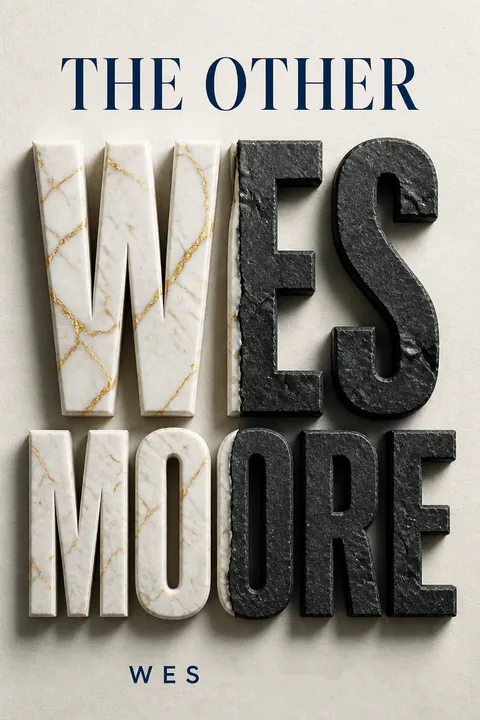
Parallel lives. The author, Wes Moore, discovered another man with his exact name, born in the same city around the same time, whose life took a drastically different turn. While the author became a Rhodes Scholar, the other Wes Moore was sentenced to life in prison for armed robbery and murder. This eerie coincidence sparked the author's quest to understand the forces that shaped their divergent destinies.
Unsettling proximity. The superficial similarities between the two Wes Moores—growing up on the same streets, sharing a name—highlighted how little can separate lives that end up in vastly different places. The author felt an inexplicable connection, a sense that the other Wes "carried part of me with him" in his prison cell, prompting him to initiate a correspondence that would last for years and form the basis of this book.
Illuminating choices. Their intertwined narratives serve as a powerful lens to examine the critical "inflection points" in every life—the sudden moments of decision where paths diverge and fates are sealed. The author sought to understand not just their individual stories, but how their experiences illuminated the larger story of a generation of young men navigating chaotic and violent times, succeeding and failing in unprecedented ways.
2. The Profound Impact of Parental Presence and Absence
Your father wasn’t there because he couldn’t be, my father wasn’t there because he chose not to be.
Differing absences. Both Wes Moores grew up without their biological fathers, but the circumstances and impact of this absence varied significantly. The author's father died when he was three, leaving a void filled by a loving, protective mother and supportive grandparents. The other Wes's father was an alcoholic who chose not to be involved, leaving a different kind of emotional scar and a lack of a consistent male role model.
Maternal strength. The author's mother, Joy, a Jamaican immigrant, was a fierce protector who sacrificed greatly to provide opportunities for her children, moving them to the Bronx and later sending the author to military school. The other Wes's mother, Mary, also worked hard and had aspirations, but struggled with her own choices and the pervasive influence of the streets, eventually losing control over her sons' paths.
Grandparental anchors. The author's maternal grandparents provided a stable, loving home in the Bronx, instilling West Indian values of discipline and community. They even sacrificed their retirement savings to send him to military school. The other Wes's paternal grandmother offered love and spoiling, but couldn't counteract the broader environmental pressures or his father's chosen absence.
3. Crucial Inflection Points: Where Paths Diverge
It’s unsettling to know how little separates each of us from another life altogether.
Small choices, big consequences. The book meticulously details how seemingly minor decisions or reactions to events created significant divergences in the two Wes Moores' lives. For the author, a punch thrown at his sister led to a slap from his mother and eventually military school. For the other Wes, a street fight escalated into a shooting, leading to juvenile detention and a deeper entanglement with the criminal justice system.
The weight of a moment. These inflection points often involved moments of anger, fear, or temptation, where one choice led to a tentative step down a "right" path, and another to a stumble down a "wrong" one.
- Author Wes: A fight with his sister, a smoke bomb incident, poor grades, and a mother's desperate intervention.
- Other Wes: A knife fight over a punch, selling drugs for pocket money, a shooting incident, and the decision to cook crack.
Irrevocable turns. For young boys in precarious environments, these forks in the road can happen rapidly, with journeys taking decisive and often irrevocable turns within months or even weeks. The book emphasizes that without intervention—or with the wrong intervention—lives can be lost forever, highlighting the fragility of destiny in challenging circumstances.
4. Mentorship and Support: The Architects of Destiny
Young boys are more likely to believe in themselves if they know that there’s someone, somewhere, who shares that belief.
A constellation of guides. The author Wes benefited from a diverse array of mentors who believed in him and actively guided his path.
- His mother, Joy, who pushed him towards education and discipline.
- His grandparents, who provided stability and financial sacrifice.
- Military school figures like Colonel Battaglioli and Cadet Captain Ty Hill, who instilled discipline and leadership.
- Paul White, the Johns Hopkins admissions officer, who saw his potential beyond test scores.
- Mayor Kurt Schmoke, who introduced him to the Rhodes Scholarship and a broader world.
The burden of belief alone. The other Wes, despite having an older brother, Tony, who desperately tried to warn him away from the drug game, lacked consistent, positive mentorship. Tony's own deep involvement in the streets undermined his advice, leaving Wes to carry the "burden of belief alone," a weight too heavy for most young shoulders.
The power of advocacy. The author's experience with Paul White at Johns Hopkins underscored the role of advocates in opening doors for those from marginalized backgrounds. This highlighted how privilege and preference often work, and the responsibility of those who "sneak in" to pull others up behind them, ensuring opportunities are not arbitrarily distributed.
5. Environment Shapes, But Doesn't Seal, Fate
If the situation or the context where you make the decisions don’t change, then second chances don’t mean too much, huh?
The two Baltimores. The book vividly portrays the stark contrast between the affluent, opportunity-rich areas and the impoverished, crime-ridden neighborhoods of Baltimore and the Bronx. These environments, shaped by historical segregation and economic contraction, profoundly influenced the choices and opportunities available to both Wes Moores.
The illusion of escape. The author's move from the Bronx to Riverdale Country School, and later to Valley Forge, provided a "bubble" of protection and opportunity, a stark contrast to the chaos outside. However, the other Wes's move to Dundee Village, a seemingly quieter Baltimore County suburb, proved to be a "deceptively green and quiet" environment where the "hood came in different shapes and sizes," and the drug game still found its way.
Context matters. The other Wes's reflection that "if the situation or the context where you make the decisions don’t change, then second chances don’t mean too much" underscores the profound influence of environment. Even with a desire to change, returning to the same pressures and temptations can make sustained transformation incredibly difficult, highlighting the systemic challenges faced by individuals in disadvantaged communities.
6. Second Chances Demand a Change in Context
Perhaps the most surprising thing I discovered was that through the stories we volleyed back and forth in letters and over the metal divider of the prison’s visiting room, Wes and I had indeed, as Wideman wrote, “collapsed the distance” between our worlds.
Fleeting opportunities. Both Wes Moores received second chances: the author through military school and scholarships, the other Wes through juvenile court and Job Corps. However, the effectiveness of these chances hinged on whether the individual, and their surrounding context, truly changed. The author embraced the structured environment of Valley Forge, while the other Wes, despite initial success at Job Corps, returned to the same pressures and temptations of his old neighborhood.
The weight of expectations. The other Wes's observation that "we will do what others expect of us" highlights how external expectations, when internalized, can become self-fulfilling prophecies. If society, or even one's immediate circle, expects failure or incarceration, it becomes incredibly difficult to break free from that narrative, even with opportunities for change.
Beyond the walls. The author's ongoing correspondence and visits with the incarcerated Wes served as a bridge between their vastly different worlds, fostering a therapeutic honesty. This dialogue allowed both men to understand their own lives and choices more deeply, demonstrating that even the worst decisions don't necessarily remove individuals from the "circle of humanity," and that reflection can still offer a path to understanding, if not freedom.
7. Accountability: The Foundation of Manhood
I think it was when I first felt accountable to people other than myself. When I first cared that my actions mattered to people other than just me.
Shifting responsibility. The author Wes defined becoming a man as feeling accountable to others, recognizing that his actions had consequences beyond himself. This realization was a cornerstone of his transformation at military school, where the honor code and collective responsibility were paramount.
Shedding blame. In contrast, the incarcerated Wes struggled with accountability, often attributing his fate to his environment or the expectations of others. While acknowledging the powerful external forces at play, the author recoiled from Wes's tendency to "shed responsibility seamlessly and drape it at the feet of others," emphasizing that true control begins with owning one's choices.
The cost of denial. The other Wes's persistent claim of innocence ("I wasn’t even there that day") even years into his life sentence, illustrates a profound struggle with self-reflection and accountability. This denial, while perhaps a coping mechanism, prevented him from fully confronting the choices that led to his tragic fate, highlighting the difference between understanding external pressures and taking personal responsibility.
8. Education and Discipline: A Transformative Journey
The Army was living the democratic ideal ahead of the rest of America.
A structured haven. For the author Wes, military school was a drastic intervention that provided the discipline, structure, and mentorship he desperately needed. It transformed him from a rebellious, underperforming student into a leader, instilling values of public service, integrity, and self-reliance. The rigorous environment, initially perceived as a "hellhole," became a crucible for growth.
The power of reading. A pivotal moment for the author was discovering the joy of reading, sparked by a book about the "Fab Five" basketball team. This led him to transformative authors and, crucially, to Colin Powell's autobiography, which offered a pragmatic perspective on America's flaws and the military's role in progress. Powell's story provided a "code that would instill discipline, restrain passion, and order his steps."
Job Corps: A fleeting hope. The other Wes, after years of street life and incarceration, sought a similar transformation through Job Corps. He excelled academically, earning his GED, and found purpose in carpentry, even building a "house to protect" his daughter. This period demonstrated his capacity for change and discipline, but the lack of sustained support and economic opportunity upon his return to Baltimore ultimately undermined his efforts.
9. The Relentless Grip of the Streets
The drug game was raw capitalism on overdrive with bullets, a pyramid scheme whose base was dead bodies and ruined lives.
A seductive trap. For the other Wes, the drug game offered immediate money, status, and a sense of belonging that school and legitimate jobs could not. He rationalized his involvement, believing he was merely a "lookout" or "hitter," not a direct seller, and enjoyed the feeling of "holding down a corner with his boys," a place where he felt safe and in his element.
The cost of the game. The book exposes the brutal realities of the drug trade:
- Violence: Turf wars, shoot-outs, and the constant threat of death or injury (Tony was shot three times).
- Incarceration: The high likelihood of arrest and long prison sentences.
- Addiction: The devastating impact on individuals and families, including the mother of Wes's children, Cheryl.
- Exploitation: The "pyramid scheme" nature, where street-level dealers take all the risks while "connects" make the real money.
Breaking the cycle. The other Wes's eventual disillusionment with the drug game, fueled by Cheryl's addiction and his own weariness, led him to seek an exit through Job Corps. However, the economic pressures of supporting four children and the lack of consistent, well-paying jobs made it incredibly difficult to escape the gravitational pull of the streets, illustrating the profound challenges of breaking free from entrenched cycles of poverty and crime.
10. Empathy Across Divides: Understanding Our Shared Humanity
The common bond of humanity and decency that we share is stronger than any conflict, any adversity, any challenge.
Bridging worlds. The author's journey to understand the other Wes, initiated by a simple letter and sustained through years of correspondence and prison visits, exemplifies a profound act of empathy. Despite their vastly different fates, the author sought to "collapse the distance" between their worlds, recognizing their shared humanity and the complex interplay of choices and circumstances.
Lessons from Langa. The author's semester in South Africa, particularly his interactions with his host mother, Mama, and her explanation of "ubuntu"—the Xhosa word for humanity—deepened his understanding of forgiveness and resilience. Mama's simple yet profound statement, "Because Mr. Mandela asked us to," after enduring apartheid, taught him that "fighting for your convictions is important. But finding peace is paramount."
A call to action. The book ultimately serves as a powerful call to action, urging readers to recognize the "unsettling truth" that "his story could have been mine." It challenges society to confront the systemic issues that create such divergent paths for young men, and to invest in interventions and support systems that offer genuine second chances, fostering a sense of belonging and purpose for all.
Review Summary
The Other Wes Moore examines two men with identical names from Baltimore who led drastically different lives—one became a Rhodes Scholar and successful professional, while the other received a life sentence for murder. Reviews are mixed: many praise the thought-provoking premise about how circumstances, family support, mentorship, and choices shape outcomes. Critics note the book lacks deep analysis, with superficial similarities between the two men and insufficient exploration of systemic racism and socioeconomic factors. Several reviewers wanted more present-day conversations and less timeline recounting. Most agree the author's story inspires, though the comparison feels somewhat forced.
People Also Read





Download PDF
Download EPUB
.epub digital book format is ideal for reading ebooks on phones, tablets, and e-readers.








































