

Key Takeaways
God builds his kingdom on nobodies, not on credentialed elites
The strategy defies human logic. Jesus staked the entire future of the church on twelve working-class men from rural Galilee: fishermen, a tax collector, a former terrorist. None was a rabbi, scribe, or priest. None was renowned for scholarship or oratory. Their training lasted roughly eighteen months, less than half the time of a modern seminary degree, and there was no backup plan.
Ordinariness was the point. MacArthur argues Christ deliberately bypassed the religious establishment as a judgment against its corruption. Choosing the weak and despised guarantees that when lives change the world, the credit belongs to God, not human talent. As Paul put it, God chose foolish and base things to shame the wise, so no one could boast. These men turned the world upside down because God worked through them.
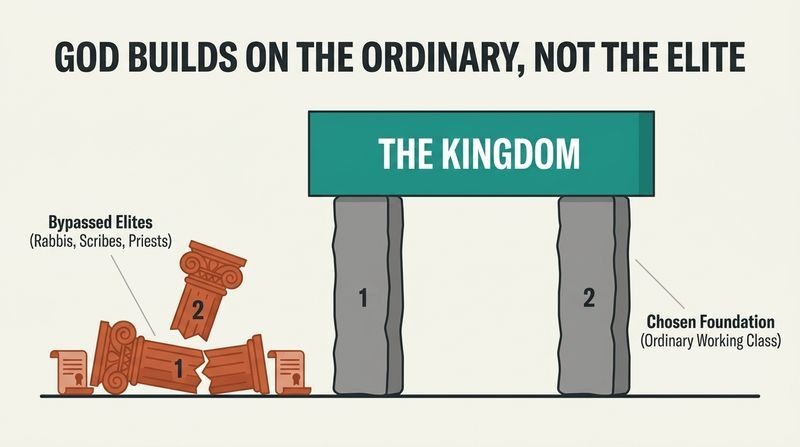
The claim doubles as organizational theory. Modern research on "expert generalists" and diverse teams echoes it: cognitive variety often outperforms uniform credentials. The apostolic band spanned the political spectrum, a Zealot who plotted Rome's overthrow beside a tax collector who funded Rome. That such enemies coexisted models reconciliation across ideological lines that fractures most institutions. Skeptics note survivorship bias: history remembers the movement that succeeded and forgets countless failed sects led by ordinary founders. Still, the underlying principle, that potential is not gatekept by pedigree, anticipates findings that grit and teachability predict achievement better than raw talent or elite background.
Character, not charisma, is the true foundation of lasting leadership
Peter is MacArthur's case study. The apostle with the "foot-shaped mouth" was brash, impulsive, and unstable, a man who lunged into commitments then bailed. Jesus renamed him "Rock" not to describe who he was, but who he would become. When Jesus called him Simon, it signaled backsliding; when he called him Rock, it was commendation.
Three ingredients forged the leader. MacArthur identifies right raw material (Peter's inquisitiveness, initiative, and involvement), right life experiences (his crushing failures like denying Christ), and right character (submission, restraint, humility, love, compassion, courage). Peter walked on water, then sank; confessed Christ as God, then was called Satan; swore loyalty, then denied him three times. Each collapse became a lesson. Trust follows respect, respect follows character.
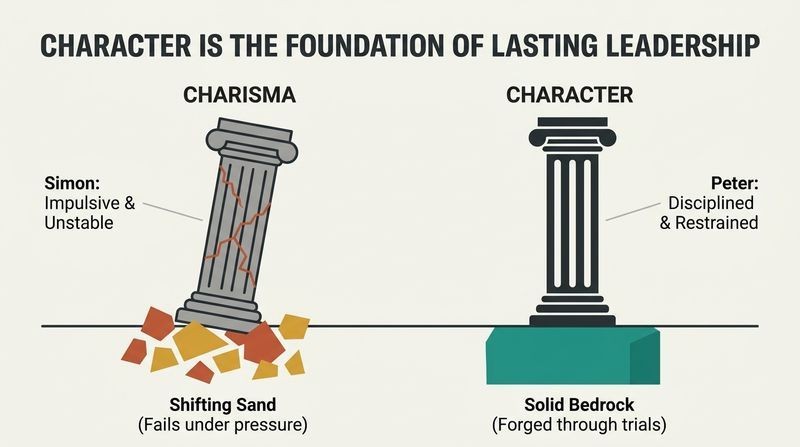
The Lasorda anecdote sharpens the point: a timid pitcher nicknamed "Bulldog" grew into the tenacity the name implied. Psychologists call this the Pygmalion effect, where expectations shape behavior and self-fulfilling labels alter identity. MacArthur's insistence that private character determines public fitness runs directly against the modern separation of competence from morality in politics and business. The Enron and Theranos collapses lend empirical weight: charismatic leaders without integrity eventually implode. One tension worth noting: the book credits transformation entirely to divine grace, leaving little room for the deliberate practice and feedback loops that leadership development literature emphasizes. Both forces likely operated together.
The most fruitful ministry happens one person at a time
Andrew is the apostle of small things. Peter's brother lived permanently in his shadow, mentioned only nine times, often merely as "Peter's brother." Yet he showed no resentment. His signature move was bringing individuals to Jesus: he brought Peter, he brought the boy with five loaves and two fish at the feeding of the five thousand, he brought the inquiring Greeks. He grasped what escaped others: no gift is insignificant in the right hands.
The domino effect of quiet faithfulness. MacArthur cites Edward Kimball, a nervous Sunday-school teacher who trembled his way into a shoe store to share the gospel with a teenage clerk named D.L. Moody. Moody became one of history's great evangelists, reaching tens of thousands and founding an institute that trained missionaries worldwide. All of it traced to one anxious man and one conversation.
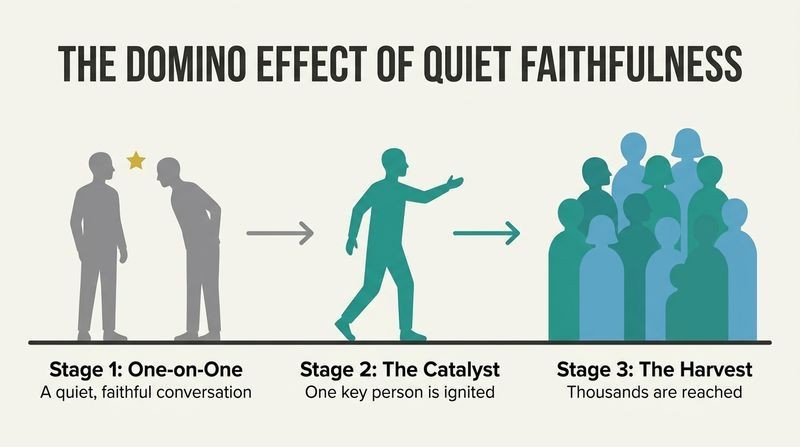
This reframes influence away from platform metrics toward network effects. Andrew never preached to crowds, but by bringing Peter, he indirectly authored the three thousand conversions at Pentecost. Sociologist Mark Granovetter's "strength of weak ties" and modern diffusion research confirm that individual, trust-based transmission spreads ideas more durably than broadcast messaging. The Kimball-to-Moody chain is a real historical example of what network scientists call a high-leverage node hidden in obscurity. The corrective here matters in an attention economy that equates impact with audience size. It quietly dignifies the introvert, the supporting player, and the unglamorous mentor whose compounding effects only eternity tallies.
Zeal without love is dangerous; harness passion, do not kill it
James wanted to incinerate a village. When Samaritans refused Jesus hospitality, the "Son of Thunder" asked permission to call down fire from heaven like Elijah. Jesus rebuked him: he came to save lives, not destroy them. James was fervent, ambitious, and combative, even lobbying through his mother for the top throne in the kingdom. That same intensity, once surrendered to the Holy Spirit, made him the first apostle martyred, beheaded by Herod because his influence had grown dangerous to the establishment.
Passion is raw fuel. MacArthur's verdict is blunt: given a choice between a burning enthusiast prone to failure and a cold compromiser, take the enthusiast every time. Zeal must be tempered with knowledge, wisdom, and love, not extinguished. Misdirected, it turns cruel; surrendered, it becomes a marvelous instrument.
The Jehu parallel MacArthur draws, an Old Testament king whose "zeal for the Lord" curdled into bloodthirsty ambition, illustrates how virtue and vice share a root. Contemporary moral psychology frames this as the double edge of "moral conviction": strong righteous feeling motivates activism but also fuels intolerance and dehumanization of opponents. James's arc suggests the fix is not less conviction but more empathy paired with it. The story that his executioner converted on the spot, moved by James's composure, hints that channeled passion persuades where raw rage repels. The insight resists both the lukewarm centrism and the scorched-earth activism that dominate current discourse.
Truth without love is brutality; love without truth is hypocrisy
John was no gentle saint originally. Popular art paints the "apostle of love" as soft and dove-eyed. The reality: he was a hard-edged fisherman, a Son of Thunder alongside James, sectarian enough to forbid an outsider from casting out demons simply because "he does not follow us." John thought in absolutes, light versus darkness, children of God versus children of Satan.
Maturity is balance, not the erasure of conviction. Over three years, Jesus tempered John's fierce love of truth with love for people. The mature John used the word love over eighty times in his writings, yet never went soft on doctrine, still thundering against deception in his epistles. MacArthur's formula: truth without love is mere cruelty; love without truth is empty sentimentality. Christlike maturity holds both in equal proportion.
This is the book's most transferable framework, mapping neatly onto contemporary debates over "grace versus truth" cultures in organizations and families. Research on high-performing teams (Google's Project Aristotle) found psychological safety, essentially love, must coexist with high standards, essentially truth, for excellence to emerge; either alone produces dysfunction. John's development also illustrates that personality traits are not destroyed by growth but redirected: his black-and-white intensity, once a liability, became the backbone of his uncompromising defense of the faith. The nuance MacArthur adds, that imbalance in any direction is itself a form of intemperance, elevates equilibrium from a personality trait to a moral discipline worth cultivating deliberately.
Counting the costs can blind you to supernatural possibility
Philip was the bean counter. The apostolic administrator, a facts-and-figures pragmatist, saw problems where others should have seen opportunity. When Jesus asked how to feed the multitude, Philip instantly calculated that two hundred denarii (eight months' wages) could not buy enough bread. He was right arithmetically and wrong spiritually, so absorbed in logistics that Christ's limitless power escaped his thinking.
Weak faith still gets used. In the Upper Room, after years of witnessing miracles, Philip still asked Jesus to "show us the Father," prompting the gentle reproach: have I been with you so long, and you still do not know me? Philip had gazed into the face of God and missed it, blinded by mundane preoccupation. Yet Jesus chose this skeptical, cautious man anyway, and he became a preacher whose name will adorn the New Jerusalem.
Philip embodies what behavioral economists might call excessive loss-aversion and analysis paralysis. His mindset is indispensable in accounting and risk management yet corrosive to vision, which requires tolerance for uncertainty. Organizations need both the Philip who asks "can we afford this?" and the Andrew who says "bring what little we have and watch." The failure mode MacArthur diagnoses, letting raw facts crowd out imagination, mirrors innovation research showing that overly data-driven cultures often miss disruptive opportunities that spreadsheets cannot model. The redemptive twist matters: Jesus did not replace Philip's temperament but stretched it. Pragmatists are not disqualified from faith; they are invited to expand their calculus.
Let honest evidence, not prejudice, decide what you believe
Nathanael almost missed the Messiah over a zip code. When told Jesus came from Nazareth, this devout student of Scripture sneered, "Can anything good come out of Nazareth?" His bias was pure emotion, ironic given that his own town of Cana was equally unremarkable. Prejudice, MacArthur notes, renders people deaf and blind to truth, and it caused much of Israel to reject their Messiah.
The cure is firsthand investigation. Philip's answer was simply "come and see." Nathanael went, and Jesus commended him as an Israelite without deceit, a genuine article in a culture riddled with hypocrisy. Because his heart was sincere and Scripture-soaked, one demonstration of Christ's omniscience (seeing him under the fig tree) was enough. He instantly confessed Jesus as Son of God and King, a conclusion most disciples reached only slowly.
MacArthur's use of Bunyan's Holy War, where the demon Diabolus stations "Mr. Prejudice" and a squad of deaf men to guard the Ear-gate of the soul, is a vivid model of motivated reasoning. Cognitive science confirms confirmation bias and in-group favoritism operate largely beneath awareness, distorting perception before evaluation begins. Nathanael's rescue came from a willingness to test the claim empirically, the same corrective the scientific method institutionalizes: subject the prejudged hypothesis to direct observation. What distinguishes him is not the absence of bias, which is universal, but that his sincerity outweighed it. The practical takeaway for any polarized age: "come and see" beats "already decided."
Willingness, not worthiness, is Christ's only entry requirement
Matthew was Israel's most hated profession. A tax collector, or publican, he had bought a Roman franchise and extorted his own people, ranking socially with harlots and barred from the synagogue. Jesus walked past his toll booth and said two words, "Follow me," and Matthew instantly abandoned an irreversible, lucrative career. His first act was throwing a banquet to introduce his disreputable friends to Jesus, scandalizing the religious elite.
The dividing line was self-awareness. Jesus said the sick, not the self-proclaimed healthy, need a physician. The religious leaders could tolerate his miracles but not being called sinners. Matthew and the other outcasts could. MacArthur's point across all twelve: the one trait uniting the faithful eleven was readiness to acknowledge their own sin and receive grace, the very humility the establishment refused.
The Matthew-and-Simon pairing is the book's quiet masterpiece of social psychology. A Roman collaborator and an anti-Roman insurgent, natural mortal enemies, became coworkers. Contact theory in sociology holds that shared superordinate goals dissolve intergroup hostility, precisely what a common mission accomplished here. Matthew's immediate impulse to host a banquet also illustrates the "convert's zeal" documented in conversion studies: new commitment seeks expression through relationships. The deeper claim, that acknowledging brokenness is the prerequisite for transformation, prefigures the foundational insight of recovery movements like Alcoholics Anonymous, whose first step is admitting powerlessness. Self-righteousness, not sin, is the harder barrier to grace.
Pessimists can be the bravest and most loyal disciples
Doubting Thomas deserves a better reputation. MacArthur reframes him as a devoted pessimist, not a faithless skeptic. When Jesus resolved to return to dangerous Judea to raise Lazarus, the other disciples balked. Thomas said, "Let us also go, that we may die with him." That is heroic pessimism: he expected catastrophe yet chose loyalty anyway, harder for a pessimist than an optimist.
His doubt was grief, not obstinacy. Thomas demanded to touch the wounds because his love was so deep that Christ's death shattered him more than the others. Notably, all the disciples disbelieved the resurrection until they saw Jesus; Thomas's sorrow, not his skepticism, set him apart. When Jesus appeared and offered his wounds, Thomas produced arguably the greatest confession in the Gospels: "My Lord and my God." Tradition says he carried the gospel as far as India.
The rehabilitation of Thomas corrects centuries of unfair caricature and lands a subtle point: temperament is not sin. Defensive pessimism, a documented cognitive strategy, actually improves performance for anxious individuals by preparing them for worst-case scenarios; it is not the same as disloyalty or unbelief. Thomas's insistence on empirical verification also reads, ironically, as proto-scientific rigor, and his subsequent confession became a cornerstone proof-text for Christ's deity. The lesson generalizes: communities often marginalize their melancholic, questioning members, yet those same traits produce fierce commitment and intellectual honesty. The demand for evidence, when paired with genuine love, strengthens rather than undermines conviction once the evidence arrives.
Proximity to greatness cannot save a heart that never surrenders
Judas had every advantage and squandered it all. For three years he heard every sermon, witnessed every miracle, and enjoyed intimate access to Jesus, even having his feet washed by the Lord. He was so skilled a hypocrite that when Jesus predicted betrayal, no one suspected him. Yet he followed for selfish gain, pilfered from the money box he managed, and finally sold Christ for thirty pieces of silver, the price of a slave.
The anatomy of ruin. MacArthur traces Judas's slide: disillusionment when Jesus refused to be a political-military Messiah, then bitterness, then greed, then treachery. His post-betrayal remorse was not repentance; he never sought mercy, only relief from a tormented conscience, and hanged himself. His life warns that spiritual privilege, unaccompanied by genuine faith, hardens rather than softens the heart.
Judas raises the book's thorniest theological knot: his betrayal was prophesied and foreordained, yet freely chosen and fully culpable. MacArthur, quoting Spurgeon, refuses to collapse the paradox, treating divine sovereignty and human responsibility as parallel lines meeting only in eternity, a stance philosophers call compatibilism. Beyond theology, Judas is a study in how gradual moral compromise, the small embezzlements, the nursed grievances, precedes catastrophic betrayal, echoing research on ethical fading where incremental rationalizations erode conscience. The distinction MacArthur draws between remorse (regretting consequences) and repentance (turning from sin) is psychologically precise and widely applicable. Judas felt terrible; he simply never changed direction, which is why proximity alone transformed nothing.
Analysis
MacArthur's project is deceptively simple: strip the twelve apostles of their stained-glass halos and present them as the flawed, provincial working men Scripture actually describes. The book, assembled from two decades of sermons on Matthew 10 and Luke 6, is an anthology of character studies unified by a single insistent thesis, that God deliberately builds his kingdom through ordinary, unqualified people so that the glory belongs unmistakably to him. It functions as devotional biography, leadership manual, and pastoral encouragement at once.
The adaptation's difficulty lies in the material's unevenness. MacArthur has abundant text on Peter, John, and Judas but only fragments on James the Less, Simon the Zealot, and Thaddaeus, whose obscurity is itself his point. The strongest transferable frameworks come from the well-documented figures: Peter's three ingredients of leadership, John's balance of truth and love, and the Judas anatomy of hypocrisy. These translate cleanly into secular domains of management, communication, and ethics, which is why the book has outlived its homiletic origins.
Critically, the work operates entirely within a conservative evangelical frame. It treats the Gospel harmonization as historically seamless, reads sovereignty and free will as compatibilist mystery, and attributes all transformation to divine grace rather than developmental process. A reader outside that tradition will find the historical claims about martyrdoms resting on late church tradition rather than verifiable record, and the psychological transformations asserted more than demonstrated. Yet even a secular reader gains genuine value: the diverse-team insight (a Zealot and a tax collector reconciled), the network theory of one-to-one influence (Kimball to Moody), and the character-over-charisma leadership thesis all stand independent of theological commitment. MacArthur's central provocation endures across worldviews: the people history remembers as foundational were, in their moment, nobodies who simply made themselves available and teachable. Availability, not credential, was the qualification.
Review Summary
Twelve Ordinary Men received mostly positive reviews, with readers praising its insightful portrayal of the disciples' lives and personalities. Many found it educational and encouraging, appreciating how MacArthur emphasized the ordinariness of the disciples. Some criticism focused on perceived speculation and repetitiveness. Readers valued the biblical references and historical context provided. The book was noted for its readability and ability to make the disciples relatable. Overall, it was seen as a worthwhile read for those seeking to deepen their understanding of Jesus' closest followers.
People Also Read


Glossary
Apostle (apostolos / shaliah)
Authorized delegate sent with authorityFrom the Greek apostolos, meaning "sent one," with an exact parallel in the Aramaic shaliah, an official representative who spoke and acted with the full authority of whoever sent him. MacArthur stresses this was more than a messenger; the apostles were Christ's ambassadors, delivering his message and exercising his authority, a role well understood in first-century Jewish culture where "the one sent is as the man himself."
Sons of Thunder (Boanerges)
Jesus' nickname for James and JohnThe Aramaic nickname Jesus gave the fervent brothers James and John, capturing their zealous, explosive, passionate temperaments. Unlike Peter's aspirational name "Rock," this label chided their tendency to let feverish intensity spill into intolerance, as when they wanted to call down fire on a Samaritan village. The name marked raw passion that required tempering with love and wisdom.
The Less (mikros)
Distinguishing epithet for obscure JamesThe Greek word mikros, meaning "little" or "small," applied to James the son of Alphaeus to distinguish him from the prominent James, son of Zebedee. It may refer to his short stature, younger age, or lesser influence. MacArthur treats his defining trait as sheer obscurity, a reminder that God uses faithful people whose labors this world barely remembers.
Zealot
Anti-Roman revolutionary political sectA militant first-century Jewish political party dedicated to overthrowing Roman rule through terrorism, sabotage, and assassination. An extremist faction called the sicarii ("dagger-men") carried curved blades to kill Romans and collaborators, including tax collectors. Simon the apostle had belonged to this movement, making his coexistence with Matthew the tax collector a striking testimony to Christ's reconciling power.
Publican
Despised Jewish Roman tax collectorA tax collector who bought a Roman franchise and extorted money from fellow Jews to fund the occupation while enriching himself. Publicans ranked among the most hated people in Israel, socially equivalent to harlots and barred from synagogue worship. Matthew was a Little Mokhes, a face-to-face toll collector, the most resented tier, before Jesus called him from his booth.
FAQ
What's Twelve Ordinary Men about?
- Focus on Apostles: The book explores the lives of the twelve apostles chosen by Jesus, highlighting their ordinary backgrounds and the extraordinary calling they received.
- Transformation and Growth: It emphasizes how Jesus transformed these common men into powerful leaders who spread the gospel after His resurrection.
- Spiritual Lessons: Each chapter provides insights into the apostles' unique traits and the spiritual lessons that can be learned from their lives.
Why should I read Twelve Ordinary Men?
- Inspiration from Ordinary Lives: The book illustrates how God can use anyone, regardless of their background or abilities, to accomplish His purposes.
- Deepens Understanding of Scripture: By examining the apostles' lives, readers gain a deeper understanding of the New Testament and the early church's formation.
- Practical Application: The lessons drawn from the apostles' experiences are applicable to modern life, offering guidance on faith, leadership, and personal growth.
What are the key takeaways of Twelve Ordinary Men?
- God Uses the Ordinary: The apostles were not extraordinary individuals; they were common men who became instruments of God’s work.
- Transformation through Christ: True transformation comes from a relationship with Jesus, as seen in the apostles' evolution from ordinary fishermen to bold leaders.
- Empowerment by the Holy Spirit: The transformation of the apostles was ultimately due to the empowerment of the Holy Spirit, emphasizing reliance on God for strength.
What are the best quotes from Twelve Ordinary Men and what do they mean?
- "God's strength is made perfect in weakness.": This emphasizes that God often uses those who are weak or ordinary to demonstrate His power and glory.
- "Love does not parade itself.": This underscores the importance of humility and service in love, reflecting the teachings of Christ.
- "You did not choose Me, but I chose you.": This highlights the idea of divine election, reminding readers that God initiates the relationship and calling.
How does John MacArthur describe the calling of the apostles in Twelve Ordinary Men?
- Personal Selection by Christ: Jesus chose the apostles personally, knowing their flaws and weaknesses, which illustrates His grace and purpose.
- Phased Calling: The calling occurred in stages: first to follow Him, then to be trained, and finally to be sent out as apostles.
- Empowerment for Ministry: The apostles were empowered by the Holy Spirit to carry out their mission, demonstrating that success in ministry comes from God.
What role did Peter play among the apostles according to Twelve Ordinary Men?
- Leader and Spokesman: Peter is depicted as the primary leader of the apostles, often speaking on behalf of the group and taking initiative.
- Transformation Journey: His journey from impulsive fisherman to a bold preacher at Pentecost illustrates the transformative power of Christ.
- Example of Human Weakness: Peter's failures, such as denying Christ, serve as reminders of human frailty and the need for reliance on God.
How does Andrew's character differ from Peter's in Twelve Ordinary Men?
- Quiet and Humble: Andrew is portrayed as a humble figure who prefers to work behind the scenes, in contrast to Peter's boldness.
- Bringer of Individuals: He is known for bringing people to Jesus, emphasizing the importance of personal evangelism over public preaching.
- Contentment in Service: Andrew's lack of desire for recognition highlights a servant's heart, making him a model for those in ministry.
What lessons can be learned from the life of Peter in Twelve Ordinary Men?
- Leadership and Impulsiveness: Peter's journey illustrates the balance between leadership and impulsiveness, showing how God can use even flawed individuals for His purposes.
- Faith and Doubt: His experience walking on water highlights the tension between faith and doubt, reminding readers that even strong believers can struggle.
- Courage in Adversity: Peter's boldness in preaching after Pentecost exemplifies the courage that comes from being filled with the Holy Spirit.
How does John MacArthur portray the character of John in Twelve Ordinary Men?
- Apostle of Love: John is referred to as the "Apostle of Love," emphasizing his writings that focus on love for Christ and one another.
- Transformation Over Time: The book discusses John's evolution from a fiery, ambitious disciple to a mature leader who balanced truth with love.
- Boldness in Truth: Despite his emphasis on love, John remained steadfast in proclaiming the truth, demonstrating that love and truth must coexist in the life of a believer.
What is the significance of Judas Iscariot's character in Twelve Ordinary Men?
- Warning Against Hypocrisy: Judas serves as a cautionary tale about the dangers of hypocrisy and the consequences of a heart not truly committed to Christ.
- Lost Opportunity: The book emphasizes that Judas had every opportunity to embrace faith but chose to pursue greed instead.
- Sovereignty and Free Will: Judas's actions demonstrate the tension between divine sovereignty and human choice, showing that while God’s plan cannot be thwarted, individuals are still responsible for their choices.
How does the book address the theme of ambition and humility?
- Ambition without Humility: The book discusses how ambition can become sinful when not tempered by humility, using the example of James and John who sought positions of power.
- Christ's Example: Jesus is presented as the ultimate model of humility, demonstrating that true greatness in the kingdom of God comes from serving others.
- Spiritual Maturity: The book encourages readers to pursue both ambition and humility in their spiritual lives, highlighting that true maturity involves a balance of both qualities in service to God and others.
How does MacArthur illustrate the transformation of the apostles throughout Twelve Ordinary Men?
- From Ordinary to Extraordinary: The book chronicles the apostles' journey from ordinary men to extraordinary leaders, emphasizing the transformative power of Christ in their lives.
- Lessons from Failure: MacArthur highlights the failures of the apostles as critical learning experiences that shaped their character and faith.
- Empowerment by the Holy Spirit: The apostles' transformation is ultimately attributed to the empowerment of the Holy Spirit at Pentecost, illustrating that true change comes from reliance on God rather than personal effort.
About the Author
Other books by John F. MacArthur Jr.







Download PDF
Download EPUB
.epub digital book format is ideal for reading ebooks on phones, tablets, and e-readers.








































