

Key Takeaways
Trust runs on five essentials, not just honesty
Trust is multidimensional. Henry Cloud, a clinical psychologist and leadership consultant, argues that most people equate trustworthiness with honesty, but that is only the entry ticket. Real trust rests on five essentials: understanding, motive, ability, character, and track record. All five must be present when the stakes are high.
Consider Colin and Shannon, founders who hired a brilliant, ethical CEO named Rick yet felt constant unease. Cloud had them rate Rick 1 to 5 on five questions. Their scores hovered around 2. The diagnosis: they simply did not trust him, despite his integrity. Rick understood the business intellectually but never grasped what the founders actually wanted, pursued his own vision, and left them perpetually worried. Honesty alone could not carry the weight of what they had entrusted him with.
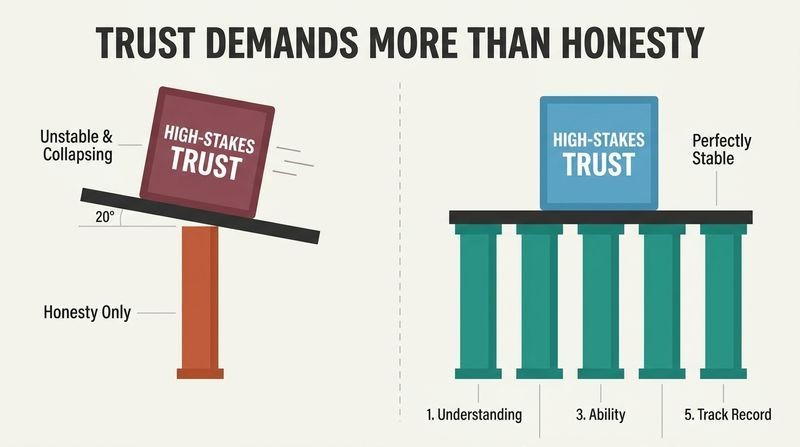
What's valuable here is the reframe from a binary (honest or dishonest) to a diagnostic matrix. This mirrors how organizational psychologists decompose vague constructs into measurable components. The parallel to medical differential diagnosis is apt: instead of concluding "something feels off," you can pinpoint which of five systems is failing. One nuance worth adding: the five essentials are not equally weighted across contexts. A surgeon needs overwhelming ability, a spouse needs deep understanding and motive. Cloud's framework implicitly acknowledges this specificity, which distinguishes it from generic trust literature that treats trust as a single dial to turn up or down.
You are biologically wired to trust, whether you admit it or not
Trust is not optional for a good life. Cloud recounts a seatmate who insisted he trusted no one. Cloud pointed out the man trusted the pilot, the fuel technician, the meat packer, and oncoming drivers not to cross the yellow line. His real issue was personal trust, damaged by past betrayals.
Neuroscience shows humans are built to bond. Oxytocin glues nursing mothers and infants together. Through thousands of moments of need met by a caregiver, a baby internalizes an "emotional object constancy," a self-soothing capacity that persists for life. Mirror neurons let us feel what others feel, generating empathy. Trust literally builds the brain, immune system, and body weight. When trust collapses across markets, as in 2008, entire economies buckle. To refuse trust is to amputate the human experience.
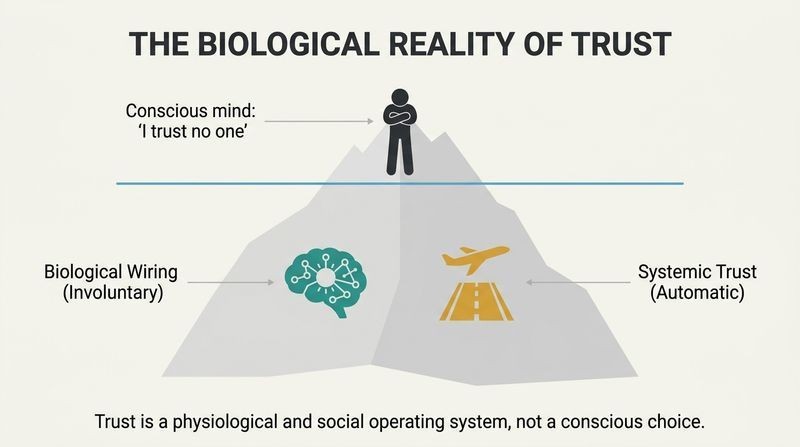
Cloud's biological framing is well supported. Attachment research from Bowlby and Ainsworth onward confirms that secure early bonding predicts adult relational health. The oxytocin story, however, deserves a caveat the book itself flags: the same bonding chemistry that heals can also snare people into fast, unwise attachments with untrustworthy partners. This is the dark side of oxytocin that recent studies confirm, showing it can increase in-group favoritism and even envy. The takeaway for readers is that biology supplies the drive but not the discernment. Wiring makes trust inevitable; wisdom makes it safe.
Win trust by understanding people, not persuading them
Trust begins when someone feels known. Cloud invokes FBI hostage negotiator Chris Voss: being right matters less than having the right mindset of deep empathy. A negotiator who lectures a bomber fails; one who says "tell me how we got here" opens a window. When people feel understood, the fearful lower brain quiets and the reasoning upper brain engages.
Cloud once physically blocked a resigning board chairman from leaving, sat on the floor, and asked how the CEO's behavior made him feel. The chairman's jaw quivered. Seeing this, the CEO apologized, and a company was saved. The same dynamic soothes a crying six-year-old missing her mother, wins customers (Chick-fil-A staff escorting a soaked mom's kids inside under umbrellas), and rebuilds marriages. Listening is only the start; acting on what you learn proves you truly get someone.
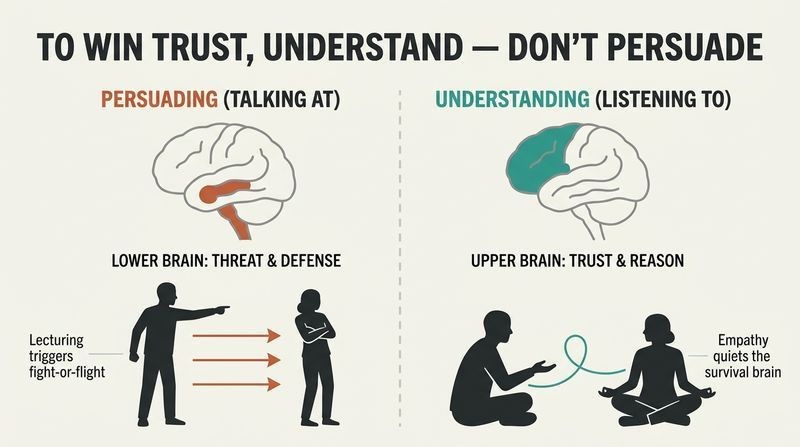
This aligns with Carl Rogers's finding that reflective listening alone produces clinical improvement, which Cloud cites. It also anticipates modern negotiation and sales research: people concede and cooperate more after feeling heard, a phenomenon behavioral scientists call "feeling felt." The subtle danger is performative empathy. Cloud rightly insists understanding must be genuine and followed by action, otherwise it curdles into manipulation, the exact tactic skilled con artists use. The distinction between empathy as connection and empathy as tool is the ethical fault line here, and it separates a Chick-fil-A culture from a predatory salesperson who mirrors you only to close.
Ask whose interests someone truly serves before you trust them
Motive is the second essential. Even someone who understands you can be in it purely for themselves. Cloud describes hunting for a knee surgeon. Two brilliant surgeons diagnosed him correctly but treated him like an assembly-line case or a teaching prop. A third surgeon asked about his golf, his family, his mobility, and clearly wanted him to have a better life. Cloud flew across the country for that surgeon because his motive was "for" the patient.
John Gottman's "index of betrayal" marks a marriage as endangered when partners stop looking out for each other's interests. A homebuilder who asked subcontractors "what's good for you?" shortened timelines and boosted everyone's profits. Airlines that shared safety data in mutual trust cut fatal crash rates by over 80% in a decade. When motives serve a higher purpose, trust and results soar.
Cloud's motive test resonates with principal-agent theory in economics, which studies exactly this misalignment: agents pursuing self-interest at the principal's expense. His homebuilder and airline examples illustrate what game theorists call moving from zero-sum to positive-sum cooperation, where trust becomes the enabling infrastructure. Political scientist Robert Putnam's work on social capital reinforces the point that high-trust groups outperform low-trust ones economically. A challenge: motive is the hardest essential to verify from outside, since people can fake benevolence indefinitely. Cloud's later reliance on track record partly compensates, but readers should note that motive assessment remains inherently probabilistic, never certain.
Liking someone is not a reason to trust their competence
Ability is context-specific. Cloud imagines his empathetic, caring surgeon revealing he is actually an obstetrician thrilled to try a knee for fun. Trust evaporates instantly. Understanding and motive mean nothing without the capacity to deliver.
He tells of Bradley, a beloved COO promoted to CEO who left the company "listless" and directionless. Cloud asked, "Where did he get the E?" A CEO must define a nonexistent future, set vision and strategy, and build external alliances, capacities distinct from operational excellence. Families hand businesses to a well-liked child, couples marry charming partners lacking conflict-resolution skills, homeowners hire a contractor because he attends their church. Cloud even suggests vetting a prospective son-in-law by asking for his tax returns, not to judge income but to see whether he can manage his own life.
The "halo effect," first documented by psychologist Edward Thorndike in 1920, is precisely the cognitive bias Cloud is fighting: we let one positive trait (likability, faith, charm) bleed into unrelated judgments (competence). His prescription, demand context-specific proof, is sound and echoes evidence-based hiring research showing that work samples predict performance far better than interviews or referrals. The tax-return anecdote is provocative but shrewd: it tests self-management behaviorally rather than rhetorically. One extension: ability is the most developable essential. Cloud acknowledges people can grow into competence, which means "not yet" is often a fairer verdict than "never."
Real integrity is wholeness of character, not just avoiding lies
Character means the whole makeup, not only morality. Cloud imagines his skilled surgeon screaming at his team mid-operation, causing chaos. Trust dies, not from dishonesty but from poor emotional makeup. Drawing on 2 Peter and emotional-intelligence research (Harvard found EQ counts twice as much as IQ for success), he argues character includes self-control, perseverance, kindness, and more.
The word integrity shares a root with "integer," a whole number. A person can be honest yet defensive, controlling, narcissistic, or unable to confront, and thus untrustworthy in specific roles. Cloud fired a gifted CFO who could not be direct with his CEO. In Atul Gawande's checklist studies, surgical complications fell 36% and deaths 47%, yet arrogant surgeons resisted checklists, letting character sink results. Character is also specific: his Navy SEAL brother-in-law Mark was trusted for combat, not for tender emotional care.
Cloud's redefinition of integrity as completeness rather than mere honesty is philosophically closer to Aristotle's notion of virtue as a integrated set of excellences than to the modern reduction of integrity to rule-following. The EQ claim (twice as important as IQ) is popular but contested; Daniel Goleman's strong versions have been criticized by researchers like Frank Schmidt, whose meta-analyses still rank cognitive ability high for job performance. The safer reading is that character and competence are complementary, not rivals. Cloud's insistence on specificity, matching a person's traits to the demands of the role, is the durable insight, sparing readers from the fantasy of a universally trustworthy person.
The best predictor of future behavior is a proven track record
Behavior builds maps. Cloud got directions in Louisiana bayou country: "turn right at the big dog lying in the grass." The dog was always there. It had a track record. Our brains build maps to navigate reality, and we trust what has happened repeatedly.
Trust cannot rest on a promise. An addict's "I'll change" is worthless until the ability to stay sober is built and demonstrated. Navy SEALs earn trust through brutal selection before deployment; the military does not guess. Bernie Madoff exploited this wiring: a fake track record of steady returns and trust-by-association let him steal roughly 65 billion dollars. Two cautions: problems are normal, but unaddressed problems become patterns, which harden into identity ("the company that always misses deadlines"). And "I'm sorry" opens a door to forgiveness but never automatically restores trust.
Cloud's "best predictor of the future is the past" is a folk restatement of a robust finding in behavioral science: past behavior is the strongest predictor of future behavior, all else equal. His Madoff example is a sharp reminder that track records can be manufactured, which is why forensic skepticism matters. Kellogg School researchers found investors trusted Madoff through nonconscious social cues rather than due diligence. The pattern-versus-problem distinction is genuinely useful for managers and spouses alike: it prevents both over-forgiving (excusing repeated betrayals) and over-punishing (treating a single lapse as character-defining). The neuroscience of predictive brain "maps" gives the intuition a credible mechanism.
When you cannot trust anyone, examine your own broken trust muscle
Trust is a two-way street. Cloud calls our internal capacity to trust the "trust muscle," built through secure early attachment. When it is damaged, even trustworthy people cannot earn our trust. Sean, a founder, killed a lucrative deal and his partnership because he could not tolerate being accountable to a board. The root was a dictatorial father; he was reliving the past in the present.
Cloud likens this to driving on a bent axle from a year-old crash: the accident is over, but the damage still shakes the car until repaired. Common barriers include fear of depending on others, fear of being controlled, perfectionism and shame, unresolved trauma (a man who lost multiple mother figures got depressed whenever love deepened), fear of inequality, and projecting one's own faults onto others. The good news: trust muscles can be rebuilt in new, healing relationships.
This section grounds Cloud's framework in attachment theory's four styles (secure, anxious, avoidant, fearful-avoidant), a well-validated model from developmental psychology. The "bent axle" metaphor elegantly dispatches the objection that dwelling on the past is a cop-out: the past is not gone, it is embodied in present functioning, a point trauma researchers like Bessel van der Kolk have made physiologically explicit. What Cloud adds practically is agency: unlike some deterministic readings of attachment, he insists these patterns are repairable through corrective relational experiences, which matches evidence that "earned secure" attachment is achievable. The projection insight (Romans 2:1) is a shrewd nod to how the jealous often betray.
Forgiveness heals your past; trust must still be earned for the future
Separate forgiveness from trust. After betrayal, Cloud prescribes a six-step repair model, and forgiveness is non-negotiable, not because the offender deserves it but because bitterness is self-poisoning. Research links forgiveness to lower blood pressure, reduced depression and anxiety, better immune function, and even improved mortality. A woman who keyed her ex's Mercedes was, Cloud saw, still that man's prisoner.
The crucial distinction: forgiveness addresses the past and is free; trust addresses the future and must be earned. You can forgive fully and still choose never to reconcile or trust again. Cloud draws on the model of divine forgiveness offered before it is requested. Anger is legitimate and necessary (name the wrong honestly), but endlessly feeding rage fixes it into identity. Forgive to get free, then decide separately whether trust is warranted.
The forgiveness-trust split is Cloud's most clarifying contribution to a topic clouded by guilt and confusion. Popular culture conflates the two, pressuring victims to "trust again" as proof of forgiveness. Cloud severs that link cleanly, which is both psychologically liberating and safety-preserving, especially for abuse survivors. The health research he cites is real; forgiveness interventions (notably Everett Worthington's REACH model and Robert Enright's process model) show measurable benefits. One nuance: forgiveness is a process, not a switch, and prematurely declaring it can bypass necessary grief. Cloud handles this well by insisting anger be felt and expressed before, not instead of, the forgiveness stance.
Reconciliation needs both people; watch how they take responsibility
Determine who you are dealing with. Forgiveness takes one person; reconciliation takes two. The offender must own the wrong, feel genuine remorse, and stop blaming. Olivia's business partner Derek embezzled tens of thousands, then denied, minimized, and rationalized everything. No ownership meant no reconciliation, and the relationship ended.
Cloud borrows a three-category diagnosis from Proverbs:
1. Wise people accept correction, own their mistakes, and change, so confront them one-on-one.
2. Fools get defensive, blame, and attack, so stop talking alone and bring in others, escalating to a group if needed.
3. Evil people intend to harm you, so skip confrontation entirely and go into protection mode (attorneys, police, distance).
Avoidance tactics like denial, gaslighting, minimizing, and projection signal reconciliation is not yet available. A heartfelt, responsibility-taking "I'm sorry" is the gateway.
The wise/foolish/evil taxonomy, though drawn from ancient wisdom literature, maps surprisingly well onto clinical categories: the coachable, the character-disordered, and the malevolent (dark-triad) personalities. Cloud's escalation protocol echoes evidence-based intervention models used in addiction treatment, where graduated confrontation with increasing social pressure is standard. The critical safety insight is refusing to "reconcile" with someone in the evil category, which counters a naive therapeutic optimism that everyone can be reached through dialogue. Forensic psychologists studying psychopathy would endorse this. The practical filter, does this person take responsibility or deflect, is a fast, observable heuristic that spares people from pouring effort into relationships incapable of repair.
Trust the change process only when eleven concrete signs appear
Watch behavior from the bleachers. Rebuilding trust does not require reading minds; it requires observing whether someone is genuinely working a change process. Cloud lists eleven objective indicators, including: admitting need and asking for help, enrolling in a proven change process (real recovery programs, not "Bob's Treatment"), submitting to structure, developing new skills, self-sustaining motivation (they pursue it without prodding), full transparency (no secrets), and welcoming being questioned without defensiveness.
Drew, who betrayed his wife Bella through a five-year affair, became Cloud's model: he entered treatment, gave Bella full access to his phone and calendar, attended a ninety-minute recovery call every Monday, and never got defensive when questioned. Ten years later their marriage thrived. The rule for rebuilding: crawl, walk, run. Extend trust in small increments as a track record forms, never zero to sixty overnight.
Cloud's eleven indicators operationalize what recovery communities have long known: sincerity is proven by structured, sustained, verifiable action, not by apology or intensity of emotion. The insistence on a "proven change process" rather than self-designed willpower aligns with evidence that structured programs (AA, evidence-based therapy) outperform solo resolutions. The "welcoming being questioned" criterion is psychologically astute; defensiveness ("you just don't trust me!") is a reliable tell of incomplete change. The "crawl, walk, run" incrementalism is essentially graded exposure, letting trust rebuild as evidence accumulates. A useful addition: if someone fully engages the process yet does not improve, the process itself, not their sincerity, may need changing, like adjusting a medication that isn't working.
Build a trust immune system so betrayers cannot fool you twice
Learn from experience like antibodies. Cloud compares misplaced trust to infection. A healthy immune system either blocks toxins or recognizes and fights them on return. People get fooled when this system was never installed (no childhood training to spot liars and bullies), when they fail to learn from experience, when they lack boundaries, when they are naive (never exposed to betrayal), or when they lack a supportive "tribe" of extra eyes.
A needy corporate board fell for a charming, grandiose candidate who could not name a single weakness; Cloud alone recognized the narcissism and warned them. They hired him anyway and he wrecked the company within eighteen months. The remedy: gain wisdom from your own and others' experience, develop boundary and confrontation skills, and recruit trusted friends to vet big decisions. As one group member quipped, a woman had not married nine abusive men but one abusive man with nine different names.
The immunological metaphor is genuinely illuminating because it captures both prevention (recognizing toxins early) and memory (not repeating mistakes). It parallels how cognitive scientists describe expertise: pattern recognition built through repeated exposure, which is why Cloud spots the narcissist the smitten board misses. His "nine names" line crystallizes the repetition-compulsion that psychoanalysts describe and trauma research confirms. The critical ethical guardrail Cloud repeats is the distinction between victim-blaming and victim-empowering: acknowledging your vulnerability patterns is not accepting fault for another's betrayal. This balance is hard to strike and often botched in self-help. Recruiting outside "eyes" for major trust decisions is underrated advice that counters the isolation in which most bad trust decisions incubate.
Analysis
Henry Cloud's Trust is a framework-driven self-help and leadership book that succeeds by making an abstract, emotionally loaded concept operational. Its central move is decomposition: trust, usually experienced as a gut feeling or reduced to honesty, becomes a five-part diagnostic (understanding, motive, ability, character, track record). This is the book's intellectual spine and its most portable tool, applicable from marriage to boardroom.
The book's structure is disciplined: define trust and its biology, dissect the five essentials, examine the reader's own capacity to trust (the "trust muscle" and attachment-based barriers), then supply a seven-step repair model. This progression from diagnosis to self-examination to repair is unusually complete for the genre. Many trust books stop at "trust is important"; Cloud insists on both how to evaluate others and how to notice when you are the obstacle.
Cloud's synthesis draws on attachment theory, neuroscience (oxytocin, mirror neurons), emotional-intelligence research, Gottman's marriage science, and biblical wisdom literature. The blend is idiosyncratic but coherent. His clinical and consulting anecdotes (the resigning chairman, the knee surgeon search, Bella and Drew, the narcissistic CEO candidate) do heavy explanatory work and are the book's most memorable assets.
Weaknesses: the framework is more a wise practitioner's taxonomy than an empirically validated instrument, and some cited research (EQ "twice as important" as IQ) is oversold. The heavy scriptural framing may narrow reach, though Cloud consistently offers secular parallels. The repair model, while thorough, can read as optimistic about how often betrayers genuinely change.
Still, the book's core contributions endure: separating forgiveness (past, free, one-person) from trust (future, earned, two-person); insisting trust is context-specific rather than global; and reframing repeated betrayal as partly a repairable deficit in one's own capacity to discern. These are clarifying, actionable, and rare.
Review Summary
Trust by Dr. Henry Cloud is highly praised for its insightful exploration of trust in relationships and business. Readers appreciate Cloud's clear communication, practical advice, and comprehensive approach to building, assessing, and repairing trust. The book's five key elements of trust (understanding, motive, ability, character, and track record) are widely lauded. Many reviewers found the book thought-provoking and applicable to various aspects of life. Some noted its Christian perspective, while a few felt it could be repetitive. Overall, it's recommended as a valuable resource for personal and professional growth.
People Also Read









FAQ
What's Trust: Knowing When to Give It, When to Withhold It, How to Earn It, and How to Fix It When It Gets Broken about?
- Exploration of Trust Dynamics: The book by Henry Cloud delves into the complexities of trust in both personal and professional relationships.
- Five Essentials of Trust: It outlines five key components—Understanding, Motive, Ability, Character, and Track Record—that are crucial for building and maintaining trust.
- Repairing Trust: Cloud provides a framework for repairing trust when it has been broken, emphasizing that trust is a multifaceted concept.
Why should I read Trust by Henry Cloud?
- Enhance Relationships: The book offers insights into the dynamics of trust, foundational for healthy personal and professional relationships.
- Practical Guidance: It provides actionable advice on assessing trustworthiness and becoming more trustworthy.
- Self-Discovery: Encourages self-reflection on personal trust issues and how past experiences influence trust.
What are the key takeaways of Trust by Henry Cloud?
- Trust is Essential: Described as the "fuel for all of life," trust is vital for intimacy and successful interactions.
- Five Essentials Framework: Understanding, Motive, Ability, Character, and Track Record guide the evaluation of trustworthiness.
- Trust Repair Process: A step-by-step process for repairing broken trust, focusing on understanding and character.
What are the best quotes from Trust by Henry Cloud and what do they mean?
- "Trust is the fuel for all of life.": Highlights trust's fundamental role in every aspect of life.
- "You can trust someone when you feel their motive is for you, not just for themselves.": Emphasizes the importance of genuine intent in building trust.
- "The best predictor of the future is the past.": Stresses the significance of a person’s track record in determining future trustworthiness.
What are the five essentials of trust according to Henry Cloud?
- Understanding: Trust begins with feeling understood, involving active listening and empathy.
- Motive: Trust grows when you believe the other person genuinely looks out for your best interests.
- Ability: Refers to the capacity to deliver on promises, requiring necessary skills and competencies.
- Character: Encompasses personal traits like integrity and emotional intelligence that affect interactions.
- Track Record: A history of reliable behavior is crucial for establishing trust.
How can I assess someone's trustworthiness according to Trust by Henry Cloud?
- Evaluate Understanding: Look for signs of active listening and empathy in their responses.
- Examine Motive: Consider if their actions prioritize your interests alongside their own.
- Check Ability: Assess their skills and experience to fulfill commitments.
- Review Character: Observe traits like honesty and reliability in various contexts.
- Look at Track Record: Investigate their history of behavior in relevant situations.
How do I repair trust when it’s broken according to Trust by Henry Cloud?
- Acknowledge the Breach: Recognize and admit that trust has been violated through open communication.
- Seek Understanding: Strive to understand each other's perspectives and feelings regarding the breach.
- Demonstrate Change: Take concrete steps to show commitment to change with consistent actions.
- Establish New Boundaries: Set clear expectations and boundaries to rebuild trust.
- Be Patient: Allow time and effort for the relationship to heal gradually.
How does Henry Cloud define trust in Trust?
- Foundation of Relationships: Trust is the foundation of all healthy relationships, essential for emotional safety.
- Two Components: Consists of understanding the other person’s needs and the motive to act in their best interest.
- Trustworthiness: Built on character and a consistent track record of behavior over time.
What is the six-step model for repairing trust in Trust by Henry Cloud?
- Heal from What Happened: Focus on personal healing and processing emotions.
- Move Beyond Anger: Work through anger and resentment, turning towards forgiveness.
- Ponder What You Really Want: Reflect on desires for the future of the relationship.
- Figure Out If Reconciliation Is Available: Assess willingness and conditions for rebuilding trust.
- Assess Trustworthiness: Evaluate the five essentials of trust for potential trustworthiness.
- Look for Evidence of Real Change: Monitor behavior for signs of genuine change.
How can I identify trustworthy individuals according to Trust by Henry Cloud?
- Understanding Their Motives: Look for genuine interest in your well-being and consistent, caring behavior.
- Assessing Their Abilities: Evaluate their skills and competencies to fulfill commitments.
- Character Evaluation: Observe honesty, integrity, and accountability.
- Track Record: Consider past behavior and handling of trust in previous relationships.
What barriers to trust does Henry Cloud discuss in Trust?
- Fear of Control: Struggle with trust due to fear of losing autonomy in relationships.
- Perfectionism and Shame: Fear of rejection if flaws are shown, hindering trust.
- Trauma and Past Experiences: Unresolved trauma can create barriers to trust.
- Inequality and Power Dynamics: Feelings of inferiority can hinder trust, especially in diverse settings.
How does Trust by Henry Cloud address the concept of forgiveness?
- Forgiveness as Healing: Essential for personal healing and moving forward after betrayal.
- Separation from Trust: Forgiveness is about letting go, while trust must be earned.
- Steps to Forgiveness: Outlines steps to move beyond anger and resentment, allowing for reconciliation.
About the Author
Other books by Henry Cloud








Download PDF
Download EPUB
.epub digital book format is ideal for reading ebooks on phones, tablets, and e-readers.








































