

Key Takeaways
A real boundary controls only you, never your spouse
Boundaries are about self-control. A wife once told Cloud she had "set a boundary" by ordering her husband to stop talking to her a certain way, and it failed. He explained why: that was a doomed attempt to control another person. You cannot enforce a rule that lives inside someone else. What you can enforce is your own response: "If you speak to me that way, I will leave the room." That threat is fully within your power.
Build the fence around your own yard. You don't erect a fence to dictate how your neighbor lives; you build it to manage your own property. The authors are blunt that this book is not a tool for fixing, punishing, or reforming your mate. If you lack self-control, the answer is never seizing control of someone else.
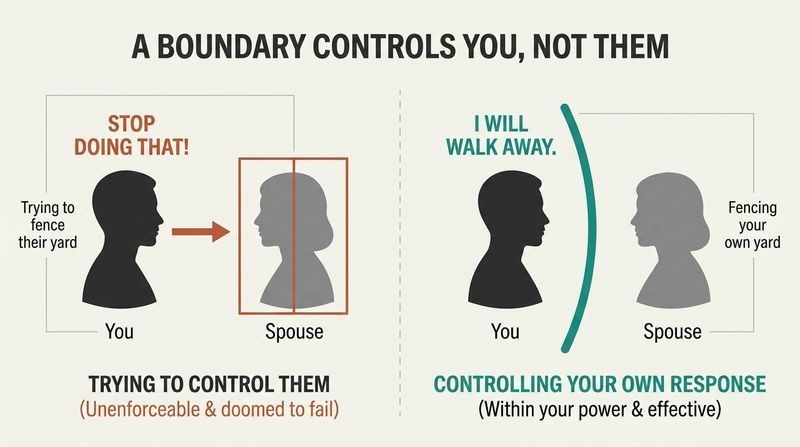
The reframe echoes Epictetus's dichotomy of control: energy spent on what lies outside your power breeds only frustration. It also aligns with modern marital research (Gottman) showing that self-regulation, not partner-correction, predicts stability. The danger the authors flag is real and worth underscoring: "boundary" language is easily weaponized as a euphemism for coercion or stonewalling. The honest test is enforceability. If your "boundary" is really a demand phrased as an ultimatum ("you must"), it is control in disguise. A true limit names your own action and leaves the other person genuinely free to choose.
Stop trying to change your spouse; start with the plank in your own eye
Own the problem before blaming. Lynn was furious that her husband Tom came home late for dinner every night. Nagging failed. So she shifted the problem from "Tom's lateness" to "my unhappiness with Tom's lateness," which she could actually control. She apologized for being a shrew, promised warmth, and added a consequence: if he missed dinner, his plate went in the fridge for him to reheat himself. Tom hated cold food more than he feared her anger, and he started coming home.
You own half the marriage and all your soul. The authors note that couples rarely split blame 100/0. Scott needed his wife's overdrafts to fuel his lifelong grievance against "irresponsible people." Once he saw his own payoff, real change began. The chapter no one wants to read is the one about limits on yourself.
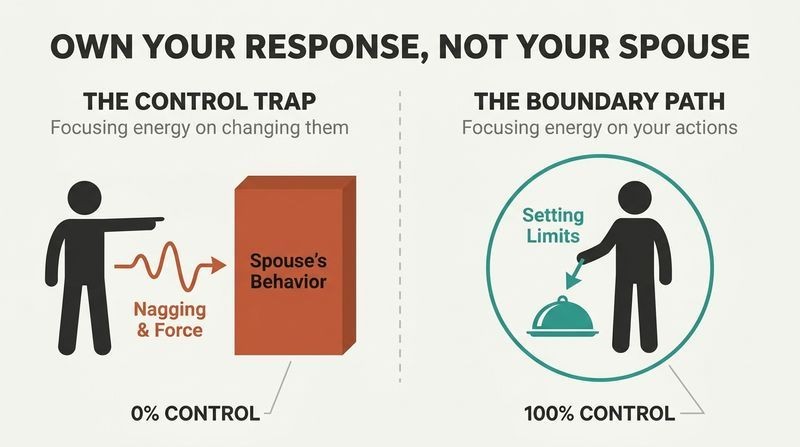
This is cognitive reappraisal applied to marriage: reframing a fixed external grievance into a controllable internal stance. It resonates with systems theory, where each partner unconsciously maintains the very pattern they complain about (the "identified patient" is never the whole story). The Lynn story is quietly radical because it pairs increased warmth with a firmer limit, defeating the false binary that you must be either nice or tough. One caution: the "you always play a part" principle can curdle into self-blame when a spouse is genuinely abusive. Ownership of your contribution is not the same as owning responsibility for another's cruelty.
Where there is no freedom, love dies and rebellion grows
Freedom, responsibility, and love form a triangle. The book opens with two long-married couples. Harold barks "Sarah. Dessert." and expects obedience; they are legally bound but emotionally dead. Frank notices Julia is tired and offers to drive the guest home himself; their hearts are knit together. The difference was decades of boundary work. Julia had once put her foot down, nearly divorced, and grew.
Control produces slavery, then revolt. The authors argue love only survives in freedom: fear drives it out. When one spouse controls and the other complies, resentment festers and often erupts in rebellion or affairs. As love grows, each partner becomes freer from self-centeredness and old wounds, which fuels more responsibility, which fuels more love. Marriage is not slavery; each person stays free from the other and therefore free to love.
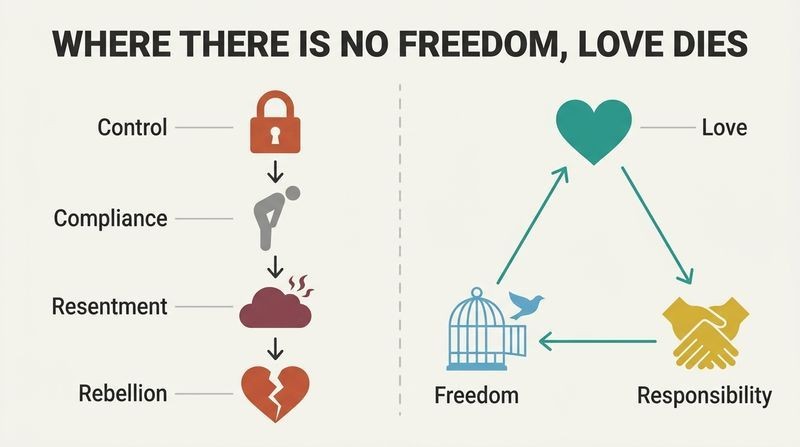
The claim that coercion breeds rebellion has robust support in self-determination theory (Deci and Ryan), which finds autonomy is a basic psychological need; controlling environments reliably reduce intrinsic motivation and satisfaction. The triangle also anticipates attachment research: secure connection requires both closeness and the freedom to be a separate self. Where the framing gets tricky is the implicit optimism that granting freedom reliably rekindles love. Sometimes a freed partner discovers they want out. Freedom is a precondition for genuine love, not a guarantee of it, which is precisely what makes it courageous rather than merely strategic.
Marry to complement, not to complete; two whole people make one
Completing differs from complementing. Amanda fell for Eric's suave assertiveness at a party; she lacked that strength herself. He was drawn to her sweet compliance; he feared vulnerability in himself. Each borrowed from the other what they refused to develop internally. Then the merger backfired: she felt steamrolled, he felt smothered by her resentment. They had to grow into two separate adults before they could form a real "we."
Complements are gifts; completing is a trap. It is healthy that one spouse is the business mind and the other the organizer. That enriches a team. It is dysfunctional to marry a "meal ticket" or a substitute parent to patch a hole in your character. The authors list capacities each person must own independently: connecting emotionally, saying no, taking initiative, grieving, being sexual, thinking for oneself. Marriage gives your wholeness new range; it cannot manufacture wholeness.
This distinction cuts against the "you complete me" romantic ideal and aligns with differentiation theory (Murray Bowen, later Schnarch): the capacity to stay yourself while staying close is the engine of durable intimacy. The Amanda-Eric arc illustrates why opposites attract and then repel: we are drawn to the disowned parts of ourselves projected onto a partner, then resent seeing them. The nuance worth adding is developmental. Nobody enters marriage fully complete, so the goal is not a finished self but a growing one. The relationship itself becomes the workshop, provided neither partner outsources their maturation to the other.
You get what you tolerate; happiness is the worst value to chase
Values are the marriage's real boundaries. The authors argue that in an imperfect world, imperfection seeks its own level: you get exactly what you tolerate. What you refuse to allow stays out; what you actively cultivate grows. They nominate six load-bearing values: love of God, love of spouse, honesty, faithfulness, compassion and forgiveness, and holiness.
Happiness makes a terrible compass. A young man kept complaining his girlfriend didn't "make him happy" whenever the relationship required effort. Cloud told him to get a goldfish, since even a dog would inconvenience him. Happiness is a result, not a guide. When a hard patch arrives, the happiness-worshipper concludes something is wrong and bails, missing that the crisis is often an invitation to grow. Like a driver who blames his car for hitting trees, he trades partners instead of improving his driving.
The critique of happiness as a target anticipates the "hedonic paradox": directly pursuing happiness tends to undermine it, while meaning and mastery produce it as a byproduct (see Viktor Frankl, and later positive-psychology work by Seligman on eudaimonia over hedonism). "You get what you tolerate" is essentially operant conditioning applied to relationships: behavior that meets no resistance persists. The goldfish quip lands because it exposes consumer logic invading intimacy, treating a partner as a mood-delivery service. The one qualifier: chronic unhappiness can also signal a genuinely destructive situation, so the trick is distinguishing the pain of growth from the pain of harm.
Stop paying for problems your spouse should feel themselves
Actions must carry their own consequences. This is the Law of Sowing and Reaping. Randall would come home moody, snap at the family, then storm off to his home office as if nothing happened. His wife Amy absorbed the fallout, tiptoeing and working to cheer him up. Randall "played" while Amy "paid," so he had zero incentive to change, and his moods worsened.
Let the reaper be the sower. The fix is to return the consequence to its owner. Amy could tell Randall his rage is unacceptable and that the next outburst means the family leaves for a movie, letting him reap the loneliness he sowed. Refusing to rescue (declining to cheer up a pouter, pay off a reckless credit card, or call in sick for a hungover spouse) keeps the problem attached to the person who created it. This is love, not cruelty, unless done for revenge.
This is the clinical concept of enabling, familiar from addiction treatment, generalized to everyday marriage. The mechanism is behavioral: a consequence absorbed by the wrong person extinguishes the feedback loop that would otherwise prompt change. What elevates the idea past tough-love cliche is the insistence that motive matters; the same action done for revenge poisons the marriage, while done for redemption it heals. A useful extension from family-systems work: the rescuer often gets a hidden payoff too (feeling needed, avoiding conflict), so stopping the rescue requires the enabler to confront their own reasons for playing that role.
You are responsible TO your spouse, not FOR your spouse
Two Greek words draw the line. The Law of Responsibility distinguishes a "burden" from a "load." A burden is a crushing boulder: a crisis, illness, or financial catastrophe. Spouses are commanded to help carry each other's burdens. A load is the daily backpack everyone must shoulder alone: your own feelings, attitudes, values, and ordinary tasks. Confusing the two wrecks marriages.
Two failure modes. On one side, a spouse neglects responsibility to the other, becoming selfish and inconsiderate. On the other, a spouse takes on responsibility for the other, trying to make an unhappy wife happy or manage a grown adult's moods. Trying to fix another person's feelings is an impossible project that breeds exhaustion and resentment. You can be sympathetic to your spouse's unhappiness without adopting it as your job to cure.
The burden-versus-load frame is a crisp antidote to codependency, and it maps neatly onto emotional-boundary research: chronic over-functioning correlates with burnout, anxiety, and diminished relationship satisfaction. Philosophically it draws a line between compassion (feeling with) and fusion (feeling for), a distinction Buddhist psychology also prizes. The practical difficulty is discernment in real time: is your partner facing a genuine boulder that warrants stepping in, or a daily backpack they need to carry to grow? Get it wrong toward rescue and you infantilize; wrong toward distance and you abandon. The categories are clean, but life delivers them mixed.
Deception is the one betrayal that makes repair impossible
Lying corrodes more than what's lied about. Rachel kept discovering her husband's hidden debts, loans, and unpaid bills. Her line was piercing: she could handle any truth, but the surprises were killing her. The authors argue almost anything (even an affair) can be worked through, except deception, because deception denies the very problem that forgiveness would address. The moment deception enters, real relating ends.
Honesty unlocks intimacy. Christy felt she was slowly dying inside her "perfect" marriage to a relentlessly nice husband who discounted her feelings. Only when both finally exploded into raw honesty (her hatred of the marriage, his buried longing and anger) did they fall into each other's arms and build the connection they craved. Intimacy means being fully known. But honesty needs grace as its partner: promise never to punish your spouse for telling the truth.
The claim that concealment damages more than the concealed act tracks with betrayal-trauma research: partners of the unfaithful often report the deception and gaslighting as more wounding than the sexual breach itself, because it attacks their grip on reality. Calling deception the "unforgivable" sin is rhetorically strong; strictly, it is unforgivable only while it continues, since confession reopens the door. The paired demand (radical honesty plus a no-punishment guarantee) is the crucial and often-skipped half. Honesty without safety simply trains people to hide better, which is why interrogation-style marriages produce ever more sophisticated lies.
Take grievances straight to your spouse, never to a third party
Triangulation drains the marriage. A marriage is a two-person club, "forsaking all others." Triangulation happens when one spouse routes to an outside party (Person C) what belongs with the partner (Person B): venting to a best friend about your husband, confiding to a secretary that your wife doesn't understand you, or making a child your emotional confidant. Each act siphons a piece of your heart out of the marriage.
Intruders are usually symptoms, not causes. Work, kids, hobbies, in-laws, and affairs move into the vacuum left by unresolved conflict. Marcia buried her ungrieved grief over her mother's death under busyness that crowded out her husband. The remedy is not banning all outside life (healthy marriages need friends and support; Ruth Graham quipped hers worked because "he plays golf and I play bridge") but ensuring outsiders strengthen rather than replace the bond, and treating the root, not the symptom.
Triangulation is a cornerstone of Bowen family-systems theory: anxiety in a two-person system gets discharged by pulling in a third, which stabilizes the pair while entrenching the problem. Gossip is its everyday form, and the authors' scripted response to a friend caught in the middle ("talk to him first, then tell me how I can help") is a practical way to refuse the triangle. The sharp insight is that the intruder is a fruit, not a root; couples who merely schedule date nights without addressing the underlying vacuum find the dates hollow. The counterbalance the authors honor: total self-containment is idolatry, not intimacy.
Consequences must be reality-based and calm, never payback
Know which spouse you're dealing with. The authors split people into boundary lovers, who welcome feedback, own their behavior, and self-correct, and boundary resisters, who deny, rationalize, blame, and reverse the issue. With a lover, conflict resolves through observation, honest confrontation, ownership, and repair. With a resister, you need consequences.
Design consequences like a wise parent. A good consequence is deliberate (planned with friends, not spat out in anger), reality-based (a rager gets left alone, since no one wants to be near a tantrum), appropriately severe, enforceable, immediate, and respectful. It protects you rather than punishes them. Michael kept earning more to fund his wife Sharon's spending until a friend rediagnosed the real problem: Sharon hated hearing no. The fix wasn't more income but a limit, held with love, plus warning and follow-through. A boundary without a consequence is just nagging.
The consequence checklist mirrors sound behavioral parenting (natural and logical consequences, per Dreikurs) and applies it, provocatively, to spouses. Framing an adult partner like a testing child risks condescension, and the authors partly own this by insisting consequences preserve the other's freedom and dignity. The deepest point is motivational hygiene: the same act done from revenge versus protection lands completely differently, both ethically and practically, because partners detect the difference. One extension from negotiation research: warnings work because they convert a surprise into a predictable cost, restoring agency to the offender. The Michael story also illustrates misdiagnosis, treating a symptom (money) while the real issue (an inability to accept limits) goes untouched.
Divorce is not a boundary; it ends the marriage instead of healing it
Suffer in the right direction. The authors distinguish godly suffering (the discomfort of doing the right thing, like telling a hard truth or holding a limit) from ungodly suffering (the pain of doing the wrong thing, like endlessly rescuing a rager or nagging). Silent, resentful endurance is not virtue; it is often fear of conflict. The goal of boundaries is to trade fruitless suffering for productive suffering that produces growth.
Boundaries belong inside the marriage. Kelly's friend told her that "getting boundaries" meant divorcing her distant husband. The authors call this a misuse. Divorce is not a limit within a relationship; it is the relationship's end, and it should never be the first stand. The right sequence is to get support, remove your own log, invite change, warn, apply consequences, be patient, and suffer long. Done well, you rarely need to leave; the destructive spouse either changes or chooses to depart.
This is the book's most contested and most Christian claim, and it deserves both respect and scrutiny. The godly-versus-ungodly-suffering distinction is genuinely useful: it reframes passivity as a choice with consequences rather than noble martyrdom, echoing Frankl's insight that suffering gains meaning only when it is unavoidable and serving growth. The vulnerability is that "suffer long before leaving" can trap victims of abuse, and the authors do carve out separation for danger, addiction, and betrayal. The wise reading: boundaries aim at redemption, but self-protection is never optional. A limit that keeps you inside a harmful system indefinitely has stopped functioning as a boundary at all.
Analysis
Boundaries in Marriage takes a single metaphor, the property line, and stretches it across the entire terrain of intimate partnership. Cloud and Townsend, both clinical psychologists writing from an evangelical frame, make one counterintuitive move that organizes everything: the boundaries that save a marriage are almost never the ones you set on your spouse. They are the ones you set on yourself. This inverts the reader's instinct (I bought this to fix my partner) and redirects it toward ownership, self-control, and the plank in one's own eye.
Structurally the book layers three systems: the nature of boundaries (ownership, responsibility, freedom, protection), a set of ten laws that operate like physics regardless of belief, and six load-bearing values that give a marriage its shape. The strongest material is diagnostic. The burden-versus-load distinction, the sowing-and-reaping principle of not paying for another's problems, and the boundary-lover-versus-resister typology are portable tools any couple can use, secular or not.
The book's intellectual DNA overlaps heavily with differentiation theory (Bowen, Schnarch) and self-determination theory, even though it cites Scripture rather than journals. Its claim that love requires freedom is empirically defensible; controlling relationships reliably corrode satisfaction. Its weaker moments are the occasional tidiness of its case studies, which resolve a bit too cleanly, and an optimism that holding a loving limit tends to redeem a resistant partner. Real outcomes are messier.
The most valuable and most dangerous chapters concern suffering and divorce. The godly-versus-ungodly-suffering frame rescues readers from martyrdom-as-virtue, but its counsel to suffer long before leaving demands the safety carve-outs the authors provide and readers must not skip. Read critically, the book delivers a durable thesis: you are responsible to your spouse and for yourself, and self-control, not partner-control, is where love actually grows.
Review Summary
Boundaries in Marriage receives mostly positive reviews, praised for its practical advice on setting healthy boundaries in relationships. Readers appreciate its biblical foundation and emphasis on personal responsibility. Many find it helpful for improving communication and resolving conflicts. Some criticize its religious overtones and potential misuse of principles. The book is recommended for both struggling couples and those seeking to strengthen their marriage. Critics note it may not adequately address abusive situations or non-Christian perspectives.
People Also Read


Glossary
Boundary
A personal property lineA line that defines where one person ends and another begins, clarifying who owns which feelings, attitudes, and behaviors. In marriage, a boundary is fundamentally about self-control: it states what you will or will not do, not what you demand your spouse do. Boundaries protect love by preserving freedom and responsibility for each partner.
The Ten Laws of Boundaries
Fixed principles governing responsibilityCloud and Townsend's set of principles that operate in relationships like laws of physics, whether or not people are aware of them. They include Sowing and Reaping, Responsibility, Power, Respect, Motivation, Evaluation, Proactivity, Envy, Activity, and Exposure. The laws describe how responsibility and consequences actually work, offering principles rather than quick techniques.
Law of Sowing and Reaping
Actions carry their own consequencesThe principle that behavior produces natural results, and problems only change when the person who created them experiences the consequences. When one spouse absorbs the fallout of the other's irresponsibility (one plays, the other pays), the irresponsible spouse has no incentive to change. Refusing to rescue returns the consequence to its owner.
Law of Responsibility
Responsible to, not forThe principle that spouses are responsible to each other but not for each other. It distinguishes a burden (a crushing crisis that partners should help carry) from a load (the daily responsibilities, feelings, and attitudes each person must carry alone). Taking over another adult's load breeds resentment and prevents their growth.
Completing versus Complementing
Wholeness versus filling holesComplementing means two whole people bring different strengths, gifts, and perspectives to form a stronger team. Completing means using a spouse to patch a gap in one's own character, such as marrying someone assertive because you cannot assert yourself. The authors argue completing always backfires; only two complete individuals can truly become one.
Triangulation
Routing grievances to a third partyWhen one spouse takes something that belongs in the marriage (a complaint, an emotional need, a confidence) to an outside party instead of directly to the partner. Examples include venting about a husband to a friend, confiding in a coworker, or making a child a confidant. It drains intimacy and betrays trust; gossip is one form.
Boundary Lover versus Boundary Resister
Feedback-welcoming versus feedback-rejecting spouseA boundary lover is open to feedback, owns their behavior, respects the other's freedom, and self-corrects, making conflict easy to resolve. A boundary resister denies, rationalizes, blames, or reverses issues, requiring warnings and consequences. The distinction determines whether a couple can problem-solve as a team or one spouse must set limits alone.
Godly versus Ungodly Suffering
Growth pain versus wrong-behavior painGodly suffering is the discomfort that comes from doing the right thing, such as telling a hard truth or holding a limit; it produces growth. Ungodly suffering comes from doing the wrong thing, such as endlessly rescuing or nagging; it is a signal to change. Boundaries aim to trade fruitless suffering for productive suffering.
Agape
Love seeking the other's goodThe self-giving love the authors say should anchor marriage, modeled on God's love. Unlike attraction or gratification-based affection, agape seeks the welfare of the other regardless of how they are pleasing you at the moment. It expresses itself through empathy, commitment (covenant), and action, and persists even when the feeling of love fades.
FAQ
What's Boundaries in Marriage about?
- Understanding Boundaries: The book explores the concept of boundaries within marriage, focusing on personal responsibility and mutual respect. It highlights how boundaries help couples maintain individuality while growing closer.
- Promoting Love and Growth: Authors Dr. Henry Cloud and Dr. John Townsend emphasize that love must be balanced with freedom and responsibility to prevent resentment and allow love to flourish.
- Practical Guidance: It offers practical advice on setting and maintaining boundaries, resolving conflicts, and fostering healthy relationships, supported by real-life examples and actionable steps.
Why should I read Boundaries in Marriage?
- Improve Relationship Dynamics: The book helps you understand relationship dynamics and how boundaries can enhance communication and intimacy, addressing common issues couples face.
- Learn to Set Boundaries: It teaches how to set healthy boundaries with your spouse and yourself, crucial for personal growth and relationship satisfaction, leading to a more fulfilling marriage.
- Biblical Foundation: The authors provide a biblical perspective on marriage, emphasizing love, honesty, and commitment, appealing to readers seeking a faith-based approach.
What are the key takeaways of Boundaries in Marriage?
- Boundaries Promote Love: Boundaries are essential for love to grow, protecting individuals and creating a safe environment for intimacy.
- Responsibility and Freedom: Couples must take responsibility for their feelings and actions while allowing their partner the freedom to do the same, crucial for a healthy relationship.
- Character Growth: Personal growth is emphasized, encouraging readers to work on character issues like honesty and ownership to improve their marriage.
What are the best quotes from Boundaries in Marriage and what do they mean?
- “You get what you tolerate.”: This highlights the importance of setting standards in marriage, as allowing negative behaviors to persist will continue to affect the relationship.
- “We are responsible to each other, but not for each other.”: It emphasizes mutual support without taking on each other's problems, encouraging personal accountability and a supportive environment.
- “Love is patient, love is kind.”: From 1 Corinthians 13:4-8, this quote underscores the qualities that should define love in marriage, emphasizing compassion and understanding.
How does Boundaries in Marriage define boundaries?
- Definition of Boundaries: Boundaries are described as property lines that define where one person ends and another begins, helping individuals understand ownership of feelings, attitudes, and behaviors.
- The Triangle of Boundaries: The authors introduce freedom, responsibility, and love as interconnected elements supporting healthy boundaries, each reinforcing the others for a balanced relationship.
- Misunderstanding Boundaries: Common misconceptions are addressed, such as viewing boundaries as selfish or controlling, instead framing them as essential for personal growth and mutual respect.
How can I apply the Ten Laws of Boundaries to my marriage?
- Law of Sowing and Reaping: Understand that actions have consequences; sowing kindness and respect leads to a loving relationship, while negativity leads to distance and resentment.
- Law of Responsibility: Recognize responsibility for your own feelings and actions while being supportive of your spouse, creating a balanced dynamic for both partners to thrive.
- Law of Respect: Respect your spouse’s boundaries as you wish for yours to be respected, fostering a safe environment for open communication and intimacy.
How do I establish boundaries in my marriage according to Boundaries in Marriage?
- Identify Specific Issues: Recognize specific boundary issues like communication problems or financial disagreements, and articulate unacceptable behaviors and their effects.
- Communicate Openly: Use “I” statements to express feelings and needs without blaming your partner, fostering understanding and respect.
- Set Consequences: Be prepared to establish consequences if boundaries are violated, ensuring they are fair and related to the boundary issue.
How do I deal with conflicts in my marriage according to Boundaries in Marriage?
- Identify the Conflict Type: The book outlines six kinds of conflict, helping you understand the nature of disagreements and guiding your approach to resolution.
- Use Boundaries to Resolve: Set limits on how conflicts are addressed, ensuring both partners feel safe to express feelings, preventing escalation and promoting constructive dialogue.
- Seek Mutual Solutions: Work together to find solutions that respect both partners' needs and boundaries, fostering intimacy and strengthening the relationship.
What role does honesty play in Boundaries in Marriage?
- Foundation of Trust: Honesty is essential for building trust in a relationship, as deception can erode the connection between partners.
- Encourages Vulnerability: Being honest allows both partners to be vulnerable, fostering deeper intimacy and a strong emotional bond.
- Promotes Growth: Honest communication helps identify areas for personal and relational growth, encouraging responsibility for actions and feelings.
How can I deal with a boundary-resistant spouse as described in Boundaries in Marriage?
- Establish Clear Communication: Clearly express your feelings and the boundaries needed in the relationship, using empathetic language to help your spouse understand your perspective.
- Set Consequences: If resistance continues, establish appropriate consequences that protect your well-being, ensuring they are fair and related to the boundary issue.
- Seek Support: Surround yourself with supportive friends or a counselor to help navigate challenges, providing strength and encouragement.
What role does compassion and forgiveness play in Boundaries in Marriage?
- Foundation for Healing: Compassion and forgiveness are essential for healing and maintaining a loving relationship, allowing couples to move past conflicts and imperfections.
- Encouraging Growth: Showing compassion helps partners grow and learn from mistakes, fostering a more resilient marriage.
- Creating Safety: Practicing forgiveness creates a safe environment where both partners can express feelings without fear of judgment or retaliation.
How can I ensure my spouse feels valued in our marriage?
- Practice Empathy: Make an effort to understand your spouse’s feelings and experiences, showing that you value their perspective and fostering a deeper connection.
- Encourage Individuality: Support your spouse’s interests and passions outside the relationship, demonstrating respect for their individuality and valuing their happiness.
- Communicate Appreciation: Regularly express gratitude and appreciation for your spouse’s contributions, reinforcing their value and strengthening your bond.
About the Author
Other books by Henry Cloud





Download PDF
Download EPUB
.epub digital book format is ideal for reading ebooks on phones, tablets, and e-readers.








































