

Key Takeaways
The world's most powerful bank meets in secret, and you've never heard of it
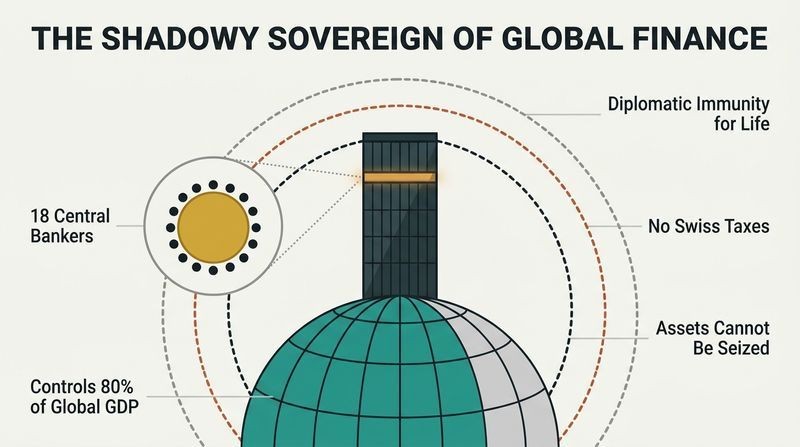
A club of eighteen central bankers runs global money. Every other month, eighteen central bank governors gather on a Sunday evening in Basel, Switzerland, in a tinted-glass tower overlooking the railway station. Over grand cru wines on the eighteenth floor, they discuss the fate of the world economy. No minutes are taken. Nothing is reported. This is the Bank for International Settlements (BIS), founded in 1930, the oldest global financial institution, predating both the IMF and World Bank.
Its privileges rival a sovereign state. The BIS pays no Swiss taxes, its buildings are legally inviolable, its staff enjoy diplomatic immunity for life, and its assets cannot be seized. The countries represented at its meetings account for roughly four-fifths of global GDP, yet the bank remains almost invisible to the public.
What's striking is how deliberately this invisibility was engineered. LeBor frames the BIS as the institutional embodiment of technocratic power operating beyond democratic reach, a theme that resonates with political scientists studying the "democratic deficit" in global governance. The comparison worth drawing is to the Basel meetings versus the transparency demanded of the US Federal Reserve, which publishes minutes and testifies to Congress. The tension the book surfaces (public servants managing public money in total secrecy) is genuinely unresolved. Skeptics might counter that confidential deliberation among specialists sometimes produces better crisis responses than politicized public debate, a point even critics of central-bank opacity concede.
A bank built to punish Germany was designed to serve bankers forever
The official purpose masked the real one. The BIS was ostensibly created to administer Germany's World War I reparations under the 1929 Young Plan. But its architects, Bank of England governor Montagu Norman and Reichsbank president Hjalmar Schacht, wanted something more ambitious: a permanent, self-financing club for central bankers, free from politicians and journalists. Norman even asked the editor of The Economist to draft statutes guaranteeing the bank's independence from governments.
Reparations vanished; the bank endured. Within a few years reparations collapsed, the gold standard died, and both original justifications disappeared. Yet the BIS proved impossible to close, because its statutes were locked by international treaty. As its first president admitted, administering reparations was routine work any trust company could do. The bank's true mission was building transnational finance itself.
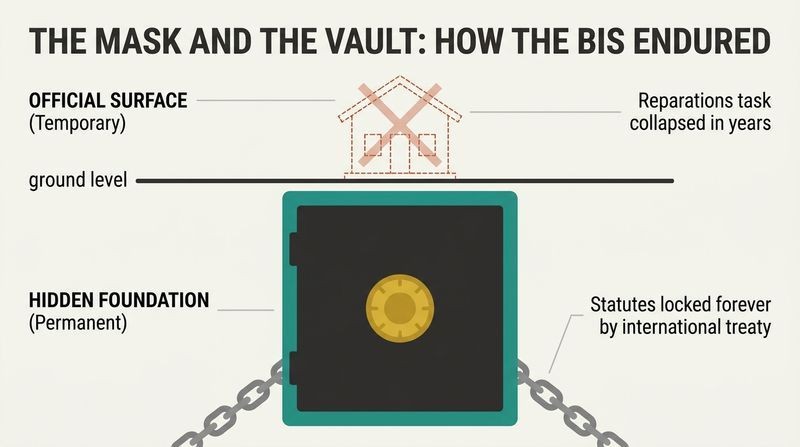
The insight here is a classic case of what sociologists call goal displacement: an organization outliving its stated mission and inventing new reasons to exist. LeBor argues the BIS was never really about reparations at all, which the historical record supports. Norman's own words about wanting a "private and eclectic Central Banks Club" predate the reparations crisis. What deserves scrutiny is whether permanence was cynical design or prudent institution-building. Institutions that survive shocks often do so precisely because their founders built in legal insulation. The same treaty armor that enabled wartime abuses also let the BIS midwife postwar European recovery, a genuinely double-edged legacy.
Financial stability is largely a confidence trick, and Schacht proved it
Money's value is belief, not backing. When hyperinflation ravaged Germany in 1923, Hjalmar Schacht stabilized the currency with the rentenmark, notionally backed by German land rather than gold. Nobody could actually redeem a rentenmark for a piece of a field. It worked anyway. Schacht understood the core psychological truth of money: the appearance of stability creates real value. If people believe someone is in charge and the chaos is ending, the currency holds.
The Yap stone parallel. LeBor illustrates with the Pacific island of Yap, where islanders used giant immovable limestone discs as money, transferring ownership without moving the stones, even trusting in one disc lost underwater. When France stored gold at the New York Fed in 1932, clerks simply relabeled drawers. Both systems rest on shared faith, not physical transfer.
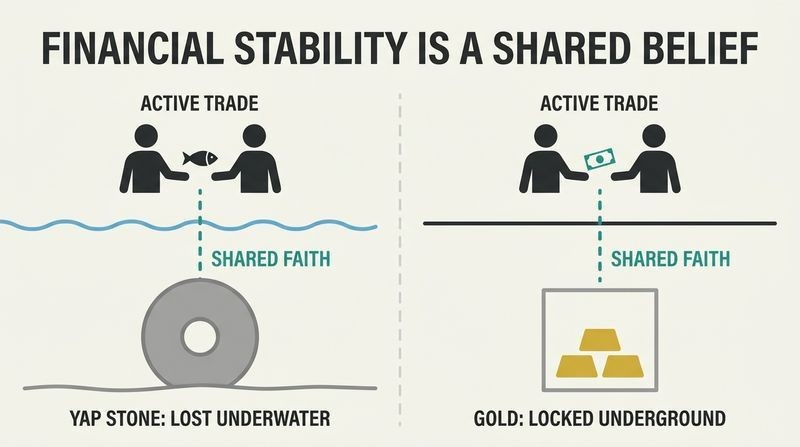
This connects directly to modern monetary theory and the fiat-currency debates. Economist Milton Friedman, whom LeBor cites, used the Yap example precisely to show that gold and stone discs are equally arbitrary stores of value. The insight anticipates the 2008-era recognition that bank runs are self-fulfilling prophecies driven by expectation, not fundamentals. Schacht's genius was essentially expectations management, the same tool Mario Draghi wielded decades later with his "whatever it takes" pledge that calmed markets without spending a cent. The unsettling corollary: if confidence is everything, then whoever controls the narrative of stability holds enormous, largely invisible power over ordinary people's savings.
Bankers' loyalty to finance outranked their loyalty to nation, even in wartime
Neutrality became complicity. During World War II the BIS declared itself neutral, but functioned as what Reichsbank official Emil Puhl called the Reichsbank's "only real foreign branch." It accepted looted Nazi gold, some melted from the teeth of concentration camp victims, conducted foreign exchange deals for Germany, and recognized Nazi annexations. American president Thomas McKittrick ran the bank while his homeland fought Germany, dining regularly with Puhl.
The Czech gold betrayal. In March 1939, after Germany invaded Czechoslovakia, the Nazis ordered the transfer of 23.1 metric tons of Czech gold held at the Bank of England. Montagu Norman let it go through, insisting politics must not interfere with BIS operations, even gold demanded at gunpoint. He declared his primary loyalty was not to Britain but to the bank, an admission close to treason.
The chilling concept underneath is what Hannah Arendt, discussing Nazi bureaucrats, called the "banality of evil," and what LeBor extends into finance as amoral formalism. The bankers were not ideologues; they simply believed transactions properly authorized required no moral inquiry into origins. This mirrors contemporary debates about correspondent banking, money laundering, and "know your customer" rules, where compliance-as-paperwork can launder atrocity. The steelman: keeping financial channels open across front lines arguably served postwar reconstruction. But LeBor's damning point stands, that treating stolen gold as fungible product, no questions asked, is precisely the logic that lets institutions participate in mass crime while feeling professionally blameless.
Wall Street financed Hitler's war machine, then escaped accountability
American capital built the Third Reich. Between 1924 and 1931, US banks poured hundreds of millions into Germany. Standard Oil formed a cartel with IG Farben, the chemical conglomerate that ran its own concentration camp at Auschwitz manufacturing synthetic rubber. General Motors and Ford's German subsidiaries produced the trucks that invaded Poland. IBM's punch-card machines catalogued Jewish assets. John Foster Dulles arranged the loans; his brother Allen protected the players.
Justice was quietly buried. At the 1942 dinner honoring McKittrick in New York, thirty-seven of America's most powerful financiers gathered, many with lucrative German ties. After the war, John McCloy, the US High Commissioner and former Cravath lawyer for IG Farben's US arm, freed imprisoned industrialists. IG Farben executives received sentences as short as four years and rejoined corporate boards.
LeBor's account aligns with a body of scholarship (Higham, Simpson, Black) documenting corporate collaboration, though historians debate how much control US parents retained over seized German subsidiaries. The deeper structural point is that transnational capital forms bonds more durable than regimes or wars. What makes this uncomfortable rather than merely historical is the continuity: the same networks that financed rearmament shaped the postwar order. A useful counterweight is that some of these firms also powered the Allied war effort, and that hindsight flattens the genuine uncertainty of the 1930s. Still, the pattern of profit insulated from consequence is the book's most forceful indictment.
The euro was engineered inside the BIS, not born in Brussels
Basel was the euro's hidden workshop. From the 1947 Paris multilateral payments agreement through the European Payments Union, the Snake exchange-rate mechanism, and the 1988-89 Delors Committee, the BIS supplied the technical machinery for European monetary integration. The Delors Committee, which drafted the blueprint for the single currency, met not in Brussels or Frankfurt but in Basel, with BIS staff support. Alexandre Lamfalussy, BIS general manager, was dubbed the "Father of the euro."
A single currency without a single government. Lamfalussy warned in a 1989 memo that a common monetary policy required a common fiscal policy, and suggested adding "enforceable" rules. His warning was ignored. As Paul Volcker put it, a central bank without a government was a peculiar thing. That unresolved contradiction later detonated the Eurozone crisis, exactly as predicted.
This is the book's most consequential contemporary claim, and it holds up against the documentary record James assembled in his history of monetary union. The design flaw Lamfalussy flagged (monetary union without fiscal union) is now economics-textbook orthodoxy, validated by the Greek crisis. What LeBor adds is the institutional lineage: technocrats, not electorates, drove integration, often by reframing profoundly political choices as neutral technical measures. Critics of this framing note that democratic governments did ratify the treaties. But the referendum record LeBor cites (Denmark, France, Ireland repeatedly voting no) suggests genuine public ambivalence steamrolled by elite consensus, a live tension in European politics today.
Watch how power reframes political choices as boring technical decisions
Depoliticization is a strategy, not a description. LeBor's recurring theme is that the most far-reaching transfers of sovereignty were disguised as dull administrative matters. The European Coal and Steel Community sounded like a bureaucratic trade pact; it was actually the first supranational body with regulatory power over member states. A 1965 State Department memo even advised pursuing monetary union without public discussion until it became "virtually inescapable."
The technocratic creed. Reaching back to Norman and Jean Monnet, the belief is that a small, expert elite should manage finance and economics, shielded from populist pressure and accountability. The BIS annual reports, praised as models of neutral analysis, described the Nazi "Aryanization" of Jewish firms as a mere technical liquidity question, with no word of condemnation. Calling something "technical" is how the political gets smuggled past citizens.
This is arguably the book's most transferable mental model, applicable well beyond finance. Political theorist Chantal Mouffe calls this "post-politics," the draining of genuine contestation from decisions presented as mere administration. The pattern recurs in central-bank independence, algorithmic governance, and technocratic pandemic policy. The steelman for depoliticization is real: insulating interest rates from electoral cycles genuinely curbs inflationary populism, and expertise matters. The danger LeBor names is that "technical" becomes an alibi that forecloses debate people are entitled to have. Readers can apply this lens skeptically whenever a consequential change is sold as too complicated or apolitical to warrant public scrutiny.
The people who managed Hitler's economy quietly ran postwar Germany's banks
Continuity, not rupture. Germany lost the war but won the economic peace, LeBor argues, largely through the BIS. Between 1948 and 1980, 39 percent of officials on the executive boards of West Germany's central banks were former Nazis. Karl Blessing, who worked at the BIS in the 1930s, oversaw an empire of slave-labor concentration camps at the oil firm Kontinental-Öl, then returned to Basel in 1958 as president of the Bundesbank, recast as a resistance member.
Allen Dulles curated the comeback. As postwar intelligence chief, Dulles compiled lists of Germans suitable for high office, whitewashing figures like Blessing by downplaying their records. Hermann Abs, the most powerful banker of the Third Reich, rebuilt Deutsche Bank and was later eulogized as Germany's outstanding banker.
The uncomfortable truth here is that reconstruction required the very expertise concentrated in compromised hands, a dilemma every transitional-justice scholar confronts. Denazification collided with the Cold War imperative to rebuild a bulwark against the Soviets, and realpolitik won. LeBor's use of Arendt's "desk-murderers" is apt: Blessing never fired a shot but signed the payrolls that leased human beings from the SS. The broader lesson connects to studies of elite persistence, showing how professional networks survive regime collapse across contexts from post-Soviet states to post-apartheid South Africa. The moral cost, rarely tallied, is that institutional memory and institutional impunity often travel together.
A single Basel phone call helped topple Communism in Eastern Europe
Personal trust moves billions. In 1982 Hungary faced capital flight and collapse. Hungarian banker János Fekete asked BIS president Fritz Leutwiler for a bridging loan. Leutwiler phoned the IMF's managing director, confirmed Hungary's membership was progressing, and approved loans totaling $510 million. The backing signaled international faith in Hungary's reformers, strengthened them politically, and accelerated liberalization.
The domino effect. Hungary's experiments with limited private enterprise, reinforced by BIS and IMF confidence, weakened the Communist party's grip. In August 1989 Hungarian border guards let thousands of East German refugees cross into Austria, opening the Iron Curtain three months before the Berlin Wall fell. The BIS also hosted biannual meetings for Eastern Bloc central bankers, reasoning that the more Communists learned capitalism, the faster their system would crumble.
This episode showcases the BIS's soft power at its most benign, and complicates the book's otherwise critical arc. It illustrates a principle from network theory: institutions that concentrate trusted relationships can act with speed impossible for formal bureaucracies. The same intimacy that enabled wartime collusion enabled rapid crisis response. Whether one loan "helped topple Communism" is a bold causal claim, and historians would rightly note many converging forces. But the mechanism LeBor identifies (confidence signals cascading through opaque elite channels) is real and repeats in every sovereign-debt rescue, from Mexico in 1982 to the Eurozone. Power exercised through a handshake leaves no paper trail to challenge.
Central bankers now trust each other more than their own governments
A brotherhood above nations. Former Fed chairman Paul Volcker observed that central bankers felt more at home with each other than with their own governments. The BIS cultivates this deliberately: limousines from Zurich airport, superb wine, separate dinners so no one feels excluded, and total confidentiality. Charles Coombs of the New York Fed recalled that however much money was involved, no agreement was ever signed; each banker's word sufficed.
Crisis camaraderie in action. When Kennedy was assassinated in 1963, Coombs defended the dollar by selling foreign currencies before even reaching the European governors, gambling correctly that they would back him. After 9/11, Mervyn King and Roger Ferguson arranged a dollar-liquidity swap by phone, trusting each other enough to say "don't worry" before the legal details were sorted.
The phenomenon LeBor describes is what organizational sociologists call an "epistemic community," a transnational network bound by shared training, worldview, and mutual recognition. Its upside is genuine: in 2008 and after 9/11, this trust enabled coordination faster than any treaty. The downside is insularity. A group that finishes each other's sentences, cocooned in luxury, risks groupthink and losing touch with the citizens whose savings they govern. Andrew Hilton's quip that central bankers should ride the Basel tram rather than limousines captures it. The deeper worry is accountability: relationships that operate on unrecorded personal trust are, by design, immune to democratic oversight.
Legal immunity built for a vanished age is the BIS's Achilles heel
Inviolability cuts both ways. When Argentina defaulted, it shipped 80 to 90 percent of its foreign reserves to the BIS, placing them beyond creditors' reach. Vulture funds like Elliott Management sued, drawing unwelcome attention to the bank's immunities. Swiss courts upheld the BIS, but the case set an unsettling precedent: a defaulting member could stash national reserves in Basel to dodge creditors, echoing the Czech gold logic of 1939.
Reform or erosion. LeBor argues the BIS should hold press conferences after governors' meetings, publish broad themes of discussion, surrender its blanket legal inviolability, and fund social responsibility programs from its profits (nearly $100 million a month in 2011-12). In an age of Twitter, Occupy, and demands for transparency, the treaty-era statutes written in 1930 for a deferential world may become the bank's greatest vulnerability.
The Argentina case crystallizes the book's core paradox: an institution preaching transparency and good governance to commercial banks shields its own affairs behind sovereign-style immunity. This is not merely hypocritical but potentially destabilizing, since the same protections that make the BIS a trusted repository for sensitive transactions (like returning looted Nigerian assets) could enable creditor evasion. LeBor's reform agenda is modest and sensible, essentially applying to the BIS the accountability standards it champions elsewhere. The realist counterpoint is that financial-transaction immunity genuinely serves cross-border monetary cooperation. But immunity without accountability, in a post-2008 world of eroding faith in unaccountable elites, looks increasingly untenable.
Analysis
Tower of Basel is a work of investigative history disguised as institutional biography, and its power lies in sustained continuity rather than any single revelation. LeBor traces one thread (the primacy of transnational finance over nation, ideology, and morality) from the 1930 founding through Nazi collaboration, postwar rehabilitation, and the birth of the euro. The book's central provocation is that the BIS embodies a coherent worldview: that a self-selecting technocratic elite should manage global money, insulated from democratic accountability, and that this creed has proven remarkably consistent across regimes it should have found abhorrent.
Methodologically, LeBor is strongest when documents speak for themselves, the Czech gold transfer, McKittrick's OSS interrogations, Funk's 1940 memo eerily prefiguring the Eurozone. His weakness is a tendency toward guilt-by-association and monocausal drama; claims that the BIS "funded the Holocaust" or that one loan helped topple Communism compress complex causation into headline. A careful reader should separate the well-evidenced (wartime gold laundering, elite continuity in West German banking) from the suggestive (the euro as Nazi economic plan reborn), which LeBor himself concedes is a provocative parallel, not a genealogy.
The book's lasting contribution is conceptual: it teaches readers to detect depoliticization as a technique of power, to see "technical" and "neutral" as words that often mask political transfers of sovereignty. This connects to broader scholarship on epistemic communities, the democratic deficit in global governance, and central-bank independence debates sharpened since 2008. What LeBor cannot fully resolve, and honestly wrestles with, is the genuine tension between expertise and accountability. Insulated technocrats respond faster to crises but answer to no one. In an era when central bankers became household names and quantitative easing reshaped economies, his demand that the BIS meet the transparency standards it imposes on others feels less like conspiracy theory and more like overdue civic hygiene. The tower is visible now; the question is who watches it.
Review Summary
Tower of Basel receives mixed reviews, with praise for its historical insights into the secretive Bank for International Settlements (BIS) and criticism for its focus on Nazi collaboration. Readers appreciate the book's exploration of the BIS's influence on global finance but find the narrative sometimes sensationalist. Some reviewers feel the book lacks depth in analyzing modern BIS operations. Overall, it's seen as an intriguing introduction to an obscure yet powerful institution, though opinions vary on its effectiveness in critiquing the BIS's lack of transparency and accountability.
People Also Read





Glossary
Bank for International Settlements (BIS)
The bank for central banksFounded in 1930 and headquartered in Basel, Switzerland, the BIS is the world's oldest international financial institution. It serves central banks, facilitates their cooperation, conducts gold and currency transactions, and hosts key regulatory committees. Protected by international treaty, it enjoys tax exemption, legal inviolability, and immunity from asset seizure. Its bimonthly governors' meetings gather central bankers representing about four-fifths of global GDP.
Young Plan
1929 German reparations programThe 1929 program, named after American diplomat Owen Young, that restructured Germany's World War I reparations and served as the official justification for creating the BIS. It set payments of roughly $29 billion over 58 years, returned economic control to Berlin, and established the BIS to administer the payments. Reparations collapsed within a few years, but the bank survived.
Economic Consultative Committee (ECC)
Elite inner circle of governorsFormerly known as the G-10 governors' meeting, the ECC is the most influential BIS gathering, restricted to a small group of central bankers from advanced economies. It meets Sunday evenings over dinner, takes no minutes, and shapes the agenda for the broader Global Economy Meeting. Its confidential discussions have steered global responses to financial crises.
Earmarked gold
Gold owned but physically elsewhereA BIS mechanism allowing central banks to transfer gold ownership without physically moving it. Gold physically stored at, say, the Bank of England could be credited to a BIS subaccount, so transferring value between central banks required only a bookkeeping change. This enabled cheap, confidential transactions but also allowed the 1939 transfer of Czech gold to the Reichsbank.
Desk-murderers
Bureaucrats who enabled genocide administrativelyA term from Hannah Arendt, applied by LeBor to bankers like Karl Blessing, describing officials who never personally killed but stamped papers, managed payrolls, and kept money moving to sustain the Nazi machine. They organized slave labor and looting from behind desks, making the Third Reich function while maintaining a sense of professional, amoral detachment.
Harvard Plan
OSS wartime business-cooperation operationA US Office of Strategic Services psychological-warfare operation that used BIS president Thomas McKittrick to broker deals between Allied and German businessmen even during the war. It aimed to preserve German industry and guarantee postwar profits for industrialists, signaling that cooperation would be rewarded after an Allied victory.
Delors Committee
Drafted the euro blueprintThe 1988-89 Committee for the Study of Economic and Monetary Union, chaired by Jacques Delors, that produced the plan for Europe's single currency. It met at the BIS in Basel with BIS staff support, and its report called for an independent European System of Central Banks. BIS general manager Alexandre Lamfalussy was among its most influential members.
FAQ
What’s Tower of Basel: The Shadowy History of the Secret Bank that Runs the World by Adam LeBor about?
- History of the BIS: The book traces the origins, evolution, and influence of the Bank for International Settlements (BIS), an international financial institution founded in 1930.
- Secretive global power: It reveals how the BIS operates as a bank for central banks, wielding immense but largely hidden power over global finance.
- Controversial roles: LeBor details the BIS’s involvement during the Nazi era, its survival after WWII, and its ongoing impact on international monetary policy and economic integration.
- Themes of secrecy and accountability: The narrative questions the transparency, legal immunities, and democratic oversight of the BIS and its elite network of central bankers.
Why should I read Tower of Basel by Adam LeBor?
- Unveils hidden financial history: The book exposes the secretive operations and controversial history of the BIS, an institution rarely discussed in mainstream accounts.
- Insight into global finance: Readers gain a deep understanding of how central banks cooperate, how financial crises are managed, and how monetary policy decisions shape the world economy.
- Relevance to current events: LeBor connects the BIS’s history to contemporary issues like the Eurozone crisis, austerity, and the rise of nationalism, making the book timely and important.
- Critical perspective: The book challenges readers to consider the ethical and political implications of technocratic power and financial secrecy.
What are the key takeaways from Tower of Basel by Adam LeBor?
- BIS as central hub: The BIS is the meeting place and coordinator for central banks, shaping global monetary policy and financial stability.
- Secrecy and legal immunity: The bank’s operations are shrouded in secrecy, protected by extensive legal immunities that limit public oversight and accountability.
- Continuity of financial elites: The BIS embodies a legacy of elite networks and policies that have persisted from the interwar period through WWII to the present.
- Indispensable yet controversial: Despite its opaque nature, the BIS is seen as essential for managing crises and maintaining the international financial system.
What is the Bank for International Settlements (BIS) as described in Tower of Basel by Adam LeBor?
- Bank for central banks: The BIS was founded to promote cooperation among central banks and manage German reparations after WWI, acting as a financial intermediary for national banks.
- Legal immunities and secrecy: It enjoys diplomatic-like immunity, tax exemptions, and confidentiality, with closed meetings and no official minutes.
- Influence on global finance: The BIS facilitates international financial operations, supervises banking standards, and hosts key committees that shape monetary policy worldwide.
- Hub for elite technocrats: It serves as a discreet meeting place for the world’s most powerful central bankers.
How did the BIS operate during the Nazi era according to Tower of Basel by Adam LeBor?
- Complicity with Nazi Germany: The BIS accepted looted Nazi gold, facilitated foreign exchange deals for the Reichsbank, and legitimized Nazi financial operations.
- Key Nazi connections: High-ranking Nazi officials and industrialists, such as Hjalmar Schacht and Hermann Schmitz, were involved with the BIS.
- Neutrality as a cover: The BIS claimed neutrality but effectively became an arm of the Reichsbank, supporting the Nazi war effort through its financial channels.
- Survival through controversy: Despite its wartime actions, the BIS survived postwar scrutiny and continued to operate.
Who were the key figures connected to the BIS highlighted in Tower of Basel by Adam LeBor?
- Montagu Norman: The influential Bank of England governor and BIS founder, who maintained secretive control over the bank’s policies, including during the Nazi era.
- Thomas McKittrick: The American BIS president during WWII, who facilitated intelligence sharing and maintained contacts with both Nazi and Allied officials.
- Jean Monnet: The “Father of the European Union,” whose federalist ideas were closely linked to BIS networks and American policymakers.
- Karl Blessing: A former Nazi and BIS staffer who became president of the Bundesbank and shaped postwar German finance.
What was the relationship between the BIS and American and European financial elites in Tower of Basel by Adam LeBor?
- Interconnected elite networks: The BIS was closely linked to powerful banking families and firms such as the Dulles brothers, J.P. Morgan, Standard Oil, and Brown Brothers Harriman.
- Prewar and wartime cooperation: These elites facilitated German loans and industrial cartels, with American companies like Standard Oil and General Motors collaborating with German firms.
- Postwar continuity: Many financial elites transitioned smoothly into postwar roles, influencing reconstruction and maintaining the BIS’s central role in global finance.
- Influence on policy: The BIS and its networks played a significant role in shaping both wartime and postwar economic policies.
How did the BIS influence postwar European economic integration as described in Tower of Basel by Adam LeBor?
- Managed multilateral payments: The BIS ran the European Payments Union, removing trade barriers and currency restrictions to foster economic cooperation in Western Europe.
- Supported European institutions: It acted as the financial agent for the European Coal and Steel Community, helping establish the foundations for the European Union and the euro.
- Hosted key committees: The BIS provided secretariat services and hosted the Committee of Governors of European Central Banks, crucial for technical and monetary coordination.
- Technical architect of the euro: The BIS played a behind-the-scenes role in the creation and management of the euro and the European Central Bank.
What controversies and criticisms about the BIS does Tower of Basel by Adam LeBor reveal?
- Collaboration with Nazis: The BIS accepted looted Nazi gold and maintained financial operations that indirectly supported the Third Reich.
- Postwar protection of elites: Allied officials helped shield Nazi industrialists and bankers connected to the BIS from prosecution, allowing them to resume influential roles.
- Legal immunities and secrecy: The BIS’s extensive legal protections make it immune from lawsuits and public scrutiny, raising ethical concerns.
- Opaque governance: The bank’s refusal to publish detailed minutes or agendas limits democratic oversight despite its global influence.
What is the significance of the Czechoslovak gold affair in Tower of Basel by Adam LeBor?
- Moral failure of the BIS: In 1939, the BIS transferred Czechoslovakia’s gold reserves to Nazi Germany despite the country’s occupation, prioritizing legalistic neutrality over ethics.
- Political and legal rigidity: BIS officials, including Montagu Norman, refused to block the transfer, arguing that banking operations should not be influenced by politics.
- Public outrage: The affair caused scandal in Britain and highlighted the BIS’s detachment from democratic accountability.
- Precedent for wartime complicity: This event foreshadowed the BIS’s later role in accepting looted gold and supporting the Reichsbank during WWII.
How does Tower of Basel by Adam LeBor describe the role of central bankers and technocrats in global finance?
- Global brotherhood: Central bankers are depicted as a close-knit elite, united by shared interests and a belief in technocratic management, often transcending national loyalties.
- Political power: Despite claims of neutrality, central bankers wield significant political influence by controlling monetary policy and financial stability.
- Secrecy and lack of accountability: The BIS’s confidentiality and legal immunities shield these technocrats from public scrutiny and political control.
- Impact on society: Their decisions shape the lives of millions, often without democratic oversight.
What reforms and changes does Adam LeBor suggest for the BIS in Tower of Basel?
- Increased transparency: LeBor argues the BIS should publish minutes, attendance lists, and meeting themes to improve public accountability.
- Limit legal immunities: He calls for reducing the BIS’s legal protections to align with modern standards and allow for greater scrutiny.
- Corporate social responsibility: The BIS should use some of its profits for philanthropy, education, and social programs to benefit society.
- Balance secrecy and openness: While confidential discussions are necessary, LeBor advocates for a better balance that respects democratic oversight.
What are the best quotes from Tower of Basel by Adam LeBor and what do they mean?
- “The Bank is completely removed from any governmental or political control.” — Gates McGarrah, first BIS president, 1931. This highlights the BIS’s foundational principle of independence, enabling its secretive and powerful role.
- “The BIS is the bank which sanctions the most notorious outrage of this generation—the rape of Czechoslovakia.” — George Strauss, British MP, 1939. This condemns the BIS’s complicity in transferring Czechoslovak gold to Nazi Germany, symbolizing its moral failures.
- “The BIS has been a very important meeting point for central bankers during the crisis, and the rationale for its existence has expanded.” — Sir Mervyn King, Bank of England governor, 2013. This reflects the BIS’s ongoing centrality in managing global financial crises and coordinating monetary policy.
- Quotes illustrate themes: These statements encapsulate the book’s focus on secrecy, power, and the ethical dilemmas at the heart of global finance.
Download PDF
Download EPUB
.epub digital book format is ideal for reading ebooks on phones, tablets, and e-readers.








































