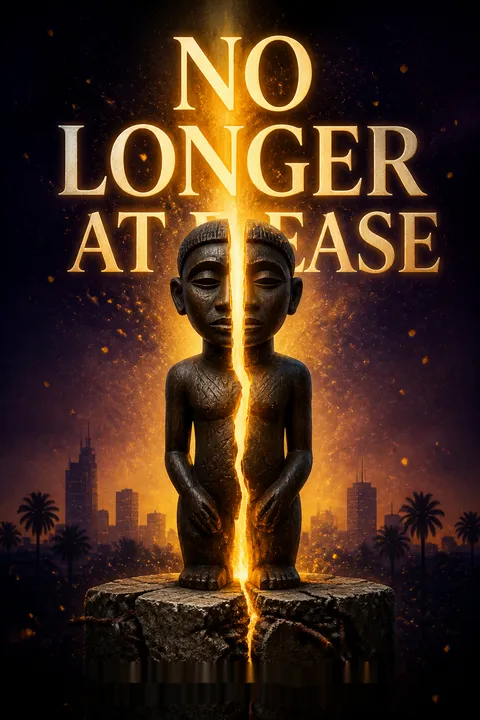

Plot Summary
The Trial's Bitter Dawn
Obi Okonkwo stands in the dock, accused of accepting a bribe. The Lagos courtroom is packed, the city abuzz with the scandal of a young, educated man's fall from grace. Obi, once the pride of his community, is numb, his emotions dulled by recent losses—his mother's death and the end of his relationship with Clara. The judge's words about wasted promise finally break through Obi's stoicism, drawing tears he tries to hide. Outside, his British boss, Mr. Green, and other Europeans discuss the case, reducing Obi's actions to a symptom of African corruption. Meanwhile, the Umuofia Progressive Union debates whether to support Obi, torn between shame and kinship. The chapter sets the tone: a man caught between worlds, ideals, and the crushing weight of expectation.
Umuofia's Only Palm-Fruit
Obi is the cherished son of Umuofia, a small but proud Igbo town. The community, eager to claim modernity, taxes itself to send him to England, hoping he'll return as a lawyer to defend their interests. Instead, Obi studies English, a first sign of his independent streak. His family's Christian faith and the village's traditions intertwine at his farewell, with prayers, proverbs, and gifts marking his departure. Obi's journey is not just personal—it's communal, a collective investment in the future. The Union's pride in Obi is matched by their expectation of repayment, both financial and symbolic. The chapter reveals the deep ties of kinship and the burdens they place on the individual, foreshadowing the conflicts to come.
England's Promise, Nigeria's Reality
Four years in England transform Obi, but the Nigeria he returns to is not the one he imagined. Lagos dazzles and disappoints: electric lights and slums, modernity and decay. Obi's friend Joseph introduces him to the city's temptations and contradictions. Obi's education sets him apart, but also alienates him—he is neither fully British nor wholly Nigerian. The civil service job he secures is prestigious, yet the system is riddled with corruption and old hierarchies. Obi's idealism is tested as he navigates the expectations of his community, the realities of bureaucracy, and the subtle pressures to conform. The chapter captures the dissonance between Western ideals and African realities, and the loneliness of those caught in between.
Clara: Love and Barriers
Obi meets Clara, a beautiful, educated nurse, on the voyage home from England. Their connection is immediate, but their love is shadowed by an ancient taboo: Clara is an osu, an outcast by Igbo custom. Despite their Western education and shared dreams, the weight of tradition looms. Obi's friends warn him, and Clara herself is torn, fearing the consequences for them both. Their relationship becomes a battleground between personal happiness and communal expectations. The chapter explores the pain of loving across boundaries, the persistence of old prejudices, and the tragic cost of defying one's roots.
Lagos: Two Cities, One Soul
Lagos is a city of stark contrasts: the vibrant, chaotic mainland and the sterile, privileged enclave of Ikoyi. Obi, now living in a government flat, straddles both worlds. He attends Union meetings, navigates office politics, and tries to maintain his integrity amid subtle and overt invitations to corruption. The city's energy is intoxicating, but also exhausting. Obi's relationship with Clara deepens, but so do his financial troubles and sense of isolation. The chapter paints Lagos as a microcosm of Nigeria's postcolonial struggle—modern yet fractured, hopeful yet haunted by the past.
The Weight of Expectations
Obi's return home is both a celebration and a reckoning. His family is proud, but his mother's frailty and his father's rigid faith weigh on him. The community expects him to repay their investment, both monetarily and by embodying their aspirations. Obi's salary is quickly consumed by debts, family obligations, and the cost of maintaining appearances. The pressure to succeed, to be both modern and dutiful, becomes suffocating. The chapter delves into the psychological toll of being a "chosen one," and the impossibility of satisfying conflicting demands.
Corruption's Subtle Invitations
Obi is quickly confronted with the pervasiveness of bribery in the civil service. Applicants and their families approach him with gifts and money, expecting favors in return. At first, Obi resists, clinging to his ideals and the belief that he can remain untainted. But the system is relentless, and his financial situation grows dire. The chapter examines the moral ambiguity of survival in a corrupt society, the rationalizations people make, and the slow erosion of integrity under constant pressure. Obi's initial victories against temptation are bittersweet, as each refusal isolates him further and deepens his despair.
The Osu Dilemma
Obi's desire to marry Clara brings him into direct conflict with his family and community. His father, a devout Christian, cannot accept the idea of his son marrying an osu, equating it with leprosy and invoking ancestral curses. His mother, Hannah, in a moment of emotional blackmail, threatens to kill herself if Obi goes through with the marriage. Clara, sensing the hopelessness, breaks off the engagement. The chapter is a devastating exploration of the power of tradition, the limits of individual will, and the pain of choosing between love and belonging.
Family, Faith, and Folklore
Obi's visit to Umuofia is a journey into the heart of his heritage. He is caught between his father's Christian convictions and his mother's lingering attachment to folk traditions. The family's history is recounted through stories and proverbs, revealing the deep roots of their beliefs and the scars of colonialism. Obi's own sense of identity is fractured—he is both insider and outsider, modern and traditional. The chapter highlights the enduring power of narrative, the complexity of faith, and the struggle to reconcile past and present.
Debt, Duty, and Despair
Obi's financial situation becomes untenable. The cost of supporting his family, repaying the Union, and maintaining his status overwhelms him. He takes out loans, cuts back on essentials, and is eventually forced to accept bribes to survive. Each compromise chips away at his self-respect and sense of purpose. The chapter is a harrowing account of the slow, inexorable descent into despair, as ideals are sacrificed to necessity and hope gives way to resignation.
Love's Undoing
Clara's pregnancy and subsequent abortion mark the final unraveling of Obi's personal life. The ordeal is traumatic for both, and Clara's departure leaves Obi bereft. His mother's death soon follows, compounding his grief and sense of failure. Obi is shunned by his community, haunted by guilt, and unable to find solace in faith or love. The chapter is a portrait of a man broken by forces beyond his control, undone by the very ties that once gave his life meaning.
The Final Betrayal
With his spirit crushed and his debts mounting, Obi succumbs to the very corruption he once abhorred. He accepts a bribe, is caught in a sting, and stands trial—his downfall complete. The community, the British authorities, and even his friends are left to wonder how such promise could end in disgrace. The novel closes as it began, with Obi in the dock, a symbol of a generation's hopes dashed by the collision of tradition, modernity, and the relentless pressures of a changing world.
Analysis
No Longer at Ease is a profound meditation on the costs of modernity, the persistence of tradition, and the tragedy of a generation caught between worlds. Achebe's novel is not merely the story of one man's fall, but a searing indictment of the systems—colonial, communal, and familial—that conspire to crush individual aspiration. Obi Okonkwo's journey from promise to disgrace is rendered with empathy and psychological acuity, revealing the impossibility of reconciling conflicting demands in a society undergoing rapid change. The novel's exploration of corruption is nuanced, showing how necessity, pride, and systemic failure erode integrity. Achebe refuses easy answers, instead inviting readers to consider the ways in which history, culture, and personal weakness intertwine. In today's world, where questions of identity, belonging, and ethical compromise remain urgent, No Longer at Ease offers a timeless lesson: that true change requires not just new laws or leaders, but a reckoning with the past and a reimagining of what it means to be at home in oneself and one's community.
Review Summary
No Longer at Ease follows Obi Okonkwo, grandson of the protagonist from Things Fall Apart, who returns to 1950s Nigeria after studying in England. Funded by his village, he secures a civil service position but faces mounting pressures: financial obligations, corruption, family expectations, and his forbidden love for Clara, an outcast. Despite his idealism against bribery, Obi succumbs to temptation. Reviewers praise Achebe's exploration of colonialism's effects, the clash between tradition and modernity, and corruption's insidious nature, though some found it less compelling than Things Fall Apart.
People Also Read



Characters
Obi Okonkwo
Obi is the protagonist, a young man sent to England by his community to become a symbol of progress. Intelligent, principled, and sensitive, he returns home burdened by debt and the weight of communal hopes. Obi's Western education alienates him from both his roots and the colonial establishment. His love for Clara and his desire to remain honest are constantly at odds with the demands of family, tradition, and a corrupt system. Psychologically, Obi is torn between duty and desire, pride and vulnerability. His gradual capitulation to bribery is not a simple moral failing, but the tragic result of impossible pressures and a society in transition. Obi's journey is a study in disillusionment, the cost of modernity, and the limits of individual agency.
Clara Okeke
Clara is a beautiful, educated nurse and Obi's beloved. Her status as an osu—an outcast—renders her unacceptable to Obi's family and community, despite her virtues. Clara is strong-willed yet deeply vulnerable, aware of the pain her identity brings to those she loves. Her relationship with Obi is passionate but doomed, and her eventual decision to end the engagement is an act of self-sacrifice. Clara's abortion and subsequent departure mark the emotional nadir of the novel. She embodies the suffering inflicted by rigid customs and the tragedy of love thwarted by forces beyond one's control.
Isaac Okonkwo
Obi's father, Isaac, is a retired catechist whose life is defined by Christian conviction and a rejection of traditional beliefs. He is proud of Obi's achievements but cannot countenance his son's defiance of social norms, especially regarding marriage. Isaac's own history—marked by estrangement from his father and the trauma of colonialism—shapes his worldview. He is both a source of strength and a symbol of the generational divide. His inability to adapt to change contributes to Obi's isolation and ultimate downfall.
Hannah Okonkwo
Obi's mother, Hannah, is frail, loving, and caught between old and new worlds. Her loyalty to her husband and faith is matched by a deep, if unspoken, attachment to traditional ways. Her emotional blackmail—threatening suicide if Obi marries Clara—reveals the power of maternal influence and the destructive potential of love twisted by fear. Hannah's death is a turning point, leaving Obi unmoored and amplifying his sense of loss and guilt.
Joseph Okeke
Joseph is Obi's childhood friend and confidant in Lagos. Practical, conservative, and deeply rooted in communal values, he serves as a foil to Obi's idealism. Joseph warns Obi against marrying Clara and urges him to conform to societal expectations. His betrayal—revealing Obi's engagement to the Union—strains their friendship. Joseph represents the pressures of conformity and the limits of personal loyalty in a tightly knit community.
Mr. Green
Mr. Green is Obi's British superior in the civil service, a man of contradictions. He is hardworking and occasionally compassionate, but his attitudes are shaped by colonial arrogance and racism. Green's belief in African inferiority and his inability to adapt to a changing Nigeria make him both a relic and a symbol of the lingering power of colonialism. His interactions with Obi are marked by condescension and a refusal to see Africans as equals.
The Umuofia Progressive Union
The Union is both a character and a force, representing the communal values and expectations that shape Obi's life. It is supportive yet demanding, proud yet quick to judge. The Union's investment in Obi is both financial and symbolic, and its members are quick to censure perceived failures. The Union's actions reflect the complexities of communal solidarity, the dangers of collective ambition, and the difficulty of balancing tradition with change.
Christopher
Christopher is Obi's colleague and friend, an economist with a pragmatic approach to life. He is skeptical of ideals, quick to adapt, and comfortable navigating the moral ambiguities of Lagos. Christopher's attitudes toward women, corruption, and tradition contrast sharply with Obi's, highlighting the generational and ideological divides within Nigeria's educated elite. He provides comic relief but also serves as a mirror to Obi's struggles.
Marie Tomlinson
Marie is Mr. Green's English secretary and Obi's office companion. She is friendly, open-minded, and curious about Nigerian life. Marie's interactions with Obi offer moments of cross-cultural understanding and highlight the possibility of genuine connection across racial and cultural lines. She is a minor but significant presence, representing the potential for empathy in a divided world.
The Mark Siblings
Mr. Mark and his sister Elsie are emblematic of the many Nigerians seeking advancement through education and patronage. Their attempts to secure a scholarship through Obi—offering bribes and, in Elsie's case, her body—underscore the desperation bred by systemic corruption and limited opportunity. They are not villains, but victims of a society where merit and morality are constantly undermined by necessity.
Plot Devices
Framing with the Trial
The novel opens and closes with Obi's trial, creating a sense of inevitability and tragedy. This framing device allows Achebe to explore the causes of Obi's downfall in retrospect, inviting readers to judge not just the individual, but the society that produced him. The trial is both a literal and symbolic judgment, exposing the failures of colonial justice, communal expectations, and personal responsibility.
Flashbacks and Nonlinear Narrative
Achebe employs flashbacks to reveal Obi's past, his family's history, and the communal sacrifices that shaped his destiny. This nonlinear approach deepens the emotional impact, allowing the reader to understand the forces at play in Obi's life. The interweaving of past and present highlights the persistence of tradition, the scars of colonialism, and the complexity of identity.
Symbolism and Folklore
The novel is rich in Igbo proverbs, songs, and folk tales, which serve as both commentary and counterpoint to the main narrative. These elements ground the story in a specific cultural context, offering wisdom, irony, and a sense of continuity. They also underscore the tension between old and new, and the ways in which language and narrative shape reality.
Foreshadowing and Irony
From the opening epigraph to the repeated warnings about corruption and the dangers of pride, the novel is suffused with a sense of impending tragedy. Achebe uses irony to highlight the gap between intention and outcome, ideal and reality. Obi's initial resistance to bribery, his belief in love's power, and his faith in progress are all undercut by the relentless logic of circumstance.
Social Realism
Achebe's narrative is grounded in the everyday realities of Lagos and Umuofia: the bureaucracy, the slums, the rituals of community life. This realism exposes the structural forces—poverty, colonial legacy, communal pressure—that shape individual choices. The novel's attention to detail makes Obi's story both particular and universal, a lens through which to view the challenges of a nation in transition.
The African Trilogy Series
About the Author
Other books by Chinua Achebe

Download PDF
Download EPUB
.epub digital book format is ideal for reading ebooks on phones, tablets, and e-readers.








































