

Key Takeaways
A man's brain fires with automatic pleasure at a sexual image before he can choose
The reaction is biological, not chosen. Feldhahn argues that the male brain is physically and chemically built to process the world visually, with more brain real estate devoted to sight and a testosterone-driven sensitivity to sexual images. When a man sees a woman dressed to accentuate her body, a deep brain region called the nucleus accumbens lights up, producing an instant, involuntary jolt of pleasure and a pull to consume the image.
Compare it to walking hungry into a buffet. The moment you spot the food, your body reacts before any thought (I want that). The author says most women never experience this gut-level visual jolt, so they assume it does not exist. Her surveys of over 6,000 men across twelve years suggest roughly 90% of men fit this wiring to some degree.
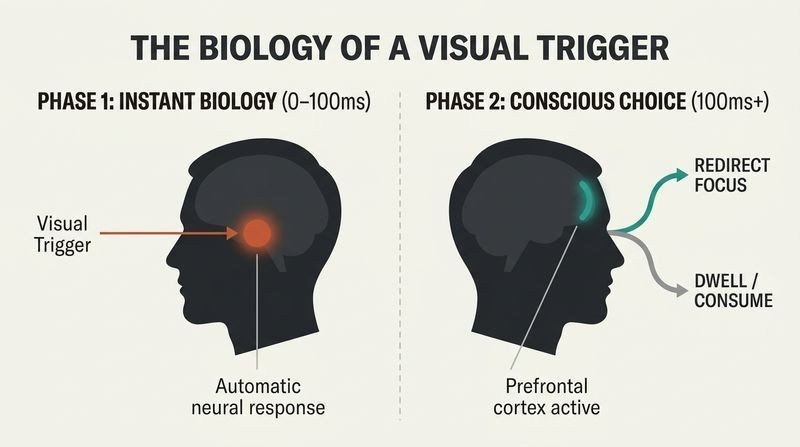
The neuroscience here is real but overstated as settled. fMRI studies (Hamann et al., 2004) do show stronger male amygdala activation to sexual stimuli, yet effect sizes are modest and heavily shaped by culture, arousal context, and individual variation. What's valuable is the reframe from moral failing to physiology: naming an automatic process reduces shame and defensiveness. The buffet analogy is pedagogically brilliant. A caution worth noting: framing this as universal and God-designed risks essentializing behavior that learning and pornography exposure also amplify, blurring the line between innate wiring and conditioned response.
Temptation is not sin; the split-second choice after the jolt is everything
Feldhahn separates the automatic from the volitional. The first draw is biological and unavoidable. But a moment later the thinking centers of the brain (the cortex) engage, and the man decides: savor the image or look away. That choice, not the initial spark, is where honor or sin lives. The book cites the biblical claim that Jesus was tempted in every way yet without sin, arguing temptation itself carries no guilt.
Jack, the fictional everyman, models it. When his colleague Abbie walks by with an unbuttoned blouse, his gut tightens and images intrude, but he turns his chair, refocuses on spreadsheets, and swaps in a memory of his wife. He is not a pervert; he is a normal man doing constant, invisible work in an oversexualized culture.
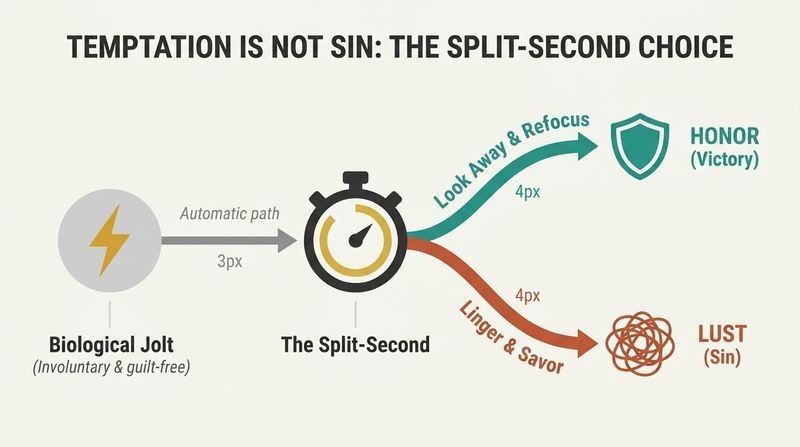
This distinction rescues the book from fatalism (boys will be boys) and from crushing perfectionism. It maps neatly onto dual-process psychology: System 1 fires the impulse, System 2 exercises restraint. It also echoes cognitive behavioral therapy, where the goal is not to eliminate intrusive thoughts but to change the response to them. The framing helpfully places responsibility squarely on the man's choices while removing shame from the involuntary spark. Skeptics might note that repeated indulgence rewires the automatic response itself, meaning today's free choices shape tomorrow's involuntary reactions, which complicates the clean temptation/sin binary.
His pull toward other images says nothing about whether you are enough
Female attraction bundles the person; male visual pull does not. Feldhahn explains that women typically feel drawn only to someone they care about emotionally, so they assume a man attracted to an image must be attracted to that woman, which must mean he loves them less. That inference, she argues, is simply wrong. A man is drawn to the image and the pleasure it gives, not to the person. He can register a stranger in Target as attractive while wanting nothing to do with her.
The stakes of the misunderstanding are high. The author recounts a wife who spiraled after learning her husband was tempted by other women, withdrew sexually, and nearly ended a fifteen-year marriage over a truth he had handled honorably all along.
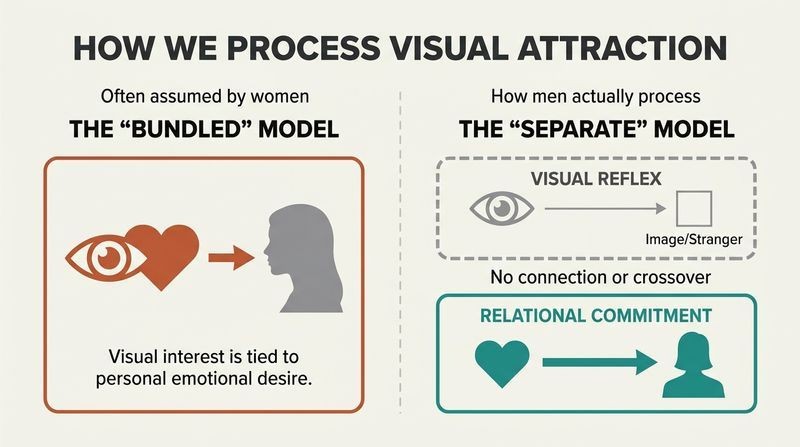
This is the book's most consequential relational insight: a cognitive attribution error. Women project their own bundled (emotional-plus-visual) attraction onto men and conclude betrayal where none exists. Attribution theory in social psychology supports the mechanism, people infer others' internal states from their own. The therapeutic payoff is depersonalization: not taking his wiring as a referendum on your worth. One nuance the framing underplays: pornography consumption can genuinely erode a partner's felt desirability and rewire preference over time, so the reassurance holds best for ordinary noticing, less so for entrenched habitual use.
Men store sexual sights as replayable images that trigger a mental slideshow
His memory works like a photo library. Where women's gut-level memories tend to be feelings, men's tend to be pictures. The amygdala acts as a holding tank for emotionally charged impressions, and these can bypass the thinking brain to resurface in three ways: recalled on purpose, set off by a trigger, or popping up unbidden. One provocative sight can launch a parade of stored images a man must work to shut down.
This has real-world costs. In a workplace study, Feldhahn found men's recall of a ninety-second video dropped 25% when the presenter showed cleavage. Her husband Jeff was stunned to learn she never has spontaneous shirtless images of Tom Cruise pop into her head, proof of how differently the sexes are wired.
The claim that cleavage impairs male comprehension is memorable and has practical workplace implications, though the cited experiment is informal rather than peer-reviewed. Cognitive load theory offers support: managing an intrusive stimulus consumes working memory that would otherwise process content. The asymmetry Jeff discovered is genuinely illuminating for cross-gender empathy, each sex assuming the other experiences the world as they do. Worth flagging: the visual-memory-versus-emotional-memory divide is drawn sharply for teaching purposes, but individual variation is large, and the book itself concedes some women are strongly visual, which softens the tidy binary.
Behind a man's wandering eyes sits a hidden fear of not measuring up
Looking soothes a private insecurity. Feldhahn's research found about 75% of men quietly worry they are inadequate, that they will be exposed as an imposter who does not measure up as husband, worker, or friend. A sexual image, especially pornography, delivers a counterfeit message: you are desirable, the most wanted man in the world. That affirmation temporarily quiets the self-doubt.
Charlie's story shows the pattern. As a boy during his parents' painful divorce, he hid by the pool watching an older girl and discovered the images made him feel powerful rather than like a stupid kid. That coping mechanism hardened into decades of addiction. Therapists note this is why even men married to beautiful, attentive wives can be drawn to porn: the two do not pull from the same emotional well.
This is the book's deepest move, recasting a supposedly purely sexual behavior as emotional self-medication. It aligns with attachment and affect-regulation research: compulsive behaviors often function to numb shame rather than to seek pleasure. The therapist's line that porn is anti-intimacy is especially sharp, distinguishing sex-as-connection from sex-as-avoidance-of-connection. The implication that affirmation weakens porn's grip is empowering and testable. A limitation: reducing male infidelity largely to insecurity risks minimizing agency and the role of opportunity, novelty-seeking, and habit. The Tiger Woods reference gestures at this complexity without fully resolving it.
Men fall on a five-point spectrum; resist playing detective or assuming the worst
Not all men relate to images the same way. The authors sketch a rough spectrum, from healthiest to most trapped:
1. The Curious Innocent (young boys just discovering the pull)
2. The Disciplined Realist (trains himself to look away, most committed men)
3. The Intense Resister (swatting down constant temptation, often teens or those in recovery)
4. The Repeat Indulger (gives thoughts free rein, the pivot toward trouble)
5. The Full-Blown Addict (genuinely in the grip of compulsion)
Do not weaponize the list. Feldhahn shares an email from a wife so consumed with catching her husband's glances that she was exhausting herself and poisoning the marriage. The counsel: observe calmly for a few days, watch his eyes and body language as a supporter, never make him self-label, and never become his accountability partner. That role must belong to another man.
The spectrum is useful precisely because it resists the binary of pure saint or hopeless addict, and it locates most men in the manageable middle. Framing the Repeat Indulger as a pivot point echoes addiction-progression models where habituation, not a single act, is the danger. The strongest practical guardrail is the warning against the wife-as-police dynamic, which surveillance research confirms breeds concealment rather than change. One tension: the book asks women to assess where a man sits while forbidding interrogation, a delicate balance that in practice may prove hard to walk without professional guidance, which the authors sensibly recommend.
Become the safe listener, and he will finally tell you what he never could
Safety unlocks honesty. The authors argue men stay silent about their inner visual lives not from deceit but from fear of a panicked or wounded reaction. One man wanted to join a men's group working through a purity book, but the moment he mentioned it his wife demanded to know if he was attracted to other women, so he dropped it. The door slammed shut.
The technique is calm, curious, non-freak-out listening. Feldhahn describes women reading her earlier book, turning to their husbands, and simply asking Is this true, opening conversations couples had never known how to have. Pastor Ted Cunningham's marriage transformed only after his wife braved the hard question and, crucially, could handle the answer. Humor and side-by-side positioning (a car ride rather than face-to-face) lower a man's defenses.
This is textbook psychological safety applied to intimacy: people disclose vulnerable truths only when they predict a non-punitive response. Gottman's research on marital stability underscores the point, defensiveness and contempt predict divorce, while gentle startup and acceptance of influence predict repair. The side-by-side detail is grounded in real observation about male communication, men often converse more freely without direct eye contact, a pattern also noted in adolescent counseling. The Cunningham story models the paradox at the book's heart: the hardest conversation becomes the gateway to deeper closeness. The prerequisite (ask only when you can bear the answer) is wise and often skipped.
How you dress can either clear a man's path or drop a stone in it
Modesty reframed as neighbor-love, not shame. The authors invoke the biblical idea of not placing a stumbling block before others. If a woman knows a certain outfit triggers the men trying to honor their thought lives and wears it anyway, she is, in their vivid image, dropping a paving stone where she knows a man will step, then blaming him when he trips. Being careful, they insist, does not mean frumpy, you can be stylish and confident.
Practical guidance follows. The more attractive the figure, the greater the magnetic pull, so the more awareness required. Curves and glimpses of the hidden are the strongest triggers, so a cami under a low top or a tunic over leggings removes the trigger. Small mirror-checks catch gaping buttons and riding hemlines.
This is the book's most culturally contested claim, and readers will split sharply. The neighbor-love framing is more generous than shame-based purity messaging, and the authors repeatedly stress men own their choices. Still, critics from within and outside evangelicalism argue that assigning women responsibility for male thoughts shifts a burden that belongs to the beholder and can shade into victim-blaming. The book anticipates this and answers that responsibility can be shared without being transferred. Empirically, objectification research (Fredrickson and Roberts) shows self-objectification harms women regardless of intent, complicating the confident-and-beautiful advice. A both-and reading, personal freedom plus mutual consideration, is the steel-manned middle.
Give your husband positive images of you as honorable ammunition against the rest
Feed the wiring you cannot change. Since a man replays stored images, the authors argue a wife can become his default sexual picture, something honorable to summon when other images intrude. Practical suggestions from Craig Gross include:
1. Sex with the lights on so he actually sees you
2. Lingerie he gets to weigh in on
3. Reasonable self-care, whatever effort you can manage
4. Flirting and playful attention to the parts he finds attractive
5. Removing household triggers like lingerie catalogs left on the counter
The point is bonding, not performance. Gross insists most husbands find their wives more attractive over years of marriage, not less, and that a woman's willingness to be seen counters the shame-and-frustration loop of constant public stimulation with no healthy outlet.
The logic follows cleanly from the book's own premises: if memory is a photo library, curate it. Framing marital intimacy as ammunition against temptation is pragmatic and, for many couples, freeing. Sex research does associate frequency and openness with relational satisfaction, though causation runs both ways. The vulnerability of lights-on sex touches real body-image barriers that the advice acknowledges but cannot fully dissolve. A fair critique: the list can read as placing the fix on the wife's willingness, which sits in tension with the book's insistence that porn use is his issue, not hers. The authors thread this by pairing it with male accountability.
Fix what is in your own control before policing what is in his
Start with the log in your own eye. The authors invoke Jesus's teaching to address your own faults before your brother's. A book for women, they say, is not about cataloging what men should do but about what women can do: dress with awareness, soften a critical voice, listen safely, and seek help rather than punishing or hiding a problem. They recount the man whose wife's neglect and derision made an affirming coworker dangerously appealing, no excuse for his affair, but a pattern worth examining.
Change requires his ownership plus your support. If a man has a real porn problem, he must take the lead: choose counseling for himself, join a men's group, use accountability software like X3watch. A wife supports and expects effort, but cannot be the enforcer, or she becomes the critic he flees.
The self-first focus is both spiritually rooted and practically shrewd: you can only reliably change yourself, and modeling effort earns credibility to ask for his. It echoes systems thinking in family therapy, where one partner shifting their own behavior alters the whole dynamic. The insistence that recovery motivation be internal, not to appease a spouse, matches addiction research showing externally coerced change relapses fast. The affair anecdote is the book's riskiest, brushing against blaming the wife; the authors guard it heavily with no excuse language. The enduring principle, ownership by him plus non-policing support from her, is a durable template well beyond this specific issue.
Analysis
This is a faith-based relationship book operating at the intersection of pop neuroscience, evangelical marriage ministry, and practical counseling. Its structure moves from a vivid narrative device (a day inside Jack's head) to brain science, emotional analysis, a behavioral spectrum, and finally role-specific advice for wives and mothers plus an extensive FAQ. The core thesis is simple and repeated: male visual wiring is real, God-designed, involuntary at first spark but volitional in response, and misunderstanding it corrodes marriages while understanding it deepens them.
The book's genuine strength is empathy engineering. By separating the automatic (nucleus accumbens jolt) from the chosen (cortical response), and by exposing the attribution error whereby women read male visual pull as evidence of being unloved, it dissolves a common and destructive misreading. Its second strength is emotional depth: the reframe of porn as anti-intimacy and self-medication for a hidden imposter fear elevates it above surface behavior modification.
The book is vulnerable on two fronts. First, its neuroscience, while directionally supported by fMRI work on amygdala activation, is presented as more settled and more binary than the evidence warrants, underweighting cultural conditioning and the plasticity by which repeated indulgence rewires the involuntary spark itself. Second, the modesty chapters carry the heaviest ideological freight; the neighbor-love framing is more gracious than shame-based alternatives, yet the practical burden still lands disproportionately on women, a tension the authors acknowledge but never fully resolve.
Read outside its Christian frame, the transferable wisdom is substantial: psychological safety unlocks disclosure, surveillance breeds concealment, change must be internally motivated, and depersonalizing a partner's wiring protects self-worth. The book is best understood not as objective science but as a persuasion tool aimed at replacing suspicion with informed compassion within committed, faith-oriented marriages, a niche it serves with unusual candor.
Review Summary
Through a Man's Eyes receives mixed reviews. Some readers find it insightful, offering a Christian perspective on male visual nature and sexuality. They appreciate its explanations of how men process visual stimuli differently from women. However, critics argue it promotes harmful stereotypes, lacks scientific evidence, and places undue responsibility on women for men's behavior. Some find it helpful for understanding male psychology and improving relationships, while others view it as outdated and potentially damaging. The book's religious undertones and focus on modesty are contentious points among reviewers.
People Also Read









Glossary
Nucleus accumbens
Brain's automatic pleasure centerA region deep in the brain that fires an instant, involuntary jolt of pleasure and desire-to-consume when triggered. The authors use it to explain why a man reacts biologically to a sexual image before any conscious thought, the same region that lights up when a hungry person sees a buffet or a gambler sees cash.
The visual spectrum
Five categories of male responseThe authors' rough classification of how men handle visual temptation, ranging from the Curious Innocent (young boys), the Disciplined Realist (trained to look away), the Intense Resister (actively swatting temptation), the Repeat Indulger (gives thoughts free rein, a pivot toward trouble), to the Full-Blown Addict. Meant to prevent assuming the worst or the best about any individual man.
Bounce your eyes
Habit of quickly looking awayA practiced technique many men and fathers teach, of immediately redirecting the gaze away from a tempting sight before the image takes hold. Paired with redirecting thoughts to neutral subjects (cars, math) or to one's wife, it becomes an ingrained lifelong habit for keeping the thought life pure.
Involuntary pop-ups
Unbidden stored sexual images resurfacingFeldhahn's term for the way emotionally charged visual memories stored in the amygdala can bypass the thinking brain and spontaneously replay in a man's mind without any external trigger, comparable to how a woman might suddenly worry about a sick child. She argues most women do not experience the sexual-visual equivalent.
X3watch
Internet accountability softwareFree accountability software created by Craig Gross's ministry XXXchurch. A user installs it and names accountability partners who receive weekly reports of any questionable sites accessed. Presented as a tool for building self-control and transparency, particularly for men in recovery and for monitoring children's online activity.
About the Author



Download PDF
Download EPUB
.epub digital book format is ideal for reading ebooks on phones, tablets, and e-readers.








































