

Key Takeaways
Most men would rather feel unloved than disrespected or inadequate
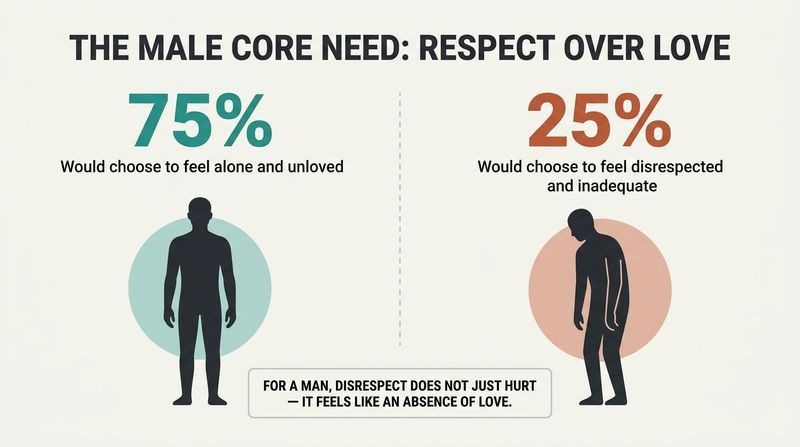
Respect outranks love for men. At a relationship retreat, a speaker asked people to choose between feeling alone and unloved or inadequate and disrespected. Most men chose to endure being unloved. In Feldhahn's professional survey of 400 anonymous men, three out of four made the same choice. When she tested the question, many men couldn't even distinguish the two options, because to a man, being disrespected already feels like being unloved.
Love him by respecting him. Feldhahn's central discovery, drawn from interviewing over a thousand men, is that a woman's respect matters more to a man than her affection. Saying "I love you" satisfies most wives, but a husband is fed by "I'm proud of you" and "I trust you." Respect, for him, is the language love is spoken in.
This inverts the cultural assumption that everyone primarily craves love. It dovetails neatly with Emerson Eggerichs's Love and Respect work, which frames marriage around a "crazy cycle" of withheld love and withheld respect. Critics note the framing risks essentialism, treating a survey snapshot as fixed male wiring rather than socialized behavior shaped by masculinity norms. Still, the underlying insight has broader support: psychologist John Gottman found contempt, the opposite of respect, is the single strongest predictor of divorce. Whether the need is biological or cultural, the practical lesson holds. People wilt under contempt and flourish under visible regard, regardless of gender.
In conflict, a man's anger usually signals he feels disrespected
Anger is his hidden hurt. Feldhahn offers a simple diagnostic: when a man gets angry mid-argument, check whether disrespect triggered it. Since men often struggle to name feelings in the moment, they rarely say "you disrespected me." They just get mad. Over 80 percent of surveyed men said that during a conflict they were more likely to feel disrespected than unloved, while women in the same fight typically feel unloved.
Respect is a choice, not a feeling. Just as men can choose to show love even when they don't feel it, women can choose to demonstrate respect even when a man hasn't earned it in the moment. Feldhahn notes the biblical Greek word for respect, phobeo, means to revere or be in awe of, not merely tolerate.
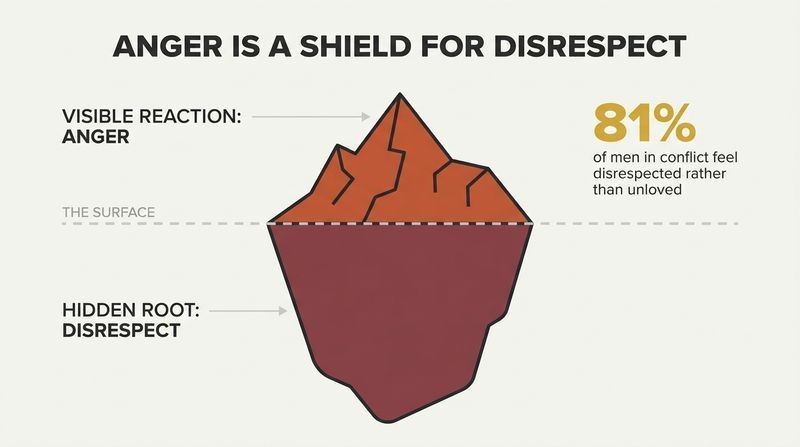
The crying-versus-anger parallel is a useful translation tool: two people expressing the same wound in opposite dialects. This aligns with research on emotional expression, where men, often socialized against vulnerability, channel distress into anger, the one sanctioned masculine emotion. The danger is treating all male anger as legitimate feedback about a woman's behavior, which could excuse genuine aggression. Feldhahn is careful to distinguish inner wiring from acceptable outward behavior. The stronger reading is diagnostic, not permissive: anger is a signal worth decoding, not a verdict that the woman did wrong. Curiosity about the trigger beats defensiveness about the outburst.
Never criticize or tease your man in public, even playfully
Public teasing feels like torture. One of the strongest survey themes was that men are wounded when their partner mocks, corrects, or questions them in front of others. What a wife considers lighthearted ribbing, a husband may experience as humiliation. Feldhahn's own father told her that belittling a husband before other men can even damage his career, because male peers read it as weakness.
The ego is fragile, not inflated. Women often think men have oversized egos that need deflating. Feldhahn reframes this: what looks like pride is actually a fragile sense of adequacy. A man drops his guard only with the woman he loves, which means she alone can pierce his heart most deeply. The flip side is powerful: publicly praising him feels, to him, like receiving roses and a surprise date.
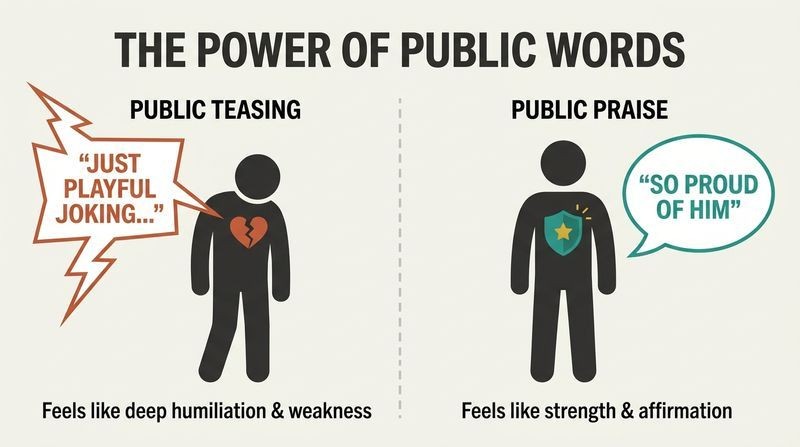
The competitive-male-hierarchy framing echoes evolutionary and sociological accounts of status among men, where reputation functions as social capital. The claim that a wife's public jab can sink a man's standing among peers may be overstated for modern workplaces, but the emotional core is sound. Behavioral economics calls this loss aversion applied to esteem: one public sting outweighs many private compliments. The actionable inverse is underrated. Bragging about a partner in front of others is a cheap, high-return gesture most couples underuse. The caution: a relationship where one partner must never be teased can tip into walking on eggshells, which serves no one.
Behind his confident mask, he secretly fears being exposed as a fraud
The impostor lives in every man. Feldhahn found that beneath a capable exterior, most men dread being unmasked as not good enough. In her follow-up survey, nearly three-fourths of men admitted insecurity about others' opinions of them, and more than three in four felt insecure when tackling something new, without letting it show. She illustrates with a Star Trek scene where a captain projects total certainty while privately guessing which direction to walk.
Affirmation is his fuel. A FedEx executive spent a miserable weekend certain he'd be fired over a boss's neutral comment. An All-Pro lineman described locker rooms full of insecure men asking "how'd I do?" Only one man in four felt actively appreciated at home. When unaffirmed, men seek validation elsewhere: overwork, sports, or worse.
This is essentially impostor phenomenon, first described by psychologists Clance and Imes in 1978, though they studied high-achieving women. Feldhahn's contribution is showing how thoroughly it saturates male experience while staying hidden behind performance. The insight connects to Brene Brown's research on shame, where the fear of being "found out" drives armor and disconnection. One nuance worth flagging: the book positions the wife as primary antidote, which places heavy emotional labor on partners and risks implying men can't self-soothe or seek male friendship and therapy. The healthiest version treats spousal affirmation as one support among several, not the sole cure for chronic self-doubt.
His drive to provide is compulsion, not choice, and never switches off
Providing is identity, not preference. Feldhahn was startled that men described providing as an inescapable duty rather than a role they could delegate. Three out of four said they'd feel the compulsion to provide even if their wife earned enough to support the family entirely. One husband told his shocked wife her income was "irrelevant" to his need to provide. For 71 percent, this responsibility is always or often on their minds.
Long hours can mean "I love you." In a man's mind, bringing home a paycheck is a love language. One traveling husband was floored his wife thought his frequent trips meant he cared more about work; to him they were a sacrifice made out of love. Financial trouble feels, to him, like personal failure, described by one man as skin being flayed off.
The provider instinct maps onto what sociologists call the "breadwinner ideal," and research does show men's self-worth and even mental health track closely with employment and earnings, with unemployment linked to elevated depression in men specifically. Yet framing this as immutable wiring underplays how rapidly norms shift: dual-income households and stay-at-home fathers are reshaping the script. The genuinely useful reframe is that complaints about overwork may land as attacks on a love offering. The counterpoint: unexamined, this compulsion fuels workaholism and absentee parenting. Naming the drive is the first step to negotiating a healthier balance rather than accepting eighty-hour weeks as biological destiny.
Sex is how he feels desired; refusal reads as personal rejection
Sex is emotional, not just physical. For men, Feldhahn argues, lovemaking answers a deep need to feel wanted, which counteracts loneliness and fuels confidence everywhere else. A staggering 97 percent of surveyed men said merely getting sex wasn't enough; they needed to feel desired by their wives. Three out of four would still feel empty if a wife participated reluctantly, out of duty.
"No" lands as "I don't want you." Men reported that rejection in the bedroom feels like rejection of who they are. One deprived husband described decades of feeling insignificant, isolated, and abandoned. Feldhahn compares a wife's sexual withdrawal to a husband simply refusing to speak to her: equally wounding, equally dangerous to the marriage. The parallel of Mark and Anne shows how naming this "love signal" transformed their intimacy.
The reframe from appetite to emotional bid is the chapter's strength and aligns with attachment theory, where physical intimacy functions as reassurance of the bond. Sex researchers distinguish spontaneous from responsive desire, and Rosemary Basson's work shows many women's desire emerges during arousal rather than before it, which suggests "not feeling it" beforehand doesn't preclude fulfilling intimacy. The book leans hard on female accommodation and says comparatively little about mutual desire or a man's role in his partner's arousal. A fuller treatment would frame this as reciprocal: both partners have legitimate needs, and enthusiastic intimacy requires both feeling safe, wanted, and unpressured, not one keeping score.
He can't stop noticing attractive women, and it says nothing about you
Visual attraction is involuntary. Feldhahn's research revealed two compulsions. First, 98 percent of men are almost helplessly drawn to look at an attractive woman, even happily married believers. Second, 87 percent carry a mental "Rolodex" of sensual images that surface unbidden, burned in by a saturated culture. A famous exchange with her husband about Tom Cruise revealed that most women simply don't experience recurring involuntary images, which is why they find this alien.
Temptation is not sin. Feldhahn separates the automatic impulse (unchosen) from the choice to dwell or dismiss (chosen). She stresses this has nothing to do with a wife's attractiveness. Even a bikini model's husband would face it. The lesson: pray for him, don't police him, appreciate his effort to look away, and champion modesty rather than taking his struggle as personal failure.
Neuroscience partly supports the involuntary framing: visual sexual stimuli activate male reward circuitry quickly, and attention capture by salient stimuli is well documented. But "98 percent" of a self-report survey measures admitted reactions, not a fixed hardwired constant, and the visual-difference-between-sexes claim is more contested than the book suggests. The framing risks two problems: excusing men from accountability by naturalizing the impulse, and placing responsibility on women's clothing choices. Feldhahn threads this partially by insisting the choice, not the impulse, is what matters morally. The most durable takeaway is depersonalization: a partner's wandering eye reflects wiring and culture, not the beholder's inadequacy.
Your man is a closet romantic paralyzed by fear of failing at it
Men want romance but fear humiliation. Contrary to the clueless-clod stereotype, nearly all men in Feldhahn's first test survey said they desire romance "very much." The obstacle isn't apathy; it's self-doubt. Almost half aren't confident their romantic efforts will please. One man said a single tease about a botched candlelit dinner would stop him from trying for five years. Another froze for three years after a home-run gift, terrified he couldn't top it.
Men define romance differently. Roughly 40 percent find "active" romance, doing fun things together like hiking or golf, more romantic than candlelight. Men want a playmate, not to escape to guy activities. To keep romance alive, encourage his attempts loudly, entice him with something to pursue, and prioritize him over the endless to-do list and even the kids.
The performance-anxiety explanation for male romantic passivity is a genuinely fresh reframe, connecting romance to the same impostor fear that governs his work life. It resonates with research on approach-avoidance motivation, where fear of rejection suppresses initiation even amid strong desire. The "different definitions" point is valuable and echoes Gary Chapman's love languages: partners often express affection in the dialect they'd want to receive, missing each other entirely. The actionable core, rewarding attempts generously to lower perceived risk, is sound behavioral shaping. The main limitation is that the burden again falls largely on women to decode and encourage, with less asked of men to simply communicate their preferences directly.
He needs to see effort on your appearance, not a size 3 body
Effort matters more than results. Seven in ten men said they'd be bothered if their partner let herself go and showed no interest in changing. But five out of six agreed the point isn't matching her honeymoon figure; it's seeing her make an effort to care for herself for him now. A man named "Ted" told Feldhahn his 115-pound wife's weight wasn't the issue at all. It was whether she cared enough to try.
Effort equals love, and he'll help. Feldhahn compares this to how a woman feels loved when a man puts thought into a flawed romantic gesture. When she makes the effort, he feels valued; when she ignores it, he feels disregarded. And 97 percent of men said they'd willingly take on cost, childcare, or chores so their partner could get in shape.
This is the book's most culturally combustible claim, and Feldhahn handles it gingerly, repeatedly disclaiming size obsession and eating disorders. The effort-over-outcome reframe is psychologically shrewd: it echoes research showing perceived partner investment, not objective attractiveness, predicts relationship satisfaction. The reciprocity argument (he curbs his wandering eye, she maintains her appearance) at least attempts fairness. Yet the framing sits uneasily against evidence that appearance-contingent affection correlates with lower security and body image in partners. A steelman: mutual physical care signals ongoing investment and vitality. The critique: linking a spouse's felt love to physique, however softened, can breed anxiety, and the standard is applied far more heavily to women than men.
What men most wish they could say is simply how much they love you
The number one unspoken message. Feldhahn ended her survey with an open question: what one thing do you wish your partner knew that you can't explain? The runaway top answer, chosen by 32 percent, nearly double the next response, was "how much I love her." Not more sex, not more respect, not appearance. Men wanted their partners to grasp the depth of a love they struggle to articulate.
The full ranking of longings. After love came appearance effort (18 percent), respect in public and private (15 percent), more sex (10 percent), and understanding of the provider burden (10 percent). Feldhahn closes with a chorus of survey quotes: men calling wives the light of their life, the best hope they have, the perfect partner for them. The confident exterior hides a tender, devoted heart that wants to be understood.
Ending on love rather than grievance is a deliberate and generous editorial choice that reframes the entire book: the preceding chapters aren't complaints but a decoder ring for affection men can't verbalize. This connects to research on alexithymia, difficulty identifying and expressing emotions, which is more prevalent in men and partly socialized. The gap between deep feeling and poor expression is real and poignant. A gentle challenge: if love is what men most want understood yet can't say, the deeper fix isn't only wives learning to read subtext but men building emotional literacy. Both moves matter. Understanding is a two-way bridge, not a one-way translation.
Analysis
Shaunti Feldhahn's 2004 book is a work of popular translation, not original psychology. Its structure is simple and effective: seven "surface understandings" women already hold about men ("men are visual," "men need respect") are cracked open to reveal what each means "in practice." Its authority rests on a genuine methodological effort: two professional surveys of 400 anonymous men each, designed with help from a former U.S. Census survey chief, plus over a thousand informal interviews. For a marriage self-help book, this empirical spine is unusually stursy, and it lets Feldhahn distinguish the typical from the exceptional.
The book's enduring value is its central reframe: many male behaviors that baffle or wound women (defensiveness, workaholism, sexual pressure, wandering eyes, romantic passivity) are downstream of two hidden engines: a fragile sense of adequacy and a compulsion to provide. Decode those, and the behavior becomes legible rather than malicious. This is a powerful act of perspective-taking.
Three critiques deserve airing. First, essentialism: the book treats survey snapshots as fixed "wiring," underweighting how masculinity is socialized and historically contingent. Second, asymmetry: by design it addresses only what women should do for men, which, read alone, can imply one-directional emotional labor. Feldhahn flags this scope limit explicitly, and the companion volume For Men Only balances it, but a reader of this book alone gets a lopsided picture. Third, its evangelical Christian frame (unconditional respect, scriptural submission language, prayer as primary tool) both grounds and narrows its appeal.
What holds up best is convergent with secular research: Gottman on contempt as divorce predictor, Clance and Imes on impostor phenomenon, attachment theory on intimacy as reassurance. Feldhahn arrived at similar truths through a different door. The book works less as science than as an empathy-generating device, and on that count, it largely succeeds.
Review Summary
For Women Only received mixed reviews. Many readers found it insightful, praising its research-based approach to understanding men. However, others criticized it for promoting outdated gender stereotypes and potentially harmful relationship advice. Some appreciated the book's Christian perspective, while others felt it was too religiously focused. Critics argued it oversimplified complex issues and placed too much responsibility on women to cater to men's needs. Despite the polarizing opinions, many readers found the book sparked meaningful conversations with their partners about relationships and gender dynamics.
People Also Read








Glossary
Impostor complex
Hidden fear of being exposedFeldhahn's term for the pervasive male anxiety that beneath a competent exterior, a man is not as capable as he appears and could be unmasked at any moment. It surfaces at work and home, drives overwork and the need for affirmation, and afflicts even highly accomplished men. Roughly three in four surveyed men reported insecurity about others' opinions of them.
Mental Rolodex
Stored sensual images resurfacing involuntarilyFeldhahn's metaphor for the collection of sexual and sensual images a man accumulates from living in a media-saturated culture. These images can pop into his mind unbidden or be recalled deliberately. In her survey, 87 percent of men reported experiencing this, consistent across age, marital status, and religiosity.
Eye magnet
Attractive woman men can't ignoreFeldhahn's term for a woman dressed to display an attractive figure, whom men find almost impossible not to notice. Even when a man forces himself to look away, he stays acutely aware of her presence. She argues the phenomenon is involuntary, driven by male visual wiring rather than a deliberate choice to leer.
Unconditional respect
Respecting him regardless of behaviorBorrowed from Emerson Eggerichs, the idea that just as women want love that isn't earned, men need respect that isn't conditional on their performance in the moment. Rooted in the biblical Greek phobeo (to revere), it means honoring a man for who he is, demonstrated through trusting his judgment, abilities, and decisions rather than merely feeling regard privately.
Crazy cycle
Love-respect withdrawal downward spiralEmerson Eggerichs's term, cited by Feldhahn, for the self-reinforcing loop in which a husband withholds love, so a wife withholds respect, which makes him feel slighted and withhold more love, and so on. Feldhahn notes couples can break the cycle through one partner's unilateral choice to show love or respect.
HALT checklist
Hungry, Angry, Lonely, Tired triggersAn acronym Feldhahn cites for four states (Hungry, Angry, Lonely, Tired) that weaken a man's resolve to keep his thought life pure. When a man is depleted or feels like a failure, he becomes more vulnerable to visual temptation, much as an unhappy person might binge on comfort food.
FAQ
What's "For Women Only" about?
- Understanding Men: "For Women Only" by Shaunti Feldhahn is a guide for women to understand the inner lives of men, based on interviews and surveys with over a thousand men.
- Key Insights: The book reveals seven key insights into men's thoughts and feelings, aiming to improve relationships by helping women understand what men wish they knew.
- Practical Advice: It provides practical advice on how women can support and love the men in their lives in ways that resonate with them.
- Research-Based: The insights are backed by professional surveys and interviews, making the findings reliable and applicable.
Why should I read "For Women Only"?
- Improve Relationships: The book offers insights that can help improve communication and understanding in relationships.
- Unique Perspective: It provides a unique perspective on men's inner thoughts and feelings, which are often misunderstood by women.
- Actionable Advice: The book includes practical advice and real-life examples that women can apply in their daily interactions with men.
- Research-Driven: The findings are based on extensive research, making the advice credible and trustworthy.
What are the key takeaways of "For Women Only"?
- Respect Over Love: Men value respect more than love, and feeling respected is crucial for their emotional well-being.
- Insecurity and Performance: Despite appearing confident, many men feel like impostors and are insecure about their abilities being discovered.
- Visual Nature: Men are highly visual and have a mental Rolodex of images that can be triggered involuntarily.
- Provider Burden: Men feel a deep-seated responsibility to provide for their families, which is a constant mental burden.
How does "For Women Only" explain men's need for respect?
- Respect Equals Love: Men equate respect with love, and feeling disrespected can be more painful than feeling unloved.
- Anger as a Signal: A man's anger in conflicts often signals that he feels disrespected, not just upset about the issue at hand.
- Unconditional Respect: Just as women desire unconditional love, men need unconditional respect, regardless of their performance.
- Public and Private Respect: Men need to feel respected both in private and in public, and public disrespect can be particularly damaging.
What does "For Women Only" say about men's insecurities?
- Impostor Syndrome: Many men feel like impostors, fearing that their inadequacies will be discovered.
- Constant Judgment: Men often feel they are being judged and worry about not measuring up, both at work and at home.
- Need for Affirmation: Affirmation from their partners can help men overcome these insecurities and feel more confident.
- Impact on Relationships: A man's insecurity can affect his relationship, making him withdraw or become defensive.
How does "For Women Only" address men's visual nature?
- Visual Triggers: Men are naturally drawn to visual stimuli, and attractive images can be hard to forget.
- Mental Rolodex: Men have a mental Rolodex of images that can be triggered involuntarily, affecting their thought life.
- Not Personal: This visual nature is not a reflection of a man's feelings for his partner; it's a hardwired trait.
- Supportive Role: Women can support their partners by understanding this trait and helping them navigate visual temptations.
What insights does "For Women Only" provide about men's need to provide?
- Deep-Seated Compulsion: Men feel a deep-seated compulsion to provide for their families, regardless of their partner's income.
- Constant Burden: The responsibility to provide is a constant mental burden that men carry with them.
- Expression of Love: Providing is a primary way men express love and care for their families.
- Risk of Failure: Men constantly worry about failing to provide, which can lead to stress and anxiety.
How does "For Women Only" explain the importance of sex for men?
- Emotional Need: Sex is not just a physical need for men; it fulfills a deep emotional need for love and connection.
- Feeling Desired: Men want to feel desired by their partners, and lack of sexual interest can lead to feelings of rejection.
- Confidence Booster: A fulfilling sex life boosts a man's confidence and well-being, affecting all areas of his life.
- Impact of Rejection: Repeated rejection or lack of interest from a partner can lead to depression and withdrawal.
What does "For Women Only" reveal about men's romantic desires?
- Secret Romantics: Contrary to stereotypes, many men desire romance and enjoy romantic activities with their partners.
- Different Definitions: Men may have different definitions of romance, often valuing shared activities and playfulness.
- Fear of Failure: Men may hesitate to initiate romance due to fear of failure or past negative experiences.
- Encouragement Needed: Encouragement and appreciation from their partners can motivate men to be more romantic.
How does "For Women Only" address men's views on women's appearance?
- Effort Matters: Men appreciate when their partners make an effort to take care of their appearance, as it makes them feel loved.
- Not About Perfection: It's not about being a certain size but about showing care and effort in maintaining one's appearance.
- Impact on Relationship: A lack of effort in appearance can make men feel unvalued and affect their happiness in the relationship.
- Willing to Help: Most men are willing to support their partners in efforts to improve their health and appearance.
What are the best quotes from "For Women Only" and what do they mean?
- "Men would rather feel alone and unloved than inadequate and disrespected." This highlights the importance of respect in a man's emotional life.
- "If a man feels disrespected, he is going to feel unloved." Respect and love are intertwined for men, and disrespect can undermine their sense of being loved.
- "A man can be having a horrible time at work...but if his wife wants him physically and affirms him in bed, he can handle the rest of the world no problem." This underscores the emotional significance of sex for men.
- "The male ego is the most fragile thing on the planet." This quote emphasizes the vulnerability men feel regarding their self-worth and the impact of their partner's actions.
What practical advice does "For Women Only" offer for improving relationships?
- Show Respect: Demonstrate respect for your partner's judgment, abilities, and efforts, both in private and public.
- Affirmation and Support: Provide affirmation and support to help your partner overcome insecurities and feel confident.
- Understand Visual Nature: Recognize and support your partner's visual nature by being understanding and protective.
- Prioritize Intimacy: Make intimacy a priority, understanding its emotional significance for your partner.
About the Author
Download PDF
Download EPUB
.epub digital book format is ideal for reading ebooks on phones, tablets, and e-readers.








































