

Summary Unavailable
This book is not suitable for a summary (it may be a textbook, workbook, cookbook, reference book, or collection). However, you can still explore the FAQs, about author, and other metadata below!
Key Takeaways
At first meeting, words speak louder than actions
Your language announces who you are. Lewis opens with an uncomfortable truth: people judge you not only by what you say but, more immediately, by how you say it. A misplaced accent, a doubled consonant in the wrong spot, a 'irregardless' or 'between you and I' can yank a listener's attention away from your ideas and onto your error. Whether in a job interview, a written report, or casual conversation, your speech and writing continuously present you to friends, colleagues, and strangers.
The book is a diagnostic mirror. Across thirty short lessons of fifteen minutes each, Lewis uses over a hundred self-tests on pronunciation, vocabulary, spelling, and grammar so you can find weaknesses you may not even know you have. The premise: most errors are invisible to the person making them.
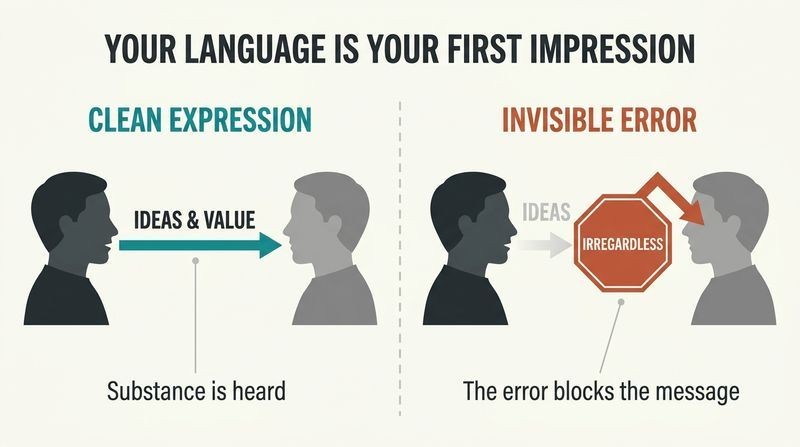
This framing anticipates modern research on linguistic prestige and the 'matched-guise' experiments of sociolinguist William Labov, who showed listeners assign intelligence, competence, and trustworthiness based on accent and grammar alone. Lewis is honest that this judgment is often unfair and illogical, yet practically unavoidable. What's striking is how the insight cuts both ways in the internet era: written language now mediates more first impressions than ever, through emails, texts, and posts. The book's value lies less in snobbery than in self-awareness, giving readers control over a signal they are broadcasting whether they intend to or not.
Vocabulary predicts career success better than your diploma
Words are the tools of thought. Lewis cites the Human Engineering Laboratory, where director Johnson O'Connor tested thousands of adults and found one trait shared by top executives across every field: an unusually large vocabulary. Formal schooling mattered less than expected. One telephone-company executive who left school at fourteen outscored the college professors taking the same test.
The numbers are stark. In a study of 100 business-school graduates tracked over five years:
1. Every senior who scored in the top 10 percent on vocabulary had become an executive.
2. Not one whose score fell in the bottom 25 percent reached an executive position.
O'Connor's explanation: words are the instruments by which people grasp others' thoughts and conduct their own thinking. A richer word-stock literally enables richer reasoning.
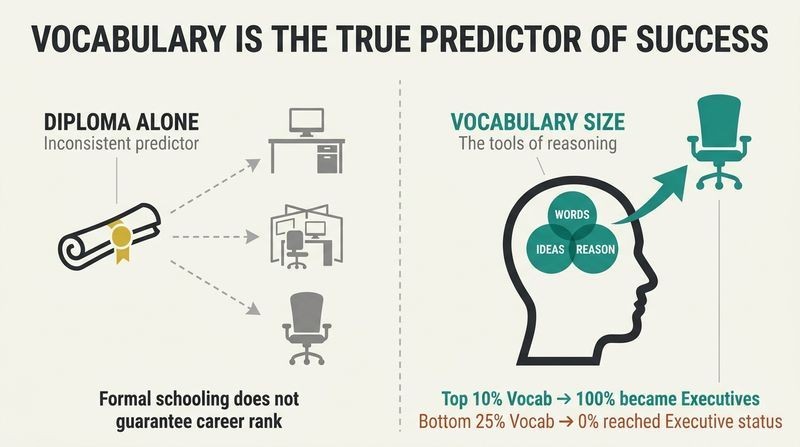
The correlation is real, but causation deserves scrutiny. Vocabulary tracks closely with general intelligence (it is a core subtest of the Stanford-Binet IQ, as Lewis notes), and with reading volume, family background, and curiosity, so it may be a marker of these rather than an independent cause of success. Still, the linguistic-relativity tradition from Sapir and Whorf, and Vygotsky's work on inner speech, supports the deeper claim that vocabulary shapes cognition, not just expression. The actionable upshot survives the causation debate intact: deliberately enlarging your word-stock is a high-leverage, low-cost investment that compounds across a lifetime of thinking and communicating.
Turn any unknown word into yours with three deliberate steps
Stop skipping over strange words. Lewis argues the average adult absorbs only 25 to 50 new words a year because most people glide past unfamiliar words, extracting just enough meaning to move on. His remedy converts a word from your passive recognition vocabulary (words you understand when you see them) into your active functional vocabulary (words you actually use).
The method, applied to one word at a time:
1. Treat the new word as a challenge: guess its meaning from context before looking it up.
2. Check yourself in a dictionary to see how close your guess was.
3. Say it aloud several times and write it once or twice, engaging voice and muscle memory.
Lewis claims this can add 8 to 14 words a day, or 2,000 to 3,000 a year. The secret ingredient throughout is repetition across many contexts.
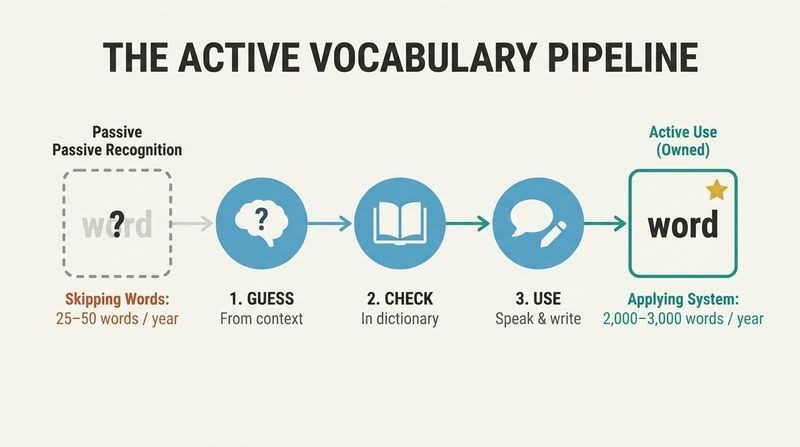
Cognitive science strongly validates this. The 'generation effect' shows that guessing a meaning before checking produces far stronger memory than passive exposure, and the 'production effect' confirms that saying and writing a word outperforms silent reading. Lewis intuited spaced, multimodal, effortful retrieval decades before these became textbook findings. The one caveat: his daily totals are optimistic and assume sustained reading volume. Real retention depends on encountering words repeatedly in meaningful contexts, which is exactly why he pairs the technique with a wide-reading plan rather than rote memorization of word lists.
Learn a few Latin and Greek roots, unlock hundreds of words
Words grow in families. Rather than memorizing words one by one, Lewis teaches the parent roots that spawn them. Latin 'pedis' (foot) gives pedestrian, pedal, impede, expedite. Greek 'podis' (also foot) gives podiatrist and tripod. Greek 'paidos' (child) gives pediatrics and pedagogy. From a single excursion, one root leads to another: 'iatr-' (medical treatment), 'ortho-' (straight), 'gam-' (marriage), 'mis-' (hatred), 'anthrop-' (mankind), 'phil-' (love), 'gyn-' (woman).
The payoff compounds. In one chapter Lewis says a reader meets roughly 67 useful words, more than the average adult learns in two years. Once you control a root, you can decode words you have never seen: knowing 'mis-' plus 'gyn-' yields misogyny without a dictionary. The roots make words understandable, memorable, and unconfusable.
This is morphological decoding, and it remains one of the most efficient vocabulary strategies in pedagogy, especially for academic and scientific English, where Greco-Latin roots dominate. Estimates suggest knowing the most common roots and affixes gives access to tens of thousands of words. The method also builds metalinguistic awareness that transfers to learning Romance languages. A fair limitation: roots can mislead. 'Pedo-' meaning foot versus child trips up even careful readers, and semantic drift means 'nice' once meant ignorant. Roots are best treated as strong hypotheses to confirm, not guarantees, a nuance Lewis himself flags with the two unrelated 'ped-' families.
Ninety-five percent of your spelling errors hide in 100 words
You misspell the same demons everyone does. Lewis's liberating claim: the average person is a better speller than they think, because 95 percent of errors fall on a list of roughly 100 common 'demons,' words that seem to have two plausible spellings. Conquer that single list and most of your trouble vanishes. Even F. Scott Fitzgerald and Andrew Jackson were notoriously bad spellers.
Mnemonics beat brute memorization. A demon is a frequently misspelled word; a mnemonic is a memory trick that locks in the correct form. Examples Lewis builds:
1. 'Super Suds' reminds you supersede is the only word ending in -sede.
2. Two robbers in Sing Sing fix embarrassed (two R's, two S's).
3. 'An able man is dependable and indispensable' settles the -able ending.
He pairs each trick with training your visual and muscular memory by looking, covering, and rewriting.
The Pareto logic here is genuinely useful: targeting the high-frequency failure points yields outsized returns versus trying to master all of English orthography, which is famously irregular thanks to its mongrel Germanic, French, and Latin heritage. The mnemonic approach exploits the 'bizarreness' and elaboration effects in memory research, where vivid, slightly absurd associations outlast plain rules. One tension: English spelling reformers from Noah Webster onward argued the real fix is changing the spelling, not memorizing exceptions. Lewis takes the pragmatic path, accepting the chaotic system as given and arming readers to survive it rather than reform it.
Three trouble spots cause 75 percent of all grammar mistakes
Concentrate your effort where errors cluster. Lewis reports that three-quarters of common grammatical mistakes occur in just three areas, so mastering them gives disproportionate returns:
1. Pronouns (I versus me, who versus whom, he versus him).
2. The verbs lay and lie.
3. Singular versus plural agreement (is or are, has or have).
Pronouns yield to simple tests. After prepositions like between, except, and but, use object pronouns (me, him, us). After forms of 'to be,' use subject pronouns (it is I). For combinations, mentally delete one part: 'for you and (me)' becomes obvious once you drop 'you and.' For than and as, finish the implied verb: 'taller than I (am).' For who versus whom, rearrange and substitute: if 'him' fits, use whom; if 'he' fits, use who.
The triage framing is the book's most transferable meta-lesson: in any complex skill, find the few high-frequency failure modes and drill those rather than attempting comprehensive coverage. The deletion and substitution tests are elegant because they convert a memorized rule into a quick mechanical check the speaker can run in real time. Worth noting that descriptive linguists increasingly regard 'who' for 'whom' and 'it's me' as fully standard in speech, a tension Lewis himself acknowledges through his Harper's survey. The tests still serve well for formal writing, where the conservative forms remain expected.
Master lay versus lie with one distinction: place versus recline
The most confused pair in English. Lewis singles out lay and lie as causing more trouble than any other verbs. The core distinction is simple:
1. Lay means to place or put something somewhere (you lay a book on the table).
2. Lie means to recline, rest, or remain (you lie down for a nap).
The tenses are where everyone stumbles. The trap is that the past tense of lie is, confusingly, lay. So today you lie down, yesterday you lay down, and you have lain asleep all morning. Meanwhile lay (to place) runs lay, laid, have laid. Lewis drills these with charts and dozens of sentences until the correct form sounds right by ear. After the helper verb 'did,' he notes, you return to the present form: 'did you lie down,' never 'did you lay down.'
This is a textbook case of why English irregular verbs resist intuition: the past of one verb is identical to the present of its near-twin, a collision that almost guarantees error. Historical linguists trace it to lay being the causative form of lie in Old English, meaning 'to cause to lie,' which is why one takes an object and the other does not. The distinction is genuinely eroding in casual speech, but it remains a reliable marker of careful writing. Lewis's bet on ear-training over rule-memorization is sound: native fluency ultimately lives in pattern recognition, not conscious recall.
Sound the letters that are there, skip the ones that aren't
Mispronunciation falls into predictable categories. Lewis catalogs the demons that trap unwary speakers. Two opposite errors dominate:
1. Dropping essential letters: saying 'libary' for library, 'Febuary' for February, 'reconize' for recognize.
2. Inserting sounds that don't exist: 'mis-CHEE-vee-us' for mischievous (it has three syllables, not four), 'grievous' becoming 'grievious,' 'athalete' for athlete.
Accent placement is the biggest trap of all. Words like comparable, preferable, and admirable are stressed on the first syllable, not the second, a pattern many speakers reverse. Lewis reports that out of thousands of words in daily use, just 13 are mispronounced more than any others. Knowing the correct form is only half the battle; the other half is saying it aloud repeatedly until the right version becomes automatic and unselfconscious.
Pronunciation carries unusually heavy social weight because, unlike spelling, it cannot be quietly corrected before others perceive it. Lewis's insistence on overlearning through repetition aligns with how phonological habits are stored as motor patterns, hard to override in the heat of conversation. A modern caveat tempers his prescriptivism: many of his 'errors' are now accepted regional variants, and dictionaries record multiple valid pronunciations. The deeper, durable point is metacognitive, that confidence about your pronunciation frees attention for your ideas, whereas uncertainty leaks into hesitation. The goal is not posh correctness but the self-assurance of not second-guessing yourself mid-sentence.
Correct English is whatever educated people actually use
Usage, not rulebooks, defines correctness. In the book's most intellectually radical section, Lewis describes a survey he conducted for Harper's Magazine, sending 19 disputed expressions to 468 professional users of English: professors, authors, editors, lexicographers, and journalists. The surprise: college English professors were the most liberal group, accepting 17 of 19 usages, while editors of women's magazines were the most conservative.
Many 'errors' are simply established English. Widely accepted: 'It is me,' 'Go slow,' ending a sentence with a preposition, 'How much money have you got,' and the split infinitive. Still controversial or rejected: 'different than,' 'less difficulties,' and 'she acts as if she was.' Lewis's verdict: 'correct' and 'incorrect' are relative, fluid terms, and slavish devotion to rigid rules is not a mark of the truly educated speaker.
This positions Lewis decades ahead of his era's pedantry and squarely in the descriptivist camp later championed by linguists like Steven Pinker, who argues that grammar 'rules' invented by 18th-century schoolmasters (the ban on split infinitives, on stranded prepositions) were never features of natural English. The genuinely sophisticated move is code-switching: knowing both the formal and informal registers and deploying each where it fits. The mild irony is that the same book teaching strict pronoun and lay-lie rules ends by declaring rules negotiable. The resolution is contextual judgment, the hallmark of real command over a living language rather than mere obedience to it.
Analysis
Norman Lewis's 1985 self-study course belongs to a distinctly American genre of confidence-through-correctness manuals, descendants of Dale Carnegie and contemporaries of Lewis's own bestselling Word Power Made Easy. Its structure is its method: thirty bite-sized, test-driven lessons that diagnose before they prescribe, exploiting the motivational sting of discovering your own hidden errors. The pedagogy is quietly ahead of its time. Decades before cognitive science formalized the generation effect, the production effect, and spaced retrieval practice, Lewis was insisting that learners guess before checking, say words aloud, write them by hand, and meet them repeatedly across contexts. His morphological approach, teaching Greco-Latin roots as word families, remains a cornerstone of serious vocabulary instruction.
What dates the book is also what makes it revealing. Its meritocratic faith that vocabulary equals success, drawn from Johnson O'Connor's Human Engineering Laboratory, glosses over the confound that vocabulary correlates with class, reading access, and IQ, raising the uncomfortable possibility that the book sells a marker of advantage as if it were the source. Yet Lewis partly redeems himself with intellectual honesty rare in the genre. The closing Harper's survey dismantles the very prescriptivism the earlier chapters enforce, showing that English professors are more permissive than magazine editors and that most cherished 'rules' bend to educated usage. This tension, drill the rules then declare them negotiable, is not incoherence but sophistication: the book ultimately teaches register-switching, the ability to wield formal and informal English deliberately.
The enduring value lies in its triage philosophy. Whether spelling (95 percent of errors in 100 demon words), grammar (75 percent in three areas), or pronunciation (13 worst offenders), Lewis relentlessly identifies the high-frequency failure points and concentrates effort there. That Pareto logic, more than any specific rule about lay and lie, is the transferable lesson for any skill worth mastering efficiently.
Last updated:
Report IssueReview Summary
Thirty Days to Better English receives mostly positive reviews, with an average rating of 4.01/5. Readers find it helpful for improving English skills, especially for exams. Some praise its focus on simple, accurate English and relevancy. However, a few reviewers note it's not as comprehensive as the author's other work, "Word Power Made Easy." The spelling and pronunciation sections are considered less useful in the age of spell-checkers. Overall, it's recommended for those looking to enhance their vocabulary and grammar in a short time.
People Also Read



Glossary
Recognition vocabulary
Words you passively understandThe set of words a person comprehends when reading or hearing them but does not actively produce. Lewis treats this as the first stage of word ownership: a word enters your recognition vocabulary once you can react to its meaning instantly on sight or hearing, even if you would not yet use it yourself in speech or writing.
Functional vocabulary
Words you actively useThe set of words a person calls forth and uses naturally in their own thinking, speaking, and writing. Lewis sees moving words from recognition into functional vocabulary as the goal of his three-step learning method: understand it, look it up, then say and write it until it surfaces effortlessly when needed.
Demons
Commonly misspelled or mispronounced wordsLewis's term for the small set of words that trip up most people, appearing to have two plausible spellings or pronunciations. He claims about 100 spelling demons account for 95 percent of errors, and that 13 words are mispronounced more than any others. Conquering these high-frequency offenders yields outsized improvement.
Mnemonics
Memory tricks for correct spellingMemory-association devices that lock in correct spellings by linking a tricky word to a vivid cue. Examples: 'two robbers in Sing Sing' for the double letters in embarrassed, or 'Super Suds' for supersede. Lewis pairs each mnemonic with training of visual and muscular memory through looking, covering, and rewriting the word.
Acceptance Ratio (A.R.)
Survey measure of grammatical liberalismThe metric Lewis devised for his Harper's Magazine usage survey: the percentage of affirmative votes to total votes a group cast in approving 19 disputed expressions. A higher A.R. meant more linguistic liberalism. College English professors scored highest at 70; editors of women's magazines were most conservative at 45.
Human Engineering Laboratory
O'Connor's aptitude-testing institutionThe research institution, associated with Johnson O'Connor and once affiliated with Stevens Institute of Technology, that tested thousands of adults' aptitudes. Lewis cites its finding that a large vocabulary was the single common trait of successful executives, and that words function as the 'tools of thought' enabling reasoning and the grasping of others' ideas.
FAQ
What is "Thirty Days to Better English" by Norman Lewis about?
- Comprehensive English improvement: The book is a practical, step-by-step guide designed to help readers improve their English speaking, writing, vocabulary, pronunciation, grammar, and spelling in just 30 days.
- Daily lessons and exercises: It is structured as a 30-day program, with each day focusing on a specific aspect of English, including self-tests, drills, and practical advice.
- Focus on real-world usage: The book emphasizes practical English for everyday situations, professional communication, and self-expression.
- Accessible to all levels: It is suitable for both beginners and those looking to polish their existing English skills, with clear explanations and progressive difficulty.
Why should I read "Thirty Days to Better English" by Norman Lewis?
- Quick, structured improvement: The book promises significant results in just 15 minutes a day over a month, making it ideal for busy learners.
- Holistic language development: It covers all key areas—vocabulary, pronunciation, grammar, spelling, and usage—ensuring well-rounded progress.
- Self-assessment tools: Frequent tests and exercises help readers identify weaknesses and track their improvement.
- Confidence in communication: By following the program, readers gain the skills and confidence to express themselves clearly and correctly in both speech and writing.
What are the key takeaways from "Thirty Days to Better English"?
- Vocabulary is power: A rich, active vocabulary is crucial for success in education, career, and social life.
- Practice makes perfect: Consistent, daily practice with targeted exercises leads to lasting improvement.
- Pronunciation and grammar matter: How you say things is as important as what you say; correct grammar and pronunciation shape others’ perceptions of you.
- Self-correction is essential: The book teaches readers to recognize and correct their own mistakes, fostering lifelong learning.
How does Norman Lewis structure the 30-day learning program in "Thirty Days to Better English"?
- Daily focused lessons: Each day introduces a new topic or skill, such as pronunciation, vocabulary, spelling, or grammar.
- Progressive difficulty: The program starts with basic concepts and gradually introduces more advanced material.
- Self-tests and drills: Every lesson includes exercises and quizzes to reinforce learning and measure progress.
- Review and repetition: Key concepts are revisited throughout the book to ensure retention and mastery.
What unique methods or advice does Norman Lewis offer for expanding vocabulary in "Thirty Days to Better English"?
- Contextual learning: Readers are encouraged to learn new words in context, not just memorize definitions.
- Root analysis: The book teaches the use of Latin and Greek roots to unlock the meanings of hundreds of English words.
- Active usage: Lewis emphasizes the importance of using new words in speech and writing to make them part of your active vocabulary.
- Daily word challenges: Exercises prompt readers to guess meanings from context, check with a dictionary, and practice pronunciation and spelling.
How does "Thirty Days to Better English" help with pronunciation and accent reduction?
- Common pronunciation pitfalls: The book identifies frequently mispronounced words and provides correct phonetic guides.
- Accent awareness: It addresses how regional or foreign accents can affect clarity and offers tips for neutralizing them.
- Practice drills: Readers are given lists of “demon” words and phrases to practice aloud, focusing on stress, syllables, and difficult sounds.
- Self-monitoring: Lewis encourages recording and listening to your own speech to catch and correct errors.
What grammar rules and common mistakes does Norman Lewis highlight in "Thirty Days to Better English"?
- Pronoun usage: The book clarifies confusing pronoun cases (I/me, he/him, who/whom) and provides simple rules for correct usage.
- Verb confusion: It explains tricky verb pairs like lay/lie and hanged/hung, with clear examples and practice.
- Subject-verb agreement: Lewis covers singular and plural forms, especially with collective nouns and tricky constructions.
- Modern usage: The book discusses evolving grammar norms and when it’s acceptable to use colloquial forms.
How does "Thirty Days to Better English" address spelling and common spelling errors?
- Mnemonic techniques: The book offers memory aids for tricky words and common spelling demons.
- Pattern recognition: Readers learn rules for suffixes (-able vs. -ible, -ance vs. -ence), double letters, and vowel combinations (ie/ei).
- Practice tests: Frequent spelling quizzes help reinforce correct forms and highlight personal trouble spots.
- Exception awareness: Lewis points out exceptions to rules and encourages memorization of the most problematic words.
What strategies does Norman Lewis recommend for mastering English pronunciation of difficult words?
- Phonetic breakdowns: The book provides phonetic spellings and stress patterns for challenging words.
- Repetition and listening: Lewis advises repeated out-loud practice and listening to native speakers for model pronunciation.
- Focus on syllable stress: Emphasis is placed on correct syllable stress, which often distinguishes correct from incorrect pronunciation.
- Awareness of silent letters and irregularities: The book highlights words with silent letters or unexpected sounds, urging careful attention.
How does "Thirty Days to Better English" help readers develop confidence in speaking and writing?
- Step-by-step skill building: The gradual progression from simple to complex tasks builds competence and self-assurance.
- Error correction: By learning to spot and fix their own mistakes, readers become more independent and confident communicators.
- Practical application: Exercises simulate real-life situations, preparing readers for everyday and professional interactions.
- Positive reinforcement: The book encourages celebrating progress and viewing mistakes as learning opportunities.
What are some of the best quotes from "Thirty Days to Better English" by Norman Lewis, and what do they mean?
- "Words can work for you or against you." This highlights the power of language in shaping perceptions and outcomes in life.
- "No one’s speech can be perfect, but too many mistakes distract from your message." Emphasizes the importance of minimizing errors for effective communication.
- "A rich vocabulary is the single most important asset for success." Stresses that knowing and using more words opens doors in education, career, and social life.
- "Practice is the only way to banish unconscious errors." Reminds readers that consistent effort is key to lasting improvement.
What level of English learner is "Thirty Days to Better English" by Norman Lewis best suited for?
- Beginner to intermediate learners: The book is accessible to those with basic English skills who want to improve quickly.
- Advanced learners seeking polish: Even proficient speakers can benefit from the advanced vocabulary, pronunciation, and grammar sections.
- Self-motivated individuals: The program is ideal for those who can commit to daily practice and self-assessment.
- Professionals and students: Anyone needing to enhance their English for work, study, or social situations will find the book valuable.
About the Author
Norman Lewis was an American author and grammarian best known for his works on improving English language skills. His most famous book, "Word Power Made Easy," has helped millions of readers expand their vocabulary. Lewis dedicated his career to making English grammar and vocabulary accessible to a wide audience. He authored numerous books on language improvement, focusing on practical techniques for enhancing communication skills. Lewis's approach emphasized understanding word origins and relationships to aid in retention and proper usage. His writing style was noted for its clarity and engaging examples.


Download PDF
Download EPUB
.epub digital book format is ideal for reading ebooks on phones, tablets, and e-readers.








































