
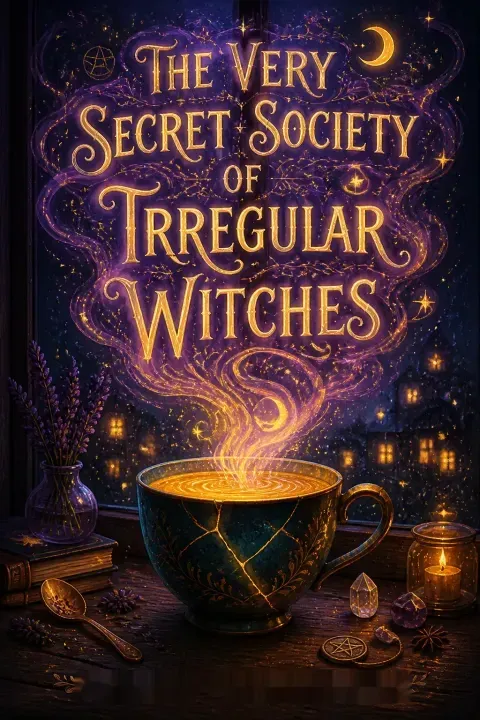


Plot Summary
The Very Secret Society
Mika Moon,1 a thirty-one-year-old witch, huddles on a freezing Outer Hebrides pier for the quarterly gathering of the covert group she privately calls the Very Secret Society of Witches. Primrose,4 the ancient and imperious leader, criticizes Mika1 for posting witchy videos online under the handle @MikaMoon, calling it reckless exposure.
Mika1 insists her cauldron-and-moonlight performances are obvious theatre that no one takes seriously. Over five hundred miles away at Nowhere House in Norfolk, retired actor Ian Kubo-Hawthorn3 watches those same videos and spots genuine magic shimmering around Mika,1 a gift inherited from his own witch mother.
He announces to the household, over librarian Jamie Kelly2's fierce objections, that this internet witch might solve their urgent, desperate problem with three young, untrained witches living under their roof.
The opening establishes the central tension between secrecy and expression. Mika's videos represent a generation of witches chafing against Primrose's ironclad Rules, seeking connection through performance even when authentic disclosure is forbidden. Primrose embodies trauma-hardened caution, while Ian, with his inherited witch-sight, represents the possibility that community can be spotted across impossible distances. The structure cleverly mirrors the theme: two separate worlds, the formal Society and the chaotic found family at Nowhere House, poised to collide.
WITCH WANTED
Ian's3 email arrives with the subject line WITCH WANTED, seeking a live-in tutor for three young witches. Despite suspecting a trap or a joke, Mika1 drives her butter-yellow hatchback, the Broomstick, to the Norfolk coast. She passes through iron gates that crackle with powerful protective wards.
At the main house, she meets Ian,3 his calm gardener husband Ken,5 housekeeper Lucie,6 and the openly hostile Jamie.2 They lead her to the back garden where Rosetta,7 Terracotta,8 and Altamira9 play in a tree house. When seven-year-old Altamira9 touches the rope ladder, it bursts into green witchfire.
Mika1 extinguishes it with a casual flick of her fingers, confirming she is exactly what they need. The household explains their predicament: the girls must learn magical control before solicitor Edward Foxhaven10 visits in December and potentially discovers their secret.
The witchfire ladder functions as a perfect test: Mika's instinctive, competent response proves her identity more convincingly than any interview could. Her decision to come despite suspicion reveals the loneliness beneath her sunny surface. Jamie's immediate hostility establishes him as the guardian of this fragile sanctuary, someone for whom trust must be earned slowly. The ticking clock of Edward's visit introduces narrative urgency, but the real stakes are emotional: these girls need someone who understands them.
A Witch in the Attic
Mika1 moves into the attic, astonishing everyone by extracting from her tiny car a floating koi pond, a full-size greenhouse, and her golden retriever Circe.13 She begins lessons with the three girls: Rosetta,7 ten, serious and bookish; Terracotta,8 eight, Vietnamese and fiercely protective; and Altamira,9 seven, barefoot and chaos-prone.
Terracotta8 arrives at their first lunch wearing a black funeral dress, cheerfully speculating she might need it after murdering Mika1 in her sleep. Jamie2 refuses to let the girls accompany Mika1 to the beach.
During an early lesson, Altamira9 accidentally levitates and cannot get down; Mika1 talks her through it, explaining that magic is like a mischievous puppy that needs a firm hand. The girls begin mastering simple animation spells with pebbles, their confidence tentatively growing under Mika's1 unorthodox, affectionate instruction.
The attic symbolizes Mika's liminal position: inside the house but slightly apart, able to see everything from her balcony. Terracotta's death threats are not genuine malice but a child's desperate attempt to protect her family from an unknown quantity. Mika's puppy metaphor for magic transforms fear into play, offering these girls a relationship with their power that Primrose's Rules never permitted. Jamie's beach refusal shows that earning trust requires proving oneself through daily acts of care, not grand gestures.
A Cyclone in Norwich
Mika1 persuades the household to take Rosetta7 on her first trip beyond the wards in two years, to a children's bookshop in Norwich. Ian3 and Jamie2 accompany them. At the shop, Rosetta7 hesitantly befriends two boys over a comic book series, her face alight with the simple joy of peer connection.
When one boy disparages a character she loves, Rosetta's7 emotions trigger a tiny cyclone that shreds several books. Mika1 swiftly contains the magic, they purchase the damaged stock, and Rosetta7 is not punished for her accidental outburst.
Meanwhile, Jamie2 slips into a solicitor's office during the outing. On the drive home, Mika1 articulates the difference between niceness and kindness, telling Jamie2 bluntly that he is not nice but he is undeniably kind, a distinction that visibly unsettles his carefully maintained defenses.
The cyclone is a perfect metaphor for autistic or neurodivergent overwhelm: Rosetta's feelings overflow into physical manifestation because she lacks the emotional regulation tools other children develop through socialization. Mika's response, buying the books without shaming Rosetta, models acceptance over punishment. Jamie's solicitor visit plants the first seed of the larger mystery. The nice-versus-kind conversation cuts to the book's moral core: surface politeness means nothing compared to the deep, consistent care that asks for nothing in return.
Terracotta's Reckoning
Despite Mika's1 repeated warnings that outdoor levitation is too dangerous for an untrained child, Terracotta8 takes matters into her own hands. During a garden lesson, Mika1 looks up to find the eight-year-old twelve feet in the air, riding a tree branch with savage satisfaction.
A gust of wind jerks the branch. Mika1 rises to rescue her, but Terracotta8 fights the spell, causing a catastrophic magical blowback. Lightning-like energy spears toward both of them. In a split-second decision, Mika1 clenches her fist and absorbs all the force into her own body, crashing unconscious to the ground with a tiny green leaf sprouting at her throat.
Ian3 recognizes this as witch hibernation, a healing trance. For twenty-six hours, Terracotta8 keeps vigil beside Mika's1 bed, guilt reshaping her hostility into something approaching devotion.
The hibernation transforms the power dynamic between Mika and Terracotta. Until now, Terracotta viewed Mika as an intruder to be expelled; Mika's willingness to take the magical blow meant for her proves, in the only language Terracotta trusts, that she is not a threat but a protector. The green leaf is a lovely piece of world-building: witches are so connected to the natural world that their bodies literally bloom when healing. Jamie's vigil and Terracotta's guilt lay groundwork for the romantic and familial bonds to come.
Tea with Primrose
Still recovering, Mika1 receives a summons from Primrose4 and meets her for tea in Cambridge. Primrose4 has sensed the magical surge and suspects Mika's1 involvement. Mika1 lies that an encounter with a manipulative ex-boyfriend from university triggered her loss of control, a story Primrose4 accepts with surprising sympathy.
Then, unexpectedly, Primrose4 reveals witch history Mika1 has never heard: in the seventeenth century, fifty-three witches attempted a spell to protect newborns from witch-hunters, but it backfired catastrophically, orphaning every future witch.
Mika's1 grandmother Sita led witches in southern India. Primrose4 admits she has never regretted taking Mika1 in. The meeting ends with Primrose's4 chilling refrain that alone is how witches survive, but Mika1 returns to Nowhere House unsettled, glimpsing the trauma beneath Primrose's4 rigid control.
This chapter retroactively explains the entire premise: the orphan curse is not random cruelty but a historical wound, a spell cast from collective terror that poisoned generations. Primrose's revelation that she corresponded with Mika's grandmother connects Mika to a lineage she never knew she had. The ex-boyfriend lie is significant: Mika's past exploitation by those who discovered her magic fuels her present fear of being used again, a vulnerability the Nowhere House household will tragically trigger when their own secrets come to light.
Cobwebs in Liverpool
Mika1 accompanies Jamie2 to Liverpool for his estranged mother's sixtieth birthday, using speed spells to compress the journey. While Jamie2 reunites with his mother at the Tate gallery and retrieves his late father's journals from brothers who once beat him with their father's belts, Mika1 meets Hilda,12 a fellow Society witch, and encourages her to tell her fiancée Kira about her magic.
Afterward, Jamie2 explains his brothers now seem like cobwebs, not monsters. In a snowy wood where they stop to forage, Jamie2 kisses Mika1 with desperate intensity, years of guarded isolation dissolving.
But back at Nowhere House, he immediately withdraws, avoiding her. Mika1 senses he is hiding something beyond his usual reticence, something that makes intimacy feel like a betrayal of a secret he cannot yet share.
Jamie's confrontation with his past follows the classic trauma-recovery pattern: the monsters under the bed, when finally faced in adulthood, prove to be mere cobwebs. But his withdrawal after the kiss reveals that he has not fully internalized this freedom. He still operates from a place of anticipatory loss, believing that connection invites destruction. The Hilda subplot mirrors the novel's central question: is telling the truth about who you are worth the risk of rejection? Mika's encouragement of Hilda becomes tragically ironic when she discovers her own trust has been betrayed.
Solstice Secrets Buried
The household celebrates the Winter Solstice with gifts, a snowflake hunt, and fairy wine that is really just lavender-stardust tea. Mika1 gives everyone jars of tea with whimsical personalized labels; Jamie's2 reads twelve of the most attractive scowls, half a tablespoon of sandpapery laughter, the best heart, and a whole lot of stardust.
That night, Mika1 confronts Jamie2 about his withdrawal. On the moonlit beach, surrounded by firefly-like lights she conjures, he confesses the truth: Lillian11 died in June of a sudden aneurysm.
The household buried her beneath the sunflowers. Her will grants guardianship of the girls to her sister Peony,4 a stranger, not to Jamie.2 They invited Mika1 hoping she could help deceive Edward,10 perhaps even magically impersonate Lillian.11 Every kindness she received was shadowed by this ulterior need.
The Solstice chapter masterfully heightens emotional investment before the devastating reveal. The tea labels, especially Jamie's, demonstrate Mika's genuine love for these people, making the betrayal cut deeper. Jamie's confession on the beach, where the sea has been Mika's only constant companion through years of rootlessness, symbolically replaces the ocean with human connection just as that connection seems to shatter. The household's moral complexity is laid bare: they did something illegal and manipulative, but from a place of desperate love for three vulnerable children.
A Window Left Open
Devastated, Mika1 packs her belongings and drives to the empty townhouse in York where she grew up under Primrose's4 distant care, a place haunted by memories of nannies who never loved her. She spends days obsessively brewing a potion to confuddle Edward's10 senses, still determined to protect the girls even as her own heart shatters.
On Christmas Day, Jamie2 appears at her door. He explains the household has left a window open for her, meaning they will always welcome her back. He admits they nearly told her the truth weeks ago, but her comment about needing other witches if the wards failed made them fear she would report them to the Society.
He tells her she has already left indelible marks on all of them. They reconcile, spend the night together, and Mika1 agrees to return, though fear still coils beneath her fragile hope.
Mika's retreat to the York house reveals her core wound: she was never truly chosen, only tolerated by paid caretakers who forgot her the moment they left. The open window metaphor, borrowed from Ken, reframes leaving not as abandonment but as an invitation to return. Jamie's visit on Christmas Day, the holiday most associated with family and belonging, signals his commitment. Their physical intimacy is earned only after emotional honesty, reversing the pattern of Mika's previous relationships where she gave herself away hoping to be loved in return.
The Animated Corpse
Returning to Nowhere House on December 26th, Mika1 and Jamie2 find Edward10 already locked in the garden shed. In their panic after Edward10 arrived early and began interrogating the adults, the three girls dug up Lillian's11 skeleton, dressed it in her clothes, and animated it using a joint spell.
The shambling, incorrectly assembled corpse chased Edward10 into the shed before collapsing. He now knows Lillian11 is dead and has witnessed magic; he called the children freaks. Mika1 enters the shed and confronts him.
When Edward10 threatens to destroy the household with legal accusations and institutionalization, she summons vines from the earth to bind him, leaning close to whisper that she is the monster under his bed. Edward10 is terrified into temporary silence. Realizing only one permanent solution exists, Mika1 calls Primrose4 for help.
The animated skeleton is simultaneously horrifying and hilarious, the children's desperate creativity making literal the household's impossible situation: they have been puppeteering a dead woman's identity for months. Edward's bigotry, revealed when he calls the girls freaks, confirms that his hostility was never about genuine concern for Lillian but about punishing people who exist outside his narrow definition of acceptable. Mika's vine magic represents her claiming her power not as something to hide but as a weapon to wield in defense of those she loves, a pivotal shift from her lifelong pattern of concealment.
The Gorgon Arrives
Primrose4 sweeps into Nowhere House, but when Ian3 sees her, he gasps Lillian's11 name. Primrose4 freezes, then reveals she was born Peony,4 Lillian's11 identical twin. The sisters changed their names at twenty to escape relatives who attempted to exorcise their magic.
They had not spoken in fifteen years, but Primrose4 felt the moment Lillian11 died. For the immediate crisis, she erases Edward's memories of the day's events, then poses as Lillian11 to fire him as her solicitor with devastating politeness.
The household watches Edward's10 car vanish through the gates, the solicitor crisis resolved. But then Primrose4 announces that as Lillian's11 sister and legal heir under the will, she intends to separate the three young witches, invoking the inviolable Rules about too much magic gathering in one place.
The twin revelation reframes everything: Lillian's globe-trotting was a search for a place where witches could live openly, a rebellion against everything Primrose represents. The sisters embody the central tension of the novel: reckless hope versus rigid caution. Primrose erasing Edward's memories is both a violation Mika has always opposed and the only solution available, forcing Mika to confront the limits of her moral absolutism. The chapter masterfully resolves one antagonist only to reveal that the true antagonist has been the Rules themselves all along.
The Gorgon's Bargain
Mika1 pulls Primrose4 aside for a private confrontation beneath the gables. She asks why Primrose4 never raised her herself, relying instead on a parade of nannies who were paid to leave and forget.
She argues that the abuse Primrose4 and Lillian11 suffered taught Primrose4 to believe she was fundamentally unlovable, that rigid control was the only safety. But that isolation damaged Mika1 more than any magical accident could have. These three girls are thriving together, loved fiercely by four adults who are not witches but who understand them anyway.
Mika1 holds Primrose's4 hand and refuses to yield. After a long silence, Primrose4 relents: she will not separate the children. She even agrees to visit and stay informed. When Altamira9 hears the news, she shouts that Primrose4 is not so scary after all.
This confrontation is the novel's emotional climax, not Edward's defeat or the twin reveal. Mika diagnoses Primrose's psychology with the precision of someone who shares the same wounds: the belief that one is too dangerous and too different to deserve love. By naming Primrose's trauma and connecting it to her own childhood neglect, Mika breaks a cycle that has lasted centuries. Primrose's surrender is not defeat but liberation, the first step out of her self-imposed isolation. The chapter argues that rules built from fear cannot produce safety, only loneliness.
Irregular Witches United
Three months later, in April, the wards have been recast with help from other witches, and Mika1 has converted the barn into an enchanted tea and potion shop. On a golden spring morning, the Very Secret Society of Witches meets at Nowhere House for the first time, and Mika1 has broken tradition by inviting every witch to bring trusted loved ones.
Belinda brings her brother with a lemon cheesecake. Hilda12 arrives with her wife Kira, now fully aware of Hilda's12 magic. Rosetta7 gazes adoringly at Belinda, Altamira9 recites swear words to delighted adults, and Terracotta8 demonstrates her spell mastery.
Jamie,2 hiding in the library, finally emerges to stand beside Mika.1 She reflects that while she may not transform the entire world, she is making it better day by day, and that is more than enough.
The final chapter delivers the book's thesis in action: community is not only possible but generative. Each witch who brought a loved one represents a small revolution against the Rules. Mika's tea shop is the physical manifestation of her dream, a place where magic can be shared openly rather than hidden. The closing image, Jamie joining Mika despite his aversion to crowds, signals that love is not about becoming someone else but about expanding your world to include another person's. The novel ends not with transformation complete but with transformation begun, an honest and hopeful cadence.
Analysis
The Very Secret Society of Irregular Witches is fundamentally about the cost of safety purchased through isolation. Primrose's4 Rules, born from genuine historical trauma (the witch-hunter era, the catastrophic spell that orphaned generations), have calcified into a system that protects witches from external threats while starving them of the connection they need to thrive. The novel does not dismiss the dangers: Edward Foxhaven10 proves that bigots will weaponize difference when they discover it. But the answer, Mika1 argues, is not to hide alone but to build communities strong enough to defend themselves together.
The twin sisters, Primrose4 and Lillian,11 embody the central philosophical divide. Lillian's11 globe-trotting search for open witch communities was reckless and left three children emotionally abandoned. Primrose's4 rigid separation kept everyone safe but left them achingly lonely. Neither approach, alone, is sufficient. The synthesis Mika1 achieves at the novel's end, recasting the wards with help from other witches while inviting loved ones into the circle of trust, represents a middle path: cautious openness, guarded community, safety through solidarity rather than solitude.
Mika's1 personal arc from sunny performance to authentic vulnerability is the novel's emotional engine. Her social media videos were a brilliant compromise between concealment and expression, but they were still a mask. The tragedy of her childhood is not that nannies discovered her magic and left, but that Primrose4 erased their memories so thoroughly that Mika1 was forgotten by everyone who ever cared for her. This created a woman desperate to be seen and terrified that being truly seen would lead to rejection. Jamie's2 betrayal, hiding Lillian's11 death while courting Mika's1 trust, confirms her deepest fear: that love is always conditional, always transactional.
Yet the novel insists that betrayal need not be final. Jamie's2 open window speech, Ken's5 quiet wisdom, Ian's3 exuberant meddling, and the girls' fierce love collectively prove that Mika1 has indeed left marks. She is remembered. She matters. The closing image of the Society gathering at Nowhere House, with witches bringing non-witch loved ones into the open, is a quiet revolution. The world has not been transformed, but this small corner of it has. And that, the novel argues, is how change actually happens: not through grand gestures but through daily acts of trust, small risks that accumulate into something irreversible.
Review Summary
The Very Secret Society of Irregular Witches receives mostly positive reviews, praised for its charming characters, cozy atmosphere, and heartwarming found family themes. Readers enjoy the diverse representation, magical elements, and slow-burn romance. Some criticize it as overly twee or predictable, while others find it the perfect comfort read. The book's witchy premise and lighthearted tone appeal to many, though a few readers dislike certain plot twists or character behaviors. Overall, it's recommended for those seeking a feel-good, magical story.
People Also Read



Characters
Mika Moon
Witch, tutor, potion-makerA thirty-one-year-old witch with a sunny disposition masking deep loneliness. Orphaned as an infant, Mika1 was raised in England by a revolving door of nannies under Primrose's4 distant guardianship. She has never stayed in one place for more than six months and has never told anyone outside the Society that she is a real witch. Her love for magic is profound and sensuous: she talks to it, plays with it, and needs it like breathing. She expresses this passion through witchy social media videos where she pretends to be merely performing, a compromise between concealment and expression. Underneath her cheerful mask, Mika1 believes she is fundamentally unlovable, that people only value her for what her magic can do for them. Her arc moves from rootless isolation toward learning that she deserves to be loved for exactly who she is.
Jamie Kelly
Librarian, reluctant guardianA thirty-six-year-old librarian with a perpetual scowl, Irish accent, and fiercely guarded heart. He ran away from Belfast at sixteen after years of abuse from his older brothers following his beloved father's death; his grief-stricken mother could not protect him. Lillian11 found him at the Norwich train station and brought him to Nowhere House, where Ian3, Ken5, and Lucie6 patiently rebuilt his shattered trust over years. He became the de facto parent to Rosetta7, Terracotta8, and Altamira9 when Lillian11 proved incapable of the role. His hostility toward Mika1 masks terror: he has built a fragile family and cannot bear anything that might destroy it. He expresses love through acts of service rather than words, and his emotional arc requires him to risk vulnerability after a lifetime of expecting loss.
Ian Kubo-Hawthorn
Retired actor, matchmaker, catalystAn eighty-two-year-old retired Shakespearean actor, married to Ken5 for over fifty years. His late mother Minerva was a witch, and Ian inherited the ability to see magic as golden light shimmering around witches. It was this gift that allowed him to spot Mika's1 true nature through her videos. Flamboyant, meddlesome, and irrepressibly affectionate, he is the emotional heart of Nowhere House. He knits terrible flamingo-pink scarves, hatches absurd matchmaking schemes, and never finishes any of his ambitious projects, from beehives to amphitheaters. Beneath his theatrical energy lies a deep awareness of mortality and a fierce determination to ensure the people he loves will not be alone after he is gone. He represents the possibility that extravagant, unapologetic personality can coexist with profound kindness.
Primrose Everly
Ancient Society leader, secret twinThe imperious, centuries-old leader of the Very Secret Society of Witches, though she would never call it that. Born Peony Smith, she and her identical twin sister Lillian11 suffered an attempted exorcism at the hands of relatives who discovered their magic, a trauma that shaped her lifelong belief that safety requires absolute secrecy and separation. She took in the orphaned infant Mika1 but kept her at arm's length, raising her through paid caretakers whose memories were erased upon departure. She is rigid, controlling, and genuinely believes her Rules protect witches from persecution. She is also capable of small, unacknowledged kindnesses and carries a deep, unhealed wound from her estrangement from Lillian11. Her arc involves learning that the Rules she built from fear have caused as much harm as the dangers they were meant to prevent.
Ken
Gardener, steady anchorA Japanese man in his seventies, husband to Ian3 for over fifty years. He works as Lillian's11 groundskeeper and lives with Ian3 in a cozy cottage on the property. Calm, wise, and unfailingly kind, he is the emotional bedrock of Nowhere House, the person everyone turns to for steady advice. He gardens with reverence and teaches the girls science and Japanese. His quiet love for Ian3 has weathered decades of societal prejudice, making him living proof that love can survive anything.
Lucie
Housekeeper, maternal heartA plump, pink-cheeked white woman in her fifties who fled an abusive husband years ago and found refuge at Nowhere House. She has been Lillian's11 housekeeper and friend for nearly three decades. She is the household's practical mother figure: she dusts, budgets, fusses over meals, and offers comfort with tea and hugs. Her fierce protectiveness of the children and the other adults masks a lingering gratitude to Lillian11 for giving her sanctuary, a loyalty that sometimes makes her reluctant to criticize Lillian's11 parental failures.
Rosetta Nowhere
Eldest witch-child, book loverA ten-year-old Black girl with serious brown eyes and thick coils of dark hair. Found by Lillian11 as an infant after a fire killed her parents in London. She is the most academically inclined of the sisters, shy and eager to please, with a quiet loneliness that Mika1 immediately recognizes. She devours Jane Austen and longs for friends beyond the wards. Her magical control is the most advanced, but her confidence lags behind her skill. She represents the quiet, internal cost of isolation.
Terracotta Nowhere
Fierce protector, hostile skepticAn eight-year-old Vietnamese girl with straight black hair, named after the Terracotta Army. Lillian11 found her as a one-year-old after a fever killed her parents. She is stubborn, prickly, and ferociously protective of her family. She greets Mika1 with elaborate murder fantasies and refuses to attend lessons. Her hostility masks vulnerability: she cannot bear anyone threatening the only safe home she has known. She takes her emotional cues from Jamie2, and her eventual acceptance of Mika1 parallels his own journey toward trust.
Altamira Nowhere
Chaotic youngest, joy incarnateA seven-year-old Palestinian girl with messy light brown braids and golden-brown skin, found as a newborn in hospital rubble. She never wears shoes, loves swearing (learned from Ian3 and Jamie2), and treats magic as a delightful playmate. She is the most accident-prone of the sisters, frequently levitating or setting things on fire by mistake. Her uncomplicated joy and matter-of-fact acceptance of magic serve as a foil to her sisters' anxieties, embodying the relationship with power that Mika1 wants all three girls to eventually achieve.
Edward Foxhaven
Lillian's bigoted solicitorAn ordinary-looking white man in his late forties who prides himself on meticulous attention to detail. He harbors deep prejudices against the diverse, unconventional household at Nowhere House, masking his bigotry behind professional courtesy. He is the ticking clock of the plot, his planned December visit forcing the household to seek Mika's1 help, and his entitlement and cruelty make him a satisfying antagonist whose defeat requires the combined magic of both Mika1 and Primrose4.
Lillian Nowhere
Absent archaeologist, dead witchThe deceased owner of Nowhere House, an archaeologist whose career was partly a cover for her lifelong search for places where witches could live openly. Born Lily Smith, she was Primrose's4 identical twin, and the sisters reacted to their shared childhood trauma in opposite ways: Primrose4 retreated into rigid rules while Lillian became recklessly hopeful. She adopted three orphaned witches but was rarely present to raise them, leaving the actual parenting to Jamie2 and the others.
Hilda Kim
Fellow witch, hopeful romanticA young witch with blue hair and a chirpy Scouse accent, engaged to a non-witch named Kira. She struggles with the secret she must keep from her fiancée, a dilemma that mirrors Mika's1 own fears about intimacy. Mika1 encourages her to tell the truth, and by the novel's end, Hilda has done so and married Kira, attending the spring gathering with her wife fully aware of her magic.
Circe
Mika's loyal golden retrieverA four-year-old golden retriever and Mika's1 most constant companion through years of moving. She is gentle, well-behaved, and inexplicably devoted to Jamie2, often choosing to nap beside him in the library. Her presence softens every interaction and she serves as an emotional barometer, her reactions to people signaling their true nature before the human characters recognize it themselves.
Plot Devices
Protective Wards
Magical barriers hiding the housePowerful enchantments anchored to the oldest trees around Nowhere House, cast annually by Lillian11 to conceal the magic within from neighbors, passersby, and even other witches. The wards make the house nearly impossible to find without an invitation, redirect mail, and contain magical accidents. Their looming expiration in the spring creates a secondary ticking clock: if the girls are still together when the wards fall, their power will be detectable. The wards represent the tension between hiding and living, safety and freedom, that runs through the entire novel.
Witch Hibernation
Involuntary healing tranceA witch's body responds to catastrophic magical injury by shutting down into a coma-like state, signified by a small green leaf sprouting at the base of the throat. Ian3 recognizes it because his mother experienced it once. During hibernation, the witch cannot be woken and requires no food or water; the body heals itself using ambient magic. Mika's1 hibernation after absorbing Terracotta's8 blowback lasts twenty-six hours and transforms the household's relationship with her, proving her willingness to sacrifice herself for the children.
Speed Spell
Bends space-time for rapid travelRather than making a vehicle move faster, this spell folds distance so that fifty-mile stretches collapse into moments. Mika1 uses it sparingly because it drains her magical energy and could draw attention. She employs it to transport her belongings from Brighton to Norfolk, to reach Primrose's4 tea meeting while still recovering, and to compress the Liverpool journey. The spell enables the plot's geographic range while maintaining the cozy, contained feel of Nowhere House as the central setting.
Memory Magic
Erasing and replacing memoriesPrimrose's4 rarest and most powerful ability, one she has never taught to any other witch. She used it throughout Mika's1 childhood to erase every nanny's memories of both magic and Mika1 herself, leaving Mika1 with the wound of having been forgotten by everyone who ever cared for her. In the climax, Primrose4 deploys this magic to remove Edward Foxhaven's10 memories of discovering Lillian's11 skeleton and witnessing witchcraft, neutralizing him as a threat. The magic represents both violation and necessary protection, forcing Mika1 to confront the moral complexity she has long resisted.
Mika's Enchanted Teas
Potions for luck, calm, and healingMika's1 particular magical talent is potion-making, especially teas infused with intention and ingredients like moonlight, stardust, lavender, and sea holly. She brews tea for luck, for achy bones, for calming tempers, and for confuddling senses. These teas become her love language: she uses them to care for the household, to protect the girls from Edward10, and eventually to build her dream business. The teas represent the novel's thesis that magic is best expressed through small, daily acts of care rather than grand, world-altering spells.
FAQ
Synopsis & Basic Details
What is The Very Secret Society of Irregular Witches about?
- Orphaned witch finds belonging: Mika Moon, a young witch who has always lived a solitary life, is invited to Nowhere House to tutor three young witches.
- Found family and hidden magic: The story explores themes of found family, love, and the challenges of keeping magic secret in a world that doesn't understand it.
- Balancing secrecy and connection: Mika must navigate her own desire for connection with the need to protect herself and the young witches from a world that might not accept them.
Why should I read The Very Secret Society of Irregular Witches?
- Heartwarming and cozy fantasy: The book offers a comforting and enchanting escape with its focus on found family and the power of love.
- Unique characters and relationships: The story features a cast of quirky and endearing characters, each with their own unique struggles and desires.
- Exploration of important themes: The book delves into themes of isolation, belonging, and the courage to embrace one's true self, making it a thought-provoking and emotionally resonant read.
What is the background of The Very Secret Society of Irregular Witches?
- Modern-day Britain with hidden magic: The story is set in a contemporary version of Britain where witches exist in secret, adhering to strict rules to avoid detection.
- Witches are often orphans: A historical event, a spell gone wrong, has led to witches being orphaned at a young age, which has shaped their lives and the rules they follow.
- Emphasis on secrecy and isolation: The witches live in isolation, avoiding contact with each other and the outside world to protect themselves and their magic.
What are the most memorable quotes in The Very Secret Society of Irregular Witches?
- "Alone is how we survive.": This quote, often repeated by Primrose, encapsulates the core belief of the Very Secret Society of Witches and highlights the theme of isolation.
- "You're a gift from the gods, Mika Moon.": This quote from Ian reflects his immediate belief in Mika's abilities and his hope that she can help the young witches.
- "It's not always enough to go looking for the place we belong. Sometimes we need to make that place.": This quote, spoken by Jamie, encapsulates the theme of creating one's own community and belonging.
What writing style, narrative choices, and literary techniques does Sangu Mandanna use?
- Warm and engaging prose: Mandanna's writing style is characterized by its warmth, humor, and ability to create a cozy and inviting atmosphere.
- Third-person limited perspective: The story is primarily told from Mika's point of view, allowing readers to connect with her thoughts and feelings while maintaining a sense of mystery about other characters.
- Use of magical realism: The story blends elements of fantasy with realistic settings and characters, creating a world that feels both familiar and magical.
Hidden Details & Subtle Connections
What are some minor details that add significant meaning?
- The unseasonal flowers: The presence of out-of-season flowers, like the lavender and sunflowers, symbolizes the powerful magic at Nowhere House and the unique nature of the witches living there.
- The names of the girls: The girls' names, Rosetta, Terracotta, and Altamira, are all references to archaeological discoveries, reflecting Lillian's profession and her desire to keep the girls' identities hidden.
- The recurring mention of tea: Tea is a recurring motif, symbolizing comfort, connection, and the sharing of secrets, especially in Mika's interactions with the other characters.
What are some subtle foreshadowing and callbacks?
- Mika's fear of being used: Mika's past experiences with being used and manipulated foreshadow her initial reluctance to trust the household at Nowhere House and her eventual fear of being used by them.
- Ian's knowledge of witches: Ian's seemingly random comments about witches and magic foreshadow his connection to the magical world and his mother's identity as a witch.
- The mention of a "disaster": The characters' repeated use of the word "disaster" to describe the events surrounding Lillian's death and the potential exposure of the girls' magic foreshadows the actual disaster that occurs later in the book.
What are some unexpected character connections?
- Primrose and Lillian's sisterhood: The revelation that Primrose is Lillian's twin sister adds a layer of complexity to their relationship and explains Primrose's knowledge of the wards and the girls.
- Jamie's connection to Lillian: Jamie's history with Lillian, who took him in as a teenager, reveals a deeper connection to Nowhere House and explains his protectiveness of the girls.
- Ian's mother was a witch: The reveal that Ian's mother was a witch explains his ability to see magic and his immediate recognition of Mika's true nature.
Who are the most significant supporting characters?
- Ian Kubo-Hawthorn: Ian's eccentric nature and belief in Mika's magic set the plot in motion, and his warmth and humor provide a counterpoint to the more serious characters.
- Jamie Kelly: Jamie's initial skepticism and protectiveness of the girls create tension, but his eventual acceptance of Mika and his willingness to fight for his family make him a crucial character.
- Lucie: Lucie's nurturing nature and her own past trauma make her a source of comfort and support for the girls and Mika, highlighting the importance of found family.
Psychological, Emotional, & Relational Analysis
What are some unspoken motivations of the characters?
- Primrose's fear of losing control: Primrose's rigid adherence to the Rules stems from her fear of losing control and her desire to protect witches from the dangers of exposure.
- Jamie's fear of vulnerability: Jamie's gruff exterior and initial mistrust of Mika are rooted in his fear of vulnerability and his desire to protect the girls from further harm.
- Mika's yearning for belonging: Mika's desire for connection and community drives her actions, even when it puts her at risk, highlighting her deep-seated loneliness.
What psychological complexities do the characters exhibit?
- Mika's internal conflict: Mika struggles with her desire for connection and her fear of being hurt, leading to a complex internal conflict that shapes her decisions.
- Jamie's trauma and protectiveness: Jamie's past trauma and his role as a caregiver have made him fiercely protective, leading to a complex mix of skepticism and love.
- Primrose's rigid beliefs: Primrose's adherence to the Rules and her fear of change stem from her own past trauma and her desire to maintain control.
What are the major emotional turning points?
- Mika's magical sacrifice: Mika's willingness to put herself in danger to protect Terracotta marks a turning point in her emotional journey, solidifying her commitment to the family at Nowhere House.
- Jamie's confession: Jamie's admission of his feelings for Mika and his vulnerability about his past mark a significant emotional turning point in their relationship.
- The revelation of Lillian's death: The discovery of Lillian's death and the subsequent lies and secrets create a major emotional upheaval for all the characters, forcing them to confront their fears and insecurities.
How do relationship dynamics evolve?
- Mika and Jamie's slow-burn romance: Their relationship evolves from initial skepticism and tension to a deep connection based on shared vulnerability and mutual respect.
- Mika and the girls' found family: Mika's relationship with the girls evolves from a teacher-student dynamic to a deep bond of love and mutual support, highlighting the theme of found family.
- The household's collective growth: The household's dynamics evolve as they learn to trust and rely on each other, creating a strong sense of community and shared purpose.
Interpretation & Debate
Which parts of the story remain ambiguous or open-ended?
- The true nature of the spell: The exact nature of the spell that caused witches to be orphaned remains ambiguous, leaving room for interpretation and further exploration.
- The future of the Very Secret Society of Witches: The future of the Very Secret Society of Witches and its rules remains open-ended, suggesting that the characters will continue to challenge and redefine their traditions.
- The long-term impact of the events: The long-term impact of the events at Nowhere House on the characters' lives and the wider magical world is left open to interpretation, allowing readers to imagine their future.
What are some debatable, controversial scenes or moments in The Very Secret Society of Irregular Witches?
- The decision to hide Lillian's death: The decision to hide Lillian's death and the subsequent lies and manipulations are debatable, raising questions about the ethics of protecting loved ones at all costs.
- Primrose's rigid adherence to the Rules: Primrose's unwavering belief in the Rules and her initial resistance to change are controversial, prompting readers to question the validity of tradition and isolation.
- Jamie's initial mistrust of Mika: Jamie's initial mistrust of Mika and his attempts to keep her at arm's length are debatable, raising questions about the nature of trust and the impact of past trauma.
The Very Secret Society of Irregular Witches Ending Explained: How It Ends & What It Means
- A new beginning for witches: The ending signifies a new beginning for witches, where they can live openly and support one another, challenging the traditional rules of isolation.
- The power of community and love: The ending emphasizes the power of community and love in overcoming fear and prejudice, highlighting the importance of connection and acceptance.
- Mika's journey to self-acceptance: Mika's journey from isolation to belonging is complete, and she embraces her role as a leader in this new era for witches, signifying her growth and self-acceptance.
Download PDF
Download EPUB
.epub digital book format is ideal for reading ebooks on phones, tablets, and e-readers.








































