


Plot Summary
Prologue
On the night of the autumn equinox, a terrible storm breaks across the continent. The Wild Hunt rides the sky, skeletal ghosts on skeletal horses harvesting souls. Nightjars scream in choruses so vast it seems the whole world is dying. The moon turns blood red.
Emperors, kings, spies, sorceresses, and priests all wake screaming from nightmares. At the temple of Melitele in Ellander, Triss Merigold, the scribe Jarre, and High Priestess Nenneke share a vision of a girl with ash-blond hair, her face covered in blood. They know it is Ciri.1 They know she is suffering.
They are helpless to act. Far to the south, in the swamps of Pereplut, the elderly hermit Vysogota5 also wakes with a nameless dread he cannot explain. Something terrible has happened to someone dear to destiny, and the ripples of that violence have touched every corner of the world.
The equinox sequence functions as a cosmic tuning fork, vibrating through the consciousness of every major power in the world. By cataloguing who feels the disturbance, the narrative establishes that Ciri's fate is not merely personal but geopolitical and metaphysical. The Wild Hunt imagery merges folklore with foreshadowing: these spectral hunters will reappear as Ciri's mysterious allies. The helplessness of Triss and Nenneke, women of considerable magical and spiritual power, establishes the central tension of the novel: those who love Ciri cannot reach her, and those who pursue her will stop at nothing. The blood moon and nightjar chorus create an atmosphere of apocalyptic dread that colors everything that follows.
Swamp Rescue and Lost Time
Vysogota of Corvo,5 a former professor and surgeon living as a hermit in the Pereplut swamps, discovers a black mare entangled in branches. Behind the horse lies the body of a teenage boy. When Vysogota5 turns the corpse over, he realizes it is a girl, her face a mask of dried blood.
He carries her to his hut and operates on a deep facial wound inflicted by a curved blade. For days she hovers between life and death, burning with fever and infection. He uses monkshood and stramonium, knowing the mixture could kill her.
When she finally regains consciousness, she calls herself Falka, then corrects herself: her name is Ciri.1 She is a fugitive, she warns him. Everyone who comes near her dies. Vysogota,5 himself a fugitive from Nilfgaardian justice, offers her shelter and asks for her story in return.
The rescue scene establishes Vysogota as both healer and confessor, a man whose own exile has prepared him to harbor the hunted. His clinical notes on Ciri's wound create an almost documentary distance that makes her suffering more real, not less. The discrepancy in dating, Ciri insists she was wounded on the equinox, but Vysogota's medical assessment says three days later, plants the first seed of the temporal mystery that will not fully bloom until the novel's end. The scar becomes more than injury; it is the visible register of trauma, something she will repeatedly touch, trying to understand how her face has become unfamiliar to her.
The False Cirilla's Shadow
In a post station taken over by the Rats, a pseudo-merchant named Hotsporn arrives with news that shakes Ciri1 to her core. Emperor Emhyr var Emreis plans to marry Cirilla, the heir to Cintra's throne, and will proclaim a general amnesty for all criminals.
Ciri1 erupts in fury: someone is impersonating her, enjoying the luxury and power that should be hers. For the first time since she fled Cintra, she feels the pull of her lost identity. That night she steals away from Mistle,17 the woman who loves her, and chases after Hotsporn to learn the route north.
She tells Mistle17 she will return in a gilded coach with a retinue of courtiers. Mistle17 does not believe her but lets her go. Ciri1 catches Hotsporn on the road, demands directions to Cintra, and begins traveling with him toward Forgeham, her mind burning with thoughts of reclaiming her birthright.
The false Cirilla plot catalyzes Ciri's identity crisis. Having spent months as Falka the Rat, she suddenly remembers she was once a princess. Her rage at the imposter is really rage at herself for having forgotten, for having accepted the erasure of who she was. The gilded coach promise to Mistle reveals both her grandiosity and her genuine love, she wants to rescue Mistle as she herself wishes to be rescued. Hotsporn's role as tempter and informant is classically ambiguous; he offers her the way forward but with motives that remain opaque until his sudden death strips away all pretense.
Jealousy's Bloody Morning
Ciri1 races toward the village of Jealousy, hoping to warn the Rats about the bounty hunter Bonhart.4 She arrives too late. In the muddy street before the Chimera's Head inn, Bonhart4 has already killed them all. Giselher, Kayleigh, Reef, Asse, and Spark lie dead.
Mistle,17 gutted and bleeding, crawls toward her sword. Bonhart4 beheads her with a scythe-like stroke. Ciri1 attacks in a fury but the towering bounty hunter4 disarms her effortlessly, striking her with his fist and kicking her sword away.
He forces her to watch as he saws off the heads of all six Rats, preserving them in salt and vinegar for bounty proof. Then he collars her like a dog and drags her into the inn. The black mare Kelpie, once Hotsporn's, now Ciri1 's, waits outside, her only remaining connection to freedom.
The Jealousy massacre is the novel's primal scene of trauma. Bonhart's methodical brutality, sawing heads before a chained witness, represents sadism elevated to ritual. Mistle's death destroys the last remnant of Ciri's life with the Rats and severs her from the only person who loved her unconditionally after the fall of Cintra. The beheading also functions symbolically: Bonhart literally removes the faces of Ciri's companions, just as her own face will soon be permanently marked. Her failed attack on Bonhart introduces the novel's central power dynamic: skill against savage experience, youth against implacable age.
Arena of the Disfigured
Bonhart4 takes Ciri1 to Claremont and the estate of Dominik Houvenaghel, a wealthy businessman who runs an arena for blood sport. In a former temple filled with paying spectators, Ciri1 is thrown into the sand pit and given her gnomish sword.
Houvenaghel and the sadistic Marquise de Nementh Uyvar watch from a private box. Men from Baron Casadei's retinue, led by Windsor Imbra, demand Ciri1 be handed over, but Houvenaghel insists they earn her in the arena. Ciri1 kills several attackers with lethal witcher precision, her training at Kaer Morhen taking over despite her conscious refusal to fight.
When she attempts to impale herself on her own sword rather than continue killing for entertainment, Bonhart4 mocks her: she lacks the courage for suicide. The crowd, denied her death, pelts her with garbage.
The arena sequence forces Ciri to confront the contradiction at her core: trained as a killer, she cannot stop her body from killing even when her will rebels. Her attempted suicide represents the logical endpoint of this internal fracture, but Bonhart's mockery reveals an even harder truth: her survival instinct is stronger than her despair. The paying audience, the leering Marquise, Houvenaghel's profit calculations, all indict a society that consumes violence as entertainment. Ciri's witcher reflexes, once a source of pride, become a curse that makes her the perfect gladiator.
The Unicorn Negotiation
Bonhart4 brings Ciri1 to the village of Unicorn where Stefan Skellen,6 the Imperial Coroner known as the Owl, has assembled his crew. Rience,12 the scarred sorcerer who once pursued Ciri1 on Thanedd, is also there, along with a silver Xenophon box through which the sorcerer Vilgefortz11 speaks.
The three men negotiate over Ciri:1 Bonhart4 wants money, Skellen6 wants her dead to please his co-conspirators, Vilgefortz11 wants her alive to harvest her Elder Blood. While they argue, the psionic Joanna Selbourne19 attempts to read Ciri1's mind.
Ciri1's dormant Power explodes, overwhelming Selbourne and incapacitating two guards. With the help of Neratin Ceka, a secret Imperial agent, Ciri1 escapes on Kelpie, leaping the seven-foot palisade gate as Skellen6 throws an Orion throwing star that tears open her cheek from eye socket to ear.
The Unicorn chapter crystallizes the novel's political economy of predation. Ciri is reduced to a commodity traded among three monstrous men, each representing a different form of exploitation: Bonhart's sadistic ownership, Skellen's ideological murder, Vilgefortz's scientific harvesting. The village named Unicorn, with its straw idol of a creature associated with purity and magic, becomes grotesquely ironic. Ciri's psionic awakening is the turning point: the Power she renounced in the Korath desert returns, catalyzed by violation. The facial scar becomes the permanent inscription of Skellen's near-miss, a wound that marks her transition from hunted object to active avenger.
Fulko's Bargain with Blood
In the town of Riedbrune, Geralt2 is summoned before Governor Fulko Artevelde, a scarred, one-eyed ruler who maintains order through mass executions. Fulko presents a crown witness: Angouleme,9 a foul-mouthed teenage bandit with straw-blond hair, who reveals that a half-elf named Schirrú hired the gang of Homer Straggen, called Nightingale, to assassinate Geralt.2
The contract was placed weeks ago, when Geralt2's company was still in Angren. Someone has been tracking them. Fulko offers a deal: Geralt2 will act as bait to lure Nightingale into the open, and in exchange Fulko will not investigate who Geralt2 really is or why he travels south.
Geralt2 accepts but demands Angouleme9's release. She joins the company, her loyalty bought by the witcher2's unexpected mercy, though Dandelion18 loudly protests welcoming a convicted criminal into their midst.
Fulko represents the authoritarian response to chaos: order through terror, justice as spectacle. His scaffold bristling with bodies mirrors Bonhart's severed heads; both men believe in deterrent cruelty. Geralt's acceptance of the deal marks his pragmatic descent from neutral monster-hunter to political tool. The revelation that someone has been magically tracking the company introduces the invisible hand of Vilgefortz, though the characters do not yet know his name. Angouleme's introduction brings a feral energy to the group, her criminal past and street wisdom a dark mirror of Ciri's own trajectory through the underworld.
The Rialto Inferno
Geralt,2 Cahir,8 and Angouleme9 track the half-elf Schirrú to the Rialto iron mine near Belhaven. Posing as mercenaries who have killed the witcher,2 they confront Schirrú, but he recognizes Geralt2 immediately. He boasts of murdering Geralt2's friends Codringher and Fenn in Dorian on Vilgefortz11's orders.
Before violence erupts, Nightingale's bandits and Nilfgaardian soldiers arrive. A three-way standoff collapses when the Free North Case rebels attack with fire bombs and arrows.
In the chaos, Cahir8's scalp is nearly torn off by an axe, Angouleme9 slashes Nightingale's face open, and Geralt2 fights with berserker fury trying to reach Schirrú. The half-elf escapes in the flames. The trio flees on stolen horses, Cahir8 bleeding heavily. Angouleme9 rides ahead to warn Regis7 and the others waiting in the Sansretour Valley.
The Rialto battle is structured as a descent into chaos that mirrors the novel's broader dissolution of order. Three armed factions collide in a space already violated by exploitation: the mine with its forced labor and environmental destruction. Schirrú's confession about Codringher and Fenn closes a loose thread from earlier books while demonstrating how thoroughly Vilgefortz's reach extends. Cahir's scalping is a wound that strips away identity, just as Ciri's scar does, creating another parallel between the two characters who both seek her. The escape sequence, with Geralt's single-minded bloodlust nearly costing him his companions, reveals how close he is to losing himself entirely.
Cave Confessions and Friendship
Alone in a mountain cave with the wounded Cahir,8 Geralt2 tends the Nilfgaardian's scalped head and waits out a storm. Cahir,8 feverish and vulnerable, finally tells his full story. He describes finding Ciri1 as a terrified child during the slaughter of Cintra, carrying her through burning streets, washing the filth from her body by the river.
He was ordered to capture her for Emhyr, but something changed in him that night. She escaped while he slept. Later, on Thanedd, he was sent to take her again, but she wounded him and fled through the portal.
Now Cahir8 admits he loves her, having dreamed of her for years, not as the child he rescued but as a woman with green eyes and a rose tattooed near her groin. He knows he can never have her, especially if she becomes Empress. Geralt,2 moved despite himself, apologizes for suspecting Cahir8 of treachery and accepts him as a friend.
The cave sequence is the emotional heart of Geralt's arc in this volume. Cahir's confession transforms him from suspicious Nilfgaardian into a tragic figure whose love is as impossible as it is genuine. His description of the child Ciri clinging to dead bodies, his own helpless tenderness while washing her, retroactively reframes the nightmares that plagued Ciri in earlier books. The rose tattoo detail, appearing in Cahir's dreams before it was ever inked, suggests a prophetic connection that transcends normal causality. Geralt's apology and acceptance of Cahir mark a necessary evolution: the witcher must set aside his possessiveness over Ciri and recognize that others genuinely love her too.
The Knowing One's Truth
Reunited with Regis,7 Geralt2 is led to a cave beneath Mount Gorgon where the elf Avallac'h,16 also called the Knowing One, is painting a fake prehistoric mural. Avallac'h16 guides Geralt2 through an underground city of marble statues, an elven cemetery called Tir ná Béa Arainne.
Before the cenotaph of Lara Dorren aep Shiadhal, the elf explains the Elder Blood. Lara, an elf genetically engineered over generations, mated with a human wizard named Cregennan of Lod and produced a child. That hybrid lineage passed through Riannon to Calanthe to Pavetta to Ciri.1
Avallac'h16 tells Geralt2 that saving Ciri1 is meaningless: she has entered her true path, and his interference will only cause the deaths of tens of thousands. He predicts Geralt2 will lose all his companions. When Geralt2 asks to see Ciri,1 Avallac'h16 shows him a vision: his friends under attack in the Druid forest of Caed Myrkvid.
Avallac'h embodies elven arrogance and ancient grief. His fake cave painting mocks human archaeology while his genuine reverence for Lara's cenotaph reveals the wound beneath his cynicism. The Elder Blood revelation systematizes what has been hinted throughout the saga: Ciri is not merely a princess but a genetic project whose existence threatens the established order of both humans and elves. Avallac'h's prophecy about losing companions functions as dramatic irony, the reader suspects he is right, but Geralt's refusal to accept fatalism defines his character. The vision sequence, allowing Geralt to see his friends in danger, demonstrates that even cynics can be manipulated into acts of rescue.
Kovir's Stray Cats
The Redanian spymaster Dijkstra travels to Kovir to beg King Esterad Thyssen15 for money to fund the war against Nilfgaard. Esterad15 refuses direct aid, citing Kovir's neutrality treaties. But Queen Zuleyka, reading from the Good Book of the Prophet Lebioda, finds a parable about giving away a stray cat instead of a beloved dog.
Esterad15 interprets this as divine business advice: he releases from prison thousands of dissidents, mercenaries, and political exiles, the 'stray cats' who will become Redania's condottieri. Meanwhile, he arranges for Novigrad merchant banks to lend Redania one million lintars, a loan partially funded by Nilfgaardian investors.
Esterad15 and Dijkstra part with mutual respect, two cynical patriots who recognize each other as necessary evils in a world sliding toward chaos. Esterad15 warns Dijkstra that someone will eventually make him pay for the blood on his hands.
The Kovir interlude functions as the novel's political thesis statement: in times of existential threat, neutrality becomes creative complicity. Esterad's solution, releasing criminals and dissidents to fight, while Nilfgaardian money funds their weapons, is a masterpiece of amoral statecraft. The stray cats parable, drawn from a sacred text, suggests that even piety can be weaponized for pragmatic ends. The mutual recognition between Esterad and Dijkstra, two men who understand that someone must do the dirty work of statehood, provides a surprisingly warm moment in a cold book. Esterad's warning about eventual reckoning is prophetic: the bill for necessary evil always comes due.
Brisingamen's Sacrifice
On the holy island of Hindarsfjall, Yennefer3 asks the priestess Sigrdrifa14 for the diamond Brisingamen, a 150-carat jewel on the statue of the goddess Freya, to power her megascope. Sigrdrifa14 refuses: the necklace has no clasp and cannot be removed.
During an evening prayer, Yennefer3 falls into a vision where she is crucified on an ash tree, forced to relive her traumatic childhood as a hunchbacked girl beaten by her father and despised by her mother. A golden-eyed woman, the goddess herself, asks what Yennefer3 is willing to sacrifice. Yennefer3 refuses to beg or repent.
When she wakes, the Brisingamen lies at the statue's feet. With the diamond, Yennefer3 constructs her megascope in the temple and begins contacting sorcerers across the continent, trading information, blackmail, and gold to locate Ciri1 and Vilgefortz.11 Crach an Craite13 funds the operation, bound by his blood oath to Calanthe.
Yennefer's ordeal on the ash tree echoes Odin's self-sacrifice for knowledge, but the content is specifically maternal: she must relive the wound of being an unloved child to become capable of saving her surrogate daughter. Her refusal to repent, even under torture, defines her character: she will accept punishment but not the shame her tormentors demand. The goddess's gift of the diamond despite Yennefer's defiance suggests that divine grace need not require submission. The megascope construction transforms Yennefer from passive fugitive into active agent, though her methods (blackmail, bribery) reveal that she shares the ruthlessness of those who hunt her.
Sedna Abyss Betrayal
Yennefer3 takes two dragon ships to the Sedna Abyss, the notorious depth where Pavetta and Duny's ship vanished years ago. She tells Crach an Craite13 she must investigate whether the disasters there are natural. Vilgefortz,11 monitoring her through the megascope communications, springs his trap.
His magical extractor lifts Yennefer3's ship from the sea and hurls it onto the rocks of his hidden fortress. The crew, including the elderly seneschal Guthlaf, perishes. Yennefer3 survives the crash but is immediately beaten by Rience12 and Schirrú. Vilgefortz,11 his face half-destroyed by the explosion of the Thanedd portal, straps her into a steel chair in his laboratory.
He threads needles into her veins and probes her brain, demanding she use her empathic connection to Ciri1 to locate the girl. When she resists, he crushes her fingers with thumbscrews. Under torture, Yennefer3 gives him Geralt2's location instead, protecting Ciri1 even as her body breaks.
The Sedna Abyss sequence repays two books of setup: the mysterious shipwrecks are revealed as Vilgefortz's harvesting operation, and Pavetta's death was no accident. Yennefer's capture mirrors Ciri's captivity under Bonhart, both women are physically tortured by men who see them as tools rather than persons. The parallel is devastating: mother and daughter, separated by distance, endure the same horror. Yennefer's choice to sacrifice Geralt rather than Ciri is ethically excruciating, it protects the child but potentially dooms the man she loves. Vilgefortz's ruined face, a mirror of the damage Ciri did to him, makes visible the cost of his obsession.
Myrkvid's Burning Justice
Geralt2 reaches Caed Myrkvid forest to find his companions under attack by Nightingale's bandits and Nilfgaardian soldiers. He fights alongside the Knight of Chess and other knights-errant of Toussaint. The druids, led by the steel-haired flaminica, have summoned tree-creatures that capture the fleeing bandits.
Geralt2 finds Schirrú and Nightingale imprisoned in a giant wicker hag. The flaminica orders the cage set aflame, ignoring Geralt2's desperate plea to question Schirrú first. The half-elf, who carried the information Geralt2 needs, burns screaming. Geralt2's witcher medallion, taken by Schirrú, melts in the fire.
The flaminica tells Geralt2 she does not believe in crown witnesses: criminals understand only fear. Angouleme,9 Milva,10 and Dandelion18 survive. Geralt2 realizes he has ceased to be a witcher, he must learn to live without the medallion that defined his identity for decades.
The Myrkvid climax presents justice as a force of nature, amoral and absolute. The druids' tree-creatures and flaming wicker cage are not revenge but ecology: predators are culled so the forest can thrive. Geralt's horror at the execution, despite Schirrú being his enemy, reveals the witcher's vestigial humanism. The destruction of his medallion is the symbolic death of Geralt's old life; he entered this quest as a professional monster-slayer and emerges as something more desperate and more human. The flaminica's refusal of due process echoes Fulko's gallows and Bonhart's beheadings: the novel repeatedly asks whether the war against evil requires becoming evil, and refuses easy answers.
Saovine Night's Reckoning
Ciri,1 guided by Vysogota5's maps, travels to the village of Dun Dare where four of Skellen6's men have been terrorizing the local population. It is Saovine, the elven night of spirits when the dead walk. She enters the tavern disguised as an old man.
Cyprian Fripp the Younger and his companions, drunk and bored, boast of their cruelty. When they recognize her, Ciri1 drops her disguise. She fights all four at once, killing them with the cold precision of Kaer Morhen training. Fripp, his hand severed, dies calling for his mother. Afterward, the innkeeper asks in horror what she has done.
Ciri1 replies that she is a witcher, she kills monsters. An old man in the tavern recognizes her as death itself. She agrees. Riding away through the freezing swamp, Ciri1 hears the distant cry of a Beann'shie, the elven death spirit. She knows Vysogota5 is dying but does not turn back.
The Dun Dare sequence is the fulfillment of Ciri's long-forestalled revenge arc. By framing it on Saovine, the narrative positions her as something liminal, neither fully human nor fully monster. The old man's recognition of her as death confirms what she has become: the inevitable consequence of her tormentors' actions. Yet the scene is morally complex. Ciri's victims are undeniably evil, rapists and murderers who terrorized a village, but her methodical execution of Fripp as he cries for his mother suggests that even righteous vengeance extracts a psychic cost. Her refusal to return for Vysogota, choosing mission over mourning, completes her transformation from victim to agent.
Ice Dance of Death
In the lake country of Centloch, Ciri1 lures Skellen6's remaining crew onto the frozen surface of Lake Tarn Mira. She has brought ice skates, a gift from Vysogota5's dead daughter. On the smooth ice, she becomes untouchable: a blur of speed and steel.
One by one, she cuts down the men who have hunted her for weeks. Bert Brigden tries to flee but she catches him. Ola Harsheim is crippled, then killed by Skellen6's own throwing star. Rience,12 the sorcerer who once tortured her, clings to the edge of broken ice begging for his life.
Ciri1 skates past and slices off his eight fingers. He drowns in the black water. Only Skellen,6 Boreas Mun, and Dacre Silifant survive. Bonhart,4 arriving on horseback, crashes through the ice but pulls himself out. He sees what Ciri1 does next and howls in rage.
The ice sequence is the novel's most cinematic set piece, transforming the frozen lake into a stage for reversed power dynamics. Ciri's skates, a dead girl's gift, become instruments of liberation: she literally moves faster than her pursuers can think. The fog that hides her, the ice that betrays them, the cold that numbs their reactions, nature itself becomes her ally. Rience's death by drowning, after his fingers are severed, is poetically appropriate: the hands that tortured Yennefer are removed, the man who burned people alive dies in freezing water. Bonhart's arrival, too late to stop the massacre, sets up the final confrontation.
The Swallow Takes Flight
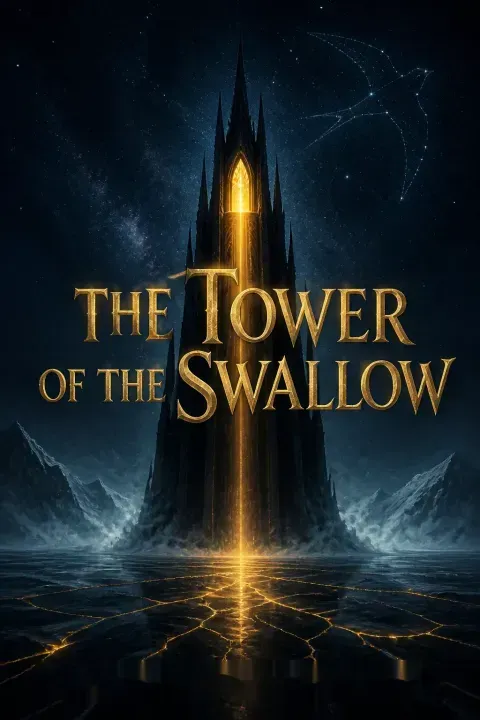
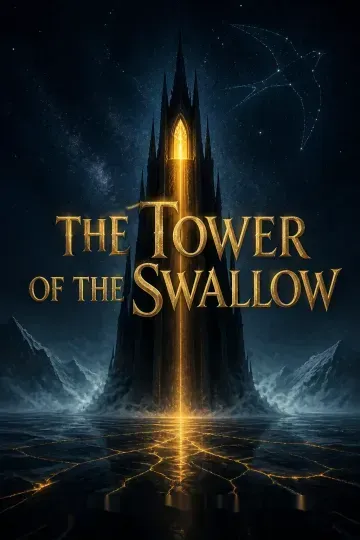
As Bonhart4 charges across the ice, spectral riders of the Wild Hunt materialize between him and Ciri.1 His horse panics, the ice breaks, and Bonhart4 plunges into the freezing water. On the shore, where moments before stood only a hillock and a cairn of stones, a slender basalt tower now rises, the Tower of the Swallow, Tor Zireael.
The aurora borealis blazes above its serrated peak. Ciri1 rides Kelpie through the stone archway and into a long corridor of bones, columns, and statues. Doors open before her in infinite sequence. She sees visions: Yennefer3 in chains, Triss on a windy hill, Geralt2 with a dark-haired woman, and finally the spirit of Vysogota,5 who tells her the Elder Blood gives her power over time and space, she is now the Mistress of the Worlds.
The final door opens onto green grass, white lilies on a lake, unicorns drinking at the shore, and an elf playing a flute beneath flowering cherry trees. It is spring. Ciri1 asks what took her so long to arrive.
The Tower of the Swallow is the novel's mythic payoff, a portal that exists outside time and responds to those who carry the Elder Blood. The bone floor, the infinite doors, the impossible geometry, all evoke a space between worlds where the normal rules do not apply. The vision sequence offers Ciri closure with Vysogota and a glimpse of the people she loves, both living and suffering. The elf's final question, what took her so long, suggests she was always expected, always destined to arrive at this precise moment. The spring world with unicorns represents rebirth after the long winter of her suffering, but the elf's presence hints that this new world has its own agenda for the child of the Elder Blood.
Epilogue
Ciri1 dismounts Kelpie and walks through the flowering cherry trees toward the elf, whose triangular face and almond-shaped eyes mark him as one of the Aen Saevherne, the Knowing Ones. The unicorns lift their heads from the lake, water dripping from their muzzles, and watch her pass.
The elf stops playing his flute and smiles. He has been waiting for her. The warm spring air carries the scent of wild roses and black cherries, a smell so intense it seems impossible after the frozen marshes and bloody ice of her journey.
Behind her, the Tower of the Swallow has vanished as if it never existed. Before her lies a world she does not know, governed by rules she cannot guess. But she is no longer the hunted girl with the scarred face. She is Zireael, the Swallow,1 and she has crossed the threshold of worlds.
The epilogue completes the novel's fairy-tale structure by delivering Ciri to a space of pure myth. The unicorns, which in the Witcher universe are creatures of incredible power and discrimination, accept her presence without fear, marking her as something beyond ordinary humanity. The elf's patient waiting suggests that her arrival was not chance but the culmination of a plan set in motion generations ago. The vanishing tower reinforces the dreamlike quality: was any of it real, or has Ciri stepped into a different kind of story entirely? The sweetness of the spring air, after so many pages of blood and ice, offers catharsis without resolution. Ciri has escaped, but to what end? The novel's final gift is not answers but the image of a scarred girl walking into an unknown spring, finally free of those who would own her.
Analysis
The Tower of the Swallow is a novel about what violence does to those who survive it. Across three intertwined storylines, Sapkowski examines trauma from multiple angles: Ciri1's physical and psychological brutalization by Bonhart,4 Yennefer3's torture at Vilgefortz11's hands, Geralt2's spiraling desperation and the companions he endangers. The book refuses to romanticize suffering or offer easy redemption; instead, it traces how pain reshapes identity, sometimes into something monstrous, sometimes into something transcendent.
The novel's central philosophical argument plays out between Vysogota5 and Ciri1 during their long conversations in the swamp hut. Ciri1 advocates for violent revenge as the only language evil understands: make the evildoer feel what they inflicted, and they will never harm anyone again. Vysogota,5 the old ethicist, counters that nature abhors a vacuum: what replaces the evil you destroy? Ciri1's answer, that she does not think about it, that witchers fight evil without hesitation, because hesitation makes killing meaningless, is both a credo and a confession of psychological damage.
The book tests this philosophy repeatedly. Ciri1's slaughter of the Dun Dare bandits feels righteous; they were rapists and murderers terrorizing a village. But Fripp dies calling for his mother, and the old man in the tavern names Ciri1 death itself. The druids burn Schirrú alive in a wicker cage, and the reader shares Geralt2's horror even knowing Schirrú tortured innocents. The novel insists that evil actions can produce just outcomes while still being evil, a paradox no character can comfortably resolve.
Structurally, the novel is a fugue. Ciri1 tells her story to Vysogota5 in the narrative present, but that story covers events from months earlier. Geralt2's quest and Yennefer3's capture run parallel, their timelines interwoven so that Yennefer3's torture produces the information that sends Schirrú after Geralt,2 while Geralt2 unknowingly avenges Yennefer3 by destroying Vilgefortz11's agent. The political subplot with Dijkstra and Esterad15 operates at a remove, showing how individual fates are shaped by massive economic and military forces the characters cannot see.
The Tower of the Swallow itself is the novel's master symbol: a structure that is not always there, that appears only to those destined to find it, that connects all times and places while belonging to none. Ciri1's passage through it represents the completion of one phase of her journey and the beginning of another, the rules of which remain unknown. The novel ends not with resolution but with transformation, a scarred girl walking into a spring world where unicorns drink at the shore and an elf has been waiting for her longer than she can imagine.
Review Summary
The Tower of Swallows receives mixed reviews, with many praising its complex narrative structure, character development, and engaging storytelling. Fans appreciate Ciri's central role and the book's political intrigue. However, some readers find the pacing slow and the multiple timelines confusing. Critics note the excessive violence and sexual content. Despite these concerns, many consider it one of the stronger entries in the Witcher saga, praising Sapkowski's writing style and world-building. The book's cliffhanger ending leaves readers eager for the series conclusion.
People Also Read


Characters
Ciri (Cirilla of Cintra)
The Scarred Swallow, fugitive princessThe heir to Cintra's throne and carrier of the Elder Blood, a genetic legacy that grants her power over space and time. After the slaughter of her found family the Rats, Ciri is captured by the bounty hunter Bonhart4, who brutalizes her physically and psychologically. Her face is permanently scarred by Stefan Skellen6's throwing star. Trained as a witcher at Kaer Morhen and as a sorceress by Yennefer3, she possesses lethal combat skills and latent psionic abilities that reawaken under extreme stress. Her arc traces the transformation from traumatized victim to active avenger to something beyond human. She loves fiercely, mourns deeply, and kills without hesitation when cornered. Her relationship with Mistle17 and her memories of Geralt2 and Yennefer3 anchor her to the person she was before the world tried to break her. By the novel's end, she has crossed the threshold from hunted fugitive to Mistress of the Worlds.
Geralt of Rivia
The Witcher without his medallionA professional monster-slayer whose search for Ciri1 has transformed him from neutral mercenary to desperate father-figure. Nursing a chronically painful knee from injuries sustained on Thanedd, Geralt moves through the novel with diminished physical capacity but undiminished determination. His company includes the vampire Regis7, the archer Milva10, the Nilfgaardian Cahir8, and the poet Dandelion18. He makes a morally compromising deal with Governor Fulko to track bandits in exchange for safe passage, and later loses his witcher's silver medallion, the symbol of his profession, in a druidic execution fire. His brief affair with the sorceress Fringilla Vigo in Toussaint, glimpsed in Ciri1's vision, suggests his emotional resources are depleted. Despite Avallac'h16's prophecy that he will lose everyone he loves, Geralt refuses to abandon his quest, embodying a stubborn humanism that defies both fate and elven cynicism.
Yennefer of Vengerberg
The tortured mother seeking redemptionA powerful sorceress and Ciri1's surrogate mother, fleeing the false accusation of treason after the Thanedd coup. Yennefer washes up on the Skellige Islands and convinces Earl Crach an Craite13 to help her locate Ciri1. She undergoes a mystical ordeal on Hindarsfjall, reliving her traumatic childhood as a hunchbacked outcast, and receives the holy diamond Brisingamen to power her megascope. Her communications network allows her to gather intelligence but also leads Vilgefortz11 directly to her. Captured and tortured in his laboratory, she endures crushed fingers and psychic violation rather than reveal Ciri1's location, ultimately sacrificing Geralt2's safety to protect the girl. Her willingness to suffer for Ciri1 completes her arc from selfish sorceress to selfless mother, though her methods remain as ruthless as ever.
Leo Bonhart
The bounty hunter with dead eyesA towering, skeletal killer who treats his victims as property and their suffering as entertainment. Bonhart slaughtered the Rats and sawed off their heads before Ciri1's eyes, then collared her like an animal. He drags her across Ebbing, forcing her to fight in Houvenaghel's arena and beating her when she refuses to confess her true identity. His interest in Ciri1 is proprietary and sadistic: he wants her broken but alive, valuable but submissive. Despite his brutality, he is not stupid; he recognizes Ciri1's witcher training and deduces her noble origins. His fish-like eyes, the most unsettling detail of his appearance, suggest something not quite human, a predator whose emotional range extends only to cruelty and greed. His confrontation with supernatural forces on the frozen lake reveals that even his formidable will has limits.
Vysogota of Corvo
The hermit philosopher and confessorA former professor of philosophy and ethics at the University of Oxenfurt, later exiled from Nilfgaard for political dissent. Now an old man living alone in the Pereplut swamps, he finds Ciri1 nearly dead and nurses her back to health using forgotten surgical skills. His hut full of books becomes a sanctuary where Ciri1 can process her trauma by telling her story. He helps her research the Tower of the Swallow, using his academic training to locate the mythical portal. His own history, multiple exiles, two failed marriages, a death sentence that never expires, makes him uniquely equipped to understand Ciri1's flight from impossible circumstances. He dies as she leaves for the tower, his death announced by the Beann'shie cry. His spirit appears to her inside the tower, offering final guidance from beyond the grave.
Stefan Skellen (The Owl)
Imperial Coroner turned conspiratorThe Nilfgaardian Imperial Coroner who has betrayed Emperor Emhyr to join a conspiracy of nobles seeking to kill Ciri1 and prevent her marriage to the Emperor. Nicknamed the Owl for his predatory stare, Skellen is a political idealist who dreams of constitutional monarchy and democracy while employing torture and assassination to achieve his goals. He throws the Orion star that scars Ciri1's face. His crew of mercenaries and killers includes the psionic Joanna Selbourne19 and the tracker Boreas Mun. Skellen's partnership with Bonhart4 and Rience12 is purely transactional; all three men plan to betray each other once Ciri1 is caught. His ideology masks a willingness to commit any atrocity in service of his vision, making him a study in the corrupting gap between political ideals and violent methods.
Emiel Regis
The vampire philosopher and physicianA four-hundred-year-old higher vampire who has sworn off drinking human blood and now serves as Geralt2's most perceptive companion. Regis possesses immense knowledge, a dry wit, and abilities that make him invaluable: he cannot be detected by magical tracking spells, which explains the error in the enemy's count of Geralt2's company. He acts as liaison between Geralt2 and both Avallac'h16 and the druids, revealing a network of contacts that spans species and centuries. His calm rationality balances Geralt2's impulsiveness, and his genuine compassion surprises those who would expect a vampire to be monstrous. Though he claims to be a coward after the trauma of the Battle of the Bridge, his actions consistently prove otherwise.
Cahir Mawr Dyffryn aep Ceallach
The Nilfgaardian knight in love with destinyA young Nilfgaardian officer sent twice to capture Ciri1 for Emperor Emhyr, first during the slaughter of Cintra when she was a child, and later on Thanedd where she wounded him. Now he rides with Geralt2, claiming he wants to rescue Ciri1 rather than deliver her to the Emperor. His confession in the cave reveals the depth of his obsession: he has dreamed of her for years, loves her hopelessly, and knows he can never have her. Severely wounded at the Rialto mine, he endures a scalping and fever with remarkable fortitude. His genuine devotion gradually overcomes Geralt2's suspicion, earning the witcher's friendship and apology. He represents the possibility that love can transcend political allegiance.
Angouleme
The feral bandit with unexpected loyaltyA blond teenage criminal from Cintra, born a bastard of a noble house, who fled an abusive orphanage-brothel to join a gang. Captured by Governor Fulko and facing execution, she becomes a crown witness to save her skin. Geralt2 takes custody of her, and she repays him with fierce loyalty. Her street knowledge proves essential in tracking Nightingale and navigating the criminal underworld. She is foul-mouthed, sexually blunt, and emotionally raw, a mirror of what Ciri1 might have become had she stayed with the Rats. Her courage in battle and her refusal to abandon Geralt2 even when outnumbered earn her a permanent place in the company.
Milva (Maria Barring)
The archer who lost everythingA skilled archer from Brokilon who suffered a miscarriage during the Battle of the Bridge. She cut off her braid afterward, declaring herself neither virgin nor widow. Her grief manifests as fierce protectiveness toward her companions and hair-trigger violence toward threats. She repeatedly saves Geralt2's company with her bow and has no patience for male posturing or intellectual vanity. Her strength is physical and emotional, though the miscarriage haunts her in ways she refuses to discuss. She becomes a surrogate aunt figure to Angouleme9 despite finding the girl's crude manners exasperating.
Vilgefortz
The sorcerer who harvests lifeThe primary antagonist, a sorcerer of immense power whose face was destroyed when Ciri1 escaped through the Thanedd portal. Vilgefortz operates from a hidden fortress above the Sedna Abyss, where he uses magical extractors to sink ships and harvest their passengers. He needs Ciri1's placenta to access the power of the Elder Blood, a process that would kill her. His laboratory contains the steel chair where he tortures Yennefer3 to locate Ciri1. His alliance with Bonhart4, Skellen6, and Rience12 is purely instrumental; he considers all of them expendable tools. His ruined face, partially regenerated with a crystal eye, makes visible the cost of his obsession and the damage Ciri1 has already inflicted on him.
Rience
The burned sorcerer and Vilgefortz's houndA sorcerer whose face was scarred by Yennefer3's fire magic during an earlier confrontation. He serves Vilgefortz11 with slavish devotion, carrying the Xenophon communication device and relaying his master's orders. His hatred of Yennefer3 and Ciri1 is intensely personal, he promised to teach them pain with his own hands. Captured and nearly tortured by Skellen6, he reveals valuable information to save himself. On the frozen lake, Ciri1 severs his fingers and watches him drown, reclaiming the threat he once made against her. His death, begging for mercy he never showed others, completes a grim arc of poetic justice.
Crach an Craite
Earl of Skellige, oath-bound protectorThe ruler of the Skellige Islands, bound by a blood oath to Calanthe to protect Ciri1. Initially hostile to Yennefer3, whom he believes a traitor, he agrees to help her after she invokes his oath. He provides ships, gold, and political cover even when it risks his position. His brief romantic history with Yennefer3 is acknowledged but set aside; the past, as both agree, was not written into the register. He is a pragmatist who balances honor with political survival, funding Yennefer3's operation while maintaining plausible deniability.
Sigrdrifa
High Priestess of the goddess FreyaThe flaminica of the temple on Hindarsfjall, a tall, plain-faced woman who witnessed Yennefer3's kindness to a pregnant woman and revised her prejudice against sorceresses. She facilitates Yennefer3's vision of the goddess, though she does not control what happens during that ordeal. Her willingness to let the Brisingamen be used, and her discretion about what she overhears of Yennefer3's megascope communications, make her an unlikely ally in the search for Ciri1. She recognizes the sacred in Yennefer3's mission even when the sorceress herself cannot.
Esterad Thyssen
King of Kovir, pragmatic neutralThe aging but vigorous king of the wealthy northern kingdom of Kovir. Married faithfully for nearly thirty years to Queen Zuleyka, he governs through a philosophy of enlightened self-interest disguised as piety. When Dijkstra asks for a million lintars to fund Redania's army, Esterad refuses direct aid but orchestrates a complex financial arrangement that releases political prisoners to fight and funnels Novigrad merchant money, partially Nilfgaardian, to Redania's war effort. His respect for Dijkstra as a fellow 'fucking bastard' who has never personally profited from his dirty work reveals Esterad's own ethical code beneath the cynicism.
Avallac'h (Crevan Espane aep Caomhan Macha)
The elven Sage who paints liesA member of the elven elite known as the Knowing Ones, Avallac'h lives deep beneath Mount Gorgon in a cave system that houses an elven cemetery. He paints fake prehistoric murals to distract human archaeologists from the treasures hidden behind the rock. His knowledge of the Elder Blood and Ciri1's destiny is encyclopedic, but he shares it with contempt, viewing humans as barely evolved vermin. He predicts Geralt2 will save Ciri1 only to lose her forever, and that all his companions will die. Despite his hostility, he provides Geralt2 with crucial information and arranges his rapid transport to Myrkvid. His reverence for Lara Dorren's cenotaph hints at personal loss beneath the arrogance.
Mistle
Ciri's lover, slain by BonhartA member of the Rats who became Ciri1's lover and protector. Her death at Bonhart4's hands, beheaded while Ciri1 watched, is the traumatic event that drives Ciri1's subsequent arc. She was tender with Ciri1 in private and ruthless in public, embodying the contradictions of the gang's found-family dynamic.
Dandelion (Julian)
Poet, memoirist, and reluctant adventurerGeralt2's oldest friend, a famous troubadour who is writing his memoirs titled 'Half a Century of Poetry' even though he is not yet forty. He fears Toussaint because of a past affair with Duchess Anna Henrietta. His companionship provides occasional comic relief but his loyalty is absolute.
Joanna Selbourne (Kenna)
The psionic who chose conscienceA telepath and clairvoyant recruited into Skellen6's crew. Her attempt to read Ciri1's mind at Unicorn triggered the girl's latent Power and nearly killed her. She eventually deserts Skellen6 with several others, unwilling to continue the hunt. Her testimony before a tribunal provides much of the novel's political exposition.
Plot Devices
The Elder Blood (Hen Ichaer)
Genetic legacy of space-time powerA carefully bred genetic trait originating with the elf Lara Dorren, who mated with the human wizard Cregennan of Lod. The gene passed through generations to Ciri1, granting her the ability to manipulate space and time. Vilgefortz11 wants to harvest this power from Ciri1's placenta, a process that would kill her. The Elder Blood also allows Ciri1 to activate the Tower of the Swallow's portal and renders her invisible to magical tracking. Its existence is the central MacGuffin driving multiple factions to pursue Ciri1.
The Tower of the Swallow
Crossroads of worlds and time gatesTor Zireael, an elven structure that phases in and out of visible reality. Located on Lake Tarn Mira in Centloch, it appears only to those of the Elder Blood. Inside, it contains infinite corridors of bones, statues, and doors that open onto different times and dimensions. The tower connects to the broken portal on Thanedd Island, offering Ciri1 a way back to her own world. Avallac'h16 described it as a place that serves the knowledgeable but brings nightmares to the common. Its appearance is heralded by the aurora borealis, and it vanishes once Ciri1 passes through.
The Brisingamen Diamond
Megascope power source for communicationA 150-carat blue-white diamond worn by the statue of the goddess Freya on Hindarsfjall. Yennefer3 uses it as the core component of her megascope, a device that allows long-distance magical communication without needing a paired crystal ball. The diamond's facets enable light refraction essential to the spell. After Yennefer3's mystical ordeal, the necklace miraculously falls from the statue, interpreted by Sigrdrifa14 as the goddess's grace. The megascope allows Yennefer3 to contact sorcerers across the continent but also alerts Vilgefortz11 to her location.
The Xenophon
Remote communication box for VilgefortzA silver box carried by Rience12 that transmits Vilgefortz11's voice across vast distances. It allows the sorcerer to coordinate his agents without risking teleportation, which would be detected by his enemies. The device is temperamental and eventually stops working, leaving Rience12 isolated during the final pursuit. Its silence during the critical moments on the ice may indicate Vilgefortz11 has abandoned his henchman or that the distance is too great.
Ciri's Gnomish Sword (Swallow)
Witcher blade inscribed with destinyA Gwyhyr forged by gnomes of Tir Tochair using ancient techniques. The blade is dark iron with a wavy, flame-shaped edge, lighter than standard swords due to pierced welds. The handle is wrapped in rayskin for grip. Etched into the steel is the elven Blathan Cáerme, a destiny mandala showing a lightning-struck tower with a swallow above it. The blacksmith Esterhazy gave it to Ciri1 as a gift, recognizing something in her that demanded the blade. She names it Zireael, Swallow, after her own elven name1. It becomes her primary weapon in the Dun Dare tavern and on the frozen lake.
The Witcher Series
About the Author
Other books by Andrzej Sapkowski
Download PDF
Download EPUB
.epub digital book format is ideal for reading ebooks on phones, tablets, and e-readers.








































