
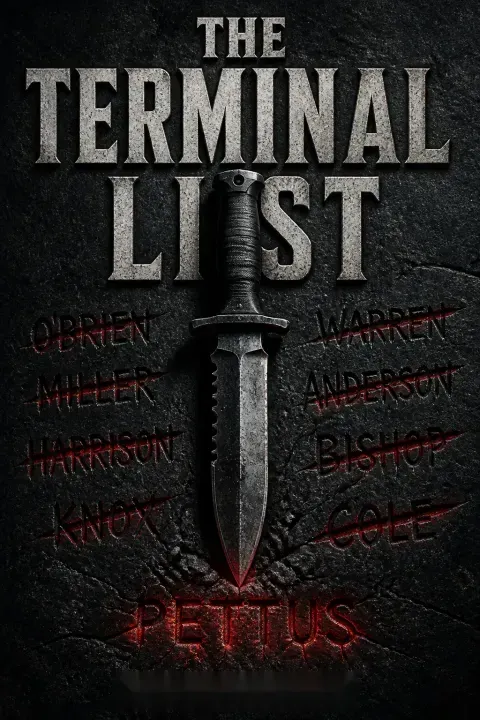


Plot Summary
Prologue
James Reece1 hikes into Wyoming's backcountry with a custom .300 Winchester Magnum hunting rifle. His target: Marcus Boykin, a wealthy accountant who commutes from his Star Valley Ranch home to Jackson three days a week with monastic predictability.
From a U-shaped notch 625 yards away, Reece1 tracks the silver Mercedes SUV as it crests the rise. He dials the elevation, accounts for the light wind, and at the natural pause between breaths, presses the trigger. The solid copper bullet strikes Boykin's face, killing him instantly.
The SUV, cruise control still set, continues up the highway before cartwheeling off the pavement. Reece1 pulls a Ziploc bag from his jacket. Inside is a crayon drawing of three figures under a rainbow, names written on the back. He crosses off the first name. The list has begun.
The prologue functions as a narrative hook that inverts the typical thriller structure. By showing Reece already executing a cold-blooded assassination, Carr forces the reader to ask not 'will he get revenge?' but 'what drove a decorated SEAL to murder?' The clinical precision of the kill (range calculation, wind calls, breath control) establishes Reece's lethality, but the crayon drawing humanizes the violence. This is not senseless killing; it is methodical, list-driven retribution. The contrast between technological precision and childlike innocence creates an emotional dissonance that defines the entire novel. We witness a man who has fused professional competence with primal grief, and the question becomes not whether he will finish the list, but what remains when he does.
The Hillside Explodes
In Khost Province, Afghanistan, Lieutenant Commander James Reece1 leads his SEAL troop on a time-sensitive target mission that none of them trust. The intelligence came from a single source, pushed down by flag officers who would never set foot on the objective. As the assault teams crest the military ridge, the entire hillside erupts.
Reece1 is thrown backward, his helmet ripped away. When he regains consciousness, he finds his troop chief's decapitated head still inside a helmet. He reestablishes communications, calls in an AC-130 gunship strike on the compound, and moves to check for survivors with the one other operator still standing, a SEAL called Boozer.18
A secondary explosion engulfs the valley floor, timed to the arrival of the QRF helicopters. Twenty-eight Rangers, four aircrew, and thirty-six of Reece1's SEALs are dead. The youngest member of his team, Donny Mitchell, dies in Reece1's arms, his body severed below the waist.
This sequence establishes the novel's central trauma with unflinching brutality. The ambush is not merely a military defeat but a betrayal of the sacred bond between commanders and their men. Reece's instinctual return to tactical problem-solving (checking his weapon, finding communications) masks a psychological rupture. The image of a friend's severed head, the dying operator asking if they 'got them,' and the sheer scale of loss (sixty-eight dead) create a wound that conventional justice cannot heal. Carr is setting up a world where the system has failed so completely that only extrajudicial violence can restore balance.
Three Tumors, One Survivor
At Bagram Air Base, NCIS agents interrogate Reece1 not about the mission's suspicious origins but about personal emails critical of military policy, painting him as a subversive. An Army neurosurgeon, Dr. Peter O'Halloran,14 shows Reece1 CT scans revealing that two of his dead teammates had rare oligodendroglioma brain tumors, and Reece1's own scan shows a similar mass.
The odds of three operators developing identical tumors are astronomical, suggesting chemical exposure. When Reece1 later calls O'Halloran14's California clinic to schedule a biopsy, he learns the surgeon14 was killed in a 'green on blue' attack, an Afghan ally turning on coalition forces.
Meanwhile, at Capstone Capital in Los Angeles, CEO Steve Horn4 and his lieutenant Saul Agnon8 discuss eliminating the 'test subjects' and silencing the doctor14 who discovered the tumors, arranging the Afghan soldier's attack as a commonplace battlefield occurrence.
The NCIS interrogation's focus on emails rather than operational failures signals an institutional cover-up already in motion. O'Halloran's death weaponizes a tragic reality of the Afghan war (insider attacks) to conceal murder. The juxtaposition of Reece learning about the tumors and Horn casually arranging O'Halloran's death reveals the conspirators' reach and ruthlessness. The tumors are the physical manifestation of betrayal: the enemy was not just the Taliban, but the very people entrusted with the operators' lives. This section transforms the story from war tragedy to medical conspiracy thriller.
Red and Blue on Coronado
Cleared to return home after weeks of interrogation, Reece1 drives to his Coronado rental anticipating a reunion with his wife Lauren12 and three-year-old daughter Lucy.13 Instead, he finds his street flooded with emergency lights. Police officers tackle him as he sprints toward the door.
Three or four men armed with AK-pattern rifles fired through the front door and swept the house. Lauren,12 pregnant with a son Reece1 never knew about, was found facedown in the bedroom closet, shielding Lucy13's body with her own. She had grabbed a Glock from a small safe and wounded at least one attacker before an entire magazine was emptied into her at close range.
At the funeral, fellow SEALs place their golden Tridents on the tiny caskets. Reece1's wealthy Mexican friend Marco del Toro11 tells him the gang members violated an agreement and offers to help exact revenge. Reece1 sits alone with his Glock, considers suicide, then flips the family photo facedown. It is time to figure this out.
This is the novel's point of no return. The murder of Lauren and Lucy transforms Reece from a grieving commander into an instrument of pure vengeance. The detail of the pregnancy, a surprise Lauren kept for the homecoming, adds a fourth victim: an unborn son. The SEAL funeral tradition of Trident-pinning honors the family as fallen warriors, reframing their deaths not as random violence but as casualties of the same war that killed Reece's men. Marco's offer introduces the theme of extralegal networks that will enable Reece's campaign. The moment with the Glock and his choice to live represents a death of the old self and the birth of something more primal.
The Photos That Linked Everything
Reece1 meets investigative journalist Katie Buranek3 at a Los Angeles Starbucks. She brings printed photos from a facial recognition database: Josh Holder,7 the DCIS agent who coerced Reece1's doctor, walking alongside Secretary of Defense Lorraine Hartley.5 Another image shows Holder7 at a charity gala with Saul Agnon8 and Steve Horn.4
Katie3 reveals her father was a Czech army doctor turned CIA asset during the Cold War; the case officer who risked his life to extract her family was Reece1's own father. Meanwhile, Reece1's friend Ben Edwards2 decrypts Holder7's cloned hard drive, uncovering emails about 'RD4895' and 'the Project,' with orders to eliminate test subjects who developed abnormalities.
Reece1's troop was given an experimental drug disguised as a Tactical Performance Study. The tumors were the reason they were all marked for death. Reece1 writes four names on the back of his daughter13's drawing: Holder,7 Boykin, Agnon,8 and Horn.4
This section weaves together personal history and investigative journalism to transform a shadow conspiracy into a mappable network. Katie's reveal about her father creates an emotional architecture for trust that transcends the transactional. The photographs establish a visual chain of corruption: the DOD agent, the financier, the cabinet secretary. The hard drive contents convert suspicion into certainty. Carr argues that in the modern surveillance state, power leaves digital footprints, and a sufficiently motivated operator can follow them. The RD4895 revelation also introduces the novel's central critique: that the military-industrial complex treats soldiers not as warriors to be protected but as assets to be leveraged.
The Jihadi in the Taxi
After lunch in Chinatown, Reece1 escorts Katie3 toward her car. His combat instincts trigger when he spots a yellow taxi with its driver's door open and a man raising a Beretta pistol. Reece1 shoves Katie3 to the sidewalk, draws his Glock 19, and fires three rounds into the attacker's chest before two more to the face end the threat.
A search of the cab reveals a page with Reece1's official Navy photograph, his home address, and vehicle description. The dead man is Humza Kamir, a Pakistani cab driver radicalized online as part of a secret government program that creates expendable domestic terrorist assets.
Katie3 escapes to her brother's home in the Sierras. Reece1 drives back to Coronado, now certain that someone with access to classified intelligence is hunting him actively. He begins building target packages on his four confirmed names.
The Chinatown shootout brings the war home literally, the novel's first major action set piece on American soil. Kamir's radicalization by the same government that created the RD4895 program reveals a hall-of-mirrors corruption: the state manufactures terrorists to eliminate inconvenient witnesses. Reece's flawless tactical response demonstrates that his skills are not diminished by grief but sharpened by purpose. The discovery of his Navy photo in the cab transforms paranoia into operational certainty: he is not just investigating a conspiracy, he is being hunted by one. This section also marks Katie's transition from observer to potential victim, raising the stakes for everyone connected to Reece.
Agnon's Last Drink
At a Palm Springs legal conference, Reece1 ambushes Saul Agnon8 in his casita. Using a handheld shower head, plastic wrap, and a bathtub, he waterboards the attorney8 until Agnon8 breaks. The confession, recorded on tape, reveals the full scope: RD4895 was purchased from a pharmaceutical company after animal testing showed tumor formation.
A lab in India reworked the compound, and Admiral Pilsner6 personally selected Reece1's troop for human trials, administered as 'vitamin B12 shots.' The Hartleys5 received a 10 percent kickback through J.D.17's consulting firm. When blood work showed abnormalities, the conspirators arranged the ambush.
A second SEAL troop is currently being tested with a supposedly fixed version of the drug. Agnon8 also discloses the Hartleys5 'sleeper radicalization program. Reece1 injects him with a lethal cocktail of methadone, alprazolam, and carisoprodol, staging an accidental overdose. He adds more names to the list: CJNG Mexico, Pilsner,6 Tedesco,9 and both Hartleys.5
The Agnon interrogation is the novel's informational fulcrum. Carr structures it as a literal extraction: the truth is pulled from Agnon's body through simulated drowning, mirroring how the conspirators extracted lives from soldiers. The revelations escalate from corporate greed (a cheap drug with blockbuster potential) to institutional corruption (a SECDEF using her position for profit) to state-sponsored terror (a radicalization program creating disposable assassins). The detail that a second troop is currently being tested adds urgency: Reece is avenging the past and racing to prevent future deaths. The overdose staging marks his first premeditated murder outside combat, a line-crossing that formalizes his transformation from soldier to executioner.
Fourteen Bodies in Tijuana
Marco del Toro11's armored convoy delivers Reece1 to a dilapidated building in La Sánchez Taboada, one of Tijuana's most dangerous neighborhoods. At 0300, Reece1 ascends the target house using night vision and a suppressor-equipped M4. He moves floor by floor, killing gang members in their sleep.
On the second floor, he recognizes a man with a bandaged wound: the shooter Lauren12 wounded while defending Lucy.13 Reece1 snaps, losing tactical discipline, and kills the man with a dagger sawed across his throat. When AK fire erupts from across the hall, Reece1 responds with a fragmentation grenade.
Marco11's security detail handles the ground floor. By the end, fourteen CJNG foot soldiers and two women are dead. Reece1 executes the last survivor on his knees rather than interrogate him. Marco11 assures him there will be no police response: the night belongs to them.
The Tijuana raid completes the most primal revenge arc: the direct killers of Reece's family are dead. Carr strips away tactical elegance once Reece identifies the bandaged shooter, showing how vengeance can overwhelm discipline. The moment is visceral and ugly, not cathartic. The collateral damage of the two women complicates any moral clarity. Marco's role expands from grieving friend to enabler, his criminal connections making him the perfect facilitator for Reece's extralegal war. By operating outside both U.S. law and the military's rules of engagement, Reece has become what he once hunted: an insurgent using an enemy's tactics against a corrupted system.
The Imam's Head
Posing as a graduate student, Reece1 attends evening prayer at the Islamic Center for Peace and Prosperity, then meets with Imam Hammadi Izmail Masood.16 The imam16 initially delivers polished, moderate rhetoric until Reece1 reveals his identity and asks about Captain Leonard Howard.15
Masood16 drops the facade, calling Reece1's family 'kafir' burning in hell, then lunges for a CZ-75 pistol. Reece1's tomahawk severs Masood16's wrist before a crippling headache drops him to the floor. Fighting through the blinding pain, Reece1 disables the imam16 with additional strikes, then decapitates him.
He carries the head out in a satchel, impales it on the mosque's wrought-iron gate, and drapes an ISIS flag over it. The message is unmistakable: the hunter is coming for everyone who facilitated the ambush. Captain Howard15 panics and flees with his family to Florida.
The Masood killing is the most psychologically complex in Reece's campaign. It weaponizes an enemy's own symbolic violence (decapitation, public display) to invert power dynamics and sow confusion among the conspirators. The headache that drops Reece mid-fight literalizes the tumor as both a ticking clock and a vulnerability. Masood's transition from moderate to fanatic when exposed reveals the hypocrisy Carr sees in those who preach peace while funding terror. By leaving the ISIS flag, Reece deploys psychological warfare: the conspirators will suspect an Islamic enemy rather than a single SEAL, buying him operational time.
Holder's Final Awakening
At 3:00 a.m., Reece1 picks the lock of Josh Holder7's apartment, a duplicate model he practiced on repeatedly. Wearing night vision, he finds Holder7 sprawled on his back, sheets kicked to the foot of the bed. Reece1 retrieves Holder7's issued SIG 9mm from the dresser, planning to use his own suppressed .45 HK Mk 24 and stage a suicide.
As Reece1 stands over him, Holder7 gasps awake from a nightmare. Reece1 shoves the suppressor into Holder7's mouth, shattering teeth, and pulls the trigger. He swaps the weapons, leaving the SIG cocked on Holder7's chest with a round missing from the magazine, then locks the door behind him and escapes.
This is for Boozer,18 the fellow survivor who hated 9mm and would never have shot himself with one. The staged suicide will not fool detectives for long, but it buys precious hours. Reece1 crosses another name off the list.
Holder's death completes the revenge for Boozer, the second survivor murdered to isolate Reece. The use of a .45 (Boozer's preferred caliber) to kill the man who staged a 9mm suicide is darkly poetic, speaking to the intimacy of Reece's vengeance. Holder's nightmare awakening introduces chance that could have compromised the mission, yet Reece's composure under surprise demonstrates operational superiority. The staging of the suicide mirrors Holder's own technique, reversing the predator-prey dynamic. Carr suggests that those who live by covert violence are uniquely vulnerable to dying by it, and that no amount of tradecraft eliminates the hunter's advantage.
The Admiral's Last Call
Mike Tedesco,9 the Hartleys5 'fundraiser and the conspiracy's acknowledged weak link, walks into Admiral Pilsner6's office at WARCOM wearing a C-4 vest sewn with framing nails. A prepaid phone rings. Pilsner6 answers and hears Reece1's voice: he is the admiral6's executioner.
Reece1 remotely triggers the blasting cap from a second phone. Two and a half pounds of C-4 detonate, turning the nails into supersonic shrapnel. Pilsner6's upper body vaporizes, his skull fragments and charred remains blowing through the massive windows onto the beach below. Tedesco9 is bisected by the blast.
Earlier, Reece1 had coerced Tedesco9 by threatening his wife and newborn, offering him a choice that functioned as atonement for his role in the conspiracy. The admiral6 who sold his men for money and promotion dies in his own command post, his remains scattered across the Coronado sand.
The Pilsner assassination is the novel's most theatrical killing, appropriate for a man who treated war as branding opportunity. The suicide vest method turns a weapon of asymmetric warfare against the asymmetric corruption within the military hierarchy. Tedesco's coerced participation creates moral complexity: he is both victim and perpetrator, and his death is framed as penance. Pilsner's death by shrapnel, blowing out the windows overlooking the Pacific, is rich with symbolism: the admiral who never left the FOB is killed by the kind of weapon his decisions inflicted on troops overseas. The visual of his remains raining onto the beach is operatic, almost mythological.
The Mangrove Execution
Tracking Captain Leonard Howard15 to Islamorada in the Florida Keys, Reece1 ambushes the JAG15 as he walks a nature trail. After beating Howard15 bloody, Reece1 drags him into the mangrove swamp, then carries him to a secluded island by boat. Howard15 begs, blames everyone else, and prays loudly.
Reece1 slashes open his abdomen with a karambit knife, spilling his intestines onto the marshy ground. Using a Razorback belt knife, Reece1 skewers the entrails and jams the blade into a sabal palm trunk, then orders Howard15 to walk around the tree.
The lawyer15 wraps himself tighter with each step until he collapses, back against the trunk, slowly dying as the swamp's creatures begin to feed. Reece1 tells him his death serves a purpose: to send a message. Howard15's body will be found in a day or two, the SEAL-designed knife leaving no doubt about who executed the man15 who brokered the ambush deal.
The Howard execution is the novel's most brutal killing, drawing on Inca ritual, Shawnee tradition, and Sendero Luminoso terrorism. It represents Reece at his most unrestrained, the point where vengeance crosses into something ancient and terrible. Howard's role as the legal facilitator who sanitized the conspiracy makes his punishment thematically appropriate: the man who used law as a weapon is destroyed by violence entirely outside legal frameworks. The disembowelment is symbolic unmasking: Howard's guts are literally exposed, just as his corruption has been. The feeding by wildlife completes a natural cycle: the swamp reclaims what civilization corrupted.
Copper Slug in SoHo
Using household chemicals (fertilizer, pool cleaner, drain opener) and a copper bowl, Reece1 constructs an explosively formed penetrator in a Vermont hangar with pilot Liz Riley10's help. He mounts it on a desk inside a white Sprinter van and positions himself outside the SoHo apartment of J.D. Hartley17's mistress.
When Hartley17 emerges and climbs into his armored Suburban, Reece1 pulls the van alongside, pinning the vehicle against the curb. He detonates the device and escapes into the crowd as the copper slug punches through the Suburban's armor and eviscerates the former congressman.17
In the chaos, Reece1 steals a Hasidic man's hat for disguise, takes a cab to Brooklyn, and meets his old teammate Raife Hastings by boat. The political fixer who monetized his wife's Pentagon position dies in the same kind of attack used against American troops in Iraq. Liz Riley,10 flying overhead, learns the mission succeeded.
The EFP assassination is the novel's most technically sophisticated kill and carries deep symbolic weight. By using the same weapon that Iranian-backed militias used against American forces in Iraq, Reece turns a tool of asymmetrical warfare against the American politicians who profited from the war. The construction sequence, with its household chemicals and Christmas lights, demystifies political violence: mass death is not the exclusive province of states or terrorist organizations. The ironic detail of Hartley dying in an armored vehicle his wife's budget likely funded underscores the novel's critique of the military-industrial revolving door. His death closes a loop: the weapon that killed American troops now kills the man who enabled their deaths.
The Traitor's Reveal
After a combat swimmer insertion onto Fishers Island using a Draeger rebreather, Reece1 kills a sniper in a guest cottage and places a demolition charge under the contractors' SUV. He enters the mansion to find Steve Horn4 and Lorraine Hartley5 by the fire, but the real shock is his best friend Ben Edwards2 holding a dead man's switch connected to detonation cord wrapped around Katie Buranek3's neck.
Ben2 reveals he joined the conspiracy after the family killings, then used Reece1 to systematically eliminate the other stakeholders, increasing his own cut to ten figures. Horn4 smugly offers a deal: Reece1 dies, Katie3 lives. The charge outside detonates.
In the chaos, Reece1 shoots Horn4 through the face, puts three rounds into the secretary of defense,5 and fires twice into Ben2's skull. Katie3 survives because the detonator was never actually connected. Reece1 cuts her free, douses the bodies with gasoline, and ignites the mansion with his father's MACV-SOG Zippo.
The Fishers Island climax reveals that Ben Edwards, Reece's closest friend and emotional anchor, has been the hidden architect of the second half of Reece's campaign. This betrayal transforms the story from revenge thriller into a meditation on instrumentalized violence: even Reece's agency was partially an illusion, managed by someone who claimed to love him. The dead man's switch with Katie literalizes the novel's central question: can you pursue justice without sacrificing those you aim to protect? Reece's decision to shoot despite not knowing if the detonator was real answers that he would rather lose everything than let the conspirators win. The burning mansion, ignited by his father's lighter, is both funeral pyre and purification rite.
Epilogue
Reece1 sails alone across the Atlantic on a Beneteau 48, provisioned by Raife and his sister Victoria. He crosses the last names off the list, then turns the paper over to the crayon drawing of Lauren12 and Lucy13 under a rainbow. His tears fall as he whispers to his daughter13 that he will be with her soon.
He releases the drawing to the sea, watching it float away on the current. He is ready to die. At FBI headquarters, investigators sift through the mountain of evidence while Katie Buranek3 continues publishing her exposés.
On Reece1's abandoned phone in Coronado, an unheard voice mail from Dr. German delivers unexpected news: the biopsy shows a benign cerebral convexity meningioma, treatable with a 75 percent survival rate. The tumor was never a death sentence. But Reece1 is already gone, sailing toward whatever horizon the ocean or his body chooses.
The epilogue operates on two devastatingly ironic levels. On the surface, it provides closure: the list is complete, the drawing is released, and Reece has accepted his death with the peace of a man who fulfilled his purpose. But Dr. German's voice mail introduces a twist that reframes the entire novel. The tumor that drove Reece's fatalistic courage, that liberated him from consequence, was survivable all along. This revelation asks whether his willingness to die was a necessary condition for his success, or a tragic misdiagnosis that led him to throw away a life he might have reclaimed. The ambiguity is deliberate and powerful. The drawing floating on the Atlantic symbolizes what was lost and what was avenged, while the unheard message suggests that redemption, like the tumor, was closer than Reece ever knew. Carr leaves his protagonist suspended between death and the possibility of survival, a man who has already let go but whom fate may not be finished with yet.
Analysis
The Terminal List operates as both a propulsive revenge thriller and a searing indictment of the military-industrial complex. Carr, a former Navy SEAL, brings documentary authenticity to the tactical details (night vision protocols, lock-picking techniques, explosive construction) that grounds the escalating violence in operational reality. But beneath the gunfights lies a deeper argument about the fungibility of American soldiers in a system that treats them as assets rather than citizens. The novel's structural genius is its conversion of a diffuse conspiracy into a checklist. Reece1's list transforms overwhelming evil into a series of solvable problems. Each name crossed off is both a tactical victory and a psychological step toward oblivion. The crayon drawing on the reverse side literalizes what is at stake: a child's vision of family happiness, already destroyed, now serving as the warrant for execution. Carr explores the psychology of the 'already dead' operator. Reece1's tumor diagnosis (later revealed as survivable) functions as liberation from consequence. He is not a vigilante who believes he will escape justice; he is a dying man delivering justice before his own clock expires. This framing lets Carr push violence to medieval extremes (disembowelment, decapitation) without losing reader sympathy, because Reece1 himself expects no survival. The conspiracy reflects real anxieties about the revolving door between government and finance, the corruption of pharmaceutical approval, and the exploitation of soldiers as unwilling test subjects. The Hartleys,5 with their foundation tax write-offs and consulting kickbacks, embody a modern form of graft: legal in form, catastrophic in consequence. Yet the novel complicates any simple reading through Ben Edwards2's betrayal. The one man Reece1 trusted was managing his revenge for profit, weaponizing grief itself. This suggests that even righteous violence can be co-opted, that the avenger is always in danger of becoming someone else's tool. Reece1's final act, releasing the drawing to the sea, is not triumph but release. He has completed his mission and can finally let go. The unheard voice mail about the treatable tumor leaves the reader suspended between tragedy and the possibility that the man who accepted death might, against all odds, have earned a second chance at life.
Review Summary
The Terminal List receives mixed reviews. Many praise its intense action, authentic military details, and compelling revenge plot. Critics note heavy-handed political views, underdeveloped characters, and excessive technical descriptions. Some find the protagonist's lack of emotion unrealistic. Fans appreciate the author's Navy SEAL background, while others feel it leads to bias. Overall, readers enjoy the fast-paced thriller aspects but are divided on the execution and political overtones. The book's popularity has led to a TV series adaptation starring Chris Pratt.
People Also Read




Characters
James Reece
Navy SEAL Commander Seeking VengeanceA highly decorated SEAL officer with multiple combat deployments, he was prior enlisted before commissioning, earning fierce loyalty through competence rather than rank. Married to his college sweetheart Lauren12 and father to young Lucy13, he planned to leave the Teams after this final deployment to focus on family. His father was a Vietnam-era SEAL turned CIA case officer whose legacy of service shaped Reece's identity. A brain tumor diagnosis becomes both a ticking clock and a liberating force: a man with nothing left to lose cannot be deterred. Beneath his professional calm lies a deep capacity for violence, now unmoored from the military's rules of engagement. He transforms methodically from grieving commander to insurgent, converting a conspiracy into a checklist and his daughter13's crayon drawing into a death warrant.
Ben Edwards
Former SEAL, CIA Operator, FriendReece1's closest friend since BUD/S training, a stocky, heavily tattooed operator who left the Navy for the intelligence community's covert side. He maintains a surface persona of easygoing humor, Copenhagen dips, and womanizing charm. He picks Reece1 up from the airfield when no one else is there, checks on his family during deployments, and offers unwavering support when the system turns against Reece1. His access to classified intelligence databases and his willingness to operate off-book make him an invaluable ally in Reece1's campaign. Yet his motivations are never entirely transparent, and his skill at compartmentalization, honed by years of covert work, conceals layers that even Reece1 cannot see.
Katie Buranek
Investigative Journalist, Loyal AllyYoung, fiercely intelligent, and uncompromising, she made her name exposing the Benghazi cover-up. Her father was a Czech army doctor turned CIA asset during the Cold War, extracted by Reece1's father, creating a multigenerational debt of loyalty that drives her commitment to Reece1's cause. She is methodical with investigative tools and facial recognition databases, providing the research that maps the conspiracy's network. Her willingness to risk her career and safety makes her one of the few people Reece1 can trust. She becomes both his intelligence support and a vulnerability that the conspirators seek to exploit.
Steve Horn
Capstone Capital CEO, Conspirator-in-ChiefA towering former Stanford quarterback turned private equity titan, he exudes the polished menace of wealth unmoored from conscience. He treats power as the ultimate currency, collecting politicians and generals like assets in a portfolio. His ruthlessness is clinical rather than passionate: he authorized the ambush and the family murder not out of malice but because they were efficient business solutions. His vanity (custom suits, an Aston Martin, the perfect golf swing) is his defining weakness. He genuinely believes that the pursuit of profit justifies any human cost, a sociopathy so complete he has never thought to question it.
Lorraine Hartley
Secretary of Defense, Presidential AspirantA liberal firebrand radicalized in college and hardened by decades of power, she has become the very thing her younger self despised. She treats the Pentagon as an ATM for her husband17's consulting firm and views soldiers as props in her political narrative. Her ambition for the presidency makes her vulnerable to Horn4's manipulations, but she is no passive player: she authorized the use of classified drone assets to track Reece1 and the activation of radicalized sleeper agents, all while publicly decrying 'domestic extremism' and calling for expanded surveillance powers.
Admiral Gerald Pilsner
WARCOM Commander, Corrupt BureaucratA careerist who never commanded men in combat, he rose through political maneuvering rather than battlefield competence. His men mock him as 'Lord Fobbit' behind his back. He personally selected Reece1's troop for the drug trial in exchange for wealth and career advancement under Hartley5's patronage. He views the SEAL brand as his personal property to monetize, caring more about media perception than the lives of operators. His desk sits on a platform to elevate him above visitors.
Josh Holder
DCIS Agent, Hartleys' EnforcerA former Army CID investigator turned Defense Criminal Investigative Service agent, he serves as the operational arm of the conspiracy. Cool, detached, and unsettlingly competent, he orchestrated Boozer18's staged suicide and managed the sleeper asset program. His lack of affect makes him the conspiracy's most dangerous implement: he kills without hesitation and without visible emotion.
Saul Agnon
Horn's Lieutenant, Conspiracy's LogisticianA disheveled, socially awkward attorney whose sharp intelligence and doglike loyalty make him indispensable to Horn4 despite his physical repulsiveness. He handled the logistics of the drug trial and the cover-up, documenting everything in emails that become Reece1's roadmap. His psychological fragility and deep need for approval make him the easiest conspirator to break under interrogation.
Mike Tedesco
Political Fundraiser, Guilty ConscienceThe quintessential Southern California fixer, connected to everyone who matters from studio executives to senators. He was the bridge between the Hartleys5 and Capstone, believing initially that the drug would help veterans. His Catholic guilt and genuine love for his wife and children make him the conspiracy's moral weak point. He joined to reach a financial number that would let him retire, only to find himself complicit in mass murder.
Liz Riley
Civilian Pilot, Former Army AviatorA compact, muscular pilot with intricate tattoos and an Alabama drawl. She flew OH-58D Kiowas in Iraq until an RPG crash left her with severe spinal injuries. Reece1 disobeyed direct orders and led his sniper team through heavy fire to rescue her, creating an unpayable debt. Now a private pilot flying a Pilatus PC-12 for a Texas billionaire, she becomes Reece1's aerial mobility, logistical support, and the closest thing to family he has left.
Marco del Toro
Wealthy Mexican Businessman, FacilitatorA diminutive jiujitsu expert who built an empire spanning telecommunications, insurance, and real estate. He moved his family to Coronado after a kidnapping threat in Mexico. His friendship with Reece1 was forged through shared love of family, combat sports, and motorcycles. His criminal connections in Tijuana, his fleet of armored vehicles, and his willingness to leverage both make him the perfect enabler for Reece1's cross-border operations.
Lauren Reece
Reece's Wife, Moral AnchorThe college sweetheart who gave a warrior something to fight for beyond the mission. Pregnant with their son and keeping it secret as a homecoming surprise, she fought back against the attackers, wounding one before shielding their daughter Lucy13 with her own body. Her death is the wound that transforms grief into vengeance.
Lucy Reece
Reece's Daughter, Innocence PersonifiedA three-year-old with blond curls and enormous blue eyes who had her father1 wrapped around her tiny finger. Her crayon drawing of the family under a rainbow becomes the physical list of the dead, the emotional core of Reece1's campaign, and the object he releases to the sea when his work is done.
Dr. Peter O'Halloran
Army Neurosurgeon, Truth's First VictimA world-class spine surgeon who volunteered after 9/11 out of duty. He discovered the tumor cluster connecting the dead operators and was killed in a staged insider attack before he could investigate further. His death proves the conspiracy will murder anyone who threatens exposure.
Captain Leonard Howard
Pilsner's JAG, Ambush BrokerA failed civilian litigator who found power in uniform as the admiral6's judge advocate. He used his position to connect the conspiracy with Imam Masood16's terrorist network, facilitating the ambush that killed sixty-eight American servicemen. His cowardice in the face of Reece1's vengeance reveals the hollowness beneath his authority.
Imam Hammadi Masood
Radical Cleric, Terrorist FacilitatorA Pakistani-born imam with a British accent who publicly preached moderate Islam while secretly funneling millions to ISIS and connecting Captain Howard15 to the Pakistani Taliban for the ambush. His polished intellectual exterior masks a fanaticism that emerges when Reece1 confronts him directly.
J.D. Hartley
Former Congressman, Corrupt LobbyistA serial philanderer whose failed presidential bid left him running a consulting firm that laundered kickbacks from the RD4895 program. He treated his wife5's Pentagon position as a personal revenue stream. His assassination by EFP in SoHo closes the transactional heart of the conspiracy.
Boozer
SEAL Troop Chief, Second SurvivorThe only other survivor of the Afghanistan ambush besides Reece1. A consummate gun enthusiast who despised 9mm pistols in favor of .45 caliber 1911s. His staged suicide with a SIG P226 provided the clue that revealed the cover-up, since anyone who knew him understood he would never choose that weapon.
Plot Devices
RD4895
Experimental PTSD drug, conspiracy's coreA neuro pathway beta-blocker designed to prevent PTSD before it takes hold, originally developed by a pharmaceutical company that abandoned it after animal testing caused tumors. Capstone Capital purchased it for pennies and had a lab in India rework the compound. Admiral Pilsner6 selected Reece1's SEAL troop for unauthorized human trials, administered as vitamin B12 shots during a fake Tactical Performance Study. When blood work revealed abnormalities and brain tumors, the conspirators arranged the ambush to eliminate the test subjects. A second SEAL troop is undergoing trials with a supposedly fixed version of the drug, creating urgency for Reece1 to stop the program entirely.
The Terminal List
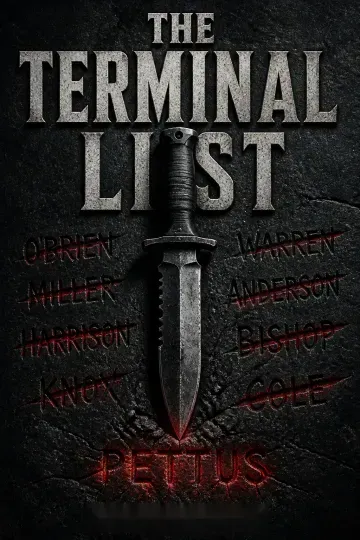
Crayon drawing turned death warrantA crayon drawing by Reece1's daughter Lucy13, depicting Daddy, Mommy, and Lucy13 under a rainbow. Reece1 carries it folded in a Ziploc bag against his chest throughout his campaign. After discovering the conspiracy, he flips the drawing over and writes the names of his targets on the back, starting with Josh Holder7, Marcus Boykin, Saul Agnon8, and Steve Horn4, then expanding as new names emerge. Each killing concludes with him crossing off a name using a tiny stub of a pencil. In the epilogue, he releases the drawing to the Atlantic, having completed every name. It humanizes his violence, transforming it from murder into a father's act of love.
Sleeper Asset Program
Government-run domestic radicalization schemeA clandestine program controlled by the Hartleys5 that identifies and radicalizes at-risk individuals (like Humza Kamir) through online propaganda. These assets believe they are serving ISIS or similar groups, but are actually expendable tools for domestic operations including assassination. The program was used to target Reece1 in the Chinatown attempt. Its existence, revealed during Agnon8's waterboarded confession, represents the deepest level of the conspiracy's corruption: the state manufactures the very terrorists it claims to fight, then uses them to eliminate inconvenient witnesses.
Suicide Vest
Remote-detonated admiral killerConstructed from two M112 blocks of C-4 plastic explosive, strips of carpenter's framing nails, a prepaid cell phone trigger wired through a safe-arm switch and silicone-controlled rectifier, all sewn into a white tuxedo vest using Lauren12's sewing machine. Reece1 coerced Mike Tedesco9 to wear it into Admiral Pilsner6's office by threatening his family. The device turned the admiral6's own security protocols against him: Tedesco9 passed inspection because he was a known, trusted visitor. The shrapnel turned Pilsner6's upper body to mist while blowing out the office windows.
Explosively Formed Penetrator
Asymmetric assassination weaponBuilt from urea nitrate (synthesized from fertilizer, pool cleaner, and drain opener), a copper bowl as the liner, PVC pipe casing, a Christmas tree lightbulb initiator packed in a modified 5.56mm cartridge case, and a wireless doorbell trigger. Mounted on a desk inside a Sprinter van, the device formed a molten copper slug at detonation that penetrated J.D. Hartley17's armored Suburban. The weapon mirrors the EFPs used by Iranian-backed militias against American forces in Iraq, creating dark poetic symmetry: the congressman17 who profited from the war died by the war's signature weapon.
FAQ
Synopsis & Basic Details
What is The Terminal List about?
- SEAL seeks revenge: After a devastating ambush wipes out his SEAL team, Lieutenant Commander James Reece returns home to discover his family murdered, setting him on a path of revenge against those responsible.
- Conspiracy unfolds: Reece uncovers a deep conspiracy involving a secret drug trial, government corruption, and powerful figures seeking to silence him and protect their interests.
- Justice outside the law: Driven by grief and a thirst for justice, Reece becomes a one-man army, using his skills and training to hunt down and eliminate his enemies, operating outside the bounds of the law.
Why should I read The Terminal List?
- Action-packed thriller: The novel offers a fast-paced, suspenseful plot filled with intense action sequences, military tactics, and a relentless pursuit of justice.
- Exploration of morality: It delves into complex moral questions about revenge, justice, and the consequences of unchecked power, prompting readers to consider the boundaries of right and wrong.
- Authentic military experience: Written by a former Navy SEAL, the book provides a realistic portrayal of military life, special operations, and the psychological toll of combat, adding depth and credibility to the story.
What is the background of The Terminal List?
- Post-9/11 military context: The novel is set against the backdrop of the post-9/11 world, exploring the experiences of special operations forces and the long-term consequences of the Global War on Terror.
- Government corruption themes: It touches upon themes of government overreach, corporate greed, and the erosion of individual liberties, reflecting contemporary concerns about the consolidation of power and the abuse of authority.
- SEAL culture and values: The story delves into the culture, values, and mindset of Navy SEALs, highlighting their dedication, resilience, and commitment to duty, while also examining the challenges they face upon returning to civilian life.
What are the most memorable quotes in The Terminal List?
- "This is a novel of revenge.": This opening line from the Preface immediately sets the tone and theme of the book, highlighting the driving force behind James Reece's actions.
- "The Americans have all the watches, but we have all the time.": This Afghan saying, mentioned in Chapter 1, underscores the challenges of fighting a protracted war against a cunning and adaptive enemy, highlighting the limitations of technology and the importance of understanding local dynamics.
- "Let these feelings turn, Reece. Let them turn...": This internal monologue in Chapter 13 marks a pivotal moment in Reece's transformation, as he channels his grief and despair into a burning desire for revenge, setting him on his path of retribution.
What writing style, narrative choices, and literary techniques does Jack Carr use?
- First-person perspective: The novel is primarily told from James Reece's point of view, providing intimate access to his thoughts, emotions, and motivations, creating a sense of immediacy and immersion for the reader.
- Realistic military jargon: Carr incorporates authentic military terminology, acronyms, and operational procedures, enhancing the realism and credibility of the story and appealing to readers familiar with military culture.
- Foreshadowing and suspense: Carr uses subtle foreshadowing and callbacks to create suspense and build tension, hinting at future events and deepening the reader's engagement with the plot.
Hidden Details & Subtle Connections
What are some minor details that add significant meaning?
- The crayon drawing: Reece carries a crayon drawing with a list of names, symbolizing his commitment to his daughter and his determination to avenge his family, turning a seemingly innocent item into a powerful reminder of his mission.
- The Echols Legend rifle: The rifle, a gift from Reece's father, represents a connection to his past and a legacy of military service, highlighting the importance of family and tradition in his life.
- The MACV-SOG lighter: The lighter, belonging to Reece's grandfather, hints at a family history of covert operations and sacrifice, suggesting that Reece's actions are part of a larger pattern of service and dedication.
What are some subtle foreshadowing and callbacks?
- Headaches foreshadow tumors: Reece's recurring headaches, initially dismissed as stress-related, foreshadow the discovery of brain tumors in himself and his teammates, hinting at the underlying cause of the conspiracy.
- "Green on Blue" reference: The mention of a "Green on Blue" incident as a way to eliminate the doctor foreshadows the betrayal and violence that Reece will experience, highlighting the theme of trust being broken.
- The Slamburger at Rick's Palm Bar: The reference to the "Slamburger" and Ben's past relationships foreshadows the themes of loss, fleeting connections, and the search for solace in the face of trauma that permeate the novel.
What are some unexpected character connections?
- Katie's father and Thomas Reece: The revelation that Katie's father was saved by James Reece's father creates a deep connection between the two characters, adding a layer of fate and destiny to their alliance.
- Pilsner and the Hartleys: The connection between Admiral Pilsner and the Hartleys reveals the extent of the conspiracy and the reach of their influence, highlighting the corruption at the highest levels of power.
- Holder and the Hartleys: The relationship between Josh Holder and the Hartleys shows the depth of their involvement and the lengths they are willing to go to protect their interests, emphasizing the theme of unchecked power.
Who are the most significant supporting characters?
- Ben Edwards: As Reece's closest friend and former teammate, Ben provides crucial support and resources, but his eventual betrayal underscores the theme of trust and deception, adding complexity to the story.
- Katie Buranek: As an investigative journalist, Katie's determination to uncover the truth and her willingness to risk her life make her an invaluable ally for Reece, highlighting the importance of truth and justice.
- Marco del Toro: As a wealthy Mexican businessman, Marco's loyalty and resources provide Reece with the means to carry out his mission, showcasing the power of friendship and the lengths people will go to help those they care about.
Psychological, Emotional, & Relational Analysis
What are some unspoken motivations of the characters?
- Reece's guilt: Beyond revenge, Reece is driven by a deep sense of guilt for the loss of his team and family, seeking to atone for his perceived failures and find a sense of closure.
- Hartley's ambition: While outwardly serving the country, Lorraine Hartley is primarily motivated by her own political ambitions, willing to sacrifice anything and anyone to achieve her goal of becoming president.
- Ben's desire for belonging: Ben's betrayal stems from a desire for belonging and recognition within the intelligence community, seeking to prove his worth and gain acceptance from those in power.
What psychological complexities do the characters exhibit?
- Reece's PTSD: Reece grapples with the psychological trauma of combat and loss, experiencing flashbacks, nightmares, and emotional detachment, highlighting the long-term effects of war on the human psyche.
- Horn's antisocial tendencies: Steve Horn exhibits traits of antisocial personality disorder, lacking empathy and relishing the discomfort of others, showcasing the dark side of ambition and the absence of morality.
- Agnon's subservience: Saul Agnon displays a complex psychological dependence on Steve Horn, willing to do anything for a hint of approval, reflecting the dynamics of power and control within the conspiracy.
What are the major emotional turning points?
- The ambush: The ambush in Afghanistan marks a turning point for Reece, shattering his sense of duty and trust in the military establishment, setting him on a path of questioning and rebellion.
- The murder of Reece's family: The murder of Lauren and Lucy is the catalyst for Reece's transformation, turning his grief into a burning desire for revenge and setting the stage for his quest for retribution.
- The discovery of the tumors: The discovery of brain tumors in himself and his teammates adds a layer of urgency and despair to Reece's mission, highlighting the physical and emotional toll of the conspiracy.
How do relationship dynamics evolve?
- Reece and Ben: The relationship between Reece and Ben evolves from close friendship to bitter betrayal, showcasing the corrosive effects of power and the difficult choices people make in the face of moral dilemmas.
- Reece and Katie: The relationship between Reece and Katie develops from professional collaboration to a deep bond of trust and mutual respect, highlighting the power of human connection in the face of adversity.
- Reece and Marco: The relationship between Reece and Marco demonstrates unwavering loyalty and support, showcasing the importance of friendship and the lengths people will go to help those they care about.
Interpretation & Debate
Which parts of the story remain ambiguous or open-ended?
- The extent of the conspiracy: The full scope of the conspiracy and the identities of all those involved remain somewhat ambiguous, leaving room for speculation and interpretation about the true nature of power and corruption.
- Reece's ultimate fate: While the novel concludes with Reece at peace, his ultimate fate and the long-term consequences of his actions remain open-ended, prompting readers to consider the cyclical nature of violence and the possibility of redemption.
- The morality of Reece's actions: The morality of Reece's actions is a central theme of the novel, with readers left to grapple with the question of whether his quest for revenge was justified or whether it ultimately consumed him.
What are some debatable, controversial scenes or moments in The Terminal List?
- The torture of Saul Agnon: The waterboarding scene is likely to be controversial, raising questions about the ethics of torture and the justification of extreme measures in the pursuit of justice.
- The execution of the Mexican gang members: The killing of the gang members in Tijuana is likely to be debated, with some arguing that it was a necessary act of retribution while others may view it as a violation of due process and the rule of law.
- Reece's decision to spare some characters: Reece's decision to spare certain characters, such as the prostitutes, may be seen as inconsistent with his overall mission of vengeance, prompting discussion about the limits of his moral code.
The Terminal List Ending Explained: How It Ends & What It Means
- Reece completes his mission: Reece successfully eliminates all those on his list, achieving a sense of closure and fulfilling his promise to avenge his family and team, but at a great personal cost.
- Reece accepts his fate: Knowing that his tumor is terminal and that he is likely to face legal consequences for his actions, Reece accepts his fate and prepares to join his loved ones in the afterlife, finding peace in the knowledge that he has done what he believed was right.
- Cycle of violence: The ending suggests a cyclical nature of violence, with Reece's actions potentially inspiring others to seek revenge, raising questions about the long-term consequences of his choices and the possibility of breaking the cycle.
Terminal List Series

About the Author
Other books by Jack Carr


Download PDF
Download EPUB
.epub digital book format is ideal for reading ebooks on phones, tablets, and e-readers.








































