
Key Takeaways
1. The Israeli-Palestinian conflict is fundamentally a dispute over the same small piece of land, with historical claims from both sides predating the 20th century.
In essence it is a dispute over land, the land of Palestine, and includes what is today the State of Israel together with the West Bank and Gaza.
Ancient roots. The land of Palestine, a small strip between the Jordan River and the Mediterranean Sea, has been a site of contention for centuries. Conquered by Arab Muslims in the seventh century, it became predominantly Arabic-speaking and Islamic, though small Christian and Jewish communities remained. In the sixteenth century, it fell under Ottoman rule, which lasted until World War I.
Zionist aspirations. By the late nineteenth century, Jewish persecution in Europe, particularly Russia, fueled the Zionist movement's desire for a national homeland in Palestine, their ancestral home. Theodor Herzl's 1896 book The Jewish State called for a Jewish nation-state, leading to the formation of the World Zionist Organization (WZO) and the Jewish National Fund (JNF) to acquire land. Early Jewish immigrants, driven by ideology, sought to establish economic independence through "Conquest of Land" and "Conquest of Labor."
Emerging Palestinian identity. While many Zionists viewed Palestine as "a land without a people for a people without a land," its Arab inhabitants increasingly developed a distinct Palestinian identity. They opposed Jewish settlement and land purchases, which often led to the eviction of Arab tenant farmers. This growing friction, sometimes violent, set the stage for a collision between two national communities vying for the same territory.
2. Britain's conflicting wartime agreements and the Balfour Declaration laid the groundwork for future strife by promising the same land to different groups.
During the war, as it attempted to secure its strategic and geopolitical interests, Britain made a series of agreements that conflicted with and contradicted each other.
Contradictory promises. During World War I, Britain made three conflicting agreements concerning Palestine. The McMahon-Hussein Correspondence (1915) promised Arab independence in exchange for fighting the Ottomans, though deliberately ambiguous about Palestine's inclusion. The secret Sykes-Picot Agreement (1916) then divided liberated Arab lands into British and French spheres of influence, with Palestine under international control.
The Balfour Declaration. The most impactful was the Balfour Declaration (1917), a sixty-five-word letter from British Foreign Secretary Arthur Balfour to Lord Rothschild, expressing support for "a national home for the Jewish people" in Palestine. Crucially, it referred to the Arab majority only as "non-Jewish communities" whose "civil and religious rights" were to be protected, without acknowledging their national aspirations.
British motivations. Britain's support for Zionism was driven by wartime exigencies and long-term imperial goals.
- Securing support from influential Jews (American capitalists, Russian Bolsheviks).
- Protecting the Suez Canal, a vital route to India and oil reserves.
- Belief that a Jewish entity in Palestine would be a reliable European ally in the Middle East.
The Balfour Declaration was later incorporated into the British Mandate for Palestine (1923), explicitly authorizing Britain to facilitate Jewish immigration and settlement, effectively giving Jews a privileged position and denying Arabs self-determination.
3. The creation of Israel in 1948, following the UN partition plan, led to war, the displacement of hundreds of thousands of Palestinians (the Nakba), and the establishment of new, expanded borders for Israel.
Israel’s War of Independence, as it is known in Israel, was to consist of three phases of fighting, interspersed by UN-sponsored ceasefires.
End of the Mandate. After World War II, Britain, exhausted and facing Zionist attacks and Arab opposition, handed the Palestine problem to the United Nations. The UN Special Committee on Palestine (UNSCOP) recommended partition, which the UN General Assembly approved in November 1947. This plan allocated 55% of Palestine to a Jewish state, despite Jews owning less than 10% of the land and constituting one-third of the population.
Civil War and Nakba. The UN Partition Plan triggered a civil war. As British forces withdrew in May 1948, Jewish forces implemented Plan Dalet, aiming to take over British installations and carry out "destruction and expulsion or occupation" of Arab villages. This led to the flight and forcible expulsion of over 300,000 Palestinians before Israel's declaration of independence. The Deir Yassin massacre, in particular, fueled widespread panic and exodus.
The 1948-49 War. On May 14, 1948, David Ben-Gurion proclaimed the State of Israel. The next day, armies from Syria, Iraq, Transjordan, and Egypt invaded. Israel, better prepared and with a secret understanding with Transjordan, won the war, expanding its territory to 78% of Mandatory Palestine. This conflict, known as Israel's War of Independence, resulted in the displacement of another 400,000 Palestinians, an event known as the Nakba ("catastrophe"). Armistice agreements were signed in 1949, but no peace treaties, leaving borders and the refugee issue unresolved.
4. The 1967 Six-Day War resulted in Israel's occupation of all historic Palestine, profoundly shaping Palestinian nationalism and daily life under military rule and settlement expansion.
For the million or more who remained in the West Bank and Gaza, resistance to Israeli military occupation was harshly dealt with and interpreted very broadly: holding a rally or demonstration, organizing a strike, distributing a leaflet, or just waving the Palestinian flag.
A new occupation. The 1967 Six-Day War saw Israel launch a preemptive strike against Egypt, Syria, and Jordan, swiftly occupying the Sinai Peninsula, Golan Heights, Gaza, and the West Bank. This meant all of historic Mandatory Palestine was now under Israeli control. While East Jerusalem was immediately annexed, the rest of the West Bank and Gaza, with over a million Palestinians, were placed under military administration.
Invisible occupation, visible control. Defense Minister Moshe Dayan initially sought to "normalize" conditions and make the "occupation invisible," but Israel's military government soon established a pervasive permit regime. This system regulated every aspect of Palestinian life, from opening businesses to building homes, effectively turning basic rights into privileges.
- Permits required for travel, building, farming, and even publishing.
- Conditions for permits often included collaboration.
- Ottoman, British, and Jordanian laws were selectively used to enforce control.
The "open bridges" policy, while allowing some movement, integrated the Palestinian economy into Israel's, making the territories a source of cheap labor and a captive market.
Settlements and land seizure. Israel pursued a policy of building settlements for Jewish civilians in the occupied territories, creating "facts on the ground" for security and ideological reasons. This violated international law (Fourth Geneva Convention). Land was seized through various legal pretexts, and water aquifers were exploited for Israeli and settler use, while Palestinian access was restricted. By 1987, 40% of West Bank land and a third of Gaza had been confiscated, with over 50,000 Jewish settlers.
5. From the PLO's armed struggle in exile to the popular First Intifada, Palestinian resistance adapted to occupation, gaining international recognition but facing severe Israeli retaliation.
The word karameh means “honor” or “dignity” in Arabic, and the news of the Battle of Karameh spread. It was as if the honor of all Arabs had been defended.
Rebirth of resistance. The 1967 war displaced another 250,000 Palestinians, swelling refugee camps, particularly in Jordan. This defeat spurred a new wave of Palestinian nationalism, with Fatah, led by Yasser Arafat, emerging as the dominant force. Fatah's ideology emphasized self-reliance and armed struggle, gaining significant support from disillusioned refugees.
Karameh and international stage. A pivotal moment came with the "Battle of Karameh" in March 1968, where Fatah fighters, against Israeli military might, stood their ground. Though suffering heavy losses, it was hailed as a heroic victory, boosting Palestinian morale and recruitment. Arafat soon became chairman of the Palestine Liberation Organization (PLO), which adopted "armed struggle" as its core principle. Radical groups like the PFLP resorted to international terrorism (hijackings, Munich Olympics massacre), bringing global attention to the Palestinian cause, albeit with a negative image.
The First Intifada. The daily humiliations and intensified Israeli "iron fist" policy in the occupied territories culminated in the First Intifada (1987-1993), a spontaneous, widespread uprising. Characterized by stone-throwing youths ("children of the stones") and nonviolent protests, it mobilized entire communities through "popular committees." Israel's brutal response, including mass arrests, beatings, and house demolitions, garnered international sympathy for Palestinians and exposed the unsustainable cost of occupation, pushing both sides towards a political solution.
6. The 1990s Oslo Accords offered hope for peace but ultimately failed due to unequal power, continued settlement expansion, and escalating violence from both sides.
Oslo represented an agreement between two very unequal partners—a militarily powerful Israel and a much weaker Palestinian body.
A new path to peace. The First Intifada and changing international dynamics (post-Cold War, US pressure) pushed Israel and the PLO towards direct talks. Secret negotiations in Oslo led to the 1993 Accords: mutual recognition (Arafat recognized Israel's right to exist, Rabin recognized the PLO) and a Declaration of Principles. This established the Palestinian Authority (PA) with limited self-rule in parts of Gaza and the West Bank, with core issues like Jerusalem, refugees, borders, and settlements postponed for "final status" negotiations within five years.
Unequal outcomes. While initially met with optimism, the Oslo process was fundamentally flawed by the power imbalance. Israel gained security and recognition upfront, while Palestinian aspirations for statehood were deferred. The Oslo II Accord (1995) divided the West Bank into Areas A, B, and C, leaving Israel in direct control of 74% of the territory, its resources, and overall security. The PA became, in effect, Israel's "enforcer," responsible for policing its own population.
Erosion of trust. Continued Israeli settlement expansion, despite agreements, severely eroded Palestinian trust. The number of settlers in the West Bank increased by 70% between 1993 and 2000. Acts of violence from both sides, such as the Hebron massacre by a Jewish settler and Hamas suicide bombings, further destabilized the process. The assassination of Israeli Prime Minister Yitzhak Rabin in 1995 by an Israeli extremist, followed by the election of the Likud government under Benjamin Netanyahu, hostile to Oslo, signaled the decline of the peace process.
7. The Second Intifada and subsequent Gaza Wars deepened the divide, solidifying a one-state reality and further fragmenting Palestinian society.
Sharon now wished to use Israel’s overwhelming strength to impose his own unilateral solution on the Israeli-Palestinian conflict.
Al-Aqsa Intifada. Ariel Sharon's provocative visit to Haram al-Sharif/Temple Mount in September 2000 triggered the Second Intifada, a more violent uprising fueled by Palestinian frustration over stalled peace, worsening living conditions, and increased settlements. This period saw a cycle of Palestinian suicide bombings and Israeli "targeted assassinations," escalating the conflict. The 9/11 attacks allowed Israel to frame Palestinian resistance, particularly Hamas, as international terrorism, further isolating Arafat.
Military reoccupation and separation. In response to suicide bombings, Israel launched Operation Defensive Shield in 2002, reoccupying West Bank towns, destroying PA infrastructure, and imposing severe restrictions. Concurrently, Israel began building a "separation barrier" (or "apartheid wall") that cut deep into the West Bank, effectively annexing about 10% of the territory and further fragmenting Palestinian communities. While reducing suicide bombings, it entrenched the occupation.
Gaza disengagement and Hamas's rise. In 2005, Sharon unilaterally disengaged from Gaza, withdrawing settlers and troops. This was seen as a strategic move to "freeze the peace process" and consolidate control over the West Bank, with US backing. Following Arafat's death in 2004, Hamas won the 2006 Palestinian elections, campaigning on anti-corruption and resistance. The West, led by the US and Israel, condemned Hamas, leading to aid cuts and a tightened blockade on Gaza. This culminated in Hamas seizing sole control of Gaza in 2007 and subsequent Israeli wars in Gaza (2008, 2014), which caused immense civilian suffering but failed to dislodge Hamas or halt rocket fire.
8. The era of Netanyahu and Trump saw a decisive shift towards Israeli annexationist policies, undermining the two-state solution and formalizing Palestinian second-class status through laws like the Nation-State Law.
The right to exercise national self-determination in the State of Israel is unique to the Jewish people.
Netanyahu's uncompromising stance. Benjamin Netanyahu's return to power in 2009 marked a period of increased right-wing governance in Israel. He openly renounced previous peace proposals and committed to continued colonization of the West Bank and expansion of settlements in East Jerusalem. Despite international pressure, particularly from President Obama, Netanyahu defied calls to halt settlement building, leveraging the strong pro-Israel lobby in the US.
Formalizing inequality. The Nation-State Law of 2018 declared Israel as the "historical homeland of the Jewish people," where "the right to exercise national self-determination... is unique to the Jewish people." It also downgraded Arabic from an official language. This law was widely criticized by Palestinian Israelis and liberal Jews as undemocratic and akin to "apartheid," contradicting Israel's 1948 Declaration of Independence which promised equality for all inhabitants.
Trump's "Deal of the Century." President Donald Trump's administration (2017-2021) openly supported Israel's annexationist agenda.
- Moved the US Embassy to Jerusalem, declaring the city "off the negotiating table."
- Cut funding to the PA and UNRWA.
- Declared Israeli settlements "not necessarily illegal."
Trump's 2020 "Deal of the Century" proposed Israel annex over 30% of the West Bank, including the Jordan Valley and major settlements, offering Palestinians a demilitarized, fragmented state with its capital in Abu Dis. This plan, rejected by all Palestinian factions, was seen as legitimizing Israeli occupation and further entrenching a one-state reality.
9. The future remains uncertain, demanding justice and equality, with a lasting resolution dependent on international pressure and a shift towards equal rights for all inhabitants.
Palestinians and Israelis will always be neighbors, and an agreement based on equality and justice could enable both to live in peace and security.
Entrenched occupation. Daily life in the West Bank is characterized by Israeli military control, settlement expansion, house demolitions, and a pervasive permit regime. Gaza remains under a tight Israeli blockade, leading to severe humanitarian crises. This "one-state reality" sees 6.6 million Jews, 1.8 million Palestinian citizens of Israel with restricted rights, and 4.8 million Palestinians in the occupied territories with no citizenship and few rights.
Resistance and advocacy. Palestinian resistance continues through various forms, from rockets fired from Gaza to nonviolent initiatives like Boycott, Divestment, Sanctions (BDS), which challenges Israel's image and calls for equal rights. Within Israel, groups like Peace Now, B'Tselem, and Breaking the Silence advocate for an end to occupation and a two-state solution, often facing accusations of disloyalty.
Distant prospect of peace. Israel, with a strong economy and unwavering US support, currently has little incentive to negotiate. Palestinian divisions further complicate prospects. A lasting peace, based on international law, self-determination, and equal rights, would require sustained international pressure, particularly from the US and EU. This would compel Israel to confront the financial and moral costs of occupation and recognize that true long-term security lies in a just resolution with its Palestinian neighbors.
Review Summary
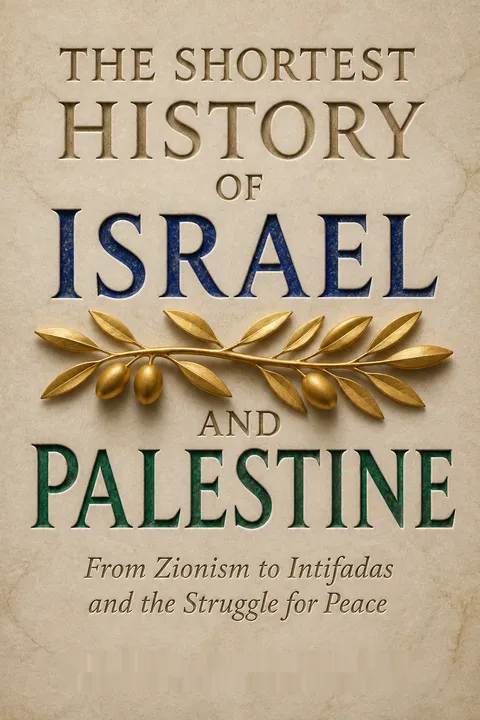
The Shortest History of Israel and Palestine receives mixed reviews. Many praise it as an accessible, concise introduction to the complex conflict, appreciating its inclusion of personal narratives and updated information. Some readers find it eye-opening and informative, while others criticize it for perceived bias, particularly in later chapters. The book is commended for its clarity and engagement, though some argue it lacks balance. Despite differing opinions, most agree it's a valuable starting point for understanding the Israeli-Palestinian conflict's historical context and ongoing challenges.
People Also Read

Download PDF
Download EPUB
.epub digital book format is ideal for reading ebooks on phones, tablets, and e-readers.








































