
Key Takeaways
1. Agriculture: The Foundation of Surplus, Specialisation, and Inequality
Where prehistoric people had to do everything, modern workers specialise in what we do best.
From foraging to farming. Early humans, nomadic hunter-gatherers, faced a harsh existence marked by scarcity, short life expectancies (around 33 years), and high infant mortality. The agricultural revolution, originating in places like northwestern India and the Levant, transformed human society by allowing communities to settle, cultivate crops, and domesticate animals. This shift created food surpluses, enabling "consumption smoothing" and providing early insurance against famine.
Specialisation emerges. With a reliable food supply, not everyone had to be a "food finder." This freed individuals to specialise as craftspeople, builders, and innovators, laying the groundwork for cities and flourishing markets. Early civilisations like the Indus Valley, with its advanced urban planning and trade networks, exemplified how settled agriculture could lead to shared prosperity and the creation of tools and toys.
A double-edged sword. While agriculture spurred innovation and trade, it also introduced significant downsides. Diets became less diverse, leading to a decrease in average human height by about 10 centimetres. More critically, the surplus created the potential for wealth inequality and the rise of repressive rulers who could extract resources and maintain power through force, as seen in the unstable Roman Empire. The need for labour-saving devices was muted in societies with abundant enslaved workers, hindering technological progress.
2. Waterways and Ideas: Catalysts for Early Globalisation and Innovation
Trade and migration were at their most valuable when they brought new ideas, and products that could be replicated.
Water as a highway. For millennia, water-borne transport was cheaper and more efficient than land travel, making rivers and oceans crucial for commerce. China's Grand Canal, over 1600 kilometres long, connected provinces, spurred trade, and fostered economic engagement during the Tang dynasty. Port cities like Venice and Bruges became financial centres, pioneering risk-sharing mechanisms like the colleganza to finance voyages.
Ideas spread rapidly. Innovations like reading glasses (Italy, 1290) and the moveable-type printing press (Germany, 1440) quickly disseminated across Europe, boosting literacy and economic development. The Reformation, by encouraging adherents to read the Bible, further fuelled the spread of knowledge. The non-rivalrous nature of ideas meant that these innovations, initially unprotected by intellectual property laws, could be freely copied, adapted, and improved, benefiting consumers immensely.
Economic forces in the Middle Ages. Despite these advances, life remained tough for most under feudalism, with limited social mobility and a plain diet. The Black Death, however, dramatically illustrated economic principles:
- Labour scarcity: Doubled European real wages.
- Land abundance: Reduced rents.
- Production shift: Farmers moved to land-intensive agriculture (cattle, sheep).
- Consumer changes: Workers ate more meat and drank more beer.
This catastrophic event inadvertently helped dismantle feudalism by shifting power towards peasants.
3. The Age of Sail: Trade's Brutality and Colonialism's Economic Roots
Economics was at the heart of these expeditions – explorers sought to fund their journeys with new products, new markets and new land.
Global exploration and exchange. Improvements in maritime technology—three-masted ships, sturdier hulls, better compasses, and the sea astrolabe—enabled longer voyages and the "Age of Discovery." Christopher Columbus's 1492 journey and Vasco da Gama's 1498 sea route to India were driven by economic motives. The "Columbian exchange" brought new crops like corn and potatoes to Europe but tragically introduced devastating diseases to the Americas, decimating indigenous populations.
The dark side of trade. This era also saw the abhorrent transatlantic slave trade, which forcibly trafficked over 12 million Africans to the Americas between 1501 and 1866. This brutal enterprise was a major source of wealth for some European nations, accounting for about 5% of British national income by the late 1700s. Spain, however, suffered from a "resource curse" as a massive influx of gold and silver from its colonies led to hyperinflation, making its manufacturers uncompetitive and transforming it from a wealthy nation to a backwater.
Colonialism's economic logic. Disease patterns significantly shaped colonial investment. In regions with high settler mortality (e.g., West Africa), colonial powers adopted extractive approaches, focusing on removing wealth (slaves, gold) with little investment in infrastructure. Conversely, areas with low settler mortality (e.g., Canada, Australia) saw investment in railways and universities. Large corporations like the Dutch and British East India Companies acted as de facto colonial powers, wielding monopolies that benefited shareholders but often exploited consumers and local populations.
4. Industrial Revolution: Unlocking Unprecedented Growth and Economic Thought
Mostly, economic growth had led to a bigger population, not a better standard of living.
A new era of prosperity. Before the Industrial Revolution, living standards for most people remained stagnant for centuries, with growth primarily leading to larger populations rather than improved quality of life. The Industrial Revolution, beginning in England, fundamentally changed this, doubling life expectancy, increasing real incomes fourteen-fold, and raising average heights by 10 centimetres. This transformation was driven by "interlocking revolutions":
- Agricultural productivity: Freed labour for urban centres.
- Urbanisation: Fostered dense social networks and innovation.
- Commercial expansion: Rapid growth in trade and private banking.
- Technological breakthroughs: Spinning jenny, steam engine, coke-based iron production.
General-purpose technologies. Innovations like James Watt's steam engine were "general-purpose technologies" that took decades to fully harness, revolutionising factories, shipping, and train travel. This pattern—underwhelming in the short run, dazzling in the long run—is also seen with electric motors and computers. Stable institutions, capital markets, and independent law courts in Britain created a fertile environment for risk-taking and long-term investment.
Adam Smith and economic philosophy. The Industrial Revolution coincided with the birth of modern economics. Adam Smith's The Wealth of Nations (1776) articulated the power of specialisation (e.g., the pin factory) and the "invisible hand" of markets, where self-interest can lead to social benefit. However, Smith also warned against monopolies and collusion. Philosophers like Jeremy Bentham introduced utilitarianism ("greatest happiness of the greatest number"), while John Stuart Mill shaped "Homo economicus" and the concept of opportunity cost, laying the intellectual groundwork for understanding the new economic landscape.
5. Globalisation's First Wave: Trade, Migration, and the Rise of Corporations
American polymath Benjamin Franklin once wrote that ‘no nation was ever ruined by trade’.
Free trade triumphs. The abolition of Britain's protectionist Corn Laws in 1846, following intense public debate and economic hardship, marked a pivotal victory for free trade. This era saw nations like Japan, after being forced to open its markets by US warships in 1853, embrace state-led economic development and rapid technological adoption under the Meiji Restoration. Trade agreements, often with "most favoured nation" clauses, spread free trade across Europe, "unbundling" production and consumption globally.
The human cost of progress. While trade generally benefited nations, it also had darker aspects, such as Britain's "narco-imperialism" in the Opium Wars against China. The gains from the Industrial Revolution were slow to reach British workers, with real wages stagnant for decades and urban life expectancy lower than rural. The US Civil War (1861-1865) highlighted the economic disparity between North and South, with the North's superior industrial production ultimately determining the outcome despite the South's prolonged resistance.
New structures for a new economy. The concept of the corporation, with limited liability for investors, became vital for financing risky ventures like railways and mining, allowing for pooled risk. However, this also created large employers with immense bargaining power, leading to the rise of trade unions to advocate for workers' rights, despite early suppression (e.g., the Tolpuddle Martyrs). This period also saw the emergence of the welfare state (Bismarck's Germany), public health innovations (Parisian sewers, humidicribs), and concerns about market concentration, as exemplified by John D. Rockefeller's Standard Oil monopoly.
6. From Depression to Bretton Woods: Government's Expanding Role in Economic Stability
Keynesians thought recessions were like natural disasters: a shock that could hit any of us.
Post-war economic turmoil. The economic damage of World War I, particularly Germany's crippling reparations and subsequent hyperinflation (prices doubling daily at its peak), created immense instability and contributed to the rise of Hitler. The "Roaring Twenties" ended abruptly with the 1929 stock market crash, plunging the world into the Great Depression, where US unemployment peaked at 25%. This crisis exposed fundamental flaws in economic thinking.
Keynes vs. Hayek. British economist John Maynard Keynes argued that recessions were due to a collapse in demand, advocating for government spending (fiscal stimulus) to restart the economy. Austrian economist Friedrich von Hayek, conversely, saw downturns as a necessary "clean-out" of bad investments, fearing government intervention would worsen things. While Hayek's insights on spontaneous market order are valued, modern policymakers largely adopt Keynesian approaches to crisis management, recognising that government action can smooth economic cycles.
Building a new global order. The 1930s also saw a retreat from openness, with protectionist policies like the Smoot-Hawley Tariff Act and tightened immigration restrictions exacerbating the Depression. World War II, a contest of industrial production won by the Allies' superior economic base, spurred a new international economic architecture. The 1944 Bretton Woods Agreement created the World Bank and the International Monetary Fund, aiming to prevent future economic isolationism and foster global stability, partially restoring a gold standard pegged to the US dollar.
7. The Post-War Boom: Shared Prosperity, Social Change, and New Economic Tools
In the post-war decades, by contrast, the rate of return on capital in many advanced countries was dramatically below its long-run average, while the rate of economic growth was significantly above its historic average.
The "Glorious Thirty". The decades following World War II saw unprecedented shared prosperity in many advanced nations, dubbed les Trente Glorieuses in France. This era was characterised by:
- Reduced inequality: Driven by progressive taxation (e.g., 95% supertax on top earners in the UK), strong unions, rising education levels, and a period where economic growth (g) outpaced the return on capital (r).
- Welfare state expansion: Inspired by reports like the Beveridge Report, governments provided social safety nets "from the cradle to the grave," nationalising key industries and expanding income taxes to most workers.
- Home ownership: Became widespread, a key driver of wealth equalisation.
Social and technological shifts. The large-scale entry of women into the paid workforce was facilitated by household technologies (electric stoves, washing machines) and the contraceptive pill, which incentivised greater investment in education. Innovations like air conditioning literally rearranged the world, enabling mass migration to warmer climates. Franchising emerged as a new business model, exemplified by McDonald's, standardising production while spreading risk.
Economics expands its scope. Economists like Gary Becker applied economic tools to new fields, analysing crime (deterrence depends on penalty and detection odds) and discrimination (racist employers face higher wage bills in competitive markets). The development of randomised trials, initially in medicine, began to be used in social science to separate correlation from causation, as seen in early childhood intervention studies. George Akerlof's "market for lemons" explained how information asymmetry could lead to market failure, a concept that would later be crucial in understanding financial crises.
8. Markets Everywhere: China's Transformation and the Globalisation Surge
In the decade following the 1978 reforms, around 10 million Chinese – a number equivalent to the modern-day population of Sweden – were brought out of poverty every year.
China's economic miracle. In 1978, a secret contract signed by 18 villagers in Xiaogang, allowing private land plots and output retention, sparked China's dramatic shift from collectivisation to market-oriented reforms. This policy change, driven by incentives rather than social norms, led to an unprecedented economic boom, lifting millions out of poverty annually and accelerating China's growth to over 9% per year.
The rise of market liberalism. Simultaneously, the UK (Margaret Thatcher) and US (Ronald Reagan) embraced policies of deregulation, privatisation, and tax cuts, reducing government intervention. Milton Friedman, a key advisor, championed free markets and criticised government stimulus, though his "permanent income hypothesis" proved less accurate in practice than Keynesian approaches during crises. The "Chicago School" also advocated a "consumer welfare standard" for competition policy, leading to a more relaxed approach to corporate mergers.
Globalisation accelerates. The 1980s and 1990s saw a worldwide wave of privatisations, though many assets were natural monopolies, leading to long-term costs for consumers. Central banks gained independence and adopted inflation targeting (pioneered by New Zealand in 1990) to stabilise prices, largely succeeding in curbing the high inflation of the 1970s. India's 1991 reforms, abolishing the "licence raj" and opening to foreign investment, also spurred rapid growth, though with a notable increase in inequality. The World Trade Organization (1994) further reduced global tariffs, and regional blocs like the Eurozone deepened economic integration.
9. Innovation's Triumph: Debunking Doomsayers and Redefining Wellbeing
Why were Malthus and the Ehrlichs wrong? A major reason is that innovation debunked the doomsayers.
Defying Malthusian predictions. Throughout history, pessimistic forecasts about population outstripping food supply (Thomas Malthus, Paul and Anne Ehrlich) have been repeatedly disproven by innovation. The "Green Revolution" of the 1960s, led by Norman Borlaug, introduced high-yield, disease-resistant crops, saving over a billion lives. Technologies like barbed wire, tractors, the Haber-Bosch process (for fertiliser), and genetically modified crops have dramatically increased food production, leading to a projected decline in global population after peaking at 10 billion.
Health breakthroughs. Medical innovations have similarly transformed human life. The discovery of penicillin and the widespread use of antibiotics revolutionised bacterial infection treatment. Vaccines for numerous diseases, from polio to COVID, have saved millions. Economists, through randomised trials (e.g., anti-malarial bed nets), have helped optimise the delivery of these life-saving treatments, demonstrating the power of evidence-based policy.
Beyond income: Measuring wellbeing. These innovations have led to a massive increase in global population and life expectancy, from under 30 in 1800 to over 70 today. This longevity, arguably more important than income, highlights that economics' ultimate goal is wellbeing, not just money. While the "Easterlin Paradox" (money doesn't buy happiness beyond a point) has been largely debunked by new data, the principle of diminishing marginal utility suggests that redistribution can still improve overall utility by giving more pleasure to the poor.
10. The 21st Century: Digital Age Challenges, Climate Risks, and the Future of Economics
Economists talk about ‘tail risk’ – small chances of very bad outcomes.
New economic realities. The early 2000s saw the dot-com bust, followed by the 2008 global financial crisis, triggered by subprime mortgages and securitisation, which exposed systemic risks and the dangers of misaligned incentives. This led to coordinated fiscal stimulus by the G20 but also highlighted persistent issues like racial inequality in recessions. Economists increasingly focused on corruption (e.g., 1MDB scandal, tax havens) and the need for greater accountability to foster development.
Behavioural insights and market failures. The Nobel Prize-winning work of Daniel Kahneman and Amos Tversky established behavioural economics, showing how systematic cognitive biases lead humans to deviate from purely rational decisions (e.g., overspending with credit cards, misjudging risks). This understanding is crucial for addressing major market failures like climate change, which Nicholas Stern called the "biggest market failure the world had ever seen," arguing that the benefits of early action far outweigh the costs.
The digital frontier and future risks. The rise of "MAMAA" and "BATX" tech giants has led to concerns about market concentration, monopsony power over workers and suppliers, and algorithmic biases (e.g., in advertising, justice systems). Big data, however, also offers unprecedented insights into economic opportunity and social mobility, as demonstrated by Raj Chetty's work. Looking ahead, artificial intelligence presents both immense potential for income growth and catastrophic "tail risks" to humanity, alongside ongoing challenges like climate change, traffic congestion, and the persistent boom-and-bust cycle. Economics, by understanding incentives, specialisation, and market failures, offers tools to navigate these complex challenges and foster a better future.
Review Summary
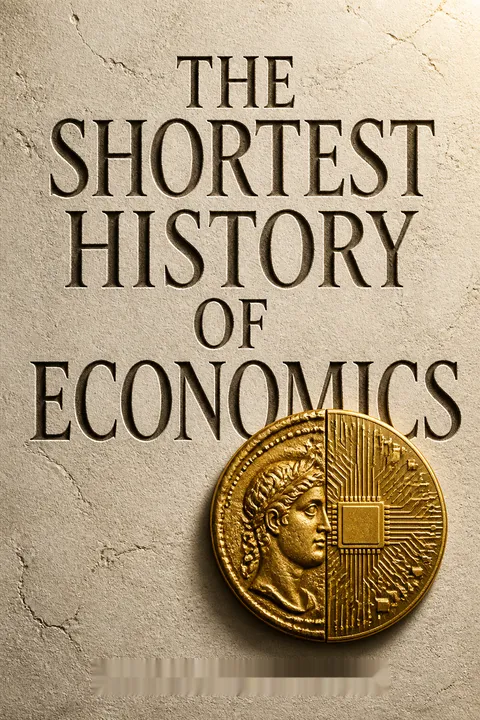
The Shortest History of Economics receives mixed reviews, with praise for its accessibility and engaging writing style. Many readers appreciate the broad overview of economic history and concepts presented concisely. However, some criticize its superficiality and Eurocentric focus. The book is commended for explaining complex ideas through relatable examples and anecdotes. While some find it informative and stimulating, others feel it lacks depth in certain areas. Overall, it is seen as a good introduction to economics for general readers, though not comprehensive enough for those seeking in-depth analysis.
About the Author
Other books by Andrew Leigh
Download PDF
Download EPUB
.epub digital book format is ideal for reading ebooks on phones, tablets, and e-readers.








































