
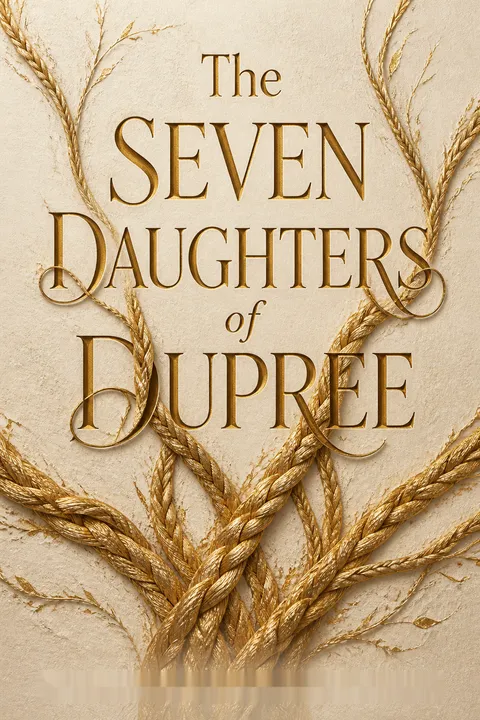


Plot Summary
Prologue
A woman's head was severed because she tried to escape. But Tati1 didn't know that. She was looking for her daddy — a name her mother, Nadia,2 refused to speak and her grandmother Gladys, called Mimi,3 refused to explain. So she searched for him, unaware there was anyone else to search for. There was no burial or body to guide her, no coffin or cemetery.
Yet she found them all, including her father,8 in the kitchen whispers and basement murmurings where her mother2 pressed hair with a hot comb every Saturday night. The story of seven generations of Dupree women begins in a salon and ends on the land where a captive girl braided a map to freedom into her own scalp.
Dear Daddy, I'm Fourteen
In Nadia's2 basement salon in Chicago, fourteen-year-old Tati1 sweeps hair while her mother2 presses Mimi's3 curls for Sunday church. The appointment doubles as a weekly tribunal.
Mimi3 needles Nadia2 about the identity of Tati's1 father — he hasn't been around since Nadia2 was pregnant — and Nadia2 deflects with the refrain she always uses: she is enough. Toya Grant11 and her daughter Desirée13 hover at the edges. Later, walking Mimi3 to the door, Tati1 asks what it was like coming to Chicago on the train.
Mimi's3 face clouds over; she calls it the hardest ride of her life and warns Tati1 to be careful, calling her both a blessing and a burden. Alone in her room, Tati1 pulls out a journal and writes a poem to the father she has never met, describing her face so he might recognize her.
The Map in Her Hair
In the hold of a slave ship bound for Alabama, a girl renamed Sarah4 is pulled from the dungeon to the captain's quarters, where Zephaniah Foster Dupree16 forces himself on her nightly. In Land's End, Evangeline9 — the plantation's midwife — bathes and tends to her as Sarah4 grows heavy with Zephaniah's16 child. Down by the marsh, Sarah4 watches six enslaved men trace escape routes in the dirt.
She memorizes their paths and, closing her eyes, braids the map directly into her own scalp — every bend, every river crossing plotted in overlapping plaits. When the men refuse to take a pregnant woman, she uncovers her head and traces the route with her fingers. Gordon the Preacher relents. On the equinox, seven people run.
Two Hundred Twenty-Two Lashes
After two hundred twenty-two miles, the dogs find Sarah4 in the river. Gordon the Preacher and another man are caught, hamstrung, and dragged to death behind horses. Before the entire enslaved community, Zephaniah Foster16 whips Sarah4 one lash for every mile. His son notices the braided map on her scalp.
Zephaniah16 shaves her head with a razor, cuts off her fingers, then orders Evangeline9 to deliver the baby while Sarah4 lies chained to the whipping tree. Evangeline9 pulls a girl from Sarah's4 body and wraps her in an apron. Then Zephaniah16 draws a blade across Sarah's4 neck. The baby, as if feeling her mother's severance, screams with a ferocity that scatters the birds overhead. Evangeline9 carries the infant — Emma5 — back to the shanties alone.
The Slaveholder's Will
When Zephaniah Foster16 dies a decade later, his will shocks the town attorney: every acre, every structure, everything goes to Evangeline9 and a girl named Emma5 — on one condition that Emma5 attend school. At the freedmen's school, Emma5 learns she needs a birthday, a concept she has never encountered.
On Census Day 1870, Evangeline9 reveals two facts: Emma5 was born in planting season of 1861, and her father was Zephaniah Foster Dupree.16 But when Emma5 asks for her mother's name, Evangeline9 goes silent.
The name they called her was never real, she explains — she came from across the water. Evangeline9 will not speak a dead woman's name without reverent things to say. Emma5 is left with her age, half her parentage, and a hunger for the rest that no amount of schooling can satisfy.
Jeremiah's Five Days
After three miscarriages, Evangeline9 erects ancestral altars — blood smeared on door frames, orchids and water offered to Sarah's4 spirit — and Emma5 carries a daughter, Jubilee,6 to term. But the protection only extends so far. Every attempt at a son fails.
Two boys are born without breath. The third, Jeremiah, arrives early and fights — screaming, nursing, alive for five miraculous days before falling silent in the night. Emma5 wakes to find him cold beside her while Jubilee6 plays in the doorway, smearing the salt lines.
George,14 Emma's5 husband, builds three coffins too fine for the ground and hides the crosses in a fence. Evangeline9 burns the altar and delivers the verdict: Sarah's4 spirit keeps the boys because she never got to keep Emma.5 Only daughters are permitted to survive.
The Black Baby Undoes Everything
Jubilee6 — who now goes by Jubi6 — inherits her mother's5 light complexion but none of her caution. She passes as white and marries Logan Danube,15 a store owner on the other side of the tracks, telling him she is Cajun. For eight years they try for children.
Baby boys arrive looking pale like their father, but none survives — the curse follows Jubi6 across the color line. When she finally carries to term, the baby girl emerges unmistakably Black — dark as night and not even a second old. Logan15 brandishes a switchblade.
Emma,5 summoned to deliver the child, brokers a desperate bargain: declare wife and daughter dead. Jubi6 wraps herself in bloody sheets and drags herself home across the tracks. Her passing is finished. The girl she names Ruby7 will grow up knowing none of this.
The Girl in Ruby's Mirror
Ruby7 grows up dark-skinned in a household of light women, never told who her father is. At seventeen, sitting before a mirror carved with the initials EGD, she discovers her fingers know how to braid without being taught — parting and crossing strands as if possessed by someone else's hands.
When she looks up, she glimpses another girl dancing in the glass. That summer, she reconnects with Sampson,12 a young man visiting for his grandmother's funeral.
At the Dupree family beach — land Emma5 purchased with farm earnings — they spend weeks tangled in each other beneath the canopy of a knotty tree. When Sampson12 returns to Mobile, Ruby7 is left pregnant. Emma5 recounts the curse for the first time: the dead baby boys, the mother stolen across the water,4 the spirit that won't let go.
The Cotton Field Before Church
Young Gladys,3 decades before Tati1 will call her Mimi, is eighteen and walking to Sunday church when a pickup truck slows behind her. Two men — JB Springer and Carl Darren Danube,21 both unknowingly connected to Jubi's6 side of the family — drag her into a cotton field.
They beat her face with a belt buckle and assault her body. She wakes hours later beneath circling birds, blood thickening in a gash across her cheek. She staggers not to the front door of Sampson's12 house but to the old house where Emma5 and Jubi6 wait.
They bathe her in an herbal tub — mugwort, rosemary, cotton root for safety — and scrub the evidence from her skin. Jubi,6 who knows exactly whose grandsons these boys are, tells Gladys3 nothing except that looking the way she does, it was bound to happen.
The Train Ride North
When her wounds heal just in time for Eugene Washington's10 arrival, Gladys3 accepts the Pullman porter's10 marriage proposal — partly for love, partly for escape. Within weeks they board the northbound train.
In the cramped bathroom, Gladys3 strips every garment from Land's End and ties it into a ball, her body releasing what the herbal bath could not prevent. She arrives in Chicago scrubbed clean, wearing a new dress, and searches her reflection for any visible mark. There is none.
In their basement kitchenette, Eugene10 finally asks what he has already heard through whispers on the rail. Gladys3 agrees to start over on one condition: she will attend nursing school. He braids her hair into a loose plait — the first time a man has touched her with gentleness since the cotton field.
Nadia and the Bishop
Twenty-five-year-old Nadia2 has dropped out of college, works a department-store register, and lives with her parents when she meets Roman Bishop Brown8 at a bar. He is a nightclub promoter, separated from his wife Deborah, and possessed of a baritone that makes every phrase feel curated.
Through mutual friends Toya11 and Lou,17 they circle each other — library visits, aquarium dates — until a Chaka Khan concert dissolves whatever boundary remained. They dance to every song. He wraps his jacket around her shoulders. In his car afterward, their bodies find each other in the cramped front seat.
Weeks later, Roman8 delivers the blow: Deborah is pregnant, and they are reconciling. He chose refreshment, not commitment. When Nadia2 asks if she had anything to do with the divorce filing, his answer — not entirely — tells her everything.
The Church Testimony
Nadia2 discovers she too is pregnant by a man who has disconnected his pager. She confronts Roman8 at the public library; he tells her to keep it or get rid of it, that the pregnancy has nothing to do with him, and walks to his car without looking back.
Nadia2 returns to her parents' house and confesses to Gladys3 and Eugene.10 Gladys3 responds by standing up at Sunday church and announcing Nadia's2 pregnancy before the entire congregation — requesting prayers for the unwed mother carrying a married man's child.
Nadia2 shrinks in the pew as outstretched hands reach toward her. She resolves to keep the baby, to enroll in beauty school, and to build a life doing hair. She and Toya11 fracture over blame, reconnecting only years later when their daughters13 end up at the same preschool.
Mimi Says His Name
The morning after her first homecoming dance — where a boy named Xavier kissed her beneath a Jodeci slow jam — Nadia2 stations Tati1 behind Mimi's3 salon chair for a setup disguised as a hair appointment. The interrogation begins lightly, spirals through boys and babies, and crashes into old wounds.
When Nadia2 insists again that she is enough, Mimi3 overrides her. Cold and deliberate as a card player laying down spades, she speaks the name Nadia2 has guarded for fourteen years: Roman Brown.8
Nadia2 clutches Tati1 to her chest and sobs. Mimi3 sits in the high chair, dry-eyed and unrepentant, satisfied she has done what needed doing. Tati1 finishes Mimi's3 hair with hands that want to hurt. In her room she writes her first poem addressed to Roman8 by name.
Step Twenty: He's Not Here
Home from college for Thanksgiving, Tati1 discovers a yellowed piece of notebook paper in Nadia's2 closet — a twenty-step poem about carrying a child in fear, cataloging everything from forgetting fairy tales to weighing adoption and abortion, ending where it began: he's not here.
She takes the letter to Desirée's13 family, where Lou17 finally breaks silence and reveals Roman8 is living in Indianapolis. At Thanksgiving dinner, Tati1 forces the reckoning Nadia2 has spent decades avoiding.
Cornered, Mimi3 confesses she was pregnant before Nadia2 — from an assault in Alabama — and lost the baby on the train to Chicago. She admits she was harder on Nadia2 than her sons20 because of an old family fear about daughters and suffering. Three generations of withheld truth spill between half-eaten plates of turkey and candied yams.
The False Bishop's Confessional
On New Year's Eve 1999, Tati1 drives to Indianapolis and meets Roman8 at his club, Worship Haus, beneath buzzing fluorescent lights. His office contains awards, filing cabinets, and a family photo — his wife Deborah, their three children, including a daughter, Faith, who is the same age as Tati.1
Roman8 answers her questions with measured detachment. He acknowledges he always knew she would come. Then he tells her she is too old to need a daddy, that just because Nadia2 gave her his mother's middle name doesn't prove anything, and that he intends to keep her a secret indefinitely.
When Tati1 asks why he left, he offers no apology — only the position that life-changing events don't require changing your life. She walks into the cold, crying only after the door closes behind her.
The Bible at Midnight
Back in Chicago, Tati1 burns every poem she ever wrote to her absent father.8 She descends to the basement salon, takes the flat iron from Nadia's2 hand, and sits her mother2 in the chair — the first time their roles have reversed.
Without music or argument, Nadia2 tells Tati1 about Roman:8 how they met, what they were, what he was not. She admits she started smoking while pregnant and that keeping Tati1 was a choice she made anew each day. Then Mimi3 arrives with the family Bible.
She opens its cracked spine to a page of names beginning with Emma Dupree,5 one entry scratched out and blotted. Rocking on the salon futon, eyes fixed on steam rising from the hair stove, Mimi3 tells them the legend passed down through the women: they cut off her head because she ran.
Epilogue
Gladys3 dies in 2019, requesting burial on the family land in Alabama. Tati1 feels the pull of the soil and convinces Nadia2 and her partner Curtis18 to relocate to the Dupree farm in Land's End. Nadia2 sets up a salon in the carport of Sampson's12 old cottage and hangs her neon sign one more time.
Tati1 meets Joshua Freeman19 through a dating app during the pandemic shutdown, and they marry at St. Joseph's church up the road. She gives birth at home — a girl with jet-black curls.
They walk her through the graves, name every headstone, and recite the litany of women who came before. In the salon, as Nadia2 parts the baby's hair for the first time, Tati1 reads aloud the dedication of the book she is writing: a poem addressed, at last, to the ancestor whose true name was taken from her.4
Analysis
The Seven Daughters of Dupree operates on a thesis radical in its specificity: Black women's silence is not complicity but architecture — structures built to house unbearable knowledge across centuries. Each generation withholds the same categories of truth (parentage, violence, desire) from the next, not from malice but from a survival logic rooted in Sarah's4 murder. If the full story could kill — if naming the dead could summon them, if acknowledging the map could invite the blade — then silence becomes a maternal technology of protection. The novel's power lies in demonstrating how that technology eventually fails. What shields one generation imprisons the next, and each daughter who inherits the silence also inherits the loneliness it enforces.
Hair functions as far more than metaphor. It is literally the vehicle of resistance (Sarah's braided map ), the site of inherited skill (Ruby's7 instinctive braiding, Nadia's2 career), and the medium through which women touch each other across guarded boundaries. Every salon scene doubles as a confessional — the physical vulnerability of having your head in someone's hands creates an intimacy that verbal communication alone cannot achieve. When Tati1 does Nadia's2 hair for the first time, the reversal signals a new covenant: the daughter now tending the mother.
Williams dismantles the mythology of Black female resilience by tracing its genealogy to actual physical brutality — Sarah's4 whipping, Gladys's3 assault, Jubi's6 exposure. These women are not strong by choice but by compulsion, their armor forged in violence and maintained through the suppression of tenderness. Mimi's3 severity toward Nadia2 is not the failure of motherhood but its distortion under trauma — a woman who lost her first pregnancy to assault treating every daughter as someone to fortify against a world that takes. The curse of the Dupree women — that only girls survive — reads as both supernatural folklore and sociological observation: in a world built on the exploitation of Black bodies, the women endure because they must. The novel insists that endurance alone is insufficient. What finally breaks the generational cycle is not strength but telling — the radical, terrifying act of speaking what was meant to stay buried.
Review Summary
The Seven Daughters of Dupree receives mostly positive reviews (4.17/5), praised for its powerful multigenerational saga following Black women through history. Readers appreciate the emotional depth, themes of resilience and generational trauma, and compelling character development. Many found the non-linear timeline and multiple characters initially confusing but ultimately rewarding. The writing draws comparisons to Toni Morrison. Several reviewers noted the devastating final section depicting slavery was difficult but necessary. Common criticisms include challenging pacing, too many characters, and some readers struggled with the writing style. The book resonates particularly as a celebration of Black women's strength and legacy.
People Also Read










Characters
Tati (Tatiana Merét Washington)
The searching granddaughterTati is the contemporary anchor of this multi-generational saga—a bright, introspective girl raised by a single mother2 who deflects every question about her absent father8. She processes the world through writing, filling journals with poems addressed to a man she cannot name. Her hunger for identity drives her from patient obedience toward increasingly bold demands for truth. Beneath her academic confidence and athletic talent runs a deep current of loneliness she masks as independence. Her psychological architecture mirrors the Dupree women who came before: she inherits their stubborn curiosity, their refusal to accept silence as sufficient truth. Yet where her foremothers buried their pain, Tati insists on excavating it—a quality that makes her both the family's greatest disruptor and its most necessary voice.
Nadia
The armored single motherNadia is Tati's1 mother and the woman who transforms hair from a spiritual inheritance into a livelihood. A college dropout who became entangled with a married man8, she builds her entire adult identity around proving she is enough—for herself, for Tati1, for the world that judged her. She inherits Gladys's3 steel temperament without understanding its origins, repeating the pattern of emotional withholding she endured as a daughter even as she resents it. Her salon is both livelihood and confessional, a space where she speaks freely with clients yet guards every truth from her own child. Her refusal to name Roman8 is not cruelty but protection learned from women who believed some things are better left unremembered. Her armor is woven from silence, routine, and Mary J. Blige albums.
Gladys (Mimi)
The iron-willed grandmotherGladys, whom Tati1 calls Mimi, is the family's most formidable gatekeeper—a woman whose rigid faith and sharp tongue conceal wounds she refuses to name. A nurse and church deaconess, she wields scripture and criticism interchangeably, controlling her family through the force of her disapproval. Her doting on sons Bryan20 and Terry while being relentlessly hard on Nadia2 suggests a fear she cannot articulate—that daughters are destined to suffer in ways sons are not. Gladys married Eugene10 not only for love but for reasons only she understands, and she carries the weight of that pragmatism in every rigid opinion she voices. Her love is genuine but conditional on compliance. She is the hinge between the Southern past the family fled and the Northern present they inhabit.
Sarah
The nameless ancestorSarah is the origin of the Dupree line—a girl captured from an African village, given a false name by her enslaver16, and subjected to systematic brutality aboard a slave ship and on a plantation in Land's End, Alabama. She exists in the novel as both historical figure and haunting presence, her spirit threading through every generation of women who follow. What defines her is not victimhood but defiance: even heavily pregnant, she memorizes the escape route drawn by six men and braids it into her own hair, insisting on running when they refuse to take her. Her execution is the founding trauma of the family, but her resourcefulness—the map, the refusal to be excluded—is the inheritance that matters most. She never speaks her true name aloud.
Emma Dupree
The first recorded daughterBorn from Sarah's4 body under conditions of unspeakable violence, Emma is raised by Evangeline9 without ever knowing her mother's real name. She inherits the Dupree farm through her father's16 deathbed guilt and becomes the family's first literate member—a landowning, record-keeping Black woman in Reconstruction Alabama. Her defining wound is incomplete knowledge: she knows the enslaver16 was her father, but her mother4 remains a scratched-out entry in a Bible. This absence shapes her into a woman who watches, waits, and reads signs in bowls of water and flickering candles. She carries on Evangeline's9 midwifery traditions while losing three infant sons to a curse she comes to understand as her mother's4 unfinished grief. Emma is the bridge between the unspeakable past and the family's recorded future.
Jubilee (Jubi)
The woman who passedEmma's5 daughter, born en caul, who inherits light skin and restless ambition. She passes as white and marries Logan Danube15, living as his wife for eight years until the birth of their unmistakably Black daughter exposes her. Driven by a hunger for access rather than mere color, Jubi never fully accepts her forced return to the Black side of the tracks. She transforms her bitterness into a corrosive protectiveness over the grandchildren who look like the life she lost.
Ruby
The dark-skinned outcast daughterJubi's6 dark-skinned daughter, born into a family that treats her complexion as an indictment. Ruby discovers an instinctive gift for braiding hair—a connection to Sarah's4 spirit through Emma's carved mirror. Her brief, passionate summer affair with Sampson12 produces Gladys3, the light-skinned daughter Jubi6 covets as her own. Ruby's quiet strength sustains the farm and the family despite receiving the least affection from her own mother6, her skin a daily reminder of truths Jubi6 refuses to face.
Roman Bishop Brown
The absent fatherTati's1 absent father, a charismatic nightclub promoter who curates atmospheres for a living but cannot sustain genuine intimacy beyond his marriage. Roman operates through performance—smooth baritone, rehearsed charm, strategic generosity. He treats relationships as experiences to manage rather than commitments to honor. He is defined not by outright cruelty but by a calculated indifference that makes his absence feel deliberate rather than accidental.
Evangeline
Keeper of buried truthThe root-working midwife who raises Emma5 after Sarah's4 murder. Evangeline delivered Emma5 from Sarah's4 body, knows the full horror of the execution, and maintains ancestral altars to appease a restless spirit. She parcels truth in careful doses, believing that names are sacred and that some knowledge can harm the living as much as it honors the dead. She lost nine pregnancies of her own, making her both the perfect mammy and the family's most intimate authority on grief.
Eugene Washington
The steadfast Pullman porterGladys's3 husband, whose gentle persistence is the counterweight to the Dupree women's severity. Fourteen years her senior, he offers Gladys3 escape from Land's End and asks only for honesty—which he receives partially. Eugene mediates between Gladys3 and Nadia2 with quiet authority, the only person before whom Gladys3 consistently holds her tongue. He brings newspapers, stability, and a willingness to braid his wife's hair when she needs tenderness more than truth.
Toya Grant
The secret-keeping friendNadia's2 complicated best friend and Desirée's13 mother. Toya introduces Nadia2 to Roman8, then refuses to reveal his location after he vanishes, protecting his secret over her friend's need. Their friendship fractures and reassembles around their daughters' closeness. Toya's loyalty operates on a delay—she keeps confidences even when they cause harm, believing the telling always belongs to someone else.
Sampson
Ruby's returning sweetheartRuby's7 lover and Gladys's3 father, a young man who returns to Land's End drawn by childhood memory and adult hunger. He arrives without a plan beyond love—no job, no house, no prospects. His cinnamon-dark skin ensures that Emma5 and Jubi6 regard him with wariness. He builds a house with his hands, teaches at the local school, and names his daughter for the gladness she gives him.
Desirée
Tati's photographer best friendTati's1 closest friend since preschool, an aspiring photographer who captures family life through disposable cameras and later professional work. She serves as both witness and confidante to Tati's1 search, and her own reconnection with her father Lou17 provides a painful contrast to Tati's1 fatherlessness.
George Dupree
Emma's woodworking husbandEmma's5 husband, a woodworker who carves the oval mirror that passes through generations. He builds three coffins for his dead infant sons and hides the crosses in a fence to spare Emma5 the sight. His grief eventually consumes him.
Logan Danube
Jubi's unknowing white husbandThe store owner who marries Jubi6 believing she is Cajun. His family profits from convict leasing and railroad work. When Ruby7 is born Black, he threatens violence and banishes his wife. His descendants unwittingly perpetuate harm against the Dupree bloodline.
Zephaniah Foster Dupree
The enslaver patriarchThe plantation owner and ship captain who repeatedly assaults Sarah4, then orders her execution after her escape. His deathbed will ironically bequeaths everything to the daughter5 he fathered through violence.
Lou Cortez
The truth-bearing friendDesirée's13 father and Roman's8 old friend, who eventually reveals to Tati1 that Roman8 lives in Indianapolis. His willingness to speak—against Toya's11 silence—becomes the pivot that enables Tati's1 search.
Curtis Knight
Nadia's late-life partnerPatient, committed, and secure in himself, Curtis represents the stable love Nadia2 never found in Roman8. He moves with her to Alabama without hesitation, proving commitment through action rather than performance.
Joshua Freeman IV
Tati's academic husbandA sociology professor from Toronto via Mobile who helps Tati1 research her family in Alabama archives. He fathers their daughter, completing the generational line on the land where it began.
Bryan
Mimi's favored sonNadia's2 brother and Mimi's3 clear favorite—a high school math teacher who avoids family conflict. He resembles Eugene10 and serves as the diplomatic counterweight to Mimi's3 severity toward everyone else.
Carl Darren Danube
Logan's violent grandsonOne of two men who attack Gladys3 on the road to church. His violence against his own unknown relative perpetuates the cross-tracks brutality the Dupree women have endured for generations.
Plot Devices
Sarah's Braided Map
Ancestral origin of hair's powerThe braided escape map is the novel's most potent symbol—a literal route to freedom encoded in a Black woman's hair. Sarah4 braids the path the men drew in the dirt directly into her scalp, transforming her body into both vehicle and archive. When Zephaniah Foster16 shaves her head, he destroys the map but not its legacy. Ruby7 braids by instinct generations later, Nadia2 builds a career from the same gift, and Tati1 does her mother's2 hair as an act of reconciliation. The map connects the novel's central concerns: hair as resistance, the body as contested territory, and the transmission of knowledge through means the oppressor cannot fully eradicate. Its destruction marks the first of many Dupree truths that survive only in fragments passed woman to woman.
The Family Bible
Genealogical record and altarThe cracked-spine Bible with gold-rimmed pages passes from Zephaniah Foster16 to Evangeline9 to Emma5, carrying the family's names in thick black ink. One entry is scratched out and blotted—the space where a name was written and then erased, because Evangeline9 would not allow a lie to stand in God's word. The Bible is the physical proof of lineage that oral tradition cannot fully provide. Emma5 writes her father's name inside. Gladys3 carries it from Land's End to Chicago. It becomes both archive and altar—the closest thing the family has to a complete record of its origins. Its final opening connects living women to their dead and transforms fragmentary legend into shared knowledge.
Nadia's Twenty-Step Poem
Proof of hidden maternal painA yellowed piece of notebook paper hidden in a shoebox, this handwritten poem catalogs the steps of carrying a child when the father has vanished—from forgetting fairy tales to exploring all options (keep, adopt, abort) to discovering a disconnected phone number. Written in rushed blue ink that burst from pressure, it is the only artifact Nadia2 ever created about her experience with Roman8. When Tati1 finds it while fetching hair rollers, the poem becomes the key that unlocks her determination to track down her father8. Its twentieth step—remember that he is not here—functions as both survival instruction and open wound, a guide disguised as verse that reveals the mother Tati1 never saw.
The Basement Salon
Confessional for Dupree womenNadia's2 salon—first in Gladys's3 basement, later her own—is the stage where every major present-day confrontation occurs. Equipped with burgundy chairs, curling irons, and Mary J. Blige on repeat, the salon is where Mimi3 gets her Sunday hair done, where Nadia2 speaks freely with clients, and where Tati1 is set up for interrogation about boys and fathers. The physical act of doing hair creates enforced vulnerability: a client must tilt her head back, close her eyes, submit to heat and hands. This submission is what makes truth slip out. The salon operates as both business and battlefield, a space where women are simultaneously at their most beautiful and their most exposed.
Emma's Oval Mirror
Portal to ancestral sightA tall, adjustable mirror carved by George Dupree14 with the couple's initials etched in the wood, this object appears across four generations. Ruby7 sees another girl dancing in its reflection—an apparition connected to Sarah's4 spirit—and the vision emboldens her to trust Sampson12. Tati1 dances before it as a child, earning punishment from Mimi3. The mirror functions as a threshold between the living and the dead, the seen and the unseen. When Ruby7 glimpses the girl who looks like herself, it is the first sign that Sarah's4 gift—the ability to braid, to map, to create with one's hands—has been inherited. The mirror confirms what the women sense but cannot name: they are accompanied by someone they have never met.
Download PDF
Download EPUB
.epub digital book format is ideal for reading ebooks on phones, tablets, and e-readers.








































