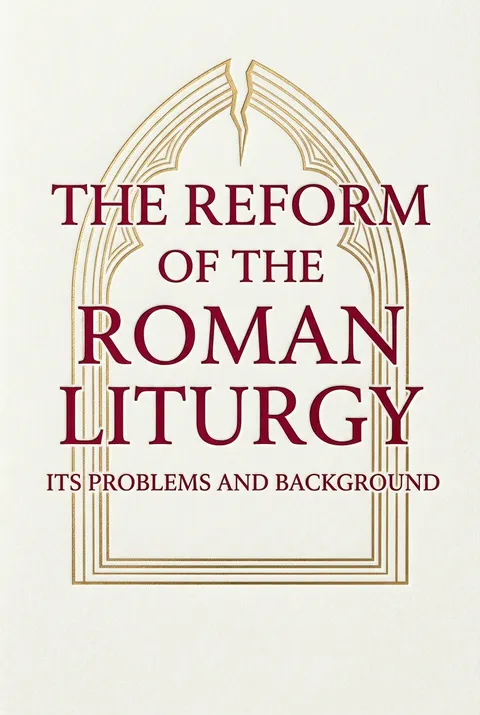

Key Takeaways
1. Post-Vatican II Liturgical Reform: A Debacle, Not Organic Development
Instead of the hoped-for renewal of the Church and of Catholic life, we are now witnessing a dismantling of the traditional values and piety on which our faith rests.
Unfulfilled hopes. The liturgical reform following the Second Vatican Council, initially welcomed with idealism, has tragically resulted in a "liturgical destruction" that worsens annually. Instead of revitalizing the Church, it has led to a weakening of traditional values and piety, contributing to a large-scale decline in religious life. The reforms failed to arrest negative trends and likely exacerbated them, leaving the hopes tied to liturgical renewal largely unrealized.
Root causes. This "debacle" cannot be solely attributed to Vatican II, as the Constitution on the Sacred Liturgy was an interim step in a process set in motion long ago. Key contributing factors include:
- The historical grafting of the Roman liturgy onto diverse local traditions.
- The alienation between Eastern and Western Churches, leading to a loss of the "cosmic liturgy" concept.
- The rise of individual piety in the Gothic period, shifting focus from communal worship to private prayer.
- The influence of the Age of Enlightenment, which prioritized moral instruction over sacred mystery.
Consequences of radical change. The rapid and extensive changes introduced after the Council, particularly the new liturgical books, have been criticized as "artificial constructions" reflecting a "new theology" rather than tradition. This break with tradition has not demonstrably improved pastoral care; instead, it has fostered confusion, diminished solemnity, and alienated many faithful who perceive changes in liturgy as changes in faith itself.
2. The Roman Rite's Enduring Tradition vs. Radical Modern Changes
Unlike the appalling changes we are currently witnessing, the changes made in the Roman Missal over a period of almost 1,400 years did not involve the rite itself.
Ancient stability. The Roman liturgy, originating in early Christianity, remained remarkably stable for centuries, unlike the Eastern liturgies which continued to develop into the Middle Ages. Revisions by popes like Damasus I and St. Gregory the Great primarily involved adding new feast days, Mass formulas, and prayers, never altering the core rite itself. This organic development preserved the Roman liturgy as the oldest Christian rite.
Tridentine continuity. The Missal of Pope St. Pius V (1570) was not a new creation but a comprehensive review and improvement of the existing Roman Curia Missal, which had been in use for centuries. St. Pius V's reform respected older, unique rites (dating back at least 200 years), demonstrating a spirit of tolerance and continuity. The subsequent popes, until Paul VI, continued this pattern, introducing new Propers for feasts but leaving the Order of the Mass intact.
Modern rupture. The radical changes introduced by Paul VI, particularly the Ordo Missae of 1969, represent an unprecedented break with this long-standing tradition. While earlier popes like Pius XII (Holy Week reform) and John XXIII (rubrics) made adjustments, they did not fundamentally alter the rite. The post-Vatican II reforms, however, effectively abolished the ancient Roman Rite, replacing it with a "manufactured" liturgy that departed significantly from its historical roots.
3. Papal Authority: Limits on Changing Apostolic Liturgical Rites
In fact, nowhere is it mentioned that the pope has the authority to change even a single local liturgical tradition.
Defining "rite." A liturgical rite is defined as mandatory forms of cult that originated with Christ, developed independently based on shared traditions, and were later officially sanctioned by the Church. This organic evolution implies that a rite cannot be entirely "developed anew" or arbitrarily abolished, as it is rooted in apostolic tradition and universal Church practice.
Historical restraint. Historically, the Church hierarchy, including the Pope, exercised limited influence on the development of liturgical forms, primarily sanctioning rites that grew out of local custom. Their authority, as defined by the Council of Trent and later canon law, focused on "supervision of the sacred liturgy" (Sacra Liturgiae moderatio), which meant preventing abuses and revising liturgical books (e.g., adding new feast days), not fundamentally altering the rite itself.
Suarez's warning. Eminent theologians like Suarez (d. 1617) explicitly stated that a pope would be schismatic "if he... were to change all the liturgical rites of the Church that have been upheld by apostolic tradition." This underscores the traditional understanding that the Pope's "full and highest power" (plena et suprema potestas) has defined limits, especially concerning matters of tradition and dogma. The absence of any document granting the Pope authority to abolish a traditional rite further strengthens this argument.
4. The Novus Ordo Missae Exceeded Council Intentions and Altered Core Theology
The truly tragic aspect of this development is that many of those involved in designing the new liturgical texts... were acting in good faith, and simply failed to recognize the negative elements that were part of the new liturgy, or they did not recognize them right away.
Beyond Council's mandate. The Ordo Missae of 1969, introduced just four years after the Council, went far beyond the modest revisions envisioned by the Second Vatican Council. The Council's Constitution on the Sacred Liturgy (Article 50) aimed to remove duplications and restore ancient elements like the Prayer of the Faithful, not to create an entirely new rite. The 1965 Ordo Missae reflected these limited changes, but the 1969 version constituted a complete overhaul.
Dogmatic concerns. Critics, including Cardinals Ottaviani and Bacci, immediately raised "serious dogmatic points" about the new liturgy. Concerns included:
- De-emphasis of Latria: A weakening of the sacrificial and adoring nature of the Mass.
- Suppression of Trinitarian formulas: Reducing explicit references to the Trinity.
- Weakening of the priest's function: Shifting the priest's role from alter Christus offering sacrifice to a "presider" of a communal meal.
- Protestant influence: The initial definition of Mass as "the Lord’s Supper or the holy gathering... to celebrate the memorial of the Lord" (Article 7, 1969 Editio typica) echoed Protestant theology, requiring later correction.
Unnecessary innovations. Many changes, such as altering the words of Consecration (e.g., "for you and for all" instead of "for many") and introducing new Eucharistic Prayers based on Oriental rites, were deemed pastorally unnecessary and stylistically unsuited to the Roman Rite. The exclusion of "mysterium fidei" from the consecration formula and the abrupt shift in addressing God during the Eucharistic Prayer further highlighted these problematic alterations.
5. Versus Populum: A Modern Innovation, Not Ancient Tradition, with Negative Impacts
In his new role, continues Siebel, the priest hardly continues to function as the representative of the faithful, but as an actor who plays God’s role, at least during the central part of the Mass, similar to what is played out in Oberammergau and other religious plays.
Lutheran origins. The practice of the priest celebrating Mass versus populum (facing the people) is a modern innovation, not a restoration of early Christian tradition. Martin Luther was the first to advocate for this in his 1526 work, The German Mass and Order of Worship, envisioning the Last Supper as Christ facing his apostles. This practice was later adopted in some Protestant Reformed Churches.
Historical evidence contradicts. Extensive research, including archaeological findings and patristic texts, demonstrates that neither the Eastern nor the Western Church historically practiced versus populum. Instead, the universal custom was for both priest and faithful to face East during prayer and sacrifice, symbolizing their collective turning "ad Dominum" (towards the Lord), the rising sun representing the Risen Christ and His return.
- Early basilicas: Even in Roman basilicas where the altar was freestanding and the apse faced West (meaning the entrance faced East), the priest would stand behind the altar to face East, not the people. Curtains often shielded the altar during the Eucharistic Prayer.
- Augustine's "Conversi ad Dominum": St. Augustine's consistent call for the faithful to "turn to face the Lord" at the end of homilies explicitly referred to turning East.
Sociological and theological concerns. Sociologists like W. Siebel criticize versus populum for transforming the priest into an "actor" dependent on his "audience," fostering a "huckster" mentality. This arrangement:
- Undermines the priest's role as a representative offering sacrifice to God.
- Emphasizes the Mass as a "communal meal" over its primary nature as a sacrifice.
- Erodes the sense of sacred space and mystery, replacing "holy fear" with "weak sentiment."
- Creates an awkward dynamic where the "meal leader" is isolated from the "meal participants" in the "auditorium."
6. New Order of Readings: A Break from Tradition, Lacking Pastoral Depth
It is quite easy to destroy an old order, but to create a new one is something else again.
Abrupt abolition. The new Order of Readings, developed by a small group of reformers and made mandatory, abruptly replaced the Roman Church's thousand-year-old tradition. While the Council's Constitution (Article 35) suggested enriching readings (e.g., more Sunday readings, Lectio continua for weekdays), it did not call for the complete abolition of the traditional order.
Exegetical bias over liturgical wisdom. Critics argue that the new selection of texts shows a marked preference for exegetical character, often neglecting established liturgical rules and customs for choosing Scripture passages. This approach often fails to consider the faithful's limited background knowledge, making many Old Testament readings, for instance, incomprehensible and thus frequently omitted.
Lost opportunities. Instead of drawing from the rich historical treasury of Eastern and Western lectionaries—some dating back to the 5th century (e.g., Jerusalem, Aquileia, Campanian, Liber comitis)—the reformers largely ignored these sources. A true reform would have retained the traditional Ordo while offering additional texts ad libitum, enriching rather than destroying a precious, time-tested tradition. The current approach risks further "liturgical renewal" leading to secular texts replacing Scripture.
7. Liturgy as "Home": The Need for Stability and Continuity in Worship
For him, the unchanging cult is a part of his Heimat.
Longing for stability. Deep within every person is a longing for "Heimat" (home or fatherland), a sense of familiarity, security, and belonging. For the religious person, this "home" is found in the Church, particularly in the unchanging celebration of liturgical worship, its rites, and feasts. This stability provides an "oasis of tranquility and peace" in a constantly changing world.
Erosion of spiritual home. The radical and incessant changes introduced in the liturgy have robbed many Catholics of this religious home, shaking the foundations of their faith. A Catholic returning to the Church after a generation often finds it unrecognizable, feeling like a stranger in a foreign place due to:
- Altered church interiors: Disappearance of accustomed statues, crosses, tabernacles, and communion rails.
- Loss of sensory elements: Absence of incense, familiar hymns, and traditional rituals.
- Homogenization with Protestant services: Diminished distinctiveness between Catholic and Protestant worship.
Psychological impact. The reformers failed to appreciate the profound psychological and spiritual connection the faithful had to traditional liturgical forms. Abolishing these forms, even if imperfect, has led to a loss of faith, particularly among the less educated. The constant changes, such as the unnecessary reassignments of saints' feast days, further alienate the faithful and demonstrate a lack of understanding of human psychology and the close association between Catholic teaching and piety.
8. A Path Forward: Coexistence and Restoration of the Traditional Roman Rite
Why should it not be possible to have two rites, the traditional and the new rite, coexisting peacefully, just as in the East where there are many different rites and liturgies, or even in the West where there still exist particular rites, such as the rite of Milan?
Acknowledging the crisis. The current liturgical confusion and crisis of faith demand courageous leadership. The author calls for a "new Athanasius" or "Basil" to fight modernist theology and re-establish traditional liturgy. The solution is not to reject all reforms, but to distinguish between justified adaptations and destructive innovations.
Proposed solution: Two coexisting rites. The most realistic and pastorally sensitive solution is to accept both the traditional ritus Romanus and the ritus modernus as legitimate, independent forms of worship. This would involve:
- Reinstating the traditional rite: Authorizing the pre-Council Missale Romanum and other liturgical texts, not as museum pieces, but as a living liturgy.
- Refining the modern rite: Recognizing the ritus modernus as a unique, ad experimentum rite, with necessary improvements (e.g., replacing the flawed Order of Readings).
- Addressing calendar issues: Overcoming difficulties related to the differing liturgical calendars.
Benefits of coexistence. This approach would resolve many problems, including:
- Reducing schism: Meeting the justified demands of countless Catholics who desire the traditional Mass, without alienating those who prefer contemporary liturgy.
- Promoting unity: Latin, as a common language, could again serve as a unifying factor, especially in ethnically mixed regions, fulfilling a neglected wish of Vatican II.
- Fostering spiritual life: History shows that spiritual life flourishes even with "outmoded" liturgies, as seen in the Russian Orthodox Church after its own reform attempts.
People Also Read

Download PDF
Download EPUB
.epub digital book format is ideal for reading ebooks on phones, tablets, and e-readers.








































