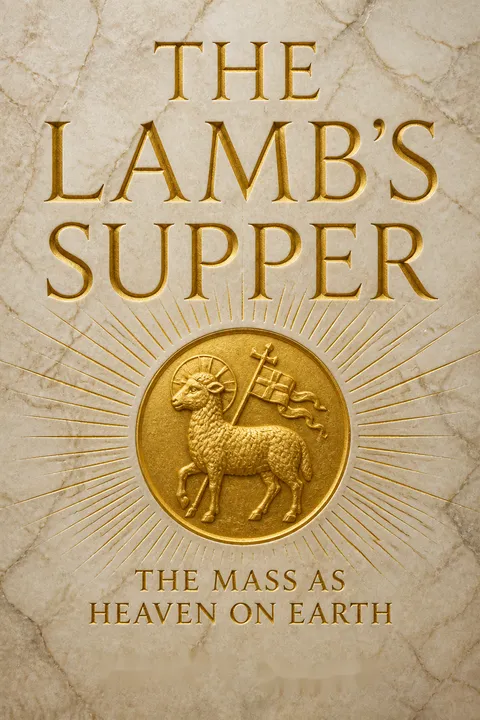

Key Takeaways
1. The Mass is Heaven on Earth, unveiled by the Book of Revelation.
Pope John Paul II has called the Mass “heaven on earth,” explaining that “the liturgy we celebrate on earth is a mysterious participation in the heavenly liturgy.”
A profound connection. The author, a former Protestant minister, discovered that the seemingly remote and puzzling Book of Revelation is the key to understanding the Mass, and conversely, the Mass is the only way a Christian can truly make sense of Revelation. This realization transformed his faith, leading him to see the Mass not as a mere religious service, but as a powerful supernatural drama. He found that the early Church Fathers explicitly linked the two, considering Revelation incomprehensible apart from the liturgy.
An "open door" to heaven. The author's first Mass experience was overwhelming, as he recognized countless biblical references, especially from Revelation, within the liturgy. Phrases like "Lamb of God" immediately transported him to the marriage feast described in the final book of the Bible, before the throne of heaven. This wasn't just a personal insight; the Second Vatican Council affirmed that "In the earthly liturgy we share in a foretaste of that heavenly liturgy which is celebrated in the Holy City of Jerusalem."
Beyond the mundane. Despite common experiences of mundane or imperfect liturgies, the Mass is objectively heaven on earth. This truth is not dependent on the quality of music or preaching, but on the objective reality of Christ's presence. The Catechism of the Catholic Church explicitly teaches that "Liturgy is an 'action' of the whole Christ... Those who even now celebrate it without signs are already in the heavenly liturgy."
2. Jesus, the Lamb of God, fulfills all Old Testament sacrifices in the Mass.
“Behold the Lamb of God!” (Jn 1:36). Why did Jesus have to be a lamb, and not a stallion or a tiger or a bull? Why does Revelation portray Jesus as a “lamb standing as if slain” (Rev 5:6)? Why must the Mass proclaim Him as the “Lamb of God”? Because only a sacrificial lamb fits the divine pattern of our salvation.
The story of sacrifice. From Cain and Abel to Abraham and Isaac, sacrifice was a primal form of worship in ancient Israel, signifying:
- Recognition of God's sovereignty
- Acts of thanksgiving
- Solemn sealing of covenants
- Renunciation and sorrow for sins
The pivotal Passover. The Passover lamb, unblemished and without broken bones, was a ransom for the firstborn, an act of redemption that foreshadowed Jesus. John's Gospel highlights Jesus' crucifixion coinciding with the slaughter of Passover lambs, His bones unbroken, and the use of hyssop, all fulfilling the Passover stipulations. Jesus is both the High Priest and the perfect victim, offering Himself "once for all" in the heavenly sanctuary.
The Mass as fulfillment. The Mass is the re-presentation of this one perfect sacrifice of Jesus Christ. Old Covenant sacrifices, like the daily Temple offerings or the Todah (thank offering), find their ultimate meaning and fulfillment in the Eucharist. St. Paul explicitly calls Christ "our paschal lamb" and the Mass "the festival" we celebrate with "unleavened bread of sincerity and truth."
3. The early Church's liturgy, from the Apostles, is the Mass we celebrate today.
To be a Christian was to go to Mass. This was true from the first day of the New Covenant.
Eucharist: The core of Christian life. From the earliest days, the Eucharist was the most identifiable element of Christian life and worship, even leading to pagan accusations of cannibalism due to its mysterious nature. The Acts of the Apostles describes the early Church "devoted... to the breaking of bread and the prayers," and St. Paul's First Letter to the Corinthians provides a "handbook of liturgical theory and practice," emphasizing the Real Presence and the dire consequences of unworthy reception.
Unbroken tradition. Early Christian writings, like the Didache (A.D. 50–110), explicitly call the Eucharist "the sacrifice" and outline liturgical practices such as:
- Celebration on "the Lord's day" (Sunday)
- Confession of sins before Communion
- Eucharistic Prayers with echoes in modern liturgies
Justin Martyr's eyewitness account. Around A.D. 155, St. Justin Martyr described the Christian liturgy to the Roman emperor, detailing elements still recognizable today:
- Gathering on Sunday
- Readings from apostles and prophets
- Homily
- Prayers for all
- Kiss of peace
- Offertory of bread, wine, and water
- Eucharistic Prayer with "Amen" acclamation
- Distribution of "eucharisted" elements by deacons
This unbroken witness, from the New Testament through the Church Fathers like St. Ignatius of Antioch and Hippolytus of Rome, demonstrates the consistent doctrine of the Real Presence and the sacrificial nature of the Mass.
4. Revelation's strange imagery depicts the Temple and heavenly worship, not just future events.
The more I studied the commentaries on Revelation, the more I came to understand selected details, but the less I seemed to understand the whole of the book. Then, while researching other matters, I happened upon a hidden treasure—hidden, that is, from someone studying the Scriptures in a tradition that reaches back only four hundred years.
Beyond futurist speculation. The author critiques common "futurist" interpretations of Revelation, which often try to map its bizarre imagery onto contemporary geopolitical events. He argues that such approaches often fail, as world leaders and empires rise and fall, rendering previous interpretations obsolete. Instead, Revelation's message must be for all Christians of all time, including its original first-century readers.
A liturgical blueprint. The "hidden treasure" the author discovered was the early Church Fathers' understanding of Revelation as a liturgical text. Many small details of John's vision become clear when viewed through the lens of ancient Temple worship and early Christian liturgy:
- Seven golden lampstands (Menorah)
- Altar of incense
- Four living creatures (cherubim)
- Twenty-four elders (priests)
- Sea of glass (Temple's bronze pool)
- Ark of the Covenant
One worship, shared by men and angels. The Temple was considered a "scale model of all creation," mirroring heavenly worship. Revelation reveals that, with Christ, this imitation transforms into participation. No longer a shadowy representation, but a unified worship shared by men and angels, where a "nation of priests" dwells in God's presence. This "unveiling" (apokalypsis) of heavenly worship in earthly terms provided guidance for the Church as it transitioned from the Old Covenant.
5. The "Woman" and "Beasts" of Revelation symbolize Mary, the Church, and corrupt earthly powers.
I believe (with the Fathers of the Church) that when John describes the woman, he is describing the ark—of the New Covenant. And who is the woman? She is the one who gives birth to the male child Who will rule the nations. The child is Jesus; His mother is Mary.
The Woman: Mary and the Church. Revelation 12's "woman clothed with the sun" is a multi-layered symbol. The Church Fathers identify her primarily with the Blessed Virgin Mary, the Ark of the New Covenant, who bore Jesus, the Word of God, the living bread, and the eternal High Priest. She is also "Daughter Zion," representing Israel bringing forth the Messiah, and the Church, besieged by Satan but preserved. Her "birth pangs" can symbolize Mary's suffering at the foot of the cross, becoming the mother of all disciples.
The Beasts: Corrupt authority. The two dreadful beasts represent the "mystery of iniquity" and Satan's attempt to subvert God's plan by corrupting both kingdom and priesthood.
- First Beast (from the sea): A seven-headed, ten-horned monster, a combination of Daniel's four gentile empires (Babylon, Medo-Persia, Greece, Rome). It symbolizes all corrupt political authority that usurps God's prerogatives and persecutes His people.
- Second Beast (from the earth): With horns like a lamb, this beast suggests corrupted religious authority, particularly the first-century Jerusalem priesthood that rejected Christ and gave allegiance to Caesar. Its actions mimic and mock the Lamb's saving work.
The Mark of the Beast (666): This "human number" can refer to Emperor Nero, but also symbolizes a degradation of the number seven (perfection/covenant). It represents humanity stalled in the "sixth day," serving worldly concerns (buying/selling) without rest for worship, rejecting God's covenant.
6. Revelation's judgments and battles primarily concern the fall of Old Jerusalem and God's merciful discipline.
Today, most of us associate the “soon” with the Second Coming of Jesus at the end of the world. And this is surely true; both John and Jesus were speaking about the end of history. I think, however, that they were also—and primarily—speaking about the end of a world: the destruction of the Jerusalem Temple, and with it the end of the world of the Old Covenant, with its sacrifices and rituals, its barriers to gentiles, and its barriers between heaven and earth.
"What must soon take place." Revelation's imminent tone ("I am coming soon") refers not only to the distant Second Coming but also, and primarily, to the destruction of Jerusalem and its Temple in A.D. 70. This event marked the definitive end of the Old Covenant world and the beginning of a new age in salvation history. Jesus Himself predicted that "this generation will not pass away till all these things take place" (Mt 24:34), a generation being roughly forty years.
Jerusalem on trial. John clearly identifies the "great city" of Revelation 11 and 17 as Jerusalem, "where their Lord was crucified" and which is "allegorically called Sodom and Egypt." It is portrayed as a harlot city, echoing Old Testament condemnations of Israel's infidelity. Jerusalem's authorities crucified Jesus and were the main persecutors of the first-generation Christians.
Echoes of Old Testament judgment. The destruction of Jerusalem is depicted with imagery recalling past divine judgments:
- Seven plagues: Echoing the plagues on Egypt (Rev 17).
- Seven trumpets: Recalling the fall of Jericho (Rev 8-9).
- Armageddon: The hill of Megiddo, where King Josiah was defeated, prefiguring Jerusalem's vulnerability.
A preserved remnant. Despite the cataclysm, not a single Christian perished in A.D. 70, having fled to Pella. Revelation 7:1-4 describes 144,000 sealed Christians, a remnant of Israel, protected by God's "sign" (tau, the Sign of the Cross), a reference to baptism. The first Christian church on Mount Zion, the site of the Last Supper and Pentecost, also miraculously survived, symbolizing the new Jerusalem.
7. God's wrath is a fatherly act of love, leading to repentance and a new creation.
God’s fatherhood does not lessen the severity of His wrath or lower the standard of His justice. On the contrary, a loving father requires more from his children than judges demand from defendants. Yet a good father also shows greater mercy.
Justice as love. Revelation's judgments, though severe, are not vindictive but remedial, restorative, and redemptive. God's wrath is an expression of His love for His wayward children, a "consuming fire" (Heb 12:29) that stubborn sinners find unbearable. Sin is a refusal of the covenant, breaking the family bond with God.
The psychology of sin. St. Paul in Romans 1 explains that God's wrath is revealed when people suppress the truth and refuse to honor Him. God "gives them up" to their vices, allowing them to experience the natural, destructive consequences of their sins. This is a dreadful manifestation of His wrath, as it allows sinners to become enslaved to their desires, redefining good and evil.
Calamity as mercy. When an individual or nation falls into habitual sin, God's most merciful act can be to allow calamity (economic depression, conquest, natural disaster). These serve as "wake-up calls," forcing repentance and detachment from a world of sin. The earthquakes, locusts, famines, and scorpions in Revelation, though frightening, are ultimately acts of love, purifying us of attachments to this world.
Judgment at Mass. Judgment is not just for the end of time or for Jerusalem; it occurs whenever we approach heaven, as we do at every Mass. We stand before the judgment seat, and our deeds are recorded in the "book of life." The chalice of the covenant brings life to the faithful but judgment to those who reject it, offering a choice between blessing and curse.
8. The Mass is the Marriage Supper of the Lamb, uniting us to God's Trinitarian family.
John describes our communion with Christ in the most remarkably intimate terms, as “the marriage supper of the Lamb” (Rev 19:9).
Family in the ancient world. To understand Revelation's family imagery, we must grasp the ancient concept of a large, extended family (tribe, clan) unified by covenant. New members sealed this bond with solemn oaths, shared meals, and sacrifices. God's relationship with Israel, and Christ's with the Church, are defined by such covenants.
God is a family. The most remarkable revelation is that our family is God Himself. Christianity is unique in that its one God is a family: Father, Son, and Holy Spirit, possessing fatherhood, sonship, and love in perfection. Through the New Covenant and incorporation into Christ's mystical body, we become "sons in the Son," sharing in the life of the Trinity. The Catholic Church is the universal Family of God.
Eucharist as mystical marriage. The Mass, the "marriage supper of the Lamb," is where we renew this covenant-family bond. It is a wedding feast where the Son of God enters into intimate union with His spouse, the Church. This "Communion" makes us one with Christ, enabling us to participate in the eternal, painless, life-giving love within the Godhead: the Father eternally begetting the Son, and their mutual love being the Holy Spirit.
Transformation through grace. We are incapable of such perfect love on our own. The Eucharist infuses us with grace, the glorified, divinized humanity of Jesus Christ, empowering us to love perfectly and sacrifice totally. This changes us, enabling our every gesture, thought, and feeling to become an expression of love for the Father, an action of the Son within us.
9. Worship in the Mass is spiritual warfare, fought with angels and saints as allies.
This war is unavoidable, and you must either fight or die. The obstinacy of your enemies is so fierce that peace and arbitration with them is utterly impossible.
Unavoidable combat. Humankind often flees from the "enormity of evil" and its seeming omnipresence. However, spiritual masters teach that flight is not an option; we must fight or perish. Revelation reveals that Christians are destined to rule, but must first conquer opposing forces. The good news is that we are not alone; two-thirds of the angels, led by St. Michael, fight on our side, and the saints in heaven constantly intercede for us.
Saints and angels direct history. The prayers of the saints and angels, especially the martyrs crying out from beneath the altar, are the true force that directs history and calls forth God's vengeance. This power is of a different order than worldly power. The "wrath of the Lamb" is not human vengeance but divine discipline, leading to repentance and transformation, much like Christ's first coming.
Eucharistic warfare. Christ's Second Coming is Eucharistic, bringing heaven to earth as the Mass transforms the cosmos. Our warfare is not grim but romantic, as history is Christ wooing His Church to the marriage supper. The Church, as the Bride, is in charge, and our prayers, especially the Mass, propel history toward its goal.
Personal combat and preparation. The battle begins at home, against pride, envy, and other sins. We must prepare for Mass through:
- Frequent Sacrament of Reconciliation
- Deep examination of conscience
- Interior recollection and prayer before Mass
- Ongoing doctrinal and spiritual formation (Bible, Catechism)
This preparation makes every liturgical word and gesture powerful, turning the Sign of the Cross into a banner against demons and Holy Communion into a rout of the enemy.
10. Active participation in the Mass transforms us into living sacrifices and missionaries.
Our whole life gets caught up in the Mass and becomes our participation in the Mass. As heaven descends to earth, we lift up our earth to meet it halfway. That’s the splendor of the ordinary: the workaday world becomes our Mass.
Solemn commitments. The Mass is not a spectator sport but a profound participation. From the moment we enter, we place ourselves under oath by dipping our fingers in holy water, renewing our baptismal covenant. Every "Amen" is a personal commitment, binding us to live by God's Word and the Church's teachings. Unworthy reception of Communion brings severe consequences, as St. Paul warns, necessitating self-examination and repentance.
Infinite grace, limited reception. The grace available in the Mass is infinite, but our capacity to receive it is limited by our preparation and openness. The more prepared we are, the more grace we receive, empowering us to:
- Love perfectly
- Sacrifice completely
- Lay down our lives as Christ did
Living the Mass. The martyrs of Revelation are sacraments of Christ's Eucharistic sacrifice, manifesting sacrificial self-offering. We are called to live this martyrdom in our daily lives, making every gesture, action, thought, and feeling an expression of love for the Father, an imitation of the Son within us. This transforms our ordinary lives into a continuous Mass.
Bringing heaven home. Our work, prayers, family life, labor, and relaxation all become "spiritual sacrifices acceptable to God through Jesus Christ" when offered during the Eucharist. This is how we bring about the Kingdom of God and become missionaries and witnesses (martyrs) to Christ's intimate Presence (Parousia). We were made for heaven, and the Mass is where heaven touches earth, inviting us to the marriage supper of the Lamb, here and now.
Review Summary
The Lamb's Supper explores connections between the Catholic Mass and the Book of Revelation, arguing the liturgy represents heaven on earth. Reviews praise Hahn's accessible writing and how the book deepened understanding of Mass symbolism and structure. Many readers, including converts, found it transformative for their faith and worship experience. Critics note excessive proof-texting, taking scripture out of context, and lack of scholarly footnotes. Some felt the organization was disjointed and explanations occasionally superficial. Despite mixed scholarly assessment, most reviewers appreciated gaining fresh perspective on the Eucharist and Revelation's apocalyptic imagery as liturgical framework.
People Also Read
About the Author
Download PDF
Download EPUB
.epub digital book format is ideal for reading ebooks on phones, tablets, and e-readers.








































