

Key Takeaways
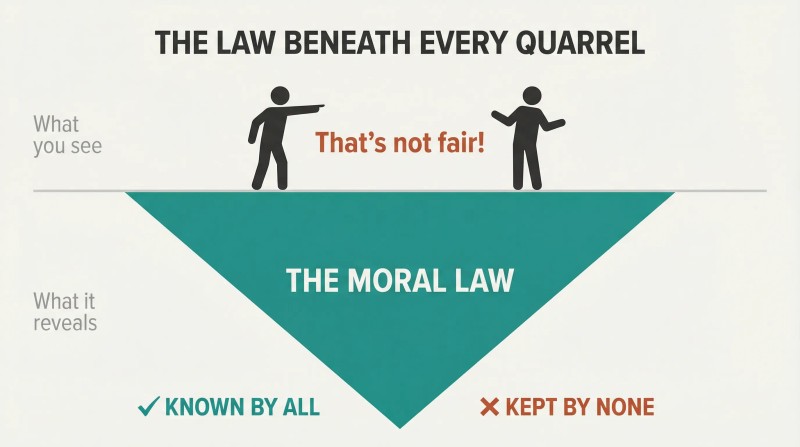
Your quarrels reveal a Moral Law you know and break daily
Lewis opens with a deceptively simple observation: every human quarrel appeals to a shared standard of fairness. "How'd you like it if anyone did the same to you?" isn't just annoyance — it's an appeal to a rule both parties recognize. Lewis calls this the Moral Law, or Law of Human Nature: a real standard of right and wrong that every civilization has known, differing in emphasis but never in fundamentals. No culture has ever admired cowardice or celebrated betrayal.
The devastating follow-up: everyone knows this Law, and nobody fully keeps it. We make excuses — tired, provoked, busy — but the excuses themselves prove we believe in the standard we've violated. These two facts — universal moral knowledge and universal moral failure — form the foundation of Lewis's entire argument.
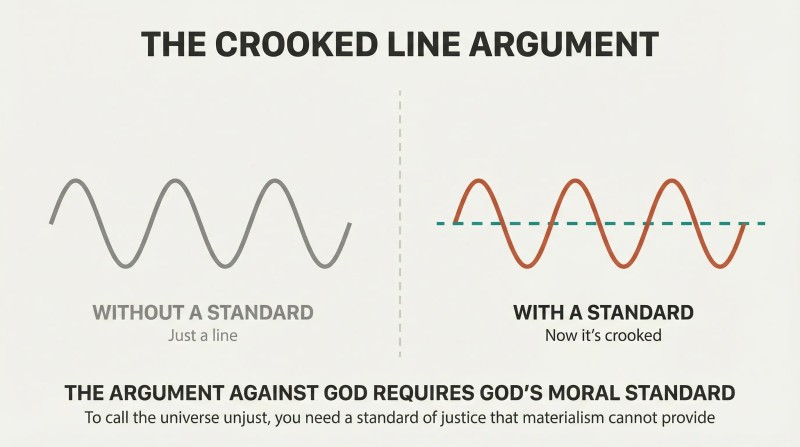
Calling the universe unjust requires the God atheism denies
Lewis turns his own atheism against itself. His chief argument against God had been the cruelty and injustice of the universe. Then he caught the contradiction: a man does not call a line crooked unless he has some idea of a straight line. To call the universe unjust, Lewis needed a real standard of justice — which a meaningless, material universe could not provide. In the very act of disproving God, he was borrowing God's moral compass.
This is the pivot of Book I. If reality is purely material, the concept of "meaningless" becomes impossible — you'd need a vantage point outside the meaninglessness to recognize it. Lewis concludes that the Moral Law pressing on every human conscience is "inside information" about a Mind behind the universe — not yet the Christian God, but enough to make pure materialism inadequate.
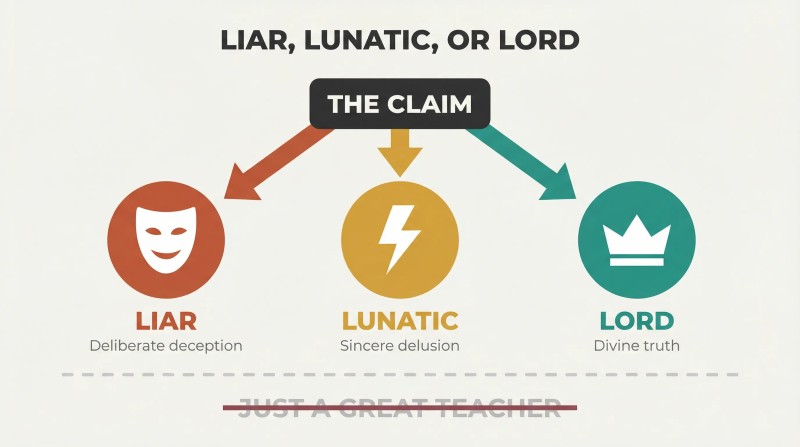
Jesus left only three options: liar, lunatic, or Lord
Lewis constructs his most famous argument around a historical fact: Jesus of Nazareth — a Jew who believed in one God wholly separate from creation — claimed the authority to forgive any sin, even sins committed against other people. Only God could coherently make that claim. A merely human being saying these things would be either delusional or demonic.
This is the Liar, Lunatic, or Lord trilemma. You can reject Jesus as a madman, condemn him as a fraud, or worship him as God. What you cannot logically do is patronize him as a wise sage who overstated his resume. Lewis frames Christianity as "enemy-occupied territory" where this God has landed in disguise, calling humanity to join a campaign of liberation against a dark power that has hijacked the world.
Pride, not lust, is the master sin — competitive to its core
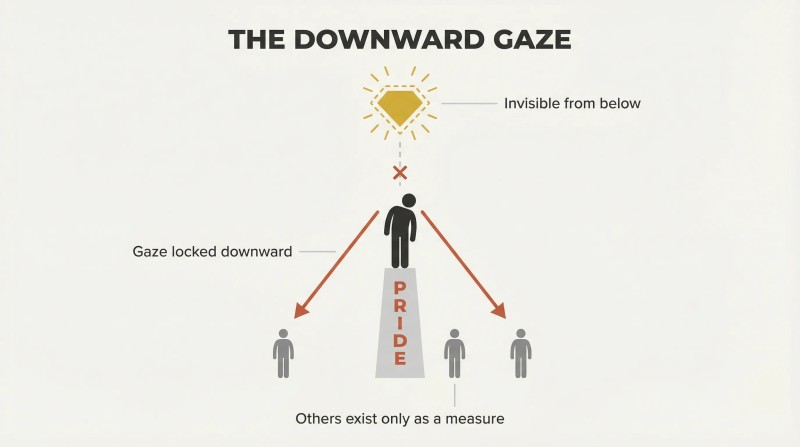
Lewis calls Pride the "Great Sin" — more dangerous than lust, greed, or anger, which are "mere fleabites in comparison." What makes pride uniquely destructive is that it's essentially competitive. A proud person doesn't enjoy being rich; they enjoy being richer than others. Remove the comparison, and the pleasure vanishes. This is why a man earning £10,000 a year craves £20,000 — not for more comfort, but for the feeling of superiority.
Pride also hides from its host. The more you have it, the less you see it — yet you instantly spot it in others. Lewis warns that pride can even hijack religion: people who imagine God approves of them more than others are feeding pride, not practicing faith. The first step toward humility is simply admitting you're proud.
Good and evil both compound: small choices set your trajectory
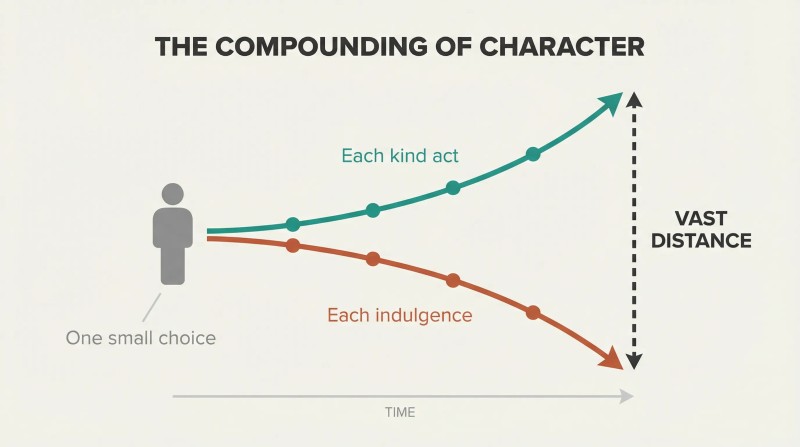
Lewis frames moral choices as territory in a war. Every kind act is a captured position; every indulgence in rage or lust is ground surrendered to the enemy. What matters isn't the visible size of the action but the mark it leaves on your soul — the central self you're slowly shaping into something heavenly or hellish.
This compounds over time. A man who sheds blood in anger and one who merely fumes in private may leave the same mark on their inner character. Both have made rage slightly easier next time and restraint slightly harder. Lewis notes this works in reverse too: as a person improves morally, they see their remaining evil more clearly, while a thoroughly bad person thinks they're fine. Good people know about both good and evil; bad people know about neither.
Stop waiting to feel love — choose it, and affection follows
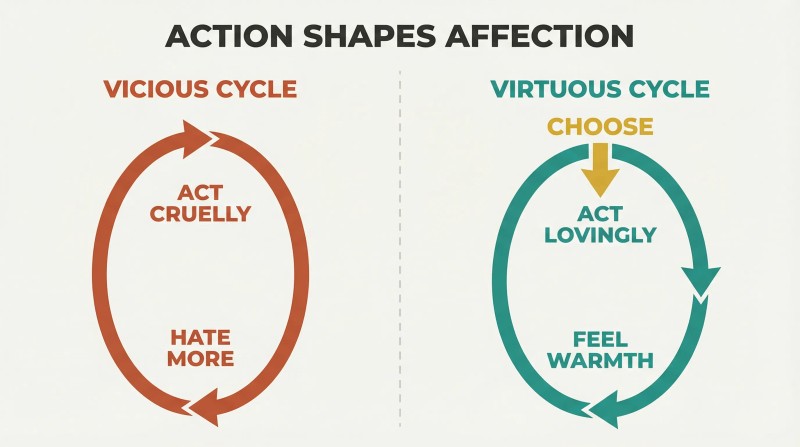
Christian love — what Lewis calls Charity — is not a feeling but a state of the will. You can't manufacture affection through effort, and you don't need to. Behave as if you loved the person, and genuine warmth will follow. Conversely, mistreat someone and you'll hate them more. Lewis cites a grim example: the Nazis initially persecuted Jews out of hatred, then hated them far more because they had persecuted them. Cruelty breeds contempt in a vicious circle.
This principle also reshapes forgiveness. Lewis realized he'd been "hating the sin but not the sinner" toward himself his entire life — loathing his own cowardice while still caring about his well-being. Christianity asks us to extend that same dual stance to enemies: despise what they do, hope for who they might become.
Your deepest unsatisfied longings are signposts, not broken promises
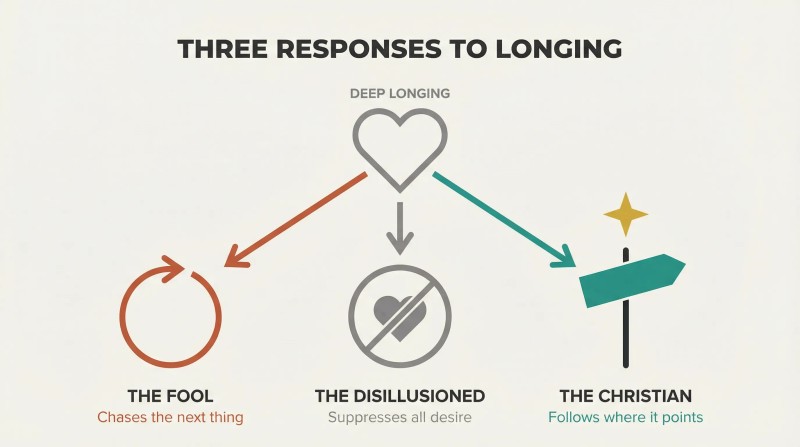
Lewis identifies three responses to life's persistent dissatisfaction. The Fool keeps chasing — the next relationship, vacation, or hobby will surely deliver. The Disillusioned Sensible Man stops wanting and represses longing as immature. The Christian recognizes these desires as evidence: if nothing on earth fully satisfies, perhaps we were designed for something beyond earth.
Lewis draws a biological analogy. Hunger proves food exists. The instinct to swim proves water exists. If we carry a longing that no earthly experience can fulfill, the most rational explanation is that we were made for another world. Earthly pleasures aren't frauds — they're echoes, signposts pointing toward the real thing. The task is to enjoy them gratefully without mistaking the signpost for the destination.
Christ demands everything, but half-measures are actually harder
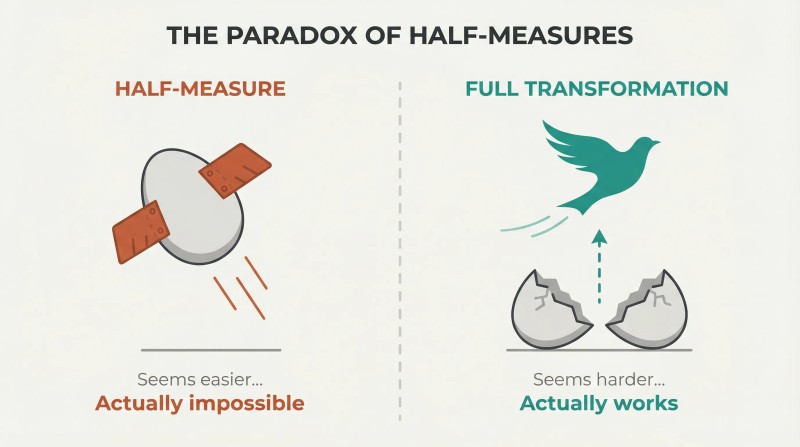
Lewis presents a paradox at the heart of Christianity. Christ doesn't want to prune a few bad habits — He wants the entire old self surrendered. "I don't want to cut off a branch here and a branch there, I want to have the whole tree down," Lewis paraphrases. This sounds terrifying. But the alternative — keeping your old self intact while bolting on good behavior — is actually impossible, like trying to pay taxes and still have enough left to live your old life.
Lewis compares God to a dentist. As a child, he avoided his mother during toothaches because she'd give aspirin tonight but drag him to the dentist tomorrow. God works the same way: ask Him for help with one sin, and He starts on all of them. You thought He was building a decent cottage; He's constructing a palace and intends to live in it Himself.
Christianity isn't moral improvement — it's a change of species
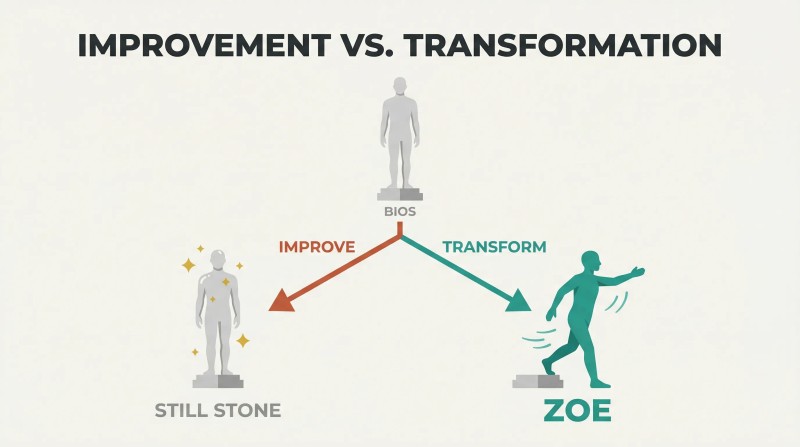
Lewis distinguishes two kinds of life. Bios is biological life — the natural life we share with animals that runs down and dies. Zoe is the uncreated spiritual life that exists eternally in God. Christianity's claim is not that Bios can be improved but that it can be transformed into Zoe — as radical a change as a stone statue coming to life. Lewis compares humanity to tin soldiers that God wants to make real; the tin soldiers resist because they can only see their tin being spoiled.
The mechanism is what Lewis calls "good infection." Christ, the one man who fully embodied Zoe, spreads this divine life through personal contact — baptism, belief, communion, and other Christians. Every believer is meant to become "a little Christ," not through imitation alone but through an actual infusion of a different kind of life.
Surrender yourself fully and become more yourself, not less
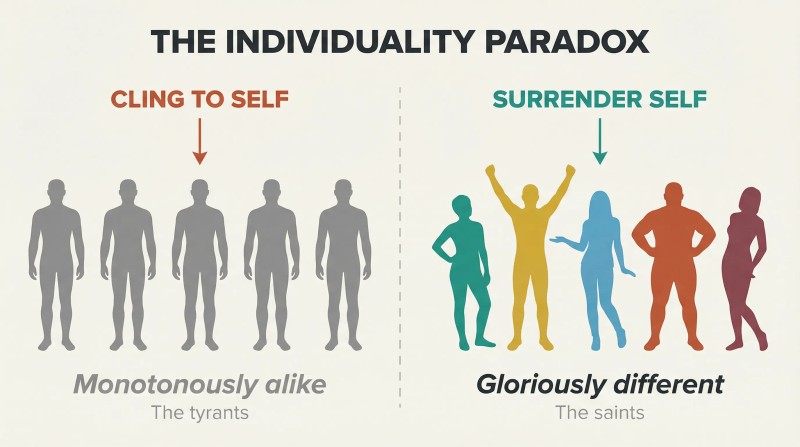
Lewis closes with an arresting paradox. The more you cling to "yourself" — your personality, preferences, independence — the less of a self you actually have. What most people call "me" is largely a product of heredity, upbringing, propaganda, and bodily chemistry. It's only when you surrender this constructed self to Christ that a genuine personality emerges.
Lewis illustrates with light and salt. People living in total darkness might assume that standing in the same light would make everyone look identical. In reality, light reveals how different they are. Salt doesn't flatten the taste of food — it brings out each dish's unique flavor. Becoming "in Christ" doesn't erase individuality; it creates it for the first time. The dictators of history blur together in dreary sameness; the saints are endlessly, radiantly distinct.
Analysis
Mere Christianity succeeds — and occasionally stumbles — because of a rhetorical strategy almost no modern apologist has matched: Lewis builds his case entirely from common ground before introducing a single specifically Christian claim. The first fifth of the book never mentions Jesus, the Bible, or the Church. It begins where every reader already stands — in the middle of a quarrel — and works outward from moral intuition to metaphysics. This inductive architecture, originally designed for BBC radio during the Blitz, remains remarkably effective because it respects the listener's skepticism rather than demanding capitulation upfront.
Lewis's argument is fundamentally analogical. Nearly every abstract claim arrives dressed in a concrete image: the Moral Law as sheet music directing instincts-as-piano-keys, the universe as enemy-occupied territory, God as a dentist who won't stop at one tooth, humanity as tin soldiers resisting transformation into real men. These analogies do heavy philosophical lifting while remaining accessible, though they occasionally smuggle in assumptions a careful reader might challenge. The Liar-Lunatic-Lord trilemma, for instance, has been criticized by scholars who note the options may not be exhaustive — a person could be sincerely mistaken without being clinically insane — but the argument's cultural persistence suggests it captures something emotionally persuasive even where it may be logically incomplete.
What distinguishes this book from lesser apologetics is Lewis's willingness to make Christianity uncomfortable. He refuses the diluted version he calls 'Christianity-and-water.' His chapters on Pride and sexual morality unsettle believers as much as skeptics. The progression from Book I's accessible moral philosophy to Book IV's startling claim that humans are meant to become 'little Christs' mirrors the spiritual escalation Lewis believes Christianity demands: begin with what you already know, end somewhere you couldn't have imagined. The book's primary limitation is cultural — Lewis's remarks on marriage hierarchy and sexual ethics reflect mid-twentieth-century Anglican assumptions that many contemporary readers will find not merely dated but alienating, a tension Lewis partially anticipated by confining himself to shared doctrine rather than claiming personal authority.
Review Summary
Mere Christianity is a widely acclaimed Christian apologetics book that presents Lewis's arguments for the existence of God and core Christian doctrines. While many readers find his logic compelling and his writing style engaging, some criticize his arguments as overly simplistic or outdated. The book is praised for its accessible explanations of complex theological concepts and Lewis's use of analogies. However, some readers disagree with specific theological points or find the language dated. Overall, it remains an influential work in Christian literature, particularly among evangelicals.
People Also Read






Glossary
The Moral Law (Law of Human Nature)
Universal standard of right conductLewis's term for the innate sense of right and wrong shared by all humans across cultures and eras. Unlike physical laws (which describe what things do), the Moral Law prescribes what humans ought to do—and can be disobeyed. Lewis argues it cannot be reduced to instinct, social convention, or evolutionary utility, and functions as inside information about a moral intelligence behind the universe.
Bios
Natural, biological lifeLewis's term (borrowed from Greek) for the ordinary biological life shared with all living things—the life sustained by food, water, and air that inevitably runs down and dies. Lewis contrasts Bios with Zoe to argue that Christianity offers not an improvement of natural life but a transformation into an entirely different kind of life, as radical as a statue coming to life.
Zoe
Eternal, spiritual divine lifeLewis's term (borrowed from Greek) for the uncreated, eternal spiritual life that exists in God. Unlike Bios, Zoe does not depend on nature and does not decay. Lewis argues that Christianity's central offer is the transformation of human Bios into Zoe—making humans into sons of God rather than merely improving their natural behavior. Christ is the first full instance of this life in human form.
Good Infection
Christ-life spreading through contactLewis's metaphor for how the divine life (Zoe) spreads from Christ to humans—not primarily through teaching or imitation, but through personal contact and spiritual transmission. Lewis compares it to a biological contagion: proximity to Christ (through prayer, sacraments, and other Christians) allows His life to infect believers, gradually transforming them into what Lewis calls 'little Christs.'
Mere Christianity
Core beliefs all Christians shareLewis's term for the fundamental doctrines common to virtually all Christian traditions across history, stripped of denominational disputes. Lewis compares it to a hallway from which doors open into various rooms (denominations). The hallway is for finding one's way, not for permanent residence—but its contents are, Lewis argues, 'not only positive but pungent' and sharply distinct from all non-Christian beliefs.
Christianity-and-water
Diluted, comfortable pseudo-ChristianityLewis's dismissive label for a watered-down version of Christianity that affirms a good God and general niceness while stripping out the difficult doctrines—sin, hell, the devil, atonement, and redemption. Lewis calls it a 'boys' philosophy' alongside pure atheism, arguing that neither faces the full complexity of reality. He insists real Christianity begins in dismay, not comfort.
FAQ
What's "Mere Christianity" about?
- Core Exploration: "Mere Christianity" by C.S. Lewis explores the fundamental beliefs common to Christians across different denominations, focusing on the essence of Christian faith rather than denominational differences.
- Origin of Content: The book is based on a series of radio talks given by Lewis during World War II, which were later compiled into this volume.
- Structure: It is divided into four books, each addressing different aspects of Christian doctrine and moral behavior.
- Purpose: Lewis aims to explain and defend the core beliefs of Christianity to both believers and skeptics, emphasizing the rational basis for faith.
Why should I read "Mere Christianity"?
- Understanding Christianity: It provides a clear and accessible explanation of Christian beliefs, making it valuable for both Christians and those curious about the faith.
- Rational Approach: Lewis uses logical arguments to discuss faith, making it appealing to readers who appreciate reasoned discourse.
- Moral Insights: The book offers profound insights into human nature and morality, encouraging readers to reflect on their own beliefs and behaviors.
- Cultural Impact: As a classic of Christian apologetics, it has influenced countless readers and thinkers, making it a significant work in religious literature.
What are the key takeaways of "Mere Christianity"?
- Universal Morality: Lewis argues for a universal moral law, which he calls the Law of Human Nature, suggesting that all humans have an inherent understanding of right and wrong.
- Christian Belief: The book outlines the core beliefs of Christianity, including the divinity of Christ and the concept of the Trinity.
- Moral Behavior: Lewis discusses the importance of virtues and moral behavior, emphasizing that Christianity is not just about belief but also about living a virtuous life.
- Transformation: The ultimate goal of Christianity, according to Lewis, is the transformation of individuals into "new men" who reflect the character of Christ.
What are the best quotes from "Mere Christianity" and what do they mean?
- "God is no fonder of intellectual slackers than of any other slackers." This quote emphasizes the importance of using one's intellect in the pursuit of faith, suggesting that God values thoughtful engagement with belief.
- "The Christian does not think God will love us because we are good, but that God will make us good because He loves us." This highlights the transformative power of God's love, which changes believers rather than requiring them to be good beforehand.
- "Aim at Heaven and you will get earth 'thrown in': aim at earth and you will get neither." Lewis suggests that focusing on spiritual goals leads to fulfillment in both spiritual and earthly matters, while focusing solely on earthly goals leads to emptiness.
- "You can never get a cup of tea large enough or a book long enough to suit me." While not directly related to the book's themes, this quote reflects Lewis's love for simple pleasures and the joy of intellectual exploration.
How does C.S. Lewis define the "Law of Human Nature"?
- Universal Moral Law: Lewis describes the Law of Human Nature as a universal moral code that all humans inherently understand, regardless of culture or time period.
- Moral Expectations: He argues that people expect others to adhere to this law, as evidenced by common reactions to perceived injustices or unfairness.
- Not Always Followed: Despite its universality, Lewis notes that humans often fail to live up to this moral standard, which he sees as evidence of a deeper moral truth.
- Foundation for Argument: This concept serves as a foundation for Lewis's argument for the existence of a moral God who instills this law in humanity.
What is C.S. Lewis's view on Christian denominations in "Mere Christianity"?
- Focus on Common Beliefs: Lewis intentionally avoids discussing denominational differences, focusing instead on the core beliefs shared by all Christians.
- Unity Over Division: He believes that discussing divisive theological points is less helpful for those outside the faith and prefers to emphasize unity.
- Personal Position: While Lewis identifies as a member of the Church of England, he does not attempt to convert readers to his specific denomination.
- Service to Non-Believers: His goal is to explain and defend the common beliefs of Christianity to those who are skeptical or curious about the faith.
How does "Mere Christianity" address the concept of faith?
- Two Levels of Faith: Lewis discusses faith in two senses: belief in Christian doctrines and trust in God despite changing emotions and circumstances.
- Faith as Virtue: He argues that faith is a virtue because it involves holding onto beliefs even when emotions and moods challenge them.
- Beyond Reason: Faith is not contrary to reason but goes beyond it, requiring trust in God even when evidence is not immediately apparent.
- Role of Moods: Lewis emphasizes the importance of recognizing and managing moods that can undermine faith, advocating for regular spiritual practices to reinforce belief.
What does C.S. Lewis mean by "Christian Behaviour"?
- Moral Framework: Lewis outlines a framework for Christian behavior based on virtues such as prudence, temperance, justice, and fortitude.
- Three Parts of Morality: He divides morality into three parts: fair play and harmony between individuals, tidying up or harmonizing things within the individual, and the general purpose of human life.
- Practical Application: The book emphasizes that Christian behavior is not just about following rules but about developing a character that reflects Christ.
- Transformation Goal: The ultimate goal of Christian behavior is the transformation of individuals into beings that reflect the character and love of God.
How does "Mere Christianity" explain the Trinity?
- Three-Personal God: Lewis describes God as a being that is three Persons while remaining one Being, using the analogy of a cube made up of six squares.
- Beyond Human Understanding: He acknowledges that the concept of the Trinity is difficult to fully grasp but emphasizes its importance in understanding God's nature.
- Dynamic Relationship: The Trinity is described as a dynamic relationship of love between the Father, Son, and Holy Spirit, which is central to the Christian understanding of God.
- Practical Implications: Understanding the Trinity helps Christians comprehend the nature of God's love and the relationship they are invited to participate in through faith.
What is the "shocking alternative" presented in "Mere Christianity"?
- Divinity of Christ: Lewis presents the "shocking alternative" that Jesus Christ is either the Son of God as He claimed or a lunatic or worse.
- Logical Argument: He argues that Jesus's claims about Himself leave no room for Him to be merely a great moral teacher; He must be accepted as divine or rejected entirely.
- Challenge to Readers: This argument challenges readers to confront the implications of Jesus's claims and decide where they stand regarding His divinity.
- Central to Christianity: The divinity of Christ is central to Christian belief, and accepting it is crucial for understanding the faith as Lewis presents it.
How does C.S. Lewis address the issue of sexual morality in "Mere Christianity"?
- Chastity as a Virtue: Lewis discusses chastity as a Christian virtue, emphasizing the importance of sexual purity and faithfulness within marriage.
- Cultural Challenges: He acknowledges the difficulty of adhering to Christian sexual ethics in a culture that often promotes contrary values.
- Natural Instincts: Lewis argues that the sexual instinct, like other natural instincts, must be controlled and directed according to moral principles.
- Not the Central Focus: While important, Lewis notes that sexual morality is not the central focus of Christian ethics, which encompasses a broader range of virtues and behaviors.
What does "Mere Christianity" say about the transformation of individuals?
- New Men Concept: Lewis describes the transformation of individuals into "new men" as the central goal of Christianity, involving a profound change in character and nature.
- Beyond Improvement: This transformation is not merely about becoming better people but about becoming fundamentally different, reflecting the life of Christ.
- Divine Assistance: The transformation is achieved through divine assistance, as individuals allow Christ to work within them and change their nature.
- Ultimate Purpose: The ultimate purpose of this transformation is to become sons of God, sharing in the divine life and reflecting God's love and character.
About the Author
Other books by C.S. Lewis









Download PDF
Download EPUB
.epub digital book format is ideal for reading ebooks on phones, tablets, and e-readers.








































