
Key Takeaways
1. The Modern Crisis: A Quest for Community Born from Alienation
Surely the outstanding characteristic of contemporary thought on man and society is the preoccupation with personal alienation and cultural disintegration.
A specter haunts. The modern mind is haunted by insecurity, a stark contrast to the 19th century's optimism. This pervasive sense of alienation and cultural disintegration stems from the decline of traditional social bonds, which once provided stability and meaning. Where 19th-century rationalists saw progress in the emancipation of the individual, contemporary observers increasingly see sterile insecurity and the shell of a broken past.
Loss of anchors. The historic triumph of secularism and individualism, while freeing individuals from traditional ties of class, religion, and kinship, has paradoxically led to disenchantment and isolation. Man, once considered autonomous and self-sufficient, is now often seen as a symbol of society's anxiety, a consequence of social disintegration rather than moral progress. This shift is evident across various fields:
- Literature: Themes of dissolution and decay in major novelists (Proust, Mann, Joyce, Kafka).
- Theology: Recognition of spiritual isolation and the inadequacy of individual faith alone.
- Social Sciences: Focus on "disorganization" in family, community, and personality.
Psychological void. This moral estrangement manifests as widespread frustration, anxiety, and insecurity, reflecting man's alienation from society's relationships and moral values. Psychiatrists like Karen Horney and Erich Fromm observe a rising tendency toward feelings of aloneness, even among "normal" populations, as basic moral values become inaccessible and the lines between right and wrong blur. This cultural "set" toward chronic disquiet underscores the profound need for belonging.
2. The State as a Revolutionary Force Against Traditional Communities
The argument of this book is that the single most decisive influence upon Western social organization has been the rise and development of the centralized territorial State.
Permanent revolution. The State, far from being a neutral arbiter, has acted as a "process of permanent revolution," fundamentally reshaping Western social organization. Its relentless expansion of function and power has consistently clashed with the authorities and allegiances embedded in traditional institutions like the church, family, gilds, and local communities. This conflict is the primary source of the social dislocations and uprootings of status that define the modern quest for community.
Beyond mere power. The State is not just a legal or military entity; it has become the supreme allegiance and a powerful symbol of cultural unity. Unlike kinship or capitalism, which have faced distrust or lost institutional significance, the State has risen as the dominant force, offering refuge from the insecurities of other life spheres. Its revolutionary influence stems from its successive penetrations into man's economic, religious, kinship, and local allegiances, displacing established centers of function and authority.
Historical trajectory. The State's growth has been both territorial and functional, gradually absorbing responsibilities once held by other associations. This expansion is evident in:
- Legal standardization: Replacing diverse local laws with a single system.
- Economic intervention: Cultivating trade, standardizing measures, and supporting new businesses outside traditional structures.
- Religious subordination: Providing protection for reformers and assuming social functions previously held by the Church.
This process has brought the State and the individual into an ever-closer legal relationship, often presenting itself as a liberator from medieval group restrictions.
3. Sovereignty's Evolution: From Limited Monarchy to Absolute State
The theory of each man holds, successively, ever greater implications of destruction to the intermediate authorities of society, ever greater implications of centralized political power, and ever greater implications of cultural and social leveling of the population.
Bodin's nascent sovereignty. Jean Bodin, in the 16th century, articulated the concept of sovereignty as "most high, absolute and perpetual power over the subjects and citizens in a Commonweale," vested in the monarch. While he sought to elevate royal power above competing authorities like the nobility and Church, his theory remained conflicted. Bodin, a transitional figure, still deeply valued intermediate associations like the family, gilds, and local communities, seeing them as logically and historically antecedent to the State and indispensable for social order, thus limiting the practical reach of his absolute sovereign.
Hobbes's monolithic State. Thomas Hobbes, a century later, radically advanced the theory of sovereignty, stripping away Bodin's medieval affections. For Hobbes, the State was not merely a reinforcement of existing order but its very creator, emerging from a "solitary, poore, nasty, brutish, and short" state of nature through a social contract. He recognized only two essential elements: the individual and the sovereign, relentlessly eradicating any social purpose or loyalty not directly from the individual or the State's command.
- No intermediate associations: Viewed as "wormes in the entrayles of a naturall man," breeding dissension.
- Law as sovereign command: Not dependent on social institutions or custom.
- Church subordination: Feared as a divisive force, demanding strict political control.
Rousseau's total community. Jean-Jacques Rousseau presented the most revolutionary theory, conceiving sovereignty as the "exalted will of the people," omnipotent and omnipresent. For Rousseau, morality, freedom, and community existed only within the State, which served as a spiritual refuge from the "oppressions and corruptions of society." He advocated for an "absolute surrender of the individual, with all of his rights and all of his powers, to the community as a whole," arguing that individuals are "compelled to be free" by conforming to the General Will. This vision, while cloaked in the rhetoric of freedom, laid the groundwork for totalitarian absorption of society.
4. Rousseau's Vision: The State as the Total Moral Community
If it is good to know how to deal with men as they are, it is much better to make them what there is need that they should be.
The reign of virtue. Rousseau's philosophy, particularly his concept of the General Will, profoundly influenced the idea of the State as a redemptive force. He believed that man, born free and good but corrupted by society's institutions, could only achieve virtue and freedom by completely subordinating himself to the collective will of the perfect State. This "political community" would resolve internal and external conflicts, offering a sanctuary from the torments and uncertainties of ordinary social life.
A new kind of freedom. For Rousseau, the State's power was not repressive but liberating. It would emancipate individuals from the "tyrannies and uncertainties of ordinary society" – class, church, school, patriarchal family – by securing their dependence upon itself. This meant:
- Freedom from institutions: Liberation from traditional social bonds.
- Equality through leveling: Mechanical equivalence of talents and functions enforced by the State.
- Fraternity through political brotherhood: Excluding all other forms of association.
- Virtue as conformity: Alignment of individual wills with the General Will.
Annihilation of diversity. To achieve this pure, unified sovereignty, Rousseau proposed the radical abrogation of all traditional social loyalties and the banishment of minor associations. He argued that "it is therefore essential, if the General Will is to be able to express itself, that there should be no partial society within the state, and that each citizen should think only his own thoughts." This extended to religion, where a purely civil religion, identified with national values, would replace Christianity, which he deemed too spiritual and pacifist to foster good citizens. The family, too, would be reshaped, with the State assuming the educative role to prevent "prejudices" from interfering with the development of citizens.
5. The French Revolution: A Catalyst for Individualism and State Power
The State must therefore lay hold on every human being at his birth and direct his education with powerful hand.
Rousseau's prophecy realized. The French Revolution served as a dramatic translation of Rousseau's ideas into administrative reality, showcasing the new perspective of redemption through political power. Its extraordinary flexibility allowed it to champion both individual freedom and collective power, ingeniously camouflaging absolute power with the rhetoric of liberty. The Revolution's leaders, inspired by Rousseau, saw the State as the ultimate community, capable of spiritualizing political relationships and removing them from mere intrigue.
Dual emancipation. The Revolution pursued a two-fold emancipation:
- Individual liberation: Freeing individuals from the "traditional associative chains" of the old regime (gilds, Church, patriarchal family, class, local community).
- State liberation: Extricating the State from feudal customs and localisms to enhance its efficacy.
This revolutionary liaison between the individual and the omnipotent State aimed to pulverize all intermediate associations, which were seen as remnants of a despised past. The Declaration of the Rights of Man, while stressing individual rights, simultaneously asserted the nation as the source of all sovereignty and law as the expression of the General Will.
Cultural standardization. Driven by militant rationalism and a passion for geometrical symmetry, the Revolution sought to standardize all aspects of social and political life. This included:
- Banning associations: Prohibiting economic, charitable, literary, and religious societies to prevent competing loyalties.
- Reforming family law: Declaring marriage a civil contract, limiting paternal authority, and mandating equal inheritance to dismantle the corporate family.
- Subordinating the Church: Suppressing monastic vows, confiscating property, and making clergy elected officials.
The goal was to convert all collectivities into atomized individuals, whose sole membership would be in the rational State, thereby creating a unified French culture and a new "political man."
6. Totalitarianism: Exploiting the Mass's Longing for Belonging
The despair of the masses, concludes Peter Drucker, ‘is the key to the understanding of fascism.
Tocqueville's chilling prophecy. Alexis de Tocqueville, nearly a century before its full manifestation, accurately described totalitarianism as a "species of oppression unlike anything that ever before existed." He foresaw an "innumerable multitude of men, all equal and alike," living in isolation, overseen by an "immense and tutelary power" that, while mild and provident, "compresses, enervates, extinguishes, and stupefies a people." This power, he noted, could even establish itself "under the wing of the sovereignty of the people," highlighting its insidious nature.
Beyond superficial evils. Understanding totalitarianism requires looking beyond its obvious horrors like racial extermination or economic distress. Its essence lies in its relationship to the masses and its ability to incorporate widely appealing values into new power structures. Totalitarianism is not irrational; it is a calculated system that recognizes human needs for security and recognition, satisfying them in political terms. It is also not a historical abnormality but closely related to 19th-century progressive trends like centralization and collectivism.
The creation of masses. Totalitarian society is built upon the existence of "masses"—aggregates of insecure, lonely individuals atomized by the destruction of traditional social and cultural relationships. Where these masses don't naturally exist, totalitarian regimes ruthlessly create them by:
- Destroying autonomous associations: Liquidating labor unions, churches, ethnic groups, and even philatelist societies.
- Eradicating old statuses: Systematically obliterating legal identities and traditional social roles.
- Fabricating new meanings: Redesigning history, art, science, and morality to fit the State's narrative.
This cultural nihilism creates a spiritual vacuum, which the totalitarian State then fills with its own "total political community," offering a new sense of belonging and purpose.
7. Liberalism's Paradox: Individual Freedom Undermined by Social Atomization
The real tragedy of existence, Hegel once wrote, ‘is not the conflict between right and wrong but between right and right.’
A crisis of values. Contemporary liberal thought faces a profound crisis, a "social schizophrenia," stemming from the conflict between cherished values. We prize individual freedom, democracy, and rational progress, yet simultaneously venerate tradition, secure social status, and communal ties. This intellectual and moral conflict has led to widespread disillusionment, as secular hopes fail and the very ideals of liberalism are seemingly corrupted by totalitarian regimes.
The flawed image of man. Eighteenth-century liberalism, while ethically noble in its emphasis on the person, was built on a flawed psychological and sociological premise: that man is inherently self-sufficing, stable, and autonomous, independent of social organization. This "rationalist image of man" led to a strategy of freedom based on "release and emancipation" from institutions, viewing groups as secondary or even fettering. However, modern social psychology reveals that individuality is a product of "normatively oriented interaction with other persons," not social isolation.
Erosion of contexts. The historical success of liberalism was predicated on unspoken "prejudgments" and strong social contexts—family, local community, church—that reinforced its values. As these intermediate associations weaken due to modern centralization and cultural mechanization, the formal values of individual and people become "loose and wavering." The rhetoric of individualism, once a force for liberation, now rings hollow for populations whose primary problems stem from moral and social release, making them vulnerable to the "intolerable individualism" that totalitarian prophets exploit.
8. The Indispensable Role of Intermediate Associations for Freedom
Only by anchoring his own conduct . . . in something as large, substantial, and superindividual as the culture of a group . . . can the individual stabilize his new beliefs sufficiently to keep them immune from the day to day fluctuations of moods and influences of which he, as an individual, is subject.
Beyond the individual and the State. True freedom and cultural creativity are not found in the isolated individual or the monolithic State, but in the vibrant interplay of diverse intermediate associations. These groups—families, local communities, churches, professions, labor unions—provide the essential social contexts where individuals develop personality, reinforce moral conscience, and find meaning. When these "primary contexts of normative association" are disrupted, individuals are separated from both cultural values and the very sources of individuality.
Lessons from experience. The 20th century's social transformations, marked by individual insecurity and the mass quest for community, underscore the critical link between human motivation for freedom and the structural coherence and functional significance of social organization. Studies in psychology, industry, and military effectiveness consistently show that personal incentives and morale are deeply tied to meaningful social relationships and group solidarity.
- Workplace morale: Vitality of production incentives correlates with informal social relationships in the factory.
- Combat effectiveness: Soldier morale and resilience depend more on platoon solidarity than abstract war aims.
- Concentration camps: Moral conscience erodes without reinforcing associative ties.
The myth of economic individualism. The idea that economic freedom rests on purely individualistic drives or impersonal market relationships is a rationalist illusion. Historically, capitalism thrived on the "extra-capitalist material" of family, local community, and pre-capitalist allegiances. The modern labor union and cooperative, often opposed by businessmen, are in fact crucial "new forms of association" that sustain economic freedom by providing social belonging and purpose. Weakening these social structures, whether by political or individualistic motives, atomizes society and paves the way for political collectivism.
9. Decentralization: The Path to Preserving Liberal Democracy
The only safeguard against power, warned Montesquieu, ‘is rival power.’
Democracy's true foundation. While democracy is fundamentally about legitimate political power arising from the consent of the governed, its liberal form depends crucially on a pluralistic conception of "the people." This means recognizing individuals not as abstract, atomized units, but as inseparable from the diverse families, unions, churches, and traditions that compose a culture. The goal of liberal democracy is to harmonize and make effective these varied group allegiances, rather than sterilizing them in favor of a monistic political community.
The dangers of unitary democracy. The unitary view of democracy, closely allied with the political community ideology, arose from rationalist attacks on feudal structures. It sought to emancipate the "people" (abstractly conceived) from traditional institutions, leading to administrative centralization and cultural standardization. This approach, while promising welfare and equality, risks becoming a "democratic totalitarianism" by concentrating all authority in the State and eroding the "smaller unions" that are the true building blocks of a free society.
Reaffirming pluralism. To counter the ominous trend toward centralized, omnicompetent states, liberal democracy must embrace administrative decentralization and foster a plurality of authorities. This means:
- Reinforcing intermediate associations: Empowering religious, economic, professional, and local groups with significant functions and authorities.
- Diversifying power: Recognizing that freedom thrives in cultural diversity, local differentiation, and associative pluralism.
- Government's role: Not to absorb functions, but to provide a legal environment where diverse associations can flourish and compete, preventing any single authority from becoming monopolistic.
A new laissez faire. The old laissez faire failed because it neglected the social contexts of human behavior, inadvertently accelerating state growth by leaving a vacuum of community. A new philosophy of laissez faire is needed, one that prioritizes the prosperity of "autonomous groups" as the basic unit. This requires conscious planning and administrative skill to create conditions where diverse associations can thrive, ensuring that liberal values of autonomy and freedom of choice are rooted in a rich, pluralistic culture, rather than being swept away by the irresistible pull of centralized power.
Review Summary
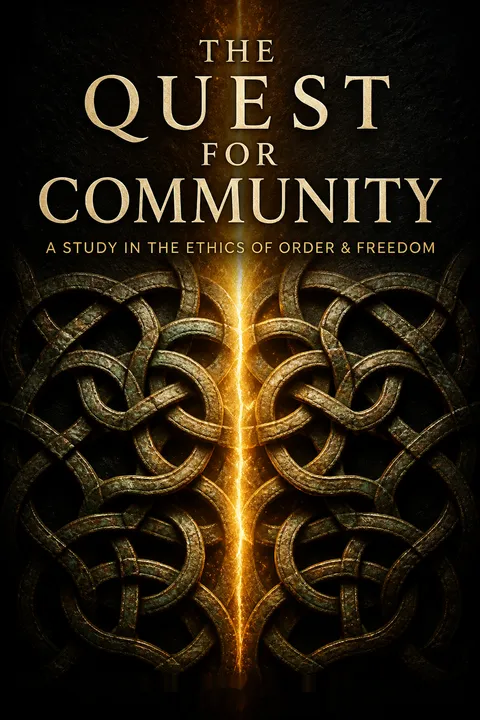
The Quest for Community by Robert Nisbet explores how modern individualism and state centralization have eroded traditional communal bonds like family, church, and local associations. Published in 1953, the book argues these intermediate institutions are essential for freedom and democracy. Reviewers praise Nisbet's interdisciplinary analysis showing how the rise of powerful states paradoxically accompanies atomized individualism, potentially leading to totalitarianism. Critics note the work remains remarkably relevant today, though some find it overly theoretical or Western-centric. Most consider it a foundational conservative text offering profound insights into community decline and the relationship between freedom, association, and state power.
People Also Read








Download PDF
Download EPUB
.epub digital book format is ideal for reading ebooks on phones, tablets, and e-readers.








































