

Key Takeaways
Your mind has two operators: a chooser and an obedient servant
Murphy's foundational model splits mind into two functions. The conscious mind reasons, chooses, and judges (picking your books, home, and partner). The subconscious mind accepts whatever the conscious mind hands it, without argument or discrimination, then executes it through your body and circumstances.
He compares this to a ship: the captain (conscious mind) issues orders from the bridge, and the crew below (subconscious) obeys without questioning where the vessel is headed. Give wrong orders and the ship hits the rocks. The subconscious is like soil, accepting any seed, good or bad, and growing it. It cannot take a joke, cannot reason controversially, and treats every assumption you accept as true as a command to be fulfilled.
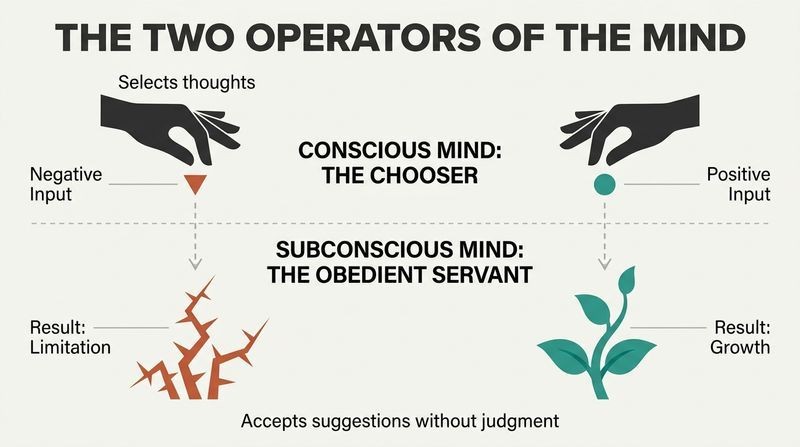
The two-mind model predates Murphy and echoes Freud's conscious/unconscious split, though Murphy strips out the darkness and conflict. Modern dual-process theory (Kahneman's System 1 and System 2) offers a research-backed cousin: fast, automatic processing versus slow, deliberate reasoning. Where Murphy overreaches is in claiming the subconscious literally arranges external events. What cognitive science supports is subtler: beliefs shape attention, behavior, and physiology, which shift outcomes. The captain-and-crew metaphor remains useful precisely because it dramatizes a real asymmetry: deliberate thought is scarce and slow, while automatic patterns run the show most of the time.
You are not what you wish for; you are what you assume is true
Murphy's central law: the subconscious responds to belief, not desire. A belief is simply a thought you accept as true, and whatever you impress on the deeper mind gets expressed as condition, experience, and event. He insists it is never the thing believed in that produces results, but the believing itself.
His cautionary tale is the man who visited a crystal gazer predicting death at the next new moon. The healthy man accepted the suggestion, arranged his will, terrified himself, and died on schedule. The fortune teller had no more power than sticks in a field. Her words only worked because he gave mental consent. Suggestions from others carry zero power until you entertain them and make them your own thought.
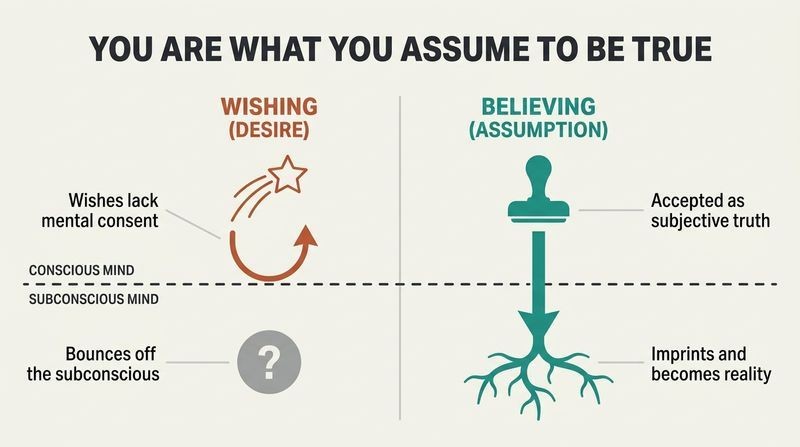
This is the placebo and nocebo effect stated as metaphysics. Documented cases of voodoo death and nocebo mortality lend the crystal gazer story real teeth: expectation can measurably alter cortisol, heart rate, and immune function. Murphy's insistence that external suggestions are inert until accepted anticipates cognitive behavioral therapy's core premise, that events do not disturb us, our interpretations do, an idea Epictetus voiced two millennia earlier. The weakness is scope. Belief clearly modulates health and behavior, but Murphy extends it to lawsuits, buyers, and lost rings, where confirmation bias and selective memory quietly do the explanatory work.
Never finish a negative sentence; reverse it on the spot
Because the subconscious accepts your words literally, Murphy warns against casual self-sabotage. Saying "I can't afford it" is a command your deeper mind obeys, keeping you unable to afford it. The dieter who declares "I don't like mushrooms" gets indigestion when served them, because the subconscious dutifully honors the boss's stated preference.
His remedy is interruption. A university student eyeing an expensive travel bag caught herself mid-complaint and reversed it: "That bag is mine. I accept it mentally." By that evening her fiance had gifted her the identical bag. The discipline is to police your idle speech, catch "I'll fail" or "I can't pay the rent" before completion, and substitute an affirmation of capability instead.
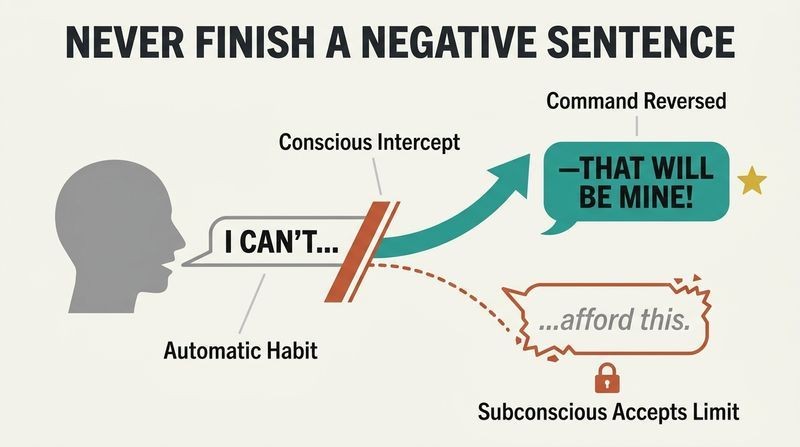
The linguistic hygiene here overlaps with modern research on self-talk and affirmation. Studies on self-affirmation theory (Claude Steele) show that affirming values can buffer stress and improve problem-solving under pressure. Yet the literature also cautions that repeating positive statements one does not believe can backfire, lowering mood in people with low self-esteem (Joanne Wood's work). Murphy partly anticipates this in a later distinction about avoiding conflict. The travel-bag anecdote is charming but a textbook case of survivorship bias: the thousands who affirmed and received nothing do not write testimonials. Still, the underlying advice, refuse habitual verbal defeatism, is sound behavioral coaching.
Drop into drowsiness to plant ideas past your inner skeptic
Murphy repeatedly names the optimal moment for reprogramming: the sleepy, relaxed state just before sleep and just after waking. Here the critical conscious mind is submerged, so suggestions slip past resistance like fluids through a porous membrane. He calls the conscious mind the watchman at the gate, and the point is to get the watchman to doze.
Several techniques exploit this window:
1. The Baudoin method: condense your desire into a short phrase ("It is finished in Divine Order") and repeat it as a lullaby.
2. The sleeping technique: lull yourself with a single word like "Wealth" or "Sobriety."
3. The thank-you technique: repeat gratitude for the thing not yet received.
A woman in a bitter will dispute repeated her six-word phrase for ten nights and woke on the eleventh convinced it was settled; her lawyer called that day.
The pre-sleep window has genuine neuroscientific interest. The hypnagogic state features reduced prefrontal control and heightened suggestibility, which is why hypnosis induction mimics drowsiness. Memory consolidation during sleep is well established, and targeted memory reactivation studies show that cues presented before or during sleep can strengthen specific learning. Murphy intuited something real: the mind is more plastic at the edges of consciousness. What he frames as impressing a creative medium, a researcher would frame as reducing cognitive interference and priming rehearsal. The lullaby repetition also resembles mantra meditation, which measurably lowers arousal and quiets the default mode network.
Every healing shrine and faith cure runs on one hidden engine
Murphy surveys healers across history: ancient temple priests, the goddess Hecate's grotesque rituals, Lourdes, Japanese Buddhist shrines, Mesmer's magnets, voodoo doctors. His verdict is that none of the theories matter. Whether the relic is genuine or a splinter from the sidewalk, the healing comes from the patient's own subconscious responding to aroused belief and expectancy.
He cites the sixteenth-century physician Paracelsus, who observed that true or false faith produces identical effects. His own family story: a son healed his tuberculosis-ridden father by passing off a random wood splinter as a fragment of the true cross. The father, imagination inflamed, slept with it on his chest and woke healed, living another fifteen years, never learning the trick.
This is a bold, essentially correct debunking dressed as spirituality. Contemporary placebo research vindicates Murphy: the ritual, the authority figure, and the patient's expectation drive real physiological change, independent of the specific mechanism claimed. Ted Kaptchuk's Harvard studies even show open-label placebos (patients told the pills are inert) can relieve symptoms. Murphy's honesty about the fake relic is refreshing given the genre. The caveat he underweights is specificity: belief mobilizes symptom relief, pain modulation, and immune shifts, but it does not regrow atrophied optic nerves or dissolve tumors on demand. Conflating subjective relief with structural cure is where the framework outruns the evidence.
Hand your problem to the deeper mind at night, then let go
Murphy argues the subconscious solves problems the straining conscious mind cannot, if you stop forcing and trust it overnight. His examples are a hall of fame of sleeping discovery: the chemist Kekule (Murphy calls him von Stradonitz) glimpsing the benzene ring as a snake biting its tail, the naturalist Agassiz seeing a fossil fish's hidden features across three nights of dreams, Dr. Banting's dream pointing toward insulin.
The method: define the problem clearly, gather what conscious research you can, then before sleep confidently affirm the answer exists and is being revealed. Do not postulate it in the future. Do not treat it as a major, time-consuming problem, which only delays the response. When you wake without it, get busy elsewhere; the answer often pops up like toast when you are preoccupied.
Incubation is one of the most robustly studied phenomena in creativity research. Setting a problem aside genuinely improves solution rates, likely through spreading activation, forgetting of misleading fixations, and unconscious associative recombination. Dmitri Mendeleev reportedly dreamed the periodic table; the sewing machine's needle design came to Elias Howe in a dream. Murphy's practical protocol, saturate consciously then release, matches the four-stage model of creativity (preparation, incubation, illumination, verification) articulated by Graham Wallas in 1926. The one correction: incubation works best after genuine effortful engagement. The subconscious is a recombiner of deposited material, not an oracle that manufactures expertise from nothing.
When desire and imagination fight, imagination always wins
Murphy borrows Emile Coue's law of reversed effort: strain and willpower backfire, because the subconscious accepts the dominant mental image, not the gritted-teeth command. Picture walking a plank on the floor and you stride across easily. Raise it twenty feet in the air and your imagination of falling overpowers your desire to walk, freezing you.
This explains exam amnesia. Students who grit their teeth to recall answers block themselves; the answers flood back once they leave the room and relax. The prescription is to stop wrestling. Enter the effortless, drowsy state, reconcile the two halves of your mind so they agree, and vividly imagine the desired end already accomplished. The simple, childlike, coercion-free approach outperforms force every time.
Coue's insight has aged remarkably well. Modern sport and performance psychology confirms that trying too hard degrades fluid skills, a phenomenon called paralysis by analysis or choking under pressure. Daniel Wegner's ironic process theory demonstrated experimentally that suppressing a thought (do not think of a white bear) makes it more intrusive, especially under cognitive load, which is essentially reversed effort quantified. The plank example maps onto how anxiety narrows attention and hijacks motor control. Where Murphy is most useful is the reframe: relaxation is not laziness but a precondition for access. The unresolved question is how one reliably makes imagination and desire agree, which he treats as easier than it often is.
Wealth is a subconscious conviction, not a bank balance
Murphy insists poverty is a mental disease and riches begin as an inner state. Affirming "I am wealthy" fails when you secretly feel you are lying, because the subconscious accepts the dominant felt belief, not the words. His fix is conflict-free phrasing like "By day and by night I am being prospered in all my interests," which the mind cannot argue against.
Two money killers he flags:
1. Condemning money as filthy or evil, which makes it fly away, since you lose what you criticize.
2. Envying the prosperous, which places you in a negative position where wealth flows from you.
The antidote to envy is to actively rejoice in others' riches. He frames money as a symbol of exchange, morally neutral as copper or lead, and healthy only when circulating freely like blood or tide.
The psychological core is defensible: money scripts, the unconscious beliefs about wealth absorbed in childhood, are a real construct in financial therapy (Brad Klontz's research identifies money avoidance and money worship as measurable patterns). Ambivalence sabotages saving and earning behavior. Murphy's conflict-free affirmation trick cleverly sidesteps the backfire effect documented in affirmation studies. The obvious limitation is that conviction alone ignores structural realities: capital, opportunity, discrimination, and luck. Rejoicing in a rival's success also has support in gratitude and prosocial research, which links comparison-driven envy to lower well-being. The book's genre convenience is attributing every windfall to the method while ignoring base rates.
You attract a mate by becoming the qualities you seek
Murphy applies subconscious impression to relationships. To attract an ideal partner, sit in relaxed reverie and dwell nightly on the specific qualities you admire (honesty, loyalty, warmth) until they sink in and the deeper mind arranges a meeting in what he calls divine order. Crucially, you must embody what you seek: to attract an honest, loving partner, be honest and loving yourself.
He tells of a teacher who married three passive men and blamed bad luck. The real cause was her own domineering, unconsciously masculine make-up, which kept attracting submissive partners. Only when she deliberately rebuilt her mental picture of a strong, masculine mate did she attract and marry an assertive physician. His broader claim: repeated mistakes are unconscious patterns, and you break them by reprogramming the picture, not by hunting harder.
Stripped of the metaphysics, this is assortative mating and self-concept theory. People do tend to partner with those who match their self-image and attachment style, and unexamined patterns (attracting the same wrong type) are a staple of attachment research and psychodynamic therapy. The teacher's story illustrates what family-systems theorists call complementarity: a dominant person unconsciously selects a submissive one, then resents the dynamic they co-created. Murphy's actionable kernel, clarify your values and examine what your choices reveal about you, is solid. The magical-thinking risk is passivity: expecting the subconscious to deliver a person while neglecting the actual social effort, vulnerability, and iteration real relationships demand.
Forgiveness is medicine you swallow for your own healing
Murphy reframes forgiveness as self-interest, not saintly generosity. Held resentment, hostility, and guilt are mental poisons that lodge in the subconscious and, per psychosomatic medicine, sit behind ailments from arthritis to heart disease. Since you are the only thinker in your mind, thinking ill of another is really thinking ill of yourself.
His acid test for genuine forgiveness: if you hear good news about someone who wronged you and still sizzle, the roots of hatred remain. True release means you recall the incident with a memory but no sting, like remembering a healed abscess without pain. The technique is a decisive mental amnesty ("I release you, and all life's blessings are yours"), repeated only until the charge fades. He adds that guilt is self-punishment, not divine punishment; a man cheated his now-dead brother, and only self-forgiveness normalized his blood pressure.
This anticipates a now-large body of forgiveness research. Studies by Everett Worthington and Robert Enright link forgiveness interventions to reduced anxiety, depression, and blood pressure, and to improved cardiovascular and immune markers. Ruminative hostility is a documented cardiac risk factor. Murphy's acid test is psychologically astute: it distinguishes cognitive decision-forgiveness from deeper emotional forgiveness, a distinction the literature explicitly draws. Reframing forgiveness as self-benefit rather than moral obligation also improves uptake, since resentment often feels justified. The nuance worth adding: forgiveness need not mean reconciliation or excusing harm, a boundary trauma clinicians stress and one Murphy gestures at when he says you can love people without liking them.
You age from the fear of time, not the passage of it
Murphy's closing thesis: the subconscious is timeless and never grows old, so decline is largely a belief you accept. He cites the De Courcy Clinic physicians who reportedly concluded that the neurotic fear of time, not time itself, drives premature aging. Grow old in your thought life, as his despairing 80-year-old London friend did with "we get old, good for nothing, and that's the end," and the body obeys.
His counter-evidence is a roll call of late-life producers: an 84-year-old surgeon still operating daily, his own father learning French and Gaelic past 65 and teaching sharply until 99, plus Goethe finishing Faust, Michelangelo painting at 80, Cato learning Greek at 80. Retirement, he argues, should be promotion, not a scrap heap. Keep hungering for new truths and the mind stays young.
Contemporary aging research strikingly supports the headline. Becca Levy's Yale studies found that people with positive age beliefs lived about 7.5 years longer than those with negative stereotypes, and that mindset predicts recovery, memory performance, and even dementia risk moderated by the APOE gene. Stereotype threat measurably impairs older adults' cognitive test scores. So Murphy's claim that expectation shapes aging is more validated than most of his book. The corrective is proportion: genetics, cellular senescence, and disease are real and not dissolved by attitude. But as a modifiable lever, mindset toward aging turns out to be one of the most powerful and underused interventions available.
Analysis
Published in 1963, Murphy's book is the most systematized entry in the New Thought tradition that runs from Phineas Quimby through Emerson to Napoleon Hill. Its structure is relentlessly repetitive by design: one thesis (the subconscious executes whatever the conscious mind accepts as true) restated across twenty life domains from health to marriage to aging, each chapter ending in numbered summaries. This makes it easy to skim and hard to distill, because the value lies less in distinct ideas than in the drilling of a single mechanism into the reader's habits.
Murphy's rhetorical move is to fuse three authorities: scripture (reinterpreted psychologically, so "the Lord" means the subconscious), science (he foregrounds his chemistry background and cites Bernheim, Coue, and Duke's J.B. Rhine), and anecdote. The anecdotes are the engine and the liability. They are vivid, memorable, and almost uniformly unfalsifiable success stories, saturated with survivorship bias and post-hoc reasoning. A modern reader should treat them as illustrations of a mindset, not as evidence of causation.
What holds up under current science is substantial and often underappreciated: placebo and nocebo effects, self-affirmation, incubation in creative problem-solving, ironic process theory, the cardiovascular toll of hostility, forgiveness research, and Becca Levy's findings on age beliefs all vindicate specific Murphy claims. What does not hold up is the metaphysical overreach: the notion of a single universal subconscious that arranges buyers, lawsuits, and Cadillacs, and that regrows dead optic nerves. Murphy conflates genuine mind-body modulation with magical control over external events.
The honest reading is that Murphy discovered real psychological levers (expectation, attention, relaxation, self-talk, mental rehearsal) decades before they were formally researched, then wrapped them in causal claims far stronger than the mechanisms support. Read as a practical manual for managing one's own beliefs, attention, and emotional habits, it remains useful. Read as a literal theory of how reality operates, it demands heavy skepticism.
Review Summary
The Power of Your Subconscious Mind receives mixed reviews. Many readers find it life-changing, praising its insights on harnessing the subconscious for personal growth and success. They appreciate the practical techniques and real-life examples. However, critics argue it's repetitive, lacks scientific evidence, and relies too heavily on religious references. Some find the claims exaggerated or pseudoscientific. Despite the polarized opinions, the book remains influential in the self-help genre, inspiring readers to explore the potential of their minds.
People Also Read



FAQ
What's "The Power of Your Subconscious Mind" about?
- Exploration of the subconscious: The book delves into the power and potential of the subconscious mind, explaining how it influences every aspect of our lives.
- Mind as a tool: It teaches readers how to harness the subconscious mind to achieve personal and professional goals, improve health, and attain happiness.
- Practical techniques: The book provides practical techniques and exercises to reprogram the subconscious mind for success and fulfillment.
- Spiritual and psychological insights: It combines spiritual wisdom with psychological insights to offer a comprehensive guide to self-improvement.
Why should I read "The Power of Your Subconscious Mind"?
- Unlock potential: The book offers insights into unlocking the vast potential of your subconscious mind to improve various aspects of life.
- Practical applications: It provides practical methods to apply these insights in everyday situations, from overcoming fears to achieving financial success.
- Holistic approach: The book combines spiritual, psychological, and practical advice, making it a holistic guide for personal development.
- Proven techniques: The techniques discussed have been used by many successful individuals, making it a valuable resource for anyone seeking self-improvement.
What are the key takeaways of "The Power of Your Subconscious Mind"?
- Subconscious influence: Your subconscious mind significantly influences your thoughts, actions, and life outcomes.
- Positive thinking: Positive thoughts and beliefs can lead to positive outcomes, while negative thoughts can hinder success.
- Visualization and affirmation: Techniques like visualization and affirmation can help reprogram the subconscious mind for success.
- Mind-body connection: The book emphasizes the connection between mental states and physical health, suggesting that mental harmony can lead to physical well-being.
How does Joseph Murphy suggest using the subconscious mind for success?
- Visualization: Murphy suggests visualizing your goals as already achieved to impress them upon the subconscious mind.
- Affirmations: Repeating positive affirmations helps to instill these beliefs in the subconscious, leading to their manifestation.
- Relaxation techniques: Relaxing the mind allows for easier access to the subconscious, making it more receptive to positive suggestions.
- Faith and belief: Cultivating a strong belief in the power of the subconscious mind is crucial for these techniques to work effectively.
What are the best quotes from "The Power of Your Subconscious Mind" and what do they mean?
- "Change your thoughts, and you change your destiny." This quote emphasizes the power of thought in shaping one's life and future.
- "Your subconscious mind is the builder of your body and is on the job 24 hours a day." It highlights the continuous influence of the subconscious on physical health and well-being.
- "The law of your mind is the law of belief." This suggests that what you believe deeply will manifest in your life.
- "The infinite intelligence within your subconscious mind can reveal to you everything you need to know." It underscores the vast potential and wisdom residing in the subconscious.
How can "The Power of Your Subconscious Mind" help with overcoming fear?
- Understanding fear: The book explains that fear is a thought in the mind and can be controlled and changed.
- Positive affirmations: Using affirmations to replace fear with confidence and calmness is a key technique.
- Visualization: Visualizing oneself successfully overcoming fear can help reprogram the subconscious to eliminate it.
- Relaxation and faith: Relaxing the mind and having faith in the subconscious' power to overcome fear are essential steps.
What does Joseph Murphy say about the relationship between the conscious and subconscious mind?
- Dual nature: The conscious mind is the reasoning mind, while the subconscious is the seat of emotions and creativity.
- Interconnectedness: The conscious mind can influence the subconscious through thoughts and beliefs, which then manifest in reality.
- Role of the conscious mind: It acts as a gatekeeper, choosing which thoughts to impress upon the subconscious.
- Subconscious as a servant: The subconscious mind acts on the instructions given by the conscious mind, whether positive or negative.
How does "The Power of Your Subconscious Mind" address health and healing?
- Mind-body connection: The book emphasizes that mental states can significantly affect physical health.
- Healing through belief: Believing in the power of the subconscious can lead to physical healing and well-being.
- Visualization for health: Visualizing oneself in perfect health can help manifest that state in reality.
- Subconscious as a healer: The subconscious mind has the power to heal the body when properly directed through positive thoughts and beliefs.
What techniques does Joseph Murphy recommend for wealth and prosperity?
- Wealth consciousness: Developing a mindset of abundance and prosperity is crucial for attracting wealth.
- Affirmations for wealth: Repeating affirmations like "Wealth and success are mine" helps instill these beliefs in the subconscious.
- Visualization of success: Visualizing financial success and abundance can help manifest these outcomes.
- Avoiding negative thoughts: Steering clear of thoughts of lack and limitation is essential for maintaining a wealth-conscious mindset.
How does "The Power of Your Subconscious Mind" suggest improving relationships?
- Positive thoughts: Thinking positively about others can improve relationships, as these thoughts are reflected back to you.
- Forgiveness: Letting go of past grievances and forgiving others can lead to healthier, more harmonious relationships.
- Visualization: Visualizing positive interactions and outcomes in relationships can help manifest them.
- Empathy and understanding: Cultivating empathy and understanding towards others can enhance relationship dynamics.
What role does faith play in "The Power of Your Subconscious Mind"?
- Foundation of belief: Faith is the foundation upon which the power of the subconscious mind operates.
- Faith in outcomes: Believing in positive outcomes helps the subconscious mind bring them to fruition.
- Faith as a motivator: It motivates individuals to take action and maintain a positive mindset.
- Faith in the subconscious: Trusting the subconscious mind's ability to solve problems and achieve goals is crucial for success.
How can "The Power of Your Subconscious Mind" help with personal growth and self-improvement?
- Self-awareness: The book encourages self-awareness and understanding of one's thoughts and beliefs.
- Positive change: It provides tools and techniques for making positive changes in one's life through the subconscious mind.
- Goal achievement: By harnessing the power of the subconscious, individuals can achieve personal and professional goals.
- Continuous learning: The book promotes continuous learning and growth by exploring the limitless potential of the subconscious mind.
About the Author
Other books by Joseph Murphy

Download PDF
Download EPUB
.epub digital book format is ideal for reading ebooks on phones, tablets, and e-readers.








































