

Key Takeaways
The idea everyone calls stupid may be your smartest move
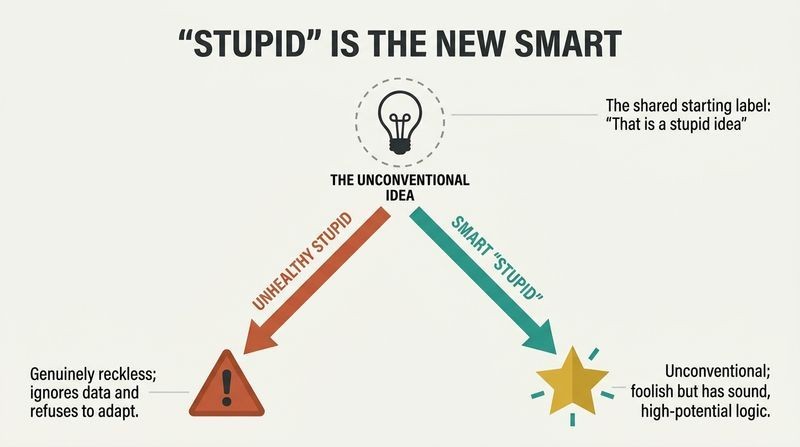
Stupid is the New Smart. Norton's central paradox: history's breakthroughs were routinely dismissed as foolish before they were celebrated as genius. Western Union called the telephone worthless in 1876. A banker warned Ford's lawyer the automobile was a passing fad. Twitter, eBay, and Spanx were all labeled crazy. Sara Blakely turned $5,000 into a billion-dollar hosiery company after lawyers assumed she was a Candid Camera prank.
Norton distinguishes two kinds of stupid. Unhealthy stupid is genuinely reckless, ignoring data and refusing to adapt. Stupid as the New Smart is the nagging, unconventional idea that only looks foolish because it breaks from convention. The skill is discernment: recognizing when the label stupid is actually masking a sound, high-potential idea worth pursuing with forethought.
The reframe is clever, but survivorship bias lurks beneath it. For every Bezos who ignored skeptics, thousands of ignored skeptics were simply correct. Norton partly addresses this with his unhealthy-stupid category, yet the line between visionary persistence and delusion is only ever clear in hindsight. Psychologist Adam Grant's research on originals suggests successful contrarians actually hedge heavily, keeping day jobs and testing cheaply, rather than betting everything on conviction. The useful core here echoes Peter Thiel's contrarian question: what important truth do few people agree with you on? Genuine innovation, almost by definition, looks wrong to the consensus before it looks obvious.
Live to start, start to live: waiting is the real risk
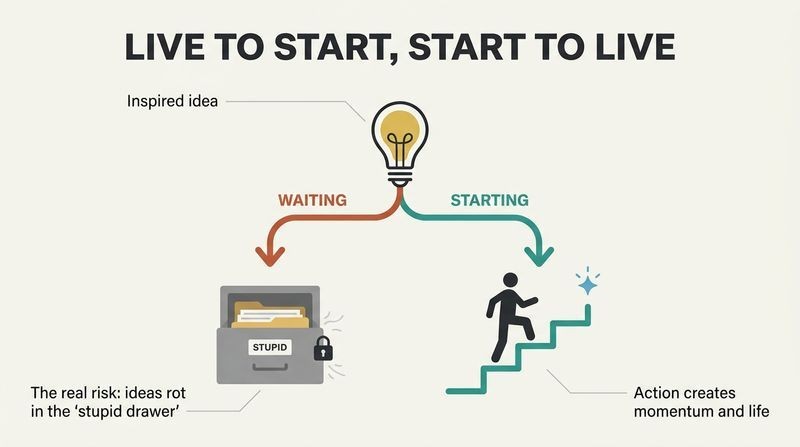
Gavin's Law. The book's emotional foundation is loss. Norton's 21-year-old brother-in-law Gavin died unexpectedly in his sleep, weeks after burying a time capsule meant to be opened in 20 years. Two years later, Norton's infant son, named after that uncle, died at 76 days old. A mentor's blunt question afterward, so what have you learned, crystallized into a principle: live to start, start to live.
The insight is that circumstances are largely outside our control, and waiting for the perfect moment guarantees the moment never comes. People stuff inspired ideas into a mental drawer marked stupid, then wait for more time, money, or permission. Norton's answer is to begin now, because now is the only time genuinely guaranteed. The most difficult part of any project is the initial act of starting.
Grounding a business book in child loss is unusual and disarming, and it inoculates the message against the glib optimism the genre often traffics in. The memento mori logic connects to Stoicism directly, Marcus Aurelius and Seneca both argued that awareness of death sharpens priorities. Modern research on mortality salience is more ambivalent, showing death-reminders can trigger avoidance and defensiveness as easily as action. What makes Gavin's Law land is its verb-first framing: not contemplate death, but start something. The behavioral lever is momentum, not morbidity. Beginning, even badly, generates the psychological traction that deliberation never will.
Save your money for later, but never save your dreams
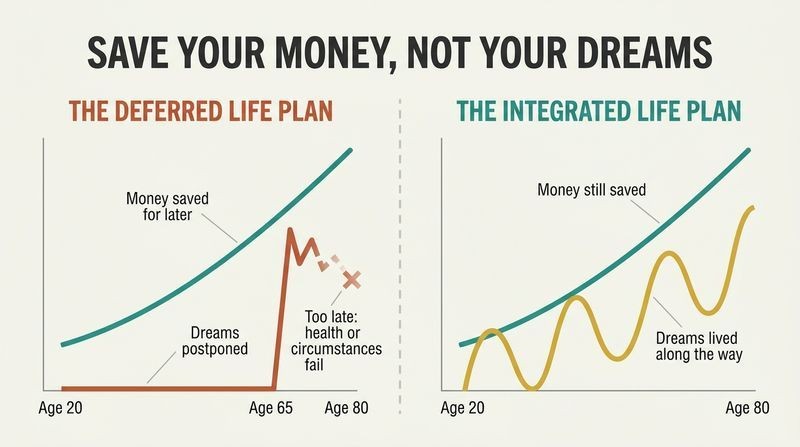
Beware the Deferred Life Plan. Norton borrows entrepreneur Randy Komisar's phrase for the two-step trap: step one, do what you have to do, step two, eventually do what you want. The flaw is that step two often never arrives. Norton met a multimillionaire investment banker who spent his entire career trying to get back to the carefree life he had at 24, the very life the young, broke Norton was living at that moment.
He calls the modern version retirement confusion: mixing up the wisdom of saving money with the folly of postponing dreams. Working years in retirement consulting, he watched clients reach 65 only to find spouses gone, health failing, or savings evaporated, with 40 years of deferred dreams unrecoverable. Covey's ladder metaphor captures it: you can climb efficiently yet discover the ladder leaned against the wrong wall.
The critique of retirement as institutionalized procrastination is provocative and historically grounded, Bismarck's Germany set 65 as the pension age in 1889, an arbitrary number now treated as destiny. But the framing risks a false binary. Dreams and financial discipline are not always in tension, and many fulfilling lives are built through patient, deferred investment rather than immediate leaps. The stronger reading aligns with Tim Ferriss's mini-retirement concept and with research on the hedonic value of experiences over deferred consumption. The actionable distinction is precise: automate your savings, but do not automate your postponement. Money compounds when delayed; dreams often decay.
Ask your 80-year-old self what you'll regret, then act on it
The Bezos Test. Before founding Amazon, Jeff Bezos left a secure, high-paying Wall Street job. His boss agreed it was a good idea, but said it would be better for someone who did not already have a good job. Bezos projected himself to age 80 and asked what he would regret. Missing the birth of the internet outweighed forfeiting an annual bonus. The long-view stripped away short-term confusion.
Norton turns this into the Stupid Equation: future regret equals today's imperative. He offers an exercise to defeat paralysis by analysis: list every pressing idea, imagine reviewing the list at 80, cross off what you would not regret abandoning, and narrow to the three or four that would haunt you. His friend Jase used it to launch a skateboard company from his garage that landed in Costco.
This is anticipatory regret, a concept psychologists Daniel Kahneman and Amos Tversky studied extensively, and it is one of the most reliable decision heuristics available. Regret about inaction tends to be more enduring than regret about action, a finding from Gilovich and Medvec that directly supports Norton's method. Bronnie Ware's palliative-care memoir found the top deathbed regret was living others' expectations rather than one's own. The mind-travel framing is memorable, though it assumes our future self shares present values, which research on affective forecasting shows we predict poorly. Still, as an antidote to overthinking, projecting to 80 cuts through analysis paralysis better than any pro-con list.
No time, no education, no money equals no excuse
Close the TEM Gap. Norton names the chasm between an idea and starting it the Time, Education (Experience), Money Gap. The three excuses are seductive because they feel legitimate, yet none ever fully resolves. On time: you will have less later, not more, and Parkinson's Law means work expands to fill whatever time you allow it. On experience: Stephen M. R. Covey told Norton that some people claim 20 years of experience when they have one year repeated 20 times. On money: Oprah, J.K. Rowling on welfare, and Steve Jobs returning Coke bottles for deposits all started from scarcity.
His reframe: lacking resources is often a gift, forcing bootstrapping, networking, and partnering (the 1+1=3 principle). The Wright brothers built flight with no funding, no degrees, and villagers mocking them as crazy fools.
The excuse-demolition is bracing, and the Parkinson's Law point about money (spending expands to fill income) is an underrated observation echoed in personal-finance research on lifestyle inflation. Yet the rags-to-riches roster deserves scrutiny. Oprah, Rowling, and Jobs are extreme statistical outliers, and citing them to prove money is no barrier risks the same survivorship bias that haunts the book's thesis. Structural constraints are real, capital access, caregiving burdens, and health are not merely mindset problems. The defensible version is narrower and true: most people overestimate the resources required to begin and underestimate what resourcefulness and small starts can accomplish. Constraint genuinely does breed creativity, as design research on limitation repeatedly confirms.
Your best idea will calcify unless you keep returning to stupid
Don't get stuck at Model T. Norton's Stupid Loop describes how a bold idea travels a cycle: stupid becomes accepted, then smart, then standard, then normal. And normal is where innovation dies. Henry Ford was crazy like a fox, doubling wages to five dollars a day and selling 15 million Model Ts. But he grew so attached that when employees surprised him with an updated model, he literally kicked in its windshield and stomped the roof. General Motors, embracing yearly redesigns, overtook him.
The defense is what LinkedIn's Reid Hoffman calls permanent beta: never stop starting, treat yourself and your work as perpetually unfinished, continuously rewritten like Gmail or Amazon staying in beta for years. Success that refuses to adapt curdles from healthy stupid into the dangerous, maladaptive kind.
The Model T story is a vivid illustration of what Clayton Christensen formalized as the innovator's dilemma: the very competencies that make a company dominant become the blinders that let disruptors win. Ford's tragedy was not incompetence but success-induced rigidity. Permanent beta connects to Carol Dweck's growth mindset and to Nassim Taleb's antifragility, the idea that systems should improve under stress rather than merely survive it. One caution: relentless reinvention has costs. In-N-Out and Coca-Cola thrive precisely by not changing their core (New Coke being the cautionary counterexample). The real skill is discerning which elements are sacred constants and which demand disruption, a judgment the loop metaphor alone does not resolve.
Turn overwhelming dreams into projects with a start and finish
Stupid Projects beat big goals. Grand ambitions paralyze because there is no map from stupid idea to stupid success. Norton's fix: reframe the abstract dream as a concrete project with a beginning and an end. Instead of I want to start a blog, it becomes working on the Blog Project. This turns an intimidating thought into an actionable assignment you and others can rally behind.
Darren Rowse began blogging as a curious experiment while working three jobs, earning six dollars a day, then nine, then compounding into a seven-figure business. Filmmaker Nirvan Mullick set out simply to make a nine-year-old's day by filming his cardboard arcade; the video went viral and raised hundreds of thousands in scholarships. Projects lower stakes, invite experimentation, and, as Zuckerberg and Google's 20-percent time show, let you fail cheaply before failing expensively.
The psychology here is sound and well-supported. Research by Brian Little on personal projects (which Norton cites) links project pursuit to well-being, and Teresa Amabile's progress principle shows that small wins on meaningful work are the single largest driver of workplace motivation and creativity. Reframing a goal as a bounded project also exploits the Zeigarnik effect, our minds fixate on unfinished tasks, and shrinks the perceived commitment. The subtle wisdom is that a project has an exit ramp, which paradoxically makes starting easier because you are not vowing forever. Google's 20-percent time, worth noting, has since been quietly curtailed, a reminder that even celebrated innovation structures require ongoing defense.
High dreams breed high fear, so crush it into small wins
The Fear Compensation Model. Norton argues the greatest threat to your goals is not lack of time or contacts but fear itself, and specifically your inability to work through it. Citing Harvard's Chris Argyris, high aspirations generate proportionally high fear. The equation runs: high aspirations equal high fear, fear management equals performance, performance equals goal achievement.
Big-wave surfer Andy Pierce had his femur snapped in two by his own board at Sunset Beach, yet was surfing giants again within months. He is genuinely scared out there; he surfs anyway because his why outweighs his fear. Two levers make this possible: defining a purpose bigger than the fear, and stacking small wins (a term from psychologist Karl Weick). Nobody attacks a 20-foot wave first; you tolerate incrementally larger fears until the impossible becomes routine.
Pairing a why with graduated exposure is essentially a folk formulation of two robust clinical findings. Viktor Frankl's logotherapy holds that a strong enough why makes almost any how bearable, and systematic desensitization, the graduated-exposure technique underpinning modern anxiety treatment, is among the most evidence-backed interventions in psychology. Weick's small wins paper (1984) remains influential in organizational studies for exactly this reason: reframing a huge problem as a series of controllable ones reduces arousal and restores agency. The nuance Norton could stress more: not all fear is a troll to defeat. Fear is also information. The skill is distinguishing signal (this is genuinely dangerous) from noise (this merely feels uncomfortable).
Pride disguised as confidence keeps you stuck and isolated
Choose the Humble Power Alternative. Norton identifies pride as the master vice sabotaging dreams. It shows up four ways: too proud to risk looking stupid, feeling entitled to results without work, blaming others for failure, and scarcity thinking that treats another's success as your loss. He calls the drift from healthy confidence into pride pride creep, when self-confident curdles into self-absorbed, innovative into impractical, courageous into reckless.
The antidote is humility as strength, not weakness. Jim Collins's Good to Great found the best leaders (Level 5) blend fierce professional will with personal humility: they look out the window to credit success and in the mirror to own failure. Brené Brown's research reframes vulnerability as the birthplace of innovation. The alternative in practice: lean into stupid instead of hiding, do more instead of coasting, take ownership, and root for others' success.
The four-part diagnosis is more precise than typical pride sermons, and the scarcity-versus-abundance distinction has real economic bite. Zero-sum thinking is empirically linked to lower trust and less collaboration, while positive-sum framing underlies everything from Adam Smith's specialization to modern network effects. Collins's Level 5 finding has held up reasonably well, though critics note his sample of great companies included some (Circuit City, Fannie Mae) that later collapsed, suggesting humble leadership is necessary but hardly sufficient. The deepest point is that pride and fear are the same beast wearing different masks, both are ultimately terror of exposure. Naming the mask (entitlement, blame, comparison) makes it easier to disarm than fighting fear head-on.
Beat procrastination by making your idea public, planned, pleasurable, and painful
The Four Ps. Even a Nobel economist procrastinates: George Akerlof took eight months to mail a friend's box, waking each morning deciding tomorrow would be the day. Norton's reassurance is that procrastinators are not lazy, many are workaholics who bury the important beneath the merely urgent. Procrastinators live in the now, addicted to immediacy, filling time with marginally useful tasks to avoid the vital ones. It is like filling up on bread before dinner.
After making time and simplifying (eliminating the unnecessary so the necessary can speak), apply four levers:
1. Public: tell someone you would feel real regret disappointing
2. Planned: set SMART goals with actual deadlines, because dreams do not get done until they are due
3. Pleasurable: reward yourself immediately on completion
4. Painful: attach a real, dreaded consequence to failure
Every P maps onto validated behavioral science. Public accountability leverages commitment devices, the same mechanism behind stickK.com, which Norton cites and which Yale economists co-founded on the finding that stakes and referees dramatically raise follow-through. The pleasurable and painful pair operationalizes reinforcement and loss aversion, and the deadline point reflects the planning fallacy and the power of implementation intentions (Gollwitzer's if-then plans reliably double goal completion). The freshest reframe is Myth Two: procrastination as present-bias, not laziness. This aligns with Piers Steel's Procrastination Equation, where impulsiveness is the strongest predictor. One addition worth making: reducing friction on the desired task often beats piling on external pressure. Make the right thing easy, not just the wrong thing costly.
Serve, thank, ask, receive, and trust your way into any room
START. Norton's connection framework doubles as a call to begin: Serve, Thank, Ask, Receive, Trust. Gandhi embodies it, failing his first court case and a teaching job, then building a movement by serving the Indians of Pretoria, teaching free English, and earning trust so deep followers would die before breaking their word.
Each action is strategic and generous. Service has almost no barrier to entry and lets you learn risk-free; internet filmmaker Devin Graham built one of YouTube's fastest-growing channels by working with brands for free, a technique Norton calls Mission Matching, asking in a way that serves both parties. Gratitude compounds goodwill (contrast his ungrateful pizza recipients with the tearfully thankful mother). Asking beats waiting in line when a faster option sits unnoticed. Receiving means running with a gift, not just accepting it. And extending trust first, as Captain Abrashoff did aboard the USS Benfold, unlocks people's creativity.
START smartly recasts networking as reciprocity rather than extraction, which the research strongly endorses. Adam Grant's Give and Take shows that givers, when strategic rather than self-sacrificing, occupy the top of success distributions. Mission Matching is essentially value-creation before value-capture, the logic behind reciprocity in Cialdini's influence research and behind most durable partnerships. The trust-first stance aligns with game-theory work on tit-for-tat, where generous opening moves outperform defensive ones over repeated interactions. The one tension worth flagging: Norton insists service must be motive-pure, yet also frames it as strategic. Most people operate in the honest middle, genuinely wanting to help while hoping it pays off, and that is fine, so long as the help is real.
You already own everything you need; leverage what's hiding in plain sight
Leverage existing resources. Norton's closing principle: stop fixating on what you lack and organize what you have. Susan Petersen wanted to sew leather goods but had no capital, so she smashed the glass out of her husband's discarded aluminum window frames and recycled the metal for cash. When her baby moccasins reached Kourtney Kardashian via a magazine editor, her company Freshly Picked became a household name.
The archetype is Archimedes: give me a place to stand and I will move the Earth. With a single compound pulley, he dragged a ship all of Syracuse could not launch. Modern levers hide everywhere: technology (Norton hired a Ukrainian designer online for an e-book that hit number one), strong and weak ties (Granovetter's research on how distant connections open new worlds), mentors, time, and money. Microlending pioneer Muhammad Yunus started with 27 dollars and one woman.
Leverage reframed as aggregation rather than debt is a useful mental model, and the point that Google, YouTube, and Amazon are essentially platforms leveraging others' content is astute, they build the lever, users supply the weight. Granovetter's strength of weak ties (1973) is one of sociology's most-cited findings: your close friends know what you know, while acquaintances bridge you to novel information and opportunity. The Yunus and Petersen examples reinforce that constraint plus resourcefulness outperforms abundance plus passivity. The quiet warning about the technological tattoo, that online posts are permanent and searchable, has aged into prophecy. The deeper takeaway ties the whole book together: starting is rarely blocked by missing resources, only by unrecognized ones.
Analysis
Richie Norton's 2013 book is a thesis-driven motivational business title dressed in a memorable contrarian hook: the word stupid as a reclaimed badge for unconventional courage. Structurally it moves from why (Gavin's Law, mortality, the cost of waiting) to when (now, via the Bezos Test and TEM Gap) to how (the Stupid Loop, projects, and the four-part Making It Happen toolkit of fear, pride, procrastination, and authenticity, capped by START and leverage). The genre is crowded, and much of the raw material is borrowed, Covey, Collins, Komisar, Hoffman, Weick, Granovetter, so the book's originality lies less in novel research than in its packaging and its unusually raw emotional spine.
That spine is what elevates it. Norton anchors an otherwise conventional hustle-and-courage message in the deaths of his brother-in-law and infant son, and this refuses the glibness the category invites. The memento mori framing gives the familiar advice, start now, unusual moral weight.
The book's central vulnerability is survivorship bias. Its evidentiary engine runs on outliers, Bezos, Ford, Blakely, Oprah, the Wright brothers, retrofitted to prove that ignored dissent precedes triumph. It underweights the vast graveyard of ignored dissent that was simply wrong. Norton's unhealthy-stupid category is a partial hedge, but he offers no rigorous test for distinguishing visionary conviction from delusion in advance, only innate sensibility, a felt sense. Contemporary work by Adam Grant suggests real originals actually de-risk aggressively rather than leap on faith.
Where the book is strongest is the operational middle: the Fear Compensation Model's small wins, the project reframe, and the Four Ps all quietly recapitulate solid behavioral science (graduated exposure, the progress principle, commitment devices, implementation intentions). Read as a permission slip and a starter kit rather than a strategy manual, it delivers real value. Its enduring message is behavioral, not philosophical: momentum beats deliberation, and beginning imperfectly beats waiting perfectly.
Review Summary
The Power of Starting Something Stupid receives largely positive reviews, with readers praising its motivational and inspiring content. Many found it helpful for pursuing their dreams and overcoming fear. Some critics felt the ideas were common or rehashed from other self-help books. The book encourages readers to take action on their "stupid" ideas, citing examples of successful entrepreneurs. While some found it life-changing, others struggled to finish or felt it lacked originality. Overall, it's seen as a good pep talk for aspiring entrepreneurs.
People Also Read





Glossary
Gavin's Law
Live to start, start to liveNorton's foundational principle, named for his late brother-in-law and infant son, both named Gavin. It holds that because life is short and circumstances are uncontrollable, you should stop waiting for perfect conditions and start acting on your ideas now. Those who live to start their dreams actually begin living them; endless waiting guarantees the ideal moment never arrives.
Stupid as the New Smart
Sound idea wrongly labeled foolishA paradox at the book's core: an idea that appears inherently faulty but is actually sound and worth pursuing, mislabeled stupid only because of doubt, fear, or unfamiliarity. It is distinguished from unhealthy stupid, which is genuinely reckless and refuses to adapt to reality. The New Smart is creative, counterintuitive, and requires forethought plus courage against critics.
Deferred Life Plan
Postponing dreams until laterA term Norton borrows from entrepreneur Randy Komisar for the two-step trap of first doing what you must (usually earning money) and only later doing what you want. The danger is step two never arrives. Related is retirement confusion, mixing up the wisdom of saving money with the folly of saving dreams for a later date that may never come.
TEM Gap
Time, education, money excusesThe Time, Education (Experience), Money Gap: the perceived chasm between an inspired idea and starting it. Norton argues these three shortages are the most common excuses for delay, yet none ever fully resolves, so they should not block action. Lacking resources often becomes an advantage, forcing bootstrapping, networking, and partnering.
Bezos Test / Stupid Equation
Future regret equals today's imperativeA decision tool based on Jeff Bezos projecting himself to age 80 before leaving Wall Street to found Amazon, asking what he would most regret. Norton formalizes it as future regret equals today's imperative: identify what your 80-year-old self would grieve not attempting, and treat that as an urgent priority now.
Stupid Loop
Innovation cycle from stupid to normalNorton's model of how a bold idea moves from stupid to accepted, to smart, to standard, to normal, where innovation stagnates. Illustrated by Henry Ford clinging to the Model T while GM overtook him with yearly redesigns. The remedy is permanent beta (Reid Hoffman's term), continuously reinventing yourself and your work to stay relevant.
Fear Compensation Model
Beat high fear with small winsNorton's framework stating that high aspirations generate proportionally high fear, so managing fear becomes the key performance skill. Fear is overcome two ways: defining a why bigger than the fear, and stacking small wins (psychologist Karl Weick's term) by tolerating incrementally larger fears rather than leaping from zero to your goal at once.
Humble Power Alternative
Humility as strength over prideNorton's antidote to pride, which sabotages dreams through fear of looking stupid, entitlement, blame, and scarcity thinking. Drawing on Jim Collins's Level 5 leadership (humility plus professional will), it means leaning into stupid instead of hiding, doing more instead of coasting, owning failure, and championing others' success. It counters pride creep, when confidence curdles into self-absorption.
Four Ps of Overcoming Procrastination
Public, planned, pleasurable, painfulNorton's method for starting a stalled idea after making time and simplifying: make it Public (tell someone you would regret disappointing), Planned (set SMART goals with real deadlines), Pleasurable (reward yourself immediately on completion), and Painful (attach a dreaded consequence to failure). Together they engineer accountability and motivation.
START
Serve, thank, ask, receive, trustAn acronym and action plan for connecting with people to advance your goals: Serve others generously, Thank sincerely, Ask for help, Receive gifts by running with them, and Trust others first. Both a memory device and a verb urging you to begin. It builds credibility and a trusted inner circle.
Mission Matching
Asking that benefits both partiesNorton's respectful way of asking for help: propose collaborations that create synergistic, mutually beneficial value rather than one-sided requests. You research the other party's needs, determine what is in it for them, and match missions. YouTuber Devin Graham used it, filming brands for free to build a portfolio that later commanded paying work.
Leverage
Maximizing existing resources for resultsThe process of aggregating and organizing resources already available to increase effectiveness, illustrated by Archimedes moving a ship with a single pulley. Norton urges leveraging existing technology, strong and weak social ties (per Granovetter), mentors, time, and money instead of fixating on what is missing. Best drawn from the goodwill built through living the START principles.
FAQ
1. What is "The Power of Starting Something Stupid" by Richie Norton about?
- Core Message: The book argues that ideas often dismissed as "stupid" are actually the seeds of innovation, fulfillment, and success, and that embracing these ideas can lead to a life without regret.
- Personal Story: Inspired by personal tragedy, Norton introduces "Gavin’s Law"—Live to start. Start to live.—as a call to action to pursue dreams now, not later.
- Practical Framework: The book provides a step-by-step approach to overcoming fear, pride, and procrastination, and offers actionable principles for turning unconventional ideas into reality.
- Real-World Examples: Through stories of entrepreneurs, innovators, and everyday people, Norton demonstrates how "stupid" ideas have changed industries and lives.
- Empowerment: The book is both motivational and practical, encouraging readers to stop waiting for the perfect time and to start acting on their passions immediately.
2. Why should I read "The Power of Starting Something Stupid" by Richie Norton?
- Overcome Regret: The book helps readers avoid the common regret of not pursuing their dreams by providing tools to act now.
- Actionable Advice: It offers practical steps and frameworks (like the START method) to move from idea to execution, regardless of resources or experience.
- Mindset Shift: Norton challenges conventional thinking, showing that what seems "stupid" may actually be the smartest move for personal and professional growth.
- Inspirational Stories: The book is filled with real-life examples of people who succeeded by acting on unconventional ideas, making it relatable and motivating.
- Universal Relevance: Whether you’re an entrepreneur, creative, or someone seeking more meaning, the book’s principles apply to anyone wanting to live a more authentic, fulfilled life.
3. What are the key takeaways from "The Power of Starting Something Stupid"?
- Gavin’s Law: Live to start. Start to live. Don’t wait for the perfect time—start now to truly live.
- Stupid Is the New Smart: Many world-changing ideas were initially considered "stupid"; embracing these ideas can lead to innovation and success.
- Overcome Excuses: Lack of time, education, or money (the T.E.M. Gap) are common excuses, but not valid reasons to delay starting.
- START Method: Success comes from Serving, Thanking, Asking, Receiving, and Trusting—principles that build relationships and momentum.
- Continuous Innovation: Avoid getting stuck in past successes; always return to "stupid" by innovating and experimenting with new projects.
4. What does Richie Norton mean by "Stupid Is the New Smart" in the book?
- Redefining Stupid: "Stupid" refers to ideas that seem risky, unconventional, or counterintuitive, but may actually be innovative and valuable.
- Healthy vs. Unhealthy Stupid: Healthy "stupid" ideas are those that challenge the status quo and have potential, while unhealthy stupid is reckless or ill-considered.
- Historical Examples: Many successful inventions and businesses (like the telephone, Amazon, Spanx) were initially dismissed as "stupid."
- Paradox of Innovation: The smartest moves often look foolish at first; embracing this paradox is key to creativity and progress.
- Trusting Intuition: Acting on persistent, passionate ideas—even if others doubt them—can lead to breakthroughs and fulfillment.
5. What is Gavin’s Law and how does it shape the message of "The Power of Starting Something Stupid"?
- Origin of Gavin’s Law: Named after the author’s brother-in-law and son, both of whom died young, it’s a reminder that life is short and unpredictable.
- Core Principle: "Live to start. Start to live."—meaning that starting projects and acting on dreams is essential to truly living.
- Urgency Over Waiting: The law emphasizes that waiting for perfect circumstances leads to missed opportunities and regret.
- Personal Motivation: Norton uses Gavin’s Law to inspire readers to act now, not later, on their most meaningful ideas.
- Foundation for the Book: This principle underpins the entire book, driving its call to action and practical advice.
6. How does "The Power of Starting Something Stupid" address common excuses like lack of time, education, or money (the T.E.M. Gap)?
- No Excuse Mentality: Norton argues that everyone faces the T.E.M. Gap, but successful people start anyway and learn along the way.
- Time: Waiting for more time is futile; each day spent waiting is less time to live your dreams.
- Education/Experience: Experience is often overrated; continuous learning and starting before you feel ready are more important.
- Money: Many success stories began with little or no money; resourcefulness and leveraging what you have are key.
- Empowerment: The book reframes these gaps as opportunities to develop creativity, resilience, and resourcefulness.
7. What is the START method in "The Power of Starting Something Stupid" and how does it work?
- Acronym Explained: START stands for Serve, Thank, Ask, Receive, and Trust.
- Serve: Begin by helping others and adding value, which opens doors and builds relationships.
- Thank: Express gratitude to those who help or support you, fostering goodwill and further opportunities.
- Ask: Don’t be afraid to seek help, advice, or collaboration; asking accelerates progress.
- Receive: Be open to accepting help, gifts, or opportunities, overcoming pride or discomfort.
- Trust: Build trust with others and yourself; trust is foundational for meaningful, sustainable success.
8. How does "The Power of Starting Something Stupid" help readers overcome fear, pride, and procrastination?
- Crush Fear: The book teaches that high aspirations naturally come with high fear, but breaking goals into small wins makes fear manageable.
- End Pride: Norton encourages embracing vulnerability, taking responsibility, and adopting an abundance mindset to avoid prideful stagnation.
- Overcome Procrastination: Practical steps include making time, simplifying, making goals public, planning, and using rewards and consequences.
- Be Authentic: Acting in alignment with your true self, rather than external expectations, reduces fear and pride.
- Action Over Perfection: The book emphasizes starting now, even if conditions aren’t perfect, to build momentum and confidence.
9. What role do personal projects and experimentation play in "The Power of Starting Something Stupid"?
- Projects as Experiments: Breaking big ideas into small, manageable projects makes starting less daunting and more actionable.
- Low Stakes, High Learning: Projects allow for experimentation and learning without risking everything at once.
- Momentum Builder: Completing projects, even small ones, creates momentum and leads to unexpected opportunities.
- Organizational Impact: Personal projects increase engagement, creativity, and fulfillment in both personal and professional settings.
- One Thing Leads to Another: The book shows how starting with a simple project can lead to major breakthroughs and new directions.
10. How does "The Power of Starting Something Stupid" define and use the concept of leverage?
- Leverage Defined: Leverage is maximizing existing resources—time, technology, relationships, education, and money—to achieve goals more effectively.
- Resourcefulness Over Resources: The book stresses using what you have, not waiting for ideal circumstances or abundant resources.
- Examples: Stories like Susan Petersen’s moccasin business illustrate leveraging small opportunities and connections for big results.
- Collaboration and Mentorship: Leveraging strong and weak ties, as well as mentors, accelerates learning and success.
- START as a Well: Living the START principles builds a "well" of trust and relationships to draw from when pursuing new ideas.
11. What are some of the best quotes from "The Power of Starting Something Stupid" and what do they mean?
- "Live to start. Start to live." – The essence of Gavin’s Law, urging immediate action on dreams for a life without regret.
- "Stupid is the New Smart." – Challenges the notion that only "smart" ideas succeed, highlighting the value of unconventional thinking.
- "A year from now, you’ll wish you started today." – Emphasizes the cost of waiting and the importance of starting now.
- "You don’t have to be great to start, but you have to start to be great." – Encourages action over perfection, reinforcing that greatness follows starting.
- "If you can foresee regret, you can mind-travel to the future." – Suggests using anticipated regret as motivation to act today.
12. How can readers apply the lessons from "The Power of Starting Something Stupid" by Richie Norton to their own lives?
- Identify "Stupid" Ideas: Reflect on persistent, passionate ideas you’ve dismissed and consider acting on them.
- Use the Bezos Test: Ask yourself, "Will I regret not doing this when I’m 80?" to prioritize meaningful projects.
- Break Down Barriers: Apply the START method and leverage existing resources to overcome excuses and obstacles.
- Start Small Projects: Turn big dreams into small, actionable projects to build momentum and confidence.
- Commit to Authenticity: Align your actions with your true values and passions, and don’t let fear, pride, or procrastination hold you back.
About the Author
Other books by Richie Norton
Download PDF
Download EPUB
.epub digital book format is ideal for reading ebooks on phones, tablets, and e-readers.








































