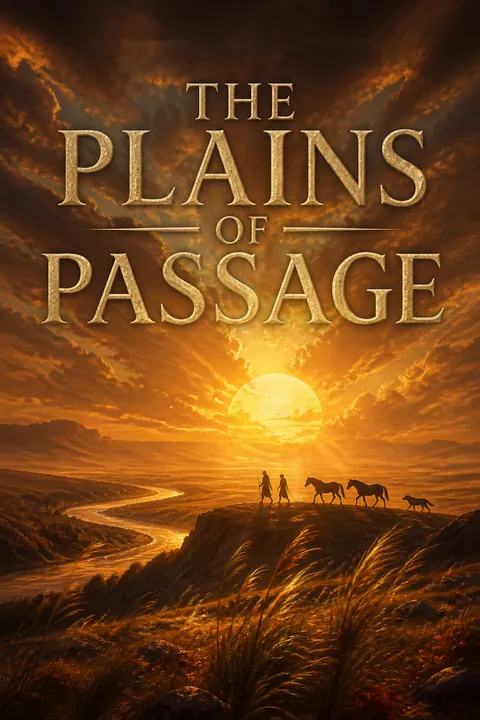

Plot Summary
Exile and New Beginnings
Ayla, cast out from the only family she has ever known, the Clan, faces the vast, cold world alone. Marked by the death curse, she is forced to leave her son Durc behind, carrying only her skills, memories, and a deep ache of loss. She survives by her wits, learning to live off the land, and eventually finds companionship in the animals she befriends—first a horse, Whinney, and then a wolf cub. The pain of exile is matched by the resilience she discovers within herself, and the hope that somewhere, her own kind, the Others, may accept her. The journey of self-reliance and the forging of new bonds with animals set the stage for her epic trek across Ice Age Europe.
The Journey with Jondalar
Ayla's world changes when she rescues Jondalar, a tall, fair-haired man grievously injured by a cave lion. Nursing him back to health, she learns his language and customs, and a deep love grows between them. Jondalar, too, is a wanderer, longing for home but captivated by Ayla's strength and uniqueness. Together, they decide to journey west, toward Jondalar's distant homeland. Their partnership is both romantic and practical, as they share skills, stories, and the burdens of travel. The journey is not just across the land, but into the heart of what it means to be human, to love, and to belong.
Encounters on the Open Plains
As Ayla and Jondalar traverse the vast steppes, they encounter other groups—some welcoming, others suspicious or hostile. Their unusual companions, the horses and the wolf, provoke awe and fear, often leading to misunderstandings. Ayla's ability to communicate with animals and her foreign accent set her apart, while Jondalar's knowledge of the land and people helps them navigate social complexities. Each encounter is a test: of trust, of adaptability, and of the willingness of others to accept what is new and different. The couple learns that the journey is as much about changing hearts as crossing distances.
The Mammoth Hunters' Welcome
The travelers are welcomed by the Lion Camp of the Mamutoi, the Mammoth Hunters, who are both fascinated and unsettled by Ayla's talents. Here, Ayla finds a sense of belonging she has never known, as she is adopted into the Mammoth Hearth and forms deep friendships. Yet, her differences—her upbringing among the Clan, her relationship with animals, and her healing skills—continue to set her apart. The warmth of the Mamutoi is contrasted with the pain of not fully fitting in, and the tension between staying and continuing the journey with Jondalar grows.
Bonds of Kinship and Difference
Ayla's relationship with Jondalar is tested by the attention she receives from others, especially the charismatic Ranec. Jealousy, cultural misunderstandings, and Ayla's lingering sense of otherness threaten to pull them apart. The presence of Rydag, a child of mixed Clan and Mamutoi heritage, brings Ayla's past into the present, forcing her to confront the pain of her lost son and the prejudices of those around her. Through these trials, Ayla and Jondalar deepen their understanding of each other and what it means to choose one's family.
The Long Trek Westward
Leaving the Mamutoi, Ayla and Jondalar embark on the arduous journey west, facing the challenges of navigation, weather, and the unknown. They meet diverse peoples—some who become friends, others who are wary or even dangerous. The journey is marked by both hardship and wonder: the beauty of the land, the abundance of animal life, and the constant test of survival. Ayla's skills as a healer and hunter, and Jondalar's knowledge of the land, are both essential. The journey is also inward, as both confront their fears and hopes for the future.
The Test of the Great River
The travelers must cross the Great Mother River and its many tributaries, a perilous undertaking that tests their ingenuity and courage. They build boats, face storms, and risk losing their precious animals. The river crossings are symbolic of the transitions they are making in their lives—leaving behind the old, risking everything for the promise of a new home. The dangers of the river are matched by the emotional toll of the journey, as Ayla and Jondalar are forced to confront the possibility of loss and the limits of their endurance.
The Glacier's Challenge
The most daunting obstacle is the glacier—a vast, frozen expanse that must be crossed to reach Jondalar's homeland. The cold is relentless, the terrain treacherous, and the risk of death ever-present. Ayla's invention of horse "boots" saves their animals from crippling injury, and their resourcefulness is tested to the utmost. The crossing is a crucible, burning away all but the essentials of their character and their love. When they finally reach the far side, battered but alive, they know they have accomplished something extraordinary.
The S'Armunai and Attaroa
Among the S'Armunai, Ayla and Jondalar encounter a society ruled by the cruel Attaroa, who keeps men imprisoned and children crippled. Ayla's sense of justice and her skills as a healer compel her to intervene, risking her own life to free the oppressed. With the help of Wolf and the support of Jondalar, she confronts Attaroa and helps the community begin to heal. This episode is a stark reminder of the darkness that can exist in human societies, and the courage required to stand against it.
The Wolf, the Horses, and the Woman
Throughout their journey, Ayla's bond with her animals is both a source of strength and a cause for suspicion. Her ability to bridge the gap between species is a metaphor for her role as a bridge between cultures, between past and future, between what is and what could be. The wolf and the horses are not just companions; they are symbols of the possibility of understanding and cooperation across boundaries. Ayla's difference, once a source of pain, becomes her greatest gift.
The Crossing and the Return
After countless trials, Ayla and Jondalar finally reach the land of the Zelandonii. The last leg of the journey is filled with anticipation, anxiety, and the bittersweet knowledge that the journey itself has changed them. They must now face the challenge of being accepted by Jondalar's people, and of forging a new life together. The return is not just a homecoming for Jondalar, but the beginning of a new chapter for Ayla—a test of whether she can truly belong.
The Homecoming
Ayla's arrival among the Zelandonii is met with curiosity, suspicion, and awe. Her animals, her accent, and her foreign ways set her apart, but her courage and kindness begin to win hearts. Jondalar's family welcomes her, but the larger community is wary. The couple must navigate the complexities of a new society, and Ayla must once again prove herself—not just as a survivor, but as a woman worthy of love and respect. The homecoming is both an end and a beginning.
The Meaning of Belonging
As Ayla settles among the Zelandonii, she grapples with questions of identity, loyalty, and the meaning of home. Her past with the Clan, her time with the Mamutoi, and her journey with Jondalar all shape who she is. The struggle to be accepted is mirrored by the community's struggle to accept what is new and different. Through acts of healing, teaching, and courage, Ayla begins to find her place, and the people around her begin to see her not as an outsider, but as one of their own.
The Gifts of the Mother
The story culminates in rituals and celebrations that honor the Great Mother, the source of life and fertility. Ayla's pregnancy is both a personal joy and a symbol of hope for the future. The gifts of the Mother are not just children, but the capacity for love, creativity, and renewal. The community comes together to celebrate not just survival, but the possibility of flourishing. The journey has been hard, but it has led to a place of abundance and promise.
The Shadow of the Past
Even as Ayla finds happiness, the shadows of her past linger. The pain of exile, the loss of her son, and the memories of those she has left behind are never far away. Yet, through ritual, remembrance, and the forging of new bonds, she learns to carry her past with her, not as a burden, but as a source of strength. The story honors the complexity of grief and the necessity of letting go in order to move forward.
The Promise of the Future
The Plains of Passage ends with the promise of a new life—not just for Ayla and Jondalar, but for the community that is learning to accept them. The journey has been both an epic adventure and a profound exploration of what it means to be human: to love, to suffer, to hope, and to belong. The future is uncertain, but it is filled with possibility. Ayla, once an exile, has found her place among her own kind, and the story closes with the sense that, at last, she is home.
Analysis
The Plains of Passage is both a sweeping adventure and a profound meditation on what it means to be human. At its core, the novel is about the search for belonging—within oneself, with others, and in the world. Ayla's journey from exile to acceptance is mirrored by the journey of humanity itself, from isolation to community, from fear to understanding. The novel explores the power of difference—not as a source of shame, but as a gift that can bridge worlds. Through Ayla's relationships with animals, her healing skills, and her courage in the face of prejudice and cruelty, the story argues for the possibility of transformation: that the boundaries between self and other, human and animal, past and future, can be crossed. The book is also a celebration of resilience, creativity, and the capacity for love. In a modern context, it speaks to the challenges of multiculturalism, the dangers of exclusion, and the hope that comes from embracing the new. The lessons of The Plains of Passage are as relevant now as ever: that empathy, openness, and the willingness to change are the keys to survival—not just for individuals, but for societies.
Review Summary
The Plains of Passage receives mixed reviews, averaging 3.86 stars. Readers appreciate Auel's extensive research on Ice Age geography, flora, and fauna, but criticize excessive repetition and lengthy descriptive passages. Many find the journey narrative slow, with minimal plot development as Ayla and Jondalar travel to his homeland. Common complaints include too many graphic sex scenes, repetitive mentions of physical descriptions, and Ayla's "Mary Sue" perfection. Reviewers note the S'Armunai storyline's problematic portrayal of women. Positive aspects include encounters with various tribes and Jondalar's character growth regarding the Clan people. Most agree the book feels bloated but remain invested in the series.
Characters
Ayla
Ayla is the heart of the story—a woman marked by loss, resilience, and an extraordinary capacity for adaptation. Raised by the Clan (Neanderthals) after losing her birth family, she is exiled for breaking taboos, forced to leave her son behind. Her survival alone in the wild forges her into a healer, hunter, and innovator, with a unique ability to communicate with animals. Ayla's psychological journey is one of longing for acceptance and wrestling with her own difference. Her relationships—with Jondalar, with her animal companions, and with the various peoples she meets—are marked by both deep love and the pain of never fully belonging. Over the course of the journey, Ayla transforms her difference from a source of shame into a gift, becoming a bridge between cultures, species, and ways of life.
Jondalar
Jondalar is a tall, fair-haired man from the Zelandonii, driven by a longing for home and a restless curiosity about the world. His partnership with Ayla is both romantic and transformative; she challenges his assumptions and expands his understanding of what is possible. Jondalar is skilled, intelligent, and sensitive, but also struggles with jealousy, fear of rejection, and the burden of leadership. His journey is as much about returning to his people as it is about becoming worthy of Ayla's love. Through hardship and loss, he learns humility, courage, and the true meaning of kinship.
Wolf
Wolf, raised by Ayla from a pup, is more than a pet—he is a symbol of the possibility of connection across boundaries. His loyalty, intelligence, and protective instincts make him both a helper and a source of awe and fear among the people they meet. Wolf's presence challenges assumptions about the relationship between humans and animals, and his bond with Ayla is a testament to trust, patience, and the breaking of old taboos.
Whinney and Racer
Whinney, the mare, and her offspring Racer, are Ayla's first true companions after her exile. Their domestication is revolutionary, changing not only Ayla's life but the course of human history. The horses are symbols of freedom, partnership, and the power of gentle persistence. Their presence provokes both wonder and fear, and their fate is deeply entwined with Ayla's own journey toward acceptance.
Talut
Talut, the red-haired headman of the Lion Camp, is a figure of warmth, strength, and open-mindedness. His willingness to welcome strangers, to laugh at the new and the strange, and to see potential where others see threat, makes him a model of leadership. Talut's acceptance of Ayla is a turning point, showing that community is built not just on blood, but on choice and generosity.
Ranec
Ranec, the dark-skinned carver of the Lion Camp, is both a friend and a rival to Jondalar. His attraction to Ayla, and her response to him, force both Ayla and Jondalar to confront their feelings, fears, and desires. Ranec's confidence, humor, and artistry make him a compelling figure, and his presence highlights the complexities of love, jealousy, and the freedom to choose.
Attaroa
Attaroa, the cruel leader of the S'Armunai, is a study in the psychology of power and pain. Her rule is marked by the imprisonment and mutilation of men, the crippling of children, and the perpetuation of suffering. Attaroa's actions are rooted in her own history of abuse, and her character is a warning of what happens when trauma is turned outward. Her confrontation with Ayla is a battle not just of wills, but of worldviews—one rooted in domination, the other in healing.
S'Armuna
S'Armuna, the One Who Serves the Mother among the S'Armunai, is a complex figure torn between complicity and conscience. Her knowledge of healing and ritual is matched by her awareness of her own failures to prevent Attaroa's cruelty. Through her relationship with Ayla, S'Armuna finds a path to redemption, using her power to help heal the community she once failed.
Joplaya
Joplaya, Jondalar's close-cousin, is a figure of intelligence, wit, and quiet sorrow. Her unrequited love for Jondalar, and her eventual acceptance of a different path, mirror Ayla's own journey through loss and hope. Joplaya's story is a reminder that not all desires are fulfilled, but that dignity and kindness endure.
Echozar
Echozar, a man of mixed Clan and Others heritage, is both a symbol of the pain of exclusion and the possibility of acceptance. His struggle to find a place among the Lanzadonii, and his eventual union with Joplaya, echo Ayla's own journey. Echozar's presence challenges the boundaries of identity, and his story is one of resilience, humility, and the quiet strength of those who persist.
Plot Devices
The Journey as Transformation
The overarching structure of The Plains of Passage is the epic journey—a literal trek across Ice Age Europe, but also a metaphor for the transformation of the self. Each obstacle—rivers, glaciers, hostile groups—mirrors an internal challenge: fear, grief, the longing for acceptance. The journey is both a test and a crucible, burning away the inessential and forging new strengths. The landscape itself is a character, shaping and being shaped by those who traverse it.
Domestication and the Human-Animal Bond
Ayla's relationships with Wolf, Whinney, and Racer are not just personal; they are revolutionary. The domestication of animals is a plot device that signals a new era in human history, and a new way of relating to the world. The animals are not just helpers, but symbols of the possibility of understanding, cooperation, and the breaking of old taboos. Their presence provokes both awe and fear, and their fate is a constant source of tension.
Cultural Encounter and the Other
The encounters with diverse peoples—Mamutoi, S'Armunai, Sharamudoi, Zelandonii—are structured as a series of tests: will the new be accepted, or rejected? Ayla's foreignness, her accent, her skills, and her animal companions are plot devices that force characters (and readers) to confront their own prejudices. The journey is a series of negotiations between self and other, tradition and innovation, fear and openness.
Ritual, Memory, and the Power of Story
Rituals—adoptions, healings, celebrations—are used to mark transitions, heal wounds, and forge community. The power of memory, both personal and collective, is a recurring motif: Ayla's memories of the Clan, her lost son, and her own mother shape her actions and her sense of self. Storytelling, both oral and enacted, is a means of making sense of the world and one's place in it.
Gender, Power, and the Meaning of Family
The novel uses the contrasting societies Ayla and Jondalar encounter to explore questions of gender, power, and the meaning of family. The matriarchal tyranny of Attaroa is contrasted with the more egalitarian Mamutoi and the complex kinship structures of the Zelandonii. Ayla's own journey is a negotiation between the roles assigned to her and the ones she claims for herself.
Foreshadowing and Dream
Ayla's dreams, often featuring Creb or her lost son, are used to foreshadow events, reveal psychological truths, and guide her decisions. The boundary between dream and reality is porous, and the spiritual dimension of the journey is as important as the physical. Dreams are both warnings and promises, shaping the path ahead.
Earth's Children Series
About the Author
Other books by Jean M. Auel
Download PDF
Download EPUB
.epub digital book format is ideal for reading ebooks on phones, tablets, and e-readers.








































